REVIEW 3 major objections 6 minor 280 references
KiDS-1000: Improved constraints on cosmology, intrinsic alignments and baryonic feedback from clipped cosmic shear
T0 review · 3 major / 6 minor · reviewed 2026-08-15 · deepseek-v4-flash
Pith's one-line read Combining clipped and unclipped shear correlations extracts extra cosmological information from KiDS-1000 data, tightening S8 by 16% and w0 by 24%.
desk verdict A careful, genuinely new application of clipping to KiDS-1000 with credible precision gains, but the IA bias modelling is the soft spot to probe in review. read the letter →
The pith
A machine-rendered reading of the paper's core claim, the machinery that carries it, and where it could break.
The reading
What carries the argument
The load-bearing object is the clipped shear correlation function $\xi^c_\pm$. Convergence maps are reconstructed from smoothed galaxy ellipticity maps via Kaiser-Squires inversion (Gaussian smoothing $\sigma_s = 6.6$ arcmin); every pixel with $\kappa \geq \kappa_c = 0.010$ is set to the threshold value $\kappa_c$, clipping roughly 20% of the observed area; the residual map $\Delta\kappa$ is inverted back to residual ellipticities and subtracted from the observed galaxy ellipticities, so only galaxies sitting on convergence peaks are modified. The correlation function of these clipped ellipticities, measured in nine angular bins across five tomographic redshift bins, forms the $\xi^c_\pm$ data vector. Its cosmological and systematic dependence is predicted by Gaussian-process emulators trained on the 26-cosmology cosmoSLICS suite (sampling $\Omega_{\rm m}$, $S_8$, $h$, $w_0$), with the covariance estimated from 1,240 independent SLICS realisations and the intrinsic-alignment, photo-$z$, and baryonic-feedback biases modelled as differences between dedicated contaminated and uncontaminated mock sets. The emulator accuracy is validated by leave-one-out cross-validation and folded into the covariance as an error term.
What would settle it
Build intrinsic-alignment mocks that carry the same 18-tile masked KiDS-1000 footprint as the cosmology set and recompute the intrinsic-alignment bias in the clipped correlation functions; if the masked and unmasked biases differ by more than the emulator-plus-statistical error budget, the separability assumption fails and the reported $A_{\rm IA}$, which already sits $3.2\sigma$ from the Asgari et al. (2021) result, would flag a biased model. A complementary check is to run the identical combined pipeline on KiDS-Legacy or DES Year 6 data and ask whether the same $S_8$ and $A_{\rm IA}$ are recovered.
Extended reading notes
Core claim
The central claim is that two-point shear correlation functions measured on a clipped convergence field carry cosmological information that is sufficiently independent of the unclipped measurement to sharpen parameter inference when the two are combined. The paper reports the first systematics-controlled application of clipping to real lensing data, with tomographic binning, masked footprint infusion, per-object shear calibration, and emulators trained on the cosmoSLICS, SLICS, intrinsic-alignment, photo-$z$, and magneticum simulation suites. On KiDS-1000 data the combined probe gives $\Omega_{\rm m} = 0.263^{+0.035}_{-0.038}$, $S_8 = 0.724 \pm 0.027$, $w_0 = -1.24^{+0.26}_{-0.28}$, tightening $S_8$ by 16% and $w_0$ by 24% over the unclipped analysis, improving the figure of merit in the $\Omega_{\rm m}$–$S_8$ plane by a factor of 1.2, and reproducing the Asgari et al. (2021) cosmology through an independent forward-modelling pipeline. It further finds that the clipped statistic breaks degeneracies the unclipped probe cannot: the intrinsic-alignment amplitude is constrained 27% more tightly ($A_{\rm IA} = -0.50^{+0.19}_{-0.20}$), and a first upper limit on baryonic feedback, $b_{\rm bary} < 0.97$, is placed from lensing alone. The paper attributes these gains to clipping's decoupling of scale-dependent information: removing high-density peaks suppresses the small scales where baryonic feedback dominates while preserving the larger, cleaner scales.
Load-bearing premise
The analysis assumes that the contamination from galaxies' intrinsic shape alignments and the cosmological lensing signal are separable in the clipped statistics, and that the survey's masked sky pattern does not change how that contamination enters the measurement — an assumption made because the intrinsic-alignment simulations are run on full, unmasked lightcones.
Editorial extensions
If this is right
- The same KiDS-1000 data, analysed with the combined clipped and unclipped probes, yields $S_8$ and $w_0$ constraints 16% and 24% tighter than the unclipped analysis alone, with the $\Omega_{\rm m}$–$S_8$ figure of merit improved by a factor of 1.2.
- The emulator-based unclipped analysis independently reproduces the Asgari et al. (2021) cosmology — $\Omega_{\rm m}$ within 0.8$\sigma$ and $S_8$ within 1.8$\sigma$ — validating the standard hmcode-based KiDS-1000 pipeline from a completely different modelling direction.
- Clipping breaks the degeneracy between intrinsic alignments and cosmic shear: $A_{\rm IA}$ is measured at 39% precision (a 27% improvement over the unclipped probe), and a first upper limit $b_{\rm bary} < 0.97$ is placed on baryonic feedback from lensing alone, where the unclipped probe leaves it unconstrained.
- Because the precision gains come from larger, less baryon-contaminated scales rather than from the small scales targeted by other higher-order statistics, the method ports directly to future data sets (KiDS-Legacy, Euclid, LSST) once tailored simulations exist.
Reading between the lines
- Editorial inference: the mechanism behind the gain — clipping decouples scale-separated information — suggests the same transform could sharpen other probes, such as clipped galaxy clustering or a clipped 3x2-point analysis, and the cross-statistic between clipped and unclipped fields (excluded here to keep the covariance invertible) is a natural addition once more realisations are available.
- Editorial inference: the 3.2$\sigma$ offset in $A_{\rm IA}$ relative to Asgari et al. (2021) could be a first hint that clipping is sensitive to scale-dependent intrinsic-alignment physics (luminosity- or redshift-dependent alignment, or tidal torquing) that the simple NLA model does not capture; a testable extension would be to fit a TATT-like model to the combined data vector.
- Editorial inference: the baryon-feedback limit is set more by emulator noise on small scales than by the information content of the data — the paper shows the $b_{\rm bary}$ constraint tightens sharply when emulator error is handled by propagating the Gaussian-process covariance — so targeted improvements to small-scale emulation accuracy (denser simulation grids) would turn clipping into a compet
Signed reviews
Editorial analysis
A structured set of objections, weighed in public.
Referee Report
Summary. The paper presents the first systematics-controlled application of density-field clipping to cosmological inference from real weak lensing data. Clipping replaces convergence-map pixels above a fixed threshold with the threshold value and recovers a clipped shear catalogue; the authors model the clipped and unclipped shear correlation functions jointly. The model is built from the cosmoSLICS and SLICS N-body suites, with the KiDS-1000 footprint, shape noise, multiplicative and additive shear calibrations, and photometric redshift distributions injected into mock catalogues. Gaussian-process emulators trained on 26 cosmologies predict the cosmological dependence; bias emulators and linear models describe intrinsic alignments, photo-z shifts, baryonic feedback, and source-lens clustering. The combined clipped and unclipped data vector yields Omega_m=0.263+0.035-0.038, S8=0.724+/-0.027, w0=-1.24+0.26-0.28, consistent with A21, with reported precision gains of 16% for S8 and 24% for w0 over the unclipped statistic alone, a 27% improvement on the IA amplitude, and an upper limit on baryonic feedback. Validation includes 1240 covariance realizations, leave-one-out emulator cross-validation with covariance inflation, a systematics-free SLICS mock, and a systematics-contaminated mock.
Significance. If the headline claims hold, this is a substantive methodological advance: it is the first demonstration that a non-Gaussian (HOWLS-type) statistic can be modelled end-to-end with systematics and applied to real lensing data, and that clipping extracts additional information while preferentially using scales least affected by baryons. The paper's strengths include the large and carefully constructed mock suites, the explicit inflation of the covariance with measured emulator error (Eq. 10), the check of Gaussianity of the data vector, the use of both Gaussian-with-Hartlap and Sellentin-Heavens likelihoods, the open-source release of the clipping and likelihood codes, and an independent simulation-based consistency check of the KiDS-1000 A21 result. The recovered consistency with LCDM and with A21 for the cosmological parameters, together with the agreement of the Delta-z posteriors with A21, gives reasonable confidence that the cosmology result is not dominated by a gross pipeline error.
major comments (3)
- [Sec. 2.2(iii) and Eq. (11)] The intrinsic-alignment bias model is the main load-bearing assumption of the combined-probe claim, and it is currently untested in precisely the two directions that matter. Equation (11) defines B_IA as the difference between AIA != 0 and AIA = 0 measurements from the IA Set, which spans full 10x10 deg^2 lightcones without the KiDS-1000 footprint and is run only at the fiducial cosmology. This single bias shape is scaled by AIA and added to the cosmology emulator at every point of the parameter space (Sec. 3.3). Clipping is a nonlinear, mask-dependent operation: the mask is reapplied to the reconstructed kappa map before thresholding, and the residual map Delta-kappa is masked before interpolation to galaxy positions (Sec. 3.1, Eqs. 1-3). The assumption that the IA bias of the clipped statistic is unaffected by the ~23% removed area is asserted in Sec. 2.2(iii) but not demonstrated, and the GI term in B_IA depends on cosmology through the lensing efficiency and the matter power spectrum. The Appendix C1 validation cannot catch a bias in B_IA because the systematics-contaminated mocks are generated with the same emulators and linear models, so that validation tests internal consistency only. The 3.2-sigma offset of the inferred AIA from the A21 value is exactly the signature a mask- or cosmology-dependent B_IA would produce, and since the combined probe is claimed to improve the AIA constraint by 27%, this matters for both the headline precision gains and the IA secondary result. I recommend that the authors (i) compute B_IA with a KiDS-like mask applied to the IA Set realizations and quantify the change in both the clipped and unclipped bias; (ii) propagate a conservative systematic error on B_IA and demonstrate that the 16% S8 and 24% w0 gains survive; and (iii) state explicitly that the Appendix C1 contaminated-mock test does not validate the bias model.
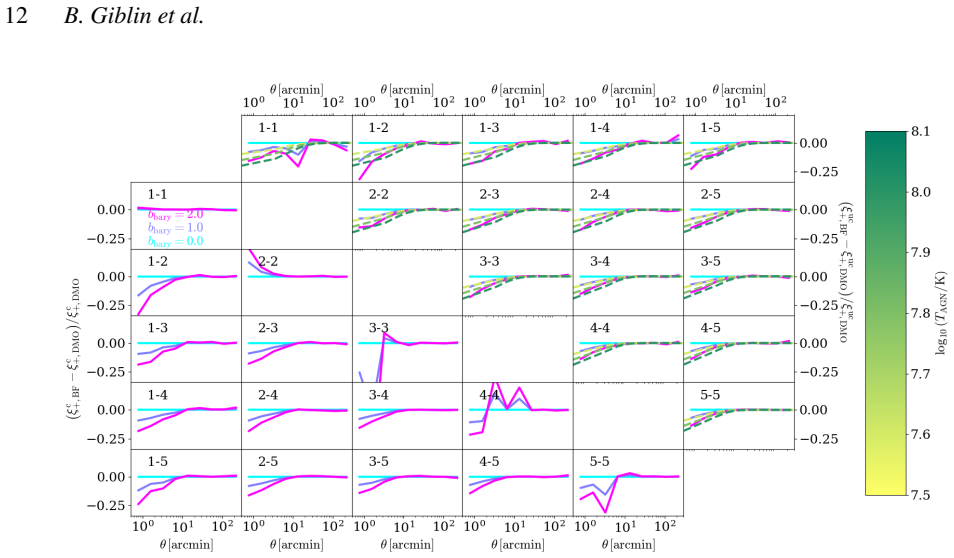
- [Sec. 2.2(v) and Sec. 3.3] The baryonic feedback model linearly rescales the magneticum dark-matter-only versus hydro difference with a single parameter bbary in [0,2], with the upper half of the prior representing an extrapolation to twice the magneticum feedback level. The comparison in Fig. 8 with hmcode for log10(T_AGN/K) = [7.6, 7.8, 8.0] shows that the fractional suppression of the unclipped correlation functions is not linear in feedback strength, and the clipped auto-correlations behave non-monotonically: stronger feedback reduces small-scale power, which decreases the amount of clipping and can increase power at 5-10 arcmin. A one-parameter linear rescaling therefore imposes a specific shape for the feedback effect, and the headline secondary result bbary < 0.97 depends on that shape. Please validate the linear-scaling ansatz against intermediate feedback strengths (for example, an additional magneticum or BAHAMAS run, or the multiple AGN-temperature nodes already available through hmcode for the unclipped part), or quantify the sensitivity of the upper limit to relaxing the linearity assumption.
- [Appendix C1] The two mock validations cover complementary but incomplete ground. The systematics-contaminated mock data are drawn from the trained emulators and linear models themselves, so they verify that the sampler and likelihood recover the input values given the adopted bias model, but they cannot falsify that model; the SLICS-based systematics-free test verifies emulator generalisation to a sister simulation suite but contains no IA, photo-z, or baryon contamination. The paper would be strengthened by a third test in which the contamination is generated from a model outside the inference set, for example a TATT-motivated IA signal or hydrodynamics from an independent simulation code, to provide at least one end-to-end check that the decompositions of Eqs. (11)-(13) and the linear BB rescaling recover the truth.
minor comments (6)
- [Sec. 3.4 and Table 2] The text states that the unclipped analysis is prior-limited for w0, yet Table 2 reports a 24% precision gain for w0 without qualification. Please report the unclipped marginalised width for w0 and state clearly how much of the quoted gain reflects the prior rather than information in the data; the same caveat applies to the FoM factors of 1.6 and 4.0 in Sec. 4.
- [Sec. 3.1 and Eq. (4)] In Eq. (4) the argument of the tangential and cross components is written with theta_g,b for both galaxies in the numerator and denominator; the second position should refer to galaxy a (theta_g,a) so that the pair weighting is unambiguous.
- [Sec. 4] The claimed 3.2-sigma disagreement of AIA with A21 should be justified: with the quoted values AIA = 0.39+0.32-0.37 (A21) and AIA = -0.50+0.19-0.20 (this work), a naive quadrature combination gives roughly 2.1-2.3 sigma depending on how the asymmetric errors are combined.
- [Abstract] There is a typographical error in the abstract: 'complimentary information' should be 'complementary information'.
- [Sec. 4] The comparison with A21 for Omega_m is made for different models (A21 fixes w0 = -1, this work varies w0); one sentence noting the implication of that difference for the 0.8-sigma consistency statement would help the reader interpret the comparison.
- [Sec. 3.1] The clipping threshold (kappa_c = 0.010) and smoothing scale (sigma_s = 6.6 arcmin) are inherited from G18 and revalidated with a single test; since these settings control the ~20% clipped area and the depth of the clipping trough, a brief exploration of the sensitivity of the final constraints to (kappa_c, sigma_s) would strengthen the robustness picture.
Circularity Check
No significant circularity: simulation-based emulators and external mocks support the central derivation; flagged assumptions are limitations, not circular reductions.
full rationale
The paper's central derivation chain is self-contained rather than circular. The clipped and unclipped shear correlation functions are predicted by Gaussian-process emulators trained on independent N-body simulation suites (cosmoSLICS, SLICS, magneticum), not fitted to the KiDS-1000 data. The cosmological emulators are validated by leave-one-out cross-validation and by recovery of the true cosmology from external SLICS mocks that are not part of the training set. Systematic contributions are constructed as differences between contaminated and baseline simulations (Eqs. 11-13 for IA, photo-z, and baryon biases); the free amplitudes (A_IA, Delta-z_i, b_bary) are nuisance parameters with priors, not quantities derived from the data vector that is then 'predicted'. The headline precision gains are outputs of the joint likelihood of clipped and unclipped probes and are additionally consistent with the fully independent A21 pipeline, although the S8 precision does not beat A21's quoted 2.3%. Two points deserve mention but do not amount to circularity. First, the systematics-contaminated mock validation in Appendix C1 is generated by the same emulators and linear models being tested, so it is an internal consistency check rather than external validation; the paper discloses this construction and also provides the external SLICS test. Second, the IA bias model in Sec. 2.2(iii) assumes additive separability of IA and cosmological contributions and negligible mask-IA coupling, using full-lightcone mocks without the KiDS footprint. This is a genuine modelling assumption and a plausible source of the reported 3.2-sigma A_IA tension with A21, but it is not a circular step: the IA bias shape comes from NLA mocks, and the assumption is stated explicitly rather than imported by definition. Self-citations to G18 for the clipping threshold and to Harnois-Deraaps et al. for emulator-error treatment are methodological and not load-bearing; the clipping threshold is re-tested in the tomographic bins. Overall, the derivation does not reduce to its inputs by construction, so the circularity score is low.
Assumptions & free parameters
free parameters (10)
- Ωm =
0.263+0.035-0.038
- S8 =
0.724±0.027
- w0 =
-1.24+0.26-0.28
- h =
>0.76 (prior-limited)
- AIA =
-0.50+0.19-0.20
- Δz1-5 =
(-0.002, 0.000, -0.012, -0.008, 0.008)
- bbary =
<0.97
- Clipping threshold κc =
0.010
- Gaussian smoothing scale σs =
6.6 arcmin
- Emulator error node count n =
12
assumptions (7)
- domain assumption The non-linear linear alignment (NLA/δ-NLA) model captures the intrinsic alignment signal for KiDS-1000.
- ad hoc to paper Baryonic feedback from the magneticum simulation can be rescaled linearly via bbary in [0,2] to cover the full prior range.
- ad hoc to paper The intrinsic alignment bias is independent of the survey footprint and masking.
- domain assumption The covariance matrix estimated at the fiducial cosmology is independent of cosmology.
- domain assumption The shear correlation function likelihood is Gaussian.
- domain assumption The clipping threshold κc=0.010 and smoothing scale σs=6.6 arcmin from G18 remain appropriate for the KiDS-1000 tomographic bins.
- ad hoc to paper Emulator errors can be approximated by diagonal covariance inflation using leave-one-out CV with n=12 nodes.
Cite this review
Pith. "Pith review of KiDS-1000: Improved constraints on cosmology, intrinsic alignments and baryonic feedback from clipped cosmic shear." pith.science (2026). https://pith.science/paper/GAKZGJC2
@misc{pith2026260807377,
  author       = {Pith},
  title        = {Pith review of: KiDS-1000: Improved constraints on cosmology, intrinsic alignments and baryonic feedback from clipped cosmic shear},
  year         = {2026},
  howpublished = {\url{https://pith.science/paper/GAKZGJC2}},
  note         = {Machine review of arXiv:2608.07377}
}
abstract
We present improved cosmological constraints from the fourth data release of the Kilo-Degree Survey ("KiDS-1000") using "clipped" shear correlation functions. Clipping filters the projected density field inferred from weak lensing data for the highest-density regions, allowing for two-point functions to extract additional cosmological information. We model, for the first time, the impact of systematics on clipped lensing statistics, including intrinsic alignments, baryonic feedback, photometric redshift uncertainties, and source-lens clustering. We train Gaussian process emulators on dark-matter-only and hydrodynamical $N$-body simulations to predict the cosmological and systematic dependence of both the clipped and conventional, "unclipped" shear correlation functions. We find that the combination of the clipped and unclipped probes improves the constraints on the free parameters of the $w$CDM model relative to the conventional approach, with a 16% tightening of the $S_8$ uncertainty and 24% for $w_0$. Our constraints, $\Omega_{\rm m} = 0.263^{+0.035}_{-0.038}$, $S_8=0.724^{+0.027}_{-0.027}$, and $w_0 = -1.24^{+0.26}_{-0.28}$, are consistent with the $\Lambda$CDM model and with the cosmic shear analysis of Asgari et al. (2021) via a completely independent simulation- and emulator-based forward-modelling approach. We also find the complimentary information in the clipped statistic provides an upper limit on the baryon feedback strength, and improves the constraints on intrinsic alignments by 27%.
Figures


Figures from the paper (7 more)




Reference graph
Works this paper leans on
-
[1]
An Intuitive Tutorial to Gaussian Process Regression. ArXiv e-prints , keywords =. doi:10.48550/arXiv.2009.10862 , archivePrefix =. 2009.10862 , primaryClass =
-
[2]
ArXiv e-prints , keywords =
Constraining CDM with density-split clustering. ArXiv e-prints , keywords =
-
[4]
, archivePrefix = "arXiv", eprint =
Revising the Halofit Model for the Nonlinear Matter Power Spectrum. , archivePrefix = "arXiv", eprint =. doi:10.1088/0004-637X/761/2/152 , adsurl =
-
[5]
The galaxy-subhalo connection in low-redshift galaxy clusters from weak gravitational lensing. , keywords =. doi:10.1093/mnras/sty1161 , archivePrefix =. 1706.06125 , primaryClass =
-
[6]
Impact on parameter estimation
Dependence of cosmic shear covariances on cosmology. Impact on parameter estimation. , archivePrefix = "arXiv", eprint =. doi:10.1051/0004-6361/200811276 , adsurl =
-
[7]
Virial Masses and the Baryon Fraction in Galaxies. , keywords =. doi:10.1086/496913 , archivePrefix =. astro-ph/0510097 , primaryClass =
-
[8]
Systematic bias in cosmic shear: extending the Fisher matrix. , keywords =. doi:10.1111/j.1365-2966.2008.13880.x , archivePrefix =. 0710.5171 , primaryClass =
arXiv 2008
-
[9]
A Bayesian quantification of consistency in correlated data sets. , keywords =. doi:10.1093/mnras/stz132 , archivePrefix =. 1809.01406 , primaryClass =
Show all 280 references
-
[10]
, keywords =
Wavelength-dependent PSFs and their impact on weak lensing measurements. , keywords =. doi:10.1093/mnras/sty1636 , archivePrefix =. 1804.04277 , primaryClass =
-
[11]
Cosmic Shear from STIS pure parallels. III. Analysis of Cycle 9 pure parallels. , keywords =. doi:10.1051/0004-6361:20034573 , adsurl =
-
[12]
, keywords =
The Advanced Camera for Surveys General Catalog: Structural Parameters for Approximately Half a Million Galaxies. , keywords =. doi:10.1088/0067-0049/200/1/9 , archivePrefix =. 1203.1651 , primaryClass =
-
[13]
New Journal of Physics , keywords =
Dark energy constraints from cosmic shear power spectra: impact of intrinsic alignments on photometric redshift requirements. New Journal of Physics , keywords =. doi:10.1088/1367-2630/9/12/444 , archivePrefix =. 0705.0166 , primaryClass =
-
[14]
, keywords =
Controlling and leveraging small-scale information in tomographic galaxy-galaxy lensing. , keywords =. doi:10.1093/mnras/stz2761 , archivePrefix =. 1903.07101 , primaryClass =
1903 arXiv
-
[15]
, keywords =
Dark Energy Survey Year 1 Results: redshift distributions of the weak-lensing source galaxies. , keywords =. doi:10.1093/mnras/sty957 , archivePrefix =. 1708.01532 , primaryClass =
-
[16]
, keywords =
The VIMOS VLT Deep Survey final data release: a spectroscopic sample of 35 016 galaxies and AGN out to z -0.5ex 6.7 selected with 17.5 i _ AB 24.75. , keywords =. doi:10.1051/0004-6361/201322179 , archivePrefix =. 1307.0545 , primaryClass =
-
[17]
Euclid preparation. VI. Verifying the performance of cosmic shear experiments. , keywords =. doi:10.1051/0004-6361/201936980 , archivePrefix =. 1910.10521 , primaryClass =
1910 arXiv
-
[18]
, keywords =
The Stability of the Point-Spread Function of the Advanced Camera for Surveys on the Hubble Space Telescope and Implications for Weak Gravitational Lensing. , keywords =. doi:10.1086/516592 , archivePrefix =. astro-ph/0702140 , primaryClass =
-
[19]
, keywords =
Defining a weak lensing experiment in space. , keywords =. doi:10.1093/mnras/stt384 , archivePrefix =. 1210.7691 , primaryClass =
-
[20]
The Open Journal of Astrophysics , keywords =
Propagating Residual Biases in Cosmic Shear Power Spectra. The Open Journal of Astrophysics , keywords =. doi:10.21105/astro.1904.07173 , archivePrefix =. 1904.07173 , primaryClass =
1904 arXiv
-
[21]
, keywords =
A blinding solution for inference from astronomical data. , keywords =. doi:10.1093/mnras/staa043 , archivePrefix =. 1910.08533 , primaryClass =
1910 arXiv
-
[22]
, keywords =
The clustering of galaxies in the completed SDSS-III Baryon Oscillation Spectroscopic Survey: Cosmological implications of the configuration-space clustering wedges. , keywords =. doi:10.1093/mnras/stw2443 , archivePrefix =. 1607.03147 , primaryClass =
-
[23]
, keywords =
Blinding multiprobe cosmological experiments. , keywords =. doi:10.1093/mnras/staa965 , archivePrefix =. 1911.05929 , primaryClass =
1911 arXiv
-
[24]
, keywords =
Beyond Limber: efficient computation of angular power spectra for galaxy clustering and weak lensing. , keywords =. doi:10.1088/1475-7516/2020/05/010 , archivePrefix =. 1911.11947 , primaryClass =
2020 arXiv
-
[25]
An unprecedented view of galaxies and large-scale structure at 0.5 < z < 1.2
The VIMOS Public Extragalactic Redshift Survey (VIPERS). An unprecedented view of galaxies and large-scale structure at 0.5 < z < 1.2. , keywords =. doi:10.1051/0004-6361/201321489 , archivePrefix =. 1303.2623 , primaryClass =
-
[26]
Computational Astrophysics and Cosmology , keywords =
PKDGRAV3: beyond trillion particle cosmological simulations for the next era of galaxy surveys. Computational Astrophysics and Cosmology , keywords =. doi:10.1186/s40668-017-0021-1 , archivePrefix =. 1609.08621 , primaryClass =
-
[27]
ArXiv e-prints , keywords =
The Buzzard Flock: Dark Energy Survey Synthetic Sky Catalogs. ArXiv e-prints , keywords =
-
[28]
, keywords =
Precision calculations of the cosmic shear power spectrum projection. , keywords =. doi:10.1093/mnras/stx2082 , archivePrefix =. 1702.05301 , primaryClass =
-
[29]
, keywords =
Dark-energy constraints and correlations with systematics from CFHTLS weak lensing, SNLS supernovae Ia and WMAP5. , keywords =. doi:10.1051/0004-6361/200811247 , archivePrefix =. 0810.5129 , primaryClass =
-
[30]
Journal of Cosmology and Astro-Particle Physics , keywords =
Testing gravity with CAMB and CosmoMC. Journal of Cosmology and Astro-Particle Physics , keywords =. 2011. doi:10.1088/1475-7516/2011/08/005 , archivePrefix =. 1106.4543 , primaryClass =
2011 arXiv
-
[32]
, keywords =
COSMOS: Hubble Space Telescope Observations. , keywords =. doi:10.1086/516580 , archivePrefix =. astro-ph/0612306 , primaryClass =
-
[33]
, keywords =
CFHTLenS: the relation between galaxy dark matter haloes and baryons from weak gravitational lensing. , keywords =. doi:10.1093/mnras/stt2013 , archivePrefix =. 1304.4265 , primaryClass =
-
[34]
, keywords =
The VISTA Science Archive. , keywords =. doi:10.1051/0004-6361/201219505 , archivePrefix =. 1210.2980 , primaryClass =
-
[35]
Development and implementation
The Astro-WISE optical image pipeline. Development and implementation. Experimental Astronomy , keywords =. doi:10.1007/s10686-011-9266-x , adsurl =
- [36]
-
[37]
, archivePrefix = "arXiv", eprint =
KiDS-450: cosmological parameter constraints from tomographic weak gravitational lensing. , archivePrefix = "arXiv", eprint =. doi:10.1093/mnras/stw2805 , adsurl =
-
[38]
, archivePrefix = "arXiv", eprint =
Gravitational lensing analysis of the Kilo-Degree Survey. , archivePrefix = "arXiv", eprint =. doi:10.1093/mnras/stv2140 , adsurl =
-
[39]
, keywords =
The first and second data releases of the Kilo-Degree Survey. , keywords =. doi:10.1051/0004-6361/201526601 , archivePrefix =. 1507.00742 , primaryClass =
-
[40]
, keywords =
The third data release of the Kilo-Degree Survey and associated data products. , keywords =. doi:10.1051/0004-6361/201730747 , archivePrefix =. 1703.02991 , primaryClass =
-
[41]
, keywords =
KiDS+VIKING-450: Cosmic shear tomography with optical and infrared data. , keywords =. 2020. doi:10.1051/0004-6361/201834878 , adsurl =
2020 doi
-
[42]
, keywords =
Dark Energy Survey Year 1 results: Cosmological constraints from cosmic shear. , keywords =. 2018. doi:10.1103/PhysRevD.98.043528 , archivePrefix =. 1708.01538 , primaryClass =
2018 arXiv
-
[43]
, keywords =
Cosmological constraints from cosmic shear two-point correlation functions with HSC survey first-year data. , keywords =. doi:10.1093/pasj/psz138 , archivePrefix =. 1906.06041 , primaryClass =
1906 arXiv
-
[44]
, keywords =
Cosmology from cosmic shear power spectra with Subaru Hyper Suprime-Cam first-year data. , keywords =. 2019. doi:10.1093/pasj/psz010 , archivePrefix =. 1809.09148 , primaryClass =
2019 arXiv
-
[45]
, keywords =
Hyper Suprime-Cam Year 3 results: Cosmology from cosmic shear power spectra. , keywords =. doi:10.1103/PhysRevD.108.123519 , archivePrefix =. 2304.00701 , primaryClass =
-
[47]
, keywords =
Dealing with systematics in cosmic shear studies: New results from the VIRMOS-Descart survey. , keywords =. 2005. doi:10.1051/0004-6361:20041513 , archivePrefix =. astro-ph/0406468 , primaryClass =
2005 arXiv
-
[48]
, archivePrefix = "arXiv", eprint =
CFHTLenS: mapping the large-scale structure with gravitational lensing. , archivePrefix = "arXiv", eprint =. doi:10.1093/mnras/stt971 , adsurl =
-
[50]
, keywords =
Dark Energy Constraints from the CTIO Lensing Survey. , keywords =. 2006. doi:10.1086/503418 , archivePrefix =. astro-ph/0502243 , primaryClass =
2006 arXiv
-
[51]
Cosmic shear analysis of archival HST/ACS data. I. Comparison of early ACS pure parallel data to the HST/GEMS survey. , keywords =. 2007. doi:10.1051/0004-6361:20065898 , archivePrefix =. astro-ph/0606611 , primaryClass =
2007 arXiv
-
[52]
, keywords =
The SDSS Co-add: Cosmic Shear Measurement. , keywords =. 2012. doi:10.1088/0004-637X/761/1/15 , archivePrefix =. 1111.6622 , primaryClass =
2012 arXiv
-
[53]
Cosmic shear in the Sloan Digital Sky Survey
Seeing in the dark - II. Cosmic shear in the Sloan Digital Sky Survey. , keywords =. 2014. doi:10.1093/mnras/stu145 , adsurl =
2014 doi
-
[54]
, archivePrefix = "arXiv", eprint =
CFHTLenS tomographic weak lensing cosmological parameter constraints: Mitigating the impact of intrinsic galaxy alignments. , archivePrefix = "arXiv", eprint =. doi:10.1093/mnras/stt601 , adsurl =
-
[55]
, keywords =
RCSLenS: The Red Cluster Sequence Lensing Survey. , keywords =. 2016. doi:10.1093/mnras/stw2013 , archivePrefix =. 1603.07722 , primaryClass =
2016 arXiv
-
[56]
Cosmic Shear Results from the Deep Lens Survey. II. Full Cosmological Parameter Constraints from Tomography. , archivePrefix = "arXiv", eprint =. doi:10.3847/0004-637X/824/2/77 , adsurl =
-
[57]
2013", month =
The VISTA Kilo-degree Infrared Galaxy (VIKING) Survey: Bridging the Gap between Low and High Redshift. The Messenger , year = "2013", month = "Dec", volume =
2013
-
[58]
2011", month =
OmegaCAM: ESO's Newest Imager. The Messenger , year = "2011", month = "Dec", volume =
2011
-
[59]
2011", month =
The VLT Survey Telescope Opens to the Sky: History of a Commissioning. The Messenger , year = "2011", month = "Dec", volume =
2011
-
[60]
2012", month =
VST: the VLT Survey Telescope. VST: An Overview. Science from the Next Generation Imaging and Spectroscopic Surveys , year = "2012", month = "Oct", eid =
2012
-
[61]
, keywords =
The fourth data release of the Kilo-Degree Survey: ugri imaging and nine-band optical-IR photometry over 1000 square degrees. , keywords =. 2019. doi:10.1051/0004-6361/201834918 , archivePrefix =. 1902.11265 , primaryClass =
2019 arXiv
-
[62]
GaBoDS: The Garching-Bonn Deep Survey. IV. Methods for the image reduction of multi-chip cameras demonstrated on data from the ESO Wide-Field Imager. Astronomische Nachrichten , eprint =. doi:10.1002/asna.200510396 , adsurl =
-
[63]
, archivePrefix = "arXiv", eprint =
THELI: Convenient Reduction of Optical, Near-infrared, and Mid-infrared Imaging Data. , archivePrefix = "arXiv", eprint =. doi:10.1088/0067-0049/209/2/21 , adsurl =
-
[64]
Experimental Astronomy , keywords =
The Astro-WISE datacentric information system. Experimental Astronomy , keywords =. 2013. doi:10.1007/s10686-012-9311-4 , archivePrefix =. 1208.0447 , primaryClass =
2013 arXiv
-
[66]
, keywords =
Interpolating point spread function anisotropy. , keywords =. 2013. doi:10.1051/0004-6361/201219739 , archivePrefix =. 1210.2696 , primaryClass =
2013 arXiv
-
[67]
, keywords =
Image Analysis for Cosmology: Results from the GREAT10 Star Challenge. , keywords =. 2013. doi:10.1088/0067-0049/205/2/12 , archivePrefix =. 1210.1979 , primaryClass =
2013 arXiv
-
[68]
, keywords =
Testing PSF Interpolation in Weak Lensing with Real Data. , keywords =. 2017. doi:10.3847/1538-3881/aa661e , archivePrefix =. 1610.09828 , primaryClass =
2017 arXiv
-
[69]
Summary of the contents and survey properties
Gaia Data Release 2. Summary of the contents and survey properties. , keywords =. 2018. doi:10.1051/0004-6361/201833051 , archivePrefix =. 1804.09365 , primaryClass =
2018 arXiv
-
[71]
, keywords =
The DES Science Verification weak lensing shear catalogues. , keywords =. 2016. doi:10.1093/mnras/stw990 , archivePrefix =. 1507.05603 , primaryClass =
2016 arXiv
-
[72]
, keywords =
Point spread function calibration requirements for dark energy from cosmic shear. , keywords =. 2008. doi:10.1051/0004-6361:20079150 , archivePrefix =. 0711.4886 , primaryClass =
2008 arXiv
-
[73]
, keywords =
Dark Energy Survey Year 1 results: weak lensing shape catalogues. , keywords =. 2018. doi:10.1093/mnras/sty2219 , archivePrefix =. 1708.01533 , primaryClass =
2018 arXiv
-
[74]
, keywords =
The first-year shear catalog of the Subaru Hyper Suprime-Cam Subaru Strategic Program Survey. , keywords =. 2018. doi:10.1093/pasj/psx130 , archivePrefix =. 1705.06745 , primaryClass =
2018 arXiv
-
[75]
, keywords =
Weak lensing shear calibration with simulations of the HSC survey. , keywords =. 2018. doi:10.1093/mnras/sty2420 , archivePrefix =. 1710.00885 , primaryClass =
2018 arXiv
-
[76]
, keywords =
Simultaneous measurement of cosmology and intrinsic alignments using joint cosmic shear and galaxy number density correlations. , keywords =. 2010. doi:10.1051/0004-6361/200913657 , archivePrefix =. 0911.2454 , primaryClass =
2010 arXiv
-
[77]
, keywords =
Dark Energy Survey year 1 results: Cosmological constraints from galaxy clustering and weak lensing. , keywords =. 2018. doi:10.1103/PhysRevD.98.043526 , archivePrefix =. 1708.01530 , primaryClass =
2018 arXiv
-
[78]
, keywords =
Joint galaxy-lensing observables and the dark energy. , keywords =. 2004. doi:10.1103/PhysRevD.70.043009 , archivePrefix =. astro-ph/0312395 , primaryClass =
2004 arXiv
-
[80]
, keywords =
KiDS+GAMA: cosmology constraints from a joint analysis of cosmic shear, galaxy-galaxy lensing, and angular clustering. , keywords =. 2018. doi:10.1093/mnras/sty551 , archivePrefix =. 1706.05004 , primaryClass =
2018 arXiv
-
[81]
, keywords =
Weak Lensing for Precision Cosmology. , keywords =. 2018. doi:10.1146/annurev-astro-081817-051928 , archivePrefix =. 1710.03235 , primaryClass =
2018 arXiv
-
[82]
, keywords =
Dark Energy Survey Year 1 Results: The Photometric Data Set for Cosmology. , keywords =. 2018. doi:10.3847/1538-4365/aab4f5 , archivePrefix =. 1708.01531 , primaryClass =
2018 arXiv
-
[83]
, keywords =
Second data release of the Hyper Suprime-Cam Subaru Strategic Program. , keywords =. 2019. doi:10.1093/pasj/psz103 , archivePrefix =. 1905.12221 , primaryClass =
2019 arXiv
-
[84]
Constraining CDM with BOSS
Cosmology from large-scale structure. Constraining CDM with BOSS. , keywords =. 2020. doi:10.1051/0004-6361/201936772 , archivePrefix =. 1909.11006 , primaryClass =
2020 arXiv
-
[85]
Reports on Progress in Physics , keywords =
Cosmology with cosmic shear observations: a review. Reports on Progress in Physics , keywords =. 2015. doi:10.1088/0034-4885/78/8/086901 , archivePrefix =. 1411.0115 , primaryClass =
2015 arXiv
-
[87]
, keywords =
Origins of weak lensing systematics, and requirements on future instrumentation (or knowledge of instrumentation). , keywords =. 2013. doi:10.1093/mnras/sts371 , archivePrefix =. 1210.7690 , primaryClass =
2013 arXiv
-
[90]
, keywords =
A study of the sensitivity of shape measurements to the input parameters of weak-lensing image simulations. , keywords =. 2017. doi:10.1093/mnras/stx724 , archivePrefix =. 1609.03281 , primaryClass =
2017 arXiv
-
[91]
Euclid preparation. IV. Impact of undetected galaxies on weak-lensing shear measurements. , keywords =. 2019. doi:10.1051/0004-6361/201935187 , archivePrefix =. 1902.00044 , primaryClass =
2019 arXiv
-
[92]
Journal of Instrumentation , keywords =
The brighter-fatter effect and pixel correlations in CCD sensors. Journal of Instrumentation , keywords =. 2014. doi:10.1088/1748-0221/9/03/C03048 , archivePrefix =. 1402.0725 , primaryClass =
2014 arXiv
-
[95]
, keywords =
The Hyper Suprime-Cam SSP Survey: Overview and survey design. , keywords =. 2018. doi:10.1093/pasj/psx066 , archivePrefix =. 1704.05858 , primaryClass =
2018 arXiv
-
[96]
, keywords =
Practical Weak-lensing Shear Measurement with Metacalibration. , keywords =. 2017. doi:10.3847/1538-4357/aa704b , archivePrefix =. 1702.02601 , primaryClass =
2017 arXiv
-
[97]
ArXiv e-prints , keywords =
Metacalibration: Direct Self-Calibration of Biases in Shear Measurement. ArXiv e-prints , keywords =. 2017
2017
-
[98]
, keywords =
Towards emulating cosmic shear data: revisiting the calibration of the shear measurements for the Kilo-Degree Survey. , keywords =. 2019. doi:10.1051/0004-6361/201834819 , archivePrefix =. 1812.03983 , primaryClass =
2019 arXiv
-
[99]
, keywords =
Dark Energy Survey Year 1 results: the impact of galaxy neighbours on weak lensing cosmology with IM3SHAPE. , keywords =. 2018. doi:10.1093/mnras/stx3282 , archivePrefix =. 1708.01534 , primaryClass =
2018 arXiv
-
[101]
, keywords =
The Dark Energy Camera. , keywords =. 2015. doi:10.1088/0004-6256/150/5/150 , archivePrefix =. 1504.02900 , primaryClass =
2015 arXiv
-
[102]
, keywords =
Hyper Suprime-Cam: System design and verification of image quality. , keywords =. 2018. doi:10.1093/pasj/psx063 , adsurl =
2018 doi
-
[103]
, year = "2003", editor =
The CFHT MegaCam 40 CCDs camera: cryogenic design and CCD integration. , year = "2003", editor =. doi:10.1117/12.460340 , adsurl =
2003 doi
-
[104]
Astronomy and Computing , keywords =
GALSIM: The modular galaxy image simulation toolkit. Astronomy and Computing , keywords =. 2015. doi:10.1016/j.ascom.2015.02.002 , archivePrefix =. 1407.7676 , primaryClass =
2015 arXiv
-
[106]
Application to the Canada-France-Hawaii Telescope Lensing Survey
Bayesian galaxy shape measurement for weak lensing surveys - III. Application to the Canada-France-Hawaii Telescope Lensing Survey. , keywords =. 2013. doi:10.1093/mnras/sts454 , archivePrefix =. 1210.8201 , primaryClass =
2013 arXiv
-
[107]
, keywords =
Calibration of weak-lensing shear in the Kilo-Degree Survey. , keywords =. 2017. doi:10.1093/mnras/stx200 , archivePrefix =. 1606.05337 , primaryClass =
2017 arXiv
-
[108]
, keywords =
IM3SHAPE: a maximum likelihood galaxy shear measurement code for cosmic gravitational lensing. , keywords =. 2013. doi:10.1093/mnras/stt1125 , archivePrefix =. 1302.0183 , primaryClass =
2013 arXiv
-
[109]
, keywords =
An implementation of Bayesian lensing shear measurement. , keywords =. 2014. doi:10.1093/mnrasl/slu104 , archivePrefix =. 1403.7669 , primaryClass =
2014 arXiv
-
[110]
, keywords =
Limitations on shapelet-based weak-lensing measurements. , keywords =. 2010. doi:10.1051/0004-6361/200912785 , archivePrefix =. 0906.5092 , primaryClass =
2010 arXiv
-
[111]
ArXiv e-prints , keywords =
Metadetection: Mitigating Shear-dependent Object Detection Biases with Metacalibration. ArXiv e-prints , keywords =. 2019
2019
-
[113]
, keywords =
Consistent cosmic shear in the face of systematics: a B-mode analysis of KiDS-450, DES-SV and CFHTLenS. , keywords =. 2019. doi:10.1051/0004-6361/201834379 , archivePrefix =. 1810.02353 , primaryClass =
2019 arXiv
-
[114]
, keywords =
CFHTLenS: the Canada-France-Hawaii Telescope Lensing Survey. , keywords =. 2012. doi:10.1111/j.1365-2966.2012.21952.x , archivePrefix =. 1210.0032 , primaryClass =
2012
-
[115]
, keywords =
KiDS-i-800: comparing weak gravitational lensing measurements from same-sky surveys. , keywords =. 2018. doi:10.1093/mnras/sty859 , archivePrefix =. 1707.04105 , primaryClass =
2018 arXiv
-
[116]
, keywords =
Discriminating Weak Lensing from Intrinsic Spin Correlations Using the Curl-Gradient Decomposition. , keywords =. 2002. doi:10.1086/338838 , archivePrefix =. astro-ph/0012336 , primaryClass =
2002 arXiv
-
[117]
, keywords =
Weak-Lensing Results from the 75 Square Degree Cerro Tololo Inter-American Observatory Survey. , keywords =. 2003. doi:10.1086/367799 , archivePrefix =. astro-ph/0210604 , primaryClass =
2003 arXiv
-
[118]
, keywords =
KiDS-1000 catalogue: Redshift distributions and their calibration. , keywords =. doi:10.1051/0004-6361/202039018 , archivePrefix =. 2007.15635 , primaryClass =
2007 arXiv
-
[119]
ArXiv e-prints , keywords =
KiDS+VIKING-450: Improved cosmological parameter constraints from redshift calibration with self-organising maps. ArXiv e-prints , keywords =
-
[120]
, keywords =
KiDS-1000 Cosmology: Constraints beyond flat CDM. , keywords =. doi:10.1051/0004-6361/202039805 , archivePrefix =. 2010.16416 , primaryClass =
2010 arXiv
-
[122]
, keywords =
The 2-degree Field Lensing Survey: design and clustering measurements. , keywords =. doi:10.1093/mnras/stw1990 , archivePrefix =. 1608.02668 , primaryClass =
-
[123]
ArXiv e-prints , keywords =
Dark Energy Survey Year 6 Results: Cosmological Constraints from Galaxy Clustering and Weak Lensing. ArXiv e-prints , keywords =. doi:10.48550/arXiv.2601.14559 , archivePrefix =. 2601.14559 , primaryClass =
-
[124]
, keywords =
Dark Energy Survey Year 3 results: Constraints on extensions to CDM with weak lensing and galaxy clustering. , keywords =. doi:10.1103/PhysRevD.107.083504 , archivePrefix =. 2207.05766 , primaryClass =
-
[125]
, keywords =
Dark Energy Survey year 1 results: Galaxy-galaxy lensing. , keywords =. 2018. doi:10.1103/PhysRevD.98.042005 , archivePrefix =. 1708.01537 , primaryClass =
2018 arXiv
-
[126]
Catalogue validation
Gaia Data Release 2. Catalogue validation. , keywords =. 2018. doi:10.1051/0004-6361/201833234 , archivePrefix =. 1804.09375 , primaryClass =
2018 arXiv
-
[128]
, keywords =
Galaxy Alignments: An Overview. , keywords =. 2015. doi:10.1007/s11214-015-0177-4 , archivePrefix =. 1504.05456 , primaryClass =
2015 arXiv
-
[129]
, keywords =
Joint cosmic shear measurements with the Keck and William Herschel Telescopes. , keywords =. 2003. doi:10.1046/j.1365-8711.2003.06877.x , archivePrefix =. astro-ph/0203134 , primaryClass =
2003
-
[130]
, keywords =
Cross-Correlation Tomography: Measuring Dark Energy Evolution with Weak Lensing. , keywords =. doi:10.1103/PhysRevLett.91.141302 , archivePrefix =. astro-ph/0306046 , primaryClass =
-
[132]
, keywords =
The clustering of galaxies in the completed SDSS-III Baryon Oscillation Spectroscopic Survey: cosmological analysis of the DR12 galaxy sample. , keywords =. doi:10.1093/mnras/stx721 , archivePrefix =. 1607.03155 , primaryClass =
-
[133]
, keywords =
The Canadian Cluster Comparison Project: detailed study of systematics and updated weak lensing masses. , keywords =. doi:10.1093/mnras/stv275 , archivePrefix =. 1502.01883 , primaryClass =
-
[134]
Dark matter clustering
The MICE grand challenge lightcone simulation - I. Dark matter clustering. , keywords =. doi:10.1093/mnras/stv138 , archivePrefix =. 1312.1707 , primaryClass =
-
[135]
, keywords =
Measuring the growth of matter fluctuations with third-order galaxy correlations. , keywords =. doi:10.1093/mnras/stu2492 , archivePrefix =. 1403.1259 , primaryClass =
-
[136]
, keywords =
An algorithm to build mock galaxy catalogues using MICE simulations. , keywords =. doi:10.1093/mnras/stu2402 , archivePrefix =. 1411.3286 , primaryClass =
-
[137]
, keywords =
The Baryon Oscillation Spectroscopic Survey of SDSS-III. , keywords =. doi:10.1088/0004-6256/145/1/10 , archivePrefix =. 1208.0022 , primaryClass =
-
[138]
, keywords =
Galaxy and Mass Assembly (GAMA): survey diagnostics and core data release. , keywords =. doi:10.1111/j.1365-2966.2010.18188.x , archivePrefix =. 1009.0614 , primaryClass =
2010
-
[140]
, keywords =
Galaxy-galaxy lensing estimators and their covariance properties. , keywords =. doi:10.1093/mnras/stx1828 , archivePrefix =. 1611.00752 , primaryClass =
-
[141]
, keywords =
A Method for Weak Lensing Observations. , keywords =. doi:10.1086/176071 , archivePrefix =. astro-ph/9411005 , primaryClass =
-
[142]
, keywords =
Mapping the dark matter with weak gravitational lensing. , keywords =. doi:10.1086/172297 , adsurl =
-
[143]
, keywords =
Mass and galaxy distributions of four massive galaxy clusters from Dark Energy Survey Science Verification data. , keywords =. doi:10.1093/mnras/stv398 , archivePrefix =. 1405.4285 , primaryClass =
-
[144]
Steps towards nonlinear cluster inversion through gravitational distortions. I. Basic considerations and circular clusters. , keywords =
-
[145]
Steps towards nonlinear cluster inversion through gravitational distortions. III. Including a redshift distribution of the sources. , keywords =
-
[146]
, keywords =
KiDS+VIKING-450 and DES-Y1 combined: Mitigating baryon feedback uncertainty with COSEBIs. , keywords =. doi:10.1051/0004-6361/201936512 , archivePrefix =. 1910.05336 , primaryClass =
1910 arXiv
-
[147]
ArXiv e-prints , keywords =
Testing KiDS cross-correlation redshifts with simulations. ArXiv e-prints , keywords =
-
[148]
, keywords =
KiDS-1000 methodology: Modelling and inference for joint weak gravitational lensing and spectroscopic galaxy clustering analysis. , keywords =. doi:10.1051/0004-6361/202038831 , archivePrefix =. 2007.01844 , primaryClass =
2007 arXiv
-
[149]
, keywords =
KiDS-1000 cosmology: Cosmic shear constraints and comparison between two point statistics. , keywords =. doi:10.1051/0004-6361/202039070 , archivePrefix =. 2007.15633 , primaryClass =
2007 arXiv
-
[150]
, keywords =
KiDS-1000 Cosmology: Multi-probe weak gravitational lensing and spectroscopic galaxy clustering constraints. , keywords =. doi:10.1051/0004-6361/202039063 , archivePrefix =. 2007.15632 , primaryClass =
2007 arXiv
-
[151]
, keywords =
Intra-Pixel Sensitivity Variation and Charge Transfer Inefficiency - Results of CCD Scans. , keywords =. doi:10.1071/AS05013 , adsurl =
-
[152]
, keywords =
A Binary Offset Effect in CCD Readout and Its Impact on Astronomical Data. , keywords =. doi:10.1088/1538-3873/aab0fe , archivePrefix =. 1802.06914 , primaryClass =
-
[154]
, keywords =
Cluster mass profile reconstruction with size and flux magnification on the HST STAGES survey. , keywords =. doi:10.1093/mnras/stw027 , archivePrefix =. 1601.02023 , primaryClass =
-
[155]
, keywords =
COSEBIs: Extracting the full E-/B-mode information from cosmic shear correlation functions. , keywords =. doi:10.1051/0004-6361/201014235 , archivePrefix =. 1002.2136 , primaryClass =
-
[156]
Analysis of two-point statistics of cosmic shear. I. Estimators and covariances. , keywords =. doi:10.1051/0004-6361:20021341 , archivePrefix =. astro-ph/0206182 , primaryClass =
-
[157]
, keywords =
Cosmic shear tomography and efficient data compression using COSEBIs. , keywords =. doi:10.1051/0004-6361/201218828 , archivePrefix =. 1201.2669 , primaryClass =
-
[158]
, keywords =
Bayesian Photometric Redshift Estimation. , keywords =. doi:10.1086/308947 , archivePrefix =. astro-ph/9811189 , primaryClass =
-
[159]
The Next Generation Virgo Cluster Survey. XV. The Photometric Redshift Estimation for Background Sources. , keywords =. doi:10.1088/0004-637X/797/2/102 , archivePrefix =. 1410.2276 , primaryClass =
-
[160]
, keywords =
Magnification bias in the shear-ratio test: a viable mitigation strategy. , keywords =. doi:10.1051/0004-6361/201834151 , archivePrefix =. 1808.09516 , primaryClass =
-
[161]
, keywords =
KiDS+VIKING-450: A new combined optical and near-infrared dataset for cosmology and astrophysics. , keywords =. doi:10.1051/0004-6361/201834879 , archivePrefix =. 1812.06077 , primaryClass =
-
[162]
ArXiv e-prints , keywords =
Photometric Redshift Calibration with Self Organising Maps. ArXiv e-prints , keywords =
-
[163]
Galaxy lensing mocks from all-sky lensing maps
The MICE Grand Challenge light-cone simulation - III. Galaxy lensing mocks from all-sky lensing maps. , keywords =. doi:10.1093/mnras/stu2464 , archivePrefix =. 1312.2947 , primaryClass =
-
[164]
Halo and galaxy catalogues
The MICE Grand Challenge lightcone simulation - II. Halo and galaxy catalogues. , keywords =. doi:10.1093/mnras/stv1708 , archivePrefix =. 1312.2013 , primaryClass =
2013 arXiv
-
[165]
, keywords =
Weak Gravitational Lensing by Galaxies. , keywords =. doi:10.1086/177537 , archivePrefix =. astro-ph/9503073 , primaryClass =
-
[166]
, keywords =
Cosmological parameter constraints from galaxy-galaxy lensing and galaxy clustering with the SDSS DR7. , keywords =. doi:10.1093/mnras/stt572 , archivePrefix =. 1207.1120 , primaryClass =
-
[167]
, keywords =
The Eleventh and Twelfth Data Releases of the Sloan Digital Sky Survey: Final Data from SDSS-III. , keywords =. doi:10.1088/0067-0049/219/1/12 , archivePrefix =. 1501.00963 , primaryClass =
-
[168]
TreeCorr: Two-point correlation functions
-
[169]
Astrophysics Source Code Library , keywords =
TreeCorr: Two-point correlation functions. Astrophysics Source Code Library , keywords =
-
[170]
, keywords =
The skewness of the aperture mass statistic. , keywords =. doi:10.1111/j.1365-2966.2004.07926.x , archivePrefix =. astro-ph/0307393 , primaryClass =
2004
-
[171]
ArXiv e-prints , keywords =
Noise from Undetected Sources in Dark Energy Survey Images. ArXiv e-prints , keywords =
-
[172]
ArXiv e-prints , keywords =
Testing gravity using galaxy-galaxy lensing and clustering amplitudes in KiDS-1000, BOSS and 2dFLenS. ArXiv e-prints , keywords =
-
[173]
, keywords =
HEALPix: A Framework for High-Resolution Discretization and Fast Analysis of Data Distributed on the Sphere. , keywords =. doi:10.1086/427976 , archivePrefix =. astro-ph/0409513 , primaryClass =
-
[174]
2019 , month = mar, publisher =
Andrea Zonca and Leo Singer and Daniel Lenz and Martin Reinecke and Cyrille Rosset and Eric Hivon and Krzysztof Gorski , title =. 2019 , month = mar, publisher =. doi:10.21105/joss.01298 , url =
2019 doi
-
[175]
, keywords =
Improving lognormal models for cosmological fields. , keywords =. doi:10.1093/mnras/stw874 , archivePrefix =. 1602.08503 , primaryClass =
-
[176]
Inference from analytical prediction of high signal-to-noise ratio convergence peaks
KiDS-450: cosmological constraints from weak lensing peak statistics - I. Inference from analytical prediction of high signal-to-noise ratio convergence peaks. , keywords =. doi:10.1093/mnras/stx2837 , archivePrefix =. 1709.07651 , primaryClass =
-
[177]
, keywords =
KiDS-450: cosmological constraints from weak-lensing peak statistics - II: Inference from shear peaks using N-body simulations. , keywords =. doi:10.1093/mnras/stx2793 , archivePrefix =. 1709.07678 , primaryClass =
-
[178]
, keywords =
Probing dark energy with tomographic weak-lensing aperture mass statistics. , keywords =. doi:10.1051/0004-6361/202039679 , archivePrefix =. 2010.07376 , primaryClass =
2010 arXiv
-
[179]
, keywords =
Impact of baryons in cosmic shear analyses with tomographic aperture mass statistics. , keywords =. doi:10.1051/0004-6361/202040155 , archivePrefix =. 2012.09614 , primaryClass =
2012 arXiv
-
[180]
, keywords =
Constraining cosmology with weak lensing voids. , keywords =. doi:10.1093/mnras/stab2251 , archivePrefix =. 2010.11954 , primaryClass =
2010
-
[181]
, keywords =
Cosmological forecasts with the clustering of weak lensing peaks. , keywords =. doi:10.1093/mnras/stac1204 , archivePrefix =. 2110.10164 , primaryClass =
-
[182]
, keywords =
A revised density split statistic model for general filters. , keywords =. doi:10.1051/0004-6361/202141628 , archivePrefix =. 2106.13214 , primaryClass =
-
[183]
, keywords =
Persistent homology in cosmic shear: Constraining parameters with topological data analysis. , keywords =. doi:10.1051/0004-6361/202039048 , archivePrefix =. 2007.13724 , primaryClass =
2007 arXiv
-
[184]
Emulating the CFHTLenS weak lensing data: Cosmological constraints from moments and Minkowski functionals , author =. Phys. Rev. D , volume =. 2015 , month =. doi:10.1103/PhysRevD.91.103511 , url =
2015 doi
-
[185]
The Open Journal of Astrophysics , keywords =
Minkowski Functionals in Joint Galaxy Clustering & Weak Lensing Analyses. The Open Journal of Astrophysics , keywords =. doi:10.21105/astro.2206.03877 , archivePrefix =. 2206.03877 , primaryClass =
-
[186]
Density split statistics: Cosmological constraints from counts and lensing in cells in DES Y1 and SDSS data , author =. Phys. Rev. D , volume =. 2018 , month =. doi:10.1103/PhysRevD.98.023507 , url =
2018 doi
-
[187]
Density split statistics: Joint model of counts and lensing in cells , author =. Phys. Rev. D , volume =. 2018 , month =. doi:10.1103/PhysRevD.98.023508 , url =
2018 doi
-
[188]
, keywords =
Redshift-space distortions with split densities. , keywords =. doi:10.1093/mnras/stab1654 , archivePrefix =. 2101.09854 , primaryClass =
-
[189]
, keywords =
Studying galaxy troughs and ridges using weak gravitational lensing with the Kilo-Degree Survey. , keywords =. 2018. doi:10.1093/mnras/sty2589 , archivePrefix =. 1805.00562 , primaryClass =
2018 arXiv
-
[190]
Introduction and matter power spectrum emulator
FORGE: the f(R)-gravity cosmic emulator project - I. Introduction and matter power spectrum emulator. , keywords =. doi:10.1093/mnras/stac1091 , archivePrefix =. 2109.04984 , primaryClass =
-
[191]
, keywords =
Cosmic shear cosmology beyond two-point statistics: a combined peak count and correlation function analysis of DES-Y1. , keywords =. doi:10.1093/mnras/stab1623 , archivePrefix =. 2012.02777 , primaryClass =
2012 arXiv
-
[192]
, keywords =
Cosmic shear beyond 2-point statistics: Accounting for galaxy intrinsic alignment with projected tidal fields. , keywords =. doi:10.1093/mnras/stab3222 , archivePrefix =. 2107.08041 , primaryClass =
-
[193]
, keywords =
KiDS-1000 and DES-Y1 combined: cosmology from peak count statistics. , keywords =. doi:10.1093/mnras/stae2249 , archivePrefix =. 2405.10312 , primaryClass =
-
[194]
, keywords =
Cosmology from weak lensing peaks and minima with Subaru Hyper Suprime-Cam Survey first-year data. , keywords =. doi:10.1093/mnras/stae098 , archivePrefix =. 2308.10866 , primaryClass =
-
[195]
, keywords =
Cosmology from HSC Y1 weak lensing data with combined higher-order statistics and simulation-based inference. , keywords =. doi:10.1103/PhysRevD.111.083510 , archivePrefix =. 2409.01301 , primaryClass =
-
[196]
, keywords =
On the impact of baryons on the halo mass function, bias, and cluster cosmology. , keywords =. doi:10.1093/mnras/staa3473 , archivePrefix =. 2009.01775 , primaryClass =
2009
-
[197]
, keywords =
The BAHAMAS project: calibrated hydrodynamical simulations for large-scale structure cosmology. , keywords =. doi:10.1093/mnras/stw2792 , archivePrefix =. 1603.02702 , primaryClass =
-
[198]
, keywords =
The cosmological simulation code GADGET-2. , keywords =. doi:10.1111/j.1365-2966.2005.09655.x , archivePrefix =. astro-ph/0505010 , primaryClass =
2005
- [199]
-
[200]
, keywords =
The BACCO simulation project: exploiting the full power of large-scale structure for cosmology. , keywords =. doi:10.1093/mnras/stab2018 , archivePrefix =. 2004.06245 , primaryClass =
2004 arXiv
-
[201]
, keywords =
The BACCO simulation project: a baryonification emulator with neural networks. , keywords =. doi:10.1093/mnras/stab1911 , archivePrefix =. 2011.15018 , primaryClass =
2011 arXiv
-
[202]
ArXiv e-prints , keywords =
Map-level baryonification: unified treatment of weak lensing two-point and higher-order statistics. ArXiv e-prints , keywords =. doi:10.48550/arXiv.2505.07949 , archivePrefix =. 2505.07949 , primaryClass =
-
[203]
, keywords =
Dark energy survey year 3 results: likelihood-free, simulation-based wCDM inference with neural compression of weak-lensing map statistics. , keywords =. doi:10.1093/mnras/stae2629 , archivePrefix =. 2403.02314 , primaryClass =
-
[204]
, keywords =
CosmoGridV1: a simulated 𝗐CDM theory prediction for map-level cosmological inference. , keywords =. doi:10.1088/1475-7516/2023/02/050 , archivePrefix =. 2209.04662 , primaryClass =
2023 arXiv
-
[205]
, keywords =
Cosmology with the shear-peak statistics. , keywords =. doi:10.1111/j.1365-2966.2009.15948.x , archivePrefix =. 0906.3512 , primaryClass =
2009
-
[206]
, keywords =
Cosmic shear covariance matrix in wCDM: Cosmology matters. , keywords =. doi:10.1051/0004-6361/201935912 , archivePrefix =. 1905.06454 , primaryClass =
1905 arXiv
-
[207]
, keywords =
Cosmological N-body simulations with suppressed variance. , keywords =. doi:10.1093/mnrasl/slw098 , archivePrefix =. 1603.05253 , primaryClass =
-
[208]
, keywords =
Cosmological simulations for combined-probe analyses: covariance and neighbour-exclusion bias. , keywords =. doi:10.1093/mnras/sty2319 , archivePrefix =. 1805.04511 , primaryClass =
-
[209]
, keywords =
High-performance P ^ 3 M N-body code: CUBEP ^ 3 M. , keywords =. doi:10.1093/mnras/stt1591 , archivePrefix =. 1208.5098 , primaryClass =
-
[210]
Planck 2015 results. XIII. Cosmological parameters. , keywords =. doi:10.1051/0004-6361/201525830 , archivePrefix =. 1502.01589 , primaryClass =
2015 arXiv
-
[211]
Planck 2018 results. VI. Cosmological parameters. , keywords =. doi:10.1051/0004-6361/201833910 , archivePrefix =. 1807.06209 , primaryClass =
2018 arXiv
-
[212]
, keywords =
Nine-year Wilkinson Microwave Anisotropy Probe (WMAP) Observations: Cosmological Parameter Results. , keywords =. doi:10.1088/0067-0049/208/2/19 , archivePrefix =. 1212.5226 , primaryClass =
-
[213]
Reports on Progress in Physics , keywords =
Dark energy two decades after: observables, probes, consistency tests. Reports on Progress in Physics , keywords =. doi:10.1088/1361-6633/aa997e , archivePrefix =. 1709.01091 , primaryClass =
-
[214]
, keywords =
The clustering of galaxies in the completed SDSS-III Baryon Oscillation Spectroscopic Survey: on the measurement of growth rate using galaxy correlation functions. , keywords =. doi:10.1093/mnras/stx883 , archivePrefix =. 1607.03148 , primaryClass =
-
[215]
, keywords =
Cosmic Distances Calibrated to 1\. , keywords =. doi:10.3847/2041-8213/abdbaf , archivePrefix =. 2012.08534 , primaryClass =
2012 arXiv
-
[216]
, keywords =
A 2.4\. , keywords =. doi:10.3847/0004-637X/826/1/56 , archivePrefix =. 1604.01424 , primaryClass =
-
[217]
and Casertano, Stefano and Yuan, Wenlong and Macri, Lucas and Bucciarelli, Beatrice and Lattanzi, Mario G
Riess, Adam G. and Casertano, Stefano and Yuan, Wenlong and Macri, Lucas and Bucciarelli, Beatrice and Lattanzi, Mario G. and MacKenty, John W. and Bowers, J. Bradley and Zheng, WeiKang and Filippenko, Alexei V. and Huang, Caroline and Anderson, Richard I. , title =. The Astro...
2018 doi
-
[218]
, keywords =
The Complete Light-curve Sample of Spectroscopically Confirmed SNe Ia from Pan-STARRS1 and Cosmological Constraints from the Combined Pantheon Sample. , keywords =. doi:10.3847/1538-4357/aab9bb , archivePrefix =. 1710.00845 , primaryClass =
-
[219]
Nature Astronomy , keywords =
Tensions between the early and late Universe. Nature Astronomy , keywords =. doi:10.1038/s41550-019-0902-0 , archivePrefix =. 1907.10625 , primaryClass =
1907 arXiv
-
[220]
Nature Reviews Physics , keywords =
The expansion of the Universe is faster than expected. Nature Reviews Physics , keywords =. doi:10.1038/s42254-019-0137-0 , archivePrefix =. 2001.03624 , primaryClass =
2001 arXiv
-
[221]
, keywords =
Small Magellanic Cloud Cepheids Observed with the Hubble Space Telescope Provide a New Anchor for the SH0ES Distance Ladder. , keywords =. doi:10.3847/1538-4357/ad630e , archivePrefix =. 2404.08038 , primaryClass =
-
[222]
, keywords =
A combined analysis of the H _ 0 late time direct measurements and the impact on the Dark Energy sector. , keywords =. doi:10.1093/mnras/stab187 , archivePrefix =. 2011.00246 , primaryClass =
2011 arXiv
-
[223]
, keywords =
Assessing tension metrics with dark energy survey and Planck data. , keywords =. doi:10.1093/mnras/stab1670 , archivePrefix =. 2012.09554 , primaryClass =
2012 arXiv
-
[224]
, keywords =
Dark Energy Survey Year 3 results: Cosmology from cosmic shear and robustness to data calibration. , keywords =. doi:10.1103/PhysRevD.105.023514 , archivePrefix =. 2105.13543 , primaryClass =
-
[225]
, keywords =
Dark Energy Survey Year 3 results: Cosmology from cosmic shear and robustness to modeling uncertainty. , keywords =. doi:10.1103/PhysRevD.105.023515 , archivePrefix =. 2105.13544 , primaryClass =
-
[226]
Physics of the Dark Universe , keywords =
Planck and the local Universe: Quantifying the tension. Physics of the Dark Universe , keywords =. 2013. doi:10.1016/j.dark.2013.09.002 , archivePrefix =. 1306.6766 , primaryClass =
2013 arXiv
-
[227]
, archivePrefix = "arXiv", eprint =
KiDS-450: testing extensions to the standard cosmological model. , archivePrefix = "arXiv", eprint =. doi:10.1093/mnras/stx998 , adsurl =
-
[228]
, keywords =
Dark Energy Survey year 1 results: Constraints on extended cosmological models from galaxy clustering and weak lensing. , keywords =. doi:10.1103/PhysRevD.99.123505 , archivePrefix =. 1810.02499 , primaryClass =
-
[229]
Dark Energy Survey year 1 results: Cosmological constraints from galaxy clustering and weak lensing , author =. Phys. Rev. D , volume =. 2018 , month =. doi:10.1103/PhysRevD.98.043526 , url =
2018 doi
-
[230]
, archivePrefix = "arXiv", eprint =
Does the Hubble constant tension call for new physics?. , archivePrefix = "arXiv", eprint =. doi:10.1088/1475-7516/2018/09/025 , adsurl =
2018 doi
-
[231]
, keywords =
KiDS-1000 catalogue: Weak gravitational lensing shear measurements. , keywords =. doi:10.1051/0004-6361/202038850 , archivePrefix =. 2007.01845 , primaryClass =
2007 arXiv
-
[232]
, keywords =
Dark energy survey year 3 results: weak lensing shape catalogue. , keywords =. doi:10.1093/mnras/stab918 , archivePrefix =. 2011.03408 , primaryClass =
2011 arXiv
-
[233]
, eprint =
The kurtosis of the cosmic shear field. , eprint =. doi:10.1046/j.1365-8711.2002.05972.x , adsurl =
2002
-
[234]
, archivePrefix = "arXiv", eprint =
CFHTLenS: cosmological constraints from a combination of cosmic shear two-point and three-point correlations. , archivePrefix = "arXiv", eprint =. doi:10.1093/mnras/stu754 , adsurl =
-
[235]
, eprint =
Cosmological parameters from combined second- and third-order aperture mass statistics of cosmic shear. , eprint =. doi:10.1051/0004-6361:20053531 , adsurl =
-
[236]
, keywords =
Dark Energy Survey Year 3 results: Cosmology with moments of weak lensing mass maps. , keywords =. doi:10.1103/PhysRevD.106.083509 , archivePrefix =. 2110.10141 , primaryClass =
-
[237]
, keywords =
Detection of the significant impact of source clustering on higher order statistics with DES Year 3 weak gravitational lensing data. , keywords =. doi:10.1093/mnrasl/slad143 , archivePrefix =. 2307.13860 , primaryClass =
- [238]
-
[239]
ArXiv e-prints , keywords =
A roadmap to cosmological parameter analysis with third-order shear statistics I: Modelling and validation. ArXiv e-prints , keywords =
-
[240]
, keywords =
Dark Energy Survey Year 3 Results: Cosmological constraints from second- and third-order shear statistics. , keywords =. doi:10.1103/sxlz-t9gb , archivePrefix =. 2508.14018 , primaryClass =
-
[241]
, keywords =
Cosmology from a joint analysis of second- and third-order shear statistics with Subaru Hyper Suprime-Cam Year 3 data. , keywords =. doi:10.1103/6wk9-q5gh , archivePrefix =. 2508.14019 , primaryClass =
-
[242]
, eprint =
Statistics of Dark Matter Halos from Gravitational Lensing. , eprint =. doi:10.1086/312480 , adsurl =
-
[243]
Physical Review Letters , archivePrefix = "arXiv", eprint =
Clipping the Cosmos: The Bias and Bispectrum of Large Scale Structure. Physical Review Letters , archivePrefix = "arXiv", eprint =. doi:10.1103/PhysRevLett.107.271301 , adsurl =
-
[244]
Clipping the cosmos. II. Cosmological information from nonlinear scales. , archivePrefix = "arXiv", eprint =. doi:10.1103/PhysRevD.88.083510 , adsurl =
-
[245]
, archivePrefix = "arXiv", eprint =
Galaxy and mass assembly: Redshift space distortions from the clipped galaxy field. , archivePrefix = "arXiv", eprint =. doi:10.1103/PhysRevD.93.023525 , adsurl =
-
[246]
ArXiv e-prints , archivePrefix = "arXiv", eprint =
Geometric and growth rate tests of General Relativity with recovered linear cosmological perturbations. ArXiv e-prints , archivePrefix = "arXiv", eprint =
-
[247]
Physical Review Letters , archivePrefix = "arXiv", eprint =
Unscreening Modified Gravity in the Matter Power Spectrum. Physical Review Letters , archivePrefix = "arXiv", eprint =. doi:10.1103/PhysRevLett.114.251101 , adsurl =
-
[248]
, archivePrefix = "arXiv", eprint =
Enhancing the cosmic shear power spectrum. , archivePrefix = "arXiv", eprint =. doi:10.1093/mnras/stv2474 , adsurl =
-
[249]
, keywords =
KiDS-450: enhancing cosmic shear with clipping transformations. , keywords =. doi:10.1093/mnras/sty2271 , archivePrefix =. 1805.12084 , primaryClass =
-
[250]
Giblin, Benjamin , title =. In-prep. , journal =
-
[251]
, keywords =
Enhancing cosmic shear with the multiscale lensing probability density function. , keywords =. doi:10.1093/mnras/stad230 , archivePrefix =. 2211.05708 , primaryClass =
-
[252]
Calibration of the non-linear matter power spectrum for arbitrary cosmologies
On the road to per cent accuracy - II. Calibration of the non-linear matter power spectrum for arbitrary cosmologies. , keywords =. doi:10.1093/mnras/stz2659 , archivePrefix =. 1906.02742 , primaryClass =
1906 arXiv
-
[253]
, keywords =
On the road to percent accuracy: non-linear reaction of the matter power spectrum to dark energy and modified gravity. , keywords =. doi:10.1093/mnras/stz1836 , archivePrefix =. 1812.05594 , primaryClass =
-
[254]
Non-linear reaction of the matter power spectrum to massive neutrinos
On the road to per cent accuracy - III. Non-linear reaction of the matter power spectrum to massive neutrinos. , keywords =. doi:10.1093/mnras/stz3189 , archivePrefix =. 1909.02561 , primaryClass =
1909 arXiv
-
[255]
, keywords =
On the road to per cent accuracy IV: ReACT - computing the non-linear power spectrum beyond CDM. , keywords =. doi:10.1093/mnras/staa2696 , archivePrefix =. 2005.12184 , primaryClass =
2005 arXiv
-
[256]
The non-linear power spectrum beyond CDM with massive neutrinos and baryonic feedback
On the road to per cent accuracy - V. The non-linear power spectrum beyond CDM with massive neutrinos and baryonic feedback. , keywords =. doi:10.1093/mnras/stab2731 , archivePrefix =. 2105.12114 , primaryClass =
-
[257]
, keywords =
On the road to per cent accuracy VI: the non-linear power spectrum for interacting dark energy with baryonic feedback and massive neutrinos. , keywords =. doi:10.1093/mnras/stac641 , archivePrefix =. 2111.13598 , primaryClass =
-
[258]
, keywords =
Dark scattering: accelerated constraints from KiDS-1000 with REACT and COSMOPOWER. , keywords =. doi:10.1093/mnras/stae1663 , archivePrefix =. 2402.18562 , primaryClass =
-
[259]
The Open Journal of Astrophysics , keywords =
On the degeneracies between baryons, massive neutrinos and f(R) gravity in Stage IV cosmic shear analyses. The Open Journal of Astrophysics , keywords =. doi:10.21105/astro.2305.06350 , archivePrefix =. 2305.06350 , primaryClass =
-
[260]
, keywords =
Stage-IV cosmic shear with Modified Gravity and model-independent screening. , keywords =. doi:10.1088/1475-7516/2024/10/099 , archivePrefix =. 2404.11508 , primaryClass =
2024 arXiv
-
[261]
, keywords =
Constraints on f(R) gravity from thermal-Sunyaev-Zel'dovich-effect-selected SPT galaxy clusters and weak lensing mass calibration from DES and HST. , keywords =. doi:10.1103/PhysRevD.111.043519 , archivePrefix =. 2409.13556 , primaryClass =
-
[262]
Baryonic effects for weak lensing. Part II. Combination with X-ray data and extended cosmologies. , keywords =. doi:10.1088/1475-7516/2020/04/020 , archivePrefix =. 1911.08494 , primaryClass =
2020 arXiv
-
[263]
, keywords =
Accurate halo-model matter power spectra with dark energy, massive neutrinos and modified gravitational forces. , keywords =. doi:10.1093/mnras/stw681 , archivePrefix =. 1602.02154 , primaryClass =
-
[264]
, keywords =
HMCODE-2020: improved modelling of non-linear cosmological power spectra with baryonic feedback. , keywords =. doi:10.1093/mnras/stab082 , archivePrefix =. 2009.01858 , primaryClass =
2020 arXiv
-
[265]
Monthly Notices of the Royal Astronomical Society , volume =
Arnold, Christian and Li, Baojiu , title =. Monthly Notices of the Royal Astronomical Society , volume =. 2019 , month =. doi:10.1093/mnras/stz2690 , url =
2019 doi
-
[266]
, keywords =
Cosmological constraints with deep learning from KiDS-450 weak lensing maps. , keywords =. doi:10.1103/PhysRevD.100.063514 , archivePrefix =. 1906.03156 , primaryClass =
1906 arXiv
-
[267]
, keywords =
Cosmology constraints from shear peak statistics in Dark Energy Survey Science Verification data. , keywords =. doi:10.1093/mnras/stw2070 , archivePrefix =. 1603.05040 , primaryClass =
-
[268]
, keywords =
Back in the saddle: large-deviation statistics of the cosmic log-density field. , keywords =. doi:10.1093/mnras/stw1074 , archivePrefix =. 1512.05793 , primaryClass =
-
[269]
, keywords =
Nuw CDM cosmology from the weak-lensing convergence PDF. , keywords =. doi:10.1093/mnras/stab1381 , archivePrefix =. 2012.07771 , primaryClass =
2012 arXiv
-
[270]
ArXiv e-prints , keywords =
It takes two to know one: Computing accurate one-point PDF covariances from effective two-point PDF models. ArXiv e-prints , keywords =
-
[271]
, keywords =
Cosmic shear full nulling: sorting out dynamics, geometry and systematics. , keywords =. doi:10.1093/mnras/stu1861 , archivePrefix =. 1312.0430 , primaryClass =
-
[272]
, keywords =
Accurate analytic model for the weak lensing convergence one-point probability distribution function and its autocovariance. , keywords =. doi:10.1103/PhysRevD.102.123545 , archivePrefix =. 2009.06547 , primaryClass =
2009 arXiv
-
[273]
The Open Journal of Astrophysics , keywords =
Unleashing cosmic shear information with the tomographic weak lensing PDF. The Open Journal of Astrophysics , keywords =. doi:10.33232/001c.121302 , archivePrefix =. 2405.09651 , primaryClass =
-
[274]
Euclid preparation. XXVIII. Forecasts for ten different higher-order weak lensing statistics. , keywords =. doi:10.1051/0004-6361/202346017 , archivePrefix =. 2301.12890 , primaryClass =
-
[275]
, archivePrefix = "arXiv", eprint =
Quantifying the effect of baryon physics on weak lensing tomography. , archivePrefix = "arXiv", eprint =. doi:10.1111/j.1365-2966.2011.19385.x , adsurl =
2011
-
[276]
, keywords =
The impact of baryons on the matter power spectrum from the Horizon-AGN cosmological hydrodynamical simulation. , keywords =. doi:10.1093/mnras/sty2093 , archivePrefix =. 1801.08559 , primaryClass =
-
[277]
ArXiv e-prints , keywords =
Euclid Definition Study Report. ArXiv e-prints , keywords =. 2011
2011
-
[278]
ArXiv e-prints , keywords =
Large Synoptic Survey Telescope: Dark Energy Science Collaboration. ArXiv e-prints , keywords =. 2012
2012
- [279]
-
[280]
ArXiv e-prints , keywords =
The DESI Experiment, a whitepaper for Snowmass 2013. ArXiv e-prints , keywords =. 2013
2013
-
[281]
American Astronomical Society Meeting Abstracts \#229 , year = 2017, series =
Weak gravitational lensing with the Hyper Suprime-Cam survey. American Astronomical Society Meeting Abstracts \#229 , year = 2017, series =
2017
-
[282]
American Astronomical Society Meeting Abstracts \#221 , year = 2013, series =
The Dark Energy Survey: Overview. American Astronomical Society Meeting Abstracts \#221 , year = 2013, series =
2013
-
[283]
Unbiased estimation of the inverse covariance matrix
Why your model parameter confidences might be too optimistic. Unbiased estimation of the inverse covariance matrix. , eprint =. doi:10.1051/0004-6361:20066170 , adsurl =
-
[284]
, keywords =
Parameter inference with estimated covariance matrices. , keywords =. doi:10.1093/mnrasl/slv190 , archivePrefix =. 1511.05969 , primaryClass =
-
[285]
, keywords =
emcee: The MCMC Hammer. , keywords =. doi:10.1086/670067 , archivePrefix =. 1202.3665 , primaryClass =
-
[286]
, keywords =
NAUTILUS: boosting Bayesian importance nested sampling with deep learning. , keywords =. doi:10.1093/mnras/stad2441 , archivePrefix =. 2306.16923 , primaryClass =
-
[287]
, keywords =
Weak-Lensing Surveys and the Intrinsic Correlation of Galaxy Ellipticities. , keywords =. 2000. doi:10.1086/317856 , archivePrefix =. astro-ph/0005384 , primaryClass =
2000 arXiv
-
[288]
, keywords =
Intrinsic correlation of galaxy shapes: implications for weak lensing measurements. , keywords =. 2000. doi:10.1046/j.1365-8711.2000.03907.x , archivePrefix =. astro-ph/0005269 , primaryClass =
2000
-
[289]
, keywords =
Cosmic Shear from Galaxy Spins. , keywords =. 2000. doi:10.1086/312556 , archivePrefix =. astro-ph/9911328 , primaryClass =
2000 arXiv
-
[290]
, keywords =
Intrinsic alignments of galaxies in the Horizon-AGN cosmological hydrodynamical simulation. , keywords =. doi:10.1093/mnras/stv2154 , archivePrefix =. 1507.07843 , primaryClass =
-
[291]
, keywords =
Galaxy-halo alignments in the Horizon-AGN cosmological hydrodynamical simulation. , keywords =. 2017. doi:10.1093/mnras/stx1998 , archivePrefix =. 1702.03913 , primaryClass =
2017 arXiv
-
[292]
, keywords =
Intrinsic alignment of simulated galaxies in the cosmic web: implications for weak lensing surveys. , keywords =. doi:10.1093/mnras/stv231 , archivePrefix =. 1406.4668 , primaryClass =
-
[293]
, keywords =
Intrinsic alignment-lensing interference as a contaminant of cosmic shear. , keywords =. doi:10.1103/PhysRevD.70.063526 , archivePrefix =. astro-ph/0406275 , primaryClass =
-
[294]
, keywords =
Tidal alignment of galaxies. , keywords =. doi:10.1088/1475-7516/2015/08/015 , archivePrefix =. 1504.02510 , primaryClass =
2015 arXiv
-
[295]
, keywords =
Beyond linear galaxy alignments. , keywords =. doi:10.1103/PhysRevD.100.103506 , archivePrefix =. 1708.09247 , primaryClass =
-
[296]
, title = "
Catelan, Paolo and Kamionkowski, Marc and Blandford, Roger D. , title = ". Monthly Notices of the Royal Astronomical Society , volume =. 2001 , month =. doi:10.1046/j.1365-8711.2001.04105.x , url =
2001
-
[297]
, keywords =
Potential sources of contamination to weak lensing measurements: constraints from N-body simulations. , keywords =. doi:10.1111/j.1365-2966.2006.10705.x , archivePrefix =. astro-ph/0604001 , primaryClass =
2006
-
[298]
Modelling the intrinsic alignment contamination of weak lensing surveys
Intrinsic galaxy shapes and alignments - II. Modelling the intrinsic alignment contamination of weak lensing surveys. , keywords =. doi:10.1093/mnras/stt1618 , archivePrefix =. 1305.5791 , primaryClass =
-
[299]
, archivePrefix = "arXiv", eprint =
CFHTLenS tomographic weak lensing: quantifying accurate redshift distributions. , archivePrefix = "arXiv", eprint =. doi:10.1093/mnras/stt276 , adsurl =
-
[300]
Extended Limber approximation , author =. Phys. Rev. D , volume =. 2008 , month =. doi:10.1103/PhysRevD.78.123506 , url =
2008 doi
Reviewed August 15, 2026 · model on record in the stance chip above.
Discussion (0). Continue with ORCID to comment.