REVIEW 4 major objections 4 minor 71 references
Mirrors to toric degenerations via intrinsic mirror symmetry
T0 review · 4 major / 4 minor · reviewed 2026-08-15 · deepseek-v4-flash
Pith's one-line read This paper proves that the intrinsic mirror construction, after resolving a special toric degeneration of K3 surfaces and base-changing by the polarization, yields a family isomorphic to the classical toric degeneration mirror.
desk verdict Strong thesis proving the K3 case of a new Gross-Siebert mirror conjecture, but the proof's load-bearing reduction rests on an unproved extension of Johnston's birational invariance theorem. read the letter →
The pith
A machine-rendered reading of the paper's core claim, the machinery that carries it, and where it could break.
The reading
What carries the argument
The load-bearing object is the scattering diagram: a finite set of walls, each carrying a function, on the dual intersection complex of a degeneration, encoding the curve-counting corrections that define a mirror family. The paper compares the algorithmic scattering diagram $\bar{\mathfrak D}$ of a toric degeneration with the canonical scattering diagram $\mathfrak D$ of its admissible log-smooth resolution. The canonical diagram is defined from wall types and punctured log Gromov-Witten invariants; the comparison, after the base change $h$, shows the two diagrams are combinatorially equivalent, and by the uniqueness property of the algorithmic construction this forces the two mirror families to be isomorphic. A second key device is the admissible resolution itself: blowing up components of the central fibre to make the degeneration log smooth and minimal log Calabi-Yau while keeping control of the dual intersection complex and curve classes.
What would settle it
Compute the two mirror families, or their defining scattering diagrams, modulo $t^2$ for a specific special toric degeneration of K3 surfaces such as the quartic hypersurface in $\mathbb P^3$ degenerating to the coordinate tetrahedron, and check whether the basechanged intrinsic mirror is isomorphic to the toric degeneration mirror; a mismatch in any leading-order wall or equation would disprove Theorem A.
Extended reading notes
Core claim
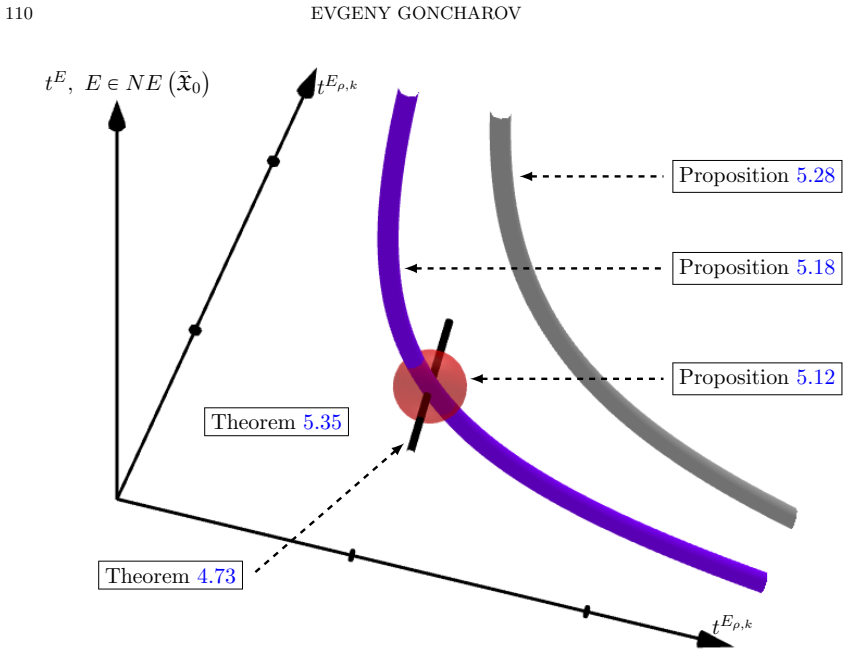
The central discovery is Theorem A: Conjecture 1.7 holds for special toric degenerations of K3 surfaces. Concretely, every such degeneration $\bar{\mathfrak X}\to \mathcal S$ with polarization $A$ admits an admissible resolution $\pi:\mathfrak X\to \bar{\mathfrak X}$ to a minimal log Calabi-Yau degeneration, and the basechange of the intrinsic mirror $\check{\mathfrak X}\to \operatorname{Spf} \widehat{k[P]}$ by the homomorphism $h:\beta\mapsto \pi_* A\cdot \beta$ is isomorphic to the toric degeneration mirror $\check{\bar{\mathfrak X}}\to \operatorname{Spec} k[t]$. The proof constructs the resolution, interprets the extended intrinsic mirror through scattering diagrams, and proves that the canonical scattering diagram of the intrinsic construction becomes combinatorially equivalent to the algorithmic scattering diagram of the toric degeneration mirror after the base change. In addition, Theorem B upgrades this to an isomorphism between the restriction of the intrinsic mirror to the minimal relative Gross-Siebert locus and a subfamily of the universal toric degeneration mirror, and Theorem C provides strongly admissible resolutions for a class of toric degenerations of Calabi-Yau threefolds obtained by the reconstruction algorithm.
Load-bearing premise
The argument leans on an externally supplied result, birational invariance of punctured log Gromov-Witten invariants, which is used to reduce Conjecture 1.7 to strongly admissible resolutions and to remove a technical global-generation assumption; if that invariance fails, the reduction and the scattering-diagram comparison do not go through.
Editorial extensions
If this is right
- For K3 surfaces, the intrinsic mirror construction is no longer a separate object: it recovers the toric degeneration mirror exactly, so results and algorithms for one construction transfer to the other.
- The toric degeneration mirror is shown to depend only on the intended data — central fibre, polarization, and chosen slab data — by being identified with the intrinsic mirror after base change.
- The extended correspondence over the minimal relative Gross-Siebert locus means the intrinsic mirror contains the universal family of the toric degeneration mirror, varying freely in initial slab functions and gluing data.
- In dimension three, a natural class of toric degenerations admits, after a bounded base change, strongly admissible resolutions, giving a path toward the same comparison for Calabi-Yau threefolds.
- For elliptic curves, the two mirror constructions agree tautologically and the universal toric degeneration mirror is isomorphic to the intrinsic mirror, giving the base case of the general picture.
Reading between the lines
- If the comparison extends to higher dimensions, the intrinsic mirror would supply a canonical choice of the initial slab functions and gluing data that the algorithmic toric degeneration mirror currently requires as input, removing a source of non-uniqueness.
- The reliance on birational invariance suggests the intrinsic mirror should be independent of the chosen admissible resolution; if true, it would be a canonical mirror attached to the original degeneration rather than to a resolution.
- A concrete testable extension would be to carry out the scattering-diagram comparison explicitly for the quartic K3 in $\mathbb P^3$ and verify the basechanged canonical diagram equals the algorithmic one wall by wall through all orders in $t$.
Signed reviews
Editorial analysis
A structured set of objections, weighed in public.
Referee Report
Summary. The paper develops a comparison between two mirror constructions in the Gross-Siebert program: the algorithmic toric degeneration mirror and the intrinsic mirror. After an explicit treatment of degenerations of elliptic curves, the main result (Theorem A / Theorem 4.73) asserts that Conjecture 1.7 holds for special toric degenerations of K3 surfaces with smooth generic fibre: any such degeneration admits an admissible resolution to a minimal log Calabi-Yau degeneration, and the basechange of the intrinsic mirror by the polarization map is isomorphic to the toric degeneration mirror. The paper also proves a correspondence between the restriction of the intrinsic mirror to the minimal relative Gross-Siebert locus and the universal toric degeneration mirror (Theorem B / Theorem 5.35), and constructs log smooth resolutions for a natural family of toric degenerations of Calabi-Yau threefolds (Theorem C / Theorem 6.16). The argument is organized around reducing to strongly admissible resolutions, removing the simple normal crossings and global-generation hypotheses, and comparing the canonical and algorithmic scattering diagrams.
Significance. If Theorem 4.73 is correct, it establishes a major, long-sought compatibility between two central constructions in mirror symmetry, and the extension to the relative Gross-Siebert locus in Chapter 5 is a substantial additional result. The paper is unusually careful about stating its assumptions, and it provides explicit, checkable computations in the elliptic curve case and in the P^3 K3 example. The strength of the work is, however, conditional: the proof of the main theorem relies on an extension of birational invariance of punctured log Gromov-Witten invariants beyond the precise statement quoted from [J], and Section 3.3.2 contains assertions rather than proofs for the removal of the simple normal crossings assumption. Because these points are load-bearing for the reduction to strongly admissible resolutions, the central claim is currently established only up to this external input. The paper does not provide machine-checked proofs or reproducible code, but its explicit computations and clear structural organization are valuable regardless.
major comments (4)
- [§1, Proposition 1.8] Proposition 1.8 is load-bearing for the reduction of Conjecture 1.7 to strongly admissible resolutions, yet its proof depends on an extension of [J, Corollary 1.6] that is not stated as a theorem anywhere. The sentence 'The proof does not use the fact that the radical of I is the maximal ideal' is an inference about the proof of an external result, not a proof of the needed statement. The needed statement concerns ideals I with radical J = P\K for the curves contracted by the logarithmic modification, which is exactly the non-maximal-radical case. Without a supplied proof, or a precise citation of a theorem covering this case, Theorem 4.73 establishes Conjecture 1.7 only for strongly admissible resolutions with maximal-radical base ideals.
- [§3.3.2] The removal of the simple normal crossings hypothesis is asserted rather than proved. The text states that the assumption 'can easily be removed' and that 'one can check that all the arguments of [GS8] work in this generalized setting', but no proof or detailed reference is given. This matters because admissible resolutions are allowed to have non-simple normal crossings D, so the comparison in Section 4.5 between the canonical scattering diagram and the algorithmic scattering diagram requires the non-snc version of the intrinsic mirror construction. The manuscript should either provide the promised argument or restrict Theorem 4.73 to the simple normal crossings case.
- [§3.3.4, Construction 3.69] The affine structure on the dual intersection complex in the general non-snc case is defined using [W, Theorem 4.1]. The hypotheses of that theorem are described only in passing, and it is not verified in the text that the log schemes X_{ρ_v} satisfy all of them in the situations needed for admissible resolutions. Since Construction 3.69 feeds directly into the definition of the canonical scattering diagram and hence into the main comparison, the precise content and applicability of [W, Theorem 4.1] should be stated and checked explicitly.
- [§4.5] The comparison of the canonical scattering diagram and the algorithmic scattering diagram for K3 surfaces relies on explicit punctured log Gromov-Witten computations taken from [G3] and [GHKS]. These computations are outsourced, and the text does not state exactly which results are used or verify that the hypotheses of those results are satisfied for the non-snc admissible resolutions introduced earlier. Since this comparison is the technical core of Theorem 4.73, the manuscript should list the precise external statements used and confirm that they apply in the full generality required.
minor comments (4)
- [§1, paragraph on Batyrev degenerations] The phrase 'Baryrev degeneration' appears once where 'Batyrev degeneration' is clearly intended; please fix the typo.
- [§2.3, Proposition 2.6] The notation X_{η(t)}^{∆} is introduced just before the proposition, but the symbol η(t) is reused for a power series without explicitly saying that it is the same function as in the displayed equation; a one-line clarification would help.
- [§3.3.3, Construction 3.57] The proof of Proposition 3.63 invokes Steinitz's theorem via a PL-embedding of B into R^3, but B is only known to be a polyhedral manifold homeomorphic to a sphere; it would be helpful to state the precise version of Steinitz's theorem used and to note whether a triangulation step is required.
- [§3.4.1] The beginning of Section 3.4.1 is truncated in the displayed text after 'Restricting', and the section appears to be incomplete; please check that the final version contains the full subsection.
Circularity Check
No significant circularity: intrinsic and toric degeneration mirrors are independently constructed and then compared.
full rationale
The central claim (Theorem 4.73 / Theorem A) is a comparison between two mirror constructions defined by independent recipes: the toric degeneration mirror is obtained from the algorithmic scattering diagram of [GS3] on the dual intersection complex of \bar{X}, while the intrinsic mirror is obtained from the resolved log CY degeneration X via punctured log Gromov-Witten invariants and the canonical scattering diagram of [GS7, GS8]. The proof in Sections 4.4 and 4.5 works by relating these two scattering diagrams, so the isomorphism asserted in Conjecture 1.7 is not built into either construction. The paper does rely on external results ([J, Corollary 1.6] for birational invariance of punctured invariants, and [G3]/[GHKS] for explicit scattering computations), and Proposition 1.8 explicitly extends [J] from ideals with maximal radical to ideals with radical J = P \setminus K, saying 'the proof does not use the fact that the radical of I is the maximal ideal'. This is a flagged inference and a potential correctness risk if [J] does not cover the non-snc or non-maximal-radical cases, but it is not circular: the target theorem is not used to justify the external input. Self-citations to the Gross-Siebert framework are present but load-bearing only as technical machinery, not as a substitute for the comparison being proved.
Assumptions & free parameters
free parameters (2)
- Initial slab functions f_rho (and constants a_{rho,i} for K3 surfaces) =
unspecified elements of the ground field k
- Gluing data s for the central fibre of the toric degeneration =
unspecified
assumptions (5)
- standard math Existence and uniqueness of the algorithmic scattering diagram (Theorem 3.35 of [GS3])
- standard math Consistency of the canonical scattering diagram (Theorem 3.90 of [GS8])
- domain assumption Birational invariance of punctured log Gromov-Witten invariants ([J, Corollary 1.6])
- domain assumption Explicit punctured Gromov-Witten computations from [G3] and [GHKS]
- domain assumption The input degeneration is special (Definition 3.39), has smooth generic fibre, and the constructed resolution is minimal log CY satisfying Assumption 3.48
Cite this review
Pith. "Pith review of Mirrors to toric degenerations via intrinsic mirror symmetry." pith.science (2026). https://pith.science/paper/3AMPYQ4T
@misc{pith2026260807381,
  author       = {Pith},
  title        = {Pith review of: Mirrors to toric degenerations via intrinsic mirror symmetry},
  year         = {2026},
  howpublished = {\url{https://pith.science/paper/3AMPYQ4T}},
  note         = {Machine review of arXiv:2608.07381}
}
abstract
We explore the connection between two mirror constructions in Gross-Siebert mirror symmetry: toric degeneration mirror symmetry (arXiv:1212.4220, arXiv:math/0309070, arXiv:0709.2290, arXiv:math/0703822) and intrinsic mirror symmetry (arXiv:1909.07649, arXiv:2105.02502). After briefly exploring the case of degenerations of elliptic curves, we show that the Gross-Siebert mirror construction for minimal relative log Calabi-Yau degenerations generalizes that for divisorial toric degenerations $\bar{\mathfrak{X}} \to \mathcal{S}$ of K3-s that have a smooth generic fibre. We achieve this by constructing a resolution of $\bar{\mathfrak{X}} \to \mathcal{S}$ to a relative minimal log Calabi-Yau degeneration $\mathfrak{X} \to \mathcal{S}$ and comparing the algorithmic scattering diagram $\bar{\mathfrak{D}}$ giving rise to the toric degeneration mirror $\check{\bar{\mathfrak{X}}}$ and the canonical scattering diagram $\mathfrak{D}$ giving rise to the intrinsic mirror $\check{\mathfrak{X}}$. Moreover, we vastly expand the construction and obtain a correspondence between the restriction of the intrinsic mirror to the (numerical) minimal relative Gross-Siebert locus and the universal toric degeneration mirror. We also discuss generalizing the results to higher dimensions. In particular, we construct log smooth resolutions for a natural family of toric degenerations of Calabi-Yau threefolds.
Figures


Figures from the paper (32 more)








Reference graph
Works this paper leans on
-
[1]
H. Argüz, Equations of mirrors to log Calabi--Yau pairs via the heart of canonical wall structures, Math. Proc. Camb. Phil. Soc. (2023)
work page 2023
-
[2]
D. Abramovich, Q. Chen, Stable logarithmic maps to Deligne-Faltings pairs II, Asian J. Math. 18 (2014), pp. 465–488
work page 2014
-
[3]
D. Abramovich, Q. Chen, S. Markus, J. Wise, Boundedness of the space of stable logarithmic maps, J. Eur. Math. Soc. (JEMS) 19 (2017), pp. 2783–2809
work page 2017
-
[4]
D. Abramovich, Q. Chen, M. Gross, B. Siebert, Decomposition of degenerate Gromov-Witten invariants, Compositio Math. 156 (2020), pp. 2020–2075
work page 2020
-
[5]
D. Abramovich, Q. Chen, M. Gross, B. Siebert, Punctured logarithmic maps, ArXiv e-prints (2020), violet arXiv:2009.07720 [math.AG] https://arxiv.org/abs/2009.07720
arXiv 2020
- [6]
-
[7]
G. Averkov, J. Krümpelmann, S. Weltge, Notions of maximality for integral lattice-free polyhedra: the case of dimension three, Math. Oper. Res. 42–4 (2017), pp. 1035–1062
work page 2017
-
[8]
D. Abramovich, S. Marcus, J. Wise, Comparison theorems for Gromov-Witten in- variants of smooth pairs and of degenerations, Ann. Inst. Fourier (Grenoble) 64 (2014), pp. 1611–1667
work page 2014
Show all 71 references
-
[9]
Abramovich, J
D. Abramovich, J. Wise, Birational invariance in logarithmic Gromov-Witten theory, Compositio Math. 154 (2018), pp. 595–620
2018
-
[10]
Averkov, C
G. Averkov, C. Wagner, R. Weismantel, Maximal lattice-free polyhedra: finiteness and an explicit description in dimension three, Math. Oper. Res. 36–4 (2011), pp. 721–742
2011
-
[11]
Batyrev, Dual Polyhedra and Mirror Symmetry for Calabi-Yau Hypersurfaces in Toric Varieties, J
V. Batyrev, Dual Polyhedra and Mirror Symmetry for Calabi-Yau Hypersurfaces in Toric Varieties, J. Algebraic Geom., Vol. 3 (1993), pp. 493–545
1993
-
[12]
Batyrev, L
V. Batyrev, L. Borisov, On Calabi-Yau Complete Intersections in Toric Varieties, Higher Dimensional Complex Varieties, De Gruyter Proc. in Math. (1994), pp. 39–67
1994
-
[13]
Brown, J
G. Brown, J. Buczyński, Maps of toric varieties in Cox coordinates, Fund. Math., Vol. 222–3 (2013), pp. 213–267
2013
-
[14]
Cairns, Triangulated manifolds which are not Brouwer manifolds, Ann
S.S. Cairns, Triangulated manifolds which are not Brouwer manifolds, Ann. Math. 41 (1940), pp. 792–795
1940
-
[15]
Clemens, Homological equivalence, modulo algebraic equivalence, is not finitely generated, Inst
H. Clemens, Homological equivalence, modulo algebraic equivalence, is not finitely generated, Inst. Hautes Études Sci. Publ. Math. 58 (1983), pp. 19–39
1983
-
[16]
Cox, The homogeneous coordinate ring of a toric variety, J
D. Cox, The homogeneous coordinate ring of a toric variety, J. Algebraic Geom. 4(1) (1995), pp. 17–50
1995
-
[17]
Clausen, A
M. Clausen, A. Fortenbacher, Efficient Solution of Linear Diophantine Equations, J. Symb. Comp. (8) (1989), pp. 201–216
1989
-
[18]
Chan, N.C
K. Chan, N.C. Leung, Z.N. Ma, Geometry of the Maurer-Cartan equation near degenerate Calabi-Yau varieties, ArXiv e-prints (2019), violet arXiv:1902.11174 [math.AG] https://arxiv.org/abs/1902.11174
2019 arXiv
-
[19]
M. Carl, M. Pumperla, B. Siebert, A tropical view on Landau-Ginzburg models, ArXiv e-prints (2022), violet arXiv:2205.07753 [math.AG] https://arxiv.org/abs/2205.07753
2022 arXiv
-
[20]
Aspinwall et al, Dirichlet Branes and Mirror Symmetry, Clay Math
P.S. Aspinwall et al, Dirichlet Branes and Mirror Symmetry, Clay Math. Monographs (4) (2009)
2009
-
[21]
Friedman, Global Smoothings of Varieties with Normal Crossings, Ann
R. Friedman, Global Smoothings of Varieties with Normal Crossings, Ann. Math., Vol. 118, No. 1 (1983), pp. 75–114
1983
-
[22]
Felten, M
S. Felten, M. Filip, H. Ruddat, Smoothing toroidal crossing spaces, Forum of Math., Pi, Vol. 9–7 (2021), pp. 1–36
2021
-
[23]
Gross, Toric Degenerations and Batyrev-Borisov Duality, Math
M. Gross, Toric Degenerations and Batyrev-Borisov Duality, Math. Ann., Vol. 333 (2005), pp. 645–688
2005
-
[24]
Gross, Mirror Symmetry and the Strominger-Yau-Zaslow conjecture, Curr
M. Gross, Mirror Symmetry and the Strominger-Yau-Zaslow conjecture, Curr. Devel. in Math. (2012), pp. 133–191
2012
-
[25]
Gross, Remarks on gluing punctured logarithmic maps, ArXiv e-prints (2023), violet arXiv:2306.02661 [math.AG] https://arxiv.org/abs/2306.02661
M. Gross, Remarks on gluing punctured logarithmic maps, ArXiv e-prints (2023), violet arXiv:2306.02661 [math.AG] https://arxiv.org/abs/2306.02661
2023 arXiv
-
[26]
Gross, P
M. Gross, P. Hacking, S. Keel, Mirror symmetry for log Calabi-Yau surfaces I, Publ. IHES 122 (2015), pp. 65–168
2015
-
[27]
Gross, P
M. Gross, P. Hacking, S. Keel, B. Siebert, Theta functions for K3 surfaces, in preparation
-
[28]
Gross, P
M. Gross, P. Hacking, B. Siebert, Theta Functions on Varieties with Effective Anti-canonical Class, Memoirs Amer. Math. Soc., Vol. 278, No. 1367 (2022)
2022
-
[29]
Greene, R
B. Greene, R. Plesser, Duality in Calabi-Yau moduli space, Nuclear Phys. B 338 (1990), No. 1, pp. 15–37
1990
-
[30]
Gross, R
M. Gross, R. Pandharipande, B. Siebert, The tropical vertex, Duke Math. J. 153(2) (2010), pp. 297–362
2010
-
[31]
Gross, B
M. Gross, B. Siebert, Mirror Symmetry via Logarithmic Degeneration Data I, J. Differential Geom. 72 (2006), pp. 169–338
2006
-
[32]
Gross, B
M. Gross, B. Siebert, Mirror Symmetry via Logarithmic Degeneration Data II, J. Algebraic Geom. 19 (2010), pp. 679–780
2010
-
[33]
Gross, B
M. Gross, B. Siebert, From real affine geometry to complex geometry, Ann. Math. 174 (2011), pp. 1301–1428
2011
-
[34]
Gross, B
M. Gross, B. Siebert, Logarithmic Gromov-Witten invariants, J. Amer. Math. Soc., Vol. 26, No. 2 (2013), pp. 451–510
2013
-
[35]
Gross, B
M. Gross, B. Siebert, Theta functions and mirror symmetry, Surv. Diff. Geom. XXI (2016), pp. 95–138
2016
-
[36]
Gross, B
M. Gross, B. Siebert, Intrinsic mirror symmetry and punctured Gromov-Witten invariants, Algebraic Geometry: Salt Lake City 2015, Proc. Sympos. Pure Math., Vol. 97, Amer. Math. Soc. (2018), pp. 199–230
2018
-
[37]
Gross, B
M. Gross, B. Siebert, Intrinsic Mirror Symmetry, ArXiv e-prints (2019), violet arXiv:1909.07649 [math.AG] https://arxiv.org/abs/1909.07649
2019
-
[38]
Gross, B
M. Gross, B. Siebert, The canonical wall structure and intrinsic mirror symmetry, Invent. Math. 229 (2022), pp. 1101–1202
2022
-
[39]
Hartshorne, Algebraic geometry, Grad
R. Hartshorne, Algebraic geometry, Grad. Texts in Math. 52, Springer (1977)
1977
-
[40]
Hu, Semi-Stable Degeneration of Toric Varieties and Their Hypersurfaces, Comm
S. Hu, Semi-Stable Degeneration of Toric Varieties and Their Hypersurfaces, Comm. in Analysis and Geometry, Vol. 14, No. 1 (2006), pp. 59–89
2006
-
[41]
Huybrechts, Lectures on K3 Surfaces, Camb
D. Huybrechts, Lectures on K3 Surfaces, Camb. Univ. Press (2016)
2016
-
[42]
T. Hibi, A. Higashitani, K. Yoshida, Existence of regular unimodular triangulations of dilated empty simplices, Europ. J. Comb., Vol. 70 (2018), pp. 374–383
2018
-
[43]
Haase, A
C. Haase, A. Paffenholz, L.C. Piechnik, F. Santos, Existence of unimodular triangulations – positive results, Memoirs Amer. Math. Soc., Vol. 270, No. 1321 (2021)
2021
-
[44]
Haase, G
C. Haase, G. M. Ziegler, On the Maximal Width of Empty Lattice Simplices, Europ. J. Comb. 21 (2000), pp. 111–119
2000
-
[45]
Hachimori, G
M. Hachimori, G. M. Ziegler, Decomposition of simplicial balls and spheres with knots consisting of few edges, Math. Z. 235 (2000), pp. 159–171
2000
-
[46]
Johnston, Birational Invariance in Punctured Log Gromov-Witten Theory, ArXiv e-prints (2022), violet arXiv:2210.06079 [math.AG] https://arxiv.org/abs/2210.06079
S. Johnston, Birational Invariance in Punctured Log Gromov-Witten Theory, ArXiv e-prints (2022), violet arXiv:2210.06079 [math.AG] https://arxiv.org/abs/2210.06079
2022 arXiv
-
[47]
Kato, Logarithmic structures of Fontaine-Illusie, Johns Hopkins Univ
K. Kato, Logarithmic structures of Fontaine-Illusie, Johns Hopkins Univ. Press (1989), pp. 191–224
1989
-
[48]
Khovanskii, Newton polygons, curves on torus surfaces, and the converse Weil theorem, Russian Math
A.G. Khovanskii, Newton polygons, curves on torus surfaces, and the converse Weil theorem, Russian Math. Surveys 52 (1997), pp. 1251–1279
1997
-
[49]
Kato, Functors of log Artin rings, Manusc
F. Kato, Functors of log Artin rings, Manusc. Math. 96(1) (1999), pp. 97–112
1999
-
[50]
Kasa, Toward Gromov–Witten Invariants for Relatively Coherent Logarithmic Schemes, PhD
M.P. Kasa, Toward Gromov–Witten Invariants for Relatively Coherent Logarithmic Schemes, PhD. Thesis, University of California, San Diego (2015)
2015
-
[51]
Kempf, F
G. Kempf, F. Knudsen, D. Mumford, B. Saint-Donat, Toroidal Embeddings I, Springer, LNM 339 (1973)
1973
-
[52]
Kollár, S
J. Kollár, S. Mori, Birational Geometry of Algebraic Varieties, Camb. Univ. Press (1998)
1998
-
[53]
F. Kohl, M. Olsen, R. Sanyal, Unconditional Reflexive Polytopes, Discrete & Comp. Geom., Branko Grünbaum Memorial Issue (2020)
2020
-
[54]
Kontsevich, Y
M. Kontsevich, Y. Soibelman, Affine structures and non-Archimedean analytic spaces, Unity of Math. (2006), pp. 321–385
2006
-
[55]
Lefschetz, L'analysis situs et la géométrie algébrique (in French), Gauthier-Villars (1924)
S. Lefschetz, L'analysis situs et la géométrie algébrique (in French), Gauthier-Villars (1924)
1924
-
[56]
Liu, Unimodular triangulations of sufficiently large dilations, ArXiv e-prints (2021), violet arXiv:2112.04654 [math.CO] https://arxiv.org/abs/2112.04654
G. Liu, Unimodular triangulations of sufficiently large dilations, ArXiv e-prints (2021), violet arXiv:2112.04654 [math.CO] https://arxiv.org/abs/2112.04654
2021 arXiv
-
[57]
Mumford, An analytic construction of degenerating abelian varieties over complete rings, Compositio Math
D. Mumford, An analytic construction of degenerating abelian varieties over complete rings, Compositio Math. 24 (1972), pp. 1–51
1972
-
[58]
Milne, Étale Cohomology, Prin
J.S. Milne, Étale Cohomology, Prin. Univ. Press (1980)
1980
-
[59]
Ogus, Lectures on Logarithmic Algebraic Geometry, Camb
A. Ogus, Lectures on Logarithmic Algebraic Geometry, Camb. Univ. Press (2018)
2018
-
[60]
Perrson, Degenerations of Algebraic Surfaces, Memoirs Amer
U. Perrson, Degenerations of Algebraic Surfaces, Memoirs Amer. Math. Soc., 189 (1977)
1977
-
[61]
I. Pak, S. Wilson, Geometric realizations of polyhedral complexes (2014), violet Dept. of Math., UCLA https://www.math.ucla.edu/ pak/papers/Fary-full31.pdf
2014
-
[62]
Richter-Gebert, Realization spaces of polytopes, Lecture Notes in Math
J. Richter-Gebert, Realization spaces of polytopes, Lecture Notes in Math. (1996)
1996
-
[63]
Ruddat, Partial Resolution of a toric log Calabi–Yau space, Master's Thesis (in German), Mathematical Institute of the Albert Ludwigs University of Freiburg (2005)
H. Ruddat, Partial Resolution of a toric log Calabi–Yau space, Master's Thesis (in German), Mathematical Institute of the Albert Ludwigs University of Freiburg (2005)
2005
-
[64]
Ruddat, B
H. Ruddat, B. Siebert, Period integrals from wall structures via tropical cycles, canonical coordinates in mirror symmetry and analyticity of toric degenerations, Publ. Math. de l'IHÉS, Vol. 132 (2020), pp. 1–82
2020
-
[65]
Schlessinger, Functors of Artin rings, Trans
M. Schlessinger, Functors of Artin rings, Trans. Amer. Math. Soc. 130 (1968), pp. 208–222
1968
-
[66]
H.M. Thompson, Pulling subdivisions of cones and blowups of monomial ideals on affine toric varieties, ArXiv e-prints (2016), violet arXiv:1612.09206 [math.AG] https://arxiv.org/abs/1612.09206
2016 arXiv
-
[67]
Griffiths et al, Topics in Transcendental Algebraic Geometry, Annals Math
P. Griffiths et al, Topics in Transcendental Algebraic Geometry, Annals Math. Studies, No. 106 (1984)
1984
-
[68]
Voisin, The Griffiths group of a general Calabi-Yau threefold is not finitely generated, Duke Math
C. Voisin, The Griffiths group of a general Calabi-Yau threefold is not finitely generated, Duke Math. J., Vol. 102, No. 1 (2000), pp. 151–186
2000
-
[69]
Wu, Splitting of Gromov-Witten Invariants with Toric Gluing Strata, ArXiv e-prints (2021), violet arXiv:2103.14780 [math.AG] https://arxiv.org/abs/2103.14780
Y. Wu, Splitting of Gromov-Witten Invariants with Toric Gluing Strata, ArXiv e-prints (2021), violet arXiv:2103.14780 [math.AG] https://arxiv.org/abs/2103.14780
2021 arXiv
-
[70]
Ziegler, Lectures on Polytopes, Vol
G.M. Ziegler, Lectures on Polytopes, Vol. 152 of Grad. Texts in Math. (1995)
1995
-
[71]
Zomervrucht, Descent on the étale site (2014), violet Dept
W. Zomervrucht, Descent on the étale site (2014), violet Dept. of Math, Leiden Univ https://pub.math.leidenuniv.nl/ zomervruchtw/docs/etdesc.pdf
2014
Reviewed August 15, 2026 · model on record in the stance chip above.
Discussion (0). Continue with ORCID to comment.