REVIEW 3 major objections 4 minor 142 references
Wild behaviour near the finish line: the Type Ibn SN 2020able and its stratified environment
T0 review · 3 major / 4 minor · reviewed 2026-08-11 · deepseek-v4-flash
Pith's one-line read This paper argues that the Type Ibn SN 2020able exploded in a stratified, three-layer circumstellar shell, with a compact shocked region, a dense inner shell ejected by a discrete pre-SN eruption similar to SN 2006jc, and an outer shell…
desk verdict A well-observed Ibn with a plausible stratified CSM, but the pre-SN eruption claim rests on an untested assumption about line broadening and needs a direct test. read the letter →
The pith
A machine-rendered reading of the paper's core claim, the machinery that carries it, and where it could break.
The reading
What carries the argument
The argument is carried by the interpretation of the constant FWHM (about $3\times10^{3}$ km s$^{-1}$) of the early high-ionization lines (N III, He II, C III) as electron-scattering broadening in an optically thick shell, following the line-profile models of Huang & Chevalier (2018). This converts a measured width into a Thomson optical depth $\tau_{\rm es}\sim6.5$, and with an assumed shell geometry, temperature, and filling factor, into an electron density $n_{\rm e}\sim1.4\times10^{9}$ cm$^{-3}$ and a shell mass near $0.02\,M_\odot$. The companion measurement is the P Cygni absorption velocity ($\sim1.2\times10^{3}$ km s$^{-1}$), which gives the shell's true expansion velocity and is roughly one-third of the scattering FWHM; the ratio between the two is what exposes the mass-loss rate as too high for a steady wind. The time evolution of the narrow He I absorption equivalent width, which drops sharply at about day 47 and disappears by day 70, locates the inner and outer radii of the outer shell, completing the three-layer picture.
What would settle it
Take early-time (before day 16) spectra at resolving power $R>4000$ and measure the resolved profiles of He II 4686 and N III 4634/4641: electron-scattering broadening should produce symmetric profiles with exponential wings and a FWHM that stays near $3\times10^{3}$ km s$^{-1}$ regardless of wavelength, while kinematic broadening should show asymmetric or structured profiles tied to the roughly $1.2\times10^{3}$ km s$^{-1}$ P Cygni velocity. If the constant FWHM dissolves into narrower kinematic components, the dense-shell density, the $0.02\,M_\odot$ mass, and the inferred eruptive mass-loss rate collapse.
Extended reading notes
Core claim
The paper concludes that SN 2020able possessed a stratified circumstellar environment with three distinct regions at different distances from the progenitor. The innermost region is a shocked, compact shell (outer radius about $3\times10^{13}$ cm) that powered a brief ejecta–CSM interaction within the first few days and produced the high peak luminosity; this shell is too small and short-lived to shape the later evolution. Beyond it, a dense He-rich shell lies at $R>9.3\times10^{14}$ cm, with Thomson optical depth $\tau_{\rm es}\sim6.5$, electron density $n_{\rm e}\sim1.4\times10^{9}$ cm$^{-3}$, and a mass near $0.02\,M_\odot$, inferred from the constant FWHM of the early high-ionization lines interpreted as electron-scattering broadening. Because maintaining such density in a steady wind would require a mass-loss rate of about $8.7\times10^{-2}\,M_\odot$ yr$^{-1}$, inconsistent with radiation-driven wind theory for Wolf-Rayet stars, the paper argues this inner shell was ejected by a discrete pre-SN eruptive event similar to SN 2006jc. The outermost component, spanning roughly $2.2\times10^{15}$ to $3.3\times10^{15}$ cm and expanding at about $1.2\times10^{3}$ km s$^{-1}$, matches the escape velocity of Wolf-Rayet stars, favoring a late WN-to-WC progenitor; the ejecta overtake this shell around day 47, when the narrow He I absorptions suddenly weaken.
Load-bearing premise
Everything hangs on the assumption that the constant $\sim3\times10^{3}$ km s$^{-1}$ width of the early high-ionization lines is electron scattering in a shell with a specific geometry, temperature, and clumping factor; if that width instead comes from gas simply moving at a range of speeds, the inferred density, shell mass, and eruptive mass-loss rate would be far lower.
Editorial extensions
If this is right
- The luminous peak of SN 2020able was powered by ejecta–CSM interaction confined to the first few days and to a region smaller than about $3\times10^{13}$ cm; after that, the light curve is powered by the ejecta themselves, not by ongoing interaction.
- The dense inner shell was ejected by a discrete eruptive episode beginning roughly 300 days before explosion, expelling about $0.02\,M_\odot$ at an average rate near $0.7\,M_\odot$ yr$^{-1}$ over about 10 days, similar to the outburst that preceded SN 2006jc.
- The outer shell's expansion velocity of about $1.2\times10^{3}$ km s$^{-1}$ is consistent with the escape velocity of Wolf-Rayet stars, making a late WN-to-WC star the most viable progenitor for SN 2020able.
- The non-LTE radiative-transfer models of Dessart et al. (2022), built for low-mass helium stars in binaries, reproduce the narrow-line phase but fail to reproduce the broad features seen after about day 43, indicating that the late spectra come from the inner ejecta of a more massive stripped-envelope star.
Reading between the lines
- If the electron-scattering interpretation holds, the same conversion of constant FWHM to Thomson optical depth could be applied to other Type Ibn SNe with early high-ionization lines to map their pre-SN mass-loss histories, but only after kinematic broadening is excluded by higher-resolution spectra.
- A single narrow-line spectrum of an interacting transient can mix light from shells ejected by different mechanisms; for objects like SN 2020able, the absence of ongoing interaction at late times means the narrow lines are a fossil record of the CSM, not evidence of current energy input.
- Archival limits rule out a pre-explosion outburst brighter than about $M_{\rm bol}=-14$ in the two years before the explosion, so the inferred eruption was either fainter than that or produced a shell that only became visible after the SN exploded; deeper pre-explosion monitoring of nearby Ibn candidates could test whether such $\sim0.02\,M_\odot$ eruptions are common.
- The slow rise and slow decline of SN 2020able, compared with faster Ibn SNe, may indicate that its early excess came from a dense inner shell rather than an extended wind; this stratification could be the reason the rise-time/decline-rate plane of Type Ibn SNe is so spread out.
Editorial analysis
A structured set of objections, weighed in public.
Referee Report
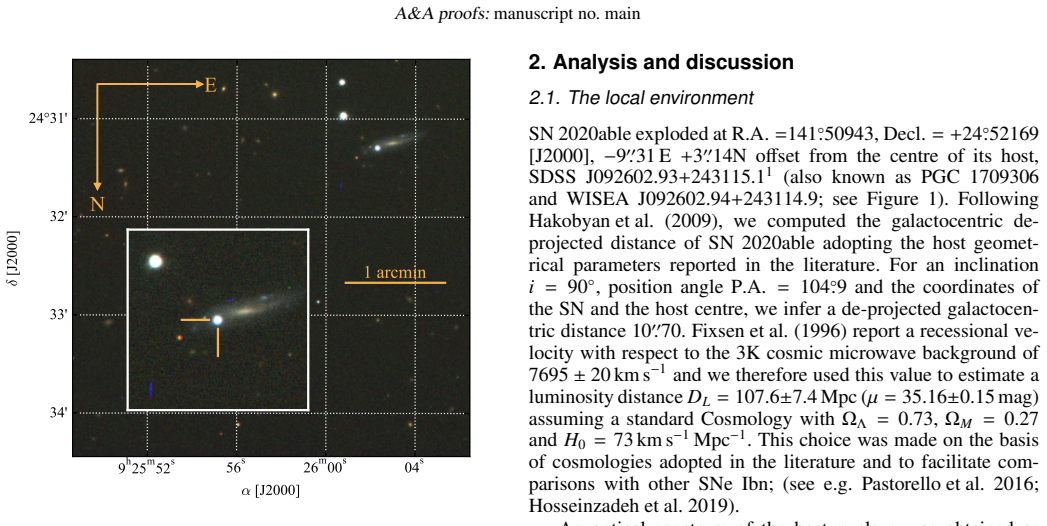
Summary. The paper presents a comprehensive spectrophotometric dataset for the Type Ibn SN 2020able, from to 7 to 98 days after explosion, and uses it to argue that the transient's environment is stratified into three distinct regions: an inner shocked shell traced by the early light-curve excess and MOSFiT modelling (M_CSM ~ 0.6 Msun, R_out ~ 3.1e13 cm), a dense un-shocked He-rich shell at R ~ 9.3e14 cm with n_e ~ 1.4e9 cm^-3 and mass ~ 0.02 Msun, and a more extended outer shell at R ~ 2.2e15 - 3.3e15 cm expanding at ~ 1.2e3 km/s. The paper concludes that the inner un-shocked shell was produced by a discrete pre-SN eruptive event similar to SN 2006jc, while the outer shell is consistent with a late WN/WC Wolf-Rayet wind. The analysis combines light-curve fitting with MOSFiT, SED blackbody fits, line-profile fitting of the high-ionisation features, and EW evolution of the narrow He I absorptions, in comparison with a sample of Type Ibn/Icn supernovae.
Significance. If the conclusions hold, SN 2020able is one of the best-documented cases of a stratified CSM in a Type Ibn SN, with early high-cadence data that directly constrain the geometry and mass-loss history of the progenitor. The paper is commendable for its transparent handling of model degeneracies, its release of light curves and posterior distributions via Zenodo, and its explicit discussion of alternative interpretations. The central stratification picture has independent qualitative support from the constant FWHM of the high-ionisation lines, the EW drop timing, and the P Cygni velocities, which are observables rather than outputs of the light-curve fit. However, the quantitative claim of a discrete eruptive event with a specific mass and mass-loss rate rests on a single, insufficiently tested assumption about the line-broadening mechanism, so the significance of the strongest conclusion is currently not established.
major comments (3)
- [Section 2.3] The conversion of the constant FWHM of about 3e3 km/s into a Thomson optical depth tau_es ~ 6.5 is the linchpin of the eruptive-CSM claim, but the paper does not convincingly exclude kinematic broadening. The He I P Cygni absorption minima at about 1.2e3 km/s and the BVZI at about 1.8e3 km/s provide a natural kinematic scale: a shell or wind with velocities up to ~1.8e3 km/s can produce an emission FWHM of ~3e3 km/s with tau_es << 1. The paper's cited arguments for electron scattering - the symmetry of the profiles and the FWHM-to-absorption ratio (paragraph beginning 'A more stringent constraint for the local density') - are not discriminating tests, since Huang & Chevalier (2018) show that a range of optical depths and kinematic configurations can produce symmetric profiles. This assumption is load-bearing because the derived n_e ~ 1.4e9 cm^-3, M_dense ~ 0.02 Msun, and M_dot ~ 0.7 Msun/yr, and hence the conclusion that a steady WR wind is ruled out (Abstract; Section 3), all follow from it. I request a direct test separating the two mechanisms, such as a quantitative comparison of the full observed line profiles with Huang & Chevalier (2018) models under both the high-tau and low-tau kinematic interpretations, or an independent density estimate from recombination/forbidden line ratios. Until this is provided, the eruptive-episode conclusion should be presented as one of two plausible interpretations rather than a demonstrated result.
- [Section 2.3 (paragraph beginning 'The geometric extent of the shell')] The shell radii used in the mass estimate are not uniquely determined. The paper derives R_in ~ 2.2e15 cm and R_out ~ 3.3e15 cm by associating the EW drop at about +47 d with the ejecta overtaking the shell's inner boundary and the disappearance at about +70 d with its outer boundary. However, the text itself immediately acknowledges that the absorption may instead be diluted in the blue wing of the emerging broad He I emission. If dilution is the cause, the EW timing does not measure the shell's physical extent, and the adopted thickness Delta_R ~ 1.3e15 cm - which enters the density n_e = tau_es/(sigma_T Delta_R) and thus the mass M_dense ~ 0.02 Msun - is not robust. I ask the authors to model the dilution scenario and quantify how the inferred radii, density, and mass change, or to provide an independent geometric constraint that does not rely on the EW drop interpretation.
- [Section 2.2, Table C.2 and Figs. C.2/C.3] The claim that the early interaction is geometrically and temporally confined (Abstract; Section 3) rests on the MOSFiT csmni result that the shocked shell's outer radius is R_out ~ 3.1e13 cm. The text acknowledges that R0 and rho_CSM have broad, strongly covariant posteriors spanning more than an order of magnitude, and the corner plots show non-Gaussian distributions. The quoted R_out is computed from the posterior medians without propagating the full covariance, and the alternative pure-csm model, though disfavored by the authors, places the shell at R0 ~ 35.5 AU with low density. To make the confinement claim quantitative, I request a demonstration that the derived R_out is robust to the degeneracies (e.g., by computing R_out over the full posterior and showing its distribution), or a revision of the claim to explicitly state that it is model-dependent.
minor comments (4)
- [Figure 3 caption] The caption reads 'at 2 fit' and 't 2 evolution'; these should be 't^2 fit' and 't^2 evolution' for the power-law fit, and the meaning of 'at 2' is unclear.
- [Section 2.3] The electron density for the dense inner shell is quoted as n_e ~ 1.4e9 cm^-3 in the paragraph following 'Taking tau_es = 6.5' and as n_e ~ 7.5e8 cm^-3 in the next paragraph; please clarify which definition (Delta_R = 3.1e13 cm from the first estimate versus Delta_R ~ 1.3e15 cm from the EW-determined thickness) corresponds to each value and keep the notation consistent.
- [Section 2.3 and Figure 9] The text says the multi-component fits adopt Lorentzian profiles to follow the electron-scattering wings, but the caption of Figure 9 states that a Gaussian absorption was used to reproduce the overall profile of He I 5876; please state the actual profile choices explicitly and consistently.
- [Section 2.3] The relation between FWHM and tau_es is cited to Figure 5 of Huang & Chevalier (2018), but the paper does not reproduce the relation or give the exact formula used; since the tau_es = 6.5 value is central, please include the relevant curve or equation in an appendix.
Circularity Check
Only minor circularity: the constant-FWHM fit is used to rule out FWHM evolution; the central stratified-CSM/eruptive-shell result is not circular.
-
fitted input called prediction
[Section 2.3, paragraphs around Fig. 9 and the following paragraph on the constant FWHM]
"the overall profiles are well-reproduced assuming a constant FWHM of approximately≃3×10 3 km s−1 at all times, leaving only the peak wavelengths and line fluxes as free parameters. ... A compact, nearby shell being swept up by the rapidly expanding SN ejecta would have introduced a shocked component, thus modifying the FWHM within the first 16 days, which is ruled out by our fitting procedure."
The constancy of the FWHM is an input to the fit: the fit is performed 'assuming a constant FWHM ... at all times'. The paper then presents the absence of FWHM evolution as a result ('ruled out by our fitting procedure') that excludes a shocked, swept-up component. A constant-FWHM fit cannot by itself rule out a model with time-varying FWHM; that would require fitting and rejecting the varying-FWHM alternative. The same constancy is visible in Fig. 9 and therefore has independent observational support, so the circularity is partial and mostly in the wording.
full rationale
The paper's central conclusion—that SN 2020able exploded inside a stratified CSM with a compact shocked shell, a dense inner unshocked shell at R≳9.3×10^14 cm, and an outer shell at ~2.2–3.3×10^15 cm, with the inner shell produced by an SN 2006jc-like eruption—is not a circular derivation. The dense-shell density and mass are obtained by applying the external Huang & Chevalier (2018) electron-scattering relation to the observed constant FWHM ≈ 3000 km/s and to radii derived from P Cygni velocities and the EW drop/disappearance times. That mapping is model-dependent (geometry, T_e, filling factor), but it is not equivalent to the conclusion by construction: the FWHM is an observed quantity, and the τ_es → n_e → M_dense → Mdot chain is a forward calculation with stated assumptions. An alternative kinematic-broadening interpretation would lower the derived mass and mass-loss rate, but that is a physical modeling degeneracy, not a circularity. The self-citations (Tartaglia et al. 2020, 2025) are used for line-formation mechanism and profile shape and are not the load-bearing step. The one genuine circular element is in Sect. 2.3: the multi-component fit is performed 'assuming a constant FWHM', and the paper then says a swept-up shocked component 'modifying the FWHM within the first 16 days' is 'ruled out by our fitting procedure'. The assumed constancy is being used as evidence against FWHM evolution. Because the constancy is also directly visible in Fig. 9, this does not invalidate the central result, but the sentence as written is a fitted input presented as a conclusion. Overall: partial, minor circularity in presentation; central claims remain independent of any fitted parameter or self-citation chain.
Assumptions & free parameters
free parameters (13)
- M_ej (MOSFiT csmni) =
1.315 (+0.062, -0.068) Msun
- E_k (MOSFiT csmni) =
2.9e50 erg (log10 Ek = 0.077)
- M_CSM (MOSFiT csmni) =
0.573 (+0.013, -0.014) Msun
- R0 (MOSFiT csmni) =
0.25 AU (16-84%: 0.1-0.6 AU)
- rho_CSM (MOSFiT csmni) =
9.3e-9 g cm^-3 (posterior spans roughly 2 dex)
- M_Ni56 (MOSFiT csmni) =
0.0315 (+0.0043, -0.0038) Msun
- n (ejecta density profile index) =
6.6 (prior 6-10)
- T_min (temperature floor) =
7499 K
- A_V (host extinction) =
0.147 mag
- Explosion epoch =
JD 2459184.46 +/- 0.43
- Filling factor f for CSM clumping =
0.1 (assumed)
- Radiative efficiency epsilon =
about 30% (assumed; 26% upper limit from archival limits)
- Electron temperature T_e =
2.0e4 K (assumed)
assumptions (6)
- domain assumption The MOSFiT csmni analytical model describes the light curve.
- domain assumption Line broadening is dominated by electron scattering in the dense shell.
- domain assumption The EW drop at +47 days marks the ejecta overtaking the shell.
- domain assumption The Galbany et al. (2016) metallicity gradient applies to this host galaxy.
- standard math Standard cosmology with H0 = 73 km/s/Mpc.
- domain assumption Na I D equivalent width to reddening relation (Poznanski et al. 2012).
Cite this review
Pith. "Pith review of Wild behaviour near the finish line: the Type Ibn SN 2020able and its stratified environment." pith.science (2026). https://pith.science/paper/YYCLC6AM
@misc{pith2026260807661,
  author       = {Pith},
  title        = {Pith review of: Wild behaviour near the finish line: the Type Ibn SN 2020able and its stratified environment},
  year         = {2026},
  howpublished = {\url{https://pith.science/paper/YYCLC6AM}},
  note         = {Machine review of arXiv:2608.07661}
}
abstract
We present spectrophotometric observations of the Type Ibn supernova SN~2020able, along with a comprehensive analysis and modelling of its evolution. The transient occurred in SDSS J092602.93+243115.1, a faint host galaxy characterised by significantly sub-solar metallicity ($12+\log(\rm{O/H})\simeq8.28\,\rm{dex}$). The early photometric evolution and high peak luminosity ($L_{peak}\simeq4.4\times10^{43}\,\rm{erg}\,\rm{s^{-1}}$) indicate an efficient conversion of ejecta kinetic energy into radiation via interaction with the circumstellar medium. Light-curve modelling suggests that this interaction involves ejecta with a mass of $M_{\rm{ej}}\simeq1.3\,M_{\odot}$ impacting a shell of $M_{\rm{CSM}}\simeq0.6\,M_{\odot}$. However, interaction is found to be geometrically and temporally confined within a few days after explosion, with the later evolution of the transient being dominated by the free expansion of the ejecta. Spectroscopic analysis reveals a complex, stratified circumstellar environment. In addition to the innermost shocked region, we identify two additional He-rich shells: a dense inner one ($n_{\rm{e}}\simeq1.4\times10^{9}\,\rm{cm^{-3}}$) located at $R\gtrsim9.3\times10^{14}\,\rm{cm}$, and a more extended outer component reaching $R_{out}\simeq3.3\times10^{15}\,\rm{cm}$ and expanding at approximately $1.2\times10^3\,\rm{km}\,\rm{s^{-1}}$. The physical parameters of the former suggest it was produced by a discrete pre-supernova eruptive event similar to that of SN~2006jc, which expelled approximately $1.8\times10^{-2}\,M_{\odot}$ of material. Conversely, the expansion velocity of the outermost shell is consistent with the escape velocity of WR stars, pointing towards a late WN to WC-type progenitor as the most viable candidate for SN~2020able.
Figures


Figures from the paper (6 more)


Reference graph
Works this paper leans on
-
[1]
MOSFiT: Modular Open Source Fitter for Transients. , keywords =. doi:10.3847/1538-4365/aab761 , archivePrefix =. 1710.02145 , primaryClass =
-
[2]
Analytical Light Curve Models of Superluminous Supernovae: ^ 2 -minimization of Parameter Fits. , keywords =. doi:10.1088/0004-637X/773/1/76 , archivePrefix =. 1306.3447 , primaryClass =
-
[3]
Theoretical Models of Optical Transients. I. A Broad Exploration of the Duration-Luminosity Phase Space. , keywords =. doi:10.3847/1538-4357/aa8fcb , archivePrefix =. 1707.08132 , primaryClass =
-
[4]
Extended Self-similar Solution for Circumstellar Material-supernova Ejecta Interaction. RNAAS , keywords =. doi:10.3847/2515-5172/ab7128 , archivePrefix =. 2008.10397 , primaryClass =
arXiv 2008
-
[5]
The Properties of NI CO Fe Decay. , keywords =. doi:10.1086/192008 , adsurl =
-
[6]
Models of X-ray bursters with radius expansion. , keywords =. doi:10.1086/160870 , adsurl =
-
[8]
Statistics and Computing , keywords =
Dynamic nested sampling: an improved algorithm for parameter estimation and evidence calculation. Statistics and Computing , keywords =. doi:10.1007/s11222-018-9844-0 , archivePrefix =. 1704.03459 , primaryClass =
-
[9]
The Magnetar Model for Type I Superluminous Supernovae. I. Bayesian Analysis of the Full Multicolor Light-curve Sample with MOSFiT. , keywords =. doi:10.3847/1538-4357/aa9334 , archivePrefix =. 1706.00825 , primaryClass =
Show all 142 references
-
[10]
, keywords =
Supernovae Ib and Ic from the explosion of helium stars. , keywords =. doi:10.1051/0004-6361/202038763 , archivePrefix =. 2008.07601 , primaryClass =
2008 arXiv
-
[11]
, keywords =
On the hydrogen recombination time in Type II supernova atmospheres. , keywords =. doi:10.1111/j.1365-2966.2009.15808.x , archivePrefix =. 0910.0552 , primaryClass =
2009
-
[13]
, keywords =
DYNESTY: a dynamic nested sampling package for estimating Bayesian posteriors and evidences. , keywords =. doi:10.1093/mnras/staa278 , archivePrefix =. 1904.02180 , primaryClass =
1904 arXiv
-
[14]
, keywords =
A meta-analysis of core-collapse supernova ^ 56 Ni masses. , keywords =. doi:10.1051/0004-6361/201935027 , archivePrefix =. 1906.00761 , primaryClass =
1906 arXiv
-
[15]
Persistently larger values than supernovae type II
Stripped-envelope core-collapse supernova ^ 56 Ni masses. Persistently larger values than supernovae type II. , keywords =. doi:10.1051/0004-6361/201937113 , archivePrefix =. 2002.01015 , primaryClass =
2002 arXiv
-
[16]
, keywords =
SN 2023zaw: An Ultrastripped, Nickel-poor Supernova from a Low-mass Progenitor. , keywords =. doi:10.3847/2041-8213/ad527a , archivePrefix =. 2403.08165 , primaryClass =
-
[17]
, keywords =
SN 2023zaw: The Low-energy Explosion of an Ultrastripped Star. , keywords =. doi:10.3847/2041-8213/adade6 , archivePrefix =. 2405.13596 , primaryClass =
-
[18]
SN 2014av, and characterization of Type Ibn SNe
Massive stars exploding in a He-rich circumstellar medium - IX. SN 2014av, and characterization of Type Ibn SNe. , keywords =. doi:10.1093/mnras/stv2634 , archivePrefix =. 1509.09069 , primaryClass =
-
[19]
, keywords =
Type Ibn Supernovae May not all Come from Massive Stars. , keywords =. doi:10.3847/2041-8213/aafc61 , archivePrefix =. 1901.03332 , primaryClass =
1901 arXiv
-
[20]
, keywords =
Measuring Reddening with Sloan Digital Sky Survey Stellar Spectra and Recalibrating SFD. , keywords =. doi:10.1088/0004-637X/737/2/103 , archivePrefix =. 1012.4804 , primaryClass =
-
[21]
, keywords =
An empirical relation between sodium absorption and dust extinction. , keywords =. doi:10.1111/j.1365-2966.2012.21796.x , archivePrefix =. 1206.6107 , primaryClass =
2012
- [22]
-
[23]
, keywords =
The Cosmic Microwave Background Spectrum from the Full COBE FIRAS Data Set. , keywords =. doi:10.1086/178173 , archivePrefix =. astro-ph/9605054 , primaryClass =
-
[24]
, keywords =
The Sixth Data Release of the Sloan Digital Sky Survey. , keywords =. doi:10.1086/524984 , archivePrefix =. 0707.3413 , primaryClass =
-
[25]
, keywords =
The 13th Data Release of the Sloan Digital Sky Survey: First Spectroscopic Data from the SDSS-IV Survey Mapping Nearby Galaxies at Apache Point Observatory. , keywords =. doi:10.3847/1538-4365/aa8992 , archivePrefix =. 1608.02013 , primaryClass =
-
[26]
, keywords =
The Relationship between Infrared, Optical, and Ultraviolet Extinction. , keywords =. doi:10.1086/167900 , adsurl =
-
[27]
Selected tables of atomic spectra
-
[28]
, keywords =
Flash Ionization Signatures in the Type Ibn Supernova SN 2019uo. , keywords =. doi:10.3847/1538-4357/ab6328 , archivePrefix =. 1912.07878 , primaryClass =
1912 arXiv
-
[29]
, keywords =
Evolution of a Peculiar Type Ibn Supernova SN 2019wep. , keywords =. doi:10.3847/1538-4357/ac6187 , archivePrefix =. 2203.15194 , primaryClass =
-
[30]
Transitional Type Ibn supernovae
Massive stars exploding in a He-rich circumstellar medium - IV. Transitional Type Ibn supernovae. , keywords =. doi:10.1093/mnras/stu2745 , archivePrefix =. 1502.04946 , primaryClass =
-
[31]
Flash spectral features in the Type Ibn SN 2019cj and observations of SN 2018jmt
Massive stars exploding in a He-rich circumstellar medium: X. Flash spectral features in the Type Ibn SN 2019cj and observations of SN 2018jmt. , keywords =. doi:10.1051/0004-6361/202451131 , archivePrefix =. 2408.12393 , primaryClass =
-
[32]
, keywords =
SN 2023emq: A Flash-ionized Ibn Supernova with Possible C III Emission. , keywords =. doi:10.3847/2041-8213/ad103d , archivePrefix =. 2306.09804 , primaryClass =
-
[33]
Astrophysics of gaseous nebulae and active galactic nuclei
-
[34]
arXiv e-prints , keywords =
Signatures of anti-social mass-loss in the ordinary Type II SN 2024bch -- A non-interacting supernova with early high-ionisation features. arXiv e-prints , keywords =. doi:10.48550/arXiv.2409.15431 , archivePrefix =. 2409.15431 , primaryClass =
-
[35]
, keywords =
The He _ II Fowler lines and the O _ III and N _ III Bowen fluorescence lines in the symbiotic nova RR Telescopii. , keywords =. doi:10.1051/0004-6361:20066175 , archivePrefix =. astro-ph/0611943 , primaryClass =
-
[36]
, keywords =
Efficiency of the bowen fluorescence mechanism in static nebulae. , keywords =. doi:10.1086/158498 , adsurl =
-
[37]
, keywords =
The Bowen fluorescence lines: overview and re-analysis of the observations. , keywords =. doi:10.1093/mnras/279.4.1137 , adsurl =
-
[38]
, keywords =
On the origin of lambda lambda 4640 - 4650 emission in X-ray stars. , keywords =. doi:10.1086/153642 , adsurl =
-
[39]
, year = 1960, month = jan, volume =
HI, HeII, and HeII intensities in planetary nebulae. , year = 1960, month = jan, volume =. doi:10.1093/mnras/120.4.326 , adsurl =
1960 doi
-
[40]
, keywords =
The radial distribution of core-collapse supernovae in spiral host galaxies. , keywords =. doi:10.1051/0004-6361/200912795 , archivePrefix =. 0910.1801 , primaryClass =
-
[41]
, keywords =
The O3N2 and N2 abundance indicators revisited: improved calibrations based on CALIFA and T _ e -based literature data. , keywords =. doi:10.1051/0004-6361/201321956 , archivePrefix =. 1307.5316 , primaryClass =
-
[42]
, keywords =
Nitrogen and oxygen abundances in galaxies. , keywords =
-
[43]
The N2 calibrator
New light on the search for low-metallicity galaxies - I. The N2 calibrator. , keywords =. doi:10.1046/j.1365-8711.2002.05041.x , archivePrefix =. astro-ph/0110356 , primaryClass =
2002
-
[44]
Nearby supernova host galaxies from the CALIFA survey. II. Supernova environmental metallicity. , keywords =. doi:10.1051/0004-6361/201528045 , archivePrefix =. 1603.07808 , primaryClass =
-
[45]
, keywords =
A Concise Reference to (Projected) S \'e rsic R ^ 1/n Quantities, Including Concentration, Profile Slopes, Petrosian Indices, and Kron Magnitudes. , keywords =. doi:10.1071/AS05001 , archivePrefix =. astro-ph/0503176 , primaryClass =
-
[46]
, keywords =
The Sloan Digital Sky Survey: Technical Summary. , keywords =. doi:10.1086/301513 , archivePrefix =. astro-ph/0006396 , primaryClass =
-
[47]
, keywords =
The Eleventh and Twelfth Data Releases of the Sloan Digital Sky Survey: Final Data from SDSS-III. , keywords =. doi:10.1088/0067-0049/219/1/12 , archivePrefix =. 1501.00963 , primaryClass =
-
[48]
An image database. III. Automatic extraction for millions of galaxies. , keywords =. doi:10.1051/aas:2000358 , adsurl =
-
[49]
Extragalactic database. VII. Reduction of astrophysical parameters. , keywords =. doi:10.1051/aas:1997354 , archivePrefix =. astro-ph/9806140 , primaryClass =
-
[50]
TNS Discovery Report , keywords =
ATLAS Transient Discovery Report for 2020-12-02. TNS Discovery Report , keywords =
2020
-
[51]
, keywords =
Design and Operation of the ATLAS Transient Science Server. , keywords =. doi:10.1088/1538-3873/ab936e , archivePrefix =. 2003.09052 , primaryClass =
2003 arXiv
- [52]
-
[53]
, keywords =
The Zwicky Transient Facility: Science Objectives. , keywords =. doi:10.1088/1538-3873/ab006c , archivePrefix =. 1902.01945 , primaryClass =
1902 arXiv
-
[54]
, keywords =
The Zwicky Transient Facility: System Overview, Performance, and First Results. , keywords =. doi:10.1088/1538-3873/aaecbe , archivePrefix =. 1902.01932 , primaryClass =
1902 arXiv
-
[55]
, keywords =
The Zwicky Transient Facility: Data Processing, Products, and Archive. , keywords =. doi:10.1088/1538-3873/aae8ac , archivePrefix =. 1902.01872 , primaryClass =
1902 arXiv
-
[56]
TNS Classification Report , keywords =
Global SN Project Transient Classification Report for 2020-12-09. TNS Classification Report , keywords =
2020
-
[57]
American Astronomical Society Meeting Abstracts , year = 2004, series =
The Swift Gamma-Ray Burst Mission. American Astronomical Society Meeting Abstracts , year = 2004, series =
2004
-
[58]
, keywords =
Las Cumbres Observatory Global Telescope Network. , keywords =. doi:10.1086/673168 , archivePrefix =. 1305.2437 , primaryClass =
-
[59]
, keywords =
Ultraviolet Light Curves of Supernovae with the Swift Ultraviolet/Optical Telescope. , keywords =. doi:10.1088/0004-6256/137/5/4517 , archivePrefix =. 0803.1265 , primaryClass =
-
[60]
JAI , keywords =
ARIES 130-cm Devasthal Fast Optical Telescope Operation and Outcome. JAI , keywords =. doi:10.1142/S2251171722400049 , adsurl =
-
[61]
Bulletin de la Societe Royale des Sciences de Liege , keywords =
3.6-m Devasthal Optical Telescope Project: Completion and first results. Bulletin de la Societe Royale des Sciences de Liege , keywords =
-
[62]
HEAsoft: Unified Release of FTOOLS and XANADU
-
[63]
TNS AstroNote , keywords =
Release of the ATLAS Forced Photometry server for public use. TNS AstroNote , keywords =
-
[64]
, keywords =
Interaction-powered Supernovae: Rise-time versus Peak-luminosity Correlation and the Shock-breakout Velocity. , keywords =. doi:10.1088/0004-637X/788/2/154 , archivePrefix =. 1404.4085 , primaryClass =
-
[65]
I - Analytic solutions for the early part of the light curve
Type I supernovae. I - Analytic solutions for the early part of the light curve. , keywords =. doi:10.1086/159681 , adsurl =
-
[66]
, keywords =
The Rise Time of Nearby Type IA Supernovae. , keywords =. doi:10.1086/301143 , archivePrefix =. astro-ph/9907037 , primaryClass =
-
[67]
, keywords =
The Seventeenth Data Release of the Sloan Digital Sky Surveys: Complete Release of MaNGA, MaStar, and APOGEE-2 Data. , keywords =. doi:10.3847/1538-4365/ac4414 , archivePrefix =. 2112.02026 , primaryClass =
-
[68]
Interacting supernovae and supernova impostors
-
[69]
, keywords =
Setting UBVRI Photometric Zero-Points Using Sloan Digital Sky Survey ugriz Magnitudes. , keywords =. doi:10.1088/0004-6256/135/1/264 , archivePrefix =. 0710.5801 , primaryClass =
-
[70]
, keywords =
Type Ibn Supernovae Show Photometric Homogeneity and Spectral Diversity at Maximum Light. , keywords =. doi:10.3847/1538-4357/836/2/158 , archivePrefix =. 1608.01998 , primaryClass =
-
[71]
, keywords =
OGLE-2014-SN-131: A long-rising Type Ibn supernova from a massive progenitor. , keywords =. doi:10.1051/0004-6361/201629619 , archivePrefix =. 1703.08222 , primaryClass =
2014 arXiv
-
[72]
PSN J07285387+3349106, a highly reddened supernova Ibn
Massive stars exploding in a He-rich circumstellar medium - VIII. PSN J07285387+3349106, a highly reddened supernova Ibn. , keywords =. doi:10.1093/mnras/stv2256 , archivePrefix =. 1509.09065 , primaryClass =
-
[73]
The metamorphosis of ASASSN-15ed from a narrow line Type Ibn to a normal Type Ib Supernova
Massive stars exploding in a He-rich circumstellar medium - VII. The metamorphosis of ASASSN-15ed from a narrow line Type Ibn to a normal Type Ib Supernova. , keywords =. doi:10.1093/mnras/stv1812 , archivePrefix =. 1509.09062 , primaryClass =
-
[74]
Observations of the slow-evolving SN Ibn OGLE-2012-SN-006
Massive stars exploding in a He-rich circumstellar medium - V. Observations of the slow-evolving SN Ibn OGLE-2012-SN-006. , keywords =. doi:10.1093/mnras/stu2621 , archivePrefix =. 1502.04945 , primaryClass =
2012 arXiv
-
[75]
Clues toward the origin of Type Ibn SNe from the Zwicky Transient Facility
The luminous and rapidly evolving SN 2018bcc. Clues toward the origin of Type Ibn SNe from the Zwicky Transient Facility. , keywords =. doi:10.1051/0004-6361/201936308 , archivePrefix =. 1910.06016 , primaryClass =
1910 arXiv
-
[76]
, keywords =
ASASSN-14ms: The Most Energetic Known Explosion of a Type Ibn Supernova and Its Physical Origin. , keywords =. doi:10.3847/1538-4357/ac0c17 , archivePrefix =. 2106.06690 , primaryClass =
-
[77]
, keywords =
SN 2020bqj: A Type Ibn supernova with a long-lasting peak plateau. , keywords =. doi:10.1051/0004-6361/202039137 , archivePrefix =. 2008.04056 , primaryClass =
2008 arXiv
-
[78]
Observations of two distant Type Ibn supernova candidates discovered by La Silla-QUEST
Massive stars exploding in a He-rich circumstellar medium - VI. Observations of two distant Type Ibn supernova candidates discovered by La Silla-QUEST. , keywords =. doi:10.1093/mnras/stv335 , archivePrefix =. 1502.04949 , primaryClass =
-
[79]
Diverse evolution of five Ibn SNe 2020nxt, 2020taz, 2021bbv, 2023utc, and 2024aej
Massive stars exploding in a He-rich circumstellar medium: XI. Diverse evolution of five Ibn SNe 2020nxt, 2020taz, 2021bbv, 2023utc, and 2024aej. , keywords =. doi:10.1051/0004-6361/202554768 , archivePrefix =. 2506.15139 , primaryClass =
-
[80]
The diverse properties of the ejecta and circumstellar matter of Type Icn supernovae
Photometry and spectroscopy of the Type Icn supernova 2021ckj. The diverse properties of the ejecta and circumstellar matter of Type Icn supernovae. , keywords =. doi:10.1051/0004-6361/202346084 , archivePrefix =. 2303.07721 , primaryClass =
-
[81]
, keywords =
The Diverse Properties of Type Icn Supernovae Point to Multiple Progenitor Channels. , keywords =. doi:10.3847/1538-4357/ac8ff6 , archivePrefix =. 2205.07894 , primaryClass =
-
[82]
, keywords =
The Type Icn SN 2021csp: Implications for the Origins of the Fastest Supernovae and the Fates of Wolf-Rayet Stars. , keywords =. doi:10.3847/1538-4357/ac478e , archivePrefix =. 2111.12110 , primaryClass =
-
[83]
, keywords =
The X-Ray Luminous Type Ibn SN 2022ablq: Estimates of Preexplosion Mass Loss and Constraints on Precursor Emission. , keywords =. doi:10.3847/1538-4357/ad8bc5 , archivePrefix =. 2407.18291 , primaryClass =
-
[84]
, keywords =
SN 2023xgo: Helium-rich Type Icn or Carbon-Flash Type Ibn supernova?. , keywords =. doi:10.1093/mnras/staf1517 , archivePrefix =. 2506.10700 , primaryClass =
-
[85]
SN 2024acyl: A fast, linearly declining Type Ibn supernova with early flash-ionisation features
Massive stars exploding in a He-rich circumstellar medium: XII. SN 2024acyl: A fast, linearly declining Type Ibn supernova with early flash-ionisation features. , keywords =. doi:10.1051/0004-6361/202558014 , archivePrefix =. 2511.04337 , primaryClass =
-
[86]
SN 2024acyl: A fast, linearly declining Type Ibn supernova with early flash-ionisation features
Massive stars exploding in a He-rich circumstellar medium XII. SN 2024acyl: A fast, linearly declining Type Ibn supernova with early flash-ionisation features. arXiv e-prints , keywords =. doi:10.48550/arXiv.2511.04337 , archivePrefix =. 2511.04337 , primaryClass =
-
[87]
, keywords =
SN 2023tsz: a helium-interaction-driven supernova in a very low-mass galaxy. , keywords =. doi:10.1093/mnras/stae2784 , archivePrefix =. 2409.14147 , primaryClass =
-
[88]
, keywords =
A WC/WO star exploding within an expanding carbon-oxygen-neon nebula. , keywords =. doi:10.1038/s41586-021-04155-1 , archivePrefix =. 2111.12435 , primaryClass =
-
[89]
, keywords =
PS1-12sk is a Peculiar Supernova from a He-rich Progenitor System in a Brightest Cluster Galaxy Environment. , keywords =. doi:10.1088/0004-637X/769/1/39 , archivePrefix =. 1303.1818 , primaryClass =
-
[90]
, keywords =
iPTF13beo: the double-peaked light curve of a Type Ibn supernova discovered shortly after explosion. , keywords =. doi:10.1093/mnras/stu1184 , archivePrefix =. 1312.0012 , primaryClass =
-
[91]
, keywords =
Light Curves of the Explosion of ONe White Dwarf + CO White Dwarf Merger Remnant and Type Icn Supernovae. , keywords =. doi:10.3847/2041-8213/ad4a7a , adsurl =
-
[92]
ArXiv e-prints , archivePrefix = "arXiv", eprint =
MOSFiT: Modular Open-Source Fitter for Transients. ArXiv e-prints , archivePrefix = "arXiv", eprint =
-
[93]
, keywords =
Analytic solutions for light curves of supernovae of Type II. , keywords =. doi:10.1086/157898 , adsurl =
-
[94]
Nature Physics , keywords =
The physics of core-collapse supernovae. Nature Physics , keywords =. doi:10.1038/nphys172 , archivePrefix =. astro-ph/0601261 , primaryClass =
-
[95]
, keywords =
Light Curves of Core-collapse Supernovae with Substantial Mass Loss Using the New Open-source SuperNova Explosion Code (SNEC). , keywords =. doi:10.1088/0004-637X/814/1/63 , archivePrefix =. 1505.06746 , primaryClass =
-
[96]
, keywords =
Revival of a stalled supernova shock by neutrino heating. , keywords =. doi:10.1086/163343 , adsurl =
-
[97]
, keywords =
The Expulsion of Stellar Envelopes in Core-Collapse Supernovae. , keywords =. doi:10.1086/306571 , archivePrefix =. astro-ph/9807046 , primaryClass =
-
[98]
, keywords =
Physical Properties of Wolf-Rayet Stars. , keywords =. doi:10.1146/annurev.astro.45.051806.110615 , archivePrefix =. astro-ph/0610356 , primaryClass =
-
[99]
Instrumentation in astronomy VI , year = 1986, editor =
The IRAF Data Reduction and Analysis System. Instrumentation in astronomy VI , year = 1986, editor =. doi:10.1117/12.968154 , adsurl =
1986 doi
-
[100]
Astronomical Data Analysis Software and Systems II , year = 1993, editor =
IRAF in the Nineties. Astronomical Data Analysis Software and Systems II , year = 1993, editor =
1993
-
[101]
PyRAF: Python alternative for IRAF
-
[102]
, keywords =
Binospec: A Wide-field Imaging Spectrograph for the MMT. , keywords =. doi:10.1088/1538-3873/ab1d78 , archivePrefix =. 1905.03320 , primaryClass =
1905 arXiv
-
[103]
, year = 1972, month = may, volume =
Spectral classification of OB stars in both hemispheres and the absolute-magnitude calibration. , year = 1972, month = may, volume =. doi:10.1086/111285 , adsurl =
1972 doi
-
[104]
Revised Edition
A Multiplet Table of Astrophysical Interest. Revised Edition. Part I - Table of Multiplets. Contributions from the Princeton University Observatory , keywords =
-
[105]
, keywords =
Signatures of anti-social mass loss in the ordinary Type II SN 2024bch: A non-interacting supernova with early high-ionisation features. , keywords =. doi:10.1051/0004-6361/202452359 , archivePrefix =. 2409.15431 , primaryClass =
-
[106]
, keywords =
Quantitative classification of WC and WO stars. , keywords =. doi:10.1046/j.1365-8711.1998.01360.x , adsurl =
1998
-
[107]
, keywords =
Early Emission from the Type IIn Supernova 1998S at High Resolution. , keywords =. doi:10.1088/0004-637X/806/2/213 , archivePrefix =. 1408.1404 , primaryClass =
-
[108]
, keywords =
The long-lived Type IIn SN 2015da: Infrared echoes and strong interaction within an extended massive shell. , keywords =. doi:10.1051/0004-6361/201936553 , archivePrefix =. 1908.08580 , primaryClass =
1908 arXiv
-
[109]
, keywords =
Electron scattering wings on lines in interacting supernovae. , keywords =. doi:10.1093/mnras/stx3163 , archivePrefix =. 1712.01237 , primaryClass =
-
[110]
, keywords =
High-density Circumstellar Interaction in the Luminous Type IIn SN 2010jl: The First 1100 Days. , keywords =. doi:10.1088/0004-637X/797/2/118 , archivePrefix =. 1312.6617 , primaryClass =
-
[111]
The shock wave revealed through the fog: The strongly interacting Type IIn SN 2013L
The Carnegie Supernova Project II. The shock wave revealed through the fog: The strongly interacting Type IIn SN 2013L. , keywords =. doi:10.1051/0004-6361/201936654 , archivePrefix =. 2003.09709 , primaryClass =
2003 arXiv
-
[112]
, keywords =
Helium stars exploding in circumstellar material and the origin of Type Ibn supernovae. , keywords =. doi:10.1051/0004-6361/202142436 , archivePrefix =. 2111.13360 , primaryClass =
-
[113]
, keywords =
Comparison of progenitor mass estimates for the Type IIP SN 2012A. , keywords =. doi:10.1093/mnras/stt1130 , archivePrefix =. 1305.5789 , primaryClass =
-
[114]
, keywords =
Mass Loss: Its Effect on the Evolution and Fate of High-Mass Stars. , keywords =. doi:10.1146/annurev-astro-081913-040025 , archivePrefix =. 1402.1237 , primaryClass =
-
[115]
Nature Physics , keywords =
Confined dense circumstellar material surrounding a regular type II supernova. Nature Physics , keywords =. doi:10.1038/nphys4025 , archivePrefix =. 1701.02596 , primaryClass =
-
[116]
, keywords =
A giant outburst two years before the core-collapse of a massive star. , keywords =. doi:10.1038/nature05825 , archivePrefix =. astro-ph/0703663 , primaryClass =
-
[117]
, keywords =
SN 2006jc: A Wolf-Rayet Star Exploding in a Dense He-rich Circumstellar Medium. , keywords =. doi:10.1086/513145 , archivePrefix =. astro-ph/0612711 , primaryClass =
-
[118]
, keywords =
Optical and Ultraviolet Spectroscopy of SN 1995N: Evidence for Strong Circumstellar Interaction. , keywords =. doi:10.1086/340295 , archivePrefix =. astro-ph/0108149 , primaryClass =
-
[119]
, keywords =
Models of interacting supernovae and their spectral diversity. , keywords =. doi:10.1093/mnras/stw336 , archivePrefix =. 1602.02977 , primaryClass =
-
[120]
, keywords =
The Chemical Composition of the Sun. , keywords =. doi:10.1146/annurev.astro.46.060407.145222 , archivePrefix =. 0909.0948 , primaryClass =
-
[121]
, keywords =
The solar carbon, nitrogen, and oxygen abundances from a 3D LTE analysis of molecular lines. , keywords =. doi:10.1051/0004-6361/202141384 , archivePrefix =. 2109.04752 , primaryClass =
-
[122]
, keywords =
How Massive Single Stars End Their Life. , keywords =. doi:10.1086/375341 , archivePrefix =. astro-ph/0212469 , primaryClass =
-
[123]
, year = 1997, month = jan, volume =
Optical Spectra of Supernovae. , year = 1997, month = jan, volume =. doi:10.1146/annurev.astro.35.1.309 , adsurl =
1997 doi
-
[124]
, keywords =
The Berkeley sample of stripped-envelope supernovae. , keywords =. doi:10.1093/mnras/sty2719 , archivePrefix =. 1810.03650 , primaryClass =
-
[125]
, keywords =
A Wolf-Rayet-like progenitor of SN 2013cu from spectral observations of a stellar wind. , keywords =. doi:10.1038/nature13304 , archivePrefix =. 1406.7640 , primaryClass =
-
[126]
The luminous blue variable/yellow hypergiant progenitor of SN 2013cu
Early-time spectra of supernovae and their precursor winds. The luminous blue variable/yellow hypergiant progenitor of SN 2013cu. , keywords =. doi:10.1051/0004-6361/201424852 , archivePrefix =. 1408.5397 , primaryClass =
-
[127]
, keywords =
The Prevalence and Influence of Circumstellar Material around Hydrogen-rich Supernova Progenitors. , keywords =. doi:10.3847/1538-4357/acd8be , archivePrefix =. 2212.03313 , primaryClass =
-
[128]
, keywords =
WISeREP An Interactive Supernova Data Repository. , keywords =. doi:10.1086/666656 , archivePrefix =. 1204.1891 , primaryClass =
-
[129]
AN , keywords =
Supernovae interacting with a circumstellar medium: New observations with X-shooter. AN , keywords =. doi:10.1002/asna.201111532 , adsurl =
-
[130]
, keywords =
Emission from Circumstellar Interaction in Normal Type II Supernovae. , keywords =. doi:10.1086/173557 , adsurl =
-
[131]
Type Ibn (SN 2006jc-like) events
Massive stars exploding in a He-rich circumstellar medium - I. Type Ibn (SN 2006jc-like) events. , keywords =. doi:10.1111/j.1365-2966.2008.13602.x , archivePrefix =. 0801.2277 , primaryClass =
2008
-
[132]
Indian Astronomical Observatory, Leh-Hanle. Proc. Indian Natl. Sci. Acad. Part A , year = 2014, month = nov, volume =. doi:10.16943/ptinsa/2014/v80i4/55174 , adsurl =
2014 doi
-
[133]
, keywords =
SN 1983N and the Nature of Stripped Envelope--Core Collapse Supernovae. , keywords =. doi:10.1086/176919 , adsurl =
-
[134]
, keywords =
Observed fractions of core-collapse supernova types and initial masses of their single and binary progenitor stars. , keywords =. doi:10.1111/j.1365-2966.2011.17229.x , archivePrefix =. 1006.3899 , primaryClass =
2011
-
[135]
, keywords =
On the Role of Continuum-driven Eruptions in the Evolution of Very Massive Stars and Population III Stars. , keywords =. doi:10.1086/506523 , archivePrefix =. astro-ph/0606174 , primaryClass =
-
[136]
, keywords =
Using shell models to investigate clumping in the WN4 star HD 50896. , keywords =. doi:10.1093/mnras/stac3160 , archivePrefix =. 2211.00283 , primaryClass =
-
[137]
Bulletin de la Societe Royale des Sciences de Liege , keywords =
Global performance and capabilities of the instruments on the 3.6-m Devasthal Optical Telescope. Bulletin de la Societe Royale des Sciences de Liege , keywords =. doi:10.48550/arXiv.1908.02531 , archivePrefix =. 1908.02531 , primaryClass =
-
[138]
JATIS , keywords =
Characterization of a deep-depletion 4K 4K charge-coupled device detector system designed for ARIES Devasthal faint object spectrograph. JATIS , keywords =. doi:10.1117/1.JATIS.9.1.018002 , archivePrefix =. 2301.08746 , primaryClass =
-
[139]
, keywords =
SN2023fyq: A Type Ibn Supernova with Long-standing Precursor Activity Due to Binary Interaction. , keywords =. doi:10.3847/1538-4357/ad8de6 , archivePrefix =. 2405.04583 , primaryClass =
-
[140]
, keywords =
Characterization of Type Ibn Supernovae. , keywords =. doi:10.1051/0004-6361/202555954 , archivePrefix =. 2511.12362 , primaryClass =
-
[141]
, keywords =
Binospec Software System. , keywords =. doi:10.1088/1538-3873/ab1ceb , archivePrefix =. 1905.03321 , primaryClass =
1905 arXiv
-
[142]
The MMT and the Future of Ground-Based Astronomy , year = 1979, editor =
An Optical Spectrograph for the MMT. The MMT and the Future of Ground-Based Astronomy , year = 1979, editor =
1979
-
[143]
, keywords =
The evolution and explosion of massive binary stars and Type Ib-Ic-IIb-IIL supernovae. , keywords =. doi:10.1016/0370-1573(94)00107-E , adsurl =
-
[144]
, keywords =
Properties of Type Ibn Supernovae: Implications for the Progenitor Evolution and the Origin of a Population of Rapid Transients. , keywords =. doi:10.3847/1538-4357/ac4672 , archivePrefix =. 2201.00955 , primaryClass =
Reviewed August 11, 2026 · model on record in the stance chip above.
Discussion (0). Continue with ORCID to comment.