REVIEW 3 major objections 4 minor 167 references
Radial Stellar Age Gradients in 42 Local Volume Dwarf Galaxies
T0 review · 3 major / 4 minor · reviewed 2026-08-11 · deepseek-v4-flash
Pith's one-line read Dwarf galaxies assemble from the inside out: the radial gradient of the time to 90% of stellar mass tracks each galaxy's global star-formation history (p < 0.001), while the gradient at 50% does not, a pairing that discriminates between…
desk verdict A substantial new catalog and a robust gamma-50 simulation discriminator, with the gamma-90 correlation weakened by a partial circularity that needs quantifying. read the letter →
The pith
A machine-rendered reading of the paper's core claim, the machinery that carries it, and where it could break.
The reading
What carries the argument
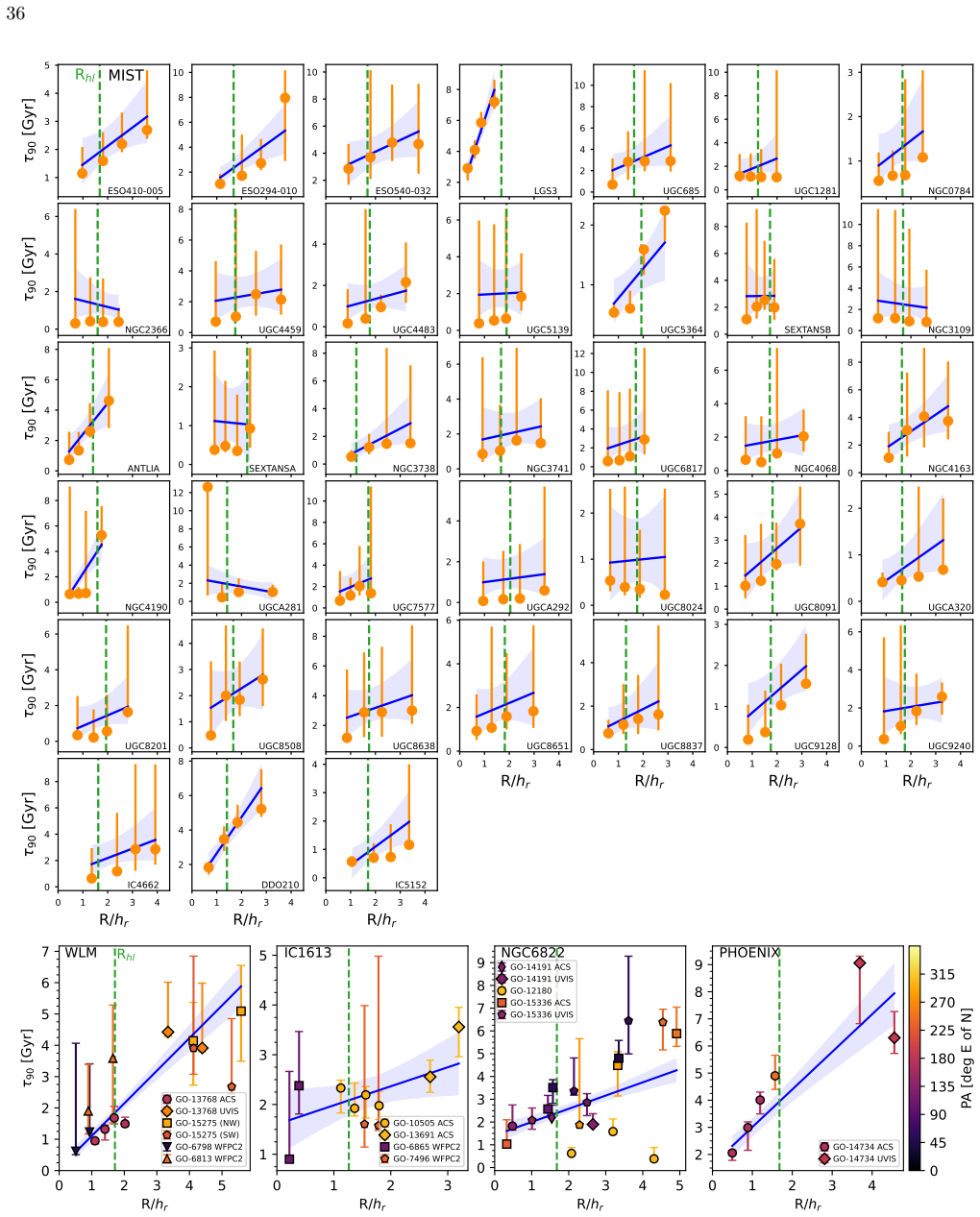
The load-bearing machinery is a uniform four-step pipeline applied to all 42 galaxies. Archival HST imaging is divided into four equally populated elliptical annuli, with shapes from 3.6 $\mu$m surface photometry and an outer boundary at 4.4 disk scalelengths $h_r$. A star-formation history is fit to each annulus' color-magnitude diagram with the MATCH code, using both PARSEC and MIST stellar libraries; each annulus' cumulative star-formation history (CSFH) is then interpolated to give $\tau_{90}$ and $\tau_{50}$, the lookback times by which 90% and 50% of that annulus' stellar mass formed. A linear fit of $\tau$ versus radius, normalized to $R_{\rm hl}$, yields the gradient slopes $\gamma_{90}$ and $\gamma_{50}$, and the galaxy-wide values $\tau_{90}(\mathrm{global})$ and $\tau_{50}(\mathrm{global})$ are read off the same fitted lines at $R_{\rm hl}$ following Graus et al. (2019). The discriminating statistic is the comparison — via Pearson and Spearman coefficients with Monte Carlo uncertainties — between the observed $\gamma_{90}$–$\tau_{90}(\mathrm{global})$ and $\gamma_{50}$–$\tau_{50}(\mathrm{global})$ correlations and those predicted by the two simulation families, whose differing stellar-feedback implementations produce a predicted difference specifically in the $\gamma_{50}$ correlation.
What would settle it
A decisive test: for the 12 galaxies with incomplete azimuthal coverage (areal fraction $A < 1$ in Table 1), fit SFHs to their full photometry without radial binning to obtain independent $\tau_{90}(\mathrm{global})$ and $\tau_{50}(\mathrm{global})$ values, then recompute the correlation coefficients. If the $\gamma_{90}$–$\tau_{90}(\mathrm{global})$ correlation drops below $p < 0.001$, the headline signal is partly an artifact of sharing the same fitted line between both axes; if it survives, inside-out assembly is confirmed. A complementary check for the $\gamma_{50}$ result: recompute the Graus et al. simulation predictions using the Riggs et al. definitions of global $\tau$ (entire galaxy, all-time cumulative stellar mass) to test whether the excluded correlation is produced by the 'breathing-mode' physics or by their different radial cut at 10% of the virial radius.
Extended reading notes
Core claim
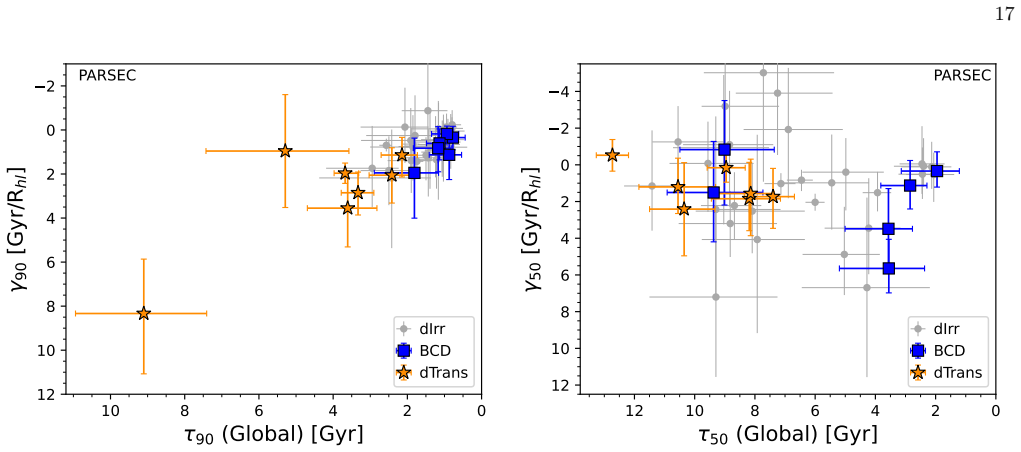
The paper's central claim is that present-day radial stellar age gradients in dwarf galaxies are a readout of each galaxy's own lifetime mass-assembly history, with measurable power to discriminate between cosmological simulations. Concretely: $\gamma_{90}$, the slope of $\tau_{90}$ versus radius normalized to the half-light radius $R_{\rm hl}$, is significantly correlated ($p \lesssim 0.001$ under both PARSEC and MIST stellar models) with $\tau_{90}(\mathrm{global})$, in agreement with both the Graus et al. (2019) and Riggs et al. (2024) simulations; while $\gamma_{50}$ is uncorrelated with $\tau_{50}(\mathrm{global})$, excluding the Graus et al. prediction at the 99.98% level and favoring Riggs et al. The simulation difference being adjudicated is the 'breathing mode' of feedback-driven radial outflows of star-forming gas, which imprints an initial radial velocity on young stars in the Graus et al. simulations but is absent in the Riggs et al. simulations. The authors further report that no target galaxy shows a significantly inside-out present-day gradient, and that no environmental metric (tidal index $\theta_1$, nearest-neighbor distance $D(\mathrm{NN})$, or distance to a $10^{10}\,M_\odot$ host) correlates with either gradient. They conclude that dwarfs form inside-out, that the observed outside-in-to-flat range of gradients results from feedback-driven outward migration of older stars combined with growing birth radii of young populations, and that radial age gradients are an actionable observational discriminant between simulations with different stellar feedback implementations.
Load-bearing premise
The load-bearing premise is that reading a galaxy's global star-formation timing off the same radial line that defines its gradient — evaluated at one half-light radius — is unbiased; the shortcut was checked only on galaxies with complete sky coverage, where it agreed within uncertainties in 86% of cases, so the 29% of the sample with incomplete azimuthal coverage is precisely where a bias would leak into both axes of the headline correlation.
Editorial extensions
If this is right
- Dwarf galaxies assemble their stars inside-out like more massive disk galaxies, with feedback-driven outward migration of old stars slightly outpacing the outward creep of recent star formation.
- None of the 42 dwarfs shows a statistically significant inside-out present-day gradient, setting a quantitative target for simulations: gradients should range from outside-in to flat, not inverted.
- Environment does not set internal age gradients: tidal index, nearest-neighbor distance, and distance to a $\geq 10^{10}\,M_\odot$ host all fail to correlate with $\gamma_{90}$ or $\gamma_{50}$, implying internal drivers dominate in this mass range.
- The null $\gamma_{50}$–$\tau_{50}(\mathrm{global})$ correlation is a new quantitative constraint on stellar-feedback physics, arguing against feedback that simultaneously drives radial breathing motions of star-forming gas.
- Gradient-versus-global-SFH correlation strength is an actionable parameter: any future simulation's feedback implementation can be ranked by whether it reproduces the observed $\gamma_{90}$ correlation and $\gamma_{50}$ non-correlation together.
Reading between the lines
- Because $\tau_{90}(\mathrm{global})$ and $\tau_{50}(\mathrm{global})$ are interpolated from the same four-point radial fits that define $\gamma_{90}$ and $\gamma_{50}$, the two axes of the headline correlation are not statistically independent; recomputing global $\tau$ values from SFHs fit to complete galaxy-wide CMDs for the 12 targets with partial azimuthal coverage would test whether the $p <
- The same annulus-and-CSFH pipeline extends naturally to lower masses: the Riggs et al. prediction that reionization-quenched dwarfs below $\mathrm{Log}\,M_\star \sim 6$ have flat gradients is directly testable with deep JWST imaging of the least massive Local Group dwarfs.
- A second decisive experiment suggested by the paper's own caveats: re-deriving the Graus et al. predictions with Riggs et al.'s definitions of global $\tau$ (full galaxy, all-time cumulative mass) would show whether the excluded $\gamma_{50}$ correlation is a product of the feedback model itself or of the different radial and definitional cuts the two simulations used.
- The null $\gamma_{50}$ result has a physical reading the paper leaves implicit: the radial ordering of the more recently formed half of a dwarf's stars is governed by stochastic, local processes rather than a coherent galaxy-wide timing relation, a distinction next-generation simulations could isolate directly.
Editorial analysis
A structured set of objections, weighed in public.
Referee Report
Summary. The paper presents radial stellar age gradients for 42 Local Volume dwarf galaxies, derived from spatially resolved SFHs fit to HST CMDs in four elliptical annuli per galaxy. The gradient slopes gamma_90 and gamma_50 (defined via the lookback times tau_90 and tau_50) are compared with galaxy-wide 'global' values tau_90(global) and tau_50(global), which are obtained by evaluating the same radial linear fit at the half-light radius. The central claims are that gamma_90 is significantly correlated with tau_90(global) (claimed p < 0.001), matching both the Graus et al. (2019) and Riggs et al. (2024) simulations, while gamma_50 is uncorrelated with tau_50(global), excluding the Graus et al. 'breathing-mode' prediction at the 99.98% level and favoring Riggs et al. The paper concludes that dwarf galaxies form inside-out, that age gradients are internally driven, and that the gamma_50 versus tau_50(global) relation can discriminate between feedback implementations in cosmological simulations.
Significance. If the central claims are robust, this is the first large, homogeneous quantitative sample of dwarf galaxy radial age gradients and it introduces a new observational discriminant between stellar feedback prescriptions in cosmological simulations. The analysis is careful in several respects: it uses Monte Carlo uncertainty propagation, tests robustness against the number of radial bins, distance and extinction assumptions, cross-checks two stellar evolution libraries (PARSEC and MIST), and validates the interpolation-based global tau values against directly measured values for 86% of the complete-coverage subset. However, the headline significance is overstated when the Spearman rank test is considered, and the interpolation-based global values are not independently validated for the 29% of the sample with incomplete azimuthal coverage, leaving the main gamma_90 correlation in need of additional verification.
major comments (3)
- [Abstract, §4.1, Table 4] The abstract and Section 4.1 claim p-values less than or equal to 0.001 for the gamma_90 versus tau_90(global) correlation, but Table 4 shows Spearman rank p-values of log10 p = -1.64 (p about 0.023) for PARSEC and log10 p = -1.03 (p about 0.09) for MIST; only the Pearson test reaches p < 0.001. Because the Spearman coefficient is reported in the same table and is less sensitive to outliers, the manuscript should either qualify the headline claim as Pearson-based or explain the discrepancy, as the current abstract overstates the significance.
- [§3.3, §4.1, Figs. 3 and 5] Both gamma_90 and tau_90(global) are derived from the same four-point linear fit: tau_90(global) is the best-fit line evaluated at R_hl. The validation in Section 3.3 covers only the 30 galaxies with A=1 and reports 86% agreement, leaving the 12 incomplete-coverage galaxies (29% of the sample) with no direct check. Please (a) report the covariance between gamma_90 and tau_90(global) measurement errors and propagate it in the Monte Carlo correlation analysis of Section 4.1, and (b) recompute the headline correlation using directly measured global tau_90 values for the A=1 subset (and any other galaxies for which direct estimates are possible) to demonstrate that the result is not an artifact of the interpolation on the incomplete-coverage subsample. The gamma_50 null result is less vulnerable to this issue, but the gamma_90 claim is load-bearing for the inside-out formation conclusion.
- [§4.1, Fig. 3, Table 3] The reported correlation may be sensitive to LGS3, which has both the steepest gamma_90 (8.33 Gyr/Rhl) and the earliest tau_90(global) (9.10 Gyr) and is excluded from the plotted range in Fig. 3. Please provide the correlation coefficients and p-values with LGS3 removed, and identify other high-leverage points, to confirm that the p < 0.001 result is not driven by a single galaxy.
minor comments (4)
- [§3.3] The 'directly measured' global tau values used for the 86% validation are not defined; please state explicitly how they were computed (for example, a single SFH fit to all stars in all radial bins).
- [Table 1] The column header 'Abdundances' should read 'Abundances'.
- [Fig. 7 caption] The caption does not specify whether the plotted intervals are the 16th-84th percentiles of the Monte Carlo distributions; please state this for reproducibility.
- [§4.4] The caveat paragraph correctly notes the different definitions of tau_global between Graus et al. (present-day stellar mass) and Riggs et al. (lifetime cumulative mass), but a brief statement on the expected sign or magnitude of this methodological difference on the quantitative comparison in Fig. 7 would strengthen the discussion.
Circularity Check
Headline gamma90-tau90(global) correlation reuses the same four-point radial fit for both axes; the gamma50 null is conservative but the main correlation is not an independent test.
-
fitted input called prediction
[Section 3.3 (Calculating Radial Age Gradients); used in Section 4.1 and Figure 3]
"Specifically, we leverage the finding by A. S. Graus et al. (2019) that galaxy-wide values of tau50 and tau90 are equivalent to values calculated at Rhl. The values of tau50(global) and tau90(global) that we present are therefore calculated by interpolating in the best-fit line (and 1-sigma uncertainties) from the maximum likelihood fit to the per-radial-bin values of tau50 and tau90 versus dSMA, evaluated at Rhl."
Both gamma90 (the slope) and tau90(global) (the value at Rhl) are read off the same maximum-likelihood line through the same four per-bin tau90 measurements. The Fig. 3 correlation is therefore not between an independent global SFH and a gradient; it is a relation between two linear combinations of one fitted line. Correlated per-bin errors, or a biased fit due to incomplete azimuthal coverage, shift slope and Rhl-intercept coherently, creating a positive gamma90-tau90(global) covariance even under a null physical correlation. The 86% validation applies only to the A=1 subset and checks bias, not this shared-noise covariance; the Monte Carlo p-values perturb gamma90 and tau90(global) independently, so they do not remove the artifact.
full rationale
The measurement pipeline is largely self-contained: per-annulus SFHs are derived from CMD fitting, and the gamma values are new data products with no circular dependence on the conclusions. The central circularity concern is narrower and located in Section 3.3: the 'global' tau values on the x-axis of the headline correlation are not independently measured galaxy-wide quantities but are re-evaluations of the same linear fit whose slope defines gamma. This creates a built-in covariance that the Monte Carlo significance estimates do not model. The gamma50 null result is conservative under this artifact, and the comparison with two external simulation sets plus the mass and environment correlations provide independent content. Self-citations to Cohen et al. and McQuinn et al. supply data or comparisons and are not load-bearing arguments. On balance, the central gamma90 correlation is partially circular, but it is not fully forced by construction, so a moderate score is appropriate.
Assumptions & free parameters
free parameters (3)
- Per-galaxy distance modulus offset (m-M)_0,fit =
Varies by target, approximately 24.1 to 29.2 mag (Table 3)
- Per-galaxy foreground extinction A_V,fit =
0.00 to 0.29 mag (Table 3)
- Per-radial-bin internal differential extinction delta A_V =
Not tabulated; allowed to float per bin
assumptions (5)
- domain assumption Stellar evolutionary libraries (PARSEC and MIST) and synthetic CMD modeling accurately map observed CMDs to star formation histories.
- ad hoc to paper A Kroupa IMF and a binary fraction of 0.35 with a flat mass ratio distribution describe the stellar populations.
- ad hoc to paper The age-metallicity relation is monotonic, with initial [M/H] between -2.1 and -1.0 dex and present-day [M/H] between -1.5 and +0.2 dex.
- domain assumption Radial age gradients are linear and azimuthally symmetric, and galaxy light profiles are exponential.
- domain assumption Bin-to-bin uncertainties in tau-50 and tau-90 are uncorrelated, and interpolating the radial fit at R_hl gives the galaxy-wide tau values.
Cite this review
Pith. "Pith review of Radial Stellar Age Gradients in 42 Local Volume Dwarf Galaxies." pith.science (2026). https://pith.science/paper/PKAM5RE4
@misc{pith2026260807671,
  author       = {Pith},
  title        = {Pith review of: Radial Stellar Age Gradients in 42 Local Volume Dwarf Galaxies},
  year         = {2026},
  howpublished = {\url{https://pith.science/paper/PKAM5RE4}},
  note         = {Machine review of arXiv:2608.07671}
}
abstract
We present radial stellar age gradients measured from star formation histories (SFHs) fit to resolved color-magnitude diagrams (CMDs) of 42 Local Volume dwarfs (6$\lesssim$Log M$_{\star}$/M$_{\odot}$$\lesssim$9), spatially divided into elliptical annuli. Ages in each annulus are quantified using $\tau_{90}$ and $\tau_{50}$, the lookback times to form 90% and 50% of the cumulative stellar mass. We find that radial age gradients are uncorrelated with environment, but gradients in $\tau_{90}$ are significantly correlated ($p$-values$\lesssim$0.001) with lifetime galaxy-wide "global" SFHs, in agreement with two independent cosmological zoom-in simulations. For radial gradients of $\tau_{50}$, simulation predictions differ. We demonstrate that given our large (N=42) and diverse observational sample, the strength of an observed correlation with global SFH is an actionable parameter to discriminate between different simulations with differing stellar feedback prescriptions. Overall, our results support predictions that dwarfs form inside-out like their more massive counterparts, with a combination of feedback-driven outward radial stellar migration and increasing birth radii for young stellar populations yielding present-day stellar age gradients ranging from outside-in to flat. In addition, the lack of a correlation between $\tau_{50}$ gradients and global SFH argues against recent star formation in radially outflowing gas. We also discuss the impact of differences between our observational sample and samples available in the latest simulations, highlighting areas for future investigation.
Figures


Figures from the paper (9 more)



Reference graph
Works this paper leans on
-
[1]
Quenching Timescales of Dwarf Satellites around Milky Way-mass Hosts. , keywords =. doi:10.3847/1538-4357/abe2ab , archivePrefix =. 2008.02805 , primaryClass =
arXiv 2008
-
[2]
Star formation at the edge of the Local Group: a rising star formation history in the isolated galaxy WLM. , keywords =. doi:10.1093/mnras/stz2903 , archivePrefix =. 1909.04040 , primaryClass =
arXiv 1909
-
[3]
DDO 44 and UGC 4998: Distances, Metallicities, and Star Formation Histories. , keywords =. doi:10.1086/502984 , adsurl =
-
[4]
The Star Formation History of NGC 1705: A Poststarburst Galaxy on the Verge of Activity. , keywords =. doi:10.1086/379556 , archivePrefix =. astro-ph/0309265 , primaryClass =
-
[5]
The Spatial and Age Distribution of Stellar Populations in DDO 190. , keywords =. doi:10.1086/301360 , archivePrefix =. astro-ph/0001468 , primaryClass =
-
[6]
DDO 187: Do Dwarf Galaxies Have Extended, Old Halos?. , keywords =. doi:10.1086/301157 , archivePrefix =. astro-ph/9909493 , primaryClass =
-
[7]
Ultrafaint Dwarfs in a Milky Way Context: Introducing the Mint Condition DC Justice League Simulations. , keywords =. doi:10.3847/1538-4357/abcafa , archivePrefix =. 2008.11207 , primaryClass =
arXiv 2008
-
[8]
The Astropy Project: Sustaining and Growing a Community-oriented Open-source Project and the Latest Major Release (v5.0) of the Core Package. , keywords =. doi:10.3847/1538-4357/ac7c74 , archivePrefix =. 2206.14220 , primaryClass =
Show all 167 references
-
[9]
Astronomical Data Analysis Software an Systems XXIV (ADASS XXIV) , year = 2015, editor =
DrizzlePac 2.0 - Introducing New Features. Astronomical Data Analysis Software an Systems XXIV (ADASS XXIV) , year = 2015, editor =. doi:10.48550/arXiv.1411.5605 , archivePrefix =. 1411.5605 , primaryClass =
-
[11]
, keywords =
The size and structure of the spheroid of IC 1613. , keywords =. doi:10.1051/0004-6361:20066578 , archivePrefix =. astro-ph/0702489 , primaryClass =
-
[12]
, keywords =
Multimessenger signatures of massive black holes in dwarf galaxies. , keywords =. doi:10.1093/mnras/sty2842 , archivePrefix =. 1806.00471 , primaryClass =
-
[13]
, keywords =
Mergers and the outside-in formation of dwarf spheroidals. , keywords =. doi:10.1093/mnras/stv2722 , archivePrefix =. 1511.06188 , primaryClass =
-
[14]
, keywords =
The star formation history of the Sculptor dwarf spheroidal galaxy. , keywords =. doi:10.1093/mnras/stz1679 , archivePrefix =. 1906.07042 , primaryClass =
1906 arXiv
-
[15]
, keywords =
Stellar Content and Recent Star Formation History of the Local Group Dwarf Irregular Galaxy IC 1613. , keywords =. doi:10.1086/520805 , archivePrefix =. 0706.1912 , primaryClass =
1912 arXiv
-
[16]
, keywords =
Direct Oxygen Abundances for Low-luminosity LVL Galaxies. , keywords =. doi:10.1088/0004-637X/754/2/98 , archivePrefix =. 1205.6782 , primaryClass =
-
[17]
Data reduction and error analysis for the physical sciences
-
[19]
, keywords =
Expanded haloes, abundance matching and too-big-to-fail in the Local Group. , keywords =. doi:10.1093/mnras/stv864 , archivePrefix =. 1410.3825 , primaryClass =
-
[20]
, keywords =
Degeneracies between self-interacting dark matter and supernova feedback as cusp-core transformation mechanisms. , keywords =. doi:10.1093/mnras/stac994 , archivePrefix =. 2108.07358 , primaryClass =
-
[21]
, keywords =
The Recent Evolution of the Dwarf Starburst Galaxy NGC 625 from Hubble Space Telescope Imaging. , keywords =. doi:10.1086/379671 , archivePrefix =. astro-ph/0309542 , primaryClass =
-
[22]
, keywords =
On the Origin of the Supergiant H I Shell and Putative Companion in NGC 6822. , keywords =. doi:10.1088/0004-637X/747/2/122 , archivePrefix =. 1201.3149 , primaryClass =
-
[23]
Mesa Isochrones and Stellar Tracks (MIST). I. Solar-scaled Models. , keywords =. doi:10.3847/0004-637X/823/2/102 , archivePrefix =. 1604.08592 , primaryClass =
-
[24]
, keywords =
Environment Matters: Predicted Differences in the Stellar Mass Halo Mass Relation and History of Star Formation for Dwarf Galaxies. , keywords =. doi:10.3847/1538-4357/ad0c5a , archivePrefix =. 2311.04975 , primaryClass =
-
[25]
Star Formation Histories of the LEGUS Dwarf Galaxies. I. Recent History of NGC 1705, NGC 4449, and Holmberg II. , keywords =. doi:10.3847/1538-4357/aab041 , archivePrefix =. 1802.06792 , primaryClass =
-
[26]
, keywords =
Project AMIGA: Distance and Metallicity Gradients along Andromeda s Giant Southern Stream from the Red Clump. , keywords =. doi:10.3847/1538-3881/aae52d , archivePrefix =. 1810.01525 , primaryClass =
-
[27]
Scylla. II. The Spatially Resolved Star Formation History of the Large Magellanic Cloud Reveals an Inverted Radial Age Gradient. , keywords =. doi:10.3847/1538-4357/ad6cd5 , archivePrefix =. 2410.11696 , primaryClass =
-
[28]
Scylla. III. The Outside-in Radial Age Gradient in the Small Magellanic Cloud and the Star Formation Histories of the Main Body, Wing, and Outer Regions. , keywords =. doi:10.3847/1538-4357/ad76a6 , archivePrefix =. 2410.11697 , primaryClass =
-
[29]
The JWST Resolved Stellar Populations Early Release Science Program. VIII. The Spatially Resolved Star Formation History of WLM. , keywords =. doi:10.3847/1538-4357/adb61d , archivePrefix =. 2502.13887 , primaryClass =
-
[30]
, keywords =
A detailed star formation history for the extremely diffuse Andromeda XIX dwarf galaxy. , keywords =. doi:10.1093/mnras/stac2794 , archivePrefix =. 2209.12912 , primaryClass =
-
[31]
, keywords =
Spitzer Local Volume Legacy (LVL) SEDs and physical properties. , keywords =. doi:10.1093/mnras/stu1787 , archivePrefix =. 1409.0847 , primaryClass =
-
[32]
, keywords =
The ACS Nearby Galaxy Survey Treasury. , keywords =. doi:10.1088/0067-0049/183/1/67 , archivePrefix =. 0905.3737 , primaryClass =
-
[33]
, keywords =
The Structural Properties and Star Formation History of Leo T from Deep LBT Photometry. , keywords =. doi:10.1086/587835 , archivePrefix =. 0801.4027 , primaryClass =
-
[34]
, keywords =
Spatial dependence of the star formation history in the central regions of the Fornax dwarf spheroidal galaxy. , keywords =. doi:10.1093/mnras/stt833 , archivePrefix =. 1305.2166 , primaryClass =
-
[35]
, keywords =
Deep Optical Imaging of Starbursting ``Transition'' Dwarf Galaxies. , keywords =. doi:10.1088/0004-6256/135/1/326 , archivePrefix =. 0710.4094 , primaryClass =
-
[36]
, keywords =
The Recent Star Formation History of GR 8 from Hubble Space Telescope Photometry of the Resolved Stars. , keywords =. doi:10.1086/300514 , adsurl =
-
[37]
, keywords =
WFPC2 Stellar Photometry with HSTPHOT. , keywords =. doi:10.1086/316630 , archivePrefix =. astro-ph/0006217 , primaryClass =
-
[38]
, keywords =
Numerical methods of star formation history measurement and applications to seven dwarf spheroidals. , keywords =. doi:10.1046/j.1365-8711.2002.05271.x , archivePrefix =. astro-ph/0112331 , primaryClass =
2002
-
[39]
, keywords =
On the Estimation of Systematic Uncertainties of Star Formation Histories. , keywords =. doi:10.1088/0004-637X/751/1/60 , archivePrefix =. 1203.4634 , primaryClass =
-
[40]
, keywords =
On the Estimation of Random Uncertainties of Star Formation Histories. , keywords =. doi:10.1088/0004-637X/775/1/76 , archivePrefix =. 1308.1740 , primaryClass =
-
[41]
DOLPHOT: Stellar photometry
-
[42]
, keywords =
MESA Isochrones and Stellar Tracks (MIST) 0: Methods for the Construction of Stellar Isochrones. , keywords =. doi:10.3847/0067-0049/222/1/8 , archivePrefix =. 1601.05144 , primaryClass =
-
[43]
, keywords =
The stellar content and distance to the nearby blue compact dwarf galaxy NGC 6789. , keywords =. doi:10.1051/aas:2000156 , adsurl =
-
[44]
, keywords =
Missing mass around galaxies - Morphological evidence. , keywords =. doi:10.1038/252111a0 , adsurl =
-
[45]
, keywords =
Breathing FIRE: How Stellar Feedback Drives Radial Migration, Rapid Size Fluctuations, and Population Gradients in Low-mass Galaxies. , keywords =. doi:10.3847/0004-637X/820/2/131 , archivePrefix =. 1512.01235 , primaryClass =
-
[46]
, keywords =
Simulation-guided galaxy evolution inference: A case study with strong lensing galaxies. , keywords =. doi:10.1051/0004-6361/202346594 , archivePrefix =. 2307.15044 , primaryClass =
-
[47]
Space Telescopes and Instruments V , year = 1998, editor =
Advanced camera for the Hubble Space Telescope. Space Telescopes and Instruments V , year = 1998, editor =. doi:10.1117/12.324464 , adsurl =
1998 doi
-
[48]
, keywords =
emcee: The MCMC Hammer. , keywords =. doi:10.1086/670067 , archivePrefix =. 1202.3665 , primaryClass =
-
[49]
, keywords =
Distance and reddening of the Local Group dwarf irregular galaxy NGC 6822. , keywords =. doi:10.1051/0004-6361/201220554 , archivePrefix =. 1210.6753 , primaryClass =
-
[50]
, keywords =
A state-of-the-art analysis of the dwarf irregular galaxy NGC 6822. , keywords =. doi:10.1051/0004-6361/201323075 , archivePrefix =. 1409.5247 , primaryClass =
-
[51]
, keywords =
A Wide Field Planetary Camera 2 Study of the Resolved Stellar Population of the Pegasus Dwarf Irregular Galaxy (DDO 216). , keywords =. doi:10.1086/300328 , archivePrefix =. astro-ph/9805284 , primaryClass =
-
[52]
, keywords =
The ACS LCID Project: On the Origin of Dwarf Galaxy Types A Manifestation of the Halo Assembly Bias?. , keywords =. doi:10.1088/2041-8205/811/2/L18 , archivePrefix =. 1507.08350 , primaryClass =
-
[53]
Clues to AGB nucleosynthesis
The planetary nebulae and H II regions in NGC 6822 revisited. Clues to AGB nucleosynthesis. , keywords =. doi:10.1051/0004-6361/201527265 , archivePrefix =. 1510.05399 , primaryClass =
-
[54]
, keywords =
Measuring Resolved Star Formation Histories from High-precision Color Magnitude Diagrams with StarFormationHistories.jl. , keywords =. doi:10.3847/1538-4365/adbb64 , archivePrefix =. 2407.19534 , primaryClass =
-
[55]
, keywords =
The Baryon Content of Extremely Low Mass Dwarf Galaxies. , keywords =. doi:10.1086/508604 , archivePrefix =. astro-ph/0608295 , primaryClass =
-
[56]
, keywords =
HST/ACS Direct Ages of the Dwarf Elliptical Galaxies NGC 147 and NGC 185. , keywords =. doi:10.1088/0004-637X/811/2/114 , archivePrefix =. 1503.06526 , primaryClass =
-
[58]
, keywords =
A predicted correlation between age gradient and star formation history in FIRE dwarf galaxies. , keywords =. doi:10.1093/mnras/stz2649 , archivePrefix =. 1901.05487 , primaryClass =
1901 arXiv
-
[59]
Astronomical Data Analysis Software and Systems XXII , year = 2013, editor =
DrizzlePac: Managing Multi-component WCS Solutions for HST Data. Astronomical Data Analysis Software and Systems XXII , year = 2013, editor =
2013
-
[60]
, keywords =
Hubble Space Telescope Imaging of Antlia B: Star Formation History and a New Tip of the Red Giant Branch Distance. , keywords =. doi:10.3847/1538-4357/ab58d2 , adsurl =
-
[61]
and Millman, K
Harris, Charles R. and Millman, K. Jarrod and van der Walt, St. Array programming with. Nature , volume =. 2020 , doi =
2020
-
[62]
, keywords =
Spatial Distribution of Stellar Populations in the Dwarf Irregular Galaxies DDO 165 and DDO 181. , keywords =. doi:10.1086/367779 , adsurl =
-
[63]
, keywords =
The Disc-Halo Structure of NGC 3109. , keywords =. doi:10.1088/0004-6256/136/6/2332 , adsurl =
-
[64]
, keywords =
On the Extended Structure of the Phoenix Dwarf Galaxy. , keywords =. doi:10.1088/0004-637X/705/1/704 , archivePrefix =. 0909.1256 , primaryClass =
-
[65]
The ACS LCID Project. V. The Star Formation History of the Dwarf Galaxy LGS-3: Clues to Cosmic Reionization and Feedback. , keywords =. doi:10.1088/0004-637X/730/1/14 , archivePrefix =. 1101.5762 , primaryClass =
-
[66]
The ACS LCID Project. IX. Imprints of the Early Universe in the Radial Variation of the Star Formation History of Dwarf Galaxies. , keywords =. doi:10.1088/0004-637X/778/2/103 , archivePrefix =. 1309.6130 , primaryClass =
-
[67]
The chemical abundances in a sample of dwarf irregular galaxies . II. The case of IC 4662 and ESO 245-G05. , keywords =. doi:10.1051/0004-6361:20010179 , adsurl =
-
[68]
, keywords =
Solo dwarfs II: the stellar structure of isolated Local Group dwarf galaxies. , keywords =. doi:10.1093/mnras/stab002 , archivePrefix =. 2101.03189 , primaryClass =
-
[69]
, keywords =
The Performance and Calibration of WFPC2 on the Hubble Space Telescope. , keywords =. doi:10.1086/133533 , adsurl =
-
[70]
, keywords =
FIRE-2 simulations: physics versus numerics in galaxy formation. , keywords =. doi:10.1093/mnras/sty1690 , archivePrefix =. 1702.06148 , primaryClass =
-
[71]
Hunter, J. D. , Title =. Computing in Science & Engineering , Volume =
-
[72]
, keywords =
The Primordial Helium Abundance: Systematic Effects and a New Determination. , keywords =. doi:10.1086/312956 , adsurl =
-
[73]
, keywords =
Updated Nearby Galaxy Catalog. , keywords =. doi:10.1088/0004-6256/145/4/101 , archivePrefix =. 1303.5328 , primaryClass =
-
[74]
, keywords =
KK258, a new transition dwarf galaxy neighbouring the Local Group. , keywords =. doi:10.1093/mnras/stu1217 , archivePrefix =. 1406.4479 , primaryClass =
-
[75]
, keywords =
DDO 161 and UGCA 319: an isolated pair of nearby dwarf galaxies. , keywords =. doi:10.1093/mnrasl/slx061 , archivePrefix =. 1704.07648 , primaryClass =
-
[76]
, keywords =
Morphological properties of galaxies in different Local Volume environments. , keywords =. doi:10.1093/mnras/sty1774 , archivePrefix =. 1806.09822 , primaryClass =
-
[77]
, keywords =
Extinction Maps and Dust-to-gas Ratios in Nearby Galaxies with LEGUS. , keywords =. doi:10.3847/1538-4357/aab101 , archivePrefix =. 1802.06915 , primaryClass =
-
[78]
Space Telescopes and Instrumentation 2008: Optical, Infrared, and Millimeter , year = 2008, editor =
Wide Field Camera 3: a powerful new imager for the Hubble Space Telescope. Space Telescopes and Instrumentation 2008: Optical, Infrared, and Millimeter , year = 2008, editor =. doi:10.1117/12.789581 , adsurl =
2008 doi
-
[79]
, keywords =
Deep Near-Infrared Surface Photometry of 57 Galaxies in the Local Sphere of Influence. , keywords =. doi:10.1088/0004-6256/136/5/1866 , archivePrefix =. 0808.2529 , primaryClass =
-
[80]
Elemental Abundance Variations and Chemical Enrichment from Massive Stars in Starbursts. II. NGC 1569. , keywords =. doi:10.1086/304830 , adsurl =
-
[81]
, keywords =
On the variation of the initial mass function. , keywords =. doi:10.1046/j.1365-8711.2001.04022.x , archivePrefix =. astro-ph/0009005 , primaryClass =
2001
-
[82]
The Panchromatic Hubble Andromeda Treasury: Triangulum Extended Region (PHATTER). II. The Spatially Resolved Recent Star Formation History of M33. , keywords =. doi:10.3847/1538-4357/ac7568 , archivePrefix =. 2206.11393 , primaryClass =
-
[83]
, keywords =
The Tip of the Red Giant Branch as a Distance Indicator for Resolved Galaxies. , keywords =. doi:10.1086/173334 , adsurl =
-
[84]
, keywords =
Stellar Populations and the Local Group Membership of the Dwarf Galaxy DDO 210. , keywords =. doi:10.1086/300988 , archivePrefix =. astro-ph/9905060 , primaryClass =
-
[85]
, keywords =
Nebular abundances of nearby southern dwarf galaxies. , keywords =. doi:10.1051/0004-6361:20030101 , archivePrefix =. astro-ph/0301492 , primaryClass =
-
[86]
Dynamics of starbursting dwarf galaxies. II. UGC 4483. , keywords =. doi:10.1051/0004-6361/201219457 , archivePrefix =. 1207.2696 , primaryClass =
-
[87]
, keywords =
Dynamics of starbursting dwarf galaxies: I Zw 18. , keywords =. doi:10.1051/0004-6361/201117867 , archivePrefix =. 1110.6042 , primaryClass =
-
[88]
, keywords =
PHANGS-ALMA: Arcsecond CO(2-1) Imaging of Nearby Star-forming Galaxies. , keywords =. doi:10.3847/1538-4365/ac17f3 , archivePrefix =. 2104.07739 , primaryClass =
-
[89]
The Panchromatic Hubble Andromeda Treasury. XI. The Spatially Resolved Recent Star Formation History of M31. , keywords =. doi:10.1088/0004-637X/805/2/183 , archivePrefix =. 1504.03338 , primaryClass =
- [90]
-
[91]
, keywords =
Population gradients and photometric metallicities in early- and transition-type dwarf galaxies: Clues from the Sculptor group. , keywords =. doi:10.1051/0004-6361/201219959 , archivePrefix =. 1211.3170 , primaryClass =
-
[92]
HyperLEDA. III. The catalogue of extragalactic distances. , keywords =. doi:10.1051/0004-6361/201423496 , archivePrefix =. 1408.3476 , primaryClass =
-
[93]
, keywords =
An Aromatic Inventory of the Local Volume. , keywords =. doi:10.1088/0004-637X/715/1/506 , archivePrefix =. 1004.1441 , primaryClass =
-
[94]
A Rogues Gallery of Andromeda's Dwarf Galaxies. I. A Predominance of Red Horizontal Branches. , keywords =. doi:10.3847/1538-4357/aa901a , archivePrefix =. 1704.01586 , primaryClass =
-
[95]
, keywords =
Dwarfs Gobbling Dwarfs: A Stellar Tidal Stream around NGC 4449 and Hierarchical Galaxy Formation on Small Scales. , keywords =. doi:10.1088/2041-8205/748/2/L24 , archivePrefix =. 1112.2154 , primaryClass =
- [96]
-
[97]
, keywords =
The synchronized dance of the magellanic clouds' star formation history. , keywords =. doi:10.1093/mnrasl/slac030 , archivePrefix =. 2203.09523 , primaryClass =
-
[98]
The spatially resolved star formation history across the Large Magellanic Cloud
The VMC survey - XLIII. The spatially resolved star formation history across the Large Magellanic Cloud. , keywords =. doi:10.1093/mnras/stab2399 , archivePrefix =. 2108.07225 , primaryClass =
-
[99]
, keywords =
The Observed Properties of Dwarf Galaxies in and around the Local Group. , keywords =. doi:10.1088/0004-6256/144/1/4 , archivePrefix =. 1204.1562 , primaryClass =
-
[100]
, keywords =
The True Durations of Starbursts: Hubble Space Telescope Observations of Three Nearby Dwarf Starburst Galaxies. , keywords =. doi:10.1088/0004-637X/695/1/561 , archivePrefix =. 0901.2361 , primaryClass =
-
[101]
The Nature of Starbursts. II. The Duration of Starbursts in Dwarf Galaxies. , keywords =. doi:10.1088/0004-637X/724/1/49 , archivePrefix =. 1009.2940 , primaryClass =
-
[102]
The Nature of Starbursts. I. The Star Formation Histories of Eighteen Nearby Starburst Dwarf Galaxies. , keywords =. doi:10.1088/0004-637X/721/1/297 , archivePrefix =. 1008.1589 , primaryClass =
-
[103]
The Nature of Starbursts. III. The Spatial Distribution of Star Formation. , keywords =. doi:10.1088/0004-637X/759/1/77 , archivePrefix =. 1210.0552 , primaryClass =
-
[104]
, keywords =
The Panchromatic STARBurst IRregular Dwarf Survey (STARBIRDS): Observations and Data Archive. , keywords =. doi:10.1088/0067-0049/218/2/29 , archivePrefix =. 1611.05045 , primaryClass =
-
[105]
, keywords =
Calibrating UV Star Formation Rates for Dwarf Galaxies from STARBIRDS. , keywords =. doi:10.1088/0004-637X/808/2/109 , archivePrefix =. 1505.00791 , primaryClass =
-
[106]
, keywords =
The Distance to M51. , keywords =. doi:10.3847/0004-637X/826/1/21 , archivePrefix =. 1606.04120 , primaryClass =
-
[107]
DUSTiNGS. III. Distribution of Intermediate-age and Old Stellar Populations in Disks and Outer Extremities of Dwarf Galaxies. , keywords =. doi:10.3847/1538-4357/834/1/78 , archivePrefix =. 1611.05044 , primaryClass =
-
[108]
, keywords =
Accurate Distances to Important Spiral Galaxies: M63, M74, NGC 1291, NGC 4559, NGC 4625, and NGC 5398. , keywords =. doi:10.3847/1538-3881/aa7aad , archivePrefix =. 1706.06586 , primaryClass =
-
[109]
, keywords =
Galactic outflows, star formation histories, and time-scales in starburst dwarf galaxies from STARBIRDS. , keywords =. doi:10.1093/mnras/sty839 , archivePrefix =. 1705.04692 , primaryClass =
-
[110]
, keywords =
The Leoncino Dwarf Galaxy: Exploring the Low-metallicity End of the Luminosity-Metallicity and Mass-Metallicity Relations. , keywords =. doi:10.3847/1538-4357/ab7447 , archivePrefix =. 2002.11723 , primaryClass =
2002 arXiv
-
[111]
, keywords =
Pegasus W: An Ultrafaint Dwarf Galaxy Outside the Halo of M31 Not Quenched by Reionization. , keywords =. doi:10.3847/1538-4357/acaec9 , archivePrefix =. 2301.04157 , primaryClass =
-
[112]
The JWST Resolved Stellar Populations Early Release Science Program. IV. The Star Formation History of the Local Group Galaxy WLM. , keywords =. doi:10.3847/1538-4357/ad1105 , archivePrefix =. 2312.03060 , primaryClass =
-
[113]
, keywords =
The Ancient Star Formation History of the Extremely Low-mass Galaxy Leo P: An Emerging Trend of a Post-reionization Pause in Star Formation. , keywords =. doi:10.3847/1538-4357/ad8158 , archivePrefix =. 2409.19050 , primaryClass =
-
[114]
, year = 1997, month = jul, volume =
Stellar Populations of the Dwarf Irregular Galaxy WLM. , year = 1997, month = jul, volume =. doi:10.1086/118461 , adsurl =
1997 doi
-
[115]
The ACS LCID Project. III. The Star Formation History of the Cetus dSph Galaxy: A Post-reionization Fossil. , keywords =. doi:10.1088/0004-637X/720/2/1225 , archivePrefix =. 1002.4300 , primaryClass =
-
[116]
The ACS LCID Project. VI. The Star Formation History of The Tucana dSph and The Relative Ages of the Isolated dSph Galaxies. , keywords =. doi:10.1088/0004-637X/722/2/1864 , archivePrefix =. 1010.2982 , primaryClass =
-
[117]
, keywords =
CLUES about M33: the reversed radial stellar age gradient in the outskirts of Triangulum galaxy. , keywords =. doi:10.1093/mnras/sty2161 , archivePrefix =. 1808.03286 , primaryClass =
-
[118]
, keywords =
Quantifying Scatter in Galaxy Formation at the Lowest Masses. , keywords =. doi:10.3847/1538-4357/ac0db6 , archivePrefix =. 2101.05822 , primaryClass =
-
[119]
, keywords =
The cores of dwarf galaxy haloes. , keywords =. doi:10.1093/mnras/283.3.L72 , archivePrefix =. astro-ph/9610187 , primaryClass =
-
[120]
An Empirical Calibration of the Tip of the Red Giant Branch Distance Method in the Near Infrared. I. Hubble Space Telescope WFC3/IR F110W and F160W Filters. , keywords =. doi:10.3847/1538-4357/ad306d , archivePrefix =. 2403.03086 , primaryClass =
-
[121]
, keywords =
A Catalog of Merging Dwarf Galaxies in the Local Universe. , keywords =. doi:10.3847/1538-4365/aad555 , archivePrefix =. 1807.07195 , primaryClass =
-
[122]
The ACS Survey of Galactic Globular Clusters. VI. NGC 6366: A Heavily Stripped Galactic Globular Cluster. , keywords =. doi:10.1088/0004-6256/137/1/246 , adsurl =
-
[123]
A Large Stellar Evolution Database for Population Synthesis Studies. II. Stellar Models and Isochrones for an -enhanced Metal Distribution. , keywords =. doi:10.1086/501344 , archivePrefix =. astro-ph/0603721 , primaryClass =
-
[124]
, keywords =
Hyper Wide Field Imaging of the Local Group Dwarf Irregular Galaxy IC 1613: An Extended Component of Metal-poor Stars. , keywords =. doi:10.3847/1538-4357/ab29fb , archivePrefix =. 1905.02210 , primaryClass =
1905 arXiv
-
[125]
, keywords =
Outer-disk Populations in NGC 7793: Evidence for Stellar Radial Migration. , keywords =. doi:10.1088/0004-637X/753/2/138 , archivePrefix =. 1206.1057 , primaryClass =
-
[126]
, keywords =
A tidally distorted dwarf galaxy near NGC 4449. , keywords =. doi:10.1038/nature10837 , archivePrefix =. 1202.2316 , primaryClass =
-
[127]
, keywords =
Testable Predictions of Outside-in Age Gradients in Dwarf Galaxies of All Types. , keywords =. doi:10.3847/1538-4357/ad8b1e , archivePrefix =. 2408.10379 , primaryClass =
-
[128]
, keywords =
The VMC survey - XXXI: The spatially resolved star formation history of the main body of the Small Magellanic Cloud. , keywords =. doi:10.1093/mnras/sty1279 , archivePrefix =. 1805.04516 , primaryClass =
-
[129]
The Large Magellanic Cloud stellar content with SMASH. I. Assessing the stability of the Magellanic spiral arms. , keywords =. doi:10.1051/0004-6361/202038392 , archivePrefix =. 2006.10759 , primaryClass =
2006 arXiv
-
[130]
, keywords =
Dissecting the stellar content of Leo I: a dwarf irregular caught in transition. , keywords =. doi:10.1093/mnras/staa3871 , archivePrefix =. 2012.07863 , primaryClass =
2012 arXiv
-
[131]
Star Formation Histories of the LEGUS Dwarf Galaxies. II. Spatially Resolved Star Formation History of the Magellanic Irregular NGC 4449. , keywords =. doi:10.3847/1538-4357/aab844 , archivePrefix =. 1803.08041 , primaryClass =
-
[132]
, keywords =
Reaching the Oldest Stars beyond the Local Group: Ancient Star Formation in UGC 4483. , keywords =. doi:10.3847/1538-4357/abea16 , archivePrefix =. 2102.13119 , primaryClass =
-
[133]
A MegaCam Survey of Outer Halo Satellites. VI. The Spatially Resolved Star-formation History of the Carina Dwarf Spheroidal Galaxy. , keywords =. doi:10.3847/0004-637X/829/2/86 , archivePrefix =. 1607.05312 , primaryClass =
-
[134]
Is KK 69 a dwarf galaxy in transition?
New H I observations of KK 69. Is KK 69 a dwarf galaxy in transition?. , keywords =. doi:10.1007/s10509-020-03825-2 , archivePrefix =. 2006.12243 , primaryClass =
2006 arXiv
-
[135]
, keywords =
The Properties of the Antlia Dwarf Galaxy. , keywords =. doi:10.1086/118663 , adsurl =
-
[136]
, keywords =
The HST/ACS star formation history of the Tucana dwarf spheroidal galaxy: clues from the horizontal branch. , keywords =. doi:10.1051/0004-6361/201936077 , archivePrefix =. 1909.04052 , primaryClass =
1909 arXiv
-
[137]
The Hubble Space Telescope Survey of M31 Satellite Galaxies. II. The Star Formation Histories of Ultrafaint Dwarf Galaxies. , keywords =. doi:10.3847/1538-4357/acf46f , archivePrefix =. 2305.13360 , primaryClass =
-
[138]
The Hubble Space Telescope Survey of M31 Satellite Galaxies. IV. Survey Overview and Lifetime Star Formation Histories. , keywords =. doi:10.3847/1538-4357/ada24f , archivePrefix =. 2501.13152 , primaryClass =
-
[139]
, keywords =
Measuring Reddening with Sloan Digital Sky Survey Stellar Spectra and Recalibrating SFD. , keywords =. doi:10.1088/0004-637X/737/2/103 , archivePrefix =. 1012.4804 , primaryClass =
-
[140]
, keywords =
Maps of Dust Infrared Emission for Use in Estimation of Reddening and Cosmic Microwave Background Radiation Foregrounds. , keywords =. doi:10.1086/305772 , archivePrefix =. astro-ph/9710327 , primaryClass =
-
[141]
, keywords =
A Stellar Population Gradient in VII ZW 403: Implications for the Formation of Blue Compact Dwarf Galaxies. , keywords =. doi:10.1086/307950 , archivePrefix =. astro-ph/9905102 , primaryClass =
-
[142]
Deep Hubble Space Telescope Imaging of IC 1613. II. The Star Formation History. , keywords =. doi:10.1086/377635 , archivePrefix =. astro-ph/0306457 , primaryClass =
-
[143]
The ACS LCID Project. X. The Star Formation History of IC 1613: Revisiting the Over-cooling Problem. , keywords =. doi:10.1088/0004-637X/786/1/44 , archivePrefix =. 1403.4609 , primaryClass =
-
[144]
The ISLAndS Project. II. The Lifetime Star Formation Histories of Six Andomeda dSphS. , keywords =. doi:10.3847/1538-4357/aa60c5 , archivePrefix =. 1606.01207 , primaryClass =
-
[145]
, keywords =
OGLE-ing the Magellanic System: Optical Reddening Maps of the Large and Small Magellanic Clouds from Red Clump Stars. , keywords =. doi:10.3847/1538-4365/abcb81 , archivePrefix =. 2006.02448 , primaryClass =
2006 arXiv
-
[146]
, keywords =
Stellar metallicity gradients of Local Group dwarf galaxies. , keywords =. doi:10.1051/0004-6361/202243508 , archivePrefix =. 2206.08988 , primaryClass =
-
[147]
On the Dwarf Irregular Galaxy NGC 6822. I. Young, Intermediate, and Old Stellar Populations. , keywords =. doi:10.3847/1538-4357/ac7468 , archivePrefix =. 2205.15143 , primaryClass =
-
[148]
Introduction to Error Analysis, the Study of Uncertainties in Physical Measurements, 2nd Edition
-
[149]
Multi-method-modeling of interacting galaxies. I. A unique scenario for NGC 4449?. , keywords =. doi:10.1051/0004-6361:20010198 , archivePrefix =. astro-ph/0104304 , primaryClass =
-
[150]
, keywords =
Star-Formation Histories, Abundances, and Kinematics of Dwarf Galaxies in the Local Group. , keywords =. doi:10.1146/annurev-astro-082708-101650 , archivePrefix =. 0904.4505 , primaryClass =
-
[151]
, keywords =
Spatially Resolved Recent Star Formation History in NGC 6946. , keywords =. doi:10.3847/1538-4357/aced44 , archivePrefix =. 2307.04853 , primaryClass =
-
[152]
, keywords =
The Extragalactic Distance Database. , keywords =. doi:10.1088/0004-6256/138/2/323 , adsurl =
-
[153]
, keywords =
Cosmicflows-2: The Data. , keywords =. doi:10.1088/0004-6256/146/4/86 , archivePrefix =. 1307.7213 , primaryClass =
-
[154]
, keywords =
Cosmicflows-4. , keywords =. doi:10.3847/1538-4357/ac94d8 , archivePrefix =. 2209.11238 , primaryClass =
- [155]
-
[156]
, keywords =
The Evolutionary History of Low-Luminosity Local Group Dwarf Galaxies. , keywords =. doi:10.1086/174270 , adsurl =
-
[157]
The ACS Nearby Galaxy Survey Treasury. VIII. The Global Star Formation Histories of 60 Dwarf Galaxies in the Local Volume. , keywords =. doi:10.1088/0004-637X/739/1/5 , archivePrefix =. 1101.1093 , primaryClass =
-
[158]
, keywords =
How Typical Are the Local Group Dwarf Galaxies?. , keywords =. doi:10.1088/0004-637X/743/1/8 , archivePrefix =. 1101.1301 , primaryClass =
-
[159]
, keywords =
Comparing the ancient star formation histories of the Magellanic Clouds. , keywords =. doi:10.1093/mnras/stt165 , archivePrefix =. 1301.7422 , primaryClass =
-
[160]
The Star Formation Histories of Local Group Dwarf Galaxies. I. Hubble Space Telescope/Wide Field Planetary Camera 2 Observations. , keywords =. doi:10.1088/0004-637X/789/2/147 , archivePrefix =. 1404.7144 , primaryClass =
-
[161]
The Star Formation Histories of Local Group Dwarf Galaxies. III. Characterizing Quenching in Low-mass Galaxies. , keywords =. doi:10.1088/0004-637X/804/2/136 , archivePrefix =. 1503.05195 , primaryClass =
-
[162]
, keywords =
The Detection of Inside-Out Disk Growth in M33. , keywords =. doi:10.1088/0004-637X/695/1/L15 , archivePrefix =. 0902.3460 , primaryClass =
-
[163]
, keywords =
The History of Star Formation in Galaxy Disks in the Local Volume as Measured by the Advanced Camera for Surveys Nearby Galaxy Survey Treasury. , keywords =. doi:10.1088/2041-8205/734/1/L22 , archivePrefix =. 1105.2571 , primaryClass =
-
[164]
The Panchromatic Hubble Andromeda Treasury. X. Ultraviolet to Infrared Photometry of 117 Million Equidistant Stars. , keywords =. doi:10.1088/0067-0049/215/1/9 , archivePrefix =. 1409.0899 , primaryClass =
-
[165]
PHAT. XIX. The Ancient Star Formation History of the M31 Disk. , keywords =. doi:10.3847/1538-4357/aa862a , adsurl =
-
[166]
The Panchromatic Hubble Andromeda Treasury: Triangulum Extended Region (PHATTER). I. Ultraviolet to Infrared Photometry of 22 Million Stars in M33. , keywords =. doi:10.3847/1538-4365/abdf4e , archivePrefix =. 2101.01293 , primaryClass =
-
[167]
, keywords =
Oxygen and Nitrogen in Isolated Dwarf Irregular Galaxies. , keywords =. doi:10.1086/498017 , archivePrefix =. astro-ph/0509677 , primaryClass =
-
[168]
, keywords =
Auto-consistent metallicity and star formation history of the nearest blue compact dwarf galaxy NGC 6789. , keywords =. doi:10.1111/j.1365-2966.2012.20885.x , archivePrefix =. 1203.2186 , primaryClass =
2012
-
[169]
, keywords =
SPARC: Mass Models for 175 Disk Galaxies with Spitzer Photometry and Accurate Rotation Curves. , keywords =. doi:10.3847/0004-6256/152/6/157 , archivePrefix =. 1606.09251 , primaryClass =
-
[170]
, keywords =
The Universal Stellar Mass-Stellar Metallicity Relation for Dwarf Galaxies. , keywords =. doi:10.1088/0004-637X/779/2/102 , archivePrefix =. 1310.0814 , primaryClass =
Reviewed August 11, 2026 · model on record in the stance chip above.
Discussion (0). Continue with ORCID to comment.