REVIEW 4 major objections 3 minor 20 references
A Study on Kakeya Needle Problem for $(n-1)$-Rectifiable Set
T0 review · 4 major / 3 minor · reviewed 2026-08-12 · deepseek-v4-flash
Pith's one-line read An $(n-1)$-rectifiable set of finite $H^{n-1}$ measure can be moved through any orientation-preserving isometry of $\mathbb{R}^n$ so that, after discarding a null subset at each stage, the union of the moved positions has Lebesgue measure…
desk verdict A substantial technical extension with a real gap at assumption (5.4): the equi-measure construction silently discards all points whose normals lie in V^⊥, and for n≥4 that looks like a genuine obstruction, not just a proof gap. read the letter →
The pith
A machine-rendered reading of the paper's core claim, the machinery that carries it, and where it could break.
The reading
What carries the argument
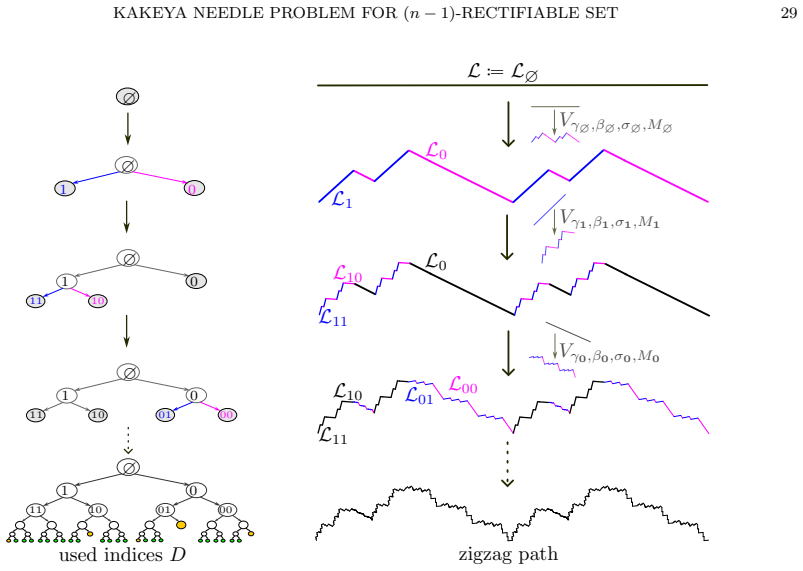
The central object is the pair consisting of the projective normal line of the set and the projective axis of a simple isometry. Each point $x$ of a rectifiable set has a projective normal line $\nu_x=[n_x:1]$ in $\mathbb{P}^n$; each simple isometry in a 2-plane $V$ has a projective axis $a_\iota$, which lifts the rotation axis or translation direction into $\mathbb{P}^n$. The key quantitative estimate, Lemma 3.2, says that moving only the points whose normal line misses a $\delta$-neighborhood of the axis sweeps volume at most $C r\,\delta |\eta(\iota)|H^{n-1}(E)$, where $\eta(\iota)\in V\times\mathbb{R}$ is a vector parameter for the isometry. The Venetian-blind zigzag path replaces the natural path by many tiny isometries whose axes lie near a chosen line, so that at every stage all but a small-angle set of normal directions are safe; iterating and taking a limit yields zero total swept measure while each $E_p$ retains full $H^{n-1}$ measure.
What would settle it
In the notation of the proof, take $n=4$, $V=\mathrm{span}\{e_1,e_2\}$, $V^\perp=\mathrm{span}\{e_3,e_4\}$, and $E$ a bounded $3$-dimensional plate whose normal directions lie in $V^\perp$; along the constructed path the inclusion (5.34) forces $E_p=\varnothing$ for every $p$, so $H^{n-1}(E_p)=0$, directly contradicting the required equality $H^{n-1}(E_p)=H^{n-1}(E)$ unless the deletion rule is changed.
Extended reading notes
Core claim
The central claim is Theorem 1.1: if $E$ is $(n-1)$-rectifiable in $\mathbb{R}^n$ with $H^{n-1}(E)<\infty$, then for every $\iota\in\mathrm{Isom}^+(\mathbb{R}^n)$ there are a continuous path $P_\iota\subset\mathrm{Isom}^+(\mathbb{R}^n)$ from the identity to $\iota$ and subsets $E_p\subset E$ with $H^{n-1}(E_p)=H^{n-1}(E)$ for every $p\in P_\iota$, such that $|\bigcup_{p\in P_\iota}p(E_p)|=0$. The proof first treats simple isometries in an arbitrary 2-plane $V$ (Theorem 1.2), then uses the fact that any isometry is a composition of at most $\lfloor n/2\rfloor+2$ simple rotations. Theorem 1.4 converts this movability into a Nikodym-type set: a Lebesgue-null $F$ such that for each $y\in\mathbb{R}^n$ an isometric copy of $E$ passes through $y$, and an equi-measure subset of that copy lies in $F$. For $n\ge 3$, Theorems 1.3 and 1.5 extend both results to orientation-preserving affine transformations.
Load-bearing premise
The proof assumes the normal directions of $E$ avoid the projective set $P_{V^\perp}^{n-3}$ common to all simple-isometry axes in a chosen 2-plane $V$, and the paper's justification of this as 'harmless' only handles one natural path, not the zigzag path that actually rotates those normals.
Editorial extensions
If this is right
- Every finite-measure $(n-1)$-rectifiable set is $\mathrm{Isom}^+(\mathbb{R}^n)$-Kakeya movable, so the strong-Kakeya obstruction for closed sets disappears once null subsets are discarded at each stage.
- There is a Lebesgue-null set that packs an isometric copy of a given curved hypersurface through every point of $\mathbb{R}^n$, extending the classical line-plane Nikodym construction to rectifiable hypersurfaces.
- For $n\ge 3$, the same zero-volume movability and Nikodym packing hold with all orientation-preserving affine transformations, so anisotropic dilations can be included in the allowed motions.
- The planar rectifiable-curve theorem and the sphere case are recovered as special cases ($n=2$ and $E=S^{n-1}$), making the result a common generalization of the two previously known extremal examples.
Reading between the lines
- Inference: the proof's 'harmless' assumption (5.4) is the place where the argument could fail; a natural test case is any $E$ whose normal set meets $P_{V^\perp}^{n-3}$, since the written deletion rule would then give empty moved sets.
- Inference: the through-every-point packing for curved hypersurfaces sits in contrast with known impossibility theorems for packing positive-measure pieces of spheres around every point; the distinction is 'through' versus 'around', and the paper shows the through version is possible in all dimensions.
- Inference: one could make the construction quantitative for polyhedral surfaces by iterating the Venetian-blind path finitely many times and measuring the swept volume; the sweep should decay at a rate controlled by the product of the small-angle parameters, providing a concrete finite-depth test of the zero-limit claim.
Signed reviews
Editorial analysis
A structured set of objections, weighed in public.
Referee Report
Summary. The paper claims that every (n-1)-rectifiable set E in R^n with finite H^{n-1} measure is Isom^+(R^n)-Kakeya movable: for every orientation-preserving isometry there is a continuous path of isometries from the identity to that isometry, and equi-measure subsets E_p of E can be moved along the path so that the union of the moved subsets has Lebesgue measure zero. A local version for a fixed two-plane V is stated as Theorem 1.2, a global version as Theorem 1.1, and a Nikodym-type set is constructed in Theorem 1.4. The proof combines projective-geometric descriptions of normals and simple isometries, measure estimates for moving hypersurfaces, and a Venetian blind zigzag construction of paths in Isom^+(V). Section 7 extends the results to affine transformations.
Significance. If correct, the results would be a substantial generalization of the planar rectifiable-curve theorem of Chang and Csörnyei and the sphere result of Chang, Dosidis, and Kim. The manuscript contains several genuinely useful ingredients: the detailed Jacobian computation in Lemma 3.4, the projective-axis formalism, and the adaptation of the Venetian blind construction to higher-dimensional isometry groups. The claimed Nikodym-type construction is also original. However, the central proof has a load-bearing gap connected with the reduction to normals avoiding P^{n-3}_{V^\perp}; as written, the proof fails for sets with a positive measure of normals in V^\perp. The paper is not acceptable in its current form, but the main idea may be repairable by treating that case separately.
major comments (4)
- [Section 5.1, Eq. (5.4) and Eqs. (5.26), (5.31), (5.33)] The reduction to the assumption N(E) ⊂ P^{n-1} \ P^{n-3}_{V^\perp} is not justified and is load-bearing. Let B = N^{-1}(P^{n-3}_{V^\perp}). Remark 3.1 shows only that, for each simple isometry ι, the swept set of B along the natural path L_ι has Lebesgue measure zero; it does not show H^{n-1}(B)=0. In the iteration, E^k_j in (5.26) and the final E_p in (5.31)/(5.33) are defined by ν_x ∩ a(\overline{B}(u^k_j, ε_k)) = ∅. Since a(u) contains P^{n-3}_{V^\perp} for every u ∈ P^2_{V×R}, every x ∈ B satisfies ν_x ∩ a(u) ≠ ∅ and is therefore excluded from every E_p. If H^{n-1}(B) > 0, then H^{n-1}(E_p) ≤ H^{n-1}(E) - H^{n-1}(B) < H^{n-1}(E), directly contradicting (1.2). This is not a vacuous situation: for V the xy-plane in R^3 and E a compact C^1 hypersurface parallel to V, such as a horizontal disk, one has B = E. Thus the proof of Theorem 1.2 does not cover such sets, and the later uses of (5.4) in the proof of Theorem 1.2 (the 'at most two E_J' counting and the proof of (5.35)) inherit the same gap.
- [Section 5.1, proof of Theorem 1.2, Eqs. (5.34)-(5.35)] The argument that {u : H^{n-1}(E(u)) > 0} is at most countable depends on the claim that the pairwise intersections E(u) ∩ E(u') are H^{n-1}-null. For u,u' ∈ P^1_{V×{0}}, the proof asserts this intersection is N^{-1}(P^{n-2}_{V^\perp}), which is empty by (5.4). If B = N^{-1}(P^{n-3}_{V^\perp}) has positive H^{n-1} measure, then B ⊂ E(u) for every u, because each a(u) contains P^{n-3}_{V^\perp}. Hence the pairwise intersections are not null, the countability argument collapses, and (5.35) fails. A repair requires an explicit treatment of the bad-normal set B, for example by proving that H^{n-1}-a.e. B is a union of V-parallel leaves, so that moving B along any path in Isom^+(V) sweeps out an H^n-null set and B can be included in E_p without changing (1.1).
- [Section 2.3 and Section 3, Lemma 2.3 and Lemma 3.3] Lemma 2.3 (approximation of compositions in the V×R parametrization) and Lemma 3.3 (small neighborhood of an isometry path) are imported with proofs omitted, the latter with only a reference to the planar case [4]. Both are load-bearing: Lemma 2.3 underlies the basic zigzag decomposition (4.4), and Lemma 3.3 is used to transfer measure estimates from natural paths to zigzag paths, for example in (5.14) and in the construction of P_ι as a limit. Since the ambient dimension is n and the planar proof does not automatically cover isometries in Isom^+(V), the manuscript should provide full proofs or precise higher-dimensional statements.
- [Section 7, Lemma 7.1 and Lemmas 7.2-7.3] The affine generalizations Theorem 1.3 and Theorem 1.5 rest on Lemma 7.1, for which only a sketch is given ('the detailed proof of this lemma is omitted'), and on Lemmas 7.2-7.3, which are stated without proofs. The adaptation of the Venetian blind construction to the affine setting is also asserted rather than demonstrated. As a result, the affine results are not established at the same standard as the isometric results.
minor comments (3)
- [Section 3, proof of Lemma 3.1] The text says 'use (3.3) in Lemma 3.2' but equations (3.3)-(3.4) belong to Lemma 3.4; the heading 'Proof of Lemma 3.1 and Lemma 3.4' should presumably read 'Lemma 3.1 and Lemma 3.2'.
- [Theorem 1.5, condition (a)] Condition (a) writes ι_y(E) but the transformation in the statement is σ_y; this is a typo.
- [Lemma 5.1, statement] The notation 'VPGpn, 2q' is malformed; it should be V ∈ G_2(R^n).
Circularity Check
No significant circularity: the proof is a constructive argument relying on disclosed external results, with no fitted parameters or self-citation loops.
full rationale
The paper's main theorems are established by explicit constructions rather than by assuming their conclusions. Section 4 builds zigzag paths using a Venetian blind-type iteration, and Section 3 provides measure estimates (Lemmas 3.1-3.3) for moving rectifiable sets along isometries. Theorem 1.2 is proved by iterating Lemma 5.1 with scales epsilon_k satisfying sum H^{n-1}(E_k) epsilon_k < infinity, then taking a limiting path and limiting equi-measure subsets E_p; the measure-zero estimate (1.1) follows from (5.20)-(5.32), while the equi-measure condition (1.2) is obtained by selecting limiting points u_p outside a countable exceptional set. No parameter is fitted to the swept measure that the proof aims to make zero, and the equi-measure property is not used as an input. Theorem 1.1 is reduced to Theorem 1.2 through the standard decomposition of isometries into simple rotations (Lemma 2.2), and Theorem 1.4 uses Theorem 1.2 plus Lemma 6.1 to cover R^n by countably many translated copies of a swept set with nonempty interior. The citations to [4] and [5] are to external works by other authors, used for techniques such as the V x R parametrization, small-neighborhood perturbation, and Venetian blind iterations; they are not self-citations and do not import an unverified uniqueness claim. The only delicate passage is the assertion in Section 5.1 that one may assume N(E) subset of P^{n-1} minus P^{n-3}_{V^perp} 'without loss of generality' from Remark 3.1. Even if that reduction is incomplete for sets whose normals meet P^{n-3}_{V^perp}, this is a correctness or justification gap, not circularity: Remark 3.1 does not restate the target conclusion of equi-measure movability, and the subsequent proof does not define the swept set as the quantity being estimated. No step in the derivation reduces to its own input by definition, by fitted parameters, or by a self-citation chain.
Assumptions & free parameters
assumptions (5)
- standard math Area formula and the Jacobian estimates for Lipschitz maps from U_i times [0,1] to R^n (Federer [9]).
- domain assumption Adapted versions of the planar lemmas [4, Lemma 2.1] (small neighborhood) and [4, Lemmas 5.4-5.5] (composition approximation) hold in Isom^+(V) for all n.
- domain assumption Equivalence (6.2): for a simple isometry iota, moving Gamma along L_iota covers Lebesgue measure zero iff the projective normal line nu_x intersects the projective axis a_iota for every x in Gamma.
- ad hoc to paper The reduction to normals avoiding P^{n-3}_{V^perp} (equation (5.4)) is without loss of generality.
- domain assumption Aff^+(R^n) is generated by the simple affinity groups Sim^+(V) for 2-planes V (Lemma 7.1).
Cite this review
Pith. "Pith review of A Study on Kakeya Needle Problem for $(n-1)$-Rectifiable Set." pith.science (2026). https://pith.science/paper/AKVCWHAT
@misc{pith2026260808201,
  author       = {Pith},
  title        = {Pith review of: A Study on Kakeya Needle Problem for $(n-1)$-Rectifiable Set},
  year         = {2026},
  howpublished = {\url{https://pith.science/paper/AKVCWHAT}},
  note         = {Machine review of arXiv:2608.08201}
}
abstract
In this article we study the analog of Kakeya needle problem for $(n-1)$-rectifiable set in $\mathbb{R}^n$ and construct the related Nikodym type set. The novelty of our approach lies in combining three ingredients: the two-dimensional Venetian blind-type construction for isometries in $\mathbb{R}^n$; the geometry of normal information of a $(n-1)$-rectifiable set viewed in the perspective of projective space; and measure estimates of moving $(n-1)$-rectifiable sets by isometries in $\mathbb{R}^n$. Together, these ingredients enable us to move $(n-1)$-rectifiable sets along paths of isometries in $\mathbb{R}^n$ and cover a Lebesgue null set.
Figures


Figures from the paper (3 more)


Reference graph
Works this paper leans on
-
[4]
A. Chang and M. Cs¨ ornyei. The Kakeya needle problem and the existence of Besicovitch and Nikodym sets for rectifiable sets.Proc. London Math. Soc. (3), 118(5):1084–1114, 2019
work page 2019
- [5]
-
[1]
A. S. Besicovitch. Sur deux questions d’integrabilite des fonctions.J. Soc. Phys. Math., 2:105–123, 1919
work page 1919
-
[2]
A. S. Besicovitch. On Kakeya’s problem and a similar one.Math. Z., 27:312–320, 1927
work page 1927
- [3]
-
[6]
M. Cs¨ ornyei, K. H´ era, and M. Laczkovich. Closed sets with the Kakeya property.Mathematika, 63(01):184–195, 2018
work page 2018
-
[7]
K. J. Falconer. Sets with prescribed projections and Nikodym sets.Proc. London Math. Soc. (3), 53(01):48–64, 1986
work page 1986
-
[8]
K. J. Falconer.Fractal Geometry: Mathematical Foundations and Applications. John Wiley & Sons, Chichester, 1990
work page 1990
Show all 20 references
-
[9]
Federer.Geometric measure theory
H. Federer.Geometric measure theory. Die Grundlehren der mathematischen Wissenschaften. Springer-Verlag, Berlin-Heidelberg-New York, 1969
1969
-
[10]
R. J. Fern´ andez-Delgado and M. de la Salle. A construction of Kakeya sets in arbitrary dimension, arXiv:2607.14824v2, 2026
2026 arXiv
-
[11]
Hickman and J
J. Hickman and J. Zahl. Improved Lp bounds for the strong spherical maximal operator.Isr. J. Math., accepted, 2026
2026
-
[12]
Iosevich, Z
A. Iosevich, Z. Li, and K. Taylor. Positive measure of unions of variable surfaces, arXiv:2605.27550v1, 2026
2026 arXiv
-
[13]
S. Kakeya. Some problems on maxima and minima regarding ovals.Sci. Rep. Tˆ ohoku Univ., I. Ser., 6:71–88, 1917. 46 WENJUAN LI, HONGQIANG W ANG, AND HUIJU W ANG
1917
-
[14]
Lin and X
M. Lin and X. Yang.Geometric Measure Theory - An Introduction. Advanced Mathematics. Science Press and International Press, Cambridge, 2002
2002
-
[15]
J. M. Marstrand. Packing circles in the plane.Proc. London Math. Soc. (3), 55(1):37–58, 1987
1987
-
[16]
Mattila.Fourier Analysis and Hausdorff Dimension
P. Mattila.Fourier Analysis and Hausdorff Dimension. Cambridge Studies in Advanced Mathematics. Cambridge University Press, Cambridge, 2015
2015
-
[17]
T. Mitsis. On a problem related to sphere and circle packing.J. London Math. Soc., 60(2):501–516, 1999
1999
-
[18]
E. M. Stein. Maximal functions: Spherical means.Proc. Natl. Acad. Sci. USA, 73(7):2174–2175, 1976
1976
-
[19]
T. Wolff. A Kakeya-type problem for circles.Amer. J. Math., 119(5):985–1026, 1997
1997
-
[20]
Yang and Y
T. Yang and Y. Zhong. Construction of a curved Kakeya set.Bull. London Math. Soc., 57(8):2531–2548, 2025
2025
Reviewed August 12, 2026 · model on record in the stance chip above.
Discussion (0). Continue with ORCID to comment.