REVIEW 3 major objections 4 minor 88 references
On the Physical Origins of Long Period Radio Transients
T0 review · 3 major / 4 minor · reviewed 2026-08-12 · deepseek-v4-flash
Pith's one-line read Long-period radio transients are not a single engine class: short-period sources are likely isolated compact objects, while long-period sources are likely compact stars in detached binaries with red dwarf companions.
desk verdict A useful organizing framework for LPRTs, but the period-based dichotomy is softer than the abstract claims and needs qualification in revision. read the letter →
The pith
A machine-rendered reading of the paper's core claim, the machinery that carries it, and where it could break.
The reading
What carries the argument
The argument runs on three physical mechanisms. The first is a binary period floor: the Roche-limit period $P_{\rm Roche}$ and the mass-transfer period $P_{\rm MT}$ for a WD/NS plus RD binary set where a companion can survive and stay detached, with characteristic values near 41 and 107 minutes. The second is unipolar induction in an asynchronous binary: a low-magnetized red dwarf moving through the compact star's magnetosphere builds a potential drop $\Phi \simeq 2 B_* R_*^3 R_{\rm RD} \zeta \Omega_{\rm orb}/(c a^2)$, accelerating electrons that emit coherently through relativistic electron cyclotron maser emission, a plasma instability that produces narrow-band, highly polarized bursts at the gyrofrequency. The third is the pair-production death line for isolated rotators, computed through inverse-Compton channels, which decides whether an isolated white dwarf or neutron star can sustain the pair plasma needed for radio emission.
What would settle it
Find one LPRT with a period below about 41 minutes that nonetheless shows unambiguous binary signatures, such as radial-velocity variations of a companion or an eclipse, or one with a period above about 107 minutes that shows no companion and a magnetic-dipole spin-down typical of an isolated neutron star; either would break the proposed two-class period divide.
Extended reading notes
Core claim
On the paper's own terms, the central discovery is a physically motivated two-class taxonomy of long-period radio transients. The paper derives two critical periods for a white-dwarf/neutron-star plus red-dwarf binary: the Roche-limit period, near 41 minutes, below which the companion would be tidally disrupted, and the mass-transfer period, near 107 minutes, below which Roche-lobe overflow would load the magnetosphere and quench coherent radio emission. It argues that observed periods shorter than these thresholds therefore point to isolated compact objects, among which isolated white dwarfs generally fall below the pair-production death line while slowly rotating neutron stars remain marginally active; periods longer than the thresholds point to detached asynchronous binaries, with unipolar induction generating the voltage and relativistic electron cyclotron maser emission producing narrow, highly polarized coherent radio bursts. The paper further claims that bright X-ray counterparts favor magnetar-like engines, faint or absent X-rays favor white-dwarf channels, and it packages the scheme as a diagnostic flow chart.
Load-bearing premise
The load-bearing premise is that the companion red dwarf has the adopted characteristic radius and mass, about 0.2 solar radii and 0.2 solar masses; if real companions are smaller or less massive, the period boundary that separates binaries from isolated sources moves well below 41 minutes.
Editorial extensions
If this is right
- Short-period LPRTs below roughly 41 minutes should be searched as isolated neutron stars rather than binaries, and their radio activity is expected to be marginally sustained by inverse-Compton pair cascades.
- Long-period LPRTs above the mass-transfer threshold should be observed for beat periods and optical red dwarf companions; such detections confirm the detached binary picture.
- Binary unipolar-induction sources should show narrow spectra and polarization that can switch between nearly 100 percent linear and nearly 100 percent circular depending on viewing geometry, while broad-spectrum sources favor isolated rotators or emission near the compact star.
- X-ray luminosity becomes a discriminator: bright X-ray counterparts point to magnetar-related engines, while faint or absent X-rays are consistent with white-dwarf-related channels.
- The proposed diagnostic flow chart can be applied to every new LPRT, using optical counterpart, beat period, period relative to the Roche limit, RM variability, supernova remnant association, and X-ray brightness to assign an engine class.
Reading between the lines
- The paper does not pursue it, but if the binary period thresholds scale as the red dwarf radius to the 3/2 power, then a source with a smaller or less massive companion could remain a binary below 41 minutes, so radial-velocity monitoring of short-period LPRTs is a direct test of the two-class split.
- The framework predicts a bimodal period distribution with few binaries between the Roche and mass-transfer thresholds, a signature that future all-sky radio surveys could look for in the growing LPRT sample.
- Measuring a candidate binary's period derivative should reveal alternating spin-up and spin-down torques tied to orbital phase, unlike the steady magnetic-dipole spin-down expected from an isolated rotator.
- If the unipolar-induction picture is right, the coherent radio bursts should be locked to the beat period and to the companion's orbital position; multi-cycle polarimetric monitoring would test this phase locking directly.
Editorial analysis
A structured set of objections, weighed in public.
Referee Report
Summary. The paper argues that long-period radio transients (LPRTs) fall into two broad classes: shorter-period sources that are likely isolated compact objects (with neutron stars favored over white dwarfs), and longer-period sources that are detached WD/NS + red-dwarf binaries. The argument combines Roche-lobe and mass-transfer period constraints with pair-production death-line calculations for isolated WDs and NSs, a unipolar-induction/relativistic ECME model for asynchronous binaries, an analysis of magnetospheric interaction and X-ray counterparts, and an observational flow chart for classification. The paper also discusses propagation effects (resonant cyclotron absorption, Faraday conversion, scintillation) and links LPRTs to cataclysmic variables and WD pulsars.
Significance. This is a useful and timely synthesis of the rapidly growing LPRT sample. The paper's order-of-magnitude energy budgets are internally consistent, the death-line comparison in the P–Pdot diagram provides a concrete framework for testing isolated-engine scenarios, and the proposed flow chart makes the classification falsifiable through X-ray luminosity, RM variability, polarization, and timing diagnostics. The explicit scaling laws for the Roche and mass-transfer periods are also a useful contribution. However, the central two-class claim is built on period constraints that apply only when the observed period is the orbital period, and the paper's own GPM J1839-10 example shows that a short period can be a beat period of a binary. The revision should qualify the classification and make the caveats prominent.
major comments (3)
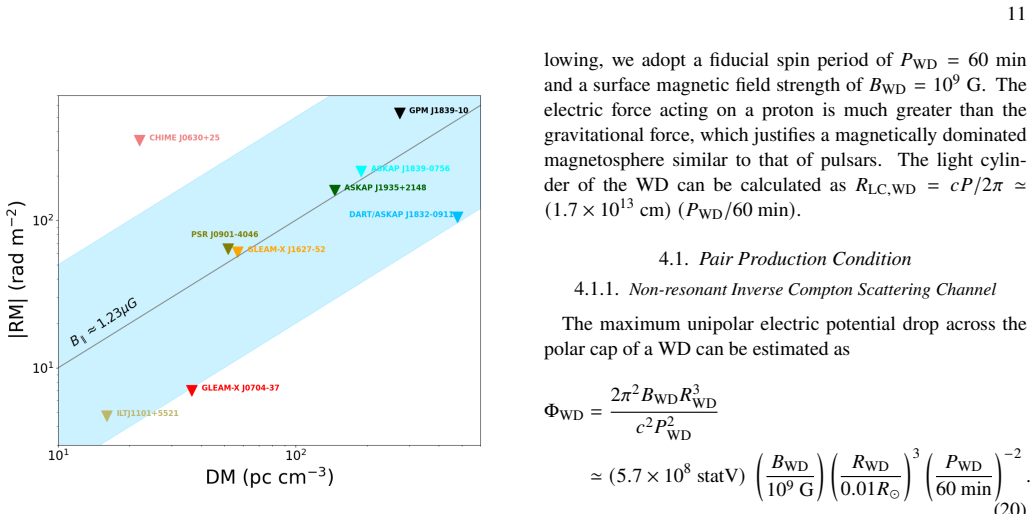
- [Section 9.1 and Section 10] The flow chart in Figure 12 states that if the observed period is shorter than P_Roche, a binary system cannot exist, without repeating the caveat from Section 3.1.1 that this applies only if the observed period is the orbital period. Applying this rule to the 21-min beat period of GPM J1839-10 (Table 1; Section 6.3) would misclassify a confirmed binary as isolated. Since CHIME J0630+25 (7.0 min), GLEAM-X J1627-52 (18.18 min), and CHIME/ILT J1634+44 (14 min) do not yet have confirmed period nature, each could be a beat period of a longer-orbit binary. The first bullet of Section 10 therefore overstates what the period constraints establish; the two-class division should be explicitly conditional on the identification of the observed period as orbital, and the flow chart should include this condition.
- [Section 3.1.1, Eqs. (1)-(4)] The thresholds P_Roche and P_MT are evaluated for a characteristic red dwarf with R_RD=0.2 R_sun and M_RD=0.2 M_sun, and both scale as R_RD^(3/2). For a smaller companion, e.g., a late M dwarf or brown dwarf with R_RD~0.1 R_sun, P_MT drops below 20 min (Eq. 4), meaning that sources with periods of 14 or 18 min could still be detached binaries if the companion is smaller than the adopted characteristic value. The hard divide near 110 min used in Section 10 is therefore not robust unless the companion mass-radius distribution is justified or the thresholds are presented as functions of R_RD and M_RD with appropriate uncertainty ranges.
- [Section 4.1.1 and Figure 7] The numerical WD death lines (solid and dashed purple curves in Figure 7) are load-bearing for the conclusion that isolated WDs generally cannot sustain pair production, but the numerical method is not described. The text gives analytical estimates in Eqs. (23)-(25), but the numerical result at T_WD=5e4 K cannot be reproduced from the manuscript: the gap model equations, the pair-production criterion, grid resolution, and code availability are missing. Please provide a description of the numerical scheme or a table of the death-line values so that the claim can be verified.
minor comments (4)
- [Section 5.1.2, Eq. (36)] In the neutron-star section, the mean free path l_e^NR is written as 1/(n_ph,WD σ_T); the subscript should be NS, i.e., n_ph,NS, to be consistent with the surrounding text.
- [Section 8.2, Eq. (82)] In the NS case of Eq. (82), the term L/(100 R_WD) should use the NS radius, L/(100 R_NS), since the expression is normalized to the WD radius but applies to a neutron star.
- [Section 9.1 and Table 2] The X-ray luminosity discriminator in the flow chart gives a range 10^21-10^27 erg/s for unipolar-induction models, whereas Table 2 lists 10^23-10^27 erg/s for Model D; also, the range 10^27-10^33 erg/s is assigned to accretion onto an NS, but AR Sco (L_X~4.9e30 erg/s) is a WD+RD system in that range. These ranges should be reconciled or made non-exclusive.
- [Table 1 and text] The source CHIME/ILT J163430+44501 in Table 1 is referred to as CHIME/ILT J1634+44 in the text; please use a single naming convention throughout.
Circularity Check
The short-period => isolated classification drops the 'if interpreted as orbital period' caveat, making the two-class split an artifact of that identification.
-
self definitional
[Section 3.1.1 (Equations 1-4); Section 9.1 flow chart; Section 10 conclusions]
"Thus, any period of LPRTs shorter than P_Roche cannot be a binary WD / NS + RD system, because the RD would break up. ... If the observed period is shorter than P_Roche, a binary system cannot exist."
P_Roche and P_MT are derived as limits on the orbital period of a WD/NS+RD binary, using characteristic RD parameters. The derivation explicitly depends on identifying the observed LPRT period with the orbital period, as stated just before Equation (4): 'If the observed LPRT period is interpreted as the orbital period...'. In the flow chart (Section 9.1) and in the Conclusions, this qualifier is dropped, so a source is classified as isolated whenever its observed period is shorter than P_Roche. That classification is true only under the unverified assumption P_obs = P_orb.
full rationale
The paper's derivation of the binary period thresholds is physically standard (Roche limit and Roche-lobe overflow), and much of the analysis is independent of the authors' prior work: the WD and NS death lines, the unipolar-induction validity parameter f_unipolar, the reconnection-power estimates, the X-ray luminosity scalings, and the duty-cycle constraints are all computed in this paper and compared with observations rather than fitted to them. The repeated citations to Qu & Zhang 2025 for the unipolar-induction/ECME binary model are load-bearing but not circular in the prohibited sense: the mechanism is a published, independently testable model with external predictions (beat periods, narrow spectra, faint X-rays), and this paper confronts those predictions with five observed systems. The main circular step is the central two-class division: the short-period -> isolated branch is derived by silently converting the conditional statement 'if the observed period is interpreted as the orbital period' into the unconditional statement 'if the observed period is shorter than P_Roche, a binary cannot exist.' The paper itself acknowledges that some short observed periods are beat periods, so the classification is not entailed by the Roche limit. This affects the central claim but not the entire paper, since the isolated-engine death-line analysis, the binary-engine power estimates, and the multi-wavelength diagnostics have substantial independent content. Score 5 reflects one central claim that reduces by construction while the rest of the physical framework remains non-circular.
Assumptions & free parameters
free parameters (6)
- Characteristic companion mass and radius =
M_RD=0.2 solar masses, R_RD=0.2 solar radii
- WD death-line surface temperature =
T_WD=5e4 K
- NS surface temperature and field for pair cascade =
T_NS=1e6 K, B_NS=1e15 G
- Red dwarf wind mass-loss rate =
Mdot_RD=1e-13 solar masses per year
- Magnetic reconnection efficiency =
epsilon_rec=0.1
- X-ray conversion efficiency =
eta_X=0.1
assumptions (5)
- domain assumption Pulsar polar-gap pair cascade physics (Erber cross section, space-charge-limited flow, curvature and inverse-Compton pair production).
- domain assumption Unipolar induction circuit model of Qu & Zhang 2025.
- domain assumption Relativistic electron cyclotron maser emission as the coherent radiation mechanism.
- domain assumption A red dwarf companion with mass around 0.2 solar masses and radius around 0.2 solar radii.
- ad hoc to paper Observed period is the orbital period for long-period binary candidates and the spin or beat period for short-period candidates.
Cite this review
Pith. "Pith review of On the Physical Origins of Long Period Radio Transients." pith.science (2026). https://pith.science/paper/Q2CD2WHC
@misc{pith2026260808243,
  author       = {Pith},
  title        = {Pith review of: On the Physical Origins of Long Period Radio Transients},
  year         = {2026},
  howpublished = {\url{https://pith.science/paper/Q2CD2WHC}},
  note         = {Machine review of arXiv:2608.08243}
}
read the original abstract
Long-period radio transients (LPRTs) are a rapidly growing class of coherent radio sources with periods ranging from minutes to hours, whose central engines and emission mechanisms remain unclear. Motivated by the detection of red dwarf (RD) companions in several LPRTs and by generic period constraints from the Roche limit and the mass transfer limit, we argue that LPRTs naturally separate into two broad classes: shorter-period sources that are likely isolated compact objects and longer-period sources that are compact objects in binary systems that are likely detached. For isolated objects, we find that isolated white dwarfs (WDs) generally have difficulty sustaining pair production and coherent radio emission unless the surface temperature is extremely high, while slow rotating neutron stars (NSs) can remain marginally active through inverse-Compton-driven pair cascades. For binary systems, asynchronous WD / NS + RD systems can power coherent radio emission through unipolar induction when the WD / NS magnetic field dominates the companion surface field, with relativistic electron cyclotron maser emission as the radiation mechanism, while at larger separations the system enters the magnetospheric interaction regime, possibly powered by magnetic reconnection. Bright X-ray counterparts favor magnetar-related systems and undetected X-ray emission is expected from WD-related channels. We propose a diagnostic flow chart that uses observational criteria to classify LPRTs and identify their central engines. These criteria lead to a physically motivated classification framework for LPRTs.
Figures


Figures from the paper (9 more)




Reference graph
Works this paper leans on
-
[1]
Adler, S. L. 1971, Annals of Physics, 67, 599, doi: 10.1016/0003-4916(71)90154-0
-
[2]
Anumarlapudi, A., Kaplan, D. L., Rea, N., et al. 2025, arXiv e-prints, arXiv:2507.13453, doi: 10.48550/arXiv.2507.13453
-
[3]
Baring, M. G., & Harding, A. K. 1998, ApJL, 507, L55, doi: 10.1086/311679 —. 2001, ApJ, 547, 929, doi: 10.1086/318390
-
[4]
Barrett, P., Dieck, C., Beasley, A. J., Mason, P. A., & Singh, K. P. 2020, Advances in Space Research, 66, 1226, doi: 10.1016/j.asr.2020.04.007
-
[5]
Bhattacharya, D., & van den Heuvel, E. P. J. 1991, PhR, 203, 1, doi: 10.1016/0370-1573(91)90064-S
-
[6]
Bloot, S., Vedantham, H. K., Bassa, C. G., et al. 2025, A&A, 699, A341, doi: 10.1051/0004-6361/202555131
-
[7]
Buckley, D. A. H., Meintjes, P. J., Potter, S. B., Marsh, T. R., & G¨ansicke, B. T. 2017, Nature Astronomy, 1, 0029, doi: 10.1038/s41550-016-0029
-
[8]
Buckley, D. A. H., Monageng, I., Aydi, E., Scaringi, S., & Charles, P. A. 2024, The Astronomer’s Telegram, 16554, 1
2024
Show all 88 references
-
[9]
2022, Nature Astronomy, 6, 828, doi: 10.1038/s41550-022-01688-x
Caleb, M., Heywood, I., Rajwade, K., et al. 2022, Nature Astronomy, 6, 828, doi: 10.1038/s41550-022-01688-x
2022 doi
- [10]
-
[11]
Chanmugam, G., & Dulk, G. A. 1983, in Astrophysics and Space Science Library, Vol. 101, IAU Colloq. 72: Cataclysmic Variables and Related Objects, ed. M. Livio & G. Shaviv, 223–226, doi: 10.1007/978-94-009-7118-9 28
1983 doi
-
[12]
2000, ApJL, 529, L29, doi: 10.1086/312448
Colpi, M., Geppert, U., & Page, D. 2000, ApJL, 529, L29, doi: 10.1086/312448
2000 doi
-
[13]
J., & Wadiasingh, Z
Cooper, A. J., & Wadiasingh, Z. 2024, MNRAS, 533, 2133, doi: 10.1093/mnras/stae1813
2024 doi
-
[14]
M., & Chatterjee, S
Cordes, J. M., & Chatterjee, S. 2019, ARA&A, 57, 417, doi: 10.1146/annurev-astro-091918-104501
2019 doi
-
[15]
K., & Ventura, J
Daugherty, J. K., & Ventura, J. 1978, PhRvD, 18, 1053, doi: 10.1103/PhysRevD.18.1053 de Ruiter, I., Rajwade, K. M., Bassa, C. G., et al. 2025, Nature Astronomy, doi: 10.1038/s41550-025-02491-0
1978 doi
-
[16]
S., et al
Dobie, D., Zic, A., Oswald, L. S., et al. 2024, MNRAS, 535, 909, doi: 10.1093/mnras/stae2376
2024 doi
-
[17]
A., Clarke, T
Dong, F. A., Clarke, T. E., Curtin, A., et al. 2025a, ApJL, 990, L49, doi: 10.3847/2041-8213/adfa8e
-
[18]
A., Shin, K., Law, C., et al
Dong, F. A., Shin, K., Law, C., et al. 2025b, ApJL, 988, L29, doi: 10.3847/2041-8213/adeaab
-
[19]
D., Foley, H
Drell, S. D., Foley, H. M., & Ruderman, M. A. 1965, J. Geophys. Res., 70, 3131, doi: 10.1029/JZ070i013p03131
1965 doi
-
[20]
Eggleton, P. P. 1983, ApJ, 268, 368, doi: 10.1086/160960
1983 doi
-
[21]
1966, Reviews of Modern Physics, 38, 626, doi: 10.1103/RevModPhys.38.626
Erber, T. 1966, Reviews of Modern Physics, 38, 626, doi: 10.1103/RevModPhys.38.626
1966 doi
-
[22]
Ferrario, L., de Martino, D., & G¨ansicke, B. T. 2015, SSRv, 191, 111, doi: 10.1007/s11214-015-0152-0
2015 doi
-
[23]
Gangadhara, R. T. 2010, ApJ, 710, 29, doi: 10.1088/0004-637X/710/1/29
2010 doi
-
[24]
2016, ApJL, 831, L10, doi: 10.3847/2041-8205/831/1/L10
Geng, J.-J., Zhang, B., & Huang, Y.-F. 2016, ApJL, 831, L10, doi: 10.3847/2041-8205/831/1/L10
2016 doi
-
[25]
1992, ApJ, 395, 250, doi: 10.1086/171646
Goldreich, P., & Reisenegger, A. 1992, ApJ, 395, 250, doi: 10.1086/171646
1992 doi
-
[26]
J., & Schr´eder, G
Gould, R. J., & Schr´eder, G. P. 1967, Physical Review, 155, 1404, doi: 10.1103/PhysRev.155.1404
1967 doi
-
[27]
K., Baring, M
Harding, A. K., Baring, M. G., & Gonthier, P. L. 1997, ApJ, 476, 246, doi: 10.1086/303605
1997 doi
-
[28]
K., & Muslimov, A
Harding, A. K., & Muslimov, A. G. 2002, ApJ, 568, 862, doi: 10.1086/338985
2002 doi
-
[29]
A., & Arons, J
Hibschman, J. A., & Arons, J. 2001a, ApJ, 554, 624, doi: 10.1086/321378 —. 2001b, ApJ, 560, 871, doi: 10.1086/323069
-
[30]
J., & Kadau, K
Horowitz, C. J., & Kadau, K. 2009, PhRvL, 102, 191102, doi: 10.1103/PhysRevLett.102.191102 Horv´ath, C., Rea, N., Hurley-Walker, N., et al. 2026, Nature Astronomy, doi: 10.1038/s41550-025-02760-y
2009 doi
-
[31]
G., Harding, A
Hu, K., Baring, M. G., Harding, A. K., & Wadiasingh, Z. 2022, ApJ, 940, 91, doi: 10.3847/1538-4357/ac9611
2022 doi
-
[32]
G., Wadiasingh, Z., & Harding, A
Hu, K., Baring, M. G., Wadiasingh, Z., & Harding, A. K. 2019, MNRAS, 486, 3327, doi: 10.1093/mnras/stz995 31
2019 doi
-
[33]
2022, Nature, 601, 526, doi: 10.1038/s41586-021-04272-x
Hurley-Walker, N., Zhang, X., Bahramian, A., et al. 2022, Nature, 601, 526, doi: 10.1038/s41586-021-04272-x
2022 doi
-
[34]
J., et al
Hurley-Walker, N., Rea, N., McSweeney, S. J., et al. 2023, Nature, 619, 487, doi: 10.1038/s41586-023-06202-5
2023 doi
- [35]
-
[36]
D., Lazio, T
Hyman, S. D., Lazio, T. J. W., Kassim, N. E., et al. 2005, Nature, 434, 50, doi: 10.1038/nature03400
2005 doi
-
[37]
Jackson, J. D. 1998, Classical Electrodynamics, 3rd Edition
1998
-
[38]
L., Hyman, S
Kaplan, D. L., Hyman, S. D., Roy, S., et al. 2008, ApJ, 687, 262, doi: 10.1086/591436
2008 doi
-
[39]
Katz, J. I. 2017, ApJ, 835, 150, doi: 10.3847/1538-4357/835/2/150 —. 2022, Ap&SS, 367, 108, doi: 10.1007/s10509-022-04146-2
2017 doi
-
[40]
2024, ApJ, 974, 160, doi: 10.3847/1538-4357/ad6cda
Kumar, P., Qu, Y., & Zhang, B. 2024, ApJ, 974, 160, doi: 10.3847/1538-4357/ad6cda
2024 doi
-
[41]
2012, ApJL, 757, L3, doi: 10.1088/2041-8205/757/1/L3
Lai, D. 2012, ApJL, 757, L3, doi: 10.1088/2041-8205/757/1/L3
2012 doi
-
[42]
Lee, Y. W. J., Caleb, M., Murphy, T., et al. 2025, Nature Astronomy, doi: 10.1038/s41550-024-02452-z
2025 doi
-
[43]
2024, arXiv e-prints, arXiv:2411.15739, doi: 10.48550/arXiv.2411.15739
Li, D., Yuan, M., Wu, L., et al. 2024, arXiv e-prints, arXiv:2411.15739, doi: 10.48550/arXiv.2411.15739
2024 doi
-
[44]
X., Liu, M
Ling, Z. X., Liu, M. J., Liu, Y., et al. 2024, The Astronomer’s Telegram, 16546, 1
2024
-
[45]
E., Johnston, S., Lyutikov, M., et al
Lower, M. E., Johnston, S., Lyutikov, M., et al. 2024, Nature Astronomy, 8, 606, doi: 10.1038/s41550-024-02225-8
2024 doi
-
[46]
G., & Graham-Smith, F
Lyne, A. G., & Graham-Smith, F. 1990, Pulsar astronomy
1990
-
[47]
R., G¨ansicke, B
Marsh, T. R., G¨ansicke, B. T., H¨ ummerich, S., et al. 2016, Nature, 537, 374, doi: 10.1038/nature18620
2016 doi
- [48]
-
[49]
2010, MNRAS, 406, 1379, doi: 10.1111/j.1365-2966.2010.16776.x
Medin, Z., & Lai, D. 2010, MNRAS, 406, 1379, doi: 10.1111/j.1365-2966.2010.16776.x
2010
-
[50]
Melrose, D. B. 2017, Reviews of Modern Plasma Physics, 1, 5, doi: 10.1007/s41614-017-0007-0
2017 doi
- [51]
- [52]
-
[53]
2026, arXiv e-prints, arXiv:2602.13742, doi: 10.48550/arXiv.2602.13742
Men, Y., Barr, E., Qu, Y., et al. 2026, arXiv e-prints, arXiv:2602.13742, doi: 10.48550/arXiv.2602.13742
2026 doi
-
[54]
E., Vink, J
Muijres, L. E., Vink, J. S., de Koter, A., M¨ uller, P. E., & Langer, N. 2012, A&A, 537, A37, doi: 10.1051/0004-6361/201015818
2012 doi
-
[55]
2013, Nature, 501, 517, doi: 10.1038/nature12470
Papitto, A., Ferrigno, C., Bozzo, E., et al. 2013, Nature, 501, 517, doi: 10.1038/nature12470
2013 doi
-
[56]
R., Buckley, D
Pelisoli, I., Marsh, T. R., Buckley, D. A. H., et al. 2023, Nature Astronomy, 7, 931, doi: 10.1038/s41550-023-01995-x
2023 doi
-
[57]
Piro, A. L. 2012, ApJ, 755, 80, doi: 10.1088/0004-637X/755/1/80
2012 doi
-
[58]
B., Buckley, D
Potter, S. B., Buckley, D. A. H., Scaringi, S., et al. 2024, MNRAS, 532, L21, doi: 10.1093/mnrasl/slae038
2024 doi
-
[59]
P., Herrero, A., et al
Puls, J., Kudritzki, R. P., Herrero, A., et al. 1996, A&A, 305, 171
1996
-
[60]
2023, MNRAS, 522, 2448, doi: 10.1093/mnras/stad1072 —
Qu, Y., & Zhang, B. 2023, MNRAS, 522, 2448, doi: 10.1093/mnras/stad1072 —. 2025, ApJ, 981, 34, doi: 10.3847/1538-4357/adb1b5
2023 doi
-
[61]
2026, Journal of High Energy Astrophysics, 52, 100566, doi: 10.1016/j.jheap.2026.100566
Rea, N., Hurley-Walker, N., & Caleb, M. 2026, Journal of High Energy Astrophysics, 52, 100566, doi: 10.1016/j.jheap.2026.100566
2026
-
[62]
2022, ApJ, 940, 72, doi: 10.3847/1538-4357/ac97ea
Rea, N., Coti Zelati, F., Dehman, C., et al. 2022, ApJ, 940, 72, doi: 10.3847/1538-4357/ac97ea
2022 doi
- [63]
- [64]
-
[65]
A., & Sutherland, P
Ruderman, M. A., & Sutherland, P. G. 1975, ApJ, 196, 51, doi: 10.1086/153393
1975 doi
-
[66]
B., & Lightman, A
Rybicki, G. B., & Lightman, A. P. 1979, Radiative processes in astrophysics
1979
-
[67]
R., Belloni, D., & Schwope, A
Schreiber, M. R., Belloni, D., & Schwope, A. D. 2024, A&A, 682, L7, doi: 10.1051/0004-6361/202348807
2024 doi
-
[68]
R., Standke, A., et al
Schwope, A., Marsh, T. R., Standke, A., et al. 2023, A&A, 674, L9, doi: 10.1051/0004-6361/202346589
2023 doi
-
[69]
F., Willems, B., & Kalogera, V
Sepinsky, J. F., Willems, B., & Kalogera, V. 2007, ApJ, 660, 1624, doi: 10.1086/513736
2007 doi
-
[70]
C., & Ritter, H
Spruit, H. C., & Ritter, H. 1983, A&A, 124, 267
1983
-
[71]
R., Marsh, T
Stanway, E. R., Marsh, T. R., Chote, P., et al. 2018, A&A, 611, A66, doi: 10.1051/0004-6361/201732380
2018 doi
-
[72]
Thompson, C., & Duncan, R. C. 1996, ApJ, 473, 322, doi: 10.1086/178147
1996 doi
-
[73]
2022, Research in Astronomy and Astrophysics, 22, 075013, doi: 10.1088/1674-4527/ac71a5
Tong, H., & Wang, H.-G. 2022, Research in Astronomy and Astrophysics, 22, 075013, doi: 10.1088/1674-4527/ac71a5
2022 doi
-
[74]
2022, ApJ, 927, 105, doi: 10.3847/1538-4357/ac4097
Wang, W.-Y., Yang, Y.-P., Niu, C.-H., Xu, R., & Zhang, B. 2022, ApJ, 927, 105, doi: 10.3847/1538-4357/ac4097
2022 doi
-
[75]
A., Shannon, R
Wang, Y., Uttarkar, P. A., Shannon, R. M., et al. 2025a, ApJL, 982, L53, doi: 10.3847/2041-8213/adbe61
-
[76]
2025b, Nature, 642, 583, doi: 10.1038/s41586-025-09077-w
Wang, Z., Rea, N., Bao, T., et al. 2025b, Nature, 642, 583, doi: 10.1038/s41586-025-09077-w
-
[77]
E., M¨ uller, H.-R., Zank, G
Wood, B. E., M¨ uller, H.-R., Zank, G. P., & Linsky, J. L. 2002, ApJ, 574, 412, doi: 10.1086/340797
2002 doi
-
[78]
E., M¨ uller, H
Wood, B. E., M¨ uller, H. R., Zank, G. P., Linsky, J. L., & Redfield, S. 2005, ApJL, 628, L143, doi: 10.1086/432716
2005 doi
- [79]
- [80]
-
[81]
2026, ApJ, 997, 124, doi: 10.3847/1538-4357/ae2864
Yang, Y.-P. 2026, ApJ, 997, 124, doi: 10.3847/1538-4357/ae2864
2026 doi
-
[82]
2018, ApJ, 868, 31, doi: 10.3847/1538-4357/aae685
Yang, Y.-P., & Zhang, B. 2018, ApJ, 868, 31, doi: 10.3847/1538-4357/aae685
2018 doi
-
[83]
2001, ApJL, 562, L59, doi: 10.1086/338051
Zhang, B. 2001, ApJL, 562, L59, doi: 10.1086/338051
2001 doi
-
[84]
2005, ApJL, 631, L143, doi: 10.1086/497428 32
Zhang, B., & Gil, J. 2005, ApJL, 631, L143, doi: 10.1086/497428 32
2005 doi
-
[85]
Zhang, B., & Harding, A. K. 2000, ApJ, 532, 1150, doi: 10.1086/308598
2000 doi
-
[86]
K., & Muslimov, A
Zhang, B., Harding, A. K., & Muslimov, A. G. 2000, ApJL, 531, L135, doi: 10.1086/312542
2000 doi
- [87]
-
[88]
Zhong, Y., & Most, E. R. 2026, ApJL, 999, L2, doi: 10.3847/2041-8213/ae4337
2026 doi
Reviewed August 12, 2026 · model on record in the stance chip above.
Discussion (0). Continue with ORCID to comment.