REVIEW 4 major objections 6 minor 49 references
Lightweight PID-Based Drift Mitigation for Cellular Traffic Forecasting
T0 review · 4 major / 6 minor · reviewed 2026-08-12 · deepseek-v4-flash
Pith's one-line read The paper establishes that a lightweight PID controller applied as an output-side correction layer on frozen HiSTM models mitigates concept drift in cellular traffic forecasting, reducing average MAE by up to 30.18% and RMSE by up to…
desk verdict A cheap and plausible PID output-correction idea, but the evaluation leaks: gains are tuned on the same clean segment that seeds the drift tests, so the headline mitigation numbers are likely optimistic. read the letter →
The pith
A machine-rendered reading of the paper's core claim, the machinery that carries it, and where it could break.
The reading
What carries the argument
The load-bearing object is the PID controller as an inference-time correction layer on top of HiSTM and HiSTM Nested. Its proportional term reacts to instantaneous error, the integral term accumulates persistent bias, and the derivative term damps rapid error swings; with three scalars per cell, it shapes the correction signal without touching model parameters. An offline per-cell search selects the gains by minimizing MAE over 200 trials, and at inference each step only three scalar operations per output cell are added. This mechanism turns the frozen forecaster into a closed loop in which yesterday's error steers today's forecast.
What would settle it
Run the same frozen HiSTM models with PID correction on a second real-world dataset with naturally occurring drift (for example, traffic around a large event or a cell-tower outage) and check whether MAE mitigation stays above 10%. If the correction fails on natural drift while matching the paper's injected-drift numbers, the central claim is an artifact of the additive drift model.
Extended reading notes
Core claim
The central discovery is that error-driven feedback control, classically used in industrial regulation, transfers cleanly to output-side correction of spatiotemporal traffic forecasts. The PID layer computes $u(t) = K_p e(t) + K_i \int_0^t e(\tau)d\tau + K_d \frac{de}{dt}$ from the prediction error and adds it to the base model's forecast; the base model's weights stay frozen. Per-cell gain tuning over a modest search budget yields consistent error reductions across all five drift scenarios and both evaluated models, with per-cell mitigations above 10% for most cells under spatially distributed drift. The authors interpret this as evidence that most drift-induced error is low-frequency and bias-like, which the integral term absorbs, rather than high-frequency noise that would require model adaptation.
Load-bearing premise
The mitigation numbers rest on the assumption that adding perturbed traffic tensors ($X_t + \delta_t$) to the original data reproduces the concept drift that real 5G/6G networks experience; if actual drift changes spatial correlations or arrival patterns rather than simply adding traffic, the measured improvements may shrink.
Editorial extensions
If this is right
- Frozen base models can be kept in service longer; operators avoid retraining cycles during slow traffic-pattern shifts.
- The same correction layer can be attached to any forecasting model that outputs cell-level predictions, since it only reads the error signal and does not modify the base model.
- Per-cell PID gains give operators a cheap, interpretable diagnostic: cells with large integral gains are showing persistent bias, while cells needing large derivative gains are responding to rapid swings.
- Because the overhead is $O(c_{\mathrm{out}})$ per step, the correction can run at the edge or in real-time pipelines.
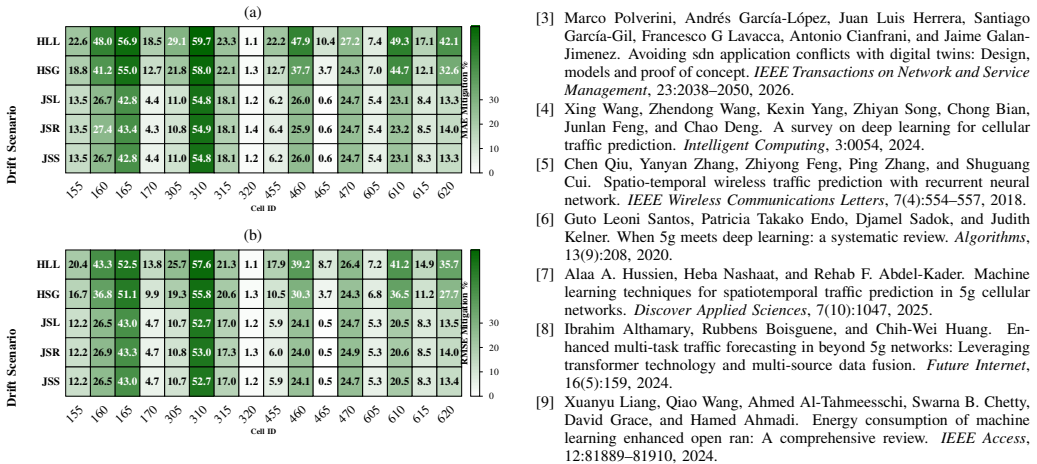
- The reported mitigation is an average over injected drift scenarios; on the Hotspot Linear Local scenario the improvement reaches about 30% MAE and 27% RMSE, while other scenarios show smaller but positive gains.
Reading between the lines
- The additive drift model in Eq. (5) treats drift as extra traffic on top of the historical pattern; real drift may also shift spatial correlations or the timing of peaks, so the 30% figure is an upper bound for realistic deployments until tested on naturally occurring drift.
- The per-cell gains could be re-tuned online with a lightweight optimizer whenever a drift detector fires, turning the static correction layer into an adaptive one without full retraining.
- If the integral gain is the main driver of gains, then a simpler exponentially weighted moving-average bias correction might match the PID results at even lower complexity; the paper does not compare against that simpler baseline.
- The same feedback-correction idea could be applied to other spatiotemporal prediction tasks, such as energy demand or edge-server load, wherever a frozen forecaster faces distribution shift.
Signed reviews
Editorial analysis
A structured set of objections, weighed in public.
Referee Report
Summary. The paper proposes adding a per-cell PID controller as an output-side correction layer on top of frozen HiSTM spatiotemporal traffic forecasting models. The controller is tuned offline with Optuna (200 trials per cell) to minimize MAE, then applied at inference time to correct the next-step prediction using the current, accumulated, and derivative of the prediction error. The authors evaluate the approach on a 30x30 subgrid of the Milan 5G traffic dataset under five synthetic drift scenarios (hotspot linear local, hotspot sudden global, joint spatiotemporal sudden/linear/recurring global), reporting MAE/RMSE reductions and drift-mitigation percentages up to 30.18% MAE and 26.68% RMSE for HiSTM Nested under the hotspot linear local scenario. The central claim is that PID correction provides lightweight, retraining-free drift mitigation for hierarchical spatiotemporal traffic forecasting.
Significance. If the reported results hold under a properly held-out evaluation, the paper would make a useful practical contribution: a minimal-parameter, inference-time correction layer that improves forecasting accuracy under drift without modifying model weights is attractive for 5G/6G network management. The manuscript provides a clear algorithmic description (Algorithm 1), a per-cell tuning procedure, and a complexity analysis showing negligible overhead. These are strengths. However, the significance is currently tempered by the evaluation protocol: the PID gains are tuned on the same evaluation data used to report clean-data improvements, the drift sets are generated from that same data, and the headline results are aggregated over 16 of 900 cells with no stated selection criterion. These issues need to be addressed before the quantitative claims can be considered reliable.
major comments (4)
- [Algorithm 1 and Section IV.C] The evaluation is circular for the clean-data claim and partially in-sample for the drift claim. In Algorithm 1, Stage 0 tunes per-cell PID gains by minimizing MAE on D_eval (lines 2), and line 11 computes the clean BL+PID metrics on the same D_eval. The drifted sets are then generated from that same D_eval via Eq. (5), X_drift_t = X_t + delta_t. Thus the clean improvement of PID over the baseline is an in-sample fit, and the drift-mitigation numbers are measured on perturbations of the exact time series used to choose the gains. This can inflate the reported improvements and does not establish generalization to unseen traffic periods. Please retune the gains on a training/validation split, apply the fixed gains to a genuinely held-out test period, and report both clean and drifted results on that held-out test period.
- [Section V, Table III, Figures 5-7] The headline averages (e.g., 30.18% MAE mitigation for HiSTM Nested under Hotspot Linear Local) are computed from 16 selected cells out of the 900 cells in the 30x30 evaluation grid, yet no selection criterion is stated. If these cells are chosen because they show favorable mitigation, the aggregated numbers are not representative. Please state how the 16 cells were selected, or better, report results aggregated over all 900 cells, or provide a random/stratified subsample with a documented seed.
- [Section V and Evaluation Metrics] No comparison is made to simpler online correction baselines, such as a constant offset correction, an exponentially weighted moving average (EWMA) of past residuals, or a Kalman-filter-based residual correction. Since the PID controller is proposed as a lightweight correction layer, it is essential to show that its proportional, integral, and derivative terms provide a measurable advantage over these simpler alternatives. Please add such baselines and report the same metrics for them.
- [Section V, Figures 3-4] The claims of consistent and significant improvement across scenarios are not supported by statistical inference. Figure 4 shows box plots, but no significance tests, confidence intervals, or paired comparisons across cells are provided. Please report paired tests (e.g., Wilcoxon signed-rank) or bootstrap confidence intervals for the MAE/RMSE differences and for the mitigation percentages, especially given the small number of selected cells.
minor comments (6)
- [Eq. (1) and Algorithm 1] Eq. (1) presents the PID control signal in continuous integral/derivative form, while Algorithm 1 implements a discrete accumulation and difference. Please state the discretization (e.g., Euler approximation with unit sampling interval) and define the relationship between the continuous notation and the discrete update.
- [Section III.C, Eq. (2)] The symbol tau is used both as the summation index in Eq. (2) and as the drift-type index in Algorithm 1. Please use distinct symbols (e.g., i for the summation index) to avoid ambiguity.
- [Table III] The table formatting makes some parameter values difficult to read (e.g., row for cell 155 and cell 160). Please use consistent scientific notation and clear column alignment, and define the units of the MAE values.
- [Section IV.C] Drift severity levels (low, mid, high) are introduced with nominal gains 0.05, 0.15, and 0.30, but the reported results do not break down by severity level. Please either report the severity-specific results or explain why they are aggregated.
- [Section V text and conclusion] There are several typos: '16 selected out cells' should be '16 selected cells', and 'extension of the formwork' should be 'extension of the framework'. Please proofread.
- [References] Reference [38] is cited to support prior work on PID correction for pretrained LSTM traffic prediction, but the cited title ('Building network digital twins part i: State synchronization') does not obviously address PID correction. Please verify and, if necessary, replace with a directly supporting reference.
Circularity Check
PID gains are tuned on the same clean evaluation signal later used for both clean and drift metrics, so the reported clean improvement is in-sample and the drift-mitigation headline is partly coupled to the fitting data.
-
fitted input called prediction
[Algorithm 1 (Stage 0, lines 1–11); Section IV.C (evaluation stages); Eq. (3)]
"K p, Ki, Kd ← OptunaTuning(n trials= 200, objective=“minimize MAE”); ... Compute clean metrics: MAE&RMSEclean HiSTM, MAE&RMSE clean pid; ... The process begins with an offline Optuna-based hyperparameter search that finds the optimal PID gains (K p, Ki,K d) by minimizing MAE over 200 trials."
The per-cell gains are chosen by minimizing MAE on the same clean evaluation data D_eval that is later used to report the BL+PID clean metrics (θ*_c = argmin L^(c)(θ), Eq. 3; Algorithm 1, line 11). The reported clean improvement is therefore the optimized objective evaluated on the fitting set, not an independent prediction. No held-out validation is used for the clean-data benefit; the result reduces to the Optuna search objective by construction.
-
fitted input called prediction
[Section IV.C, Eq. (5); Algorithm 1, lines 12–21]
"Xdrift t =X t +δ t (5) where X t denotes the original spatiotemporal traffic observation at time t ... During drift evaluation, we injected drift scenarios into the traffic data to emulate realistic changes commonly observed in network traffic environments."
The drift sets are additive perturbations of the same clean D_eval on which Stage 0 tuned Kp, Ki, Kd per cell. Thus the drift evaluation reuses the exact base time series used for fitting; gains specialized to a cell's clean residual structure can transfer to X_t + δ_t without demonstrating general robustness to a genuinely new drift process. The headline mitigation (e.g., 30.18% MAE for HiSTM Nested under HLL) is therefore partly in-sample, although not an identity.
full rationale
The PID control law itself is standard and model-agnostic; the closed-loop equations are not circular. The main circularity is evaluational: Optuna minimizes MAE on D_eval and the same D_eval is used to report clean BL+PID metrics, so the clean improvement is an in-sample fit reported as a result. Because the drifted sets are generated from that same D_eval via Eq. (5), the drift-mitigation numbers share the fitting signal and do not constitute a fully held-out test of drift robustness. The paper also aggregates its headline 30.18%/26.68% values over only 16 of 900 cells with no stated selection criterion, which is not itself circularity but compounds the evaluational concern. I do not see a load-bearing self-citation chain: the HiSTM baselines are cited from the authors' prior work, but the PID correction applies to any frozen base model and does not invoke a uniqueness theorem or ansatz that forbids alternatives. Score 5 reflects one prediction that reduces by construction plus a partially in-sample drift evaluation, while the drift claim still retains some independent content because the additive perturbations genuinely alter the signal.
Assumptions & free parameters
free parameters (2)
- Per-cell PID gains theta_c = (Kp, Ki, Kd) =
cell 610: Kp=0.001117, Ki=0.001139, Kd=0.001745 (Table III)
- Drift severity multipliers (low, mid, high) =
0.05, 0.15, 0.30
assumptions (3)
- domain assumption PID feedback of past prediction errors can reduce forecasting error under concept drift.
- domain assumption The pre-trained HiSTM model's residuals carry structured, correctable signal rather than white noise.
- domain assumption Additive perturbation X_drift = X + delta preserves the spatiotemporal correlation structure of real traffic while shifting its level.
Cite this review
Pith. "Pith review of Lightweight PID-Based Drift Mitigation for Cellular Traffic Forecasting." pith.science (2026). https://pith.science/paper/OKQ4WVAQ
@misc{pith2026260808332,
  author       = {Pith},
  title        = {Pith review of: Lightweight PID-Based Drift Mitigation for Cellular Traffic Forecasting},
  year         = {2026},
  howpublished = {\url{https://pith.science/paper/OKQ4WVAQ}},
  note         = {Machine review of arXiv:2608.08332}
}
read the original abstract
As mobile networks transition from Beyond 5G (B5G) towards 6G, accurate traffic forecasting is a prerequisite for improving network management. However, with increasing heterogeneity and a massive surge in connected devices, combined with dynamically evolving traffic patterns, accurate forecasting is a persistent bottleneck. Existing frameworks, while generally effective, often lack efficiency and degrade under drift, thus requiring costly model retraining to restore performance. In this paper, we propose a lightweight error correction framework that improves forecasting accuracy by integrating a Proportional-Integral-Derivative (PID) controller as a correction layer enhancing Hierarchical Spatio-temporal Models (HiSTM). Unlike retraining-based model adaptation, our framework performs online error correction without modifying the model parameters. Results from the proposed framework, evaluated across drift scenarios and cell-level analysis, demonstrate reduced Mean Absolute Error (MAE) and Root Mean Squared Error (RMSE), achieving an average drift mitigation of up to 30.18\% in MAE and 26.68\% in RMSE, thereby validating the robustness of the PID framework as a drift mitigation mechanism for network traffic forecasting.
Figures


Figures from the paper (4 more)



Reference graph
Works this paper leans on
-
[1]
Estefan ´ıa Coronado, Rasoul Behravesh, Tejas Subramanya, Adriana Fern`andez-Fern`andez, Muhammad Shuaib Siddiqui, Xavier Costa-P´erez, and Roberto Riggio. Zero touch management: A survey of network automation solutions for 5g and 6g networks.IEEE Communications Surveys & Tutorials, 24(4):2535–2578, 2022
work page 2022
-
[2]
Ericsson. Iot connections outlook, 2026. Part of Ericsson Mobility Report, accessed May 19, 2026
work page 2026
-
[3]
Marco Polverini, Andr ´es Garc ´ıa-L´opez, Juan Luis Herrera, Santiago Garc´ıa-Gil, Francesco G Lavacca, Antonio Cianfrani, and Jaime Galan- Jimenez. Avoiding sdn application conflicts with digital twins: Design, models and proof of concept.IEEE Transactions on Network and Service Management, 23:2038–2050, 2026
work page 2026
-
[4]
A survey on deep learning for cellular traffic prediction.Intelligent Computing, 3:0054, 2024
Xing Wang, Zhendong Wang, Kexin Yang, Zhiyan Song, Chong Bian, Junlan Feng, and Chao Deng. A survey on deep learning for cellular traffic prediction.Intelligent Computing, 3:0054, 2024
work page 2024
-
[5]
Chen Qiu, Yanyan Zhang, Zhiyong Feng, Ping Zhang, and Shuguang Cui. Spatio-temporal wireless traffic prediction with recurrent neural network.IEEE Wireless Communications Letters, 7(4):554–557, 2018
work page 2018
-
[6]
When 5g meets deep learning: a systematic review.Algorithms, 13(9):208, 2020
Guto Leoni Santos, Patricia Takako Endo, Djamel Sadok, and Judith Kelner. When 5g meets deep learning: a systematic review.Algorithms, 13(9):208, 2020
work page 2020
-
[7]
Hussien, Heba Nashaat, and Rehab F
Alaa A. Hussien, Heba Nashaat, and Rehab F. Abdel-Kader. Machine learning techniques for spatiotemporal traffic prediction in 5g cellular networks.Discover Applied Sciences, 7(10):1047, 2025
work page 2025
-
[8]
Ibrahim Althamary, Rubbens Boisguene, and Chih-Wei Huang. En- hanced multi-task traffic forecasting in beyond 5g networks: Leveraging transformer technology and multi-source data fusion.Future Internet, 16(5):159, 2024
work page 2024
Show all 49 references
-
[9]
Chetty, David Grace, and Hamed Ahmadi
Xuanyu Liang, Qiao Wang, Ahmed Al-Tahmeesschi, Swarna B. Chetty, David Grace, and Hamed Ahmadi. Energy consumption of machine learning enhanced open ran: A comprehensive review.IEEE Access, 12:81889–81910, 2024
2024
-
[10]
Cost-effective retraining of machine learning models.arXiv preprint arXiv:2310.04216, 2023
Ananth Mahadevan and Michael Mathioudakis. Cost-effective retraining of machine learning models.arXiv preprint arXiv:2310.04216, 2023
2023 arXiv
-
[11]
A survey on big data for network traffic monitoring and analysis.IEEE Transactions on Network and Service Management, 16(3):800–813, 2019
Alessandro D’Alconzo, Idilio Drago, Andrea Morichetta, Marco Mellia, and Pedro Casas. A survey on big data for network traffic monitoring and analysis.IEEE Transactions on Network and Service Management, 16(3):800–813, 2019
2019
-
[12]
Generative-ai for ai/ml model adaptive retraining in beyond 5g networks.arXiv preprint arXiv:2408.14827, 2024
Venkateswarlu Gudepu, Bhargav Chirumamilla, Venkatarami Reddy Chintapalli, Piero Castoldi, Luca Valcarenghi, Bheemarjuna Reddy Tamma, and Koteswararao Kondepu. Generative-ai for ai/ml model adaptive retraining in beyond 5g networks.arXiv preprint arXiv:2408.14827, 2024
2024 arXiv
-
[13]
Do global forecasting models require frequent retraining? University of Milan Bicocca Department of Economics, Management and Statistics Working Paper, (551), 2025
Marco Zanotti. Do global forecasting models require frequent retraining? University of Milan Bicocca Department of Economics, Management and Statistics Working Paper, (551), 2025
2025
-
[14]
Short-term mobile network traffic forecasting using seasonal arima and holt-winters models.Future Internet, 15(9):290, 2023
Irina Kochetkova, Anna Kushchazli, Sofia Burtseva, and Andrey Gor- shenin. Short-term mobile network traffic forecasting using seasonal arima and holt-winters models.Future Internet, 15(9):290, 2023
2023
-
[15]
An abstracted survey on 6g: Drivers, requirements, efforts, and enablers
Bin Han, Wei Jiang, Mohammad Asif Habibi, and Hans D Schotten. An abstracted survey on 6g: Drivers, requirements, efforts, and enablers. arXiv preprint arXiv:2101.01062, 2021
2021 arXiv
-
[16]
Intelligent resource orchestration for 5g edge infrastructures.Future Internet, 16(3):103, 2024
Rafael Moreno-V ozmediano, Rub ´en S Montero, Eduardo Huedo, and Ignacio M Llorente. Intelligent resource orchestration for 5g edge infrastructures.Future Internet, 16(3):103, 2024
2024
-
[17]
Intelligent management at the edge
Mohammadreza Mosahebfard, Claudia Torres-P ´erez, Estela Carmona- Cejudo, Andr ´es C ´ardenas C ´ordova, Adri ´an Pino Mart ´ınez, Barragan Juan Sebastian Camargo, Estefan ´ıa Coronado, and Muhammad Shuaib Siddiqui. Intelligent management at the edge. InShaping the Future of I...
2024
-
[18]
A long short-term memory re- current neural network framework for network traffic matrix prediction
Abdelhadi Azzouni and Guy Pujolle. A long short-term memory re- current neural network framework for network traffic matrix prediction. arXiv preprint arXiv:1705.05690, 2017
2017 arXiv
-
[19]
FLEXIBLE: Forecasting cellular traffic by leveraging explicit inductive graph-based learning
Duc-Thinh Ngo, Kandaraj Piamrat, Ons Aouedi, Thomas Hassan, and Philippe Raipin. FLEXIBLE: Forecasting cellular traffic by leveraging explicit inductive graph-based learning. In2024 IEEE 35th International Symposium on Personal, Indoor and Mobile Radio Communications (PIMRC), ...
2024
-
[20]
Spatio- temporal beam-level traffic forecasting in 5g wireless systems us- ing multi-task learning.Frontiers in Communications and Networks, 6:1658461, 2025
Israel Tommy, Taoreed Akinola, Xiangfang Li, and Lijun Qian. Spatio- temporal beam-level traffic forecasting in 5g wireless systems us- ing multi-task learning.Frontiers in Communications and Networks, 6:1658461, 2025
2025
-
[21]
Spatial-temporal cellular traffic prediction for 5g and beyond: A graph neural networks-based approach.IEEE Transactions on Industrial Informatics, 19(4):5722–5731, 2022
Zi Wang, Jia Hu, Geyong Min, Zhiwei Zhao, Zheng Chang, and Zhe Wang. Spatial-temporal cellular traffic prediction for 5g and beyond: A graph neural networks-based approach.IEEE Transactions on Industrial Informatics, 19(4):5722–5731, 2022
2022
-
[22]
Spatio- temporal graph learning: Traffic flow prediction of mobile edge com- puting in 5g/6g vehicular networks.Computer Networks, 252:110676, 2024
Chao Song, Jie Wu, Kunyang Xian, Jianfeng Huang, and Li Lu. Spatio- temporal graph learning: Traffic flow prediction of mobile edge com- puting in 5g/6g vehicular networks.Computer Networks, 252:110676, 2024. 5 10 15 20 25 30 155 160 165 170 305 310 315 320 455 460 465 470 605...
2024
-
[23]
Spatio-temporal graph neural network for real-time network traffic prediction and adaptive resource allocation in 6g networks
Praveen Kumar Patidar, Nitin Pal, Mukesh Patidar, Nikunj Chandrakant Gediya, Ashish Dubey, and Shivshankar Rajput. Spatio-temporal graph neural network for real-time network traffic prediction and adaptive resource allocation in 6g networks. In2025 IEEE International Confer- e...
2025
-
[24]
HiSTM: Hierarchical spatiotemporal mamba for cellular traffic fore- casting
Zineddine Bettouche, Khalid Ali, Andreas Fischer, and Andreas Kassler. HiSTM: Hierarchical spatiotemporal mamba for cellular traffic fore- casting. InProceedings of the 3rd Workshop on Machine Learning in Networking (MaLeNe), 2025
2025
-
[25]
A survey on concept drift adaptation.ACM Computing Surveys, 46(4):44:1–44:37, 2014
Jo ˜ao Gama, Indr ˙e ˇZliobait˙e, Albert Bifet, Mykola Pechenizkiy, and Abdelhamid Bouchachia. A survey on concept drift adaptation.ACM Computing Surveys, 46(4):44:1–44:37, 2014
2014
-
[26]
A novel adaptive concept drift detection approach for evolving network traffic patterns
Beny Nugraha, Krishna Yadav, and Thomas Bauschert. A novel adaptive concept drift detection approach for evolving network traffic patterns. In2025 9th Cyber Security in Networking Conference (CSNet), pages 1–8. IEEE, 2025
2025
-
[27]
Towards reliable ai in 6g: Detecting concept drift in wireless network
Athanasios Tziouvaras, Carolina Fortuna, George Floros, Kostas Kolom- vatsos, Panagiotis Sarigiannidis, Marko Grobelnik, and Bla ˇz Bertalaniˇc. Towards reliable ai in 6g: Detecting concept drift in wireless network. arXiv preprint arXiv:2508.00042, 2025
2025 arXiv
-
[28]
Quantifying concept drifting in network traffic using roc curves from naive bayes classifiers
Mayank Pal Singh. Quantifying concept drifting in network traffic using roc curves from naive bayes classifiers. In2013 Nirma University International Conference on Engineering (NUiCONE), pages 1–5. IEEE, 2013
2013
-
[29]
Cost-aware retraining for machine learning.Knowledge-Based Systems, 293:111610, 2024
Ananth Mahadevan and Michael Mathioudakis. Cost-aware retraining for machine learning.Knowledge-Based Systems, 293:111610, 2024
2024
-
[30]
Peter Zhang
G. Peter Zhang. Time series forecasting using a hybrid arima and neural network model.Neurocomputing, 50:159–175, 2003
2003
-
[31]
Residual correction in real-time traffic forecasting
Daejin Kim, Youngin Cho, Dongmin Kim, Cheonbok Park, and Jaegul Choo. Residual correction in real-time traffic forecasting. InProceedings of the 31st ACM International Conference on Information & Knowledge Management, pages 962–971. ACM, 2022
2022
-
[32]
The forecast after the forecast: A post- processing shift in time series
Daojun Liang, Qi Li, Yinglong Wang, Jing Chen, Hu Zhang, Xiaoxiao Cui, Qizheng Wang, and Shuo Li. The forecast after the forecast: A post- processing shift in time series. InInternational Conference on Learning Representations, 2026. ICLR 2026 Poster
2026
-
[33]
Rudolf E. Kalman. A new approach to linear filtering and prediction problems.Journal of Basic Engineering, 82(1):35–45, 1960
1960
-
[34]
A predictive approach to enhance time-series forecasting.Nature Communications, 16:8645, 2025
Skye Gunasekaran, Assel Kembay, Hugo Ladret, Rui-Jie Zhu, Laurent Perrinet, Omid Kavehei, and Jason Eshraghian. A predictive approach to enhance time-series forecasting.Nature Communications, 16:8645, 2025
2025
-
[35]
PID control
Sebasti ´an Dormido and Antonio Visioli. PID control. In John Baillieul and Tariq Samad, editors,Encyclopedia of Systems and Control, pages 1724–1733. Springer International Publishing, Cham, 2021
2021
-
[36]
PID control.IEEE Control Systems Magazine, 26(1):30– 31, 2006
Carl Knospe. PID control.IEEE Control Systems Magazine, 26(1):30– 31, 2006
2006
-
[37]
Johnson and Mohammad H
Michael A. Johnson and Mohammad H. Moradi, editors.PID Control: New Identification and Design Methods. Springer, London, 2005
2005
-
[38]
Building network digital twins part i: State synchronization
John Sengendo and Fabrizio Granelli. Building network digital twins part i: State synchronization. In2024 3rd International Conference on 6G Networking (6GNet), pages 182–188, 2024
2024
-
[39]
Ying Bai and Zvi S. Roth. Classical linear control systems—PID control systems. InClassical and Modern Controls with Microcontrollers: Design, Implementation and Applications, pages 195–321. Springer, Cham, 2019
2019
-
[40]
Springer, 2020
Kishore Bingi, Rosdiazli Ibrahim, Mohd Noh Karsiti, Sabo Miya Has- san, and Vivekananda Rajah Harindran.Fractional-Order Systems and PID Controllers: Using Scilab and Curve Fitting Based Approximation Techniques, volume 264 ofStudies in Systems, Decision and Control. Springer, 2020
2020
-
[41]
Alfaro and Ramon Vilanova.Model-Reference Robust Tuning of PID Controllers
V ´ıctor M. Alfaro and Ramon Vilanova.Model-Reference Robust Tuning of PID Controllers. Advances in Industrial Control. Springer, Cham, 2016
2016
-
[42]
Cell-specific association for heterogeneous networks with interference control.IEICE Transactions on Communications, E98.B(4):653–660, 2015
Yinghong WEN, Yuan CAO, Wei XU, and Hideo NAKAMURA. Cell-specific association for heterogeneous networks with interference control.IEICE Transactions on Communications, E98.B(4):653–660, 2015
2015
-
[43]
T. M. Shami, D. Grace, A. Burr, et al. Load balancing and control with interference mitigation in 5g heterogeneous networks.Journal of Wireless Communications and Networking, 2019:177, 2019
2019
-
[44]
Optuna: A next-generation hyperparameter optimiza- tion framework
Takuya Akiba, Shotaro Sano, Toshihiko Yanase, Takeru Ohta, and Masanori Koyama. Optuna: A next-generation hyperparameter optimiza- tion framework. InProceedings of the 25th ACM SIGKDD international conference on knowledge discovery & data mining, pages 2623–2631, 2019
2019
-
[45]
Algorithms for hyper-parameter optimization.Advances in neural information processing systems, 24, 2011
James Bergstra, R ´emi Bardenet, Yoshua Bengio, and Bal ´azs K ´egl. Algorithms for hyper-parameter optimization.Advances in neural information processing systems, 24, 2011
2011
-
[46]
Spatial pde-aware selective state-space with nested memory for mobile traffic grid forecasting
Zineddine Bettouche, Khalid Ali, Andreas Fischer, and Andreas Kassler. Spatial pde-aware selective state-space with nested memory for mobile traffic grid forecasting. In7th Machine Learning in Networking (MaLeNe) Workshop, 2026 proceedings, 2026
2026
-
[47]
A multi-source dataset of urban life in the city of milan and the province of trentino.Scientific data, 2(1):150055, 2015
Gianni Barlacchi, Marco De Nadai, Roberto Larcher, Antonio Casella, Cristiana Chitic, Giovanni Torrisi, Fabrizio Antonelli, Alessandro Vespignani, Alex Pentland, and Bruno Lepri. A multi-source dataset of urban life in the city of milan and the province of trentino.Scientific ...
2015
-
[48]
Clustering in the presence of concept drift
Richard Hugh Moulton, Herna L Viktor, Nathalie Japkowicz, and Jo˜ao Gama. Clustering in the presence of concept drift. InJoint European Conference on Machine Learning and Knowledge Discovery in Databases, pages 339–355. Springer, 2018
2018
-
[49]
Root mean square error (rmse) or mean absolute error (mae)?–arguments against avoiding rmse in the literature.Geoscientific model development, 7(3):1247–1250, 2014
Tianfeng Chai and Roland R Draxler. Root mean square error (rmse) or mean absolute error (mae)?–arguments against avoiding rmse in the literature.Geoscientific model development, 7(3):1247–1250, 2014
2014
Reviewed August 12, 2026 · model on record in the stance chip above.
Discussion (0). Continue with ORCID to comment.