REVIEW 2 major objections 4 minor 166 references
Hybrid Beamforming in Non-Terrestrial Networks: Architectures, Design Challenges, and Opportunities
T0 review · 2 major / 4 minor · reviewed 2026-08-14 · deepseek-v4-flash
Pith's one-line read This survey claims to be the first to review hybrid beamforming for LEO satellites and drones under one five-category framework that makes the two platforms directly comparable.
desk verdict A useful first joint LEO-UAV hybrid beamforming survey whose five-category taxonomy holds up; the undocumented literature search is the one real, fixable flaw. read the letter →
The pith
A machine-rendered reading of the paper's core claim, the machinery that carries it, and where it could break.
The reading
What carries the argument
The load-bearing structure is the five-category taxonomy applied identically to LEO and UAV systems, built on the shared HBF signal model $x = FBs$, where the constant-modulus analog precoder $F$ maps $N_{\mathrm{RF}}$ radio-frequency chains to $N_t$ antennas and the low-dimensional digital precoder $B$ operates on the reduced effective channel $\tilde{H} = HF$. Two further mechanisms carry the argument. The first is multi-scale temporal decoupling: on an LEO payload, analog beam-steering coefficients need updates only on a seconds scale while digital precoding must be refreshed at millisecond intervals, a split that makes hybrid architectures viable under tight power budgets. The second is the platform-coupling distinction: LEO robustness is against CSI aging, Doppler, and beam squint, whereas UAV robustness is against jitter, trajectory variation, and blockage, which is why the same five categories fill in so differently for the two platforms.
What would settle it
Run a documented systematic search, with named databases, explicit inclusion and exclusion criteria, and a defined date range up to the paper's 2026 submission, for any survey that jointly reviews hybrid beamforming for both LEO satellite and UAV systems; finding one published before this paper refutes the stated gap. Independently, re-derive the paper's central contrast, beam hopping for LEO versus beam tracking for UAV, from the complete retrieved corpus rather than from Tables II–IV; if the literature outside the selection organizes differently, the taxonomy's generality weakens.
Extended reading notes
Core claim
The paper asserts that no existing survey jointly reviews hybrid beamforming for LEO satellite and UAV communication systems under a common platform-aware, architecture-aware, and methodology-aware framework, and that this survey fills that gap. It organizes both literatures under one set of five categories, namely system architecture and precoding design, time-varying beam management, network-level design, sensing and reconfigurable surfaces, and security and multiple access, and shows that the categories fill in differently in a revealing way: the dominant time-varying mechanism is traffic-driven beam hopping on an LEO payload but mobility-aware beam tracking on a UAV. The survey's own lesson is that architecture and algorithm must be co-designed with the platform, not selected after it: LEO couples to quantities the payload can predict but cannot alter, such as orbital trajectory, Doppler, beam squint, and channel aging, which favors predicted or statistical CSI and a slow-analog/fast-digital update split, whereas UAV couples to quantities the platform controls, such as altitude, position, and trajectory, making placement a first-class beamforming variable.
Load-bearing premise
The whole synthesis stands on the selected papers in Tables II–IV being a fair sample of the field, yet the paper never says how it searched for, screened, or chose those papers, so a biased selection would make its claimed platform contrasts unreliable.
Editorial extensions
If this is right
- LEO and UAV HBF work can now be compared directly: the same five categories organize both literatures, so a choice such as fully-connected versus partially-connected arrays is judged by the same yardstick on a satellite and on a drone.
- Exploiting the analog/digital update-rate split, with analog steering refreshed on a seconds scale and digital precoding at millisecond intervals, can sharply cut onboard computation on LEO payloads without sacrificing sum rate.
- CSI quality outweighs CSI quantity: for both platforms, location, ephemeris, sensing, and statistical CSI can outperform delayed instantaneous CSI, redirecting effort from feedback bandwidth toward prediction.
- Wide-beam and rate-splitting schemes degrade gracefully under beam misalignment and imperfect CSI, making jitter-robust analog beams and RSMA natural robustness layers for NTN HBF.
- Learning-aided HBF earns its place when anchored to physical structure, such as deterministic orbital motion, beamspace sparsity, or trajectory-driven channel evolution, rather than as a black-box replacement for the radio model.
Reading between the lines
- The framework likely generalizes beyond the two named platforms: the survey itself notes that high-altitude platforms inherit the same mechanisms, and the five categories would map without much distortion onto any mobile large-array link, so the taxonomy's usefulness may outlive its two home platforms.
- A testable prediction the paper does not make itself: if the taxonomy is as natural as claimed, new NTN beamforming papers outside its selection should slot into the five categories with little forcing.
- The reported update-rate split, seconds-scale analog versus millisecond-scale digital for LEO, implies a design rule the paper leaves implicit: implementations should budget analog and digital refresh separately rather than merge them into one beam-tracking loop.
- The survey concedes that most reviewed designs are simulation-only; a natural follow-up it does not propose is hardware-in-the-loop replication of its headline contrast, beam hopping on a real payload front end versus jitter-robust tracking on a real drone array.
Signed reviews
Editorial analysis
A structured set of objections, weighed in public.
Referee Report
Summary. This survey reviews hybrid analog-digital beamforming (HBF) for low-Earth-orbit satellite and UAV communication systems, which it treats as the two primary non-terrestrial platform axes. It first presents common HBF foundations (signal model, hardware architectures, channel models, analog and digital precoding, and learning-aided methods), then organizes the LEO and UAV literatures under a single five-category taxonomy: system architecture and precoding design, time-varying beam management, network-level design, sensing and reconfigurable surfaces, and security and multiple access. The central claim is that no existing survey jointly covers both platforms under such a common framework, and that the sharpest platform contrast lies in beam hopping for LEO versus mobility-aware beam tracking for UAVs. The paper concludes with cross-platform lessons and a set of open challenges in hardware-aware, wideband, ISAC, 3D multi-layer, and THz HBF design.
Significance. If the surveyed literature is representative, the paper provides a genuinely useful unified reference: the five-category taxonomy enables category-by-category comparison, and the beam-hopping-versus-beam-tracking contrast is an insightful organizing observation. The paper also makes good use of summary tables and architectural figures to map a large number of references to design objectives and platform couplings, and it explicitly connects simulation-level results to hardware-implementation concerns such as predistortion, calibration, and true-time-delay architectures. However, the value of the synthesis is contingent on the representativeness of the selected references in Tables II-IV, and the manuscript currently provides no methodology for how those references were found, screened, or coded. This is the main correctness risk for a survey whose contribution is the synthesis itself.
major comments (2)
- [I-A, I-B, Tables III-IV] The survey's central claim and its main cross-platform conclusions depend on the representativeness of the references in Tables III and IV, but the paper provides no methodology for selecting or screening the literature. The abstract promises a 'systematic review,' yet there is no search strategy, no list of databases, no date range, and no inclusion or exclusion criteria; Section I-A asserts the research gap ('no existing survey jointly reviews...') and Section II-F draws general cross-platform lessons without explaining how the cited set was assembled. Because the sharpest contrast, traffic-driven beam hopping for LEO (Section III-B) versus mobility-aware beam tracking for UAVs (Section IV-B), is derived from the selected works, an undocumented selection process makes it impossible to tell whether this contrast is a property of the field or an artifact of the sample. This is load-bearing for a survey whose contribution is the synthesis. Please add a reproducible methodology subsection describing the search, screening, and coding procedure, and use it to audit Tables III and IV for coverage and balance; also report the number of candidate papers screened and the number and reasons for exclusions.
- [I-B and Tables I-IV] The five-category taxonomy is presented as the organizing principle of the survey, but no operational criteria are given for assigning a paper to a category, and no evidence is provided that the five categories are exhaustive for the LEO and UAV HBF literature. For example, 'sensing capability and reconfigurable surfaces' combines ISAC, RIS/RHS, lens, and holographic architectures, while 'security and multiple access' groups at least three distinct problem families; whether these groupings emerged from the literature or were imposed a priori is not justified. This matters because the paper's contribution is the claim of a common framework that permits category-by-category comparison. Please define each category operationally (for instance, in terms of the primary objective or hardware constraint used for coding) and state how borderline or multi-topic papers were assigned.
minor comments (4)
- [II-A1, Eq. (3)] The rate expression in Eq. (3) does not explicitly state that b_k denotes the k-th column of B and that the digital precoder dimension requires N_RF >= K; please add this clarification to avoid ambiguity.
- [IV-B] The statement that 'beam-coherence time grows with beamwidth and range but shrinks with transverse speed' is supported by a vehicular-channel reference [92]; since the paper is about UAV links, please either add a UAV-specific reference or an explicit argument for why the vehicular result carries over.
- [V-A3] The claim of 'approximately 11-ms latency in [127]' should be accompanied by the specific measurement context reported in that paper, including the hardware platform, so that readers can judge whether the number is representative of onboard NTN processors.
- [Throughout] The text contains inconsistent spacing artifacts in 'UA V' and 'UA Vs' (for instance, in the abstract and Section IV headers); please harmonize these to 'UAV' in the final version.
Circularity Check
No circularity: the survey contains no derivation chain whose outputs reduce to its inputs, and its novelty claim is benchmarked against external surveys rather than self-citations.
full rationale
This is a survey paper, so there is no mathematical derivation chain, fitted parameter, or prediction whose output could reduce to its input by construction. The central claim, that no existing survey jointly reviews HBF for LEO satellite and UAV systems under a common platform-aware, architecture-aware, and methodology-aware framework, is supported by a comparison against external surveys in Table I, including terrestrial HBF surveys and satellite/NTN surveys that are not authored by the present authors. None of the load-bearing argument relies on the authors' own prior work: the self-citations that appear (e.g., [15], [16], [46], [78]-[80], [85], [132]) are presented as representative items within the surveyed literature, not as evidence for the paper's novelty or taxonomy. The paper makes no fitted numerical predictions and no empirical claims derived from its own adjustable parameters, so none of the circularity patterns (self-definitional, fitted-input-called-prediction, self-citation-load-bearing, imported uniqueness, ansatz-by-citation, or renaming) is present. The lack of a documented literature-search protocol, if true, is a methodological or correctness concern about the representativeness of Tables II-IV, but it is not circularity: an undocumented selection procedure does not make the survey's synthesis equivalent to its inputs by definition. The five-category taxonomy is an organizing framework imposed on the literature, and the paper does not claim that the taxonomy was derived from the references in the sense of a derivation. Accordingly, the honest finding is no significant circularity, with score 0.
Assumptions & free parameters
assumptions (3)
- domain assumption The representative works cited in Tables II-IV accurately reflect the state of the art in NTN HBF.
- ad hoc to paper The five-category taxonomy (system architecture, beam management, network-level design, sensing/surfaces, security/multiple access) is a valid and exhaustive organization of the LEO and UAV HBF literature.
- domain assumption The common signal model (Eqs. (1)-(4)) and geometric channel model (Eq. (5)) apply to both LEO and UAV HBF problems.
Cite this review
Pith. "Pith review of Hybrid Beamforming in Non-Terrestrial Networks: Architectures, Design Challenges, and Opportunities." pith.science (2026). https://pith.science/paper/RQG5ESKD
@misc{pith2026260808501,
  author       = {Pith},
  title        = {Pith review of: Hybrid Beamforming in Non-Terrestrial Networks: Architectures, Design Challenges, and Opportunities},
  year         = {2026},
  howpublished = {\url{https://pith.science/paper/RQG5ESKD}},
  note         = {Machine review of arXiv:2608.08501}
}
read the original abstract
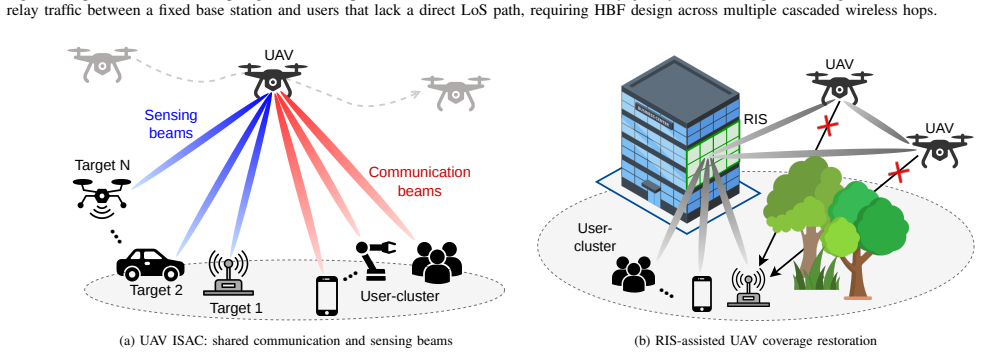
Hybrid analog-digital beamforming (HBF) has emerged as a key enabling technology for non-terrestrial networks (NTNs), where large antenna arrays are required to compensate for severe propagation loss but fully digital beamforming is often impractical due to radio-frequency (RF) chain cost, power consumption, and payload limitations. Compared with terrestrial networks, NTN platforms such as low Earth orbit (LEO) satellites and unmanned aerial vehicles (UAVs) impose distinctive HBF design challenges, including high mobility, Doppler effects, sparse line-of-sight-dominant channels, stringent on-board energy budgets, and, for UAVs, the additional coupling between beamforming and controllable platform placement or trajectory. This survey provides a systematic review of HBF techniques for NTN systems, with emphasis on LEO satellite and UAV communications. We first introduce common HBF architectures, signal models, channel representations, analog and digital precoder designs, and learning-aided approaches that form the shared technical foundation of existing works. We then survey both platforms under a common set of five categories, which cover system architecture and precoding design, time-varying beam management, network-level cooperation and scheduling, sensing capability and reconfigurable surfaces, and security and multiple access. Their platform-specific content differs most sharply in the second one, since the dominant time-varying mechanism is traffic-driven beam hopping on an LEO payload but mobility-aware beam tracking on a UAV. Finally, we discuss open research challenges and future directions toward scalable, robust, and hardware-efficient HBF in next-generation NTNs.
Figures


Figures from the paper (9 more)




Reference graph
Works this paper leans on
-
[15]
Robust fairness-aware hybrid beamforming for LEO satellite downlink under beam misalignment and SINR aging,
T. Van Le, N. Van Dinh, N.-T. Nguyen, N. C. Luong, X. Li, and D. I. Kim, “Robust fairness-aware hybrid beamforming for LEO satellite downlink under beam misalignment and SINR aging,”IEEE Trans. Veh. Technol., pp. 1–12, 2026
2026
-
[16]
Soft-min fairness optimization for limited-feedback LEO hybrid beamforming,
T. V . Le, “Soft-min fairness optimization for limited-feedback LEO hybrid beamforming,”IEEE Commun. Lett., vol. 30, pp. 1676–1680, 2026
2026
-
[85]
Conflict-triggered can- didate refinement for greedy sector hybrid beamforming in mmWave UA V systems,
N. Van Dinh, N.-T. Nguyen, and T. Van Le, “Conflict-triggered can- didate refinement for greedy sector hybrid beamforming in mmWave UA V systems,” inProc. IEEE Int. Conf. Commun. Syst. Netw. Technol. (CSNT), 2026, pp. 41–46
2026
-
[132]
Outage- aware hash-based opportunistic hybrid beamforming for high-mobility mmWave UA Vs,
T. V . Le, H. M. Truong, T.-D. Hoang, and N.-T. Nguyen, “Outage- aware hash-based opportunistic hybrid beamforming for high-mobility mmWave UA Vs,” inProc. IEEE 18th Int. Conf. Comput. Intell. Commun. Netw. (CICN), Jun. 2026, pp. 114–119
work page 2026
-
[1]
Non- terrestrial networking for 6G: Evolution, opportunities, and future directions,
F. Wang, S. Zhang, H. Yang, and T. Q. S. Quek, “Non- terrestrial networking for 6G: Evolution, opportunities, and future directions,” Dec. 2024, arXiv:2412.00820 [cs]. [Online]. Available: http://arxiv.org/abs/2412.00820
arXiv 2024
-
[2]
Modeling and analysis of non-terrestrial networks by spherical stochastic geometry: A survey,
R. Wang, M. A. Kishk, and M.-S. Alouini, “Modeling and analysis of non-terrestrial networks by spherical stochastic geometry: A survey,” IEEE Commun. Surveys Tuts., vol. 28, pp. 1879–1905, 2026
1905
-
[3]
A survey on hybrid beamforming techniques in 5G: Architecture and system model perspectives,
I. Ahmed, H. Khammari, A. Shahid, A. Musa, K. S. Kim, E. De Poorter, and I. Moerman, “A survey on hybrid beamforming techniques in 5G: Architecture and system model perspectives,”IEEE Commun. Surveys Tuts., vol. 20, no. 4, pp. 3060–3097, 2018
2018
-
[4]
Hybrid analog/digital precoding for downlink massive MIMO LEO satellite communications,
L. You, X. Qiang, K.-X. Li, C. G. Tsinos, W. Wang, X. Gao, and B. Ottersten, “Hybrid analog/digital precoding for downlink massive MIMO LEO satellite communications,”IEEE Trans. Wireless Com- mun., vol. 21, no. 8, pp. 5962–5976, Aug. 2022
2022
Show all 166 references
-
[5]
Beam squint-aware integrated sensing and communications for hybrid massive MIMO LEO satellite systems,
L. You, X. Qiang, C. G. Tsinos, F. Liu, W. Wang, X. Gao, and B. Ot- tersten, “Beam squint-aware integrated sensing and communications for hybrid massive MIMO LEO satellite systems,”IEEE J. Sel. Areas Commun., vol. 40, no. 10, pp. 2994–3009, Oct. 2022
2022
-
[6]
Joint user scheduling and hybrid beamforming design for massive MIMO LEO satellite multigroup multicast communication systems,
Y . Liu, C. Li, J. Li, and L. Feng, “Joint user scheduling and hybrid beamforming design for massive MIMO LEO satellite multigroup multicast communication systems,”Sensors, vol. 22, no. 18, p. 6858, Sep. 2022
2022
-
[7]
Deep learning (DL)-based channel prediction and hybrid beamforming for LEO satellite massive MIMO system,
Y . Zhang, A. Liu, P. Li, and S. Jiang, “Deep learning (DL)-based channel prediction and hybrid beamforming for LEO satellite massive MIMO system,”IEEE Internet Things J., vol. 9, no. 23, pp. 23 705– 23 715, Dec. 2022
2022
-
[8]
Energy- saving UA V-assisted multiuser communications with massive MIMO hybrid beamforming,
J. Du, W. Xu, Y . Deng, A. Nallanathan, and L. Vandendorpe, “Energy- saving UA V-assisted multiuser communications with massive MIMO hybrid beamforming,”IEEE Commun. Lett., vol. 24, no. 5, pp. 1100– 1104, May 2020
2020
-
[9]
Multi-UA V aided millimeter-wave networks: Positioning, clustering, and beamforming,
L. Zhu, J. Zhang, Z. Xiao, X.-G. Xia, and R. Zhang, “Multi-UA V aided millimeter-wave networks: Positioning, clustering, and beamforming,” IEEE Trans. Wireless Commun., vol. 21, no. 7, pp. 4637–4653, Jul. 2022
2022
-
[10]
Adaptive hybrid beamforming for UA V mmWave communications against asymmetric jitter,
W. Chen, C. Liu, W. Wang, M. Peng, and W. Zhang, “Adaptive hybrid beamforming for UA V mmWave communications against asymmetric jitter,”IEEE Trans. Wireless Commun., vol. 23, no. 8, pp. 9432–9445, Aug. 2024
2024
-
[11]
Deployment and robust hybrid beamforming for UA V mmWave communications,
K. Liu, Y . Liu, P. Yi, Z. Xiao, and X.-G. Xia, “Deployment and robust hybrid beamforming for UA V mmWave communications,”IEEE Trans. Commun., vol. 71, no. 5, pp. 3073–3086, May 2023
2023
-
[12]
A hybrid beamforming design for massive MIMO LEO satellite communications,
J. Palacios, N. Gonzalez-Prelcic, C. Mosquera, T. Shimizu, and C.-H. Wang, “A hybrid beamforming design for massive MIMO LEO satellite communications,”Front. Space Technol., vol. 2, p. 696464, Sep. 2021
2021
-
[13]
Robust energy-efficient hybrid beamforming design for massive MIMO LEO satellite communication systems,
Y . Liu, C. Li, J. Li, and L. Feng, “Robust energy-efficient hybrid beamforming design for massive MIMO LEO satellite communication systems,”IEEE Access, vol. 10, pp. 63 085–63 099, 2022
2022
-
[14]
Joint beamforming and dynamic beam hopping based on MAPPO for LEO satellite commu- nication system,
M. Meng, B. Hu, S. Chen, and S. Kang, “Joint beamforming and dynamic beam hopping based on MAPPO for LEO satellite commu- nication system,”IEEE Wireless Commun. Lett., vol. 14, no. 5, pp. 1461–1465, May 2025
2025
-
[17]
Hybrid beamforming design and resource allocation for UA V-aided wireless-powered mobile edge computing networks with NOMA,
W. Feng, J. Tang, N. Zhao, X. Zhang, X. Wang, K.-K. Wong, and J. A. Chambers, “Hybrid beamforming design and resource allocation for UA V-aided wireless-powered mobile edge computing networks with NOMA,”IEEE J. Sel. Areas Commun., vol. 39, no. 11, pp. 3271–3286, Nov. 2021
2021
-
[18]
Joint altitude and hybrid beamspace precoding optimization for UA V-enabled multiuser mmWave MIMO system,
Z. Chen, N. Zhao, D. K. C. So, J. Tang, X. Y . Zhang, and K.-K. Wong, “Joint altitude and hybrid beamspace precoding optimization for UA V-enabled multiuser mmWave MIMO system,”IEEE Trans. Veh. Technol., vol. 71, no. 2, pp. 1713–1725, Feb. 2022
2022
-
[19]
Cooperative hybrid beamforming design in multi-UA V mmWave MIMO systems,
Y . Wang, R. Zhang, X. Liu, L. Gan, and Y . Feng, “Cooperative hybrid beamforming design in multi-UA V mmWave MIMO systems,”IET Commun., vol. 17, no. 12, pp. 1384–1393, Jul. 2023
2023
-
[20]
Sensing-assisted beamforming and trajectory design for UA V-enabled networks,
X. Zhang, M. Peng, and C. Liu, “Sensing-assisted beamforming and trajectory design for UA V-enabled networks,”IEEE Trans. Veh. Technol., vol. 73, no. 3, pp. 3804–3819, Mar. 2024
2024
-
[21]
Joint hybrid beamforming and artificial noise design for secure multi-UA V ISAC networks,
R. Dong, B. Wang, C. Feng, J. Weng, C. Han, and J. Tian, “Joint hybrid beamforming and artificial noise design for secure multi-UA V ISAC networks,” Dec. 2025, arXiv:2509.23687 [eess]. [Online]. Available: http://arxiv.org/abs/2509.23687
2025
-
[22]
Beamforming for millimeter wave communi- cations: An inclusive survey,
S. Kutty and D. Sen, “Beamforming for millimeter wave communi- cations: An inclusive survey,”IEEE Commun. Surveys Tuts., vol. 18, no. 2, pp. 949–973, 2015
2015
-
[23]
Hybrid beamforming for massive MIMO: A survey,
A. F. Molisch, V . V . Ratnam, S. Han, Z. Li, S. L. H. Nguyen, L. Li, and K. Haneda, “Hybrid beamforming for massive MIMO: A survey,” IEEE Commun. Mag., vol. 55, no. 9, pp. 134–141, 2017
2017
-
[24]
Taxonomy and performance evaluation of hybrid beamforming for 5G and beyond systems,
M. Rihan, T. A. Soliman, C. Xu, L. Huang, and M. I. Dessouky, “Taxonomy and performance evaluation of hybrid beamforming for 5G and beyond systems,”IEEE Access, vol. 8, pp. 74 605–74 626, 2020
2020
-
[25]
A review on millimeter-wave hybrid beamforming for wireless intelligent transport systems,
W. Shahjehan, R. S. Rathore, S. W. Shah, M. Aljaidi, A. S. Sadiq, and O. Kaiwartya, “A review on millimeter-wave hybrid beamforming for wireless intelligent transport systems,”Future Internet, vol. 16, no. 9, p. 337, 2024
2024
-
[26]
Advancements in hybrid beamforming for massive MIMO: Design, challenges, and opportu- nities,
S. Srivastava, R. Singh, and A. Barinov, “Advancements in hybrid beamforming for massive MIMO: Design, challenges, and opportu- nities,”Integr. Technol. Elect. Electron. Biotechnol. Eng., pp. 527–533, 2025
2025
-
[27]
Smart beamforming techniques for high-speed and energy-efficient wireless systems: A survey,
R. Tala, T. Nahar, and C. Parmar, “Smart beamforming techniques for high-speed and energy-efficient wireless systems: A survey,” inProc. 6th Int. Conf. Opt. Wireless Technol. (OWT), vol. 14168. SPIE, 2026, pp. 349–356
2026
-
[28]
Precoding for high throughput satellite communication systems: A survey,
M. Khammassi, A. Kammoun, and M.-S. Alouini, “Precoding for high throughput satellite communication systems: A survey,” Jul. 2023, arXiv:2208.08542 [eess]. [Online]. Available: http: //arxiv.org/abs/2208.08542
2023 arXiv
-
[29]
Massive MIMO hybrid precoding for LEO satellite communications with twin-resolution phase shifters and nonlinear power amplifiers,
L. You, X. Qiang, K.-X. Li, C. G. Tsinos, W. Wang, X. Gao, and B. Ottersten, “Massive MIMO hybrid precoding for LEO satellite communications with twin-resolution phase shifters and nonlinear power amplifiers,”IEEE Trans. Commun., vol. 70, no. 8, pp. 5543– 5557, Aug. 2022
2022
-
[30]
A dynamic codebook design for analog beamforming in MIMO LEO satellite communications,
J. Palacios, N. Gonzalez-Prelcic, C. Mosquera, and T. Shimizu, “A dynamic codebook design for analog beamforming in MIMO LEO satellite communications,” inProc. IEEE Int. Conf. Commun. (ICC). Seoul, Korea, Republic of: IEEE, May 2022, pp. 1–6
2022
-
[31]
Hybrid beamforming optimization for UA V-enabled mmWave beamspace MIMO system,
Z. Chen, J. Tang, H. Tang, X. Zhang, D. K. Chun So, N. Zhao, and K.-K. Wong, “Hybrid beamforming optimization for UA V-enabled mmWave beamspace MIMO system,” inProc. IEEE 21st Int. Conf. Commun. Technol. (ICCT). Tianjin, China: IEEE, Oct. 2021, pp. 638–643
2021
-
[32]
Holographic MIMO for LEO satellite communications aided by reconfigurable holographic surfaces,
R. Deng, B. Di, H. Zhang, H. V . Poor, and L. Song, “Holographic MIMO for LEO satellite communications aided by reconfigurable holographic surfaces,”IEEE J. Sel. Areas Commun., vol. 40, no. 10, pp. 3071–3085, Oct. 2022
2022
-
[33]
Holographic metasurface-based beamforming for multi-altitude LEO satellite networks,
Q. Li, M. El-Hajjar, K. Cao, C. Xu, H. Haas, and L. Hanzo, “Holographic metasurface-based beamforming for multi-altitude LEO satellite networks,”IEEE Trans. Wireless Commun., vol. 24, no. 4, pp. 3103–3116, Apr. 2025
2025
-
[34]
Joint beamforming and 3D lo- cation optimization for multi-user holographic UA V communications,
C. K. Sheemar, A. Mahmood, C. K. Thomas, G. C. Alexandropoulos, J. Querol, S. Chatzinotas, and W. Saad, “Joint beamforming and 3D lo- cation optimization for multi-user holographic UA V communications,” IEEE Trans. Commun., vol. 74, pp. 4974–4988, 2026
2026
-
[35]
Hybrid beamforming design for ITS-aided THz wideband massive MIMO non-terrestrial communication,
Y . Wu, L. Xiao, J. Zhang, P. Xiao, and T. Jiang, “Hybrid beamforming design for ITS-aided THz wideband massive MIMO non-terrestrial communication,” inProc. IEEE 98th Veh. Technol. Conf. (VTC2023- Fall). Hong Kong, Hong Kong: IEEE, Oct. 2023, pp. 1–5
2023
-
[36]
Beam update rate analysis for low-complexity hybrid beamforming in LEO satellites,
M. Momani, T. Delamotte, and A. Knopp, “Beam update rate analysis for low-complexity hybrid beamforming in LEO satellites,” inProc. 12th Adv. Satell. Multimedia Syst. Conf. 18th Signal Process. Space Commun. Workshop (ASMS/SPSC). Sitges, Spain: IEEE, Feb. 2025, pp. 1–6
2025
-
[37]
Performance study of multiuser interference mitigation schemes for hybrid broad- band multibeam satellite architectures,
J. Arnau, B. Devillers, C. Mosquera, and A. Pérez-Neira, “Performance study of multiuser interference mitigation schemes for hybrid broad- band multibeam satellite architectures,”EURASIP J. Wireless Commun. Netw., vol. 2012, no. 1, p. 132, Dec. 2012. MANUSCRIPT SUBMITTED TO IE...
2012
-
[38]
Hybrid beamforming for massive MIMO over-the-air computation,
X. Zhai, X. Chen, J. Xu, and D. W. Kwan Ng, “Hybrid beamforming for massive MIMO over-the-air computation,”IEEE Trans. Commun., vol. 69, no. 4, pp. 2737–2751, Apr. 2021
2021
-
[39]
Serving cluster design and hybrid precoding for cell-free-assisted LEO satellite communications with nonlinear power amplifiers,
X. Miao, Y . Zhang, L. Liu, and Z. Zhang, “Serving cluster design and hybrid precoding for cell-free-assisted LEO satellite communications with nonlinear power amplifiers,”Electronics, vol. 14, no. 7, p. 1317, Mar. 2025
2025
-
[40]
Machine learning-based hybrid precoding with robust error for UA V mmWave massive MIMO,
H. Ren, L. Li, W. Xu, W. Chen, and Z. Han, “Machine learning-based hybrid precoding with robust error for UA V mmWave massive MIMO,” inProc. IEEE Int. Conf. Commun. (ICC). Shanghai, China: IEEE, May 2019, pp. 1–6
2019
-
[41]
Hybrid beam- forming for c-NOMA-enabled multi-UA Vs in 6G IoT networks,
M. Hevesli, A. M. Seid, M. Abdallah, and A. Erbad, “Hybrid beam- forming for c-NOMA-enabled multi-UA Vs in 6G IoT networks,” in Proc. IEEE Int. Conf. Commun. (ICC). Montreal, QC, Canada: IEEE, Jun. 2025, pp. 1304–1309
2025
-
[42]
A novel hybrid beamforming algorithm for massive MIMO LEO satellite communication,
A. L. Mahmood and Y . A. Mohammed, “A novel hybrid beamforming algorithm for massive MIMO LEO satellite communication,” Feb
-
[43]
Leveraging autoencoder for joint pilot waveforming and compressive sensing in beamspace channel estimation for LEO satellite communications,
M.-L. Ku, M.-H. Yang, Y .-Z. Song, and T. Q. S. Quek, “Leveraging autoencoder for joint pilot waveforming and compressive sensing in beamspace channel estimation for LEO satellite communications,” IEEE Internet Things J., pp. 1–1, 2026
2026
-
[44]
Location information assisted mmWave hybrid beamforming scheme for 5G-enabled UA Vs,
H. Wu, R. Hou, and B. Sun, “Location information assisted mmWave hybrid beamforming scheme for 5G-enabled UA Vs,” inProc. IEEE Int. Conf. Commun. (ICC). Dublin, Ireland: IEEE, Jun. 2020, pp. 1–6
2020
-
[45]
Hybrid sensor fusion beamforming for UA V mmWave communication,
Y . Sugimoto and G. K. Tran, “Hybrid sensor fusion beamforming for UA V mmWave communication,”Future Internet, vol. 17, no. 11, p. 521, Nov. 2025
2025
-
[46]
Low-complexity direction-of- arrival estimation with orthogonal matching pursuit for large-scale lens antenna array,
T.-D. Hoang, X. Huang, and P. Qin, “Low-complexity direction-of- arrival estimation with orthogonal matching pursuit for large-scale lens antenna array,”IEEE Trans. Commun., vol. 73, no. 6, pp. 3924–3939, Jun. 2025
2025
-
[47]
UA V-BS millimeter-wave 3-d hybrid beamforming with low power consumption,
L. Zhang, W. Zhang, M. Jia, and L. Xu, “UA V-BS millimeter-wave 3-d hybrid beamforming with low power consumption,” inProc. IEEE Int. Conf. Commun. (ICC). Rome, Italy: IEEE, May 2023, pp. 4664–4670
2023
-
[48]
Secrecy- energy efficient hybrid beamforming for satellite-terrestrial integrated networks,
Z. Lin, M. Lin, B. Champagne, W.-P. Zhu, and N. Al-Dhahir, “Secrecy- energy efficient hybrid beamforming for satellite-terrestrial integrated networks,”IEEE Trans. Commun., vol. 69, no. 9, pp. 6345–6360, Sep. 2021
2021
-
[49]
Hybrid beamforming for secure transmission of massive MIMO UA V communication networks,
R. Dong, B. Wang, K. Cao, and J. Tian, “Hybrid beamforming for secure transmission of massive MIMO UA V communication networks,” IEEE Syst. J., vol. 17, no. 3, pp. 4200–4211, Sep. 2023
2023
-
[50]
Joint beamforming optimiza- tion for UA V and an active RIS-assisted hybrid DFRC systems,
G. Wu, X. Zhao, H. Jiang, and Z. Chen, “Joint beamforming optimiza- tion for UA V and an active RIS-assisted hybrid DFRC systems,”IEEE Internet Things J., vol. 12, no. 18, pp. 38 059–38 072, Sep. 2025
2025
-
[51]
Hybrid precoding design for RSMA-enabled LEO-ISAC satellite system in PIoT,
X. Liu, X. Wang, F. Du, S. Geng, and X. Zhao, “Hybrid precoding design for RSMA-enabled LEO-ISAC satellite system in PIoT,”IEEE Trans. Veh. Technol., vol. 74, no. 10, pp. 15 704–15 717, Oct. 2025
2025
-
[52]
Deep double-pilot-based hybrid precoding in UA V-enabled mmWave massive MIMO,
Z. Hong, T. Li, and F. Li, “Deep double-pilot-based hybrid precoding in UA V-enabled mmWave massive MIMO,”EURASIP J. Wireless Commun. Netw., vol. 2020, no. 1, p. 229, 2020
2020
-
[53]
Deep learning based energy- efficient hybird RSMA for UA V-assisted mmWave communications,
K. Wang, Y . Sun, and T. Q. S. Quek, “Deep learning based energy- efficient hybird RSMA for UA V-assisted mmWave communications,” IEEE Trans. Veh. Technol., vol. 74, no. 3, pp. 4625–4638, Mar. 2025
2025
-
[54]
Hybrid RIS-assisted multi-hop indoor-outdoor secure communication in UA V mmWave networks,
A. Kakati, G. Li, E. M. Diallo, M. A. Ouamri, M. I. Khalid, A. B. M. Adam, and X. Li, “Hybrid RIS-assisted multi-hop indoor-outdoor secure communication in UA V mmWave networks,”IEEE Trans. Veh. Technol., pp. 1–16, 2025
2025
-
[55]
Sub-connected hybrid precoding and trajec- tory optimization using deep reinforcement learning for energy-efficient millimeter-wave UA V communications,
Silvirianti and S. Y . Shin, “Sub-connected hybrid precoding and trajec- tory optimization using deep reinforcement learning for energy-efficient millimeter-wave UA V communications,”IEEE Wireless Commun. Lett., vol. 12, no. 9, pp. 1642–1646, Sep. 2023
2023
-
[56]
A low-complexity hybrid precoding for wideband satellite communication systems,
I. Hwang and D. Hong, “A low-complexity hybrid precoding for wideband satellite communication systems,”IEEE Trans. Wireless Commun., vol. 24, no. 11, pp. 9233–9248, Nov. 2025
2025
-
[57]
Hybrid beamforming for satellite ground stations in the mmWave band,
A. Struyf, N. Ismaili, P. De Doncker, D. Lederer, and F. Quitin, “Hybrid beamforming for satellite ground stations in the mmWave band,” inProc. 19th Eur. Conf. Antennas Propag. (EuCAP). Stockholm, Sweden: IEEE, Mar. 2025, pp. 1–5
2025
-
[58]
Hybrid multibeamforming receiver with high-precision beam steering for low Earth orbit satellite com- munication,
Y .-E. Chi, J. Park, and S.-O. Park, “Hybrid multibeamforming receiver with high-precision beam steering for low Earth orbit satellite com- munication,”IEEE Trans. Antennas Propag., vol. 71, no. 7, pp. 5695– 5707, Jul. 2023
2023
-
[59]
Spatial resource manage- ment in LEO satellite,
A. Ivanov, R. Bychkvo, and E. Tcatcorin, “Spatial resource manage- ment in LEO satellite,”IEEE Trans. Veh. Technol., vol. 69, no. 12, pp. 15 623–15 632, Dec. 2020
2020
-
[60]
Physical layer representation in LEO satellite with a hybrid multi-beamforming,
A. Ivanov, M. Stoliarenko, A. Savinov, and S. Novichkov, “Physical layer representation in LEO satellite with a hybrid multi-beamforming,” inProc. 15th Int. Wireless Commun. Mobile Comput. Conf. (IWCMC). Tangier, Morocco: IEEE, Jun. 2019, pp. 140–145
2019
-
[61]
Digital precoders for partially spectral overlapping subarrays in mmWave satellite communications,
F.-C. Hsiao, M.-L. Ku, and Y .-Z. Song, “Digital precoders for partially spectral overlapping subarrays in mmWave satellite communications,” IEEE Access, vol. 12, pp. 187 265–187 277, 2024
2024
-
[62]
Hybrid precoding algorithms for non terrestrial networks,
D. Kong, G. Taricco, and Q. Guo, “Hybrid precoding algorithms for non terrestrial networks,” inProc. IEEE Int. Conf. Softw. Telecommun. Comput. Netw. (SoftCOM), 2025, pp. 1–6
2025
-
[63]
Joint beam hopping and precoding for dense LEO satellite communication systems,
G. Cui, X. Xin, L. Xu, W. Wang, and X. Tang, “Joint beam hopping and precoding for dense LEO satellite communication systems,”IEEE Internet Things J., vol. 12, no. 15, pp. 32 132–32 147, Aug. 2025
2025
-
[64]
On beam hopping pattern design for satellite communication systems with hybrid precoding,
Z. Han, T. Yang, and R. Liu, “On beam hopping pattern design for satellite communication systems with hybrid precoding,”IEEE Trans. Veh. Technol., vol. 73, no. 1, pp. 1364–1369, Jan. 2024
2024
-
[65]
Beam hopping pattern design using Viterbi algorithm for satellite communication systems,
Z. Han, T. Yang, R. Liu, and S. Jiao, “Beam hopping pattern design using Viterbi algorithm for satellite communication systems,” inProc. IEEE Int. Conf. Commun. (ICC). Rome, Italy: IEEE, May 2023, pp. 2590–2594
2023
-
[66]
Hybrid beamforming design for beam- hopping LEO satellite communications,
J. Wang, C. Qi, and S. Yu, “Hybrid beamforming design for beam- hopping LEO satellite communications,” inProc. IEEE Global Com- mun. Conf. (GLOBECOM). Kuala Lumpur, Malaysia: IEEE, Dec. 2023, pp. 3959–3964
2023
-
[67]
Real-time digital pre- distortion for rapid beam hopping in LEO satellites,
Y . Deng, Z. Deng, K. Wang, W. Lin, and Y . Wei, “Real-time digital pre- distortion for rapid beam hopping in LEO satellites,”IEEE Commun. Lett., vol. 29, no. 6, pp. 1426–1430, Jun. 2025
2025
-
[68]
Multi-satellite cooperative networks: Joint hybrid beamforming and user scheduling design,
X. Zhang, S. Sun, M. Tao, Q. Huang, and X. Tang, “Multi-satellite cooperative networks: Joint hybrid beamforming and user scheduling design,” Dec. 2023, arXiv:2310.08095 [cs]. [Online]. Available: http://arxiv.org/abs/2310.08095
2023 arXiv
-
[69]
Joint hybrid beam- forming and user scheduling for multi-satellite cooperative networks,
X. Zhang, S. Sun, M. Tao, Q. Huang, and X. Tang, “Joint hybrid beam- forming and user scheduling for multi-satellite cooperative networks,” inProc. IEEE Wireless Commun. Netw. Conf. (WCNC). Glasgow, United Kingdom: IEEE, Mar. 2023, pp. 1–6
2023
-
[70]
Distributed hybrid beam- forming for downlink multi-user space-MIMO communications,
S. Xu, G. Chen, Y . Ma, and R. Tafazolli, “Distributed hybrid beam- forming for downlink multi-user space-MIMO communications,”IEEE Trans. Veh. Technol., vol. 74, no. 10, pp. 16 574–16 578, Oct. 2025
2025
-
[71]
Hybrid beamforming, user scheduling, and resource allocation for integrated terrestrial-satellite communication,
P. Deyi, A. Bandi, Y . Li, S. Chatzinotas, and B. Ottersten, “Hybrid beamforming, user scheduling, and resource allocation for integrated terrestrial-satellite communication,”IEEE Trans. Veh. Technol., vol. 70, no. 9, pp. 8868–8882, Sep. 2021
2021
-
[72]
User selection algorithms and hybrid beamforming for power minimization in multiuser massive MIMO- OFDM LEO satellite communication systems,
L.-X. Wang and Y .-F. Chen, “User selection algorithms and hybrid beamforming for power minimization in multiuser massive MIMO- OFDM LEO satellite communication systems,” inProc. 10th Int. Conf. Appl. Syst. Innov. (ICASI). Kyoto, Japan: IEEE, Apr. 2024, pp. 49–51
2024
-
[73]
Integrated communications and localization for massive MIMO LEO satellite systems,
L. You, X. Qiang, Y . Zhu, F. Jiang, C. G. Tsinos, W. Wang, H. Wymeersch, X. Gao, and B. Ottersten, “Integrated communications and localization for massive MIMO LEO satellite systems,”IEEE Trans. Wireless Commun., vol. 23, no. 9, pp. 11 061–11 075, Sep. 2024
2024
-
[74]
Robust hybrid beamforming design for RSMA-assisted multicast multi-beam LEO systems,
C. Cao, Y . Cang, and M. Chen, “Robust hybrid beamforming design for RSMA-assisted multicast multi-beam LEO systems,” inProc. IEEE 101st Veh. Technol. Conf. (VTC2025-Spring). Oslo, Norway: IEEE, Jun. 2025, pp. 1–6
2025
-
[75]
LEO satellite hybrid beamforming with reconfigurable intelligent surface deployment,
B. Kang, S. Yun, and J. Lee, “LEO satellite hybrid beamforming with reconfigurable intelligent surface deployment,” inProc. 15th Int. Conf. Inf. Commun. Technol. Converg. (ICTC). Jeju Island, Korea, Republic of: IEEE, Oct. 2024, pp. 134–135
2024
-
[76]
Maximizing energy efficiency for LEO satellite systems with massive MIMO-NOMA,
L. Li and X. Liu, “Maximizing energy efficiency for LEO satellite systems with massive MIMO-NOMA,” inProc. 9th Int. Conf. Comput. Commun. (ICCC). Chengdu, China: IEEE, Dec. 2023, pp. 190–197
2023
-
[77]
Interference-aware multiuser hybrid precoding for coexistence with LEO satellite communication,
N. Razavi, M. Bayraktar, N. González-Prelcic, and R. W. Heath, “Interference-aware multiuser hybrid precoding for coexistence with LEO satellite communication,” inProc. IEEE Mil. Commun. Conf. (MILCOM). Los Angeles, CA, USA: IEEE, Oct. 2025, pp. 344–349
2025
-
[78]
Gradient descent-based direction- of-arrival estimation for lens antenna array,
T.-D. Hoang, X. Huang, and P. Qin, “Gradient descent-based direction- of-arrival estimation for lens antenna array,”IEEE Signal Process. Lett., vol. 30, pp. 838–842, Jul. 2023
2023
-
[79]
Improved Root-MUSIC-aided joint AoA and AoD estimation for lens array-based MIMO systems,
T.-D. Hoang, X. Huang, and P. Qin, “Improved Root-MUSIC-aided joint AoA and AoD estimation for lens array-based MIMO systems,” inProc. IEEE Int. Conf. Commun. (ICC), Montreal, QC, Canada, Jun. 2025, pp. 5530–5535
2025
-
[80]
Joint coherent sig- nal enumeration and direction estimation for lens array-based systems,
T.-D. Hoang, L.-Z. Song, X. Huang, and P.-Y . Qin, “Joint coherent sig- nal enumeration and direction estimation for lens array-based systems,” IEEE Trans. Signal Process., pp. 1–17, 2026, early Access. MANUSCRIPT SUBMITTED TO IEEE COMMUNICATIONS SURVEYS AND TUTORIALS, 2026 29
2026
-
[81]
Energy efficiency beamforming design for UA V communica- tions with broadband hybrid polarization antenna arrays,
G. Zhou, “Energy efficiency beamforming design for UA V communica- tions with broadband hybrid polarization antenna arrays,”IEEE Access, vol. 7, pp. 34 521–34 532, 2019
2019
-
[82]
On the beamforming design of millimeter wave UA V networks: Power vs. capacity trade-offs,
Y . Wang, M. Giordani, and M. Zorzi, “On the beamforming design of millimeter wave UA V networks: Power vs. capacity trade-offs,” Oct. 2020, arXiv:2010.12380 [cs]. [Online]. Available: http://arxiv.org/abs/2010.12380
2020 arXiv
-
[83]
Power optimization of unmanned aerial vehicle-assisted future wireless communication using hybrid beamforming technique in disaster management,
R. Sharma, S. R. Chopra, and A. Gupta, “Power optimization of unmanned aerial vehicle-assisted future wireless communication using hybrid beamforming technique in disaster management,”IOP Conf. Ser.: Earth Environ. Sci., vol. 1285, no. 1, p. 012025, Jan. 2024
2024
-
[84]
Energy efficiency hybrid precoding for UA V inspection communication system,
L. Minzheng and Z. Jiaqing, “Energy efficiency hybrid precoding for UA V inspection communication system,”J. Phys.: Conf. Ser., vol. 1948, no. 1, p. 012020, Jun. 2021
1948
-
[86]
Mitigating complex- ity in UA V MIMO: Sub-block-level holographic hybrid precoding for spectral and power efficiency,
D. Geng, Z. Wei, X. Tang, W. Ji, Y . Ji, and Q. Shi, “Mitigating complex- ity in UA V MIMO: Sub-block-level holographic hybrid precoding for spectral and power efficiency,” inProc. IEEE 25th Int. Conf. Commun. Technol. (ICCT). Shenyang, China: IEEE, Oct. 2025, pp. 1059–1063
2025
-
[87]
Robust hybrid beamforming for jittering UA V with mmWave antenna array,
K. Liu, Y . Liu, T. Mao, Z. Xiao, and X.-G. Xia, “Robust hybrid beamforming for jittering UA V with mmWave antenna array,” inProc. IEEE/CIC Int. Conf. Commun. China (ICCC). Sanshui, Foshan, China: IEEE, Aug. 2022, pp. 244–249
2022
-
[88]
SSB-based sensing-assisted robust beamforming for high-mobility UA V communications in LAWN,
A. Tang, S. Wang, and Y . Xu, “SSB-based sensing-assisted robust beamforming for high-mobility UA V communications in LAWN,” arXiv preprint arXiv:2604.19010, 2026
2026 arXiv
-
[89]
Machine-learning beam tracking and weight optimization for mmWave multi-UA V links,
H.-L. Chiang, K.-C. Chen, W. Rave, M. Khalili Marandi, and G. Fet- tweis, “Machine-learning beam tracking and weight optimization for mmWave multi-UA V links,”IEEE Trans. Wireless Commun., vol. 20, no. 8, pp. 5481–5494, Aug. 2021
2021
-
[90]
Unscented Kalman filter-based beam tracking in NR MIMO system using hybrid beamforming,
Y . Sim, S. Sin, J. Cho, K. Kim, S. Moon, and I. Hwang, “Unscented Kalman filter-based beam tracking in NR MIMO system using hybrid beamforming,” inProc. Int. Conf. Artif. Intell. Inf. Commun. (ICAIIC). Bali, Indonesia: IEEE, Feb. 2023, pp. 650–653
2023
-
[91]
Joint trajectory and hybrid beamforming design for multi antenna UA V enabled network,
F. Zhou and R. Wang, “Joint trajectory and hybrid beamforming design for multi antenna UA V enabled network,”IEEE Access, vol. 9, pp. 49 131–49 140, 2021
2021
-
[92]
The impact of beamwidth on temporal channel variation in vehicular channels and its implications,
V . Va, J. Choi, and R. W. Heath, “The impact of beamwidth on temporal channel variation in vehicular channels and its implications,”IEEE Trans. Veh. Technol., vol. 66, no. 6, pp. 5014–5029, 2017
2017
-
[93]
Relay hybrid precoding in UA V-assisted wideband millimeter- wave massive MIMO system,
T. Mir, M. Waqas, S. Tu, C. Fang, W. Ni, R. MacKenzie, X. Xue, and Z. Han, “Relay hybrid precoding in UA V-assisted wideband millimeter- wave massive MIMO system,”IEEE Trans. Wireless Commun., vol. 21, no. 9, pp. 7040–7054, Sep. 2022
2022
-
[94]
Efficient dual-hop massive MIMO IoT networks with UA V DF relaying and hybrid beamforming,
A. Koc, M. Mahmood, and T. Le-Ngoc, “Efficient dual-hop massive MIMO IoT networks with UA V DF relaying and hybrid beamforming,” inProc. IEEE Global Commun. Conf. (GLOBECOM). Kuala Lumpur, Malaysia: IEEE, Dec. 2023, pp. 6414–6419
2023
-
[95]
PSO-based joint UA V positioning and hybrid precoding in UA V-assisted massive MIMO systems,
M. Mahmood, A. Koc, and T. Le-Ngoc, “PSO-based joint UA V positioning and hybrid precoding in UA V-assisted massive MIMO systems,” inProc. IEEE 96th Veh. Technol. Conf. (VTC2022-Fall). London, United Kingdom: IEEE, Sep. 2022, pp. 1–6
2022
-
[96]
Perfor- mance and user association optimization for UA V relay-assisted mm- wave massive MIMO systems,
W. Belaoura, K. Ghanem, M. Z. Shakir, and M. O. Hasna, “Perfor- mance and user association optimization for UA V relay-assisted mm- wave massive MIMO systems,”IEEE Access, vol. 10, pp. 49 611– 49 624, 2022
2022
-
[97]
Coordinated beamforming for UA V-aided millimeter-wave communications using GPML-based channel estimation,
J. Wang, R. Han, L. Bai, T. Zhang, J. Liu, and J. Choi, “Coordinated beamforming for UA V-aided millimeter-wave communications using GPML-based channel estimation,”IEEE Trans. Cogn. Commun. Netw., vol. 7, no. 1, pp. 100–109, Mar. 2021
2021
-
[98]
Spectral efficiency and hybrid beamform- ing for multi-user in airborne integrated sensing and communication systems,
A. Salih and S. Al-Dharrab, “Spectral efficiency and hybrid beamform- ing for multi-user in airborne integrated sensing and communication systems,”IEEE Open J. Commun. Soc., vol. 6, pp. 1190–1201, 2025
2025
-
[99]
Location-based hybrid precoding schemes and QoS-aware power allocation for radar-aided UA V-UGV cooperative systems,
X. Xu, R. Zhang, and Y . Qian, “Location-based hybrid precoding schemes and QoS-aware power allocation for radar-aided UA V-UGV cooperative systems,”IEEE Access, vol. 10, pp. 50 947–50 958, 2022
2022
-
[100]
3D spherical directly- connected antenna array for low-altitude UA V swarm ISAC,
H. Jiang, Z. Dong, Z. Zhou, and Y . Zeng, “3D spherical directly- connected antenna array for low-altitude UA V swarm ISAC,”arXiv preprint arXiv:2603.17620, 2026
2026
-
[101]
Energy-efficient hybrid beamforming for multilayer RIS-assisted secure integrated terrestrial-aerial networks,
Y . Sun, K. An, Y . Zhu, G. Zheng, K.-K. Wong, S. Chatzinotas, D. W. K. Ng, and D. Guan, “Energy-efficient hybrid beamforming for multilayer RIS-assisted secure integrated terrestrial-aerial networks,”IEEE Trans. Commun., vol. 70, no. 6, pp. 4189–4210, Jun. 2022
2022
-
[102]
Hybrid beam- forming design for securing large-scale antenna array empowered UA V communication system,
R. Dong, B. Wang, K. Cao, T. Cheng, and D. Diao, “Hybrid beam- forming design for securing large-scale antenna array empowered UA V communication system,” inProc. 13th Int. Conf. Wireless Commun. Signal Process. (WCSP). Changsha, China: IEEE, Oct. 2021, pp. 1–5
2021
-
[103]
Physical layer security communica- tions and path planning for UA V base stations,
G. Niu, Q. Cao, and M.-O. Pun, “Physical layer security communica- tions and path planning for UA V base stations,” inProc. 32nd Wireless Opt. Commun. Conf. (WOCC). Newark, NJ, USA: IEEE, May 2023, pp. 1–6
2023
-
[104]
Hybrid direction of arrival precoding for multiple un- manned aerial vehicles aided non-orthogonal multiple access in 6G networks,
L. Pierucci, “Hybrid direction of arrival precoding for multiple un- manned aerial vehicles aided non-orthogonal multiple access in 6G networks,”Appl. Sci., vol. 12, no. 2, p. 895, Jan. 2022
2022
-
[105]
Energy efficiency of multi-user mmWave rate-splitting multiple access with hybrid precoding,
J. S. Everett and B. L. Mark, “Energy efficiency of multi-user mmWave rate-splitting multiple access with hybrid precoding,” inProc. IEEE Int. Conf. Commun. Workshops (ICC Wkshps). Denver, CO, USA: IEEE, Jun. 2024, pp. 1846–1851
2024
-
[106]
RIS-assisted secure UA V com- munication scheme against active jamming and passive eavesdropping,
Y . Shang, Y . Peng, R. Ye, and J. Lee, “RIS-assisted secure UA V com- munication scheme against active jamming and passive eavesdropping,” IEEE Trans. Intell. Transp. Syst., vol. 25, no. 11, pp. 16 953–16 963, Jul. 2024
2024
-
[107]
Integrated STAR-RIS and UA V for satellite IoT communications: An energy-efficient approach,
W. D. Lukito, W. Xiang, P. Lai, P. Cheng, C. Liu, K. Yu, and X. Zhu, “Integrated STAR-RIS and UA V for satellite IoT communications: An energy-efficient approach,”IEEE Internet Things J., vol. 12, no. 9, pp. 11 356–11 371, Oct. 2024
2024
-
[108]
Intelligent discrete RIS phase configuration in se- cure non-terrestrial networks: A heuristic conditional GAN approach,
T. Bao, M. Elsayed, P. E. Iturria-Rivera, Y . Ozcan, M. Bavand, and M. Erol-Kantarci, “Intelligent discrete RIS phase configuration in se- cure non-terrestrial networks: A heuristic conditional GAN approach,” IEEE Trans. Netw. Sci. Eng., May 2026
2026
-
[109]
Delay-phase precoding for wideband THz massive MIMO,
L. Dai, J. Tan, Z. Chen, and H. V . Poor, “Delay-phase precoding for wideband THz massive MIMO,”IEEE Trans. Wireless Commun., vol. 21, no. 9, pp. 7271–7286, Sep. 2022
2022
-
[110]
Beam squint mitigation in wideband hybrid beamform- ers: Full-TTD, sparse-TTD, or non-TTD?
M. Monemi, M. A. Fallah, M. Rasti, O. Yazdani, O. L. A. López, and M. Latva-aho, “Beam squint mitigation in wideband hybrid beamform- ers: Full-TTD, sparse-TTD, or non-TTD?”IEEE Wireless Commun., 2026, early Access
2026
-
[111]
Beamfocusing optimization for near-field wideband multi-user communications,
Z. Wang, X. Mu, and Y . Liu, “Beamfocusing optimization for near-field wideband multi-user communications,”IEEE Trans. Commun., vol. 73, no. 1, pp. 555–572, Jan. 2025
2025
-
[112]
TTD configurations for near- field beamforming: Parallel, serial, or hybrid?
Z. Wang, X. Mu, Y . Liu, and R. Schober, “TTD configurations for near- field beamforming: Parallel, serial, or hybrid?”IEEE Trans. Commun., vol. 72, no. 6, pp. 3783–3799, Jun. 2024
2024
-
[113]
Beamforming design for the distributed RISs-aided THz communications with double-layer true time delays,
G. Sun, W. Yan, W. Hao, C. Huang, and C. Yuen, “Beamforming design for the distributed RISs-aided THz communications with double-layer true time delays,”IEEE Trans. Veh. Technol., vol. 73, no. 3, pp. 3886– 3900, Mar. 2024
2024
-
[114]
Joint delay-phase precoding under true- time delay constraints in wideband sub-THz hybrid massive MIMO systems,
D. Q. Nguyen and T. Kim, “Joint delay-phase precoding under true- time delay constraints in wideband sub-THz hybrid massive MIMO systems,”IEEE Trans. Commun., vol. 72, no. 10, pp. 6633–6646, Oct. 2024
2024
-
[115]
Hybrid delay-phase precoding in wideband UM-MIMO systems under true time delay and phase shifter hardware limitations,
A. Najjar, M. El-Absi, and T. Kaiser, “Hybrid delay-phase precoding in wideband UM-MIMO systems under true time delay and phase shifter hardware limitations,”IEEE Trans. Wireless Commun., vol. 23, no. 7, pp. 7246–7262, Jul. 2024
2024
-
[116]
On the effects of calibration errors and mutual coupling on the beam pattern of an antenna array,
C. M. Schmid, S. Schuster, R. Feger, and A. Stelzer, “On the effects of calibration errors and mutual coupling on the beam pattern of an antenna array,”IEEE Trans. Antennas Propag., vol. 61, no. 8, pp. 4063– 4072, Aug. 2013
2013
-
[117]
Rotman lens-based two-tier hybrid beamforming for wideband mmwave MIMO-OFDM system with beam squint,
B. Liu and H. Zhu, “Rotman lens-based two-tier hybrid beamforming for wideband mmwave MIMO-OFDM system with beam squint,” EURASIP J. Wireless Commun. Netw., vol. 2018, p. 267, Nov. 2018
2018
-
[118]
Beam squint in ultra-wideband mmWave systems: RF lens array vs. phase-shifter-based array,
S.-H. Park, B. Kim, D. K. Kim, L. Dai, K.-K. Wong, and C.-B. Chae, “Beam squint in ultra-wideband mmWave systems: RF lens array vs. phase-shifter-based array,”IEEE Wirel. Commun., vol. 30, no. 4, pp. 82–89, May 2022
2022
-
[119]
Circuit type multiple beamforming networks for antenna arrays in 5G and 6G terrestrial and non-terrestrial networks,
Y . J. Guo, M. Ansari, and N. J. G. Fonseca, “Circuit type multiple beamforming networks for antenna arrays in 5G and 6G terrestrial and non-terrestrial networks,”IEEE J. Microw., vol. 1, no. 3, pp. 704–722, Jul. 2021
2021
-
[120]
A 3d-printed GRIN lens array for hybrid beamforming: Design and experimental validation,
Y . Wen, S. Zhu, Z. Cui, L. Song, H. Zhang, and P. Qin, “A 3d-printed GRIN lens array for hybrid beamforming: Design and experimental validation,”IEEE Trans. Antennas Propag., May 2026, early Access
2026
-
[121]
Exploiting spatial- wideband effect for fast AoA estimation at lens antenna array,
K. Wu, W. Ni, T. Su, R. P. Liu, and Y . J. Guo, “Exploiting spatial- wideband effect for fast AoA estimation at lens antenna array,”IEEE J. Sel. Topics Signal Process., vol. 13, no. 5, pp. 902–917, Sep. 2019
2019
-
[122]
Green joint communications and sensing employing analog multi- beam antenna arrays,
K. Wu, J. A. Zhang, X. Huang, J. Robert W. Heath, and Y . J. Guo, “Green joint communications and sensing employing analog multi- beam antenna arrays,”IEEE Commun. Mag., vol. 61, no. 7, pp. 172– 178, Jul. 2023. MANUSCRIPT SUBMITTED TO IEEE COMMUNICATIONS SURVEYS AND TUTORIALS, 2026 30
2023
-
[123]
Energy-efficient dynamic-subarray with fixed true-time-delay design for terahertz wideband hybrid beamform- ing,
L. Yan, C. Han, and J. Yuan, “Energy-efficient dynamic-subarray with fixed true-time-delay design for terahertz wideband hybrid beamform- ing,”IEEE J. Sel. Areas Commun., vol. 40, no. 10, pp. 2840–2854, Oct. 2022
2022
-
[124]
Beamforming for beam- squint effect mitigation in LEO satellite communication systems,
J. H. Lee, P. Kim, J.-Y . Lee, and K. Son, “Beamforming for beam- squint effect mitigation in LEO satellite communication systems,”ICT Express, vol. 11, no. 6, pp. 1103–1109, Dec. 2025
2025
-
[125]
Embracing beam-squint effects for wideband LEO satellite communications: A 3D rainbow beamforming approach,
J. Park, S. Kim, W. Shin, and H. V . Poor, “Embracing beam-squint effects for wideband LEO satellite communications: A 3D rainbow beamforming approach,”IEEE Trans. Wireless Commun., vol. 25, pp. 16 136–16 152, Apr. 2026
2026
-
[126]
Tensor-based channel estimation considering beam squint effects in LEO satellite communications,
K. Son, P. Kim, and J. H. Lee, “Tensor-based channel estimation considering beam squint effects in LEO satellite communications,” IEEE Access, vol. 13, pp. 140 282–140 296, 2025
2025
-
[127]
Machine learning- empowered beam management for mmWave-NOMA in multi-UA Vs networks,
H. Gao, C. Jia, W. Xu, C. Yuen, Z. Feng, and Y . Lu, “Machine learning- empowered beam management for mmWave-NOMA in multi-UA Vs networks,”IEEE Trans. Veh. Technol., vol. 71, no. 8, pp. 8487–8502, May 2022
2022
-
[128]
5G from space: An overview of 3GPP non-terrestrial networks,
X. Lin, S. Rommer, S. Euler, E. A. Yavuz, and R. S. Karlsson, “5G from space: An overview of 3GPP non-terrestrial networks,”IEEE Commun. Stand. Mag., vol. 5, no. 4, pp. 147–153, Oct. 2021
2021
-
[129]
Multi-agent reinforcement learning counteracts delayed CSI in multi-satellite systems,
M. Aristodemou, Y . Omid, S. Lambotharan, M. Derakhshan, and L. Hanzo, “Multi-agent reinforcement learning counteracts delayed CSI in multi-satellite systems,”arXiv preprint arXiv:2603.16470, 2026
2026
-
[130]
Beam management in low Earth orbit satellite communication with handover frequency control and satellite- terrestrial spectrum sharing,
J. Zhu, Y . Sun, and M. Peng, “Beam management in low Earth orbit satellite communication with handover frequency control and satellite- terrestrial spectrum sharing,”IEEE Trans. Commun., vol. 73, no. 7, pp. 5247–5263, Dec. 2024
2024
-
[131]
Beam management in low Earth orbit satellite networks with random traffic arrival and time-varying topology,
J. Zhu, Y . Sun, and M. Peng, “Beam management in low Earth orbit satellite networks with random traffic arrival and time-varying topology,”IEEE Trans. Veh. Technol., vol. 73, no. 9, pp. 13 352–13 367, May 2024
2024
-
[133]
Hybrid beamforming with a reduced number of phase shifters for massive MIMO systems,
S. Payami, M. Ghoraishi, M. Dianati, and M. Sellathurai, “Hybrid beamforming with a reduced number of phase shifters for massive MIMO systems,”IEEE Trans. Veh. Technol., vol. 67, no. 6, pp. 4843– 4851, Feb. 2018
2018
-
[134]
Massive MIMO for cellular-connected UA V: Challenges and promising solutions,
Y . Huang, Q. Wu, R. Lu, X. Peng, and R. Zhang, “Massive MIMO for cellular-connected UA V: Challenges and promising solutions,”IEEE Commun. Mag., vol. 59, no. 2, pp. 84–90, Mar. 2021
2021
-
[135]
Learning to optimize: Training deep neural networks for wireless resource management,
H. Sun, X. Chen, Q. Shi, M. Hong, X. Fu, and N. D. Sidiropoulos, “Learning to optimize: Training deep neural networks for wireless resource management,” inProc. IEEE Int. Workshop Signal Process. Adv. Wireless Commun. (SPAWC), 2017, pp. 1–6
2017
-
[136]
Matrix-inverse-free deep unfolding of the weighted MMSE beamforming algorithm,
L. Pellaco, M. Bengtsson, and J. Jaldén, “Matrix-inverse-free deep unfolding of the weighted MMSE beamforming algorithm,”IEEE Open J. Commun. Soc., vol. 3, pp. 65–81, Dec. 2021
2021
-
[137]
Deep graph unfolding for beamforming in MU-MIMO interference networks,
A. Chowdhury, G. Verma, A. Swami, and S. Segarra, “Deep graph unfolding for beamforming in MU-MIMO interference networks,” IEEE Trans. Wireless Commun., vol. 23, no. 5, pp. 4889–4903, Oct. 2023
2023
-
[138]
DeepMIMO: A generic deep learning dataset for millimeter wave and massive MIMO applications,
A. Alkhateeb, “DeepMIMO: A generic deep learning dataset for millimeter wave and massive MIMO applications,”arXiv preprint arXiv:1902.06435, 2019
1902 arXiv
-
[139]
ViWi vision- aided mmWave beam tracking: Dataset, task, and baseline solutions,
M. Alrabeiah, J. Booth, A. Hredzak, and A. Alkhateeb, “ViWi vision- aided mmWave beam tracking: Dataset, task, and baseline solutions,” arXiv preprint arXiv:2002.02445, 2020
2002 arXiv
-
[140]
Towards real-world 6G drone communication: Position and camera aided beam prediction,
G. Charan, A. Hredzak, C. Stoddard, B. Berrey, M. Seth, H. Nunez, and A. Alkhateeb, “Towards real-world 6G drone communication: Position and camera aided beam prediction,” inProc. IEEE Globecom Workshops (GC Wkshps), 2022, pp. 2951–2956
2022
-
[141]
Location-aware predictive beamforming for UA V communications: A deep learning approach,
C. Liu, W. Yuan, Z. Wei, X. Liu, and D. W. K. Ng, “Location-aware predictive beamforming for UA V communications: A deep learning approach,”IEEE Wireless Commun. Lett., vol. 10, no. 3, pp. 668–672, Dec. 2020
2020
-
[142]
Radar aided 6G beam prediction: Deep learning algorithms and real-world demonstration,
U. Demirhan and A. Alkhateeb, “Radar aided 6G beam prediction: Deep learning algorithms and real-world demonstration,” inProc. IEEE Wireless Commun. Netw. Conf. (WCNC), 2022, pp. 2655–2660
2022
-
[143]
Implementation of a channel model for non-terrestrial networks in ns-3,
M. Sandri, M. Pagin, M. Giordani, and M. Zorzi, “Implementation of a channel model for non-terrestrial networks in ns-3,” inProc. Workshop ns-3 (WNS3), 2023, pp. 28–34
2023
-
[144]
Sionna RT: Differentiable ray tracing for radio propagation modeling,
J. Hoydis, F. Aït Aoudia, S. Cammerer, M. Nimier-David, N. Binder, G. Marcus, and A. Keller, “Sionna RT: Differentiable ray tracing for radio propagation modeling,” inProc. IEEE Global Commun. Conf. (GLOBECOM), 2023, pp. 317–321
2023
-
[145]
A digital beamforming receiver architecture implemented on a FPGA for space applications,
E. Ortega, A. Martínez, A. Oliva, F. Sanz, O. Rodríguez, M. Prieto, P. Parra, A. Da Silva, and S. Sánchez, “A digital beamforming receiver architecture implemented on a FPGA for space applications,” Microprocess. Microsyst., vol. 121, p. 105243, 2026
2026
-
[146]
Sionna research kit: A GPU-accelerated research platform for AI-RAN,
S. Cammerer, G. Marcus, T. Zirr, F. Aït Aoudia, L. Maggi, J. Hoydis, and A. Keller, “Sionna research kit: A GPU-accelerated research platform for AI-RAN,” inProc. IEEE Int. Conf. Mach. Learn. Commun. Netw. (ICMLCN), 2025, pp. 1–2
2025
-
[147]
Empowering future 6G wireless networks with transmitarray antennas: A review,
L.-Z. Song, Y . Wen, R. Sauleau, P.-Y . Qin, S. Maci, and Y . J. Guo, “Empowering future 6G wireless networks with transmitarray antennas: A review,”IEEE Trans. Antennas Propag., vol. 74, no. 1, pp. 125–140, Jan. 2026
2026
-
[148]
A novel fully-connected beamforming network architecture with the QR factorization synthesis method,
L. Sun, J.-Y . Gu, Y .-M. Wan, and S.-G. Zhou, “A novel fully-connected beamforming network architecture with the QR factorization synthesis method,”IEEE Trans. Antennas Propag., vol. 72, no. 11, pp. 8772– 8785, Jul. 2024
2024
-
[149]
Gaines and H
A. Gaines and H. Wahl. (2026, Jun.) Antenna array could provide protected tactical satellite communications in low-Earth orbit. MIT Lincoln Laboratory. [Online]. Available: https://news.mit.edu
2026
-
[150]
A bistatic ISAC framework for LEO satellite systems: A rate-splitting approach,
J. Park, J. Seong, Y . Mao, W. Shin, and B. Ottersten, “A bistatic ISAC framework for LEO satellite systems: A rate-splitting approach,”IEEE Trans. Aerosp. Electron. Syst., Aug. 2025
2025
-
[151]
ISAC- enabled handover design in LEO satellite networks,
S. Bhandari, T. X. Vu, N. T. Nguyen, and S. Chatzinotas, “ISAC- enabled handover design in LEO satellite networks,”IEEE Trans. Commun., Feb. 2026
2026
-
[152]
Distributed integrated sensing, localization, and communica- tions over LEO satellite constellations,
Y . Zhang, F. Soualle, M. F. Keskin, Y . Liu, L. Wu, J. A. del Peral- Rosado, B. S. MR, G. Seco-Granados, H. Wymeersch, and T. Y . Al- Naffouri, “Distributed integrated sensing, localization, and communica- tions over LEO satellite constellations,”IEEE Wireless Commun., Jan. 2026
2026
-
[153]
LEO satellite- enabled ISAC: Bistatic framework and beamforming design,
Y . Zhang, Y . Gang, T. Mao, R. Liu, M. Hua, and Q. Wu, “LEO satellite- enabled ISAC: Bistatic framework and beamforming design,”IEEE Trans. Veh. Technol., Apr. 2026
2026
-
[154]
Ubiquitous integrated sensing and communications for massive MIMO LEO satellite systems,
L. You, Y . Zhu, X. Qiang, C. G. Tsinos, W. Wang, X. Gao, and B. Ottersten, “Ubiquitous integrated sensing and communications for massive MIMO LEO satellite systems,”IEEE Internet Things Mag., Jun. 2024
2024
-
[155]
In- tegrating terrestrial and non-terrestrial networks: 3D opportunities and challenges,
G. Geraci, D. López-Pérez, M. Benzaghta, and S. Chatzinotas, “In- tegrating terrestrial and non-terrestrial networks: 3D opportunities and challenges,”IEEE Commun. Mag., vol. 61, no. 4, pp. 42–48, Apr. 2022
2022
-
[156]
D3.1 report on 3D multi-layered NTN,
S. Scalise, J. Poliak, M. Nadarassin, N. Chuberre, R. Hills, J. Lianghai, E. Medeiros, P.-E. Eriksson, S. Euler, F. P. ORAet al., “D3.1 report on 3D multi-layered NTN,” Oct. 2023
2023
-
[157]
Multi-layer NTN architectures toward 6G: The ITA-NTN view,
A. Rago, A. Guidotti, G. Piro, E. Cianca, A. Vanelli-Coralli, S. Morosi, G. Virone, F. Brasca, M. Troscia, M. Settembreet al., “Multi-layer NTN architectures toward 6G: The ITA-NTN view,”Comput. Netw., vol. 254, p. 110725, Dec. 2024
2024
-
[158]
A multi-layer non-terrestrial networks architecture for 6G and beyond under realistic conditions and with practical limitations,
F. Khennoufa, K. Abdellatif, H. Yanikomeroglu, M. Ozturk, T. Elga- nimi, F. Kara, and K. Rabie, “A multi-layer non-terrestrial networks architecture for 6G and beyond under realistic conditions and with practical limitations,”IEEE Internet Things Mag., Sep. 2025
2025
-
[159]
Energy-efficient service-aware multi-connectivity sched- uler for uplink multi-layer non-terrestrial networks,
M. N. Dazhi, H. Al-Hraishawi, M. B. Shankar, S. Chatzinotas, and B. Ottersten, “Energy-efficient service-aware multi-connectivity sched- uler for uplink multi-layer non-terrestrial networks,”IEEE Trans. Green Commun. Netw., vol. 7, no. 3, pp. 1326–1341, Sep. 2023
2023
-
[160]
Joint NTN slicing and admission control for infrastructure- as-a-service: A deep learning aided multi-objective optimization,
M. N. Dazhi, H. Al-Hraishawi, M. B. Shankar, S. Chatzinotas, and J. Grotz, “Joint NTN slicing and admission control for infrastructure- as-a-service: A deep learning aided multi-objective optimization,”IEEE Trans. Cogn. Commun. Netw., vol. 11, no. 2, pp. 1297–1315, Apr. 2024
2024
-
[161]
Hybrid precoding design for two-way relay-assisted terahertz massive MIMO systems,
T. Mir, M. Waqas, U. Mir, S. M. Hussain, A. M. Elbir, and S. Tu, “Hybrid precoding design for two-way relay-assisted terahertz massive MIMO systems,”IEEE Access, vol. 8, pp. 222 660–222 671, 2020
2020
-
[162]
A survey on advancements in THz technology for 6G: Systems, circuits, antennas, and experiments,
S. Thomas, J. Singh Virdi, A. Babakhani, and I. P. Roberts, “A survey on advancements in THz technology for 6G: Systems, circuits, antennas, and experiments,”IEEE Open J. Commun. Soc., vol. 6, pp. 1998–2016, 2025
1998
-
[163]
Technical advancements toward RIS-assisted NTN-based THz communication for 6G and beyond,
O. A. Amodu, R. Nordin, N. F. Abdullah, S. A. Busari, I. Otung, M. Ali, M. Behjatiet al., “Technical advancements toward RIS-assisted NTN-based THz communication for 6G and beyond,”IEEE Access, vol. 12, pp. 183 153–183 181, Dec. 2024
2024
-
[164]
Terahertz band for high- altitude platform station communications: Performance analysis, poten- tial, and challenges,
M. Erdem, K. Qaraqe, and M.-S. Alouini, “Terahertz band for high- altitude platform station communications: Performance analysis, poten- tial, and challenges,”IEEE Open J. Veh. Technol., May 2026
2026
-
[165]
Secure trans- mission for THz-empowered RIS-assisted non-terrestrial networks,
J. Yuan, G. Chen, M. Wen, R. Tafazolli, and E. Panayirci, “Secure trans- mission for THz-empowered RIS-assisted non-terrestrial networks,” IEEE Trans. Veh. Technol., vol. 72, no. 5, pp. 5989–6000, Dec. 2022
2022
-
[2024]
Available: https://www.researchsquare.com/article/ rs-3970783/v1
[Online]. Available: https://www.researchsquare.com/article/ rs-3970783/v1
Reviewed August 14, 2026 · model on record in the stance chip above.
Discussion (0). Continue with ORCID to comment.