REVIEW 2 major objections 6 minor 135 references
Recoiling Black Holes I. Burst of Observables
T0 review · 2 major / 6 minor · reviewed 2026-08-11 · deepseek-v4-flash
Pith's one-line read A recoiling black hole's kick instantly refills its loss cone, producing a burst of tidal disruptions and gravitational-wave captures that could reach roughly 290 offset events per year out to redshift 3.
desk verdict A credible N-body demonstration of a prompt TDE/GW burst from recoiling IMBHs, with headline all-sky rates that are softer than the abstract implies because the γ=1 forecast is an extrapolation of a fit calibrated only at γ=1.75. read the letter →
The pith
A machine-rendered reading of the paper's core claim, the machinery that carries it, and where it could break.
The reading
What carries the argument
The central object is the loss cone: the region of angular momentum below which a star is tidally disrupted or a compact object is captured by the black hole, defined by $L_{\min}\simeq\sqrt{2GM_\bullet R_{\rm tide}}$. The kick repopulates it instantly through the velocity translation $\mathbf{v}\to\mathbf{v}-\mathbf{v}_k$, and the prolonged burst is carried by apsidal alignment: clustered eccentricity vectors make the cluster a mildly triaxial, coherently precessing system whose resonant torques replenish the loss cone on the precession timescale $t_\omega\simeq(M_\bullet/M_{\rm HCSC})P_{\rm orb}$. The quantitative backbone is the fitted rate law $\Gamma=\eta\,A\,B\,C\,D\,E^{-1}e^{-Dt}$, built from the loss-cone filling fraction for a nonspherical potential ($P_{LC}\sim v_k^{-1}$), the scoured-cavity power-law cusp of Equation 5, and the apsidal precession decay.
What would settle it
Survey the sky for offset TDEs and compact-object mergers out to $z\simeq3$ with all-sky X-ray/optical and gravitational-wave instruments: an observed all-sky rate far below the paper's $\gamma=1$ forecast of ~30 yr$^{-1}$ (let alone ~290 yr$^{-1}$), given the assumed intermediate-mass black hole merger rates, would falsify the loss-cone-burst mechanism as quantified here. A more local test is to measure the stellar density slope at milliparsec scales around a post-merger black hole and check whether $\gamma=1.75$ actually holds there.
Extended reading notes
Core claim
The central claim is that the loss cone of a merged black hole is not left empty: the recoil kick's velocity shift places a substantial fraction of the bound stellar cusp on low-angular-momentum orbits, so the remnant immediately begins disrupting stars and capturing compact objects. This initial burst is extended by apsidal alignment—the eccentricity vectors of the surviving cluster are preferentially oriented relative to the kick direction, making the hyper-compact stellar cluster mildly triaxial—and the coherent torques among aligned orbits drive eccentricity oscillations that keep refilling the loss cone for roughly $10^4$ orbital periods. The paper packages the result as an analytic rate law, $\Gamma(t)\propto M_\bullet^{0.365}\,v_k^{-1}\,e^{-t/t_\omega}$, with a precession timescale $t_\omega\simeq0.045$\,–\,$0.125$ Myr for the simulated configurations, and translates it into all-sky forecasts of $\dot{N}\lesssim290$ yr$^{-1}$ for $\gamma=1.75$ and $\dot{N}\lesssim30$ yr$^{-1}$ for $\gamma=1$ up to $z=3$. Rates are higher for lower kick velocities, larger black hole masses, and steeper cusps—an inverse-kick scaling opposite to the prediction of resonant-relaxation models.
Load-bearing premise
The quantitative forecasts and the burst enhancement assume that the post-merger nuclear star cluster is spherical with a Bahcall–Wolf cusp ($\gamma=1.75$), scoured empty inside the gravitational-wave radius $a_{\rm GW}$, and consists of a single 100-Myr-old stellar population with no primordial mass segregation.
Editorial extensions
If this is right
- With the steep Bahcall–Wolf cusp, recoiling intermediate-mass black holes ejected from their hosts yield up to ~290 observable offset tidal-disruption and gravitational-wave events per year out to redshift 3; with a shallow cusp ($\gamma=1$) the same calculation gives $\dot{N}\lesssim30$ yr$^{-1}$.
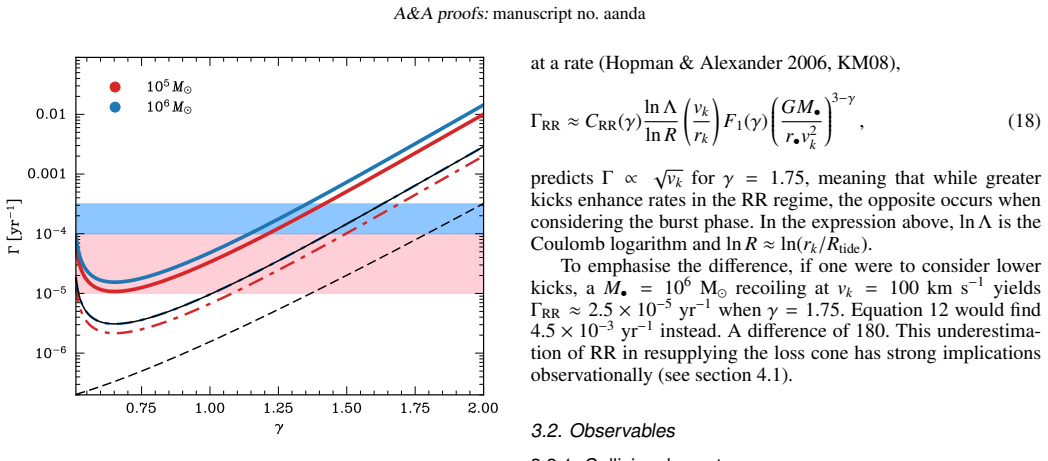
- The burst phase extends well beyond the first orbital pass: apsidal alignment keeps the loss cone refilled for several orbital periods, boosting rates by roughly 7–20 times relative to a static black hole for $\gamma=1.75$ and 30–100 times for $\gamma=2$.
- Because the event rate is so sensitive to the inner density slope $\gamma$, observed counts (or non-detections) of offset transients become a probe of the milliparsec-scale stellar distribution at the moment of black hole merger.
- Rates increase for lower kick velocities and larger black hole masses, and the inverse scaling of the burst rate with $v_k$ distinguishes this mechanism from resonant-relaxation-driven models, which predict rates that grow with kick speed.
Reading between the lines
- If nuclear star clusters are mass-segregated before merger, the inner ~10 mpc could be dominated by stellar-mass black holes rather than stars; the burst would then shift toward EMRI-type gravitational-wave captures and away from optical/UV tidal disruptions, changing the observable mix.
- A few years of all-sky transient surveys with no offset TDEs would not uniquely falsify the idea, because rare intermediate-mass black hole mergers, low nuclear-star-cluster occupancy, or a shallow cusp could each suppress the rate; the paper's two density-slope cases bracket this degeneracy.
- Extending the same mechanism to sub-escape kicks, which the paper only briefly mentions, would add a factor ~10–20 to the rates; the resulting sources would not appear as offsets but as returning transients.
- Adding post-Newtonian terms to the integrator is a natural next step; the paper argues their omission underestimates EMRI occurrence and strains, so the frequency–strain map shown for the simulated events is likely a lower bound.
Editorial analysis
A structured set of objections, weighed in public.
Referee Report
Summary. This paper uses 25 direct N-body simulations (AMUSE/Ph4, 4th-order Hermite, no softening, stellar evolution with SeBa) of an intermediate-mass black hole (M_sun = 10^5 and 4x10^5) embedded in a Bahcall-Wolf (gamma=1.75) nuclear star cluster, subjected to a recoil kick v_k = 300 or 600 km/s, and integrated for 0.1 Myr. The principal claims are: (i) the kick instantaneously refills the loss cone, producing a burst of tidal disruptions and gravitational-wave events; (ii) the post-kick apsidal alignment of the bound (HCSC) population sustains this burst on the t_omega ~ 45-65 kyr precession timescale; (iii) rates scale as v_k^-1, M^0.365, and increase with gamma; and (iv) after calibrating the analytic rate formula (Eq. 12) to the simulations and convolving with cosmological IMBH merger histories, the all-sky observable rate is ~290/yr for gamma=1.75 and ~30/yr for gamma=1 out to z=3, dominated by TDEs. The paper is explicitly framed as a burst-phase extension of Komossa & Merritt (2008) and Stone & Loeb (2012), and it repeatedly discloses its main simplifications: Newtonian-only dynamics with EMRI proxies, a lower-limit scoured cavity a_GW, and single-gamma initial conditions.
Significance. If the burst mechanism is confirmed, the paper delivers a falsifiable, observationally timely prediction: an early post-merger phase whose rates exceed RR-based forecasts by factors of 5-180, with a v_k dependence opposite to the RR regime - a distinctive signature for Rubin/eROSITA and LISA-era surveys. Credit is due for the mechanics of the study: event counts are directly visible in the simulations; the fit is anchored to a publicly available, standard N-body stack (AMUSE/Ph4/SeBa/AGAMA); and the limitation statements are unusually thorough (PN omission, cavity overestimate, limited mass/kick range, NSC occupancy). The headline 290/yr is an upper limit; the paper's own acknowledged factors (NSC occupancy 0.3-0.6, mean stellar mass of 2 M_sun, wider cavity, mass segregation) can individually reduce it by factors of 2-5, so the robust takeaway is 'of order tens to a few hundred events per year, TDE-dominated.' The gamma=1 branch, which is the more realistic one for massive post-merger galaxies per the paper's own citation of Merritt & Milosavljevic (2005), is the least supported and needs direct testing before the forecast stands as a quantitative prediction.
major comments (2)
- [Sec. 4.1.1-4.1.2; Eq. 12] The gamma=1.0 forecast of ~30/yr is an untested extrapolation of constants calibrated only at gamma=1.75. All 25 runs in Table 1 use gamma=1.75, and the best-fit eta~8.7e4, alpha~6.4e-4, beta~9.55 (Section 3.1.1) are inserted into Eq. 12 for gamma=1.0 without any check that these constants are gamma-independent; the passage at the end of Section 3.1.1 describes them as encapsulating the mass of the apsidally aligned population, the characteristic semi-major axis ratio, and the angular dispersion of eccentricity vectors, all of which plausibly vary with gamma. The same issue underlies the entire gamma-scan in Figure 3 and the '30-100 times greater' burst-enhancement factors quoted in Section 3.1.2, since these are evaluations of Eq. 12, not of simulations at those slopes. Because the forecast varies by a factor of 10 between gamma=1.75 and gamma=1, and because Section 3.1.2 cites Merritt & Milosavljevic (2005) as indicating that real major-merger cusps settle at gamma~1, the 30/yr figure in the abstract and conclusions is a load-bearing quantitative claim resting on an unvalidated assumption. I recommend either running a gamma=1 grid at the same cost as the existing runs, or explicitly reframing the gamma=1 curve as an uncalibrated scaling estimate with an uncertainty band.
- [Sec. 2.3, 3.2.2, 4.1.1] The GW component of the results and forecasts (Table 2, left panel of Figure 2, and the roughly 20/yr GW contribution to the 290/yr forecast) is derived from collision proxies: because the code is Newtonian, a compact object whose periastron relative to the IMBH exceeds the Schwarzschild radius is classified as a 'potential EMRI progenitor' (Section 2.3). The paper discloses this limitation honestly and repeats it in Sections 3.2.2 and 5, but the forecast still splits the observable rate into TDE and GW channels using the simulation's 1:10 ratio, and that ratio inherits an unquantified bias from the proxy. The paper's own argument (Section 2.3, citing Hochart & Portegies Zwart 2024) is that PN terms would increase the EMRI number and strain, so the direction of the bias is known but its magnitude is not; consequently the ~20/yr GW number is not a calibrated EMRI rate. Since the abstract and conclusions present 'gravitational wave mergers' as part of the headline burst, the GW branch of the forecast should be labeled as an order-of-magnitude proxy estimate, ideally calibrated against the PN-inclusive treatment cited in Section 2.3.
minor comments (6)
- [Sec. 3.1.1, Eq. 10] Equation 10 presents the rate as Gamma(t) proportional to A(gamma) M^0.365 v_k <m*> exp(-t/t_omega), with v_k in the numerator, but the text immediately below states that the non-spherical potential 'provides the 1/v_k dependency', and the appendix's Eq. A.44 (and the full expression A.45, where <m*> appears in the denominator) give Gamma proportional to v_k^-1. Equation 10 appears to have a misplaced superscript and should be corrected to avoid contradicting Figure 2 and the abstract's 'rates increase for lower v_k'.
- [Sec. 6] The energy accounting contains arithmetic errors: 5160 core-hours x 150 W = 774 kWh, not the quoted 32.250 kWh (the spurious factor 1/24 appears), and the CO2 line is internally inconsistent because 91.875 kWh x 0.27936 kg/kWh is about 25.7 kg, not 9.0 kg. The energy-consumption estimate should be recomputed.
- [Sec. 4.1.1 vs 4.1.2] Section 4.1.1 states that the observed NSC occupancy factor of 0.3-0.6 'can lead to a factor two to three enhancement in forecasted rates', but Section 4.1.2 states the opposite, that predicted rates 'shrink by a factor~0.3-0.6'; the latter is the correct direction and the former appears to be a wording error.
- [Sec. 5 vs Sec. 3.1.2, 4.2] Section 5 disclaims any extrapolation to SMBH masses ('it is difficult to motivate any extrapolation of our results to SMBH masses'), yet Figure 3 and Section 4.2 apply Eq. 12 at M = 10^6-10^7 M_sun, including the LRD rate estimates; the mass-regime caveat should be stated at the point of use in Sections 3.1.2 and 4.2.
- [Sec. 3.1.1] The statement that the apsidal-alignment mechanism 'can prolong the initial burst of tidal disruptions and merging events for >10^4 orbital periods' is taken from Madigan et al. (2018) and Akiba et al. (2024); the runs here cover 5-180 orbits and the fitted decay sets in at t_omega about 45-65 kyr, so the prolongation claim should be attributed explicitly to the literature at that location rather than appearing as a result of these simulations.
- [Sec. 3.1.1, Fig. 2] The best-fit parameters eta, alpha, beta are quoted once for fits to both panels of Figure 2, although the GW and TDE event counts differ by roughly an order of magnitude; please state whether the two channels are fitted separately and how eta is normalized per channel.
Circularity Check
No circularity: the burst result is a direct N-body finding and the forecasted rates are calibrated extrapolations, not re-statements of the inputs.
full rationale
The derivation chain is not circular. The central burst claim is a direct output of 25 N-body runs (Table 1; Fig. 2), where the kick is applied to a pre-scoured Bahcall-Wolf cusp and TDE/GW events are counted from collision detection; no fitted parameter defines the existence or timing of the burst. Equation 12 is an analytic fitting function calibrated to those simulations (eta, alpha, beta), and using a calibrated formula to extrapolate to un-simulated masses, kicks, and redshifts is standard modeling rather than a self-referential reduction: the all-sky rates in Eqs. (19)-(20) integrate Eq. 12 against independent cosmological inputs (Kritos et al. 2025 merger rates, Lousto et al. 2012 kick distribution, Furlong et al. 2015 galaxy masses, Planck cosmology), so Ndot is not equal to the fitted constant by construction. The gamma=1.0 forecast is an extrapolation of the gamma=1.75-calibrated coefficients, which the paper treats as assumption-dependent; extrapolation risk is a correctness caveat, not circularity. The 1:10 GW/TDE split from Table 2 is used for decomposition, not to generate the total rate. Self-citations (Hochart & Portegies Zwart 2024; Hochart et al. in prep.) appear only as caveats or bracketing assumptions; the central physical conclusion does not reduce to them, and the forecast is externally compared against Stone & Loeb (2012) and Komossa & Merritt (2008). No equation is equivalent to its own input by construction.
Assumptions & free parameters
free parameters (7)
- eta (Eq 12 normalization) =
~8.7e4
- alpha (Eq 12) =
~6.4e-4
- beta (Eq 12) =
~9.55
- GW-to-TDE ratio =
1:10 (IMBH-involving events)
- Disrupted HCSC fraction =
0.30
- Average stellar mass in HCSC =
1 M_sun (fiducial)
- NSC occupancy fraction =
1.0 (all galaxies host NSC)
assumptions (8)
- standard math Kepler's third law and orbit-averaged loss-cone theory are used to derive the event-rate integral (Eq A.11, A.19).
- domain assumption The NSC density profile at merger is a Bahcall-Wolf cusp (gamma=1.75) with zero stars inside a_GW (Eq 5).
- domain assumption The HCSC is mildly triaxial, giving loss-cone filling fraction scaling as 1/v_k (Eq A.7).
- domain assumption Apsidal alignment of eccentricity vectors sustains loss-cone refilling for more than 10^4 orbital periods (Madigan et al. 2018).
- domain assumption The recoil kick exceeds the galactic escape velocity, so the galactic potential can be neglected.
- domain assumption Newtonian collisions with the central BH (within ISCO or tidal radius) are proxies for GW mergers and EMRI progenitors.
- ad hoc to paper The interaction-window factor f_win (Eq A.37-A.42) with undetermined constant k captures the finite duration of clump torques.
- domain assumption The fitted event-rate formula (Eq 12) extrapolates to untested gamma, M_bullet, and v_k in the cosmological forecast.
Cite this review
Pith. "Pith review of Recoiling Black Holes I. Burst of Observables." pith.science (2026). https://pith.science/paper/QVRUNPNZ
@misc{pith2026260809662,
  author       = {Pith},
  title        = {Pith review of: Recoiling Black Holes I. Burst of Observables},
  year         = {2026},
  howpublished = {\url{https://pith.science/paper/QVRUNPNZ}},
  note         = {Machine review of arXiv:2608.09662}
}
abstract
We aim to investigate the tidal disruption and gravitational wave events shortly after a massive black hole binary merges in the galactic centre and whose remnant black hole is ejected from the galaxy. Using computational methods, black holes of mass $M_{\bullet}=10^{5}$ M$_\odot$ and $4\times10^{5}$ M$_\odot$ embedded in a nuclear star cluster are kicked at velocities of $v_k=300$ and $600$ km s$^{-1}$. Systems are integrated for $0.1$ Myr using a $4$th-order Hermite scheme. The kick instantaneously repopulates the loss cone, producing a strong burst of tidal disruption events and gravitational wave mergers. The anisotropy in the apsidal orientation of bound stars prolongs this burst phase. Rates increase for lower $v_k$, larger $M_{\bullet}$ and for steeper nuclear star cluster density profiles at moment of merger. Assuming binary black holes scour a Bahcall-Wolf density profile during coalescence, ejected remnants with mass between $10^{5}\leq M_{\bullet}$ [M$_\odot] \leq 4\times10^{5}$ generate observable offset events at a forecasted rate of $\dot{N}\lesssim290$ yr$^{-1}$ up to redshift $z=3$. If, at the moment of merger, the milliparsec scales of the nuclear star cluster are described by a shallow density profile ($\gamma=1$), this decreases to $\dot{N}\lesssim30$ yr$^{-1}$. The strong dependence on the initial density profile and recoil kick makes observables powerful probes of the nuclear star cluster post-massive black hole binary coalescence, and provides test for numerical relativity.
Figures


Figures from the paper (3 more)


Reference graph
Works this paper leans on
-
[1]
D., Abraham, S., et al
Abbott, R., Abbott, T. D., Abraham, S., et al. 2020, Phys. Rev. Lett., 125, 101102
2020
-
[2]
& Madigan, A.-M
Akiba, T. & Madigan, A.-M. 2021, ApJ, 921, L12
2021
-
[3]
& Madigan, A.-M
Akiba, T. & Madigan, A.-M. 2023, ApJ, 958, 137
2023
-
[4]
2024, ApJ, 966, L4
Akiba, T., McIntyre, S., & Madigan, A.-M. 2024, ApJ, 966, L4
2024
-
[5]
B., Casey, C
Akins, H. B., Casey, C. M., Lambrides, E., et al. 2025, ApJ, 991, 37
2025
-
[6]
2017, arXiv e-prints, arXiv:1702.00786
Amaro-Seoane, P., Audley, H., Babak, S., et al. 2017, arXiv e-prints, arXiv:1702.00786
arXiv 2017
-
[7]
T., Bogdán, Á., Kovács, O
Ananna, T. T., Bogdán, Á., Kovács, O. E., Natarajan, P., & Hickox, R. C. 2024, ApJ, 969, L18
2024
-
[8]
Baggen, J. F. W., van Dokkum, P., Brammer, G., et al. 2024, ApJ, 977, L13
2024
Show all 135 references
-
[9]
Baggen, J. F. W., van Dokkum, P., Labbé, I., & Brammer, G. 2025, arXiv e-prints, arXiv:2512.03239
2025 arXiv
-
[10]
Bahcall, J. N. & Wolf, R. A. 1976, ApJ, 209, 214
1976
-
[11]
G., Boggs, W
Baker, J. G., Boggs, W. D., Centrella, J., et al. 2008, ApJ, 682, L29
2008
-
[12]
F., Dickey, C., Geha, M., & Reines, A
Baldassare, V . F., Dickey, C., Geha, M., & Reines, A. E. 2020, ApJ, 898, L3
2020
-
[13]
F., Reines, A
Baldassare, V . F., Reines, A. E., Gallo, E., & Greene, J. E. 2015, The Astrophys- ical Journal, 809, L14
2015
-
[14]
S., Comerford, J
Barrows, R. S., Comerford, J. M., Negus, J., & Muller-Sanchez, F. 2025, Re- coiling Black Hole Candidates from Spatially Offset Broad Emission Lines in MaNGA
2025
-
[15]
E., Treister, E., Schawinski, K., et al
Bauer, F. E., Treister, E., Schawinski, K., et al. 2017, MNRAS, 467, 4841
2017
-
[16]
C., Blandford, R
Begelman, M. C., Blandford, R. D., & Rees, M. J. 1980, Nature, 287, 307
1980
-
[17]
C., V olonteri, M., & Rees, M
Begelman, M. C., V olonteri, M., & Rees, M. J. 2006, MNRAS, 370, 289
2006
-
[18]
Bekenstein, J. D. 1973, ApJ, 183, 657
1973
-
[19]
2025, ApJ, 984, L55
Bellovary, J. 2025, ApJ, 984, L55
2025
-
[20]
2006, ApJ, 642, L21
Berczik, P., Merritt, D., Spurzem, R., & Bischof, H.-P. 2006, ApJ, 642, L21
2006
-
[21]
Boekholt, T. C. N., Moerman, A., & Portegies Zwart, S. F. 2021, Phys. Rev. D, 104, 083020 Bogdán, Á., Goulding, A. D., Natarajan, P., et al. 2024, Nature Astronomy, 8, 126 Bogdanovi´c, T., Reynolds, C. S., & Miller, M. C. 2007, ApJ, 661, L147
2021
-
[22]
2004, ApJ, 613, L37
Boylan-Kolchin, M., Ma, C.-P., & Quataert, E. 2004, ApJ, 613, L37
2004
-
[23]
L., et al
Buikema, A., Cahillane, C., Mansell, G. L., et al. 2020, Phys. Rev. D, 102, 062003
2020
-
[24]
O., Zlochower, Y ., & Merritt, D
Campanelli, M., Lousto, C. O., Zlochower, Y ., & Merritt, D. 2007, Phys. Rev. Lett., 98, 231102
2007
-
[25]
2008, Modern Physics Letters A, 23, 99
Capozziello, S., de Laurentis, M., de Paolis, F., Ingrosso, G., & Nucita, A. 2008, Modern Physics Letters A, 23, 99
2008
-
[26]
C., Li, R., & Zhuang, M.-Y
Chen, C.-H., Ho, L. C., Li, R., & Zhuang, M.-Y . 2025, ApJ, 983, 60
2025
-
[27]
& Shen, R.-F
Chen, J.-H. & Shen, R.-F. 2018, ApJ, 867, 20
2018
-
[28]
G., Kotok, E
Diener, P., Kosovichev, A. G., Kotok, E. V ., Novikov, I. D., & Pethick, C. J. 1995, MNRAS, 275, 498 2 https://www.nowtricity.com/country/netherlands/ Article number, page 10 of 15 E. Hochart and S. Portegies Zwart: Recoiling Black Holes I. D’Orazio, D. J. & Samsing, J. 2018, ...
1995
-
[29]
2010, MNRAS, 402, 682
Dotti, M., V olonteri, M., Perego, A., et al. 2010, MNRAS, 402, 682
2010
-
[30]
G., et al
Ebisuzaki, T., Makino, J., Tsuru, T. G., et al. 2001, ApJ, 562, L19
2001
-
[31]
& Ford, H
Ferrarese, L. & Ford, H. 2005, Space Sci. Rev., 116, 523
2005
-
[32]
2006, ApJ, 649, 91
Freitag, M., Amaro-Seoane, P., & Kalogera, V . 2006, ApJ, 649, 91
2006
-
[33]
G., Theuns, T., et al
Furlong, M., Bower, R. G., Theuns, T., et al. 2015, MNRAS, 450, 4486
2015
-
[34]
J., Labbé, I., Zitrin, A., et al
Furtak, L. J., Labbé, I., Zitrin, A., et al. 2024, Nature, 628, 57
2024
-
[35]
J., Zitrin, A., Plat, A., et al
Furtak, L. J., Zitrin, A., Plat, A., et al. 2023, ApJ, 952, 142 García-Bellido, J. & Nesseris, S. 2018, Physics of the Dark Universe, 21, 61
2023
-
[36]
2003, ApJ, 594, 812
Genzel, R., Schödel, R., Ott, T., et al. 2003, ApJ, 594, 812
2003
-
[37]
2026, MNRAS, 545, staf1979
Geris, S., Maiolino, R., Isobe, Y ., et al. 2026, MNRAS, 545, staf1979
2026
-
[38]
2021, ARA&A, 59, 21 Gondán, L
Gezari, S. 2021, ARA&A, 59, 21 Gondán, L. & Kocsis, B. 2021, MNRAS, 506, 1665
2021
-
[39]
Greene, J. E. & Ho, L. C. 2006, ApJ, 641, L21
2006
-
[40]
E., Labbe, I., Goulding, A
Greene, J. E., Labbe, I., Goulding, A. D., et al. 2024, ApJ, 964, 39
2024
-
[41]
M., Bortolas, E., et al
Gualandris, A., Khan, F. M., Bortolas, E., et al. 2022, Monthly Notices of the Royal Astronomical Society, 511, 4753
2022
-
[42]
& Merritt, D
Gualandris, A. & Merritt, D. 2008, ApJ, 678, 780
2008
-
[43]
I., Dehnen, W., & Bortolas, E
Gualandris, A., Read, J. I., Dehnen, W., & Bortolas, E. 2017, MNRAS, 464, 2301
2017
-
[44]
A., Pacucci, F., & Kocevski, D
Guia, C. A., Pacucci, F., & Kocevski, D. D. 2024, Research Notes of the Ameri- can Astronomical Society, 8, 207
2024
-
[45]
2023, ApJ, 959, 39 Häring, N
Harikane, Y ., Zhang, Y ., Nakajima, K., et al. 2023, ApJ, 959, 39 Häring, N. & Rix, H.-W. 2004, ApJ, 604, L89
2023
-
[46]
R., Millman, K
Harris, C. R., Millman, K. J., van der Walt, S. J., et al. 2020, Nature, 585, 357
2020
-
[47]
& Portegies Zwart, S
Hochart, E. & Portegies Zwart, S. 2024, A&A, 685, A123
2024
-
[48]
Hogg, D. W. 1999, arXiv e-prints, astro
1999
-
[49]
2008, ApJ, 686, 829
Holley-Bockelmann, K., Gültekin, K., Shoemaker, D., & Yunes, N. 2008, ApJ, 686, 829
2008
-
[50]
& Sigurdsson, S
Holley-Bockelmann, K. & Sigurdsson, S. 2006, arXiv e-prints, astro
2006
-
[51]
& Alexander, T
Hopman, C. & Alexander, T. 2006, ApJ, 645, 1152
2006
-
[52]
Howell, D. A. 2011, Nature Communications, 2, 350
2011
-
[53]
Hunter, J. D. 2007, Computing in Science and Engineering, 9, 90 Ivezi´c, Ž., Kahn, S. M., Tyson, J. A., et al. 2019, ApJ, 873, 111
2007
-
[54]
Jeans, J. H. 1919, MNRAS, 79, 408
1919
-
[55]
G., Torres, M
Jonker, P. G., Torres, M. A. P., Fabian, A. C., et al. 2010, MNRAS, 407, 645 Juodžbalis, I., Marconcini, C., D’Eugenio, F., et al. 2026, Nature, 653, 1017
2010
- [56]
-
[57]
M., Berczik, P., Sobolenko, M., et al
Khan, F. M., Berczik, P., Sobolenko, M., et al. 2026, A&A, 706, A354
2026
-
[58]
Khan, F. M. & Holley-Bockelmann, K. 2021, MNRAS, 508, 1174
2021
-
[59]
M., Holley-Bockelmann, K., Berczik, P., & Just, A
Khan, F. M., Holley-Bockelmann, K., Berczik, P., & Just, A. 2013, ApJ, 773, 100
2013
-
[60]
M., Javed, F., Holley-Bockelmann, K., et al
Khan, F. M., Javed, F., Holley-Bockelmann, K., et al. 2024, ApJ, 976, 22
2024
-
[61]
2024, A&A, 691, A52
Killi, M., Watson, D., Brammer, G., et al. 2024, A&A, 691, A52
2024
-
[62]
E., & Márka, S
Kocsis, B., Gáspár, M. E., & Márka, S. 2006, ApJ, 648, 411
2006
-
[63]
I., Greene, J
Kokorev, V ., Caputi, K. I., Greene, J. E., et al. 2024, ApJ, 968, 38
2024
-
[64]
& Merritt, D
Komossa, S. & Merritt, D. 2008, ApJ, 689, L89
2008
-
[65]
B., Cornell, M
Kormendy, J., Fisher, D. B., Cornell, M. E., & Bender, R. 2009, ApJS, 182, 216
2009
-
[66]
& Richstone, D
Kormendy, J. & Richstone, D. 1995, ARA&A, 33, 581
1995
-
[67]
Kovacs, Jr., S. J. & Thorne, K. S. 1978, ApJ, 224, 62
1978
-
[68]
L., Amaro-Seoane, P., et al
Kremer, K., Rodriguez, C. L., Amaro-Seoane, P., et al. 2019, Phys. Rev. D, 99, 063003
2019
-
[69]
S., Silk, J., et al
Kritos, K., Beckmann, R. S., Silk, J., et al. 2025, ApJ, 991, 58
2025
-
[70]
E., Bezanson, R., et al
Labbe, I., Greene, J. E., Bezanson, R., et al. 2025, ApJ, 978, 92
2025
-
[71]
G., Rauer, J
Lena, D., Jonker, P. G., Rauer, J. P., Hernandez, S., & Kostrzewa-Rutkowska, Z. 2020, MNRAS, 495, 1771
2020
-
[72]
D., Shen, Y ., et al
Li, J., Silverman, J. D., Shen, Y ., et al. 2025, ApJ, 981, 19
2025
-
[73]
K., Berczik, P., Chen, X., & Spurzem, R
Li, S., Liu, F. K., Berczik, P., Chen, X., & Spurzem, R. 2012, ApJ, 748, 65
2012
-
[74]
R., Webb, N
Lin, D., Carrasco, E. R., Webb, N. A., et al. 2016, ApJ, 821, 25
2016
-
[75]
O., Zlochower, Y ., Dotti, M., & V olonteri, M
Lousto, C. O., Zlochower, Y ., Dotti, M., & V olonteri, M. 2012, Phys. Rev. D, 85, 084015
2012
-
[76]
2018, ApJ, 853, 141
Madigan, A.-M., Halle, A., Moody, M., et al. 2018, ApJ, 853, 141
2018
-
[77]
2005, Nature, 437, 381
Magain, P., Letawe, G., Courbin, F., et al. 2005, Nature, 437, 381
2005
-
[78]
2024, A&A, 691, A145
Maiolino, R., Scholtz, J., Curtis-Lake, E., et al. 2024, A&A, 691, A145
2024
-
[79]
2026, MNRAS, 548, staf2109
Maiolino, R., Übler, H., D’Eugenio, F., et al. 2026, MNRAS, 548, staf2109
2026
-
[80]
2012, ApJ, 749, 168
Mapelli, M., Hayfield, T., Mayer, L., & Wadsley, J. 2012, ApJ, 749, 168
2012
-
[81]
J., et al
Mastrobuono-Battisti, A., Amaro Seoane, P., Fullana i Alfonso, M. J., et al. 2025, A&A, 693, A22
2025
-
[82]
2023, MNRAS, 521, 6089
Mastrobuono-Battisti, A., Ogiya, G., Hahn, O., & Schultheis, M. 2023, MNRAS, 521, 6089
2023
-
[83]
P., Brammer, G., et al
Matthee, J., Naidu, R. P., Brammer, G., et al. 2024, ApJ, 963, 129
2024
-
[84]
2012, in Astronomical Society of the Pacific Conference Series, V ol
McMillan, S., Portegies Zwart, S., van Elteren, A., & Whitehead, A. 2012, in Astronomical Society of the Pacific Conference Series, V ol. 453, Advances in Computational Astrophysics: Methods, Tools, and Outcome, ed. R. Capuzzo-
2012
-
[85]
Limongi, & A
Dolcetta, M. Limongi, & A. Tornambè, 129 Mérida, R. M., Gaspar, G., Sawicki, M., et al. 2025, A&A, 698, A317
2025
-
[86]
2006, ApJ, 648, 976
Merritt, D. 2006, ApJ, 648, 976
2006
-
[87]
2013, Classical and Quantum Gravity, 30, 244005
Merritt, D. 2013, Classical and Quantum Gravity, 30, 244005
2013
-
[88]
2007, ApJ, 671, 53
Merritt, D., Mikkola, S., & Szell, A. 2007, ApJ, 671, 53
2007
-
[89]
& Milosavljevi´c, M
Merritt, D. & Milosavljevi´c, M. 2005, Living Reviews in Relativity, 8, 8
2005
-
[90]
& Poon, M
Merritt, D. & Poon, M. Y . 2004, ApJ, 606, 788
2004
-
[91]
D., & Komossa, S
Merritt, D., Schnittman, J. D., & Komossa, S. 2009, ApJ, 699, 1690
2009
-
[92]
2006, MNRAS, 367, 1746
Merritt, D., Storchi-Bergmann, T., Robinson, A., et al. 2006, MNRAS, 367, 1746
2006
-
[93]
2017, International Journal of Modern Physics D, 26, 1730021
Mezcua, M. 2017, International Journal of Modern Physics D, 26, 1730021
2017
-
[94]
2024, ApJ, 966, L30 Milosavljevi´c, M
Mezcua, M., Pacucci, F., Suh, H., Siudek, M., & Natarajan, P. 2024, ApJ, 966, L30 Milosavljevi´c, M. & Merritt, D. 2001, ApJ, 563, 34
2024
-
[95]
R., Portegies Zwart, S
Nelemans, G., Yungelson, L. R., Portegies Zwart, S. F., & Verbunt, F. 2001, A&A, 365, 491
2001
-
[96]
2024, gwastro/pycbc: v2.3.3 release of Py- CBC O’Leary, R
Nitz, A., Harry, I., Brown, D., et al. 2024, gwastro/pycbc: v2.3.3 release of Py- CBC O’Leary, R. M., Kocsis, B., & Loeb, A. 2009, MNRAS, 395, 2127 O’Leary, R. M. & Loeb, A. 2012, MNRAS, 421, 2737 Ordenes-Briceño, Y ., Eigenthaler, P., Taylor, M. A., et al. 2018, ApJ, 859, 52
2024
-
[97]
2025, MNRAS, 537, 956
Partmann, C., Naab, T., Lahén, N., et al. 2025, MNRAS, 537, 956
2025
-
[98]
I., van Elteren, A., de Vries, N., et al
Pelupessy, F. I., van Elteren, A., de Vries, N., et al. 2013, A&A, 557, A84
2013
-
[99]
1962, Physical Review, 128, 2471
Peres, A. 1962, Physical Review, 128, 2471
1962
-
[100]
2025, Universe, 11, 294
Perger, K., Fogasy, J., & Frey, S. 2025, Universe, 11, 294
2025
-
[101]
Peters, P. C. 1970, Phys. Rev. D, 1, 1559
1970
-
[102]
Peters, P. C. & Mathews, J. 1963, Physical Review, 131, 435 Planck Collaboration, Aghanim, N., Akrami, Y ., et al. 2020, A&A, 641, A6
1963
-
[103]
Poon, M. Y . & Merritt, D. 2001, ApJ, 549, 192 Portegies Zwart, S. & McMillan, S. 2018, Astrophysical Recipes; The art of AMUSE (IOP Publishing) Portegies Zwart, S., McMillan, S., Harfst, S., et al. 2009, New A, 14, 369 Portegies Zwart, S. F. & McMillan, S. L. W. 2002, ApJ, 57...
2001
-
[104]
& Amaro-Seoane, P
Preto, M. & Amaro-Seoane, P. 2010, ApJ, 708, L42
2010
-
[105]
Rantala, A., Rawlings, A., Naab, T., Thomas, J., & Johansson, P. H. 2024, Monthly Notices of the Royal Astronomical Society, 535, 1202–1227
2024
-
[106]
Rauch, K. P. & Ingalls, B. 1998, MNRAS, 299, 1231
1998
-
[107]
Rauch, K. P. & Tremaine, S. 1996, New A, 1, 149
1996
-
[108]
H., Naab, T., et al
Rawlings, A., Johansson, P. H., Naab, T., et al. 2025, ApJ, 991, 83
2025
-
[109]
Rees, M. J. 1988, Nature, 333, 523
1988
-
[110]
Rees, M. J. 1998, in Black Holes and Relativistic Stars, ed. R. M. Wald, 79
1998
-
[111]
E., Greene, J
Reines, A. E., Greene, J. E., & Geha, M. 2013, ApJ, 775, 116
2013
-
[112]
G., Fliri, J., & Valls-Gabaud, D
Riess, A. G., Fliri, J., & Valls-Gabaud, D. 2012, ApJ, 745, 156
2012
-
[113]
H., et al
Rinaldi, P., Bonaventura, N., Rieke, G. H., et al. 2025, ApJ, 992, 71
2025
-
[114]
J., & Liu, C
Robson, T., Cornish, N. J., & Liu, C. 2019, Classical and Quantum Gravity, 36, 105011
2019
-
[115]
Salpeter, E. E. 1955, ApJ, 121, 161
1955
-
[116]
J., et al
Samsing, J., Bartos, I., D’Orazio, D. J., et al. 2022, Nature, 603, 237
2022
-
[117]
& D’Orazio, D
Samsing, J. & D’Orazio, D. J. 2018, MNRAS, 481, 5445
2018
-
[118]
& D’Orazio, D
Samsing, J. & D’Orazio, D. J. 2019, Phys. Rev. D, 99, 063006
2019
-
[119]
& Ilan, T
Samsing, J. & Ilan, T. 2018, Monthly Notices of the Royal Astronomical Society, 476, 1548 Sánchez-Janssen, R., Côté, P., Ferrarese, L., et al. 2019, ApJ, 878, 18 Schödel, R., Nogueras-Lara, F., Gallego-Cano, E., et al. 2020, A&A, 641, A102
2018
-
[120]
E., & Greene, J
Schutte, Z., Reines, A. E., & Greene, J. E. 2019, The Astrophysical Journal, 887, 245
2019
-
[121]
Z., Farahat, E
Selim, H. Z., Farahat, E. A., Mohareb, A. S. O., Toto, S. M., & Hassan, K. T. S. 2024, Egyptian Journal of Botany, 64, 258
2024
-
[122]
& Loeb, A
Stone, N. & Loeb, A. 2011, MNRAS, 412, 75
2011
-
[123]
& Loeb, A
Stone, N. & Loeb, A. 2012, MNRAS, 422, 1933
2012
-
[124]
C., Küpper, A
Stone, N. C., Küpper, A. H. W., & Ostriker, J. P. 2017, MNRAS, 467, 4180
2017
-
[125]
2021, ApJ, 907, L20
Tagawa, H., Kocsis, B., Haiman, Z., et al. 2021, ApJ, 907, L20
2021
-
[126]
L., Fan, X., Wang, F., & Yang, J
Tee, W. L., Fan, X., Wang, F., & Yang, J. 2025, ApJ, 983, L26
2025
-
[127]
1977, ApJ, 216, 610 van Dokkum, P., Pasha, I., Buzzo, M
Turner, M. 1977, ApJ, 216, 610 van Dokkum, P., Pasha, I., Buzzo, M. L., et al. 2023, ApJ, 946, L50 van Velzen, S. & Farrar, G. R. 2014, ApJ, 792, 53
1977
-
[128]
2019, MNRAS, 482, 1525
Vasiliev, E. 2019, MNRAS, 482, 1525
2019
-
[129]
2015, ApJ, 810, 49
Vasiliev, E., Antonini, F., & Merritt, D. 2015, ApJ, 810, 49
2015
-
[130]
& Merritt, D
Wang, J. & Merritt, D. 2004, ApJ, 600, 149
2004
-
[131]
White, S. D. M. & Rees, M. J. 1978, MNRAS, 183, 341
1978
-
[132]
2007, ApJ, 665, L59
Willems, B., Kalogera, V ., Vecchio, A., et al. 2007, ApJ, 665, L59
2007
-
[133]
2026, arXiv e-prints, arXiv:2601.06015
Yanagisawa, H., Ouchi, M., Golubchik, M., et al. 2026, arXiv e-prints, arXiv:2601.06015
2026
-
[134]
Zhang, Z., Jiang, L., Liu, W., & Ho, L. C. 2025, ApJ, 985, 119
2025
-
[135]
& Lousto, C
Zlochower, Y . & Lousto, C. O. 2015, Phys. Rev. D, 92, 024022 Article number, page 11 of 15 A&A proofs:manuscript no. aanda Appendix A: Deriving the Event Rate The simulations here are integrated fort=0.1 Myr. This is much shorter than RR timescales oft RR≈10 3 Myr (c.f Equati...
2011
Reviewed August 11, 2026 · model on record in the stance chip above.
Discussion (0). Continue with ORCID to comment.