REVIEW 4 major objections 5 minor 27 references
SLIM-0.5B: Learning Action-Grounded Predictive Latents for Robot Manipulation
T0 review · 4 major / 5 minor · reviewed 2026-08-11 · deepseek-v4-flash
Pith's one-line read SLIM, a 0.47B latent interaction policy, matches or exceeds large VLA and world-action-model baselines with fewer parameters, no extra embodied pretraining, lower latency, and lower GPU memory.
desk verdict Solid methods paper with a genuinely new compact latent-interaction architecture; Stage-1 ablations are strong, but the headline comparison leans on unevaluated published baselines and needs a controlled rerun or softer claim. read the letter →
The pith
A machine-rendered reading of the paper's core claim, the machinery that carries it, and where it could break.
The reading
What carries the argument
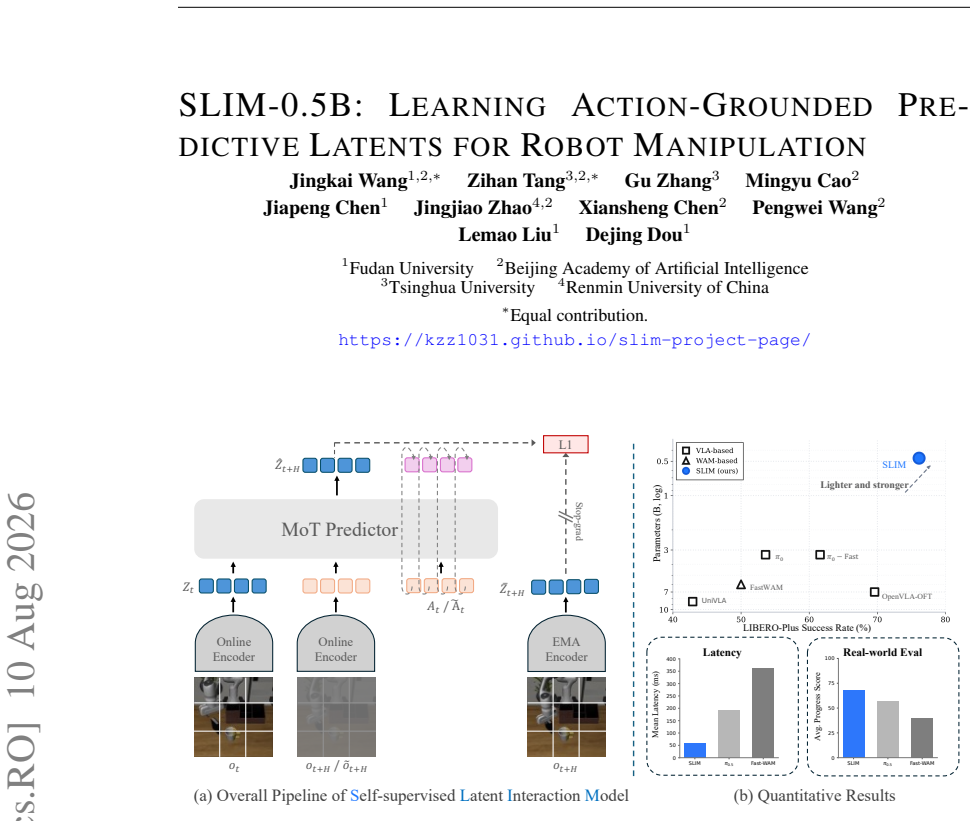
The central machinery is action-grounded masked trajectory prediction inside a compact Mixture-of-Transformers (MoT) backbone, a two-stream transformer where an observation stream and an action stream interact through shared joint attention and per-stream language cross-attention. Stage 1 masks one trajectory variable at a time: with the action chunk masked, the model performs inverse dynamics by predicting the flow velocity of the noised action from current and future observation latents; with the future latent masked, it performs forward dynamics by predicting that latent from the current observation latent and the clean action chunk, supervised by a stop-gradient EMA target. Stage 2 reuses the same backbone for flow-matching action generation without any future observation. The predictive slots learned in Stage 1 remain in the observation stream and, the paper argues, guide action generation during inference, which is why the deployed policy needs no pixel decoder or future-frame generation.
What would settle it
Run the strongest baselines, say OpenVLA-OFT and VLA-JEPA, under SLIM's exact LIBERO-Plus zero-shot protocol, including the same 10,030 perturbation cases, rollout counts, seeds, and flow-sampling steps; if their overall scores become statistically indistinguishable from SLIM's 77.45%, the comparative advantage collapses, even though the method itself may still work.
Extended reading notes
Core claim
The paper's discovery is that a compact policy can internalize dynamics as predictive structure in observation-latent space rather than as VLM reasoning or pixel prediction. SLIM couples an inverse-dynamics objective—reconstructing the noised action chunk from current and future observation latents—with a forward-dynamics objective—predicting the future observation latent from the current latent and clean action chunk—using a Mixture-of-Transformers backbone with separate observation and action streams. This masked trajectory prediction is trained self-supervised on robot trajectories, and the same backbone is then trained with flow matching for language-conditioned action generation. The result, the paper argues, is that action-grounded predictive latents give a 0.47B policy performance on LIBERO, LIBERO-Plus, CALVIN ABC→D, and real-world manipulation that matches or exceeds representative baselines, with 60.6 ms mean latency, 4.26 GiB peak VRAM, and no embodied pretraining beyond the target data.
Load-bearing premise
The load-bearing premise is that the published numbers for the baselines are directly comparable to SLIM's, even though the baselines were not retrained or re-evaluated under SLIM's exact seeds, rollouts, and sampling schedules.
Editorial extensions
If this is right
- A robot control policy does not need a large vision-language backbone at its center; a 0.5B latent interaction model can reach or exceed 7B-class VLA performance on standard manipulation benchmarks.
- Dynamics can be an explicit training signal without pixel reconstruction: bidirectional latent prediction grounds actions in observation changes at a fraction of the compute of video world models.
- Because SLIM needs no test-time future imagination, its 60.6 ms inference latency and 4.26 GiB peak GPU memory make deployment on physically embodied robots materially cheaper than π0.5 or Fast-WAM.
- Self-supervised masked trajectory prediction transfers across settings: the same LIBERO-trained checkpoint handles zero-shot LIBERO-Plus perturbations, and the same two-stage recipe works on real-world demonstrations.
- The ablation results indicate that the Stage-1 latent-learning phase, not the flow-matching policy head, is what drives the gains: removing it lowers LIBERO-Plus success from 77.45% to roughly 66.8% and CALVIN average length from 4.556 to 4.382.
Reading between the lines
- Beyond the paper: scaling this latent-interaction recipe with broader cross-embodiment data may give large-VLA-level generalization at small-model efficiency, since the ablations suggest the limiting factor is the breadth of training data rather than backbone capacity.
- A testable extension suggested by the EMA-target analysis is that an explicit rank or diversity regularizer could replace the EMA teacher and might transfer better to smaller data budgets, since the paper shows the EMA's value lies in preventing latent collapse.
- The attention-probe result, if it holds beyond the two shown sequences, predicts that Stage-1-trained policies will be more robust to distractors and background shifts because the action stream attends to the manipulated object; this could be tested with systematic saliency evaluations.
- The paper's comparative claim is more sensitive than its method to evaluation standardization: rerunning baselines under SLIM's exact seeds and rollouts could change the reported margins, and that comparison is the part most worth rechecking.
Signed reviews
Editorial analysis
A structured set of objections, weighed in public.
Referee Report
Summary. This paper proposes SLIM, a 0.47B-parameter latent interaction policy for language-conditioned robot manipulation. SLIM uses a Mixture-of-Transformers (MoT) backbone with two streams (observation and action) and a two-stage training procedure: Stage 1 learns action-grounded predictive latents via masked trajectory prediction, combining an inverse-dynamics loss (reconstructing noised action chunks from current and future observation latents) and a forward-dynamics loss (predicting future observation latents from current observations and clean actions, supervised by an EMA target); Stage 2 trains a flow-matching policy conditioned only on the current observation latent, learned future-slot embeddings, proprioception, language, and noised actions. The paper reports results on LIBERO (97.5% overall), zero-shot LIBERO-Plus (77.45%), CALVIN ABC→D (4.556 average sequence length), and a five-task real-world manipulation suite, alongside ablations showing that Stage-1 training and the EMA target improve performance. The central claim is that SLIM matches or exceeds representative vision-language-action and world-action-model baselines with fewer parameters, no additional embodied pretraining, lower inference latency, and lower GPU memory usage.
Significance. If the empirical comparison holds, the paper demonstrates a valuable design point: compact latent interaction policies can be competitive with much larger VLA and world-action-model baselines on standard manipulation benchmarks, with substantial efficiency gains. The method is clearly specified, the two-stage pipeline is well-described, and the ablations (especially the EMA collapse diagnostics in Table 3) provide useful insights into predictive representation learning. The controlled inference benchmark (Table 4) is a strength, as is the real-world evaluation comparing SLIM, π0.5, and Fast-WAM under a common training protocol. The primary risk is the comparability of the simulation baselines, which are taken from prior papers with different protocols and reported without error bars.
major comments (4)
- [§4.1, Table 1] The headline claim that SLIM 'matches or exceeds representative large-scale VLA and world-action-model baselines' rests on comparing SLIM's in-house rollouts with published baseline numbers that differ in training data, seeds, evaluation rollouts, flow-sampling schedules, and hyperparameters. The reported numbers themselves do not uniformly support the claim: on zero-shot LIBERO-Plus, SLIM obtains 77.45% whereas VLA-JEPA obtains 79.5%, and the paper provides no confidence intervals or seed-level statistics. A single strong baseline (e.g., VLA-JEPA or OpenVLA-OFT) rerun under SLIM's exact evaluation harness could materially shift the claimed margins. This is a load-bearing gap for the paper's central efficiency-versus-performance claim.
- [§4.1, Table 2] On CALVIN ABC→D, SLIM's 4.556 average sequence length is within 0.026 of FLOWER's 4.53, a difference smaller than typical seed noise. With no reported variance or number of seeds, the 'matches' part of the claim is unsupported; the same issue applies to several other CALVIN entries where differences are within a few hundredths of a point. The paper should provide seed-level statistics or otherwise justify that these differences are meaningful.
- [§4.2, Figure 6] The real-world comparison reports only point estimates from 10 trials per task-condition, without error bars or statistical tests. The observed differences, e.g., SLIM's average progress 67.8 vs π0.5's 56.8, and the 'close' performance under background shift (49 vs 54), could be within trial noise. This undercuts the real-world generalization claim, which is one of the paper's four main evaluation axes.
- [§3.3, Eq. (7)] The forward-dynamics target is produced by an EMA copy of the same online encoder, and the policy is trained in that same latent space. The no-EMA ablation (Table 3) shows collapse, but the EMA target still does not provide an externally grounded supervision signal; the Stage-1 improvement could be an auxiliary-task regularizer rather than evidence for action-grounded predictive latents. A concrete test would be to compare against a fixed pre-trained target encoder (e.g., frozen DINOv2) or to measure whether the predicted latent aligns with a genuinely independent future-state encoding. This would strengthen the conceptual contribution of the paper.
minor comments (5)
- [§4.1, Table 1 caption] The 'Overall' column for LIBERO-Plus appears to be an average over seven perturbations; please state explicitly whether the average is equally weighted and how the per-perturbation scores are computed.
- [§3.3, Eq. (7)] The notation 'LN' is used without definition; please clarify whether it denotes layer normalization or a learned normalization operator.
- [§4.4, Figure 8] The attention maps are described as showing that SLIM 'more consistently follows the manipulated object,' but only two example sequences are shown and no quantitative attention metric is provided; this claim should be softened or supported with a quantitative analysis.
- [§5, Conclusion] The authors acknowledge that the experiments use a single model scale and do not establish scaling behavior; this limitation is appropriate and should be stated earlier so the headline claim is scoped as a single-scale result.
- [References] There are several typographical issues, e.g., 'In F orty-third International Conference on Machine Learning' (the LaST 0 entry) and inconsistent use of spaces in 'arXiv' entries; please proofread the reference list.
Circularity Check
No significant circularity: the derivation is self-contained and the headline claims are checked against external benchmarks.
full rationale
SLIM's derivation chain is not circular. Stage 1 defines two self-supervised objectives, L_IDM and L_FDM, where the future-latent target is produced by a stop-gradient EMA copy of the same online visual encoder. This is self-referential in the narrow sense of self-supervised learning, but it is not an argumentative circularity: the paper does not use the future-latent prediction loss as evidence of prediction quality; the central evidence is downstream success on LIBERO, LIBERO-Plus, CALVIN, and real-world tasks, which are external benchmarks independent of SLIM's fitted parameters. The EMA target is a standard JEPA-style technique, not an imported uniqueness theorem or an ansatz smuggled in by self-citation. Stage 2's flow-matching objective L_FM conditions on current observations, language, and learned future-slot embeddings, not on a future latent, and the Stage-2-only ablation provides a non-self-referential comparison showing that Stage 1 improves external success. The efficiency and latency comparisons are empirical measurements under a stated protocol; whether the protocol is fair is a correctness or comparability concern, not a circularity. No load-bearing step reduces to its own inputs by construction, and no result is renamed and presented as a prediction. The paper's own equations define the training losses, and the claims are evaluated against independent benchmarks, so the central claim does not collapse into a fit or a self-citation chain.
Assumptions & free parameters
free parameters (5)
- IDM:FDM loss ratio (lambda_IDM / lambda_FDM) =
0.125:1
- EMA momentum =
0.999
- Flow sampling steps =
4
- MoT depth and hidden width =
16 layers, d=768
- Action horizon H =
8 (LIBERO), 12 (CALVIN)
assumptions (6)
- standard math Conditional flow matching (Lipman et al., 2023) provides a valid generative model for continuous action chunks.
- domain assumption An EMA target encoder with stop-gradient prevents representation collapse in Stage-1 future-latent prediction.
- domain assumption Inverse and forward masked-prediction objectives in observation-latent space produce representations that are useful for downstream flow-matching policy training.
- domain assumption DINOv2 initialization plus fine-tuning and frozen T5-small language embeddings provide sufficient semantic grounding for language-conditioned control.
- domain assumption Published baseline results in Tables 1, 2, and 5 are comparable to SLIM's results despite differences in training data, seeds, and evaluation protocols.
- domain assumption The MoT two-stream joint-attention backbone can model the needed observation-action interactions at 0.47B scale.
invented entities (1)
-
Future-slot embeddings M_z
Cite this review
Pith. "Pith review of SLIM-0.5B: Learning Action-Grounded Predictive Latents for Robot Manipulation." pith.science (2026). https://pith.science/paper/A3XROF2Q
@misc{pith2026260809771,
  author       = {Pith},
  title        = {Pith review of: SLIM-0.5B: Learning Action-Grounded Predictive Latents for Robot Manipulation},
  year         = {2026},
  howpublished = {\url{https://pith.science/paper/A3XROF2Q}},
  note         = {Machine review of arXiv:2608.09771}
}
read the original abstract
Vision-language-action policies rely on large multimodal backbones to jointly perform perception, language conditioning, and action generation at every control step. Much of this capacity supports open-domain semantics, whereas continuous robot manipulation primarily requires compact representations of observations, actions, and the transitions induced by actions. Pixel-level world models provide another route, but predicting visual details irrelevant to control can be unnecessarily expensive. We propose SLIM (Self-supervised Latent Interaction Model), a compact 0.5B-parameter latent interaction policy. SLIM learns action-grounded predictive latents that capture both action-conditioned future transitions and the actions that explain observed changes. SLIM learns these representations through self-supervised masked trajectory prediction, combining action reconstruction with future-latent prediction. A compact Mixture-of-Transformers (MoT) backbone models interactions between observation latents and action tokens. The resulting policy is trained with flow matching for language-conditioned action generation. Across simulation benchmarks and real-world evaluation, SLIM matches or exceeds representative large-scale VLA and world-action-model baselines with fewer parameters, no additional embodied pretraining, lower inference latency, and substantially lower GPU memory usage.
Figures


Figures from the paper (8 more)


Reference graph
Works this paper leans on
-
[5]
WorldVLA: Towards autoregressive action world model.arXiv preprint arXiv:2506.21539,
11 Jun Cen, Chaohui Yu, Hangjie Yuan, Yuming Jiang, Siteng Huang, Jiayan Guo, Xin Li, Yibing Song, Hao Luo, Fan Wang, Deli Zhao, and Hao Chen. WorldVLA: Towards autoregressive action world model.arXiv preprint arXiv:2506.21539,
-
[6]
Jialei Chen, Kai Wang, Kang Chen, Shuaihang Chen, Feng Gao, Wenhao Tang, Zhiyuan Li, Weilin Liu, Zhuyu Yao, Boxun Li, et al. LaW AM: Latent world action models for efficient dynamics- aware robot policies.arXiv preprint arXiv:2606.15768,
-
[7]
PaLM-E: An embodied multi- modal language model.arXiv preprint arXiv:2303.03378,
Danny Driess, Fei Xia, Mehdi SM Sajjadi, Corey Lynch, Aakanksha Chowdhery, Brian Ichter, Ayzaan Wahid, Jonathan Tompson, Quan Vuong, Tianhe Yu, et al. PaLM-E: An embodied multi- modal language model.arXiv preprint arXiv:2303.03378,
-
[8]
Senyu Fei, Siyin Wang, Junhao Shi, Zihao Dai, Jikun Cai, Pengfang Qian, Li Ji, Xinzhe He, Shiduo Zhang, Zhaoye Fei, et al. LIBERO-Plus: In-depth robustness analysis of vision-language-action models.arXiv preprint arXiv:2510.13626,
-
[10]
URLhttps://proceedings.mlr.press/v267/hu25g.html. Chia-Yu Hung, Qi Sun, Pengfei Hong, Amir Zadeh, Chuan Li, U-Xuan Tan, Navonil Majumder, and Soujanya Poria. NORA: A small open-sourced generalist vision language action model for embodied tasks.arXiv preprint arXiv:2504.19854,
-
[11]
Moo Jin Kim, Chelsea Finn, and Percy Liang
URLhttps://arxiv.org/ abs/2406.09246. Moo Jin Kim, Chelsea Finn, and Percy Liang. Fine-tuning vision-language-action models: Op- timizing speed and success. InRobotics: Science and Systems,
-
[12]
URLhttps:// roboticsconference.org/2025/program/papers/17/. Yann LeCun. A path towards autonomous machine intelligence,
work page 2025
-
[13]
URLhttps:// openreview.net/pdf?id=BZ5a1r-kVsf. Version 0.9.2. Peiyan Li, Hongtao Wu, Yan Huang, Chilam Cheang, Liang Wang, and Tao Kong. GR-MG: Lever- aging partially-annotated data via multi-modal goal-conditioned policy.IEEE Robotics and Au- tomation Letters, 10(2):1912–1919,
work page 1912
Show all 27 references
-
[15]
V-JEPA 2.1: Unlocking dense features in video self-supervised learning.arXiv preprint arXiv:2603.14482,
Lorenzo Mur-Labadia, Matthew Muckley, Amir Bar, Mido Assran, Koustuv Sinha, Mike Rabbat, Yann LeCun, Nicolas Ballas, and Adrien Bardes. V-JEPA 2.1: Unlocking dense features in video self-supervised learning.arXiv preprint arXiv:2603.14482,
-
[16]
Reconstruction or semantics? what makes a latent space useful for robotic world models.arXiv preprint arXiv:2605.06388,
Nilaksh, Saurav Jha, Artem Zholus, and Sarath Chandar. Reconstruction or semantics? what makes a latent space useful for robotic world models.arXiv preprint arXiv:2605.06388,
-
[17]
Octo Model Team, Dibya Ghosh, Homer Walke, Karl Pertsch, Kevin Black, Oier Mees, Sudeep Dasari, Joey Hejna, Tobias Kreiman, Charles Xu, et al
URLhttps: //arxiv.org/abs/2503.14734. Octo Model Team, Dibya Ghosh, Homer Walke, Karl Pertsch, Kevin Black, Oier Mees, Sudeep Dasari, Joey Hejna, Tobias Kreiman, Charles Xu, et al. Octo: An open-source generalist robot policy.arXiv preprint arXiv:2405.12213,
-
[18]
Open x-embodiment: Robotic learning datasets and RT-X models.arXiv preprint arXiv:2310.08864,
Open X-Embodiment Collaboration, Abby O’Neill, Abdul Rehman, Abhinav Gupta, Abhiram Maddukuri, Abhishek Gupta, Abhishek Padalkar, Abraham Lee, Acorn Pooley, Agrim Gupta, et al. Open x-embodiment: Robotic learning datasets and RT-X models.arXiv preprint arXiv:2310.08864,
-
[19]
Physical Intelligence, Kevin Black, Noah Brown, James Darpinian, Karan Dhabalia, Danny Driess, Adnan Esmail, Michael Equi, Chelsea Finn, Niccolo Fusai, et al.π 0.5: A vision-language-action model with open-world generalization.arXiv preprint arXiv:2504.16054,
-
[21]
VLA-JEPA: Enhancing vision-language-action model with latent world model.arXiv preprint arXiv:2602.10098,
13 Jingwen Sun, Wenyao Zhang, Zekun Qi, Shaojie Ren, Zezhi Liu, Hanxin Zhu, Guangzhong Sun, Xin Jin, and Zhibo Chen. VLA-JEPA: Enhancing vision-language-action model with latent world model.arXiv preprint arXiv:2602.10098,
-
[22]
Yang Tian, Sizhe Yang, Jia Zeng, Ping Wang, Dahua Lin, Hao Dong, and Jiangmiao Pang
URL https://arxiv.org/abs/2605.07931. Yang Tian, Sizhe Yang, Jia Zeng, Ping Wang, Dahua Lin, Hao Dong, and Jiangmiao Pang. Pre- dictive inverse dynamics models are scalable learners for robotic manipulation. InInternational Conference on Learning Representations,
-
[23]
Repwam: World action modeling with representation visual-action tokenizers
Junke Wang, Qihang Zhang, Shuai Yang, Yiming Luo, Yujun Shen, Zuxuan Wu, Yu-Gang Jiang, and Yinghao Xu. Repwam: World action modeling with representation visual-action tokenizers. arXiv preprint arXiv:2606.13674, 2026a. Yuqi Wang, Xinghang Li, Wenxuan Wang, Junbo Zhang, Yingya...
-
[24]
World action models are zero-shot policies.arXiv preprint arXiv:2602.15922,
Seonghyeon Ye, Yunhao Ge, Kaiyuan Zheng, Shenyuan Gao, Sihyun Yu, George Kurian, Suneel Indupuru, You Liang Tan, Chuning Zhu, Jiannan Xiang, et al. World action models are zero-shot policies.arXiv preprint arXiv:2602.15922,
-
[25]
Fast-W AM: Do world action models need test-time future imagination?arXiv preprint arXiv:2603.16666,
Tianyuan Yuan, Zibin Dong, Yicheng Liu, and Hang Zhao. Fast-W AM: Do world action models need test-time future imagination?arXiv preprint arXiv:2603.16666,
-
[26]
org/abs/2604.16391
URLhttps://arxiv. org/abs/2604.16391. Chuning Zhu, Raymond Yu, Siyuan Feng, Benjamin Burchfiel, Paarth Shah, and Abhishek Gupta. Unified world models: Coupling video and action diffusion for pretraining on large robotic datasets,
-
[27]
Brianna Zitkovich, Tianhe Yu, Sichun Xu, Peng Xu, Ted Xiao, Fei Xia, Jialin Wu, Paul Wohlhart, Stefan Welker, Ayzaan Wahid, et al
URLhttps://arxiv.org/abs/2504.02792. Brianna Zitkovich, Tianhe Yu, Sichun Xu, Peng Xu, Ted Xiao, Fei Xia, Jialin Wu, Paul Wohlhart, Stefan Welker, Ayzaan Wahid, et al. RT-2: Vision-language-action models transfer web knowl- edge to robotic control. InConference on Robot Learni...
-
[2019]
Yucheng Hu, Yanjiang Guo, Pengchao Wang, Xiaoyu Chen, Yen-Jen Wang, Jianke Zhang, Koushil Sreenath, Chaochao Lu, and Jianyu Chen
URLhttps://arxiv.org/abs/1811.07819. Yucheng Hu, Yanjiang Guo, Pengchao Wang, Xiaoyu Chen, Yen-Jen Wang, Jianke Zhang, Koushil Sreenath, Chaochao Lu, and Jianyu Chen. Video prediction policy: A generalist robot policy with predictive visual representations. InProceedings of th...
-
[2020]
FLOWER: Democratizing generalist robot policies with efficient vision-language-action flow policies.arXiv preprint arXiv:2509.04996,
Moritz Reuss, Hongyi Zhou, Marcel R ¨uhle, ¨Omer Erdinc ¸ Ya˘gmurlu, Fabian Otto, and Rudolf Li- outikov. FLOWER: Democratizing generalist robot policies with efficient vision-language-action flow policies.arXiv preprint arXiv:2509.04996,
-
[2022]
Towards synergistic, generalized, and efficient dual-system for robotic manipulation.arXiv preprint arXiv:2410.08001,
Qingwen Bu, Hongyang Li, Li Chen, Jisong Cai, Jia Zeng, Heming Cui, Maoqing Yao, and Yu Qiao. Towards synergistic, generalized, and efficient dual-system for robotic manipulation.arXiv preprint arXiv:2410.08001,
-
[2023]
Mido Assran et al
URLhttps://arxiv.org/abs/2301.08243. Mido Assran et al. V-JEPA 2: Self-supervised video models enable understanding, prediction and planning.arXiv preprint arXiv:2506.09985,
-
[2024]
Anthony Brohan, Noah Brown, Justice Carbajal, Yevgen Chebotar, Joseph Dabis, Chelsea Finn, Keerthana Gopalakrishnan, Karol Hausman, Alex Herzog, Jasmine Hsu, et al
URLhttps://arxiv.org/ abs/2410.24164. Anthony Brohan, Noah Brown, Justice Carbajal, Yevgen Chebotar, Joseph Dabis, Chelsea Finn, Keerthana Gopalakrishnan, Karol Hausman, Alex Herzog, Jasmine Hsu, et al. RT-1: Robotics transformer for real-world control at scale.arXiv preprint ...
-
[2025]
Revisiting feature prediction for learning visual representations from video.arXiv preprint arXiv:2404.08471,
Adrien Bardes, Quentin Garrido, Jean Ponce, Xinlei Chen, Michael Rabbat, Yann LeCun, Mahmoud Assran, and Nicolas Ballas. Revisiting feature prediction for learning visual representations from video.arXiv preprint arXiv:2404.08471,
-
[2026]
LDA-1B: Scaling latent dynamics action model via universal embodied data ingestion.arXiv preprint arXiv:2602.12215,
Jiangran Lyu, Kai Liu, Xuheng Zhang, Haoran Liao, Yusen Feng, Wenxuan Zhu, Tingrui Shen, Jiayi Chen, Jiazhao Zhang, Yifei Dong, et al. LDA-1B: Scaling latent dynamics action model via universal embodied data ingestion.arXiv preprint arXiv:2602.12215,
Reviewed August 11, 2026 · model on record in the stance chip above.
Discussion (0). Continue with ORCID to comment.