REVIEW 3 major objections 5 minor 49 references
The Last Crossing in Excursion-Set Theory of Cosmic Reionization
T0 review · 3 major / 5 minor · reviewed 2026-08-14 · deepseek-v4-flash
Pith's one-line read The paper introduces the last crossing of the photon-counting barrier as a new statistic for reionization, separating externally ionized underdense regions from internally ionized ones and predicting a central galaxy deficit around Lyα…
desk verdict The last-crossing statistic is a genuinely new analytic result, well validated by Monte Carlo, but the simulation-based empirical claims rest on a resolution-dependent classification that needs a robustness test. read the letter →
The pith
A machine-rendered reading of the paper's core claim, the machinery that carries it, and where it could break.
The reading
What carries the argument
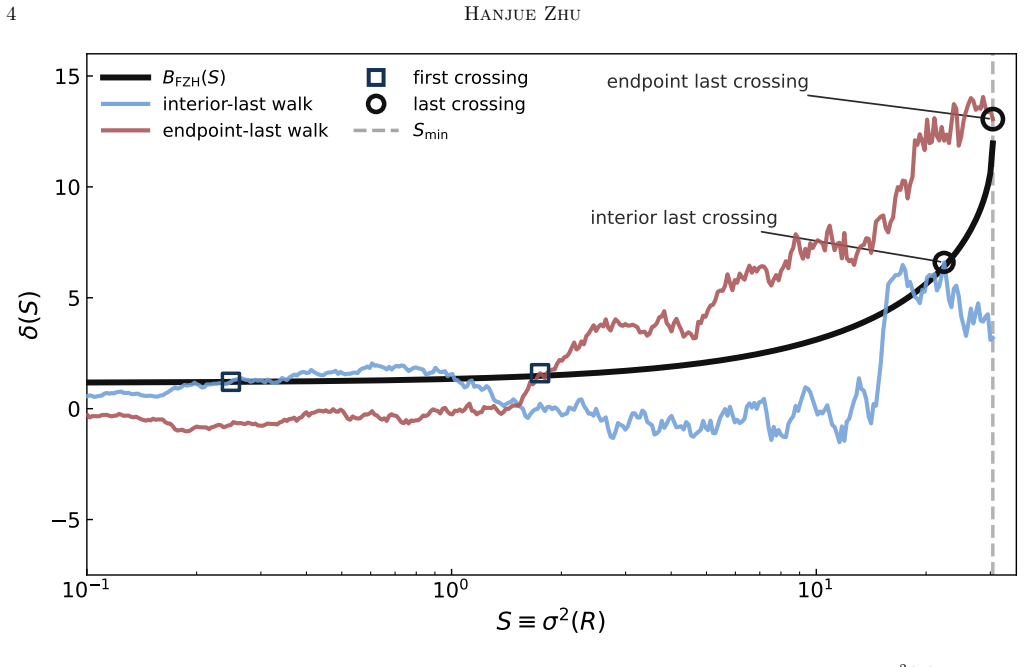
The load-bearing object is the FZH04 photon-counting barrier $B(S,z) = \delta_c(z) - \sqrt{2}\,K(\zeta)\sqrt{S_{\rm min} - S}$, where $K(\zeta) = \operatorname{erfc}^{-1}(1/\zeta)$, and the conjugate crossing rule $S_\ell = \max\{S : \delta(S) \geq B(S,z)\}$. The analytic machinery is a Volterra integral equation of the first kind, $A(S) = \int_{S}^{S_i} f_\ell(S')\,K(S,S')\,dS'$, where $A(S)$ is a bivariate Gaussian probability that the trajectory lies above the barrier at $S$ and below it at the endpoint $S_i = S_{\rm min}$, and $K(S,S')$ is the sharp-$k$ conditional probability of being above at $S$ given a crossing at $S'$. The equation is inverted by forward substitution on a grid linear in $u = \sqrt{S_i - S}$, plus the endpoint atom $p_{\rm end} = 1 - \Phi(\delta_c(z)/\sqrt{S_i})$. The same crossing definitions applied to the empirical neutral/ionized conditional barrier from CROC yield the resolved/unresolved $R_\ell$ classification that drives the environmental analysis.
What would settle it
Run the same empirical-barrier analysis on a higher-resolution radiative-transfer simulation, or on CROC with a finer smoothing grid, and measure the radial source-density profile around $R_\ell$: if the central deficit and intermediate excess diminish or reverse once more small-scale structure is resolved, the central empirical claim is wrong. Independently, stack galaxy catalogs around observed Lyα transmission spikes; the predicted central galaxy deficit with an excess at finite separation would be refuted by a flat or monotonically increasing profile.
Extended reading notes
Core claim
The central claim is that the last crossing of the FZH04 photon-counting barrier, defined by $S_\ell = \max\{S : \delta(S) \geq B(S,z)\}$ with $B(S,z) = \delta_c(z) - \sqrt{2}\,K(\zeta)\sqrt{S_{\rm min} - S}$, is a physical statistic rather than a mathematical artifact. Because trajectories end at a finite source-halo endpoint $S_{\rm min}$, the last-crossing distribution splits into a smooth interior density and a discrete endpoint atom, and the interior density obeys a Volterra integral equation that the paper solves deterministically. Measured in CROC via the Kaurov empirical barrier, resolved last-crossing regions form coherent structures tracing the edges of ionized regions around neutral pockets, are predominantly underdense, and, at fixed local density, first-crossing scale, and reionization redshift, differ from matched unresolved regions in source environment: roughly half the central ionizing-luminosity density and a one-third deficit in galaxy number density, with excesses of about 75% and 65% at intermediate radius. The paper interprets this as gas that is externally ionized—sustained by sources on larger scales rather than by its own small-scale photon budget.
Load-bearing premise
The classification of a region as resolved or unresolved depends on how finely the simulation grid is smoothed, and a finer grid could move regions from one class to the other, changing the reported source-density contrasts.
Editorial extensions
If this is right
- Ionized gas splits into two observable classes: unresolved regions whose own photon budget closes at the smallest resolved aperture, and resolved regions that stay ionized only through photons counted on larger apertures.
- Among resolved regions, larger $R_\ell$ selects lower gas density and later reionization, so the statistic reads off a region's position in the density–reionization-time plane.
- $R_\ell$ adds information beyond $\delta$, $R_f$, and $z_{\rm rei}$: matched regions differ by about a factor of two in central luminosity density and by one third in central galaxy number density, with intermediate-radius excesses near 75% and 65%.
- If transmission spikes preferentially inhabit resolved regions, stacked galaxy profiles around Lyα transmission-selected IGM locations should show a central deficit and a finite-separation excess relative to matched control locations.
- The extended large-$R_\ell$ tail relative to the analytic FZH04 model quantifies the importance of nonlocal photon transport in sustaining ionized regions.
Reading between the lines
- The same finite-endpoint Volterra construction could be transported to other excursion-set problems with a physically motivated minimum scale, such as the star-formation and IMF fragmentation problem that motivated Hopkins's equation, to separate internally from externally fed fragments.
- The resolved/unresolved split is resolution-relative by construction; a finer grid would convert some endpoint-atom regions into interior crossings, so the class fractions and the Figure 9 contrasts are predictions of the analysis scale, not just of reionization physics.
- If the Lyα prediction survives mock-spectra tests, $R_\ell$ could become a bridge statistic connecting 21 cm bubble morphology to transmission-spike statistics, two observables currently modeled in separate communities.
- The analytic first- and last-crossing pair could be used as a fast two-population likelihood for inferring $\zeta$ and $M_{\rm min}$ from observations of bubble sizes and transmission-spike environments jointly.
Editorial analysis
A structured set of objections, weighed in public.
Referee Report
Summary. The paper introduces a new statistic for excursion-set models of cosmic reionization: the last crossing of the FZH04 photon-counting barrier, denoted R_ℓ, defined as the smallest smoothing scale on which the enclosed photon budget still ionizes the enclosed gas. After the first crossing gives the enclosing ionized-bubble scale, the last crossing identifies the smallest aperture on which the same condition holds; trajectories that remain above the barrier down to the minimum source-halo scale contribute a discrete endpoint population. The author derives an analytic last-crossing distribution using a finite-endpoint Volterra equation of the first kind, validates the solver against Monte Carlo sharp-k random walks in Appendix A, and then applies the same crossing statistics to an empirical barrier extracted from CROC radiative-transfer simulations following Kaurov (2016). The empirical analysis finds that resolved-R_ℓ regions are predominantly underdense, reionize later, and, when matched in local density, first-crossing scale, and reionization redshift, show a central deficit and intermediate-radius excess in ionizing-luminosity and galaxy-number density relative to unresolved regions. The author interprets these regions as externally ionized and suggests they may preferentially host Lyα transmission spikes.
Significance. The analytic part of the paper is a genuine contribution: the last-crossing formalism is new for the FZH04 barrier, the finite-endpoint treatment is explicit, and the Volterra solution is independently checked with Monte Carlo realizations. These strengths should be credited. If the empirical claims hold, the statistic connects the internal source geometry of ionized regions to testable galaxy–IGM measurements around transmission-selected locations. However, the empirical conclusions currently rest on a resolution-dependent classification and on an empirical barrier derived from the same ionization field whose crossings are then measured. The central analytic derivation appears sound; the empirical part needs additional robustness work before the source-environment contrasts can be regarded as physical rather than operational.
major comments (3)
- [Sec. 4, text after Eq. (34); Sec. 6, Fig. 9] The resolved/unresolved R_ℓ classification is defined with respect to the minimum resolved smoothing scale in the CROC trajectory construction, not the physical source-halo scale, as stated in Sec. 4. The unresolved sample therefore contains all regions whose photon budget closes on scales below R_min, and a higher-resolution trajectory set would reclassify some of them as resolved. Because the source-environment contrasts in Fig. 9 are ratios between samples defined by this resolution boundary, the reported factor-of-two central deficit and intermediate-radius excess are not yet shown to be stable physical properties of externally ionized regions. Please add a convergence test, for example by repeating the crossing classification with the trajectory endpoint deliberately coarsened to several larger R_min values and checking whether the matched ratios in Fig. 9 persist; if this is not computationally feasible, the physical claims should be explicitly restricted to the operational, resolution-dependent definition.
- [Sec. 6, Fig. 9 and matching description] The matching procedure for Fig. 9 is described only as holding fixed local density, first-crossing scale R_f, and reionization redshift, with no tolerances, binning scheme, or algorithm given. If the matching is not sufficiently tight, residual differences in these variables between the resolved and unresolved samples could contribute to the central deficit and intermediate excess. Please specify the exact matching construction (e.g., nearest-neighbor in log-density, log-R_f, and z_rei with stated tolerances or kernel widths), show the distributions of the matched variables before and after matching, and include a null control using randomly paired samples to calibrate the expected contrast.
- [Sec. 4, Eq. (34) and Fig. 4] Because B_sim(R) is defined from the same CROC ionization field whose crossings are subsequently measured, and because the analytic ζ in Fig. 4 is chosen to match the simulated ionized fraction, the comparison in Fig. 4 is not an independent validation of the analytic model. The extended large-R tails in CROC are consistent with nonlocal photon transport, but they could also reflect the particular C_neutral=0.5 barrier definition, the Gaussianization of the density field, or the sharp-k smoothing filter. Please add a sensitivity test varying the barrier threshold (for example using the C_neutral=0.25 and 0.75 edges of the transition region) and refitting ζ, to show that the qualitative shape comparison and the resolved/unresolved split are robust to the empirical-barrier construction.
minor comments (5)
- [Sec. 4, paragraph after Eq. (34)] The phrase 'prior-weighted neutral and ionized distributions' is ambiguous; please define the priors explicitly (presumably the volume fractions of each class at the snapshot redshift).
- [Sec. 3 and Fig. 3] The 'approximately self-similar' evolution of the last-crossing distribution is asserted qualitatively; consider quantifying it with, for example, the ratio of the median or characteristic scales at different ionized fractions.
- [Fig. 6 caption] The volume fractions 50%, 34%, and 16% are for one snapshot; please state in the caption or text that these values are specific to z=8.0 and will evolve with redshift.
- [Appendix A, Eq. (A4)] The Brownian-bridge correction approximates the barrier as linear across each interval; since the FZH04 barrier curvature is strongest near S_min, please state explicitly that the u-grid (or equivalent) keeps the linear approximation accurate near the endpoint.
- [Sec. 6, first paragraph] When first citing the two papers by Zhu and coauthors, the text should disambiguate H. Zhu et al. (2024) from Y. Zhu et al. (2026) to avoid reader confusion, since both are relevant to the Lyα transmission discussion.
Circularity Check
No circularity: the analytic last-crossing derivation is self-contained and Monte Carlo validated, while the empirical CROC analysis uses the fitted barrier as a classifier whose source-environment contrasts are external to the fit.
full rationale
The analytic derivation in Sections 2–3 is not circular. The last-crossing scale R_ell is defined through the FZH04 photon-counting barrier, and the interior last-crossing density f_ell is recovered by solving the first-kind Volterra equation (26), whose left-hand side A(S) is computed directly from the bivariate Gaussian statistics of the sharp-k walk. No property of f_ell is assumed in order to construct A(S); the equation is genuinely inverted. Appendix A independently validates the deterministic solver against direct Monte Carlo random walks, confirming that the analytic crossing statistics are not wired in by construction. The empirical analysis in Sections 4–6 uses the Kaurov empirical barrier as a data-driven classification device. It is true that B_sim is constructed from the same simulated ionization field, but the paper does not present the resulting crossing distributions as an external test of the analytic model; it uses them to define resolved versus unresolved classes and then measures properties—local density, reionization time, ionizing-luminosity density, and galaxy-number density—that were not inputs to the barrier fit. The Figure 9 matched source-environment contrasts are therefore external to the construction of the barrier, not consequences of it. The analytic comparison in Figure 4 fixes zeta=17.7 to match the integrated ionized fraction, but the shape of the first- and last-crossing distributions is not determined by that single normalization; only the total area is matched, so the shape comparison retains independent content and is not a fitted input called a prediction. The paper explicitly states that the simulation trajectory endpoint is the minimum resolved smoothing scale, not the source-halo scale. That is a genuine resolution limitation that affects interpretation of the simulated resolved/unresolved split, but it is not a circular reduction: a higher-resolution simulation could change the empirical classification, yet the analytic derivation and the use of the classifier remain logically independent of the result being claimed. The self-citation to H. Zhu et al. (2024) is used only to motivate an observational hypothesis about Ly-alpha transmission spikes and does not function as the load-bearing support for either the analytic derivation or the central crossing-statistics claims. Overall, no step in the paper reduces by definition or by self-citation to its own inputs.
Assumptions & free parameters
free parameters (3)
- Ionizing efficiency ζ =
17.7 (at z=8.0)
- Minimum source-halo mass M_min (via S_min) =
Not stated
- Empirical barrier B_sim(R) =
Function measured from CROC
assumptions (4)
- standard math The initial density field is Gaussian; smoothing with a sharp-k filter yields a Markov random walk for δ(S).
- domain assumption The FZH04 photon-counting condition ζ f_coll ≥ 1 describes whether a region is ionized.
- ad hoc to paper The empirical barrier B_sim(R), defined by C_neutral=0.5, is a faithful representation of the physical ionization threshold and can be interpreted as the photon-counting barrier.
- domain assumption Classification of grid locations as ionized or neutral uses their reionization scale factor relative to the snapshot epoch.
Cite this review
Pith. "Pith review of The Last Crossing in Excursion-Set Theory of Cosmic Reionization." pith.science (2026). https://pith.science/paper/NWVIKKVG
@misc{pith2026260810066,
  author       = {Pith},
  title        = {Pith review of: The Last Crossing in Excursion-Set Theory of Cosmic Reionization},
  year         = {2026},
  howpublished = {\url{https://pith.science/paper/NWVIKKVG}},
  note         = {Machine review of arXiv:2608.10066}
}
abstract
I introduce the last crossing of the photon-counting barrier as a statistic for analytical models of cosmic reionization. Because ionizing galaxies are biased tracers of density and their photons propagate through gas of spatially varying opacity, the galaxy-IGM connection requires statistics beyond the global ionized fraction. The excursion-set model of Furlanetto et al. (2004) identifies the ionized-bubble scale around a point with the first crossing of a photon-counting barrier. I develop the last-crossing formalism and define the last-crossing scale, $R_\ell$, as the smallest scale on which the enclosed photon budget still ionizes the enclosed gas. I derive its distribution analytically. Using the empirical-barrier framework of Kaurov (2016) applied to CROC simulations, I measure both crossings in the simulated IGM. The last-crossing formalism separates externally ionized regions, whose photon-counting condition fails below $R_\ell$, from internally ionized regions whose trajectories remain above the barrier to the resolution scale. Resolved external regions are predominantly underdense, with larger $R_\ell$ selecting lower density and later reionization. At fixed local density, first-crossing scale, and reionization redshift, these regions show deficits in ionizing-luminosity and galaxy-number density at small radius relative to matched unresolved regions, and excesses in both at intermediate radius. Their combination of low gas density and a deficit of nearby sources suggests that Ly$\alpha$ transmission spikes may preferentially arise in these regions: low density reduces the opacity, while sources on larger scales maintain the ionized state. The last-crossing picture connects the internal source geometry of ionized regions to a testable prediction for radial galaxy distributions around transmission-selected IGM locations.
Figures


Figures from the paper (6 more)


Reference graph
Works this paper leans on
-
[1]
, year = 2004, month = sep, volume =
The Growth of H II Regions During Reionization. , year = 2004, month = sep, volume =. doi:10.1086/423025 , archivePrefix =. astro-ph/0403697 , primaryClass =
arXiv 2004
-
[2]
On improving analytical models of cosmic reionization for matching numerical simulation
On Improving Analytical Models of Cosmic Reionization for Matching Numerical Simulation. , year = 2016, month = nov, volume =. doi:10.3847/0004-637X/831/2/198 , archivePrefix =. 1512.01312 , primaryClass =
work page Pith review arXiv 2016
-
[3]
Physics Reports , year = 2001, month = jul, volume =
In the Beginning: The First Sources of Light and the Reionization of the Universe. Physics Reports , year = 2001, month = jul, volume =. doi:10.1016/S0370-1573(01)00019-9 , archivePrefix =. astro-ph/0010468 , primaryClass =
arXiv 2001
-
[4]
Physics Reports , year = 2006, month = oct, volume =
Cosmology at Low Frequencies: The 21 cm Transition and the High-Redshift Universe. Physics Reports , year = 2006, month = oct, volume =. doi:10.1016/j.physrep.2006.08.002 , archivePrefix =. astro-ph/0608032 , primaryClass =
arXiv 2006
-
[5]
Annual Review of Astronomy and Astrophysics , year = 2016, month = sep, volume =
The Evolution of the Intergalactic Medium. Annual Review of Astronomy and Astrophysics , year = 2016, month = sep, volume =. doi:10.1146/annurev-astro-082214-122355 , archivePrefix =. 1512.00086 , primaryClass =
arXiv 2016
-
[6]
Living Reviews in Computational Astrophysics , year = 2022, month = nov, volume =
Modeling Cosmic Reionization. Living Reviews in Computational Astrophysics , year = 2022, month = nov, volume =. doi:10.1007/s41115-022-00015-5 , archivePrefix =. 2208.02260 , primaryClass =
arXiv 2022
-
[7]
, year = 2015, month = apr, volume =
Cosmic Reionization and Early Star-forming Galaxies: A Joint Analysis of New Constraints from Planck and the Hubble Space Telescope. , year = 2015, month = apr, volume =. doi:10.1088/2041-8205/802/2/L19 , archivePrefix =. 1502.02024 , primaryClass =
arXiv 2015
-
[8]
, year = 2019, month = jul, volume =
Conditions for Reionizing the Universe with a Low Galaxy Ionizing Photon Escape Fraction. , year = 2019, month = jul, volume =. doi:10.3847/1538-4357/ab1ea8 , archivePrefix =. 1902.02792 , primaryClass =
arXiv 2019
Show all 49 references
-
[9]
, year = 1996, month = sep, volume =
An Analytic Model for the Spatial Clustering of Dark Matter Haloes. , year = 1996, month = sep, volume =. doi:10.1093/mnras/282.2.347 , archivePrefix =. astro-ph/9512127 , primaryClass =
1996 arXiv
-
[10]
Reports on Progress in Physics , year = 2012, month = aug, volume =
21 cm Cosmology in the 21st Century. Reports on Progress in Physics , year = 2012, month = aug, volume =. doi:10.1088/0034-4885/75/8/086901 , archivePrefix =. 1109.6012 , primaryClass =
2012 arXiv
-
[11]
Experimental Astronomy , year = 2013, month = aug, volume =
Reionization and the Cosmic Dawn with the Square Kilometre Array. Experimental Astronomy , year = 2013, month = aug, volume =. doi:10.1007/s10686-013-9334-5 , archivePrefix =. 1210.0197 , primaryClass =
2013 arXiv
-
[12]
, year = 2005, month = sep, volume =
The Kinetic Sunyaev-Zel'dovich Effect from Reionization. , year = 2005, month = sep, volume =. doi:10.1086/432049 , archivePrefix =. astro-ph/0504189 , primaryClass =
2005 arXiv
-
[14]
, year = 2015, month = mar, volume =
Evidence of Patchy Hydrogen Reionization from an Extreme Ly Trough below Redshift Six. , year = 2015, month = mar, volume =. doi:10.1093/mnras/stu2646 , archivePrefix =. 1407.4850 , primaryClass =
2015 arXiv
-
[15]
, year = 2022, month = jul, volume =
Hydrogen Reionization Ends by z = 5.3: Ly Optical Depth Measured by the XQR-30 Sample. , year = 2022, month = jul, volume =. doi:10.1093/mnras/stac1046 , archivePrefix =. 2108.03699 , primaryClass =
2022 arXiv
-
[16]
, year = 2024, month = nov, volume =
On the Physical Nature of Ly Transmission Spikes in High-redshift Quasar Spectra. , year = 2024, month = nov, volume =. doi:10.3847/1538-4357/ad7dd4 , archivePrefix =. 2401.04762 , primaryClass =
2024 arXiv
-
[17]
Keck Spectroscopy of 5 < z < 7 Galaxies in the QSO Field J1148+5251
The Role of Galaxies and AGN in Reionizing the IGM -- I. Keck Spectroscopy of 5 < z < 7 Galaxies in the QSO Field J1148+5251. , year = 2018, month = sep, volume =. doi:10.1093/mnras/sty1318 , archivePrefix =. 1803.02981 , primaryClass =
2018 arXiv
-
[18]
Metal-tracing the Faint Sources of Reionization at 5 z 6
The Role of Galaxies and AGNs in Reionizing the IGM -- II. Metal-tracing the Faint Sources of Reionization at 5 z 6. , year = 2019, month = feb, volume =. doi:10.1093/mnras/sty2954 , archivePrefix =. 1807.07899 , primaryClass =
2019 arXiv
-
[19]
EIGER. I. A Large Sample of [O III]-emitting Galaxies at 5.3 < z < 6.9 and Direct Evidence for Local Reionization by Galaxies. , year = 2023, month = jun, volume =. doi:10.3847/1538-4357/acc588 , archivePrefix =. 2211.08254 , primaryClass =
2023 arXiv
-
[20]
The Geometry of Reionization
Simulating Cosmic Reionization at Large Scales -- I. The Geometry of Reionization. , year = 2006, month = jul, volume =. doi:10.1111/j.1365-2966.2006.10502.x , archivePrefix =. astro-ph/0512187 , primaryClass =
2006
-
[21]
Radiative Transfer Simulations of Cosmic Reionization. I. Methodology and Initial Results. , year = 2007, month = dec, volume =. doi:10.1086/522566 , archivePrefix =. astro-ph/0612406 , primaryClass =
2007 arXiv
-
[22]
, year = 2016, month = dec, volume =
Cosmic Dawn (CoDa): The First Radiation-Hydrodynamics Simulation of Reionization and Galaxy Formation in the Local Universe. , year = 2016, month = dec, volume =. doi:10.1093/mnras/stw2036 , archivePrefix =. 1511.00011 , primaryClass =
2016 arXiv
-
[23]
Cosmic Reionization on Computers. I. Design and Calibration of Simulations. , year = 2014, month = sep, volume =. doi:10.1088/0004-637X/793/1/29 , archivePrefix =. 1403.4245 , primaryClass =
2014 arXiv
-
[24]
, year = 2022, month = apr, volume =
Introducing the THESAN Project: Radiation-magnetohydrodynamic Simulations of the Epoch of Reionization. , year = 2022, month = apr, volume =. doi:10.1093/mnras/stab3710 , archivePrefix =. 2110.00584 , primaryClass =
2022 arXiv
-
[25]
, year = 2024, month = jun, volume =
The THESAN Project: Public Data Release of Radiation-Hydrodynamic Simulations Matching Reionization-era JWST Observations. , year = 2024, month = jun, volume =. doi:10.1093/mnras/stae839 , archivePrefix =. 2309.06475 , primaryClass =
2024 arXiv
-
[26]
, year = 2007, month = may, volume =
The Morphology of H II Regions During Reionization. , year = 2007, month = may, volume =. doi:10.1111/j.1365-2966.2007.11489.x , archivePrefix =. astro-ph/0610094 , primaryClass =
2007
-
[27]
, year = 2007, month = nov, volume =
Efficient Simulations of Early Structure Formation and Reionization. , year = 2007, month = nov, volume =. doi:10.1086/521806 , archivePrefix =. 0704.0946 , primaryClass =
2007 arXiv
-
[28]
, year = 2016, month = sep, volume =
The Distribution of Bubble Sizes During Reionization. , year = 2016, month = sep, volume =. doi:10.1093/mnras/stw1542 , archivePrefix =. 1511.01506 , primaryClass =
2016 arXiv
-
[29]
, year = 1991, month = oct, volume =
Excursion Set Mass Functions for Hierarchical Gaussian Fluctuations. , year = 1991, month = oct, volume =. doi:10.1086/170520 , adsurl =
1991 doi
-
[30]
, year = 2012, month = jul, volume =
The Stellar Initial Mass Function, Core Mass Function and the Last-crossing Distribution. , year = 2012, month = jul, volume =. doi:10.1111/j.1365-2966.2012.20731.x , archivePrefix =. 1201.4387 , primaryClass =
2012
-
[31]
, year = 2011, month = jun, volume =
Comparison of Reionization Models: Radiative Transfer Simulations and Approximate, Seminumeric Models. , year = 2011, month = jun, volume =. doi:10.1111/j.1365-2966.2011.18439.x , archivePrefix =. 1003.3455 , primaryClass =
2011
-
[32]
, year = 2022, month = sep, volume =
Cosmic Reionization on Computers: Physical Origin of Long Dark Gaps in Quasar Absorption Spectra. , year = 2022, month = sep, volume =. doi:10.3847/1538-4357/ac8a44 , archivePrefix =. 2209.03968 , primaryClass =
2022 arXiv
-
[33]
, year = 2023, month = jul, volume =
A SPectroscopic Survey of Biased Halos in the Reionization Era (ASPIRE): JWST Reveals a Filamentary Structure around a z = 6.61 Quasar. , year = 2023, month = jul, volume =. doi:10.3847/2041-8213/accd6f , archivePrefix =. 2304.09894 , primaryClass =
2023 arXiv
-
[34]
Planck 2018 results. VI. Cosmological parameters. , year = 2020, month = sep, volume =. doi:10.1051/0004-6361/201833910 , archivePrefix =. 1807.06209 , primaryClass =
2018 arXiv
-
[35]
, year = 2011, month = feb, volume =
21CMFAST: a fast, seminumerical simulation of the high-redshift 21-cm signal. , year = 2011, month = feb, volume =. doi:10.1111/j.1365-2966.2010.17731.x , archivePrefix =. 1003.3878 , primaryClass =
2011
-
[36]
, year = 2020, month = apr, volume =
Improved upper limits on the 21 cm signal power spectrum of neutral hydrogen at z 9.1 from LOFAR. , year = 2020, month = apr, volume =. doi:10.1093/mnras/staa327 , archivePrefix =. 2002.07196 , primaryClass =
2020 arXiv
-
[37]
, year = 2023, month = mar, volume =
Improved Constraints on the 21 cm EoR Power Spectrum and the X-Ray Heating of the IGM with HERA Phase I Observations. , year = 2023, month = mar, volume =
2023
-
[38]
, year = 2018, month = sep, volume =
The SPHINX Cosmological Simulations of the First Billion Years: the Impact of Binary Stars on Reionization. , year = 2018, month = sep, volume =
2018
-
[39]
, year = 2022, month = jun, volume =
The THESAN project: properties of the intergalactic medium and its connection to reionization-era galaxies. , year = 2022, month = jun, volume =. doi:10.1093/mnras/stac257 , archivePrefix =. 2110.01628 , primaryClass =
2022 arXiv
-
[40]
, year = 2022, month = may, volume =
The THESAN project: Lyman- emission and transmission during the epoch of reionization. , year = 2022, month = may, volume =. doi:10.1093/mnras/stac713 , archivePrefix =. 2110.02966 , primaryClass =
2022 arXiv
-
[41]
IGM-galaxy cross-correlations at z 6 from eight quasar fields with DEIMOS and MUSE
The role of galaxies and AGN in reionizing the IGM -- III. IGM-galaxy cross-correlations at z 6 from eight quasar fields with DEIMOS and MUSE. , year = 2020, month = may, volume =. doi:10.1093/mnras/staa746 , archivePrefix =. 1912.04314 , primaryClass =
2020 arXiv
-
[42]
, keywords =
A SPectroscopic Survey of Biased Halos In the Reionization Era (ASPIRE): JWST Supports Earlier Reionization around [O III] Emitters. , keywords =. doi:10.3847/1538-4357/ad82de , archivePrefix =. 2410.01318 , primaryClass =
-
[43]
arXiv e-prints , year = 2025, month = mar, eid =
JWST ASPIRE: How Did Galaxies Complete Reionization? Evidence for Excess IGM Transmission around [O III] Emitters during Reionization. arXiv e-prints , year = 2025, month = mar, eid =
2025
-
[44]
, year = 2025, month = may, volume =
The galaxy--IGM cross-correlation in the epoch of reionization. , year = 2025, month = may, volume =. doi:10.1093/mnras/staf648 , archivePrefix =. 2501.10513 , primaryClass =
2025 arXiv
-
[45]
The Open Journal of Astrophysics , year = 2025, month = aug, volume =
The galaxy-IGM connection in THESAN: the physics connecting the IGM Lyman- opacity and galaxy density in the reionization epoch. The Open Journal of Astrophysics , year = 2025, month = aug, volume =. doi:10.33232/001c.143245 , adsurl =
2025 doi
-
[46]
The Open Journal of Astrophysics , year = 2025, month = dec, volume =
The galaxy-IGM connection in THESAN: on the observability of the galaxy-Lyman- forest cross-correlation. The Open Journal of Astrophysics , year = 2025, month = dec, volume =. doi:10.33232/001c.151666 , adsurl =
2025 doi
-
[47]
, year =
Experimental constraints on self-consistent reionization models. , year =. doi:10.1111/j.1365-2966.2005.09229.x , eprint =
2005
-
[48]
, year =
Inhomogeneous recombinations during cosmic reionization. , year =. doi:10.1093/mnras/stu377 , eprint =
-
[49]
, keywords =
Galaxy Underdensities Host the Clearest Intergalactic Medium Ly Transmission and Indicate Anisotropic Reionization. , keywords =. doi:10.3847/1538-4357/ae5bbb , archivePrefix =. 2510.09568 , primaryClass =
- [50]
Reviewed August 14, 2026 · model on record in the stance chip above.
Discussion (0). Continue with ORCID to comment.