REVIEW 4 major objections 5 minor 165 references
Spiral Morphology and Radial Migration: Kinematically heating, cooling, and cold
T0 review · 4 major / 5 minor · reviewed 2026-08-14 · deepseek-v4-flash
Pith's one-line read The paper claims that a rigidly rotating density-wave spiral torques trapped stars progressively farther as its pitch angle increases, that a corotating winding spiral shows the opposite trend, and that this asymmetry makes pitch angle a…
desk verdict The headline cotθ scaling does not follow from the paper's own Equation 32; the simulations are useful but the central analytic claim needs to be reworked. read the letter →
The pith
A machine-rendered reading of the paper's core claim, the machinery that carries it, and where it could break.
The reading
What carries the argument
The central object is the logarithmic spiral perturbation $\Phi_{1,s}(R,\phi,t) = \Phi_s \cos[\alpha\ln(R/R_{\rm CR}) + m\Omega_p t - m\phi]$ with $\alpha = m\cot\theta$, whose amplitude $\Phi_s$ depends on pitch angle through the radial wavenumber $k = m\cot\theta/R$. Around corotation, trapped orbits are described by an assumed azimuthal libration $\phi_1(t) = |\phi_1|\cos(\omega t + \delta)$ with maximum amplitude $2\pi/m$; substituting this into the equations of motion yields the radial equation of motion and, at the libration phase $\tau = \pi/(2m)$, the approximate maximum excursion used throughout. That expression carries the argument because it converts spiral morphology, arm number, and pattern speed into a quantitative prediction $\max(\Delta R_g) \propto |\Phi_s(\theta)|\cot\theta$ that the tracer-particle experiments are designed to verify.
What would settle it
Compute the exact libration amplitude and frequency for orbits trapped at corotation in a logarithmic spiral potential by direct numerical integration, then check whether the maximum guiding-centre change follows $\max(\Delta R_g) \propto |\Phi_s(\theta)|\cot\theta$ across pitch angles such as 10, 20, 30, and 40 degrees; a clear departure from that scaling would falsify the central claim.
Extended reading notes
Core claim
For a rigidly rotating density-wave-like spiral with $m$-fold symmetry and pitch angle $\theta$, stars trapped at corotation librate about the stable maxima of the effective potential in the rotating frame. Solving the linearized equations of motion gives a maximum first-order radial excursion $|R_{1,s}| \approx (\Phi_s/\kappa^2 R_0)[m\cot\theta\,\sin(1/\sqrt{2}m) + 2\sqrt{2}\pi^2 \Omega_0/\omega]$, so the largest change in guiding-centre radius is $\max(\Delta R_g) = 2\max(|R_{1,s}|) \propto |\Phi_s(\theta)|\cot\theta$. More open arms are therefore stronger radial migrators at fixed spiral strength. When the pattern speed instead equals the local circular frequency at every radius, a winding sheared spiral, corotation exists everywhere and the simulations show the rms change in angular momentum growing as the pitch angle decreases, reversing the density-wave trend. The same transient spiral also heats orbits at resonances away from corotation and circularizes a minority of orbits at the inner Lindblad resonance, so a single spiral passage produces cold torquing plus net kinematic heating alongside some resonant cooling.
Load-bearing premise
The entire analytic prediction hangs on the assumed shape of a trapped star's azimuthal libration, a cosine with amplitude $2\pi/m$ and a libration frequency $\omega$ that is not derived from the potential, so if real trapped orbits librate differently, the $\cot\theta$ scaling need not hold.
Editorial extensions
If this is right
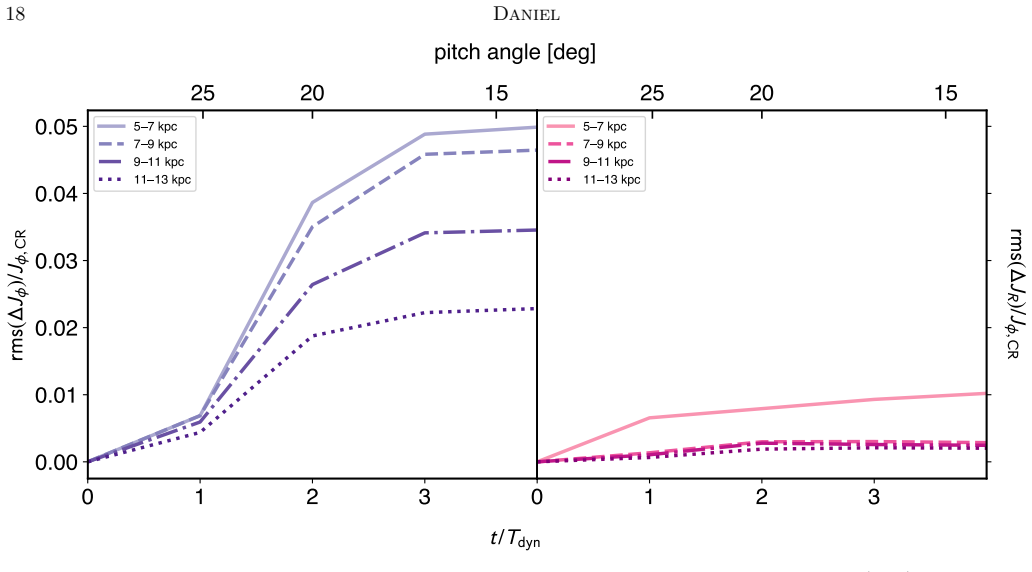
- For a rigidly rotating spiral of fixed strength, more open patterns produce larger radial changes in the guiding centres of trapped stars, and the 2D and 3D simulations confirm that rms$(\Delta J_\phi)$ grows with pitch angle while kinematic heating stays minimal.
- Estimates that use the older bar-symmetry formula $\max(R) \propto \sqrt{|\Phi_b|}$ overstate the maximum radial migration from a transient spiral episode by roughly a factor of two or more for typical pitch angles.
- At observed Milky Way spiral amplitudes and pitch angles, cold-torquing excursions are comparable to or smaller than ordinary epicyclic excursions, so a single transient rigid spiral episode moves the Sun at most about 2 kpc rather than the several kiloparsecs a bar formula would suggest.
- A winding spiral that corotates everywhere shows the opposite trend: cold torquing becomes more efficient as the pattern shears to smaller pitch angles, with nearly zero kinematic heating.
- Spiral morphology alone cannot predict cold-torquing efficiency, so the relation between pitch angle and radial redistribution can distinguish rigid density-wave spirals from winding, corotating spirals in observations.
Reading between the lines
- Editorial inference: measuring radial migration strength or azimuthal metallicity variations as a function of pitch angle in galaxy samples could separate density-wave from winding-spiral behaviour, provided an independent constraint on the pattern-speed nature is available.
- Editorial inference: if the $\cot\theta$ scaling survives in fully self-consistent spiral simulations, the burden for Milky Way radial migration shifts toward repeated generations of transient patterns rather than one strong episode.
- Editorial inference: the assumed cosine form for azimuthal libration with amplitude $2\pi/m$ and an undetermined frequency $\omega$ is the step most worth testing; comparing the analytic maximum against numerically computed libration trajectories would either confirm or falsify the central scaling.
- Editorial inference: the resonant-cooling result suggests that old, metal-rich, nearly circular orbits near the Sun should be interpreted not only as accretion relics but also as stars circularised by transient spiral resonances.
Signed reviews
Editorial analysis
A structured set of objections, weighed in public.
Referee Report
Summary. The paper studies how the morphology of spiral arms—pitch angle, arm number, lifetime, and radial dependence of pattern speed—controls the efficiency of 'cold torquing' at corotation. It derives an analytic expression for the maximum radial excursion of stars trapped at the corotation resonance of a Lin-Shu spiral, Eq. (32), and states in Eq. (64) that max(ΔRg) ∝ |Φs(θ)| cotθ. This leads to the headline prediction that rigidly rotating, density-wave-like spirals torque stars more efficiently when they are more open, while corotating winding spirals show the opposite trend. The paper tests the prediction with 2D and 3D tracer-particle simulations, reports that cold torquing increases with pitch angle for fixed fractional amplitude, and demonstrates a trend reversal for a winding spiral. It also discusses resonant kinematic heating and cooling and observational diagnostics.
Significance. If the central scaling were established, this would be a useful diagnostic for distinguishing density-wave from winding-spiral theories and would correct earlier bar-based estimates of cold-torquing efficiency. The paper has real strengths: it addresses an important question, includes 2D and 3D tracer simulations, uses an independent Cox-Gómez spiral potential in 3D, and explicitly contrasts rigid and winding spiral models. However, the central quantitative claim is undermined by an algebraic inconsistency in Eqs. (32)–(64), and the 2D confirmation shares the same Lin-Shu potential, so the paper's main new quantitative result is not currently supported. The qualitative trend may survive, but the claimed cotθ scaling needs to be re-derived and tested with a controlled numerical experiment.
major comments (4)
- [§2.3.4, Eqs. (32) and (64)] The claimed scaling is not what Eq. (32) gives. With the Lin-Shu amplitude, Φs = 2πGΣ εΣ / k and k = m cotθ/R0 (Eqs. 17–18), so Φs ∝ tanθ. Substituting into Eq. (32), the first term in the bracket is ∝ cotθ, making its product with Φs θ-independent, while the second term is proportional to tanθ. Thus |R1,s| behaves as a constant plus a term ∝ tanθ, not as |Φs(θ)| cotθ; the claimed quantity |Φs(θ)| cotθ is actually constant in θ. The increasing red curve in Fig. 5 therefore reflects the amplitude variation Φs ∝ tanθ, not a geometric cotθ enhancement. In addition, the coefficients in Eq. (32) correspond to τ = π/4, not τ = π/(2m) as stated in the text; for m = 4 the stated choice gives cos(π/8) = 0.924 and sin(π/8) = 0.383, not the 1/√2 and 1/√2 used in Eq. (32). This needs to be corrected and the consequences for Eq. (64) and the abstract must be addressed.
- [§2.3.3, Eq. (29)] The derivation assumes a specific azimuthal libration φ1(t) = |φ1| cos(ωt + δ) with |φ1| = 2π/m and an unspecified libration frequency ω. This assumption enters directly into Eq. (30) and the final amplitude Eq. (32). The paper gives no derivation of this form from the effective potential near L4/L5 and no check that numerically trapped orbits satisfy it for moderate pitch angles. If the amplitude, phasing, or θ-dependence of ω differs, the predicted scaling changes; since ω is a free parameter, Eq. (32) is not a closed prediction until ω is specified or shown not to matter for the trend.
- [§3.2.2] The 2D simulation confirmation is not an independent test of the cotθ dependence. The simulations adopt the same Lin-Shu spiral potential used in the analytic derivation, and they hold εΣ fixed, so Φs ∝ tanθ varies with pitch angle. The measured increase of rms(ΔLz) with θ is therefore consistent with the amplitude scaling alone, without any geometric cotθ effect. The authors should run a control with Φs at R_CR held fixed across pitch angles, or otherwise separate the amplitude contribution from the shape contribution. This is essential because Eq. (64) and the abstract's emphasis on 'more open spiral patterns' are about the geometric dependence.
- [§3.2.2, 'best matched'] The statement that the rms(ΔLz) values are 'best matched' to Eq. (32) is not supported by an explicit procedure. No fitting metric, parameter values, or comparison of the θ-dependence is given, and since Eq. (32) contains the unspecified ω, the match is ambiguous. Please provide the quantitative comparison, for example predicted versus measured peak values and slopes, or remove the claim.
minor comments (5)
- [§1] The text contains a duplicated word: 'without without kinematically heating a stellar population'.
- [Fig. 3 caption] The caption lists pitch angles θ = {5°, 15°, 30°, 45°} while the surrounding text says θ = {5°, 15°, 25°, 35°}; these should be aligned.
- [Fig. 4 and §2.3.4] Figure 4 describes the vertical line as purple while §2.3.4 says gray, dotted; the color reference should be consistent.
- [§3.4, Eq. (39)] The winding potential wrapper is described only by a phase shift; please state explicitly how the pitch angle evolves with time and what value of ϕ0 is used at t_ref.
- [§3.2.1, Eq. (49)] The harmonic indexing is unclear: the text says n = 0 gives the I/OLRs but then refers to n = 1 as the first harmonics; please clarify the indexing convention.
Circularity Check
Claimed cotθ scaling cancels under the paper's own Lin-Shu definitions; 2D confirmation uses the same input potential.
-
other
[Eqs. (17)-(18), (32), (34) in §2.3.4; Eq. (64) in §5]
"The amplitude of the perturbing spiral potential is given by, Φs(R) = 2πGΣ(R)ϵΣ/k ... k = α/R = mcotθ/R0. ... |R1,s| ≈ Φs/κ²R0 ( mcotθ sin(1/(√2m)) + 2√2π² Ω0/ω ). ... max(ΔRg) = 2 max(|R1,s|) ∝ |Φs(θ)|cotθ."
Substituting Φs=2πGΣϵΣ/k and k=mcotθ/R0 into Eq. (32), the first bracket term becomes 2πGΣϵΣ m sin(1/(√2m))/(κ²R0), which is independent of θ, while the second term is proportional to tanθ. Thus Eq. (32) predicts |R1,s| ≈ const + C·tanθ, not ∝|Φs|cotθ; and since Φs∝tanθ, the product |Φs|cotθ is itself constant. The headline scaling Eq. (64) therefore does not follow from the derivation; the monotonic increase of the plotted |R1,s| is carried by the amplitude variation Φs∝tanθ built into the Lin-Shu ansatz, not by the claimed cotθ geometry. In addition, Eq. (32) is said to adopt τ=π/(2m), but its coefficients correspond to τ=π/4, so the 'maximum' expression is not the stated phase.
-
self definitional
[§3.2 and §3.2.2 (Eqs. 16, 37, 38)]
"The adopted underlying axisymmetric potential has the form Φ0=v_c² ln(R/Rp). ... The perturbing potential, Φ1(R,ϕ,t), takes the form described in Equation 37 where the time-independent amplitude for a Lin-Shu spiral potential is given by Equation 16. ... The only condition modified for each simulation within the 2D and 3D suites is the assigned spiral pitch angle, which takes a value θ={10°,20°,30°,40°}."
The 2D tracer experiments are constructed with the same Lin-Shu spiral potential (Eq. 16) and the same amplitude prescription (Eqs. 37-38) used in the analytic derivation, with ϵΣ held fixed. Because in that prescription Φs∝tanθ, the measured increase of rms(ΔLz) with θ inherits the assumed amplitude-pitch-angle dependence; the experiment is a self-consistency check of the algebra rather than an independent validation of the cotθ factor. By construction it cannot falsify the input potential's θ-dependence.
full rationale
The paper's central qualitative contrast — rigidly rotating spirals torque more efficiently when more open, while winding spirals torque more efficiently as they wind — has independent content: the Cox & Gómez 3D potential and the winding-spiral experiment do not assume the Lin-Shu form used in the analytic section, and the trend reversal is a genuine dynamical result. Self-citations (Daniel & Wyse 2015; Daniel et al. 2019; Smock et al. 2026) are contextual and not load-bearing for the central derivation. However, the quantitative prediction Eq. (64) is not actually obtained from Eq. (32): under the paper's own definitions (Eqs. 17-18), the claimed ∝|Φs|cotθ factor cancels to a constant in the first term and leaves only the input amplitude ∝tanθ in the second; the 2D 'confirmation' uses the same Lin-Shu potential and so partly confirms an input assumption. These are partial, construction-level reductions of the central prediction, but not a self-citation chain and not a full equivalence, so the score is 4.
Assumptions & free parameters
free parameters (2)
- libration frequency ω =
not stated
- spiral fractional amplitude ε_Σ =
0.1, 0.2, 0.3 in the 2D model; set by the 3D model parameters
assumptions (6)
- domain assumption The perturbation is weak (|Φ1/Φ0| ≪ 1) and the underlying disk is axisymmetric, so linear epicyclic theory applies.
- domain assumption The spiral perturbation has the Lin-Shu form (Eq. 16) with radially independent pattern speed Ωp and constant pitch angle θ.
- ad hoc to paper Trapped stars librate azimuthally as φ1(t) = |φ1| cos(ωt + δ) with |φ1| = 2π/m.
- ad hoc to paper For θ ≲ 30 degrees, the maximum of Eq. (31) occurs at τ = π/2m.
- domain assumption The torque determining radial excursions is dominated by the spiral amplitude at corotation.
- domain assumption For the winding spiral model, the pattern corotates with the disk at all radii (Ωp(R) = Ω(R)) and winds up due to differential rotation.
Cite this review
Pith. "Pith review of Spiral Morphology and Radial Migration: Kinematically heating, cooling, and cold." pith.science (2026). https://pith.science/paper/DGVUKB3Z
@misc{pith2026260810097,
  author       = {Pith},
  title        = {Pith review of: Spiral Morphology and Radial Migration: Kinematically heating, cooling, and cold},
  year         = {2026},
  howpublished = {\url{https://pith.science/paper/DGVUKB3Z}},
  note         = {Machine review of arXiv:2608.10097}
}
read the original abstract
Transient spiral arms are known to drive radial redistribution of stars and thus could play a central role in shaping disk galaxies, including modifying, over time, the age, chemical, and kinematic (chrono-chemo-dynamic) distributions in the Milky Way. However, the physical factors governing the efficiency of such processes remain poorly understood. This paper investigates how the morphology of spiral arms -- the number, pitch angle, lifetime, and radial dependence of the pattern speed -- influences orbital redistribution through 'cold torquing' at the corotation resonance(s). Analytic expressions are derived for the maximum radial excursion of stars trapped at corotation that explicitly account for spiral morphology, predicting that the efficiency of cold torquing for a density-wave like spiral is greater for more open spiral patterns. Tracer-particle simulations confirm the analytic prediction, in both two- and three-dimensional galactic potentials. In contrast, spirals that have a radially dependent pattern speed such that they corotate with the disk at all radii exhibit the opposite behavior, with cold torquing becoming more efficient as the spiral winds to smaller pitch angles over time. This study further finds that resonant interactions from the same transient spiral causing cold torquing naturally also produces both kinematic heating and cooling of orbits away from corotation. These results demonstrate that spiral morphology alone cannot predict the efficiency of cold torquing and suggest that the relationship between spiral pitch angle and radial redistribution provides a potential diagnostic for distinguishing between competing theories of spiral structure.
Figures


Figures from the paper (7 more)


Reference graph
Works this paper leans on
-
[1]
L., Eufrasio, R., et al
Abdeen, S., Davis, B. L., Eufrasio, R., et al. 2022, MNRAS, 512, 366
2022
-
[2]
2008, A&A, 490, 135
Antoja, T., Figueras, F., Fern´ andez, D., & Torra, J. 2008, A&A, 490, 135
2008
-
[3]
2012, MNRAS, 426, L46
Athanassoula, E. 2012, MNRAS, 426, L46
2012
-
[4]
R., & Wada, K
Baba, J., Saitoh, T. R., & Wada, K. 2013, ApJ, 763, 46
2013
-
[5]
1967, ApJ, 150, 461
Barbanis, B., & Woltjer, L. 1967, ApJ, 150, 461
1967
-
[6]
K., S´ anchez, S
Barrera-Ballesteros, J. K., S´ anchez, S. F., Espinosa-Ponce, C., et al. 2023, RMxAA, 59, 213
2023
-
[7]
E., Font, J., Borlaff, A., & Garc ´ ıa-Lorenzo, B
Beckman, J. E., Font, J., Borlaff, A., & Garc ´ ıa-Lorenzo, B. 2018, ApJ, 854, 182
2018
-
[8]
A., Wetzel, A., Loebman, S
Bellardini, M. A., Wetzel, A., Loebman, S. R., et al. 2021, MNRAS, 505, 4586
2021
Show all 165 references
-
[9]
2022, MNRAS, 514, 689 24Daniel Beraldo e Silva, L., Debattista, V
Belokurov, V., & Kravtsov, A. 2022, MNRAS, 514, 689 24Daniel Beraldo e Silva, L., Debattista, V. P., Anderson, S. R., et al. 2023, ApJ, 955, 38
2022
-
[10]
P., Minchev, I., Ratcliffe, B., et al
Bernaldez, J. P., Minchev, I., Ratcliffe, B., et al. 2026, A&A, 707, A147
2026
-
[11]
Bertin, G., & Lin, C. C. 1996, Spiral structure in galaxies a density wave theory (MIT Press)
1996
-
[12]
2010, MNRAS, 401, 2318
Binney, J. 2010, MNRAS, 401, 2318
2010
-
[13]
2011, MNRAS, 413, 1889
Binney, J., & McMillan, P. 2011, MNRAS, 413, 1889
2011
-
[14]
1987, Galactic dynamics (Princeton University Press) —
Binney, J., & Tremaine, S. 1987, Galactic dynamics (Princeton University Press) —. 2008, Galactic Dynamics: Second Edition (Princeton University Press)
1987
-
[15]
C., Kazantzidis, S., & Weinberg, D
Bird, J. C., Kazantzidis, S., & Weinberg, D. H. 2012, MNRAS, 420, 913
2012
-
[16]
C., Loebman, S
Bird, J. C., Loebman, S. R., Weinberg, D. H., et al. 2021, MNRAS, 503, 1815
2021
-
[17]
L., & Puerari, I
Block, D. L., & Puerari, I. 1999, A&A, 342, 627
1999
-
[18]
2013, ApJ, 779, 115
Bovy, J., & Rix, H.-W. 2013, ApJ, 779, 115
2013
-
[19]
A., Law, D
Bundy, K., Bershady, M. A., Law, D. R., et al. 2015, ApJ, 798, 7
2015
-
[20]
Buta, R. J. 2017, MNRAS, 470, 3819
2017
-
[21]
G., & Sellwood, J
Carlberg, R. G., & Sellwood, J. A. 1985, ApJ, 292, 79
1985
-
[22]
V., Laporte, C
Carr, C., Johnston, K. V., Laporte, C. F. P., & Ness, M. K. 2022, MNRAS, 516, 5067
2022
-
[23]
2011, A&A, 530, A138+
Casagrande, L., Sch¨ onrich, R., Asplund, M., et al. 2011, A&A, 530, A138+
2011
-
[24]
McCarthy, J. K. 1997, AJ, 114, 376
1997
-
[25]
V., Marchuk, A
Chugunov, I. V., Marchuk, A. A., & Mosenkov, A. V. 2025, PASA, 42, e029
2025
-
[26]
1978, A&A, 64, 323
Contopoulos, G. 1978, A&A, 64, 323
1978
-
[27]
G., Guo, Y., et al
Costantin, L., P´ erez-Gonz´ alez, P. G., Guo, Y., et al. 2023, Nature, 623, 499
2023
-
[28]
P., & G´ omez, G
Cox, D. P., & G´ omez, G. C. 2002, ApJS, 142, 261
2002
-
[29]
2012, Research in Astronomy and Astrophysics, 12, 1197
Cui, X.-Q., Zhao, Y.-H., Chu, Y.-Q., et al. 2012, Research in Astronomy and Astrophysics, 12, 1197
2012
-
[30]
2019, ApJ, 882, 111
Kawaguchi, C., & Loebman, S. 2019, ApJ, 882, 111
2019
-
[31]
J., & Wyse, R
Daniel, K. J., & Wyse, R. F. G. 2015, MNRAS, 447, 3576 —. 2018, MNRAS, 476, 1561 de Jong, J. T. A., Yanny, B., Rix, H.-W., et al. 2010, ApJ, 714, 663 De Silva, G. M., Freeman, K. C., Bland-Hawthorn, J., et al. 2015, MNRAS, 449, 2604
2015
-
[32]
P., Khachaturyants, T., Amarante, J
Debattista, V. P., Khachaturyants, T., Amarante, J. A. S., et al. 2025, MNRAS, 537, 1620
2025
-
[33]
P., Roˇ skar, R., & Loebman, S
Debattista, V. P., Roˇ skar, R., & Loebman, S. R. 2017, in Outskirts of Galaxies, ed. J. H. Knapen, J. C. Lee, & A. Gil de Paz, Vol. 434, 77
2017
-
[34]
1999, AJ, 118, 1190 —
Dehnen, W. 1999, AJ, 118, 1190 —. 2000, AJ, 119, 800 Di Matteo, P., Haywood, M., Combes, F., Semelin, B., &
1999
-
[35]
Snaith, O. N. 2013, A&A, 553, A102
2013
-
[36]
S., & L´ epine, J
Dias, W. S., & L´ epine, J. R. D. 2005, ApJ, 629, 825 D’Onghia, E., & L. Aguerri, J. A. 2020, ApJ, 890, 117 D’Onghia, E., Vogelsberger, M., & Hernquist, L. 2013, ApJ, 766, 34
2005
-
[37]
2000, A&A, 358, L13
Drimmel, R. 2000, A&A, 358, L13
2000
-
[38]
1993, A&A, 275, 101
Edvardsson, B., Andersen, J., Gustafsson, B., et al. 1993, A&A, 275, 101
1993
-
[39]
W., Rix, H.-W., et al
Eilers, A.-C., Hogg, D. W., Rix, H.-W., et al. 2020, ApJ, 900, 186
2020
-
[40]
G., & Elmegreen, D
Elmegreen, B. G., & Elmegreen, D. M. 1983, ApJ, 267, 31
1983
-
[41]
G., Elmegreen, D
Elmegreen, B. G., Elmegreen, D. M., & Leitner, S. N. 2003, ApJ, 590, 271
2003
-
[42]
Elmegreen, D. M. 1998, Galaxies and galactic structure (Prentice Hall)
1998
-
[43]
1999, AJ, 118, 2618
Corrado, K. 1999, AJ, 118, 2618
1999
-
[44]
M., & Elmegreen, B
Elmegreen, D. M., & Elmegreen, B. G. 1984, ApJS, 54, 127
1984
-
[45]
M., Elmegreen, B
Elmegreen, D. M., Elmegreen, B. G., Yau, A., et al. 2011, ApJ, 737, 32 Espejo Salcedo, J. M., Pastras, S., V´ acha, J., et al. 2025, A&A, 700, A42
2011
-
[46]
2016, Astronomische Nachrichten, 337, 949 Fern´ andez, D., Figueras, F., & Torra, J
Famaey, B., Monari, G., & Siebert, A. 2016, Astronomische Nachrichten, 337, 949 Fern´ andez, D., Figueras, F., & Torra, J. 2001, A&A, 372, 833
2016
-
[47]
L., Weinberg, M
Filion, C., McClure, R. L., Weinberg, M. D., D’Onghia, E., & Daniel, K. J. 2023, MNRAS, 524, 276
2023
-
[48]
L., Bagley, M
Finkelstein, S. L., Bagley, M. B., Ferguson, H. C., et al. 2023, ApJL, 946, L13
2023
-
[49]
R., Debattista, V
Fiteni, K., Anderson, S. R., Debattista, V. P., et al. 2026, A&A, 708, A252
2026
-
[50]
E., Epinat, B., et al
Font, J., Beckman, J. E., Epinat, B., et al. 2011, ApJL, 741, L14
2011
-
[51]
E., Querejeta, M., et al
Font, J., Beckman, J. E., Querejeta, M., et al. 2014, ApJS, 210, 2
2014
-
[52]
Frankel, N., Rix, H.-W., Ting, Y.-S., Ness, M., & Hogg, D. W. 2018, ApJ, 865, 96
2018
-
[53]
2020, ApJ, 896, 15
Frankel, N., Sanders, J., Ting, Y.-S., & Rix, H.-W. 2020, ApJ, 896, 15
2020
-
[54]
Freeman, K. C. 1970, ApJ, 160, 811 Gaia Collaboration, Prusti, T., de Bruijne, J. H. J., et al. 2016, A&A, 595, A1
1970
-
[55]
1965, MNRAS, 130, 125
Goldreich, P., & Lynden-Bell, D. 1965, MNRAS, 130, 125
1965
-
[56]
1981, ApJ, 243, 1062 —
Goldreich, P., & Tremaine, S. 1981, ApJ, 243, 1062 —. 1982, ARA&A, 20, 249 Spiral morphology and radial redistribution25 Gonz´ alez Rivera de La Vernhe, I., Hill, V., Kordopatis, G., et al. 2024, A&A, 692, A131
1981
-
[57]
L., Wetzel, A., Bailin, J., & Orr, M
Graf, R. L., Wetzel, A., Bailin, J., & Orr, M. E. 2025, ApJ, 991, 139
2025
-
[58]
Grand, R. J. J., Fragkoudi, F., Pakmor, R., et al. 2026, MNRAS, 548, stag774
2026
-
[59]
Grand, R. J. J., Kawata, D., & Cropper, M. 2012, MNRAS, 421, 1529 —. 2013, A&A, 553, A77
2012
-
[60]
Grand, R. J. J., G´ omez, F. A., Marinacci, F., et al. 2017, MNRAS, 467, 179
2017
-
[61]
2020, MNRAS, 493, 2111
Griv, E., Gedalin, M., Shih, I.-C., Hou, L.-G., & Jiang, I.-G. 2020, MNRAS, 493, 2111
2020
-
[62]
L., et al
Guo, Y., Jogee, S., Finkelstein, S. L., et al. 2023, ApJL, 945, L10
2023
-
[63]
1972, Celestial mechanics
Hagihara, Y. 1972, Celestial mechanics. pt.1: Perturbation theory, Vol. 2 (MIT Press)
1972
-
[64]
2024, arXiv e-prints, arXiv:2411.08944
Hamilton, C., Modak, S., & Tremaine, S. 2024, arXiv e-prints, arXiv:2411.08944
2024 arXiv
-
[65]
2023, MNRAS, 525, 3318
Hawkins, K. 2023, MNRAS, 525, 3318
2023
-
[66]
R., Bovy, J., Holtzman, J
Hayden, M. R., Bovy, J., Holtzman, J. A., et al. 2015, ApJ, 808, 132
2015
-
[67]
2024, A&A, 690, A147
Haywood, M., Khoperskov, S., Cerqui, V., et al. 2024, A&A, 690, A147
2024
-
[68]
2021, Research in Astronomy and Astrophysics, 21, 009
He, Z.-H., Xu, Y., & Hou, L.-G. 2021, Research in Astronomy and Astrophysics, 21, 009
2021
-
[69]
2017, MNRAS, 467, 5022
Herpich, J., Tremaine, S., & Rix, H.-W. 2017, MNRAS, 467, 5022
2017
-
[70]
F., Wetzel, A., Kereˇ s, D., et al
Hopkins, P. F., Wetzel, A., Kereˇ s, D., et al. 2018, MNRAS, 480, 800
2018
-
[71]
2023, ApJL, 958, L26
Huang, S., Kawabe, R., Kohno, K., et al. 2023, ApJL, 958, L26
2023
-
[72]
Hunt, J. A. S., Bub, M. W., Bovy, J., et al. 2019, MNRAS, 490, 1026
2019
-
[73]
Hunt, J. A. S., & Vasiliev, E. 2025, NewAR, 100, 101721
2025
-
[74]
F., et al
Jeanneau, A., Richard, J., Bouch´ e, N. F., et al. 2026, A&A, 709, A120 Juri´ c, M., Ivezi´ c,ˇZ., Brooks, A., et al. 2008, ApJ, 673, 864
2026
-
[75]
A., Weiner, B
Kassin, S. A., Weiner, B. J., Faber, S. M., et al. 2012, ApJ, 758, 106
2012
-
[76]
2018, MNRAS, 479, L108
Kawata, D., Baba, J., Ciucˇ a, I., et al. 2018, MNRAS, 479, L108
2018
-
[77]
Kennicutt, R. C., J. 1981, AJ, 86, 1847
1981
-
[78]
P., & Daniel, K
Khachaturyants, T., Beraldo e Silva, L., Debattista, V. P., & Daniel, K. J. 2022, MNRAS, 512, 3500
2022
-
[79]
2018, A&A, 611, L2
Khoperskov, S., Di Matteo, P., Haywood, M., & Combes, F. 2018, A&A, 611, L2
2018
-
[80]
Snaith, O. N. 2020, A&A, 638, A144
2020
-
[81]
2022, A&A, 663, A38
Khoperskov, S., & Gerhard, O. 2022, A&A, 663, A38
2022
-
[82]
2025, A&A, 700, A89
Khoperskov, S., Steinmetz, M., Haywood, M., et al. 2025, A&A, 700, A89
2025
-
[83]
2026, arXiv e-prints, arXiv:2604.07076
Koller, M., Maiolino, R., ¨Ubler, H., et al. 2026, arXiv e-prints, arXiv:2604.07076
2026 arXiv
-
[84]
2015, MNRAS, 447, 3526
Kordopatis, G., Binney, J., Gilmore, G., et al. 2015, MNRAS, 447, 3526
2015
-
[85]
2024, ApJL, 968, L15
Kuhn, V., Guo, Y., Martin, A., et al. 2024, ApJL, 968, L15
2024
-
[86]
2026, ApJ, 1006, 137 Labb´ e, I., van Dokkum, P., Nelson, E., et al
Kuhn, V., Guo, Y., Rentschler, S., et al. 2026, ApJ, 1006, 137 Labb´ e, I., van Dokkum, P., Nelson, E., et al. 2023, Nature, 616, 266
2026
-
[87]
Lacey, C. G. 1984, MNRAS, 208, 687 L´ epine, J. R. D., Mishurov, Y. N., & Dedikov, S. Y. 2001, ApJ, 546, 234
1984
-
[88]
C., & Shu, F
Lin, C. C., & Shu, F. H. 1964, ApJ, 140, 646 —. 1966, Proceedings of the National Academy of Science, 55, 229
1964
-
[89]
C., Yuan, C., & Shu, F
Lin, C. C., Yuan, C., & Shu, F. H. 1969, ApJ, 155, 721
1969
-
[90]
L., Krawczyk, C., et al
Lingard, T., Masters, K. L., Krawczyk, C., et al. 2021, MNRAS, 504, 3364
2021
-
[91]
2011, MNRAS, 410, 166
Lintott, C., Schawinski, K., Bamford, S., et al. 2011, MNRAS, 410, 166
2011
-
[92]
R., Debattista, V
Loebman, S. R., Debattista, V. P., Nidever, D. L., et al. 2016, ApJL, 818, L6
2016
-
[93]
R., Roˇ skar, R., Debattista, V
Loebman, S. R., Roˇ skar, R., Debattista, V. P., et al. 2011, ApJ, 737, 8 Lokas, E. L. 2019, A&A, 629, A52
2011
-
[94]
L., Minchev, I., Buck, T., et al
Lu, Y. L., Minchev, I., Buck, T., et al. 2024, MNRAS, 535, 392
2024
-
[95]
Lynden-Bell, D., & Kalnajs, A. J. 1972, MNRAS, 157, 1
1972
-
[96]
L., Shu, C
Ma, J., Zhao, J. L., Shu, C. G., & Peng, Q. H. 1999, A&A, 350, 31
1999
-
[97]
R., Schiavon, R
Majewski, S. R., Schiavon, R. P., Frinchaboy, P. M., et al. 2017, AJ, 154, 94
2017
-
[98]
2025, A&A, 701, A88
Marques, L., Minchev, I., Ratcliffe, B., et al. 2025, A&A, 701, A88
2025
-
[99]
L., Lintott, C
Masters, K. L., Lintott, C. J., Hart, R. E., et al. 2019, MNRAS, 487, 1808
2019
-
[100]
Daniel, K. J. 2025, MNRAS, 537, 1475
2025
-
[101]
R., et al
McCluskey, F., Wetzel, A., Loebman, S. R., et al. 2024, MNRAS, 527, 6926
2024
-
[102]
J., & Hobbs, D
Mikkola, D., McMillan, P. J., & Hobbs, D. 2020, MNRAS, 495, 3295 26Daniel
2020
-
[103]
H., Prendergast, K
Miller, R. H., Prendergast, K. H., & Quirk, W. J. 1970, ApJ, 161, 903
1970
-
[104]
2010, ApJ, 722, 112
Minchev, I., & Famaey, B. 2010, ApJ, 722, 112
2010
-
[105]
2011, A&A, 527, A147+
Minchev, I., Famaey, B., Combes, F., et al. 2011, A&A, 527, A147+
2011
-
[106]
C., et al
Minchev, I., Famaey, B., Quillen, A. C., et al. 2012, A&A, 548, A126
2012
-
[107]
Minchev, I., & Quillen, A. C. 2006, MNRAS, 368, 623
2006
-
[108]
2026, A&A, 706, A31
Minchev, I., Attard, K., Ratcliffe, B., et al. 2026, A&A, 706, A31
2026
-
[109]
C., & Tremaine, S
Modak, S., Hamilton, C., Ostriker, E. C., & Tremaine, S. 2026, arXiv e-prints, arXiv:2605.21579
2026 arXiv
-
[110]
2022, AJ, 164, 85
Myers, N., Donor, J., Spoo, T., et al. 2022, AJ, 164, 85
2022
-
[111]
P., Oesch, P
Naidu, R. P., Oesch, P. A., van Dokkum, P., et al. 2022, ApJL, 940, L14
2022
-
[112]
F., Frenk, C
Navarro, J. F., Frenk, C. S., & White, S. D. M. 1997, ApJ, 490, 493
1997
-
[113]
A., Skokos, C., & Athanassoula, E
Patsis, P. A., Skokos, C., & Athanassoula, E. 2002, MNRAS, 337, 578
2002
-
[114]
2025, Research Notes of the American Astronomical Society, 9, 236 P´ erez-Montero, E., Garc ´ ıa-Benito, R., V ´ ılchez, J
Pearlstein, T., Masters, K., & G´ eron, T. 2025, Research Notes of the American Astronomical Society, 9, 236 P´ erez-Montero, E., Garc ´ ıa-Benito, R., V ´ ılchez, J. M., et al. 2016, A&A, 595, A62
2025
-
[115]
G., Merrifield, M
Peterken, T. G., Merrifield, M. R., Arag´ on-Salamanca, A., et al. 2019, Nature Astronomy, 3, 178
2019
-
[116]
E., & Dobbs, C
Pringle, J. E., & Dobbs, C. L. 2019, MNRAS, 490, 1470
2019
-
[117]
E., Cao, Y., et al
Querejeta, M., Meidt, S. E., Cao, Y., et al. 2025, A&A, 701, A183
2025
-
[118]
2009, MNRAS, 397, 1599
Haywood, M. 2009, MNRAS, 397, 1599
2009
-
[119]
2014, MNRAS, 437, 1284
Matteo, P. 2014, MNRAS, 437, 1284
2014
-
[120]
R., Loebman, S
Quinn, J. R., Loebman, S. R., Daniel, K. J., et al. 2026, ApJ, 997, 363
2026
-
[121]
J., Roˇ skar, R., Debattista, V
Radburn-Smith, D. J., Roˇ skar, R., Debattista, V. P., et al. 2012, ApJ, 753, 138 Re Fiorentin, P., Spagna, A., Lattanzi, M. G., Cignoni, M., & Vitali, S. 2024, ApJ, 977, 278
2012
-
[122]
J., Menten, K
Reid, M. J., Menten, K. M., Brunthaler, A., et al. 2019, ApJ, 885, 131
2019
-
[123]
A., & Mosenkov, A
Usachev, P. A., & Mosenkov, A. V. 2023, A&A, 680, L14
2023
-
[124]
1995, ApJ, 447, 82 Roˇ skar, R., Debattista, V
Rix, H.-W., & Zaritsky, D. 1995, ApJ, 447, 82 Roˇ skar, R., Debattista, V. P., Quinn, T. R., & Wadsley, J. 2012, MNRAS, 426, 2089 Roˇ skar, R., Debattista, V. P., Stinson, G. S., et al. 2008, ApJL, 675, L65
1995
-
[125]
E., Hodge, J., Bouwens, R., et al
Rowland, L. E., Hodge, J., Bouwens, R., et al. 2024, MNRAS, 535, 2068
2024
-
[126]
Rubin, V. C. 1983, Science, 220, 1339
1983
-
[127]
Saha, K., Tseng, Y.-H., & Taam, R. E. 2010, ApJ, 721, 1878 S´ anchez, S. F., P´ erez, E., S´ anchez-Bl´ azquez, P., et al. 2016, RMxAA, 52, 171 S´ anchez-Menguiano, L., S´ anchez, S. F., P´ erez, I., et al. 2018, A&A, 609, A119 Sch¨ onrich, R., & Binney, J. 2009, MNRAS, 399, 1145
2010
-
[128]
S., & James, P
Seigar, M. S., & James, P. A. 1998, MNRAS, 299, 685
1998
-
[129]
Sellwood, J. A. 2011, MNRAS, 410, 1637
2011
-
[130]
A., & Athanassoula, E
Sellwood, J. A., & Athanassoula, E. 1986, MNRAS, 221, 195
1986
- [131]
-
[132]
A., & Binney, J
Sellwood, J. A., & Binney, J. J. 2002, MNRAS, 336, 785
2002
-
[133]
A., & Carlberg, R
Sellwood, J. A., & Carlberg, R. G. 2014, ApJ, 785, 137
2014
-
[134]
A., & Gerhard, O
Sellwood, J. A., & Gerhard, O. 2020, MNRAS, 495, 3175
2020
- [135]
-
[136]
A., Trick, W
Sellwood, J. A., Trick, W. H., Carlberg, R. G., Coronado, J., & Rix, H.-W. 2019, MNRAS, 484, 3154
2019
-
[137]
2026, MNRAS, 548, stag563
Sestito, F., Fern´ andez-Alvar, E., Brooks, R., et al. 2026, MNRAS, 548, stag563
2026
-
[138]
R., Bland-Hawthorn, J., et al
Sharma, S., Hayden, M. R., Bland-Hawthorn, J., et al. 2021, MNRAS, 506, 1761
2021
-
[139]
L., et al
Sheth, K., Regan, M., Hinz, J. L., et al. 2010, PASP, 122, 1397
2010
-
[140]
J., Rampalli, R., et al
Smock, A., Daniel, K. J., Rampalli, R., et al. 2026, ApJ, 1005, 151, accepted
2026
-
[141]
2009, Publications of the Astronomical Society of Japan, 61, 227
Sofue, Y., Honma, M., & Omodaka, T. 2009, Publications of the Astronomical Society of Japan, 61, 227
2009
-
[142]
A., & Sch¨ onrich, R
Solway, M., Sellwood, J. A., & Sch¨ onrich, R. 2012, MNRAS, 422, 1363
2012
-
[143]
C., Aust, V., & Lu, Q
Speights, J. C., Aust, V., & Lu, Q. 2025, ApJ, 981, 115
2025
-
[144]
1953, ApJ, 118, 106
Spitzer, Jr., L., & Schwarzschild, M. 1953, ApJ, 118, 106
1953
-
[145]
1996, MNRAS, 279, 1263
Sridhar, S., & Touma, J. 1996, MNRAS, 279, 1263
1996
-
[146]
2026, arXiv e-prints, arXiv:2607.00077
Steel, C., Wetzel, A., Kang, R., et al. 2026, arXiv e-prints, arXiv:2607.00077
2026 arXiv
-
[147]
L., & Hwang, J.-S
Struck, C., Dobbs, C. L., & Hwang, J.-S. 2011, MNRAS, 414, 2498
2011
-
[148]
G., & D’Onghia, E
Struck, C., Elmegreen, B. G., & D’Onghia, E. 2026, ApJ, 1000, 198
2026
-
[149]
1964, ApJ, 139, 1217
Toomre, A. 1964, ApJ, 139, 1217
1964
-
[150]
1981, in Structure and Evolution of Normal Galaxies, ed
Toomre, A. 1981, in Structure and Evolution of Normal Galaxies, ed. S. M. Fall & D. Lynden-Bell, 111–136
1981
-
[151]
Tremaine, S., & Weinberg, M. D. 1984, ApJL, 282, L5
1984
-
[152]
2000, MNRAS, 319, 1
Tremaine, S., & Yu, Q. 2000, MNRAS, 319, 1
2000
-
[153]
H., Coronado, J., & Rix, H.-W
Trick, W. H., Coronado, J., & Rix, H.-W. 2019, MNRAS, 484, 3291 Spiral morphology and radial redistribution27 van der Kruit, P. C. 1987, A&A, 173, 59 van Donkelaar, F., Capelo, P. R., Mayer, L., Reed, D. S., &
2019
-
[154]
Quinn, T. R. 2025, MNRAS, 543, 2760
2025
-
[155]
2014, ApJ, 794, 173
Vera-Ciro, C., D’Onghia, E., Navarro, J., & Abadi, M. 2014, ApJ, 794, 173
2014
-
[156]
Vera-Ciro, C., D’Onghia, E., & Navarro, J. F. 2016, ApJ, 833, 42
2016
-
[157]
Wada, K., Baba, J., & Saitoh, T. R. 2011, ApJ, 735, 1
2011
-
[158]
R., Hopkins, P
Wetzel, A. R., Hopkins, P. F., Kim, J.-h., et al. 2016, ApJL, 827, L23
2016
-
[159]
1996, A&A, 314, 438
Wielen, R., Fuchs, B., & Dettbarn, C. 1996, A&A, 314, 438
1996
-
[160]
I., Quinn, J
Wiggins, A. I., Quinn, J. R., Oeur, M., et al. 2025, ApJL, 995, L25
2025
-
[161]
G., Lee, J
Williams, T. G., Lee, J. C., Larson, K. L., et al. 2024, ApJS, 273, 13
2024
-
[162]
T., Leaman, R., et al
Wisnioski, E., Mendel, J. T., Leaman, R., et al. 2025, MNRAS, 544, 2777
2025
-
[163]
2025, ApJ, 983, 57
Belfiore, F. 2025, ApJ, 983, 57
2025
-
[164]
Wyse, R. F. G., & Silk, J. 1989, ApJ, 339, 700
1989
-
[165]
L., et al
Zhang, H., Belokurov, V., Sanders, J. L., et al. 2025a, arXiv e-prints, arXiv:2512.09987
Reviewed August 14, 2026 · model on record in the stance chip above.
Discussion (0). Continue with ORCID to comment.