REVIEW 1 major objections 5 minor 40 references
Quasi-isometries, contractions, and intersection graphs
T0 review · 1 major / 5 minor · reviewed 2026-08-14 · deepseek-v4-flash
Pith's one-line read Every graph that is quasi-isometric to a planar graph is obtained from planar graphs by finitely many bounded subdivisions and cover-intersection operations, and conversely.
desk verdict Strong, significant paper with a load-bearing lemma that is only sketched; the characterization is plausible and worth referee time. read the letter →
The pith
A machine-rendered reading of the paper's core claim, the machinery that carries it, and where it could break.
The reading
What carries the argument
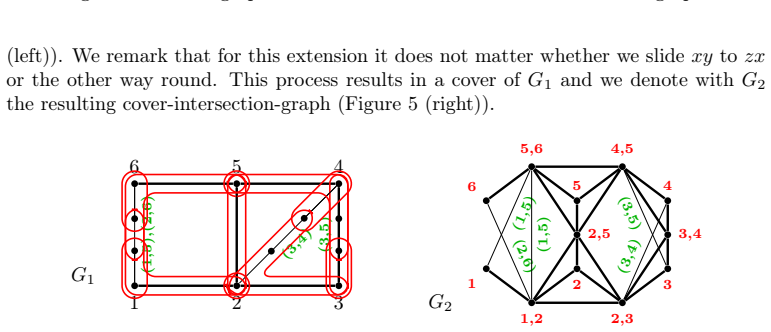
The two load-bearing constructions are the subdivision-cover-intersection operation and edge-sliding. The subdivision-cover-intersection operation takes a graph, subdivides each edge into a path of length at most 3, and then forms the cover-intersection graph: the vertices are a family of connected subgraphs that cover the base graph, and two vertices are adjacent when the corresponding subgraphs intersect. Edge-sliding is an equivalence relation on graphs sharing a vertex set: an edge can be moved by sliding one endpoint along another edge of the shared frame, and two graphs are edge-sliding twins when every difference can be removed this way; twins are 2-bi-Lipschitz equivalent, and every bi-Lipschitz equivalence between graphs on the same vertex set can be decomposed into finitely many edge-slidings. The proof's core lemma realizes a single edge-sliding by two subdivision-cover-intersection operations with cover sets of diameter at most 4, while bounded-diameter cover sets make the operation quasi-isometry-preserving (Corollary 3.3).
What would settle it
A countable graph that is quasi-isometric to a planar graph but is not an iterated subdivision-cover-intersection graph of any planar graph would refute Theorem 1.7. The square grid with both diagonals added to every cell is a concrete test case: it is non-planar, it is quasi-isometric to the planar grid, and the constructive proof must produce a finite SCIG derivation; if the number of iterations or the diameters of the cover sets grow without bound for larger and larger finite grids, the uniform finite-graph version fails.
Extended reading notes
Core claim
The central claim is Theorem 1.7: a graph is quasi-isometric to a planar graph if and only if it is an iterated subdivision-cover-intersection-graph of a planar graph. Iterating means starting with a planar graph and, a finite number of times, first subdividing every edge into a path of length at most 3 and then taking the intersection graph of a family of connected subgraphs whose union is the whole graph. The paper also proves the more general Theorem 1.8, in which two graphs are quasi-isometric exactly when each is obtained from the other by such operations with cover sets of bounded diameter. The backward direction of Theorem 1.7 builds on the cited theorem that every string graph is quasi-isometric to a planar graph with universal constants; the forward direction is proved by introducing edge-sliding and showing that every bi-Lipschitz equivalence decomposes into edge-slidings, each of which is realized by two subdivision-cover-intersection steps. Along the way the paper shows that contraction minors of quasi-planar graphs are quasi-planar, and that tree-decompositions with bounded-diameter adhesions and quasi-planar induced bags preserve quasi-planarity.
Load-bearing premise
The load-bearing premise is the cited theorem, not reproved here, that every countable string graph is quasi-isometric to a planar graph with universal constants; the backward half of the main equivalence collapses if that theorem fails. The paper also assumes throughout that all graphs are countable.
Editorial extensions
If this is right
- Quasi-planarity now has a finite combinatorial certificate: a graph is quasi-planar exactly when a finite sequence of bounded subdivisions and cover-intersection steps leads from a planar graph to it.
- Every contraction minor of a quasi-planar graph is quasi-planar, with constants depending explicitly on the original quasi-isometry constants.
- Tree-decompositions with bounded-diameter adhesions and quasi-planar induced bags produce quasi-planar graphs, so quasi-planarity composes along tree-like splittings.
- A finitely generated group that splits over a finite subgroup into virtually-planar factors is itself virtually-planar.
- Any graph quasi-isometric to a planar graph is bi-Lipschitz equivalent to a planar graph, so the metric and bi-Lipschitz notions of quasi-planarity coincide at the level of existence.
Reading between the lines
- Inference: If the string-graph theorem is extended from planar graphs to every minor-closed family, as the paper reports is plausible, the same SCIG characterization would give a uniform combinatorial description of every quasi-minor-closed class.
- Inference: The characterization turns quasi-planarity into an existence problem with finite witnesses; for fixed constants, verifying a candidate SCIG derivation is a local combinatorial check, which may make quasi-planarity algorithmically recognizable in ways that the metric definition does not.
- Inference: The paper leaves open whether subdivisions can be dropped from the characterization (Problem 7.1); a positive answer would reduce the description to iterated string graphs, making the generative recipe purely intersection-theoretic.
Signed reviews
Editorial analysis
A structured set of objections, weighed in public.
Referee Report
Summary. The paper develops tools in coarse graph theory around cover-intersection graphs and a new 'edge-sliding' equivalence relation, and uses them to prove a combinatorial characterization of quasi-planar graphs. Theorem 1.7 states that a graph is quasi-isometric to a planar graph if and only if it is an iterated subdivision-cover-intersection-graph (SCIG) of a planar graph. The backward direction builds on Davies' theorem that countable string graphs are quasi-planar; the forward direction is derived from the more general Theorem 1.8, which asserts that two graphs are quasi-isometric if and only if each can be obtained from the other by a bounded number of bounded-diameter SCIG operations. The paper also proves that quasi-planarity is preserved under contraction minors (Theorem 1.2), gives a tree-decomposition gluing theorem (Theorem 1.10/4.3), and derives applications to finitely generated groups, including a quasi-isometry statement for finite-index subgroups. The main technical work is in Section 6, where Lemma 6.1 reduces quasi-isometry to bi-Lipschitz equivalence, Lemma 6.9 connects bi-Lipschitz equivalence to iterated edge-sliding twins, and Lemma 6.10 performs a four-step construction realizing each edge-sliding step by two SCIG operations.
Significance. If the proofs are completed as intended, this is a substantial contribution: it gives a purely combinatorial, generative description of a whole quasi-isometry class, with explicit quantitative versions for families of finite graphs. The paper is careful with constants and constructive bounds, and the edge-sliding notion is likely to be of independent interest. The contraction-minor closure, the tree-decomposition theorem, and the group-theoretic corollaries are concrete, falsifiable consequences that go beyond the main characterization. However, the forward direction of the central theorem currently rests on a lemma whose proof is only sketched, so the main characterization is conditional on additional work.
major comments (1)
- [§6, Lemma 6.1] The proof of Lemma 6.1 is only a sketch, and it is load-bearing: the forward direction of Theorem 1.8, and hence the forward direction of Theorem 1.7, begins with this reduction. The text says the required cover is 'natural' and that edge contractions and clique attachments 'can be realized' by merging and adding cover sets in a subdivision of G, but it does not specify which edges of G are subdivided, how the merged cover sets are defined when a contracted component from Proposition 5.2 is not a star, why the resulting intersection graph has exactly the edge set of the target graph (no missing or spurious edges), and why every cover set remains connected with diameter bounded by a function of M and A only. Without these details the claimed reduction is not checkable. I recommend proving this lemma in full, or replacing the forward direction with a direct construction.
minor comments (5)
- [§4, proof of Theorem 4.3] In the lower-bound estimate for d_G(x,y), the printed constant '2AM^2 r' should be '2M^2 r': the preceding inequality gives d_G(˚x_i,˚x_{i+1}) ≤ 2M^2 r + 6AM, without an extra factor of A. As written, the bound fails when A = 0.
- [§2 and abstract] Section 2 states that all graphs are assumed countable, and the abstract says the results apply to infinite graphs and to finite families with uniform constants, but the statements of Theorem 1.7 and Corollary 1.6 omit the word 'countable' for infinite graphs. This qualifier should appear in the theorem statements.
- [§6.2, proof of Theorem 1.8] The phrase 'by Lemma 6.1, we have reduced to the case where G and H are bi-Lipschitz equivalent' should be made explicit, since Theorem 1.8(ii) requires both memberships G ∈ SCIG_n(H) and H ∈ SCIG_n(G); the reduction uses Lemma 6.1 once in each direction. As written, the proof only describes one application.
- [§6.3, proof of Lemma 6.10, Step 2] The assignment of green labels to edges of E(G2)\E(A) is said to 'involve a choice' for edges of the second type. Please add a sentence explaining explicitly why the truth of (13) and the final isomorphism G4 ≅ H are independent of these choices; the current text asserts this but does not justify it.
- [§6.1, Lemma 6.9] The proof of (i)⇒(ii) in Lemma 6.9 begins 'suppose G and H are bi-Lipschitz equivalent via the identity map'. For a general bi-Lipschitz equivalence one should first identify the vertex sets by the given bijection; this is standard but should be stated.
Circularity Check
No significant circularity: the forward direction rests on new SCIG constructions and the backward direction on Davies' external theorem.
full rationale
The paper's central claim (Theorem 1.7) is not circular. The backward direction is explicitly conditional on Davies' theorem (Theorem 1.1), an external result cited from [14,16]; the induction in Corollary 1.6 transfers quasi-planarity along cover-intersection-graphs using Corollary 1.5, whose proof is a self-contained construction (Theorems 1.3 and 1.4). The forward direction is a new chain: Lemma 6.1 reduces quasi-isometry to bi-Lipschitz equivalence via an elementary shallow-contraction/clique-attachment observation (Proposition 5.2, proved in the paper, and Proposition 5.1, cited to [25]); Lemmas 6.9 and 6.10 then give a constructive two-step SCIG realization of edge-sliding twins. None of these steps defines SCIG in terms of quasi-isometry or fits a parameter to the claimed output. The one author-self-citation (Proposition 5.1 from [25]) is a parameter-free, elementary observation and thus counts as independent support rather than circularity. The proof of Lemma 6.1 is only sketched, which is a proof-completeness concern, not a circularity: the reduction is not by construction equal to the theorem's conclusion. No fitted-input-called-prediction, uniqueness-imported-from-authors, or ansatz-smuggled-in-via-citation pattern occurs.
Assumptions & free parameters
assumptions (4)
- domain assumption Every graph in this paper is assumed countable (Section 2).
- domain assumption Theorem 1.1: every countable string graph is (M,A)-quasi-isometric to a planar graph for universal constants (Davies [16], Chang, Conroy, Tan, Zheng [14]).
- standard math Standard tree-decomposition facts, including separation properties (Diestel [20, Lemma 12.3.1]) and the radius-enlargement lemma (Albrechtsen et al. [2, Lemma 3.3]).
- domain assumption MacManus' theorem [36, Corollary D]: a finitely generated group is quasi-planar iff it is virtually-planar.
Cite this review
Pith. "Pith review of Quasi-isometries, contractions, and intersection graphs." pith.science (2026). https://pith.science/paper/ZDXG2WNM
@misc{pith2026260810164,
  author       = {Pith},
  title        = {Pith review of: Quasi-isometries, contractions, and intersection graphs},
  year         = {2026},
  howpublished = {\url{https://pith.science/paper/ZDXG2WNM}},
  note         = {Machine review of arXiv:2608.10164}
}
abstract
We prove that a graph $G$ is quasi-planar - i.e. quasi-isometric to a planar graph - if and only if it can be obtained by iterating the following two operations a bounded number of times: a) subdividing each edge into a path of bounded length, and b) taking the intersection graph of a family of connected subgraphs covering $G$. This applies both to infinite graphs, and to families of finite graphs with uniform constants. The backward implication relies on, and generalises, a deep result of Davies, partly proved independently by Chang, Conroy, Tan & Zheng, saying that every string graph is quasi-planar. The forward implication requires new ideas. As a byproduct of our proofs, we deduce that every contraction minor of a quasi-planar graph is quasi-planar. Moreover, if $G$ admits a tree-decomposition with adhesions of bounded diameter and quasi-planar induced bags, then $G$ is itself quasi-planar. Our results apply to other graph classes as well, and we offer various tools for understanding quasi-isometries as well as bi-Lipschitz equivalences between graphs.
Figures


Figures from the paper (4 more)



Reference graph
Works this paper leans on
-
[1]
T. Abrishami, M. Briański, J. Davies, X. Du, J. Masaříková, P. Rzążewski, and B. Walczak. Burling graphs in graphs with large chromatic number. InProceedings of the 2026 Annual ACM-SIAM Symposium on Discrete Algorithms (SODA), pages 3978–3998, 2026
work page 2026
-
[2]
Albrechtsen, R
S. Albrechtsen, R. Diestel, A.-K. Elm, E. Fluck, R. W. Jacobs, P. Knappe, and P. Wollan. A structural duality for path-decompositions into parts of small radius. Innovations in Graph Theory, 3:207–246, 2026
2026
-
[3]
S. Albrechtsen, M. Distel, and A. Georgakopoulos. ExcludingK2,t as a fat minor. arXiv:2510.14644
-
[4]
S. Albrechtsen, M. Distel, and A. Georgakopoulos. Small counterexamples to the fat minor conjecture. arXiv:2601.05761
-
[5]
A coarse block-cutvertex tree-decomposition
S. Albrechtsen and A. Georgakopoulos. A coarse block-cutvertex tree- decomposition. arXiv:2607.07030
-
[6]
S. Albrechtsen, R. Jacobs, P. Knappe, and P. Wollan. A characterisation of graphs quasi-isometric toK 4-minor-free graphs.Combinatorica, 45(61), 2025
work page 2025
-
[7]
E. Berger and P. Seymour. Bounded diameter tree-decompositions.Combinatorica, 44(1):659–674, 2024
work page 2024
- [8]
Show all 40 references
-
[9]
Bonamy, N
M. Bonamy, N. Bousquet, L. Esperet, C. Groenland, C.-H. Liu, F. Pirot, and A. Scott. Asymptotic Dimension of Minor-Closed Families and Assouad-Nagata Dimension of Surfaces.J. Eur. Math. Soc., 26(10):3739–3791, 2023
2023
-
[10]
Bonnet and R
É. Bonnet and R. Hickingbotham. Induced minors and region intersection graphs. Innovations in Graph Theory, 2:313–327, 2025
2025
-
[11]
Bonnet, H
É. Bonnet, H. Le, Ma. Pilipczuk, and Mi. Pilipczuk. Coarse Balanced Separators in Fat-Minor-Free Graphs. arXiv:2604.11318
-
[12]
Brandstädt, F
A. Brandstädt, F. F. Dragan, H.-O. Le, and V. B. Le. Tree spanners on chordal graphs: complexity and algorithms.Theor. Comput. Sci., 310(1):329–354, 2004
2004
-
[13]
Catusse, V
N. Catusse, V. Chepoi, and Y. Vaxès. Planar hop spanners for unit disk graphs. In C. Scheideler, editor,Algorithms for Sensor Systems, pages 16–30. Springer Berlin Heidelberg, 2010
2010
-
[14]
Chang, J
H.-C. Chang, J. Conroy, Z. Tan, and D. W. Zheng. O(1)-Distortion Planar Emula- tors for String Graphs. arXiv:2510.21700
-
[15]
Chepoi, F
V. Chepoi, F. F. Dragan, I. Newman, Y. Rabinovich, and Y. Vaxès. Constant Ap- proximation Algorithms for Embedding Graph Metrics into Trees and Outerplanar Graphs.Discrete & Computational Geometry, 47(1):187–214, 2012
2012
-
[16]
J. Davies. String graphs are quasi-isometric to planar graphs. arXiv:2510.19602
-
[17]
Davies, A
J. Davies, A. Georgakopoulos, M. Hatzel, and R. McCarty. Strongly Sublinear Separators and Bounded Asymptotic Dimension for Sphere Intersection Graphs. In O. Aichholzer and H. Wang, editors,41st International Symposium on Computa- tional Geometry (SoCG 2025), volume 332 ofLeib...
2025
-
[18]
Davies, R
J. Davies, R. Hickingbotham, F. Illingworth, and R. McCarty. Fat minors cannot be thinned (by quasi-isometries).Analysis and Geometry in Metric Spaces, 14(1), 2026
2026
-
[19]
Diestel, R
R. Diestel, R. W. Jacobs, P. Knappe, and J. Kurkofka. Canonical graph decompo- sitions via coverings. arXiv:2207.04855
-
[20]
Springer-Verlag, 2025
Reinhard Diestel.Graph Theory(6th edition). Springer-Verlag, 2025. Electronic edition available at: http://www.math.uni-hamburg.de/home/diestel/books/graph.theory
2025
-
[21]
Distel, U
M. Distel, U. Giocanti, J. Hodor, C. Legrand-Duchesne, and P. Micek. A coarse Gallai theorem. arXiv:2601.18439
-
[22]
Esperet and U
L. Esperet and U. Giocanti. Coarse geometry of quasi-transitive graphs beyond planarity.Europ. J. Comb., 31(2):P2.41, 2024
2024
-
[23]
Fujiwara and P
K. Fujiwara and P. Papasoglu. A coarse-geometry characterization of cacti. arXiv:2305.08512
-
[24]
Fujiwara and P
K. Fujiwara and P. Papasoglu. Asymptotic dimension of planes and planar graphs. Trans. Am. Math. Soc., 374:8887–8901, 2021
2021
-
[25]
Georgakopoulos and P
A. Georgakopoulos and P. Papasoglu. Graph minors and metric spaces.Combina- torica, 45:33, 2025
2025
-
[26]
Georgakopoulos and F
A. Georgakopoulos and F. Vigolo. Triangulating surfaces quasi-isometrically. arXiv:2603.21189
-
[27]
Godsil and G
C. Godsil and G. Royle.Algebraic Graph Theory. Springer-Verlag, 2001
2001
-
[28]
M. Gromov. Asymptotic invariants of infinite groups. InGeometric group theory, Vol. 2 (Sussex, 1991), number 182 in London Math. Soc. Lecture Note Ser., pages 1–295. Camb. Univ. Press, 1993
1991
-
[29]
Gupta, I
A. Gupta, I. Newman, Y. Rabinovich, and A. Sinclair. Cuts, trees andℓ 1- embeddings of graphs.Combinatorica, 2:233–269, 2004
2004
-
[30]
Kleinberg and E
J. Kleinberg and E. Tardos.Algorithm Design. Pearson, 2005
2005
-
[31]
J. R. Lee. Separators in region intersection graphs. In C. H. Papadimitriou, editor, Proc. 8th Innovations in Theoretical Computer Science, volume 67 ofLIPIcs, pages 1:1–1:8. Schloss Dagstuhl, 2017
2017
-
[32]
C.-H. Liu. Assouad-Nagata dimension of minor-closed metrics. arXiv:2308.12273
-
[33]
C.-H. Liu. Coarse Menger property of quasi-minor excluded graphs and length spaces. arXiv:2605.10068
-
[34]
Lyndon and Paul E
Roger C. Lyndon and Paul E. Schupp.Combinatorial Group Theory. Springer Science & Business Media, January 2001
2001
-
[35]
J. M. Mackay, J. P. MacManus, and D. Spriano. Almost planar finitely presented groups. arXiv:2605.03040
- [36]
-
[37]
MacManus
J. MacManus. Fat minors in finitely presented groups.Combinatorica, 45(40), 2025. 26
2025
-
[38]
Nguyen, A
T. Nguyen, A. Scott, and P. Seymour. Asymptotic structure. I. Coarse tree-width. arXiv:2501.09839
-
[39]
Nguyen, A
T. Nguyen, A. Scott, and P. Seymour. Asymptotic structure. II. Path-width and additive quasi-isometry. Preprint 2024
2024
-
[40]
Nguyen, A
T. Nguyen, A. Scott, and P. Seymour. Asymptotic structure. VI. Distant paths across a disc. ArXiv:2509.07174. 27
Reviewed August 14, 2026 · model on record in the stance chip above.
Discussion (0). Continue with ORCID to comment.