REVIEW 3 major objections 5 minor 139 references
The Carbon Giant Population Revealed by Gaia DR3
T0 review · 3 major / 5 minor · reviewed 2026-08-14 · deepseek-v4-flash
Pith's one-line read Lower-luminosity carbon giants show strong astrometric binary signals, marking them as evolved mass-transfer stars rather than self-enriched AGB stars.
desk verdict Useful catalog science with a strong RUWE result, but the Milky Way sample definition is internally inconsistent and the radial C-AGB peak rests on that ambiguity. read the letter →
The pith
A machine-rendered reading of the paper's core claim, the machinery that carries it, and where it could break.
The reading
What carries the argument
The machine that drives the argument is the all-sky high-confidence carbon-star catalog built from Gaia DR3 low-resolution spectra with a trained classifier, restricted here to stars with classification probability above 0.85, combined with two diagnostics. RUWE (renormalised unit weight error, an astrometric indicator of unresolved binarity) measures the wobble that reveals companions; near-infrared $(J-K_s)_0$ versus $M^0_J$ cuts separate C-AGB from C-RGB stars, and matching to a long-period-variable catalog validates the split (98.3% of C-AGB are LPVs versus 2.9% of C-RGB). Space densities are derived with $1/V_{\rm max}$ volume corrections and fitted with MCMC to five disk/halo models compared by BIC, with the radial profile modeled as an exponential plus Gaussian.
What would settle it
Measure radial velocities of a few hundred C-RGB stars from the sample over several years; if they do not show a high binary fraction (comparable to the roughly 95% found for dwarf carbon stars) or white-dwarf companions, the extrinsic-origin claim fails. Alternatively, recompute the C-AGB radial density profile using an independent three-dimensional dust map or Gaia DR4 parallaxes: if the $R\approx9.8$ kpc peak and the inner-disk deficit disappear, they are artifacts of extinction or sample completeness.
Extended reading notes
Core claim
The central claim is that Gaia DR3 astrometry separates carbon giants into intrinsic and extrinsic populations. Among stars within 3 kpc, faint carbon giants ($M^0_J>-4$) have median RUWE 1.11 and 22.8% with RUWE$>1.4$, versus 0.99 and 3.6% for C-AGB stars ($M^0_J<-5$); a Kolmogorov-Smirnov test gives $D=0.32$, $p<0.001$. Since high RUWE flags astrometric wobble from an unseen companion, the paper concludes that most C-RGB stars are post-mass-transfer binaries, likely evolved dwarf carbon stars, not self-enriched AGB stars. In the Galactic spatial distribution, C-AGB stars are fitted by a single exponential disk with scale height 206 pc and are rare inside $R\approx7$ kpc, with a statistically significant Gaussian excess centered at 9820 pc; C-RGB stars are better fitted with a disk plus power-law halo, consistent with an older, hotter population.
Load-bearing premise
The result assumes that the Gaia DR3 $G<16.5$ sample is complete and that the adopted three-dimensional extinction corrections are accurate along every line of sight with $|b|>5$; if the dust map is biased toward the inner disk or the direction of the C-AGB peak, the inferred deficit inside $R\approx7$ kpc and the 9.8 kpc excess could be artifacts, since each star's maximum detectable distance is computed from its dereddened absolute magnitude.
Editorial extensions
If this is right
- Most faint carbon giants are the evolved descendants of dwarf carbon stars, so their binary fraction and kinematics can be used to trace the old mass-transfer channel that creates carbon-enhanced stars.
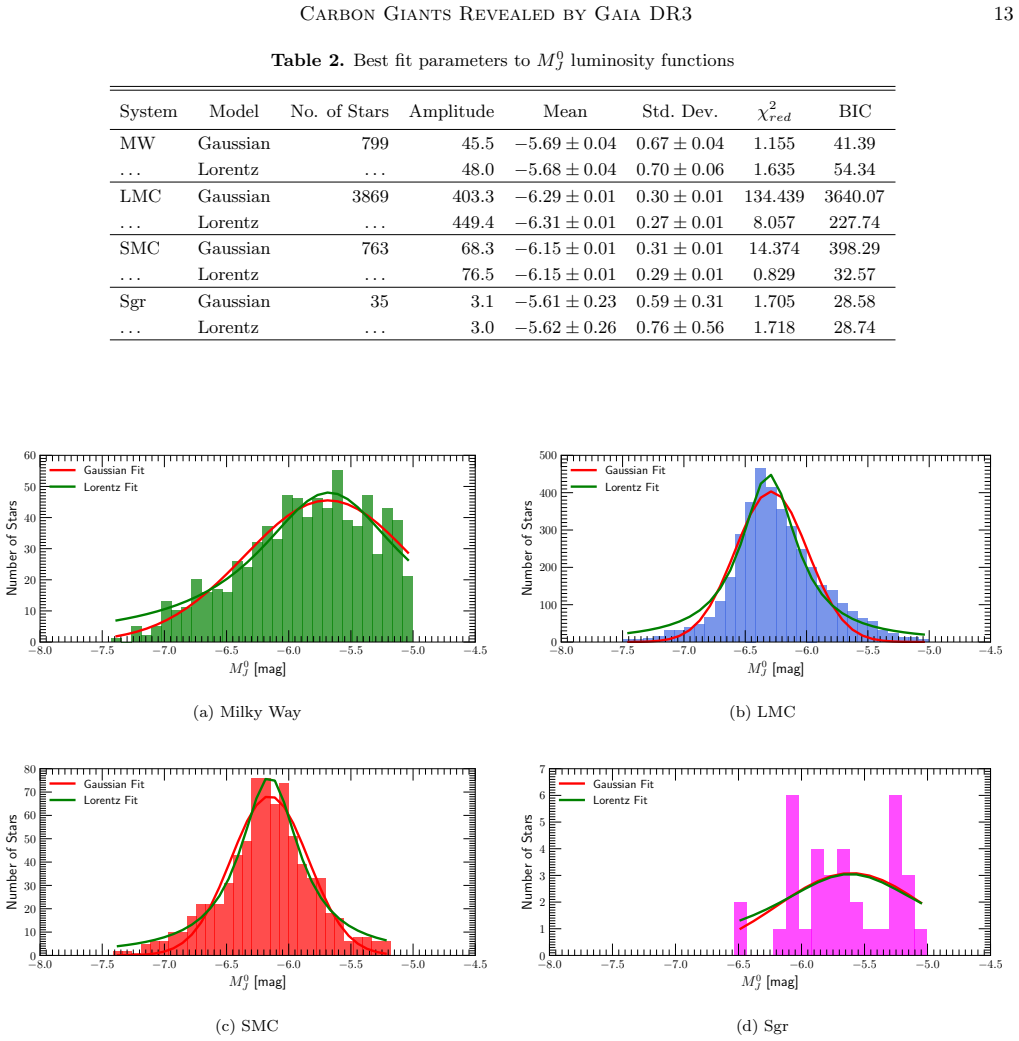
- C-AGB stars are confirmed as workable distance indicators: their mean $M^0_J$ is -6.30 in the LMC and -6.15 in the SMC, matching photometric values.
- The Milky Way's C-AGB population is thin-disk confined (scale height 206 pc) and nearly vanishes inside $R\approx7$ kpc, because high-metallicity, old inner-disk populations rarely produce third dredge-up carbon stars.
- The peak in C-AGB density near $R\approx9.8$ kpc, just outside the solar circle, points to a localized enhancement in intermediate-age star formation or spiral-arm structure.
- Roughly 1-1.3% of C-AGB stars end up producing a dwarf carbon system, constraining binary mass-transfer efficiency on the AGB.
Reading between the lines
- If C-RGB stars are evolved dC stars, their measured halo component implies that the dC formation channel operated in the old stellar halo; counting C-RGB stars in known halo streams could test whether some of this halo component is accreted.
- The $R\approx9.8$ kpc C-AGB annulus should have a kinematic signature: measuring radial velocities and proper motions of the excess stars can reveal whether they corotate with the disk or trace a distinct substructure.
- The paper defers variability and binarity studies to future work; a direct radial-velocity campaign on a sample of C-RGB stars would sharpen the RUWE-based binary conclusion.
- With a longer Gaia baseline, RUWE and acceleration measurements could turn the statistical C-RGB binary signal into individual orbital solutions and white-dwarf companion detections.
Signed reviews
Editorial analysis
A structured set of objections, weighed in public.
Referee Report
Summary. This manuscript uses the G<16.5 mag high-confidence carbon-star catalog of Roulston et al. (2025; XGProb C>0.85) to construct samples of carbon giants in the Milky Way, its globular clusters, and nearby Local Group galaxies. Main results include: 70 C stars matched to 34 globular clusters; 6937 LMC, 2148 SMC, and 219 Sgr C giants (abstract values); near-infrared luminosity functions giving mean M_J^0 = -6.30 (LMC) and -6.15 (SMC) that agree with the JAGB photometric values of Ripoche et al. (2020); a RUWE comparison showing significantly larger astrometric anomalies in low-luminosity C-RGB stars than in C-AGB stars (median RUWE 1.11 vs 0.99; 22.8% vs 3.6% with RUWE>1.4; KS D=0.32, p<0.001); 1/Vmax space-density fits yielding a double-exponential disk for all C giants (H_z=257±4 pc), an exponential disk for C-AGB stars (H_z=206±4 pc), and an exponential disk plus power-law halo for C-RGB stars (H_z≈327 pc, α≈14.5); and a radial C-AGB profile with an inner deficit (R≲7 kpc) and a Gaussian excess peaking at R≈9.8 kpc. The paper also reports candidate X-ray-emitting carbon symbiotic stars.
Significance. If the results hold, the paper provides a homogeneous all-sky census of carbon giants that goes well beyond heterogeneous compilations. The RUWE test, reinforced by the LPV purity contrast (98.3% of C-AGB versus 2.9% of C-RGB stars classified as long-period variables), is a strong statistical argument that most low-luminosity carbon giants are extrinsic, post-mass-transfer systems. The agreement of the JAGB luminosity-function means with independent photometric calibrations also supports the sample's absolute-magnitude reliability. The C-AGB inner-disk deficit and the radial peak at R≈9.8 kpc, if robust, would be interesting constraints on intermediate-age disk structure; however, this part of the analysis is the least secure because it relies on extinction and completeness corrections in the low-latitude/inner-disk regime and on an empirical Gaussian-plus-exponential model. The analyses are applied to the authors' own published catalog, but this is self-use rather than circularity because the catalog construction did not assume the conclusions of this paper.
major comments (3)
- [§5 and §7/Table 3] Section 5 reports that after the XGProb C>0.85, parallax>3σ, M_G<0, |b|>10° cuts, and after excluding GC/LMC/SMC/Sgr members, "This leaves 2238 Milky Way C giants for study." Section 7 and Table 3 instead fit N=4276 for "All C Stars" with a |b|>5° footprint, while Figure 8 states 2063 MW C stars and §6 mentions 4277. These numbers cannot all describe the same sample. If the 4276-star sample includes the 5°<|b|<10° strip, then the 1/Vmax volume corrections and MWDUST extinction corrections are applied in exactly the region most affected by crowding and dust, and the footprint contradicts §5; if the fits used the 2238-star sample, the abstract and Table 3 counts are wrong. Because the 1/Vmax fits and the radial profile (deficit R≲7 kpc, peak R≈9.8 kpc) are built on this sample, this ambiguity is load-bearing and must be resolved with a single explicit sample definition and consistent counts in the abstract, text, figures, and tables.
- [Abstract, §4.1, §4.2, Figure 8] The abstract states 6937 LMC and 2148 SMC C giants, while §4.1 and §4.2 report 6738 and 2114 after the parallax/proper-motion cuts, and Figure 8 uses 6738 and 2114. Similarly, §6 mentions 4277 MW C giants, Table 3 uses 4276, and Figure 8 gives 2063. These are headline-number inconsistencies in a paper whose contribution is partly a census; the authors should correct the errors and verify each number against the final query outputs.
- [§7.3, Eq. (4)] The claimed radial peak of C-AGB stars at R_peak=9820±85 pc is modeled by an exponential background plus a Gaussian excess with no physical motivation; the authors themselves note that none of the models are selected on physical motivations. This is acceptable as an empirical description only if the result is robust to the main selection systematics. The two tests presented (excluding |l|<50° sightlines, and the absence of a peak in raw heliocentric distances) are reassuring but do not fully address the effect of MWDUST extinction errors and Gaia completeness in the inner disk and near the plane, especially where the 5°<|b|<10° strip enters. Please recompute the radial profiles with (i) an alternative extinction map, (ii) a |b|>10° footprint, and (iii) a stricter parallax significance cut, and report whether R_peak, B/A, and ΔBIC survive; without this, the peak should be presented as tentative.
minor comments (5)
- [§2 and Figure 2] The text gives 418 C-AGB and 395 C-RGB stars, while the Figure 2 caption gives 418 C giants with -4<M0J<0 (blue) and 395 AGB stars with M0J<-5 (red); the labels and numbers are mutually inconsistent and should be corrected.
- [§4.2] Near the end of the SMC subsection, the text says "we define LMC C stars" when it should say SMC C stars; this typo appears in the SMC section.
- [§6 and Figure 8] The MW C-star count varies among 4277, 4276, and 2063; if the differences are due to 2MASS matching requirements or the JAGB color box, each caption and text passage should state the exact selection that produces each number.
- [§7.3] The statement that the raw heliocentric distance distribution "does not show a corresponding peak-then-decline shape" is given without a figure or quantitative summary; please add the plot or a numerical comparison.
- [Table 3] In the AGB row for the double-exponential disk, n0,disk,2=0.000+0.000/-0.000 and H_z,2=3698+2805/-2316 indicate a non-converged, unconstrained second component; the table should mark this explicitly rather than quoting posterior medians as if they were meaningful.
Circularity Check
No construction-level circularity: the central RUWE, density, and JAGB analyses are new tests on an external catalog; only minor, non-load-bearing self-citations appear, alongside a separate sample-count reproducibility concern.
full rationale
The central analyses are independent of the paper's own inputs. The RUWE comparison separates C-RGB from C-AGB by absolute J-band magnitude and near-IR color, not by binarity, so the higher RUWE of C-RGB stars is an independent astrometric test rather than a definitional consequence. The 1/Vmax space-density fits and radial profiles use Gaia parallaxes, 2MASS photometry, and MWDUST extinction, with no fitted parameter being 'predicted' from itself. The JAGB mean magnitudes are explicitly validated against the independent photometric results of Ripoche et al. (2020), and the C-AGB/C-RGB separation is externally corroborated by the LPV catalog of Lebzelter et al. (2023). Self-citations occur (the Roulston et al. 2025 catalog, the XGProb purity calibration, and the dC space density used in Section 8), but none is load-bearing in a circular sense: the catalog is an input dataset, the purity was established by external spectral inspection in the prior paper, and the dC density is a separately measured quantity from a different population. The paper even cautions where its model selection is not conclusive (Delta-BIC of 4.1 between the double-exponential disk and exponential disk + halo). A separate, non-circular reproducibility concern is that Section 5 reports 2238 Milky Way C giants after a |b|>10 cut, while Section 7 and Table 3 fit N=4276 with |b|>5 and Figure 8 shows 2063 stars; the paper does not reconcile these sample definitions, which undermines transparency of the density fits but does not make any claim equivalent to its inputs by construction.
Assumptions & free parameters
free parameters (5)
- C-AGB selection threshold M_J0 < -5 and (J-Ks)0 > 1.3
- C-RGB selection threshold M_J0 > -4.8 and (J-Ks)0 < 1.2
- JAGB color-magnitude box for LF fits =
1.4<(J-Ks)0<2 and -5>M_J0>-7.5
- Sgr proper motion membership box =
mu_alpha cos delta in [-3.1,-2.2], mu_delta in [-1.9,-0.9] mas/yr
- RUWE < 1.4 threshold for galaxy membership =
1.4
assumptions (6)
- domain assumption The Gaia DR3 carbon star catalog of Roulston et al. (2025) with XGProb C>0.85 has 95.5% purity and is complete to G<16.5 mag.
- domain assumption RUWE > 1.4 is a reliable indicator of astrometric binarity in nearby giants.
- domain assumption The 1/Vmax volume corrections assume the G<16.5 survey is complete and the MWDUST extinction corrections are accurate for |b|>5.
- ad hoc to paper The radial C-AGB density profile is modeled as an exponential background plus a Gaussian excess (Equation 4), with no physical motivation.
- domain assumption The Galaxy is axisymmetric and the halo follows a power-law ellipsoid (Equation 3).
- domain assumption C-AGB stars are produced only by initial masses roughly 1.5-5 Msun, so they are absent from old globular clusters.
Cite this review
Pith. "Pith review of The Carbon Giant Population Revealed by Gaia DR3." pith.science (2026). https://pith.science/paper/7JXK3PQR
@misc{pith2026260810244,
  author       = {Pith},
  title        = {Pith review of: The Carbon Giant Population Revealed by Gaia DR3},
  year         = {2026},
  howpublished = {\url{https://pith.science/paper/7JXK3PQR}},
  note         = {Machine review of arXiv:2608.10244}
}
abstract
Classical carbon stars (atmospheric C/O >1) are asymptotic giant branch (AGB) stars that become carbon-rich through third dredge-up during the thermally pulsing AGB phase. However, carbon stars also occur among red giants and main-sequence stars, where the carbon is thought to originate from binary mass transfer from a former AGB companion. Using the all-sky catalog of G<16.5 mag Gaia DR3 carbon stars from Roulston et al. (2025), we investigate a uniform, high-confidence sample of carbon giants in the Milky Way, its globular clusters, and nearby Local Group galaxies. We identify 6937 carbon giants in the Large Magellanic Cloud, 2148 in the Small Magellanic Cloud, and 219 associated with the Sagittarius dwarf spheroidal, nearly quadrupling the previously known sample in the latter. We identify several candidate carbon symbiotic stars through their X-ray counterparts. The mean absolute C-AGB magnitude, $M^0_J=-6.30$ in the LMC and -6.15 in the SMC, agrees closely with the photometrically derived values of Ripoche et al. (2020), reinforcing the utility of carbon AGB stars as distance indicators. From 4276 Galactic carbon giants with $M_G<0$ and $|b|>5^\circ$, we measure a local disk space density of $n_0=11\pm0.5\times10^{-8},\mathrm{pc}^{-3}$ and a scale height of $H_z=257\pm4$ pc. Lower-luminosity carbon giants exhibit significantly larger Gaia DR3 RUWE values than C-AGB stars, providing strong evidence that most are extrinsic post-mass-transfer systems, likely evolved dwarf carbon stars. C-AGB stars are more tightly confined to the Galactic disk and are rare inside $R\lesssim7$ kpc, consistent with Galactic age and metallicity gradients, whereas the lower-luminosity carbon giants have a larger scale height and require an additional halo component.
Figures


Figures from the paper (8 more)




Reference graph
Works this paper leans on
-
[1]
Mink, S. E. 2013, A&A, 552, A26, doi: 10.1051/0004-6361/201220007
-
[2]
2022, A&A, 664, A45, doi: 10.1051/0004-6361/202243595
Abia, C., de Laverny, P., Romero-G´ omez, M., & Figueras, F. 2022, A&A, 664, A45, doi: 10.1051/0004-6361/202243595
-
[3]
2002, ApJ, 579, 817, doi: 10.1086/342924
Abia, C., Dom ´ ınguez, I., Gallino, R., et al. 2002, ApJ, 579, 817, doi: 10.1086/342924
doi:10.1086/342924 2002
-
[4]
Aoki, W., Beers, T. C., Christlieb, N., et al. 2007, ApJ, 655, 492, doi: 10.1086/509817 Astropy Collaboration, Robitaille, T. P., Tollerud, E. J., et al. 2013, A&A, 558, A33, doi: 10.1051/0004-6361/201322068 24Roulston et al. Astropy Collaboration, Price-Whelan, A. M., Sip˝ ocz, B. M., et al. 2018, AJ, 156, 123, doi: 10.3847/1538-3881/aabc4f
doi:10.1086/509817 2007
-
[5]
1981, ApJ, 250, 293, doi: 10.1086/159374
Rosner, R. 1981, ApJ, 250, 293, doi: 10.1086/159374
doi:10.1086/159374 1981
-
[6]
Azzopardi, M., Lequeux, J., Rebeirot, E., & Westerlund, B. E. 1991, A&AS, 88, 265
1991
-
[7]
2021, AJ, 161, 147, doi: 10.3847/1538-3881/abd806
Demleitner, M., & Andrae, R. 2021, AJ, 161, 147, doi: 10.3847/1538-3881/abd806
-
[8]
Ball, S. E., Bromley, B. C., & Kenyon, S. J. 2025, The Open Journal of Astrophysics, 8, 122, doi: 10.33232/001c.143522
Show all 139 references
-
[9]
Barnbaum, C., Stone, R. P. S., & Keenan, P. C. 1996, ApJS, 105, 419, doi: 10.1086/192323
1996 doi
-
[10]
2013, A&A, 553, A93, doi: 10.1051/0004-6361/201321059
Battinelli, P., & Demers, S. 2013, A&A, 553, A93, doi: 10.1051/0004-6361/201321059
2013 doi
-
[11]
C., & Christlieb, N
Beers, T. C., & Christlieb, N. 2005, ARA&A, 43, 531, doi: 10.1146/annurev.astro.42.053102.134057
2005
-
[12]
B., Evans, N
Belokurov, V., Zucker, D. B., Evans, N. W., et al. 2006, ApJL, 642, L137, doi: 10.1086/504797
2006 doi
-
[13]
2001, A&A, 369, 178, doi: 10.1051/0004-6361:20010106
Bergeat, J., Knapik, A., & Rutily, B. 2001, A&A, 369, 178, doi: 10.1051/0004-6361:20010106
2001 doi
- [14]
-
[15]
Finkbeiner, D. P. 2016, ApJ, 818, 130, doi: 10.3847/0004-637X/818/2/130
2016 doi
-
[16]
Bovy, J., Rix, H.-W., & Hogg, D. W. 2012, ApJ, 751, 131, doi: 10.1088/0004-637X/751/2/131
2012 doi
-
[17]
R., et al
Castro-Ginard, A., Penoyre, Z., Casey, A. R., et al. 2024, A&A, 688, A1, doi: 10.1051/0004-6361/202450172
2024 doi
-
[18]
Choudhury, S., Subramaniam, A., & Cole, A. A. 2016, MNRAS, 455, 1855, doi: 10.1093/mnras/stv2414
2016 doi
-
[19]
J., Wisotzki, L., & Reimers, D
Christlieb, N., Green, P. J., Wisotzki, L., & Reimers, D. 2001, A&A, 375, 366, doi: 10.1051/0004-6361:20010814
2001 doi
-
[20]
Hintzen, P. M. 1977, ApJ, 216, 757, doi: 10.1086/155518 de Castro, D. B., Pereira, C. B., Roig, F., et al. 2016, MNRAS, 459, 4299, doi: 10.1093/mnras/stw815 de Kool, M., & Green, P. J. 1995, ApJ, 449, 236, doi: 10.1086/176051
1977 doi
-
[21]
J., Liu, C., et al
Deng, L.-C., Newberg, H. J., Liu, C., et al. 2012, Research in Astronomy and Astrophysics, 12, 735, doi: 10.1088/1674-4527/12/7/003
2012 doi
-
[22]
Dominy, J. F. 1984, ApJS, 55, 27, doi: 10.1086/190946
1984 doi
-
[23]
2008, ApJS, 178, 89, doi: 10.1086/589654
Dotter, A., Chaboyer, B., Jevremovi´ c, D., et al. 2008, ApJS, 178, 89, doi: 10.1086/589654
2008 doi
-
[24]
2003, A&A, 409, 205, doi: 10.1051/0004-6361:20031070 Duchˆ ene, G., & Kraus, A
Drimmel, R., Cabrera-Lavers, A., & L´ opez-Corredoira, M. 2003, A&A, 409, 205, doi: 10.1051/0004-6361:20031070 Duchˆ ene, G., & Kraus, A. 2013, ARA&A, 51, 269, doi: 10.1146/annurev-astro-081710-102602
2003 doi
-
[25]
2019, A&A, 626, A128, doi: 10.1051/0004-6361/201935390
Escorza, A., Karinkuzhi, D., Jorissen, A., et al. 2019, A&A, 626, A128, doi: 10.1051/0004-6361/201935390
2019 doi
-
[26]
N., Evans, J
Evans, I. N., Evans, J. D., Mart ´ ınez-Galarza, J. R., et al. 2024, ApJS, 274, 22, doi: 10.3847/1538-4365/ad6319
2024 doi
-
[27]
W., Lang, D., & Goodman, J
Foreman-Mackey, D., Hogg, D. W., Lang, D., & Goodman, J. 2013, PASP, 125, 306, doi: 10.1086/670067 Gaia Collaboration, Vallenari, A., Brown, A. G. A., et al. 2023, A&A, 674, A1, doi: 10.1051/0004-6361/202243940
2013 doi
-
[28]
2000, A&AS, 141, 371, doi: 10.1051/aas:2000126
Girardi, L., Bressan, A., Bertelli, G., & Chiosi, C. 2000, A&AS, 141, 371, doi: 10.1051/aas:2000126
2000 doi
-
[29]
D., Clayton, G
Gordon, K. D., Clayton, G. C., Misselt, K. A., Landolt, A. U., & Wolff, M. J. 2003, ApJ, 594, 279, doi: 10.1086/376774 G´ orski, M., Zgirski, B., Pietrzy´ nski, G., et al. 2020, ApJ, 889, 179, doi: 10.3847/1538-4357/ab65ed
2003 doi
-
[30]
B., et al
Graczyk, D., Pietrzy´ nski, G., Thompson, I. B., et al. 2020, ApJ, 904, 13, doi: 10.3847/1538-4357/abbb2b GRA VITY Collaboration, Abuter, R., Amorim, A., et al. 2019, A&A, 625, L10, doi: 10.1051/0004-6361/201935656
2020 doi
-
[31]
O., & Corbally, J., C
Gray, R. O., & Corbally, J., C. 2009, Stellar Spectral Classification (Princeton university press)
2009
-
[32]
2019a, ApJ, 887, 93, doi: 10.3847/1538-4357/ab5362
Finkbeiner, D. 2019a, ApJ, 887, 93, doi: 10.3847/1538-4357/ab5362
-
[33]
2013, ApJ, 765, 12, doi: 10.1088/0004-637X/765/1/12
Green, P. 2013, ApJ, 765, 12, doi: 10.1088/0004-637X/765/1/12
2013 doi
-
[34]
J., Margon, B., & MacConnell, D
Green, P. J., Margon, B., & MacConnell, D. J. 1991, ApJL, 380, L31, doi: 10.1086/186166
1991 doi
-
[35]
J., Montez, R., Mazzoni, F., et al
Green, P. J., Montez, R., Mazzoni, F., et al. 2019b, ApJ, 881, 49, doi: 10.3847/1538-4357/ab2bf4
-
[36]
Kastner, J. H. 2024, A&A, 689, A62, doi: 10.1051/0004-6361/202450155
2024 doi
-
[37]
T., Andersen, J., Nordstr¨ om, B., et al
Hansen, T. T., Andersen, J., Nordstr¨ om, B., et al. 2016, A&A, 588, A3, doi: 10.1051/0004-6361/201527409
2016 doi
-
[38]
R., Millman, K
Harris, C. R., Millman, K. J., van der Walt, S. J., et al. 2020, Array programming with NumPy, doi: 10.1038/s41586-020-2649-2
2020 doi
-
[39]
1993, A&A, 267, L31
Heber, U., Bade, N., Jordan, S., & Voges, W. 1993, A&A, 267, L31
1993
-
[40]
Hunter, J. D. 2007, Computing in Science & Engineering, 9, 90, doi: 10.1109/MCSE.2007.55
2007 doi
-
[41]
A., Gilmore, G., & Irwin, M
Ibata, R. A., Gilmore, G., & Irwin, M. J. 1994, Nature, 370, 194, doi: 10.1038/370194a0
1994 doi
-
[42]
1974, ARA&A, 12, 215, doi: 10.1146/annurev.aa.12.090174.001243
Iben, I., J. 1974, ARA&A, 12, 215, doi: 10.1146/annurev.aa.12.090174.001243
1974
-
[43]
1983, ARA&A, 21, 271, doi: 10.1146/annurev.aa.21.090183.001415 Carbon Giants Revealed by Gaia DR325
Iben, I., J., & Renzini, A. 1983, ARA&A, 21, 271, doi: 10.1146/annurev.aa.21.090183.001415 Carbon Giants Revealed by Gaia DR325
1983
-
[44]
A., et al
Imig, J., Price, C., Holtzman, J. A., et al. 2023, ApJ, 954, 124, doi: 10.3847/1538-4357/ace9b8
2023 doi
-
[45]
2018, MNRAS, 474, 2142, doi: 10.1093/mnras/stx2819
Iorio, G., Belokurov, V., Erkal, D., et al. 2018, MNRAS, 474, 2142, doi: 10.1093/mnras/stx2819
2018 doi
-
[46]
2013, A&A Rv, 21, 59, doi: 10.1007/s00159-013-0059-2
Ivanova, N., Justham, S., Chen, X., et al. 2013, A&A Rv, 21, 59, doi: 10.1007/s00159-013-0059-2
2013 doi
-
[47]
G., Dermine, T., & Church, R
Izzard, R. G., Dermine, T., & Church, R. P. 2010, A&A, 523, A10, doi: 10.1051/0004-6361/201015254
2010 doi
-
[48]
G., Jeffery, C
Izzard, R. G., Jeffery, C. S., & Lattanzio, J. 2007, in American Institute of Physics Conference Series, Vol. 948, Unsolved Problems in Stellar Physics: A Conference in Honor of Douglas Gough, ed. R. J. Stancliffe, G. Houdek, R. G. Martin, & C. A. Tout (AIP), 51–55, doi: 10.10...
2007 doi
-
[49]
2001, A&A, 365, L1, doi: 10.1051/0004-6361:20000036
Jansen, F., Lumb, D., Altieri, B., et al. 2001, A&A, 365, L1, doi: 10.1051/0004-6361:20000036
2001 doi
-
[50]
W., Weinberg, D
Johnson, J. W., Weinberg, D. H., Blanc, G. A., et al. 2025, ApJ, 988, 8, doi: 10.3847/1538-4357/addbe5
2025 doi
-
[51]
V., Hernquist, L., & Bolte, M
Johnston, K. V., Hernquist, L., & Bolte, M. 1996, ApJ, 465, 278, doi: 10.1086/177418
1996 doi
-
[52]
Jones, D., Corradi, R. L. M., Garc ´ ıa P´ erez, G. A., et al. 2026, A&A, 707, A169, doi: 10.1051/0004-6361/202557784
2026 doi
- [53]
-
[54]
2016, A&A, 586, A158, doi: 10.1051/0004-6361/201526992
Jorissen, A., Van Eck, S., Van Winckel, H., et al. 2016, A&A, 586, A158, doi: 10.1051/0004-6361/201526992
2016 doi
-
[55]
S., Marigo, P., & Tremblay, P.-E
Kalirai, J. S., Marigo, P., & Tremblay, P.-E. 2014, ApJ, 782, 17, doi: 10.1088/0004-637X/782/1/17
2014 doi
-
[56]
P., Besla, G., Anderson, J., & Alcock, C
Kallivayalil, N., van der Marel, R. P., Besla, G., Anderson, J., & Alcock, C. 2013, ApJ, 764, 161, doi: 10.1088/0004-637X/764/2/161
2013 doi
-
[57]
I., & Lattanzio, J
Karakas, A. I., & Lattanzio, J. C. 2014, PASA, 31, e030, doi: 10.1017/pasa.2014.21
2014 doi
-
[58]
Keenan, P. C. 1993, PASP, 105, 905, doi: 10.1086/133252
1993 doi
-
[59]
2001, A&A, 371, 222, doi: 10.1051/0004-6361:20010348
Knapp, G., Pourbaix, D., & Jorissen, A. 2001, A&A, 371, 222, doi: 10.1051/0004-6361:20010348
2001 doi
-
[60]
2014, A&A, 572, A30, doi: 10.1051/0004-6361/201424113
Kunder, A., Bono, G., Piffl, T., et al. 2014, A&A, 572, A30, doi: 10.1051/0004-6361/201424113
2014 doi
-
[61]
A., Sloan, G
Lagadec, E., Zijlstra, A. A., Sloan, G. C., et al. 2009, MNRAS, 396, 598, doi: 10.1111/j.1365-2966.2009.14736.x
2009
-
[62]
2023, A&A, 674, A15, doi: 10.1051/0004-6361/202244241
Lebzelter, T., Mowlavi, N., Lecoeur-Taibi, I., et al. 2023, A&A, 674, A15, doi: 10.1051/0004-6361/202244241
2023 doi
-
[63]
J., Freedman, W
Lee, A. J., Freedman, W. L., Madore, B. F., et al. 2025, ApJ, 985, 182, doi: 10.3847/1538-4357/adc8a1
2025 doi
-
[64]
2024, ApJS, 271, 12, doi: 10.3847/1538-4365/ad1881
Li, L., Zhang, K., Cui, W., et al. 2024, ApJS, 271, 12, doi: 10.3847/1538-4365/ad1881
2024 doi
-
[65]
L., Du, C.-D., et al
Li, Y.-B., Luo, A. L., Du, C.-D., et al. 2018, ApJS, 234, 31, doi: 10.3847/1538-4365/aaa415
2018 doi
-
[66]
D., Lesser, M., et al
Liebert, J., Schmidt, G. D., Lesser, M., et al. 1994, ApJ, 421, 733, doi: 10.1086/173685
1994 doi
- [67]
-
[68]
2025, A&A, 702, A237, doi: 10.1051/0004-6361/202556420
Locatelli, N., Ponti, G., Magaudda, E., & Stelzer, B. 2025, A&A, 702, A237, doi: 10.1051/0004-6361/202556420
2025 doi
-
[69]
C., et al
Lucatello, S., Tsangarides, S., Beers, T. C., et al. 2005, ApJ, 625, 825, doi: 10.1086/428104
2005 doi
-
[70]
T., & Bovy, J
Mackereth, J. T., & Bovy, J. 2020, MNRAS, 492, 3631, doi: 10.1093/mnras/staa047
2020 doi
-
[71]
T., Bovy, J., Schiavon, R
Mackereth, J. T., Bovy, J., Schiavon, R. P., et al. 2017, MNRAS, 471, 3057, doi: 10.1093/mnras/stx1774
2017 doi
-
[72]
F., & Freedman, W
Madore, B. F., & Freedman, W. L. 2020, ApJ, 899, 66, doi: 10.3847/1538-4357/aba045
2020 doi
-
[73]
2011, ApJ, 731, 53, doi: 10.1088/0004-637X/731/1/53
Mainzer, A., Bauer, J., Grav, T., et al. 2011, ApJ, 731, 53, doi: 10.1088/0004-637X/731/1/53
2011 doi
-
[74]
2007, A&A, 469, 239, doi: 10.1051/0004-6361:20066772
Marigo, P., & Girardi, L. 2007, A&A, 469, 239, doi: 10.1051/0004-6361:20066772
2007 doi
-
[75]
2008, A&A, 482, 883, doi: 10.1051/0004-6361:20078467
Marigo, P., Girardi, L., Bressan, A., et al. 2008, A&A, 482, 883, doi: 10.1051/0004-6361:20078467
2008 doi
-
[76]
2003, A&A, 403, 225, doi: 10.1051/0004-6361:20030192
Marigo, P., Girardi, L., & Chiosi, C. 2003, A&A, 403, 225, doi: 10.1051/0004-6361:20030192
2003 doi
-
[77]
2017, ApJ, 835, 77, doi: 10.3847/1538-4357/835/1/77
Marigo, P., Girardi, L., Bressan, A., et al. 2017, ApJ, 835, 77, doi: 10.3847/1538-4357/835/1/77
2017 doi
-
[78]
2006, A&A, 453, 635, doi: 10.1051/0004-6361:20053842
Picaud, S. 2006, A&A, 453, 635, doi: 10.1051/0004-6361:20053842
2006 doi
-
[79]
R., et al
Massari, D., Bellini, A., Ferraro, F. R., et al. 2013, ApJ, 779, 81, doi: 10.1088/0004-637X/779/1/81
2013 doi
-
[80]
A., Plez, B., et al
Masseron, T., Johnson, J. A., Plez, B., et al. 2010, A&A, 509, A93, doi: 10.1051/0004-6361/200911744
2010 doi
-
[81]
D., & Woodsworth, A
McClure, R. D., & Woodsworth, A. W. 1990, ApJ, 352, 709, doi: 10.1086/168573
1990 doi
-
[82]
McConnachie, A. W. 2012, AJ, 144, 4, doi: 10.1088/0004-6256/144/1/4
2012 doi
-
[83]
R., Zijlstra, A
McDonald, I., White, J. R., Zijlstra, A. A., et al. 2012, MNRAS, 427, 2647, doi: 10.1111/j.1365-2966.2012.22109.x
2012
-
[84]
Miszalski, B., Boffin, H. M. J., & Corradi, R. L. M. 2013, MNRAS, 428, L39, doi: 10.1093/mnrasl/sls011
2013 doi
-
[85]
H., & Hatzidimitriou, D
Morgan, D. H., & Hatzidimitriou, D. 1995, A&AS, 113, 539
1995
-
[86]
2014, Astronomische Nachrichten, 335, 79, doi: 10.1002/asna.201312006
Mucciarelli, A. 2014, Astronomische Nachrichten, 335, 79, doi: 10.1002/asna.201312006
2014 doi
-
[87]
Newman, M. J. B., McQuinn, K. B. W., Skillman, E. D., et al. 2024, ApJ, 975, 195, doi: 10.3847/1538-4357/ad79f8
2024 doi
-
[88]
2000, A&AS, 143, 23, doi: 10.1051/aas:2000169
Ochsenbein, F., Bauer, P., & Marcout, J. 2000, A&AS, 143, 23, doi: 10.1051/aas:2000169
2000 doi
-
[89]
Ortiz, R., & Guerrero, M. A. 2021, ApJ, 912, 93, doi: 10.3847/1538-4357/abefd7 26Roulston et al
2021 doi
-
[90]
A., & Costa, R
Ortiz, R., Guerrero, M. A., & Costa, R. D. D. 2019, MNRAS, 482, 4697, doi: 10.1093/mnras/sty3076
2019 doi
-
[91]
2020, ApJ, 893, 121, doi: 10.3847/1538-4357/ab7b75
Patel, E., Kallivayalil, N., Garavito-Camargo, N., et al. 2020, ApJ, 893, 121, doi: 10.3847/1538-4357/ab7b75
2020 doi
-
[92]
2015, ApJS, 220, 15, doi: 10.1088/0067-0049/220/1/15
Paxton, B., Marchant, P., Schwab, J., et al. 2015, ApJS, 220, 15, doi: 10.1088/0067-0049/220/1/15
2015 doi
-
[93]
2011, Journal of Machine Learning Research, 12, 2825
Pedregosa, F., Varoquaux, G., Gramfort, A., et al. 2011, Journal of Machine Learning Research, 12, 2825
2011
-
[94]
2004, ApJ, 612, 168, doi: 10.1086/422498 Pietrzy´ nski, G., Graczyk, D., Gallenne, A., et al
Pietrinferni, A., Cassisi, S., Salaris, M., & Castelli, F. 2004, ApJ, 612, 168, doi: 10.1086/422498 Pietrzy´ nski, G., Graczyk, D., Gallenne, A., et al. 2019, Nature, 567, 200, doi: 10.1038/s41586-019-0999-4
2004 doi
-
[95]
Plummer, H. C. 1911, MNRAS, 71, 460, doi: 10.1093/mnras/71.5.460
1911 doi
-
[96]
2017, MNRAS, 465, 1621, doi: 10.1093/mnras/stw2819
Portail, M., Gerhard, O., Wegg, C., & Ness, M. 2017, MNRAS, 465, 1621, doi: 10.1093/mnras/stw2819
2017 doi
-
[97]
T., Nidever, D
Povick, J. T., Nidever, D. L., Majewski, S. R., et al. 2025, MNRAS, 544, 457, doi: 10.1093/mnras/staf1428
2025 doi
-
[98]
2021, A&A, 647, A1, doi: 10.1051/0004-6361/202039313
Predehl, P., Andritschke, R., Arefiev, V., et al. 2021, A&A, 647, A1, doi: 10.1051/0004-6361/202039313
2021 doi
-
[99]
J., & Honma, M
Reid, M. J., & Honma, M. 2014, ARA&A, 52, 339, doi: 10.1146/annurev-astro-081913-040006
2014 doi
-
[100]
2020, MNRAS, 495, 2858, doi: 10.1093/mnras/staa1346
Ripoche, P., Heyl, J., Parada, J., & Richer, H. 2020, MNRAS, 495, 2858, doi: 10.1093/mnras/staa1346
2020 doi
-
[101]
R., Green, P
Roulston, B. R., Green, P. J., & Kesseli, A. Y. 2020, ApJS, 249, 34, doi: 10.3847/1538-4365/aba1e7
2020 doi
-
[102]
R., Green, P
Roulston, B. R., Green, P. J., Toonen, S., & Hermes, J. J. 2021, ApJ, 922, 33, doi: 10.3847/1538-4357/ac157c
2021 doi
-
[103]
2025, ApJ, 982, 184, doi: 10.3847/1538-4357/adba53
Portnoi, E. 2025, ApJ, 982, 184, doi: 10.3847/1538-4357/adba53
2025 doi
-
[104]
R., Green, P
Roulston, B. R., Green, P. J., Ruan, J. J., et al. 2019, ApJ, 877, 44, doi: 10.3847/1538-4357/ab1a3e
2019 doi
-
[105]
R., Green, P
Roulston, B. R., Green, P. J., Montez, R., et al. 2022, ApJ, 926, 210, doi: 10.3847/1538-4357/ac4706
2022 doi
-
[106]
2015, ApJ, 810, 77, doi: 10.1088/0004-637X/810/1/77
Sahai, R., Sanz-Forcada, J., S´ anchez Contreras, C., & Stute, M. 2015, ApJ, 810, 77, doi: 10.1088/0004-637X/810/1/77
2015 doi
-
[107]
2018, MNRAS, 473, 4937, doi: 10.1093/mnras/stx2651
Salvato, M., Buchner, J., Budav´ ari, T., et al. 2018, MNRAS, 473, 4937, doi: 10.1093/mnras/stx2651
2018 doi
-
[108]
2025, A&A, 704, A344, doi: 10.1051/0004-6361/202556142 Samus’, N
Salvato, M., Wolf, J., Dwelly, T., et al. 2025, A&A, 704, A344, doi: 10.1051/0004-6361/202556142 Samus’, N. N., Kazarovets, E. V., Durlevich, O. V.,
2025 doi
-
[109]
N., & Pastukhova, E
Kireeva, N. N., & Pastukhova, E. N. 2017, Astronomy Reports, 61, 80, doi: 10.1134/S1063772917010085
2017 doi
-
[110]
1988, ApJS, 66, 387, doi: 10.1086/191262
Sanduleak, N., & Pesch, P. 1988, ApJS, 66, 387, doi: 10.1086/191262
1988 doi
-
[111]
Schmitt, J. H. M. M., H¨ unsch, M., Schneider, P. C., et al. 2024, A&A, 688, A9, doi: 10.1051/0004-6361/202449181
2024 doi
-
[112]
1978, Annals of Statistics, 6, 461
Schwarz, G. 1978, Annals of Statistics, 6, 461
1978
-
[113]
P., & Conroy, C
Sharpe, K., Naidu, R. P., & Conroy, C. 2024, ApJ, 963, 162, doi: 10.3847/1538-4357/ad19ca
2024 doi
-
[114]
2014, Science China Physics, Mechanics, and Astronomy, 57, 176, doi: 10.1007/s11433-013-5374-0
Si, J., Luo, A., Li, Y., et al. 2014, Science China Physics, Mechanics, and Astronomy, 57, 176, doi: 10.1007/s11433-013-5374-0
2014 doi
-
[115]
H., Dotter, A., Majewski, S
Siegel, M. H., Dotter, A., Majewski, S. R., et al. 2007, ApJL, 667, L57, doi: 10.1086/522003
2007 doi
-
[116]
F., Cutri, R
Skrutskie, M. F., Cutri, R. M., Stiening, R., et al. 2006, AJ, 131, 1163, doi: 10.1086/498708
2006 doi
-
[117]
Stetson, P. B. 2002, ApJ, 566, 239, doi: 10.1086/337985
2002 doi
-
[118]
2020, MNRAS, 495, 2222, doi: 10.1093/mnras/staa1209
Sollima, A. 2020, MNRAS, 495, 2222, doi: 10.1093/mnras/staa1209
2020 doi
- [119]
-
[120]
Stephenson, C. B. 1985, AJ, 90, 784, doi: 10.1086/113787
1985 doi
-
[121]
1972, Publications of the Department of Astronomy University of Chile, 2, 59
Stock, J., & Wroblewski, H. 1972, Publications of the Department of Astronomy University of Chile, 2, 59
1972
-
[122]
2024, ApJS, 272, 16, doi: 10.3847/1538-4365/ad38b5
Suh, K.-W. 2024, ApJS, 272, 16, doi: 10.3847/1538-4365/ad38b5
2024 doi
-
[123]
Taylor, M. B. 2005, in Astronomical Society of the Pacific Conference Series, Vol. 347, Astronomical Data Analysis Software and Systems XIV, ed. P. Shopbell, M. Britton, & R. Ebert, 29
2005
-
[124]
M., & Huber, D
Frinchaboy, P. M., & Huber, D. 2025, arXiv e-prints, arXiv:2507.20212, doi: 10.48550/arXiv.2507.20212 van Loon, J. T., van Leeuwen, F., Smalley, B., et al. 2007, MNRAS, 382, 1353, doi: 10.1111/j.1365-2966.2007.12478.x
2025 doi
-
[125]
2013, ApJ, 775, 134, doi: 10.1088/0004-637X/775/2/134
Casagrande, L. 2013, ApJ, 775, 134, doi: 10.1088/0004-637X/775/2/134
2013 doi
-
[126]
Vanture, A. D. 1992, AJ, 104, 1986, doi: 10.1086/116374
1992 doi
-
[127]
2021, MNRAS, 505, 5978, doi: 10.1093/mnras/stab1475
Vasiliev, E., & Baumgardt, H. 2021, MNRAS, 505, 5978, doi: 10.1093/mnras/stab1475
2021 doi
-
[128]
E., et al
Virtanen, P., Gommers, R., Oliphant, T. E., et al. 2020, Nature Methods, 17, 261, doi: 10.1038/s41592-019-0686-2
2020 doi
-
[129]
2025, A&A, 699, A163, doi: 10.1051/0004-6361/202453354
Vitali, S., Rojas-Arriagada, A., Jofr´ e, P., et al. 2025, A&A, 699, A163, doi: 10.1051/0004-6361/202453354
2025 doi
-
[130]
Wallerstein, G., & Knapp, G. R. 1998, ARA&A, 36, 369, doi: 10.1146/annurev.astro.36.1.369
1998 doi
-
[131]
A., Coriat, M., Traulsen, I., et al
Webb, N. A., Coriat, M., Traulsen, I., et al. 2020, A&A, 641, A136, doi: 10.1051/0004-6361/201937353
2020 doi
-
[132]
2000, A&AS, 143, 9, doi: 10.1051/aas:2000332
Wenger, M., Ochsenbein, F., Egret, D., et al. 2000, A&AS, 143, 9, doi: 10.1051/aas:2000332
2000 doi
-
[133]
Westerlund, B. E. 1971, A&AS, 4, 51 Carbon Giants Revealed by Gaia DR327
1971
-
[134]
1999, in IAU Symposium, Vol
Whitelock, P., Menzies, J., Irwin, M., & Feast, M. 1999, in IAU Symposium, Vol. 192, The Stellar Content of Local Group Galaxies, ed. P. Whitelock & R. Cannon, 136
1999
-
[135]
L., Eisenhardt, P
Wright, E. L., Eisenhardt, P. R. M., Mainzer, A. K., et al. 2010, AJ, 140, 1868, doi: 10.1088/0004-6256/140/6/1868
2010 doi
-
[136]
2015, ApJ, 809, 144, doi: 10.1088/0004-637X/809/2/144
Xue, X.-X., Rix, H.-W., Ma, Z., et al. 2015, ApJ, 809, 144, doi: 10.1088/0004-637X/809/2/144
2015 doi
-
[137]
B., Liu, X
Yuan, H. B., Liu, X. W., & Xiang, M. S. 2013, MNRAS, 430, 2188, doi: 10.1093/mnras/stt039
2013 doi
-
[138]
2009, A&A, 508, 909, doi: 10.1051/0004-6361/200912843
Zamora, O., Abia, C., Plez, B., Dom ´ ınguez, I., & Cristallo, S. 2009, A&A, 508, 909, doi: 10.1051/0004-6361/200912843
2009 doi
-
[139]
S., Li, Y., & Bi, S
Zhang, X., Jeffery, C. S., Li, Y., & Bi, S. 2020, ApJ, 889, 33, doi: 10.3847/1538-4357/ab5e89
2020 doi
Reviewed August 14, 2026 · model on record in the stance chip above.
Discussion (0). Continue with ORCID to comment.