REVIEW 3 major objections 6 minor 133 references
Astro+ database. I. Description and first results
T0 review · 3 major / 6 minor · reviewed 2026-08-14 · deepseek-v4-flash
Pith's one-line read A fully automatic pipeline, HiLineThere, can derive stellar parameters for massive OB stars and red supergiants, matching expert literature values within about 800 K in effective temperature, 0.1 dex in surface gravity, and 10 km/s in…
desk verdict A genuine infrastructure paper with honest caveats: the blue-path accuracy claims are plausible but partly in-sample, the red-path Teff check is circular, and the yellow path is unvalidated — still worth a serious referee. read the letter →
The pith
A machine-rendered reading of the paper's core claim, the machinery that carries it, and where it could break.
The reading
What carries the argument
The load-bearing mechanism is a hierarchical decision tree combined with reduced chi-squared minimization over large model grids. A line-detection routine identifies Balmer, He I, He II, and metal lines; their absence or presence routes the spectrum to MARCS-based SteParSyn (red path), KURUCZ/ATLAS9 (yellow path), or FASTWIND (blue path). For blue-path stars, the projected rotation $v\sin i$ is set from the first zero of the Fourier transform of a line profile, macroturbulence $\zeta$ is then fitted, and a reduced chi-squared comparison to $46\,000$ solar-metallicity FASTWIND models yields $T_{\rm eff}$ and $\log g$, with a subroutine that discards H$\alpha$ when wind emission invalidates it.
What would settle it
Run HiLineThere on a sample of massive-star spectra that were never used in its development and whose parameters were determined independently, or on synthetic spectra from an independent atmosphere code such as CMFGEN or PoWR; if the differences systematically exceed about $800$ K in $T_{\rm eff}$, $0.1$ dex in $\log g$, or $10$ km s$^{-1}$ in $v\sin i$, the claimed autonomy overstates its accuracy.
Extended reading notes
Core claim
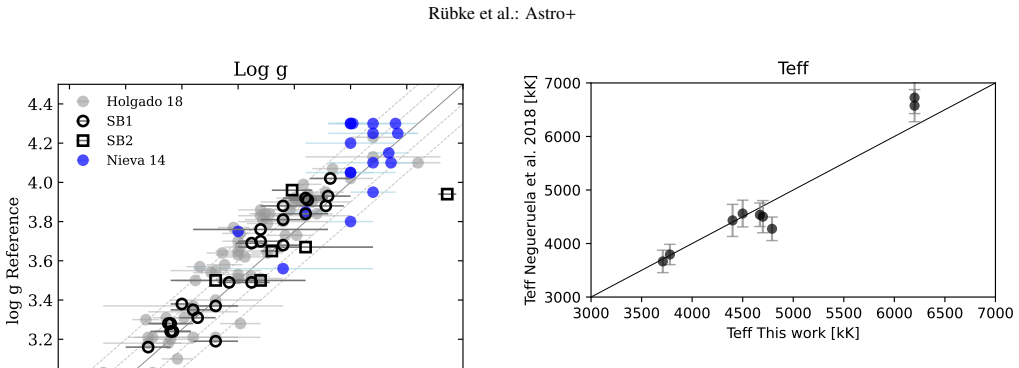
The paper's central claim is that a fully automated program, HiLineThere, can take an optical spectrum of a massive star and, without any human input, classify it and determine effective temperature, surface gravity, projected rotational velocity, and radial velocity. For OB-type stars analyzed against a grid of FASTWIND models, comparison with the expert-analysis sample of Holgado et al. (2018) and early-B stars from Nieva & Przybilla (2014) yields differences within about $800$ K in $T_{\rm eff}$, $0.1$ dex in $\log g$, and $10$ km s$^{-1}$ in $v\sin i$; for red supergiants, radial velocities agree within $7$ km s$^{-1}$ and temperatures within about $300$ K. The pipeline's hierarchical logic routes spectra into blue, yellow, or red analysis paths depending on whether Balmer lines are present and whether the star is hotter or cooler than about $15\,000$ K. The authors claim this replaces human inspection for large spectroscopic surveys while providing strictly homogeneous parameters.
Load-bearing premise
The validation benchmarks are independent of how the algorithm was built: the code was iteratively adjusted until it reproduced the Holgado et al. (2018) sample, so the quoted agreement on that sample may overstate performance on truly new spectra.
Editorial extensions
If this is right
- Surveys such as WEAVE can have their OB and red supergiant spectra processed automatically and homogeneously, with no expert line selection.
- Single-lined binaries and binaries with faint secondaries are analyzed without degrading parameter accuracy, since their snapshot spectra behave like single stars.
- Spectra with chemical peculiarities, such as the ON supergiant HD 105056, are correctly recovered when the pipeline is allowed to select lines freely rather than using a fixed line list.
- Red supergiant radial velocities from the CaT region are recovered to within about 7 km/s, making the database useful for kinematic studies of cool supergiants.
- The model-grid experiment with TLUSTY spectra places an upper bound of roughly 2,000 K on temperature systematics for O-type stars, though part of that difference reflects known code-to-code atmosphere physics.
Reading between the lines
- If the pipeline's accuracy holds on independent data, the bottleneck in massive-star spectroscopy shifts from parameter fitting to quality control: the inspection graph becomes a spot-check rather than the analysis itself.
- A sharper validation would feed the pipeline synthetic spectra from an independent grid that includes winds, line blanketing, and non-solar abundances; the TLUSTY test already points in this direction but mixes resolution effects with atmosphere-code differences.
- The yellow path (7,500-15,000 K) is implemented but not systematically validated, so claims of full OBAFGKM coverage currently rest on the blue and red path tests plus the early-B transition sample.
- Because the blue-path grid is solar-metallicity with microturbulence fixed at 10 km/s, the quoted accuracies should be treated as conditional on those assumptions; extending the grid is a testable way to see how much of the residual scatter they explain.
Editorial analysis
A structured set of objections, weighed in public.
Referee Report
Summary. The paper presents Astro+, a web-based database for massive-star spectra, together with HiLineThere, an automated analysis pipeline. HiLineThere routes spectra through three paths: a blue path using a large FASTWIND grid for OB stars, a yellow path using KURUCZ/ATLAS9 models for intermediate temperatures, and a red path using MARCS models and the SteParSyn code for cool stars and red supergiants. The pipeline automatically measures radial velocity, vsini, and macroturbulence from diagnostic lines, then derives Teff and logg by reduced chi-square fitting. Validation is carried out against the O-star sample of Holgado et al. (2018) and a small set of early-B stars from Nieva & Przybilla (2014), reporting differences of Teff ~ 800 K, logg ~ 0.1 dex, and vsini ~ 10 km/s for OB stars; against Dorda et al. (2018) for RSG radial velocities (within 7 km/s); and against Negueruela et al. (2018) for RSG Teff (within ~300 K). A TLUSTY model-injection experiment is added to estimate systematic errors of the blue path. The paper claims that the tool can homogeneously process large future surveys in a completely autonomous way.
Significance. If the accuracy figures are confirmed on independent data, Astro+ and HiLineThere would be a timely and valuable contribution: they address a real bottleneck for upcoming multi-object surveys of massive stars, provide a public database, and include a transparent hierarchical decision tree with quantitative comparisons against large, carefully studied samples. The authors are also commendably explicit about several limitations, such as the deferred validation of the yellow path, the use of the same code in the RSG Teff comparison, and the non-like-for-like nature of the TLUSTY test. However, the headline accuracy claims are not yet established for genuinely new spectra because the OB validation sample was used iteratively to tune the algorithm, and the RSG Teff validation is circular. The significance of the paper therefore hinges on the additional independent validation requested below.
major comments (3)
- [Sect. 3.1, O-type stars] The paragraph beginning 'This iterative comparison process led to progressively more complex and rigorous versions of the code' explicitly states that the Holgado et al. (2018) sample was used as a tuning set during development. Both Test 1 and Test 2 are applied to this same sample, so the reported agreement in Teff, logg, and vsini is partly in-sample and may not represent performance on new spectra. This directly affects the abstract's central claim of 'completely autonomous' analysis with quoted differences of ~800 K, ~0.1 dex, and ~10 km/s. Please add a genuinely independent validation: for example, hold out a subset of the Holgado et al. (2018) stars during all tuning and report residuals on that subset, or use another large independent sample such as IACOB or VFTS. Alternatively, if such a test is not feasible, the quoted differences should be explicitly reframed as internal consistency with the development benchmark, not as expected errors for survey data.
- [Sect. 3.2, Late-type stars] The Teff comparison against Negueruela et al. (2018) is circular because the same SteParSyn implementation and MARCS grid were used in both the reference analysis and the present pipeline. The text acknowledges this in the sentence 'we must keep in mind that we are using the same code as in the original paper,' but the abstract and conclusions still present ~300 K as a validation result. The only independent red-path check in the paper is the radial-velocity comparison against Dorda et al. (2018). Please remove the Teff comparison from the validation claims, or supplement it with an independent set of RSG parameters derived with a different code or method. As currently presented, the evidence for the accuracy of the red-path Teff, logg, and [Fe/H] is insufficient.
- [Sect. 3.3, Systematic errors on blue path] The TLUSTY experiment is a model-to-model consistency check rather than an observational validation. The injected spectra are noiseless synthetic models, so the test does not exercise the pipeline's response to normalization errors, cosmic-ray residuals, weak blends, wind variability, or other real-data artifacts that contribute to the actual error budget. The final cautionary sentence of the section is appropriate, but the earlier statement that this experiment gives 'an upper limit on the systematic differences... should be below 2,000 K' can easily be read as an accuracy claim. Please present this test strictly as a code-consistency sanity check and avoid using it to bound the systematic error of the pipeline on real spectra.
minor comments (6)
- [Sect. 2.1.3, Eq. (8)] The displayed expression for the macroturbulence kernel appears to contain a typo: the proposed delta-function term '(-v pi^(1/2)/zeta_RT) delta(-v^2/zeta_RT^2 - 1)' is dimensionally inconsistent and is not a standard radial-tangential expression. Please check the formula; as written it cannot be implemented literally.
- [Sect. 3.1] The comparison with Holgado et al. (2018) would benefit from explicit summary statistics for the whole sample (mean and rms or median absolute differences for Test 1 and Test 2), rather than only qualitative statements and quoted subgroup values. This would make it easier for readers to assess the headline numbers.
- [Sect. 3.2 and Fig. 15] The Teff axis of Fig. 15 is labeled in kK but the plotted range is 3000-7000 K, so the units are inconsistent. In addition, the text does not provide the rms scatter for the 11-star sample; please include it.
- [Sect. 3.1, Test 2 description] The phrase 'the full spectrum with all the features considered by the code' is misleading: Test 2 uses all detected H, Hei, and Heii diagnostic lines from Table 1, not the entire spectral range. Consider rewording to 'all available diagnostic lines.'
- [Table C.3] The headers 'eTeff' and 'e(logg)' are not self-explanatory; please use standard notation such as 'sigma(Teff)' or a dedicated error column. Also, the table lists only 11 stars, while the text just says 'small sample'; please specify the sample selection from Negueruela et al. (2018).
- [Sect. 2.1.2, Condition IV and Sect. 5] The phrasing 'No point closer to line center than Gaussian sigma deviates by >3 sigma fit' is awkward; a clearer formulation is 'no point within one Gaussian sigma of the line center deviates from the fit by more than 3 sigma.' Also, Section 5 states that the database is public but the HiLineThere source code is not; given the paper's aim of community use, please provide a code repository or state clearly that the code is available on request.
Circularity Check
OB accuracy is partly in-sample: the code was iteratively tuned on the Holgado benchmark, and the RSG Teff validation re-uses the same SteParSyn code.
-
fitted input called prediction
[Sect. 3.1 (O-type stars), validation of the blue path; quoted accuracy in Abstract]
"This iterative comparison process led to progressively more complex and rigorous versions of the code, ensuring that the automated reducedχ2 minimization reproduces expert-level parameters without introducing systematic bias."
The headline accuracy figures (Teff~800 K, logg~0.1 dex, vsini~10 km/s) are computed by comparing HiLineThere to the Holgado et al. (2018) sample. The quoted sentence states that the code was iteratively modified until its reduced chi-squared minimization reproduces the expert-level parameters of that same sample. The benchmark therefore functioned as a training set for line weighting, thresholds, and selection logic; the agreement reported on it is in-sample by construction, not an out-of-sample prediction of literature values. Test 1 additionally fixes the same lines and weights as Holgado et al. (2018), further importing the benchmark's choices into the algorithm.
-
self citation load bearing
[Sect. 3.2 (Late-type stars), red-path Teff validation]
"There is obviously a good correlation, but we must keep in mind that we are using the same code as in the original paper."
The red-path Teff comparison uses Negueruela et al. (2018) as the literature reference, but that work applied the same SteParSyn code (developed by co-author Tabernero et al. 2022) to the same type of MARCS model networks. The ~300 K Teff agreement therefore shows that the new pipeline reproduces an earlier run of the same code and its overlapping authors, not that an independent method agrees with the pipeline. The only genuinely independent red-path benchmark in the paper is the V_r comparison against Dorda et al. (2018), which is not circular.
full rationale
The pipeline itself is an engineering contribution with real independent content: automated line detection, Fourier-based vsini, path selection, FASTWIND grid fitting, and the Dorda et al. (2018) RV comparison are all independent of the claimed accuracy numbers. However, the two headline validation results are not independent. For OB stars, Sect. 3.1 explicitly says the comparison with Holgado et al. (2018) drove iterative code revisions until the chi-squared minimization 'reproduces expert-level parameters'; the same sample is then used to quote Teff~800 K, logg~0.1 dex, vsini~10 km/s. That is fitting the algorithm to the benchmark and then reporting agreement with the benchmark as a prediction. For red supergiants, Sect. 3.2 concedes the Teff comparison uses 'the same code as in the original paper' (Negueruela et al. 2018), so the ~300 K Teff agreement is a self-consistency check rather than an external validation. The TLUSTY experiment is transparently described as model-to-model and is not used to claim independent observational accuracy. Because the central accuracy claims reduce in part to the benchmarks that shaped the algorithm, a partial circularity score is warranted; the Vr benchmark and pipeline architecture keep the work from being wholly circular.
Assumptions & free parameters
free parameters (6)
- Microturbulence in FASTWIND grid =
10 km/s
- Wind velocity exponent beta =
1.0
- Limb darkening coefficient epsilon =
0.6
- Default Vsini =
100 km/s
- Minifilter temperature threshold =
15000 K
- Line weights for temperature diagnostics =
Hei4471/Heii4541 ratio emphasized
assumptions (6)
- domain assumption FASTWIND models with NLTE, spherical geometry, mass loss and line blanketing accurately represent OB star photospheres.
- domain assumption MARCS models and the SteParSyn implementation provide reliable Teff and logg for red supergiants.
- domain assumption Solar metallicity is appropriate for all Galactic targets analyzed in this paper.
- standard math The first zero of the Fourier transform of a line profile uniquely identifies the projected rotational velocity.
- domain assumption The literature values from Holgado et al. (2018) and Nieva & Przybilla (2014) are accurate enough to serve as benchmarks.
- domain assumption The Teff values from Negueruela et al. (2018) are accurate despite being produced with the same SteParSyn code.
Cite this review
Pith. "Pith review of Astro+ database. I. Description and first results." pith.science (2026). https://pith.science/paper/ZZMFJQ55
@misc{pith2026260810250,
  author       = {Pith},
  title        = {Pith review of: Astro+ database. I. Description and first results},
  year         = {2026},
  howpublished = {\url{https://pith.science/paper/ZZMFJQ55}},
  note         = {Machine review of arXiv:2608.10250}
}
read the original abstract
The vast amounts of spectroscopic data for massive stars provided by previous and existing instruments on ground-based and space-based telescopes have saturated our capability to process them by human inspection routines. Consequently, there is a pressing need for fully automatic machine-assisted tools to help handle incoming data. To this end, we present the development of a massive star spectroscopic interactive database, Astro+. We aim to provide users with a reliable, versatile, and user-friendly platform that will be significant for understanding massive stars and set an important precedent for future open-access astrophysical research. This tool allows authorized users to upload their own spectra and, by using the fully automated tool HiLineThere, a Python-based program, it can homogeneously derive basic stellar parameters, such as v_rad, v sin i, Teff and log g for massive OB-type stars, using a solar-metallicity grid of FASTWIND models, and v_rad, [Fe/H], Teff and log g for red supergiant stars, in a completely autonomous way. Here we present the first results of the tool HiLineThere on optical spectra for OB-type stars and red supergiants. We compare the output of our analysis for OB-type stars with literature values for a large sample of well-studied objects, finding differences within the expected error ranges: Teff ~ 800 K, log g ~ 0.1 dex, and v sin i ~ 10 km/s. Preliminary tests on early-B stars also show consistent results during the transition to lower temperatures. For red supergiants, we find differences within 7 km/s in v_rad and ~300 K in Teff for two test samples.
Figures


Figures from the paper (12 more)




Reference graph
Works this paper leans on
-
[1]
, keywords =
Atmospheric NLTE-models for the spectroscopic analysis of luminous blue stars with winds. , keywords =
-
[2]
The IACOB project. VII. The rotational properties of Galactic massive O-type stars revisited. , keywords =. doi:10.1051/0004-6361/202243851 , archivePrefix =. 2207.12776 , primaryClass =
-
[3]
An LTE effective temperature scale for red supergiants in the Magellanic clouds. , keywords =. doi:10.1093/mnras/sty399 , archivePrefix =. 1802.03219 , primaryClass =
-
[4]
Stellar wind properties of the nearly complete sample of O stars in the low metallicity young star cluster NGC 346 in the SMC galaxy. , keywords =. doi:10.1051/0004-6361/202243281 , archivePrefix =. 2207.09333 , primaryClass =
-
[5]
Fundamental properties of nearby single early B-type stars
Fundamental properties of nearby single early B-type stars. , keywords =. doi:10.1051/0004-6361/201423373 , archivePrefix =. 1412.1418 , primaryClass =
-
[6]
Surface abundances of ON stars
Surface abundances of ON stars. , keywords =. doi:10.1051/0004-6361/201526130 , archivePrefix =. 1504.06194 , primaryClass =
-
[7]
The IACOB project. IX. Building a modern empirical database of Galactic O9 - B9 supergiants: Sample selection, description, and completeness. , keywords =. doi:10.1051/0004-6361/202346179 , archivePrefix =. 2305.00305 , primaryClass =
-
[8]
Updated calibrations of fundamental parameters of Galactic O-type stars
The IACOB project: XV. Updated calibrations of fundamental parameters of Galactic O-type stars. , keywords =. doi:10.1051/0004-6361/202556713 , archivePrefix =. 2508.05233 , primaryClass =
Show all 133 references
-
[9]
, keywords =
Binarity at LOw Metallicity (BLOeM): pipeline-determined physical properties of OB stars. , keywords =. doi:10.1093/mnras/staf900 , archivePrefix =. 2506.00117 , primaryClass =
-
[10]
The Galactic O-Star Spectroscopic Survey. I. Classification System and Bright Northern Stars in the Blue-violet at R -0.5ex 2500. , keywords =. doi:10.1088/0067-0049/193/2/24 , archivePrefix =. 1101.4002 , primaryClass =
-
[11]
Wolf-Rayet Stars and Interrelations with Other Massive Stars in Galaxies , year = 1991, editor =
New Observations of LBV Environments. Wolf-Rayet Stars and Interrelations with Other Massive Stars in Galaxies , year = 1991, editor =
1991
-
[12]
, keywords =
Massive Stars in the Field and Associations of the Magellanic Clouds: The Upper Mass Limit, the Initial Mass Function, and a Critical Test of Main-Sequence Stellar Evolutionary Theory. , keywords =. doi:10.1086/175064 , adsurl =
-
[13]
, year = 2013, month = may, volume =
A Comparison of the Physical Properties of the LMC and SMC O-type Stars Derived with CMFGEN and FASTWIND. , year = 2013, month = may, volume =. doi:10.1088/0004-637X/768/1/6 , adsurl =
2013 doi
-
[14]
, year = 2011, month = aug, volume =
Accurate Stellar Kinematics at Faint Magnitudes: Application to the Bo \"o tes I Dwarf Spheroidal Galaxy. , year = 2011, month = aug, volume =. doi:10.1088/0004-637X/736/2/146 , adsurl =
2011 doi
-
[15]
The VLT-FLAMES Tarantula Survey. I. Introduction and observational overview. , keywords =. doi:10.1051/0004-6361/201116782 , archivePrefix =. 1103.5386 , primaryClass =
-
[16]
, keywords =
The Gaia-ESO Survey: The analysis of the hot-star spectra. , keywords =. doi:10.1051/0004-6361/202142349 , archivePrefix =. 2202.08662 , primaryClass =
-
[17]
, keywords =
Quantitative spectral classification of Galactic O stars. , keywords =. doi:10.1051/0004-6361/201833050 , archivePrefix =. 1805.08267 , primaryClass =
-
[18]
Encyclopedia of Astrophysics , year = 2026, volume =
Spectral classification. Encyclopedia of Astrophysics , year = 2026, volume =. doi:10.1016/B978-0-443-21439-4.00057-2 , archivePrefix =. 2410.07301 , primaryClass =
2026 arXiv
-
[19]
doi:10.1017/9781009082136 , adsurl =
The observation and analysis of stellar photospheres. doi:10.1017/9781009082136 , adsurl =
-
[20]
Encyclopedia of Astrophysics , year = 2026, volume =
Stellar atmospheres. Encyclopedia of Astrophysics , year = 2026, volume =. doi:10.1016/B978-0-443-21439-4.00021-3 , adsurl =
2026 doi
-
[21]
Identification in the UBC catalogue and comparison between manual and automated analyses
Gaia colour-magnitude diagrams of young open clusters. Identification in the UBC catalogue and comparison between manual and automated analyses. , keywords =. doi:10.1051/0004-6361/202244933 , archivePrefix =. 2303.00467 , primaryClass =
-
[22]
Spectroscopic and physical parameters of Galactic O-type stars. III. Mass discrepancy and rotational mixing. , keywords =. doi:10.1051/0004-6361/201731361 , archivePrefix =. 1803.03410 , primaryClass =
-
[23]
, keywords =
Fourier Analysis with Unequally-Spaced Data. , keywords =. doi:10.1007/BF00681947 , adsurl =
- [24]
-
[25]
, keywords =
Model atmospheres for G, F, A, B, and O stars. , keywords =. doi:10.1086/190589 , adsurl =
-
[26]
The IACOB project. II. On the scatter of O-dwarf spectral type - effective temperature calibrations. , keywords =. doi:10.1051/0004-6361/201424742 , archivePrefix =. 1409.6653 , primaryClass =
-
[27]
, keywords =
Line-blanketed model atmospheres for WR stars. , keywords =. doi:10.1051/0004-6361:20020269 , adsurl =
-
[28]
Reviews in Frontiers of Modern Astrophysics; From Space Debris to Cosmology , year = 2020, editor =
A Modern Guide to Quantitative Spectroscopy of Massive OB Stars. Reviews in Frontiers of Modern Astrophysics; From Space Debris to Cosmology , year = 2020, editor =. doi:10.1007/978-3-030-38509-5_6 , adsurl =
2020 doi
-
[29]
New interface and second data release
The IACOB spectroscopic database. New interface and second data release. XIV.0 Scientific Meeting (virtual) of the Spanish Astronomical Society , year = 2020, month = jul, eid =
2020
-
[30]
, keywords =
The wide-field, multiplexed, spectroscopic facility WEAVE: Survey design, overview, and simulated implementation. , keywords =. doi:10.1093/mnras/stad557 , archivePrefix =. 2212.03981 , primaryClass =
-
[31]
The London, Edinburgh, and Dublin Philosophical Magazine and Journal of Science , volume =
Karl Pearson , title =. The London, Edinburgh, and Dublin Philosophical Magazine and Journal of Science , volume =. 1900 , publisher =. doi:10.1080/14786440009463897 , URL =
1900 doi
-
[32]
, keywords =
Does the radial-tangential macroturbulence model adequately describe the spectral line broadening of solar-type stars?*. , keywords =. doi:10.1093/pasj/psx022 , archivePrefix =. 1703.02233 , primaryClass =
-
[33]
Improvements of the theory and first results
Radiation-driven winds of hot luminous stars. Improvements of the theory and first results. , keywords =
-
[34]
OWN Survey: new binaries and trapezium-like systems
Spectroscopic survey of galactic O and WN stars. OWN Survey: new binaries and trapezium-like systems. Revista Mexicana de Astronomia y Astrofisica Conference Series , year = 2010, series =
2010
-
[35]
Revista Mexicana de Astronomia y Astrofisica Conference Series , year = 2014, series =
OWN Survey: results after seven years of high-resolution spectroscopic monitoring of Southern O and WN stars. Revista Mexicana de Astronomia y Astrofisica Conference Series , year = 2014, series =
2014
-
[36]
A high-resolution spectroscopic survey of southern Galactic O and WN-type stars: I
The OWN Survey. A high-resolution spectroscopic survey of southern Galactic O and WN-type stars: I. Project description and single-lined spectroscopic orbits. , year = 2026, month = apr, volume =. doi:10.1051/0004-6361/202558665 , adsurl =
2026 doi
-
[37]
The Lives and Death-Throes of Massive Stars , year = 2017, editor =
OWN Survey: a spectroscopic monitoring of Southern Galactic O and WN-type stars. The Lives and Death-Throes of Massive Stars , year = 2017, editor =. doi:10.1017/S1743921317003258 , adsurl =
2017 doi
- [38]
-
[39]
Science , keywords =
The Initial Mass Function of Stars: Evidence for Uniformity in Variable Systems. Science , keywords =. doi:10.1126/science.1067524 , archivePrefix =. astro-ph/0201098 , primaryClass =
-
[40]
, keywords =
Atmospheric turbulence measured in stars above the main sequence. , keywords =. doi:10.1086/153960 , adsurl =
-
[41]
, keywords =
A new extensive library of PHOENIX stellar atmospheres and synthetic spectra. , keywords =. doi:10.1051/0004-6361/201219058 , archivePrefix =. 1303.5632 , primaryClass =
-
[42]
A grid of MARCS model atmospheres for late-type stars. I. Methods and general properties. , keywords =. doi:10.1051/0004-6361:200809724 , archivePrefix =. 0805.0554 , primaryClass =
-
[43]
Atmospheric NLTE-models for the spectroscopic analysis of blue stars with winds. II. Line-blanketed models. , keywords =. doi:10.1051/0004-6361:20042365 , archivePrefix =. astro-ph/0411398 , primaryClass =
- [44]
-
[45]
Bulletin de la Societe Royale des Sciences de Liege , keywords =
The IACOB spectroscopic database of Northern Galactic OB stars. Bulletin de la Societe Royale des Sciences de Liege , keywords =
-
[46]
VizieR Online Data Catalog , keywords =
VizieR Online Data Catalog: O-stars in VLT-FLAMES Tarantula Survey (Ramirez-Agudelo+ 2013). VizieR Online Data Catalog , keywords =
2013
-
[47]
Massive Stars: From alpha to Omega , year = 2013, month = jun, eid =
Macroturbulent broadening and its consequences on the study of rotational velocities and pulsations in massive stars. Massive Stars: From alpha to Omega , year = 2013, month = jun, eid =
2013
-
[48]
, keywords =
Fourier method of determining the rotational velocities in OB stars. , keywords =. doi:10.1051/0004-6361:20066060 , archivePrefix =. astro-ph/0703216 , primaryClass =
-
[49]
Rotational velocities, stellar parameters, and oxygen abundances
Detailed spectroscopic analysis of the Trapezium cluster stars inside the Orion nebula. Rotational velocities, stellar parameters, and oxygen abundances. , keywords =. doi:10.1051/0004-6361:20053066 , adsurl =
-
[50]
The IACOB project. I. Rotational velocities in northern Galactic O- and early B-type stars revisited. The impact of other sources of line-broadening. , keywords =. doi:10.1051/0004-6361/201322758 , archivePrefix =. 1311.3360 , primaryClass =
-
[51]
Highlights of Spanish Astrophysics VIII , year = 2015, month = may, pages =
The IACOB spectroscopic database: recent updates and first data release. Highlights of Spanish Astrophysics VIII , year = 2015, month = may, pages =
2015
-
[52]
, keywords =
Berkeley 51, a young open cluster with four yellow supergiants. , keywords =. doi:10.1093/mnras/sty718 , archivePrefix =. 1803.07477 , primaryClass =
-
[53]
The IACOB project. V. Spectroscopic parameters of the O-type stars in the modern grid of standards for spectral classification. , keywords =. doi:10.1051/0004-6361/201731543 , archivePrefix =. 1711.10043 , primaryClass =
-
[54]
, keywords =
STEPARSYN: A Bayesian code to infer stellar atmospheric parameters using spectral synthesis. , keywords =. doi:10.1051/0004-6361/202141763 , archivePrefix =. 2110.00444 , primaryClass =
-
[55]
Massive Stars: From alpha to Omega , year = 2013, month = jun, eid =
Optical and NIR Spectroscopic analysis of OB Stars. Massive Stars: From alpha to Omega , year = 2013, month = jun, eid =
2013
-
[56]
, year = 1928, month = may, volume =
The form of an absorption line in the spectrum of a rotating or expanding star. , year = 1928, month = may, volume =. doi:10.1093/mnras/88.7.548 , adsurl =
1928 doi
-
[57]
, year = 1933, month = may, volume =
The rotational speeds of the stars. , year = 1933, month = may, volume =. doi:10.1093/mnras/93.7.508 , adsurl =
1933 doi
-
[58]
, year = 1933, month = may, volume =
The spectroscopic determination of stellar rotation and its effect on line profiles. , year = 1933, month = may, volume =. doi:10.1093/mnras/93.7.478 , adsurl =
1933 doi
-
[59]
, keywords =
The rotationally broadened line profiles of Sirius. , keywords =
-
[60]
, keywords =
Detection of differential rotation in psi Cap with profile analysis. , keywords =. doi:10.1051/0004-6361:20011023 , archivePrefix =. astro-ph/0107332 , primaryClass =
-
[61]
, keywords =
Differential rotation in rapidly rotating F-stars. , keywords =. doi:10.1051/0004-6361:20034255 , archivePrefix =. astro-ph/0309616 , primaryClass =
-
[62]
Grids of stellar models with rotation. I. Models from 0.8 to 120 M _ at solar metallicity (Z = 0.014). , keywords =. doi:10.1051/0004-6361/201117751 , archivePrefix =. 1110.5049 , primaryClass =
-
[63]
arXiv e-prints , keywords =
The wide-field, multiplexed, spectroscopic facility WEAVE: Survey design, overview, and simulated implementation. arXiv e-prints , keywords =
-
[64]
doi:10.5281/zenodo.11813 , version =
LMFIT: Non-Linear Least-Square Minimization and Curve-Fitting for Python. doi:10.5281/zenodo.11813 , version =
-
[65]
, keywords =
A Grid of Non-LTE Line-blanketed Model Atmospheres of O-Type Stars. , keywords =. doi:10.1086/374373 , archivePrefix =. astro-ph/0210157 , primaryClass =
-
[66]
A guide for the classification of luminous red stars
An atlas of cool supergiants from the Magellanic Clouds and typical interlopers. A guide for the classification of luminous red stars. , keywords =. doi:10.1051/0004-6361/201833219 , archivePrefix =. 1807.07456 , primaryClass =
-
[67]
The VLT-FLAMES Tarantula Survey . XXIV. Stellar properties of the O-type giants and supergiants in 30 Doradus. , keywords =. doi:10.1051/0004-6361/201628914 , archivePrefix =. 1701.04758 , primaryClass =
-
[68]
Spectroscopic Challenges of Photoionized Plasmas , year = 2001, editor =
CMFGEN: A non-LTE Line-Blanketed Radiative Transfer Code for Modeling Hot Stars with Stellar Winds. Spectroscopic Challenges of Photoionized Plasmas , year = 2001, editor =
2001
-
[69]
, keywords =
On stars with weak winds: the Galactic case. , keywords =. doi:10.1051/0004-6361:20052927 , archivePrefix =. astro-ph/0507278 , primaryClass =
-
[70]
, keywords =
Quantitative H and K band spectroscopy of Galactic OB-stars at medium resolution. , keywords =. doi:10.1051/0004-6361:20052739 , archivePrefix =. astro-ph/0501606 , primaryClass =
-
[71]
XIII: On the nature of O Vz stars in 30 Doradus
The VLT-FLAMES Tarantula Survey. XIII: On the nature of O Vz stars in 30 Doradus. , keywords =. doi:10.1051/0004-6361/201322798 , archivePrefix =. 1312.3278 , primaryClass =
-
[72]
, keywords =
Toward Understanding Massive Star Formation. , keywords =. doi:10.1146/annurev.astro.44.051905.092549 , archivePrefix =. 0707.1279 , primaryClass =
-
[73]
H., Gamen , R., Arias , J
Barb \'a , R. H., Gamen , R., Arias , J. I., et al. 2010, in Revista Mexicana de Astronomia y Astrofisica Conference Series, Vol. 38, Revista Mexicana de Astronomia y Astrofisica Conference Series, 30--32
2010
-
[74]
H., Gamen , R., Arias , J
Barb \'a , R. H., Gamen , R., Arias , J. I., & Morrell , N. I. 2017, in IAU Symposium, Vol. 329, The Lives and Death-Throes of Massive Stars, ed. J. J. Eldridge , J. C. Bray , L. A. S. McClelland , & L. Xiao , 89--96
2017
-
[75]
H., Gamen , R., Morrell , N
Barb \'a , R. H., Gamen , R., Morrell , N. I., et al. 2026, , 708, A98
2026
-
[76]
M., Crowther , P
Bestenlehner , J. M., Crowther , P. A., Bronner , V. A., et al. 2025, , 540, 3523
2025
-
[77]
2022, , 661, A120
Blomme , R., Daflon , S., Gebran , M., et al. 2022, , 661, A120
2022
-
[78]
Carroll , J. A. 1928, , 88, 548
1928
-
[79]
Carroll , J. A. 1933, , 93, 478
1933
-
[80]
Carroll , J. A. & Ingram , L. J. 1933, , 93, 508
1933
-
[81]
& Kurucz , R
Castelli , F. & Kurucz , R. L. 2003, in IAU Symposium, Vol. 210, Modelling of Stellar Atmospheres, ed. N. Piskunov , W. W. Weiss , & D. F. Gray , A20
2003
-
[82]
A., & Negueruela , I
de Burgos , A., Sim \'o n-D \' az , S., Urbaneja , M. A., & Negueruela , I. 2023, , 674, A212
2023
-
[83]
Deeming , T. J. 1975, , 36, 137
1975
-
[84]
2018, , 618, A137
Dorda , R., Negueruela , I., Gonz \'a lez-Fern \'a ndez , C., & Marco , A. 2018, , 618, A137
2018
-
[85]
1990, , 237, 137
Dravins , D., Lindegren , L., & Torkelsson , U. 1990, , 237, 137
1990
-
[86]
J., Taylor , W
Evans , C. J., Taylor , W. D., H \'e nault-Brunet , V., et al. 2011, , 530, A108
2011
-
[87]
Gr \"a fener , G., Koesterke , L., & Hamann , W. R. 2002, , 387, 244
2002
-
[88]
Gray , D. F. 1975, , 202, 148
1975
-
[89]
Gray , D. F. 2022, The observation and analysis of stellar photospheres
2022
-
[90]
2008, , 486, 951
Gustafsson , B., Edvardsson , B., Eriksson , K., et al. 2008, , 486, 951
2008
-
[91]
Hillier , D. J. & Lanz , T. 2001, in Astronomical Society of the Pacific Conference Series, Vol. 247, Spectroscopic Challenges of Photoionized Plasmas, ed. G. Ferland & D. W. Savin , 343
2001
-
[92]
H., et al
Holgado , G., Sim \'o n-D \' az , S., Barb \'a , R. H., et al. 2018, , 613, A65
2018
-
[93]
2025, , 703, A175
Holgado , G., Sim \'o n-D \' az , S., & Herrero , A. 2025, , 703, A175
2025
-
[94]
Holgado , G., Sim \'o n-D \' az , S., Herrero , A., & Barb \'a , R. H. 2022, , 665, A150
2022
-
[95]
O., Wende-von Berg , S., Dreizler , S., et al
Husser , T. O., Wende-von Berg , S., Dreizler , S., et al. 2013, , 553, A6
2013
-
[96]
C., Dalton , G
Jin , S., Trager , S. C., Dalton , G. B., et al. 2024, , 530, 2688
2024
-
[97]
E., Gilmore , G., Walker , M
Koposov , S. E., Gilmore , G., Walker , M. G., et al. 2011, , 736, 146
2011
-
[98]
2002, Science, 295, 82
Kroupa , P. 2002, Science, 295, 82
2002
-
[99]
& Hubeny , I
Lanz , T. & Hubeny , I. 2003, , 146, 417
2003
-
[100]
Ma \' z Apell \'a niz , J., Negueruela , I., & Caballero , J. A. 2026, in Encyclopedia of Astrophysics, Vol. 2, 43--84
2026
-
[101]
R., et al
Ma \' z Apell \'a niz , J., Sota , A., Walborn , N. R., et al. 2011, in Highlights of Spanish Astrophysics VI, ed. M. R. Zapatero Osorio , J. Gorgas , J. Ma \' z Apell \'a niz , J. R. Pardo , & A. Gil de Paz , 467--472
2011
-
[102]
2018, , 616, A135
Martins , F. 2018, , 616, A135
2018
-
[103]
J., et al
Martins , F., Schaerer , D., Hillier , D. J., et al. 2005, , 441, 735
2005
-
[104]
2015, , 578, A109
Martins , F., Sim \'o n-D \' az , S., Palacios , A., et al. 2015, , 578, A109
2015
-
[105]
C., Degioia-Eastwood , K., & Garmany , C
Massey , P., Lang , C. C., Degioia-Eastwood , K., & Garmany , C. D. 1995, , 438, 188
1995
-
[106]
F., Hillier , D
Massey , P., Neugent , K. F., Hillier , D. J., & Puls , J. 2013, , 768, 6
2013
-
[107]
& de Burgos , A
Negueruela , I. & de Burgos , A. 2023, , 675, A19
2023
-
[108]
2018, , 477, 2976
Negueruela , I., Mongui \'o , M., Marco , A., et al. 2018, , 477, 2976
2018
-
[109]
& Przybilla , N
Nieva , M.-F. & Przybilla , N. 2014, , 566, A7
2014
-
[110]
Pauldrach , A., Puls , J., & Kudritzki , R. P. 1986, , 164, 86
1986
-
[111]
Puls , J., Herrero , A., & Prieto , C. A. 2026, in Encyclopedia of Astrophysics, Vol. 2, 85--105
2026
-
[112]
A., Venero , R., et al
Puls , J., Urbaneja , M. A., Venero , R., et al. 2005, , 435, 669
2005
-
[113]
H., Sana , H., de Koter , A., et al
Ram \' rez-Agudelo , O. H., Sana , H., de Koter , A., et al. 2017, , 600, A81
2017
-
[114]
& Schmitt , J
Reiners , A. & Schmitt , J. H. M. M. 2003, , 412, 813
2003
-
[115]
M., Kudritzki , R
Repolust , T., Puls , J., Hanson , M. M., Kudritzki , R. P., & Mokiem , M. R. 2005, , 440, 261
2005
-
[116]
J., Hainich , R., Hamann , W
Rickard , M. J., Hainich , R., Hamann , W. R., et al. 2022, , 666, A189
2022
-
[117]
2014, , 564, A39
Sab \' n-Sanjuli \'a n , C., Sim \'o n-D \' az , S., Herrero , A., et al. 2014, , 564, A39
2014
-
[118]
E., Puls , J., & Herrero , A
Santolaya-Rey , A. E., Puls , J., & Herrero , A. 1997, , 323, 488
1997
-
[119]
2020, in Reviews in Frontiers of Modern Astrophysics; From Space Debris to Cosmology, ed
Sim \'o n-D \' az , S. 2020, in Reviews in Frontiers of Modern Astrophysics; From Space Debris to Cosmology, ed. P. Kab \'a th , D. Jones , & M. Skarka , 155--187
2020
-
[120]
2011, Bulletin de la Societe Royale des Sciences de Liege, 80, 514
Sim \'o n-D \' az , S., Castro , N., Garcia , M., Herrero , A., & Markova , N. 2011, Bulletin de la Societe Royale des Sciences de Liege, 80, 514
2011
-
[121]
2013, in Massive Stars: From alpha to Omega, 28
Simon-Diaz , S., Castro , N., Herrero , A., et al. 2013, in Massive Stars: From alpha to Omega, 28
2013
-
[122]
& Herrero , A
Sim \'o n-D \' az , S. & Herrero , A. 2007, , 468, 1063
2007
-
[123]
& Herrero , A
Sim \'o n-D \' az , S. & Herrero , A. 2014, , 562, A135
2014
-
[124]
2006, , 448, 351
Sim \'o n-D \' az , S., Herrero , A., Esteban , C., & Najarro , F. 2006, , 448, 351
2006
-
[125]
2014, , 570, L6
Sim \'o n-D \' az , S., Herrero , A., Sab \' n-Sanjuli \'a n , C., et al. 2014, , 570, L6
2014
-
[126]
2015, in Highlights of Spanish Astrophysics VIII, 576--581
Sim \'o n-D \' az , S., Negueruela , I., Ma \' z Apell \'a niz , J., et al. 2015, in Highlights of Spanish Astrophysics VIII, 576--581
2015
-
[127]
A., Holgado , G., de Burgos , A., & Iacob Team
Sim \'o n-D \' az , S., P \'e rez Prieto , J. A., Holgado , G., de Burgos , A., & Iacob Team . 2020, in XIV.0 Scientific Meeting (virtual) of the Spanish Astronomical Society, 187
2020
-
[128]
R., et al
Sota , A., Ma \' z Apell \'a niz , J., Walborn , N. R., et al. 2011, , 193, 24
2011
-
[129]
M., Dorda , R., Negueruela , I., & Gonz \'a lez-Fern \'a ndez , C
Tabernero , H. M., Dorda , R., Negueruela , I., & Gonz \'a lez-Fern \'a ndez , C. 2018, , 476, 3106
2018
-
[130]
M., Marfil , E., Montes , D., & Gonz \'a lez Hern \'a ndez , J
Tabernero , H. M., Marfil , E., Montes , D., & Gonz \'a lez Hern \'a ndez , J. I. 2022, , 657, A66
2022
-
[131]
& UeNo , S
Takeda , Y. & UeNo , S. 2017, , 69, 46
2017
-
[132]
R., Evans , I
Walborn , N. R., Evans , I. N., Fitzpatrick , E. L., & Phillips , M. M. 1991, in IAU Symposium, Vol. 143, Wolf-Rayet Stars and Interrelations with Other Massive Stars in Galaxies, ed. K. A. van der Hucht & B. Hidayat , 505
1991
-
[133]
& Yorke , H
Zinnecker , H. & Yorke , H. W. 2007, , 45, 481
2007
Reviewed August 14, 2026 · model on record in the stance chip above.
Discussion (0). Continue with ORCID to comment.