REVIEW 3 major objections 4 minor 83 references
Design of ALPHA Phase I: A Plasma Haloscope for 10--20 GHz Post-Inflation Axions
T0 review · 3 major / 4 minor · reviewed 2026-08-14 · deepseek-v4-flash
Pith's one-line read This paper argues that a 10–20 GHz plasma haloscope with tunable wire-array metamaterial resonators can search post-inflation axion dark matter at sensitivity approaching the KSVZ benchmark.
desk verdict Detailed, honest design paper for a 10–20 GHz plasma haloscope; the KSVZ reach projection rests on unmeasured simulated resonator Q and C, but the paper flags its own uncertainties and deserves serious refereeing. read the letter →
The pith
A machine-rendered reading of the paper's core claim, the machinery that carries it, and where it could break.
The reading
What carries the argument
The load-bearing element is the wire-array plasma resonator: a lattice of thin metal rods in a metallic enclosure whose lowest transverse-magnetic mode acts as an effective plasma oscillation. In this metamaterial the plasma frequency depends on the rod spacing and on the enhanced effective electron mass from mutual inductance, so tuning the geometry changes the resonant frequency while the macroscopic volume stays fixed. The paper relies on two tuning mechanisms—rotation of nested rings of rods (Rinnegan) and coherent pivoting of a triangular 37-rod lattice about off-center axles—each preserving a symmetry that limits mode mixing, plus a photonic bandgap perimeter to suppress transverse-electric modes that would dilute the form factor. This decoupling of frequency from physical size is what converts the usual $\nu^{-6}$ scan-rate penalty of cavity haloscopes into a flat, broadband search.
What would settle it
Measure, at 100 mK in the 9 T field, the full transmission response of a Phase I prototype through its entire tuning range and compare the extracted quality factor and tuning coverage with the simulated $Q\simeq1.3\times10^4$ and the coverage bands in Figure 2; a realized quality factor below roughly $10^4$ or gaps in the continuous tuning range would falsify the sensitivity projection.
Extended reading notes
Core claim
The paper's claim is that the post-inflation axion window from $10$ to $20$ GHz ($m_a\simeq 40$–$80~\mu$eV) can be scanned with sensitivity approaching the KSVZ benchmark using a plasma haloscope. The axion is a proposed particle that resolves the strong-CP problem and is a dark-matter candidate; the KSVZ benchmark is a standard reference coupling strength for QCD axions. The decisive object is a wire-array metamaterial resonator: an array of metal rods whose collective plasma frequency acts as a bulk property of the unit cell, so the resonant frequency can be set by rod spacing rather than by the confinement volume. ALPHA Phase I plans two tunable implementations—the Rinnegan (ring nested group rotation), which rotates nested rings of spiral-packed rods about one axis, and a symmetric triangular lattice of pivoting rods—both enclosed in a photonic bandgap structure that suppresses unwanted transverse-electric modes. With target parameters $Q=1.3\times10^4$, form factor $C=0.4$, volume $V=0.012$ m$^3$, giving a figure of merit $QC^2V^2=0.3$ m$^6$, the projected figure of merit is two to three orders of magnitude above a single cylindrical cavity scaled to the same frequency, and the system noise is projected at $N_{\rm sys}=1.32$ quanta with near-quantum-limited readout. In 3.7 years of integration the projected discovery potential reaches KSVZ-level couplings across the band.
Load-bearing premise
The load-bearing premise is that the built resonators will reach, across the whole 10–20 GHz band, the simulated sharpness and field alignment that drive the scan rate; if the realized ring-up quality or tuning range falls well below simulation, the projected KSVZ sensitivity is not achieved.
Editorial extensions
If this is right
- If the resonators perform as simulated, ALPHA Phase I will cover 10–20 GHz continuously by swapping a few optimized resonators, each matched to a JPA band, and reach KSVZ-level couplings in 3.7 years.
- A positive signal in the 40–80 $\mu$eV window would be a discovery-level candidate for the axion consistent with post-inflation dark matter; a null result would exclude KSVZ axions in that window under the paper's discovery-potential and rescan protocol.
- The same wire-array technique, with denser rod lattices, is projected to support searches to 50 GHz, and superconducting magnesium diboride wires could raise the quality factor above $10^6$ in strong magnetic fields.
- Rescanning candidate fluctuations would add only about 4% to the integration time, so the sensitivity estimate is robust to the halo-search analysis overhead.
- Because the resonator decouples frequency from size, the design can be adapted to other magnet bore geometries without redesigning the wire unit cell.
Reading between the lines
- An extension the paper leaves implicit: the same 10–20 GHz apparatus, before full axion scanning, is already being validated as a dark-photon search, so it can produce competitive hidden-photon limits independently of the axion run.
- An extension the paper leaves implicit: the figure-of-merit gain implies the practical ceiling for resonant axion searches is set by readout and magnet bore, not by cavity volume; a direct test would be extending dense rod lattices to 20–50 GHz in the same 9 T bore.
- An extension the paper leaves implicit: because the two resonator designs trade quality factor against effective volume differently with frequency, a per-sub-band choice between the Rinnegan and the symmetric lattice could outperform the single-design projection shown in Figure 2.
- An extension the paper leaves implicit: if the projected $N_{\rm sys}=1.32$ quanta is achieved, further scan-rate gains are more likely to come from raising resonator quality factor, for example with superconducting wires, than from adding a squeezed-state receiver, which the paper estimates buys only $1.4\times$–$1.8\times$ at these frequencies.
Editorial analysis
A structured set of objections, weighed in public.
Referee Report
Summary. The paper presents the technical design and projected sensitivity of ALPHA Phase I, a wire-array plasma haloscope at Yale Wright Laboratory targeting QCD axion dark matter in the 10–20 GHz range (about 40–80 µeV). It describes a 9 T cryogen-free magnet, two tunable wire-metamaterial resonators (the Rinnegan and the tunable symmetric lattice) with photonic-bandgap enclosures, a JPA-based quantum readout, and the data acquisition chain. The sensitivity projection uses the standard haloscope scanning-rate formula, Eq. (1), with Table I parameters Q=1.3e4, C=0.4, V=0.012 m^3, B=9 T, Nsys=1.32, and τ=3.7 years, giving a scan rate of 2.7 GHz/year and thus coverage of the full 10–20 GHz band near the KSVZ benchmark. The paper also discusses future superconducting resonators and alternative readout schemes for higher frequencies.
Significance. If the simulated resonator performance, JPA coverage, and receiver noise are realized, ALPHA Phase I would be the first experiment to scan the post-inflation axion mass window of 40–80 µeV at near-KSVZ sensitivity, substantially extending current limits. The projection is transparently derived from Eq. (1) with explicitly stated parameters, and the noise budget in Appendix A and the DAQ architecture in Section II.D are described in useful detail. The paper builds on published wire-metamaterial validation [39, 40] and HAYSTAC receiver experience. The main limitation is that the central sensitivity claim rests on simulated quality factor and form factor at 10–20 GHz with no measured prototype data, and on JPA bands that are not yet fully demonstrated; the paper itself flags some of these issues, but does not quantify their impact on the headline reach.
major comments (3)
- [Section II.B and Table I; Fig. 2] The claimed KSVZ-level scan rate of 2.7 GHz/year is set by Q=1.3e4 and C=0.4, values obtained only from simulations of the Rinnegan and tunable symmetric lattice. No measured Q or C at 10–20 GHz is reported, and the paper itself describes the designs as "an extrapolation of current resonator designs" and "currently under evaluation." Because the scan rate scales as Q C^2, a factor-of-2 reduction in Q and a drop of C from 0.4 to 0.2 would reduce the scan rate by 16, shrinking the 3.7-year coverage at reference sensitivity from 10 GHz to about 0.6 GHz and invalidating the headline "approaching KSVZ" reach. Please add a quantitative sensitivity study over the plausible Q/C ranges and clearly label the Figure 6 curve as nominal-simulation-based.
- [Appendix A and Section III, Fig. 6] The Nsys=1.32 quanta assumption depends on the superconducting cable loss scaling as ν^0.5 (0.045 dB/m at 15 GHz). As the paper notes, the literature allows a scaling as high as ν^2.7, which would give 1.83 dB/m and Nsys≈2.0 quanta, reducing the scan rate by about a factor of 2.3. Since this is identified as the largest noise uncertainty, the projected discovery potential in Figure 6 should show a band corresponding to this range, not a single curve, so that the KSVZ-coverage claim is not presented with false precision.
- [Section II.C and Fig. 2] The continuous 10–20 GHz coverage relies on JPA bands that are stated to be design targets; the first fabricated JPA measured about 20% below design frequency. If the corrected devices do not fully recover the target bands, the scan will have frequency gaps that break the claimed 10–20 GHz coverage. The paper should state which JPA devices have been measured to meet their target bands and how any residual gaps would be covered, for example by alternative amplifiers or by re-optimizing resonator sub-bands.
minor comments (4)
- [Appendix A, Eq. (A2)] The text says that the first term of Eq. (A2) contributes 1.25 quanta, but this only matches the stated numbers if N_MXC in Eq. (A2) already includes the sideband factor of 2 discussed in the text; please define N_MXC explicitly as the two-sideband noise to avoid confusion.
- [Section II.C] The relation G_1Q = 2G - 1 + 2 sqrt(G(G-1)) ≃ 4G is stated without derivation; a one-sentence justification or reference would help the reader understand why the single-quadrature gain is 4G for large G.
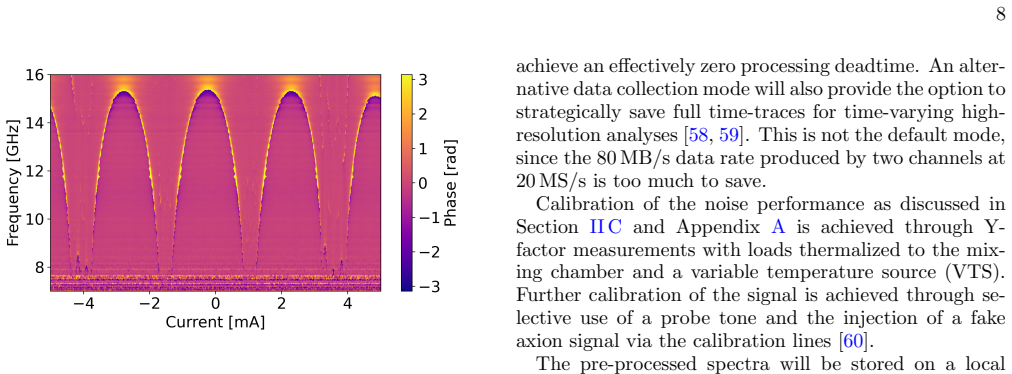
- [Fig. 2 caption] The caption says "Varying marker colors denote distinct structural configurations," but the colors are not defined in the caption or in a legend; please add a legend or a table describing the configurations.
- [Abstract and Section V] The phrase "sensitivity approaching KSVZ" is not quantified; consider specifying that the discovery potential is the median 5σ sensitivity at the KSVZ coupling for 3.7 years of integration, which would make the claim more precise.
Circularity Check
No circular derivation: the KSVZ-reach projection evaluates the standard scan-rate formula with stated design parameters, and the resonator Q and C values come from simulations rather than from fitting the projected sensitivity.
full rationale
The paper's central quantitative claim is the sensitivity projection in Section III, based on Eq. (1), which is the standard haloscope scan-rate proportionality from Sikivie and HAYSTAC references. The paper does not fit any parameter to a target discovery; instead it inserts chosen design parameters (Q=1.3e4, C=0.4, V=0.012 m^3, B=9 T, N_sys=1.32, tau=3.7 y) into an externally established formula. The resonator-dependent values are stated as simulation results summarized in Figure 2 and Table I, and the figure-of-merit enhancement is defined as a ratio to a reference cylindrical cavity rather than being derived from the desired KSVZ reach. The theory of wire metamaterials is cited from prior work, but the load-bearing experimental support includes published measurements in Refs. [39,40], which are independent empirical evidence even though some authors overlap with the collaboration. Self-citations such as Lawson et al. 2019 and Millar et al. 2023 establish the plasma-haloscope concept, but the present paper's projection does not reduce to those citations: the specific Phase I resonator designs, tuning mechanisms, JPA readout, and simulation parameters are new content. The weakest assumption, that simulated Q and C hold at 10-20 GHz with realistic mechanics and tolerances, is a validation risk or correctness concern, not a circularity: no equation in the paper defines Q or C in terms of the projected coupling, and no fitted parameter is renamed as a prediction. Therefore no circular step can be exhibited, and the appropriate finding is no significant circularity.
Assumptions & free parameters
free parameters (5)
- Resonator quality factor Q =
1.3e4
- Form factor C =
0.4
- Active resonator volume V =
0.012 m^3
- Total system noise Nsys =
1.32 quanta
- Integration time tau =
3.7 years
assumptions (5)
- domain assumption Haloscope scanning-rate formula (Eq. 1)
- domain assumption Wire-metamaterial effective plasma frequency theory (Refs. 35-37)
- ad hoc to paper Extrapolation of wire-array measurements to 10 to 20 GHz resonator designs
- domain assumption Cascaded noise model of Eq. A2 with assumed component losses
- domain assumption The plasma mode behaves as the lowest TM mode and PBG suppresses TE modes
Cite this review
Pith. "Pith review of Design of ALPHA Phase I: A Plasma Haloscope for 10--20 GHz Post-Inflation Axions." pith.science (2026). https://pith.science/paper/4IDCYDM7
@misc{pith2026260810292,
  author       = {Pith},
  title        = {Pith review of: Design of ALPHA Phase I: A Plasma Haloscope for 10--20 GHz Post-Inflation Axions},
  year         = {2026},
  howpublished = {\url{https://pith.science/paper/4IDCYDM7}},
  note         = {Machine review of arXiv:2608.10292}
}
read the original abstract
The axion is a well-motivated hypothetical particle capable of resolving both the strong CP problem and the dark matter mystery, with recent post-inflationary cosmological simulations favoring masses above 40 {\mu}eV. Plasma haloscopes serve as a promising experimental approach to reach theoretically preferred sensitivities in this mass range. ALPHA, hosted at Yale Wright Laboratory, is an international collaboration developing plasma haloscopes to search for QCD dark matter axions. In this letter we present the detailed design and sensitivity projection for the first phase of the ALPHA experiment, which will search the mass range from 10 GHz to 20 GHz (~40 {\mu}eV to 80 {\mu}eV). This search will make use of wire-array plasma resonators to decouple the physical size from the resonant frequency, a limitation typically faced by traditional microwave cavities, allowing broadband sensitivity approaching KSVZ coupling strengths.
Figures


Figures from the paper (4 more)


Reference graph
Works this paper leans on
-
[1]
Bertone and D
G. Bertone and D. Hooper, History of dark matter, Rev. Mod. Phys.90, 045002 (2018)
2018
-
[2]
R. D. Peccei and H. R. Quinn, CP conservation in the presence of pseudoparticles, Phys. Rev. Lett.38, 1440 (1977)
1977
-
[3]
R. D. Peccei and H. R. Quinn, Constraints imposed by CP conservation in the presence of pseudoparticles, Phys. Rev. D16, 1791 (1977)
1977
-
[4]
Weinberg, A new light boson?, Phys
S. Weinberg, A new light boson?, Phys. Rev. Lett.40, 223 (1978)
1978
-
[5]
Wilczek, Problem of strongpandtinvariance in the presence of instantons, Phys
F. Wilczek, Problem of strongpandtinvariance in the presence of instantons, Phys. Rev. Lett.40, 279 (1978)
1978
-
[6]
Preskill, M
J. Preskill, M. B. Wise, and F. Wilczek, Cosmology of the invisible axion, Phys. Lett. B120, 127 (1983)
1983
-
[7]
Abbott and P
L. Abbott and P. Sikivie, A cosmological bound on the invisible axion, Phys. Lett. B120, 133 (1983)
1983
-
[8]
Dine and W
M. Dine and W. Fischler, The not-so-harmless axion, Phys. Lett. B120, 137 (1983)
1983
Show all 83 references
-
[9]
Di Luzio, M
L. Di Luzio, M. Giannotti, E. Nardi, and L. Visinelli, The landscape of QCD axion models, Phys. Rept.870, 1 (2020), arXiv:2003.01100 [hep-ph]
2020 arXiv
-
[10]
J. E. Kim, Weak Interaction Singlet and Strong CP In- variance, Phys. Rev. Lett.43, 103 (1979)
1979
-
[11]
M. A. Shifman, A. I. Vainshtein, and V. I. Zakharov, Can Confinement Ensure Natural CP Invariance of Strong In- teractions?, Nucl. Phys. B166, 493 (1980)
1980
-
[12]
M. Dine, W. Fischler, and M. Srednicki, A Simple Solu- tion to the Strong CP Problem with a Harmless Axion, Phys. Lett. B104, 199 (1981)
1981
-
[13]
A. R. Zhitnitsky, On Possible Suppression of the Axion Hadron Interactions. (In Russian), Sov. J. Nucl. Phys. 31, 260 (1980)
1980
-
[14]
Saikawa, J
K. Saikawa, J. Redondo, A. Vaquero, and M. Kaltschmidt, Spectrum of global string net- works and the axion dark matter mass, JCAP10, 043, arXiv:2401.17253 [hep-ph]
-
[15]
H. Kim, J. Park, and M. Son, Axion dark matter from cosmic string network, JHEP07, 150, arXiv:2402.00741 [hep-ph]
-
[16]
Buschmann, J
M. Buschmann, J. W. Foster, A. Hook, A. Peterson, D. E. Willcox, W. Zhang, and B. R. Safdi, Dark matter from axion strings with adaptive mesh refinement, Nat. Commun.13, 1049 (2022), arXiv:2108.05368 [hep-ph]
2022 arXiv
-
[17]
J. N. Benabou, M. Buschmann, J. W. Foster, and B. R. Safdi, Axion mass prediction from adaptive mesh refine- ment cosmological lattice simulations, Phys. Rev. Lett. 134, 241003 (2025)
2025
-
[18]
Gorghetto, E
M. Gorghetto, E. Hardy, and G. Villadoro, More axions from strings, SciPost Phys.10, 050 (2021), arXiv:2007.04990 [hep-ph]
2021 arXiv
-
[19]
Sikivie, Experimental tests of the ”invisible” axion, Phys
P. Sikivie, Experimental tests of the ”invisible” axion, Phys. Rev. Lett.51, 1415 (1983)
1983
-
[20]
invisible
P. Sikivie, Detection rates for “invisible”-axion searches, Phys. Rev. D32, 2988 (1985)
1985
-
[21]
Al Kenanyet al., Design and operational expe- rience of a microwave cavity axion detector for the 20–100µeV range, Nucl
S. Al Kenanyet al., Design and operational expe- rience of a microwave cavity axion detector for the 20–100µeV range, Nucl. Instrum. Meth. A854, 11 (2017), arXiv:1611.07123 [physics.ins-det]
2017 arXiv
-
[22]
Simanovskaia, G
M. Simanovskaia, G. Carosi, and K. v. Bibber, Microwave cavity searches, inThe Search for Ultralight Bosonic Dark Matter, edited by D. F. Jackson Kimball and K. van Bibber (Springer International Publishing, Cham, 2023) pp. 123–139
2023
-
[23]
Jeong, S
J. Jeong, S. Youn, and J. E. Kim, Multiple-cell cavity design for high mass axion searches: An extended study, Nucl. Instrum. Methods Phys. Res. A1053, 168327 (2023)
2023
-
[24]
Hagmann, P
C. Hagmann, P. Sikivie, N. Sullivan, D. B. Tanner, and S. Cho, Cavity design for a cosmic axion detector, Rev. Sci. Instrum.61, 1076 (1990)
1990
-
[25]
Jeong, S
J. Jeong, S. Youn, S. Ahn, J. E. Kim, and Y. K. Se- mertzidis, Concept of multiple-cell cavity for axion dark matter search, Phys. Lett. B777, 412 (2018)
2018
-
[26]
A. A. Melcon, S. A. Cuendis, C. Cogollos, A. D ´ ıaz- Morcillo, B. Dobrich, J. D. Gallego, B. Gimeno, I. G. Irastorza, A. J. Lozano-Guerrero, C. Malbrunot, P. Navarro, C. P. Garay, J. Redondo, T. Vafeiadis, and W. Wuensch, Axion searches with microwave filters: the rades proje...
-
[27]
M. O. Withers and C.-L. Kuo, Beehive haloscope for high-mass axion dark matter, Phys. Rev. D111, 072011 (2025)
2025
-
[28]
Boutan, M
C. Boutan, M. Jones, B. H. LaRoque, N. S. Oblath, R. Cervantes, N. Du, N. Force, S. Kimes, R. Ottens, L. J. Rosenberg, G. Rybka, J. Yang, G. Carosi, N. Woollett, D. Bowring, A. S. Chou, R. Khatiwada, A. Sonnenschein, W. Wester, R. Bradley, E. J. Daw, A. Agrawal, A. V. Dixit, J...
2018
-
[29]
J. Kim, S. Youn, J. Jeong, W. Chung, O. Kwon, and Y. K. Semertzidis, Exploiting higher-order resonant modes for axion haloscopes, J. Phys. G: Nucl. Part. Phys. 47, 035203 (2020)
2020
-
[30]
Alesini, D
D. Alesini, D. Babusci, C. Braggio, G. Carugno, N. Crescini, D. D’Agostino, A. D’Elia, D. Di Gioacchino, R. Di Vora, P. Falferi, U. Gambardella, C. Gatti, G. Ian- none, C. Ligi, A. Lombardi, G. Maccarrone, A. Ortolan, R. Pengo, A. Rettaroli, G. Ruoso, L. Taffarello, and S. Toc...
2022
-
[31]
S. Bae, S. Youn, and J. Jeong, Tunable photonic crys- tal haloscope for high-mass axion searches, Phys. Rev. D 107, 015012 (2023)
2023
-
[32]
Caldwell, G
A. Caldwell, G. Dvali, B. Majorovits, A. Millar, G. Raf- felt, J. Redondo, O. Reimann, F. Simon, and F. Steffen (MADMAX Working Group), Dielectric haloscopes: A new way to detect axion dark matter, Phys. Rev. Lett. 118, 091801 (2017)
2017
-
[33]
Baryakhtar, J
M. Baryakhtar, J. Huang, and R. Lasenby, Axion and 14 hidden photon dark matter detection with multilayer op- tical haloscopes, Phys. Rev. D98, 035006 (2018)
2018
-
[34]
J. F. Hern´ andez-Cabrera, J. De Miguel, E. Hern´ andez- Su´ arez, E. Joven- ´Alvarez, H. Lorenzo-Hern´ andez, C. Otani, M. A. Rapado-Tamarit, J. A. Rubi˜ no-Mart ´ ın, and on behalf of the DALI collaboration, Experimental measurement of the quality factor of a fabry-p´ erot o...
-
[35]
Lawson, A
M. Lawson, A. J. Millar, M. Pancaldi, E. Vitagliano, and F. Wilczek, Tunable axion plasma haloscopes, Phys. Rev. Lett.123, 141802 (2019), arXiv:1904.11872 [hep-ph]
2019 arXiv
-
[36]
J. B. Pendry, A. J. Holden, D. J. Robbins, and W. J. Stewart, Low frequency plasmons in thin-wire structures, J. Phys. Condens. Matter10, 4785 (1998)
1998
-
[37]
P. A. Belov, R. Marqu´ es, S. I. Maslovski, I. S. Nefe- dov, M. Silveirinha, C. R. Simovski, and S. A. Tretyakov, Strong spatial dispersion in wire media in the very large wavelength limit, Phys. Rev. B67, 113103 (2003)
2003
-
[38]
Balafendiev, C
R. Balafendiev, C. Simovski, A. J. Millar, and P. Belov, Wire metamaterial filled metallic resonators, Phys. Rev. B106, 075106 (2022)
2022
-
[39]
Wooten, A
M. Wooten, A. Droster, A. Kenany, D. Sun, S. M. Lewis, and K. van Bibber, Exploration of wire array metama- terials for the plasma axion haloscope, Ann. Phys.536, 2200479 (2024)
2024
-
[40]
Kowitt, R
N. Kowitt, R. Balafendiev, D. Sun, M. Wooten, A. Droster, M. A. Gorlach, K. van Bibber, and P. A. Belov, Tunable wire metamaterials for an axion halo- scope, Phys. Rev. Appl.20, 044051 (2023)
2023
-
[41]
A. J. Millaret al.(ALPHA), Searching for dark mat- ter with plasma haloscopes, Phys. Rev. D107, 055013 (2023), arXiv:2210.00017 [hep-ph]
2023 arXiv
-
[42]
M. A. Castellanos-Beltran and K. W. Lehnert, Widely tunable parametric amplifier based on a superconduct- ing quantum interference device array resonator, Appl. Phys. Lett.91, 083509 (2007), arXiv:0706.2373 [cond- mat.supr-con]
2007 arXiv
-
[43]
Bluefors, LD Dilution Refrigerator Measurement System, https://bluefors.com
-
[44]
Balafendiev, G
R. Balafendiev, G. Kaur, J. A. Enriquez, G. Singh, A. J. Millar, J. E. Gudmundsson, and P. Belov, Tunable epsilon near zero metamaterial with rotating obround-shaped meta-atoms (2025), arXiv:2506.04428 [physics.optics]
2025 arXiv
-
[45]
Simanovskaia, A
M. Simanovskaia, A. Droster, H. Jackson, I. Urdinaran, and K. van Bibber, A symmetric multi-rod tunable mi- crowave cavity for a microwave cavity dark matter axion search, Rev. Sci. Instrum.92, 033305 (2021)
2021
-
[46]
Goulart, A
D. Goulart, A. M. Sindhwad, H. M. Jackson, N. I. Kowitt, K. A. Dones, P. C. Basurto, A. Dawes, S. Jois, S. M. Lewis, and K. van Bibber, Practical photonic bandgap structures for high frequency axion haloscopes, Rev. Sci. Instrum.96, 094704 (2025)
2025
-
[47]
Lindahl, R
J. Lindahl, R. Balafendiev, G. Kaur, G. Singh, A. Gallo Rosso, J. Conrad, J. E. Gudmundsson, and J. Jeong, Spiral tuning of wire-metamaterial cavity for a plasma haloscope, Phys. Rev. Appl.25, 024073 (2026)
2026
-
[48]
B. M. Brubaker,First results from the HAYSTAC axion search, Ph.D. thesis, Yale U. (2017), arXiv:1801.00835 [astro-ph.CO]
2017 arXiv
-
[49]
Zhonget al.(HAYSTAC), Results from phase 1 of the HAYSTAC microwave cavity axion experiment, Phys
L. Zhonget al.(HAYSTAC), Results from phase 1 of the HAYSTAC microwave cavity axion experiment, Phys. Rev. D97, 092001 (2018), arXiv:1803.03690 [hep-ex]
2018 arXiv
-
[50]
K. M. Backeset al.(HAYSTAC), A quantum-enhanced search for dark matter axions, Nature590, 238 (2021), arXiv:2008.01853 [quant-ph]
2021 arXiv
-
[51]
S. K. Lamoreaux, K. A. van Bibber, K. W. Lehn- ert, and G. Carosi, Analysis of single-photon and lin- ear amplifier detectors for microwave cavity dark mat- ter axion searches, Phys. Rev. D88, 035020 (2013), arXiv:1306.3591 [physics.ins-det]
2013 arXiv
-
[52]
H. A. Haus and J. A. Mullen, Quantum noise in linear amplifiers, Phys. Rev.128, 2407 (1962)
1962
-
[53]
C. M. Caves, Quantum limits on noise in linear ampli- fiers, Phys. Rev. D26, 1817 (1982)
1982
-
[54]
M. S. Turner, Periodic signatures for the detection of cosmic axions, Phys. Rev. D42, 3572 (1990)
1990
-
[55]
(2024), version 1.5
AlazarTech,180 MS/s 16-Bit PCI Express Digitizer, Alazar Technologies Inc. (2024), version 1.5
2024
-
[56]
Python Software Foundation,multiprocessing — Process- based parallelism(2026), python 3.14.4 documentation
2026
-
[57]
Python Software Foundation,concurrent.futures — Launching parallel tasks(2026), python 3.14.4 documen- tation
2026
-
[58]
L. D. Duffy, P. Sikivie, D. B. Tanner, S. J. Asztalos, C. Hagmann, D. Kinion, L. J. Rosenberg, K. van Bibber, D. B. Yu, and R. F. Bradley, High resolution search for dark-matter axions, Phys. Rev. D74, 012006 (2006)
2006
-
[59]
C. A. O’Hare and G. Pierobon, Fine-grained dark mat- ter substructure and axion haloscopes, JCAP2026(04), 039
-
[60]
Y. Zhu, M. J. Jewell, C. Laffan, X. Bai, S. Ghosh, E. Gra- ham, S. B. Cahn, R. H. Maruyama, and S. K. Lamore- aux, An improved synthetic signal injection routine for the haloscope at yale sensitive to axion cold dark matter (HAYSTAC), Rev. Sci. Instrum.94, 054712 (2023)
2023
-
[61]
B. J. Koopmanet al., The Simons Observatory: Overview of data acquisition, control, monitoring, and computer infrastructure, Proc. SPIE Int. Soc. Opt. Eng. 11452, 1145208 (2020), arXiv:2012.10345 [astro-ph.IM]
2020 arXiv
-
[62]
Simons Observatory, OCS - Observatory Control System, https://github.com/simonsobs/ocs
-
[63]
Gallo Rosso, S
A. Gallo Rosso, S. Algeri, and J. Conrad, Sequential hy- pothesis testing for axion haloscopes, Phys. Rev. D108, 023003 (2023), arXiv:2210.16095 [physics.data-an]
2023 arXiv
-
[64]
B. M. Brubaker, L. Zhong, S. K. Lamoreaux, K. W. Lehnert, and K. A. van Bibber, HAYSTAC axion search analysis procedure, Phys. Rev. D96, 123008 (2017)
2017
-
[65]
Caputo, A
A. Caputo, A. J. Millar, C. A. J. O’Hare, and E. Vitagliano, Dark photon limits: A handbook, Phys. Rev. D104, 095029 (2021), arXiv:2105.04565 [hep-ph]
2021 arXiv
-
[66]
Baiet al.(HAYSTAC), Dark Matter Axion Search with HAYSTAC Phase II, Phys
X. Baiet al.(HAYSTAC), Dark Matter Axion Search with HAYSTAC Phase II, Phys. Rev. Lett.134, 151006 (2025), arXiv:2409.08998 [hep-ex]
2025 arXiv
-
[67]
Alesiniet al., Galactic axions search with a supercon- ducting resonant cavity, Phys
D. Alesiniet al., Galactic axions search with a supercon- ducting resonant cavity, Phys. Rev. D99, 101101 (2019), arXiv:1903.06547 [physics.ins-det]
2019 arXiv
-
[68]
Alesiniet al., Search for invisible axion dark matter of mass m a=43µeV with the QUAX–aγexperiment, Phys
D. Alesiniet al., Search for invisible axion dark matter of mass m a=43µeV with the QUAX–aγexperiment, Phys. Rev. D103, 102004 (2021), arXiv:2012.09498 [hep-ex]
2021 arXiv
-
[69]
Di Voraet al.(QUAX), Search for galactic axions with a traveling wave parametric amplifier, Phys
R. Di Voraet al.(QUAX), Search for galactic axions with a traveling wave parametric amplifier, Phys. Rev. D108, 062005 (2023), arXiv:2304.07505 [hep-ex]
2023 arXiv
-
[70]
Rettaroliet al.(QUAX), Search for axion dark matter with the QUAX–LNF tunable haloscope, Phys
A. Rettaroliet al.(QUAX), Search for axion dark matter with the QUAX–LNF tunable haloscope, Phys. Rev. D 110, 022008 (2024), arXiv:2402.19063 [physics.ins-det]
2024 arXiv
-
[71]
B. T. McAllister, G. Flower, E. N. Ivanov, M. Goryachev, 15 J. Bourhill, and M. E. Tobar, The ORGAN Experiment: An axion haloscope above 15 GHz, Phys. Dark Univ.18, 67 (2017), arXiv:1706.00209 [physics.ins-det]
2017 arXiv
-
[72]
A. P. Quiskamp, B. T. McAllister, P. Altin, E. N. Ivanov, M. Goryachev, and M. E. Tobar, Direct search for dark matter axions excluding ALP cogenesis in the 63- to 67- µeV range with the ORGAN experiment, Sci. Adv.8, abq3765 (2022), arXiv:2203.12152 [hep-ex]
2022 arXiv
-
[73]
Quiskamp, B
A. Quiskamp, B. T. McAllister, P. Altin, E. N. Ivanov, M. Goryachev, and M. E. Tobar, Exclusion of Axionlike- Particle Cogenesis Dark Matter in a Mass Window above 100µeV, Phys. Rev. Lett.132, 031601 (2024), arXiv:2310.00904 [hep-ex]
2024 arXiv
-
[74]
A. P. Quiskamp, G. R. Flower, S. Samuels, B. T. McAllis- ter, P. Altin, E. N. Ivanov, M. Goryachev, and M. E. To- bar (ORGAN), Near-quantum-limited axion dark mat- ter search with the ORGAN experiment around 26µeV, Phys. Rev. D111, 095007 (2025), arXiv:2407.18586 [hep- ex]
2025 arXiv
-
[75]
J. Ruz, E. Todarello, J. K. Vogel, F. R. Cand´ on, M. Gian- notti, B. Grefenstette, H. S. Hudson, I. G. Hannah, I. G. Irastorza, C. S. Kim, M. Regis, D. M. Smith, M. Taoso, and J. Trujillo Bueno, Nustar as an axion helioscope, Phys. Rev. Lett.135, 141001 (2025)
2025
-
[76]
Altenm¨ uller, V
K. Altenm¨ uller, V. Anastassopoulos, S. Arguedas- Cuendis, S. Aune, J. Baier, K. Barth, H. Br¨ auninger, G. Cantatore, F. Caspers, J. F. Castel, S. A. C ¸ etin, F. Christensen, C. Cogollos, T. Dafni, M. Davenport, T. A. Decker, K. Desch, D. D ´ ıez-Ib´ a˜ nez, B. D¨ obrich, E...
2024
-
[77]
Ahn,(The) first high-temperature superconducting cavities in axion dark matter search, Ph.D
D. Ahn,(The) first high-temperature superconducting cavities in axion dark matter search, Ph.D. thesis, Korea Advanced Institute of Science and Technology (2023)
2023
-
[78]
Ricci, N
M. Ricci, N. Orloff, and S. M. Anlage, Superconducting metamaterials, Appl. Phys. Lett.87, 034102 (2005)
2005
-
[79]
Graham, S
E. Graham, S. Ghosh, Y. Zhu, X. Bai, S. B. Cahn, E. Durcan, M. J. Jewell, D. H. Speller, S. M. Zacarias, L. T. Zhou, and R. H. Maruyama, Rydberg-atom-based single-photon detection for haloscope axion searches, Phys. Rev. D109, 032009 (2024)
2024
-
[80]
Braggio, L
C. Braggio, L. Balembois, R. Di Vora, Z. Wang, J. Trav- esedo, L. Pallegoix, G. Carugno, A. Ortolan, G. Ruoso, U. Gambardella, D. D’Agostino, P. Bertet, and E. Flurin, Quantum-enhanced sensing of axion dark matter with a transmon-based single microwave photon counter, Phys. Re...
2025
-
[81]
A. V. Dixit, S. Chakram, K. He, A. Agrawal, R. K. Naik, D. I. Schuster, and A. Chou, Searching for dark mat- ter with a superconducting qubit, Phys. Rev. Lett.126, 141302 (2021)
2021
-
[82]
A. L. Pankratov, L. S. Revin, A. V. Gordeeva, A. A. Yablokov, L. S. Kuzmin, and E. Il’ichev, Towards a mi- crowave single-photon counter for searching axions, npj Quantum Inf.8, 61 (2022)
2022
-
[83]
M. J. Jewellet al.(HAYSTAC), New results from HAYSTAC’s phase II operation with a squeezed state receiver, Phys. Rev. D107, 072007 (2023), arXiv:2301.09721 [hep-ex]
2023 arXiv
Reviewed August 14, 2026 · model on record in the stance chip above.
Discussion (0). Continue with ORCID to comment.