REVIEW 2 major objections 4 minor 114 references
Hip Energized Monopedal Hopping
T0 review · 2 major / 4 minor · reviewed 2026-08-12 · deepseek-v4-flash
Pith's one-line read This paper claims that a single hip torque can simultaneously stabilize body pitch and pump energy into the leg spring, sustaining steady monopedal hopping at user-selected speeds and heights, and it backs the claim with closed-form…
desk verdict Genuine advance in hip-energized hopping with a first hybrid-averaging analysis of 2-DoF SLIP with attitude, but the flagship stability theorem leans on an unproved conjecture and the model accuracy is post-fit. read the letter →
The pith
A machine-rendered reading of the paper's core claim, the machinery that carries it, and where it could break.
The reading
What carries the argument
The load-bearing machinery is a cascade decomposition plus a change of coordinates. The paper first isolates the 1-DoF pitch dynamics, using Assumption 5 to replace the leg-force moment by a constant $\chi$-scaled disturbance, so the pitch loop with its discrete torque-bias integrator becomes an LTI hybrid system with an explicit stable fixed point (13). That fixed point feeds a constant hip torque $\bar{\tau}^*$ into the otherwise unactuated 2-DoF SLIP, whose stance dynamics are then re-expressed in coordinates (14) with master phase $\psi_r$, energy ratio $\psi_e$, leg angle $\theta$, and energy $a_e$; hybrid averaging, a technique for approximating Poincar\'e return maps when fast phases and slow energy states coexist, yields the averaged field (17), fixed point (18), and eigenvalue estimates (27)-(29). The stepping law (22), a filtered Raibert-style law augmented by a term $-\pi/\omega_e(a)$ that encodes the required asymmetry, keeps $\psi_e$ near its target and stabilizes the leg angle. Theorem 2 completes the picture by proving that any hip-energized period-one gait must land asymmetrically, which is why the extra term is a necessity rather than a hack.
What would settle it
Simulate or instrument the full 3-DoF closed-loop system and measure the local return-map Jacobian at the predicted fixed point $q^*$ (30) for several small $\epsilon$ values; if any eigenvalue leaves the unit circle, or the numerically exact fixed point is not $O(\epsilon)$-close to the predicted one, Theorem 1's conclusion fails. To test Conjecture 1 directly, perturb the unperturbed SLIP limit cycle with small continuous disturbances and check that the linearized response decays; a marginal or growing linearized cycle would falsify the formal stability claim. Empirically, force a symmetric stepping law (touchdown angle exactly the negative of liftoff angle) on the hardware hopper, since Theorem 2 predicts sustained period-one hip-energized hopping then becomes impossible.
Extended reading notes
Core claim
On the authors' own terms, the central discovery is that pitch stabilization and translational energy injection are not competing uses of a single hip actuator but one combined mechanism: the PD-plus-feedforward torque that holds the body near a desired pitch exerts a reaction force on the leg that adds energy to the SLIP subsystem at a rate proportional to the steady torque bias $\bar{\tau}^*$. The paper formalizes this by decomposing the 3-DoF pitch-unlocked SLIP into an isolated linear pitch subsystem cascading into a 2-DoF translational SLIP subsystem, then applies hybrid averaging in new coordinates, the energy ratio $\psi_e$ and twice the mass-specific square-root energy $a_e$ of (14), to obtain the averaged fixed point $\hat{x}^*$ (18) and eigenvalue approximations (27)-(29). Theorem 1 assembles these into explicit fixed points $q^*=[q_a^*, q_s^*]$ (30) and asymptotic stability for small $\epsilon$ under the assumptions in Tables 3 to 5, assuming Conjecture 1 on exponential stability and BIBO stability of the underlying limit cycle. The result predicts that stable, user-selectable fore-aft speed and apex height can be tuned through the COM offset $d_x$ and target energy ratio $\psi_e^d$, with simulated and physical data matching the predictions at roughly 6 to 16 percent mean error.
Load-bearing premise
The formal stability conclusion of Theorem 1 depends on an unproved conjecture, Conjecture 1: that the averaged unperturbed SLIP limit cycle is locally exponentially stable and bounded-input bounded-output stable under small continuous disturbances, and that this property persists for small $\epsilon$ in the unaveraged dynamics; if that conjecture is false, the proof's stability guarantee for the cascade collapses, even though the controller might still work in practice.
Editorial extensions
If this is right
- A monoped can hop stably using only the hip motor during stance; no shank actuator is needed to restore energy lost to damping.
- Steady-state fore-aft speed and apex height become user-selectable through two scalar setpoints, the COM offset $d_x$ and target energy ratio $\psi_e^d$.
- Hip-energized hopping that returns to the same state each stride must use an asymmetric stepping strategy; symmetric neutral-point stepping cannot work when the hip injects nonzero net energy.
- The closed-form eigenvalues give explicit gain-scheduling guidance: $k_e$ governs energy-ratio convergence, $\alpha$ governs leg-angle damping, and the energy eigenvalue shows why high-energy setpoints lose stability.
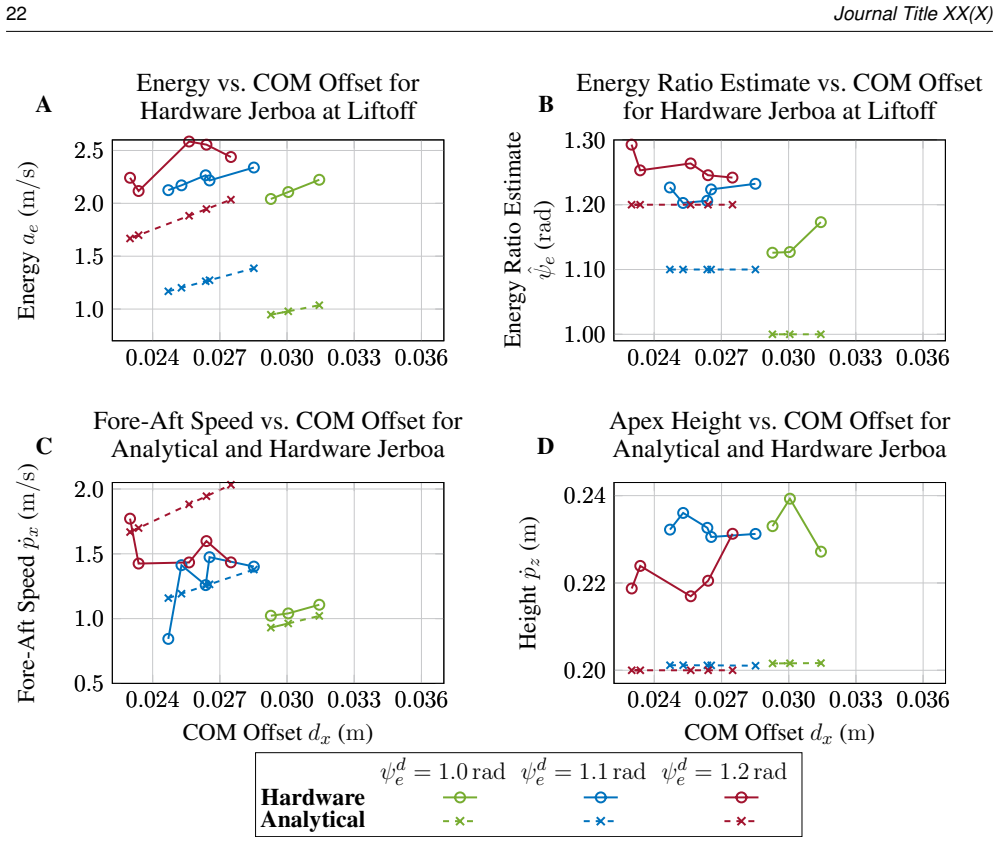
- On the Penn Jerboa the strategy sustains speeds from 1.02 to 1.77 m/s, about 5.1 to 8.85 leg lengths per second, with the analytical model predicting the observed fixed points to roughly 6 to 16 percent mean error.
Reading between the lines
- Our inference: if any controller injects a nonzero net hip torque per stride, Theorem 2's asymmetry argument should apply beyond this specific law, so virtual-pivot-point-style torque laws that stabilize pitch may also require asymmetric foot placement to avoid unbounded angular energy.
- A testable extension: replace the fitted constants $\gamma$ and $\chi$ with state-dependent estimates; the paper notes that its fixed-point accuracy depends on these fitted values, so an online estimator could broaden the operating regime where the closed-form map predicts hardware behavior.
- Our inference: the same cascade decomposition may transfer to spatial robots by treating yaw and roll as isolated attitude subsystems perturbing a planar SLIP, potentially yielding closed-form fixed points for more than sagittal-plane motion, although the paper does not claim this.
Editorial analysis
A structured set of objections, weighed in public.
Referee Report
Summary. The paper presents a hip-only control strategy for pitch-unlocked planar monopedal hopping, in which the pitch-stabilizing hip torque also injects energy into the translational SLIP dynamics. The stance dynamics are decomposed into a 1-DoF pitch subsystem cascading into a 2-DoF SLIP subsystem. Closed-form fixed points and eigenvalue estimates are derived via hybrid averaging, with a new coordinate transformation treating SLIP as a unitary 2-DoF system. Theorem 2 establishes that hip-energized period-one gaits require asymmetric stepping. The analytical predictions are compared against simulations of a 5-link biped and a model of the Penn Jerboa, and against physical experiments on the Penn Jerboa, reporting stable hopping at 1.02--1.77 m/s. The formal stability result (Theorem 1) is explicitly conditional on an unproved conjecture about the continuous-time exponential stability and BIBO stability of the unperturbed SLIP limit cycle. The free parameters gamma and chi are fitted to the same simulation and hardware data used for validation, so the reported accuracy is calibrated rather than predicted.
Significance. If the central claims hold, the paper makes a valuable contribution to legged locomotion: it demonstrates that a single hip actuator can simultaneously stabilize pitch and replenish translational energy, gives closed-form expressions for the resulting fixed points and eigenvalues, and documents fast, sustained hopping on a physical robot. The hybrid-averaging extension to a full 2-DoF SLIP with attitude is a methodological advance, and Theorem 2's necessity result for asymmetric stepping is a clean conceptual insight. The paper is unusually transparent in listing its assumptions and in stating Conjecture 1 as an unproved hypothesis. However, the headline formal stability guarantee is conditional on that conjecture, and the quantitative validation is in-sample because gamma and chi are fitted to the data being compared. These limitations materially temper the strength of the stated conclusions.
major comments (2)
- [Section 2.3.10, Theorem 1] Placeholder
- [Section 3.4, Tables 9 and 10] Placeholder
minor comments (4)
- [Abstract and Introduction] Placeholder
- [Abstract, Section 1.2] Placeholder
- [Section 2.3.6, footnote 17] Placeholder
- [Section 6.1, Table 8] Placeholder
Circularity Check
Quantitative validation is in-sample: γ and χ are fitted to the same simulation/hardware fixed points that Tables 9–10 then use to report model 'accuracy'; the formal stability theorem is conditional on an unproved conjecture, but that is an explicit assumption rather than a circular reduction.
-
fitted input called prediction
[Section 3.4 (Finding Free Model Parameters), Tables 9 and 10, Figures 8 and 10]
"We found the values of γ and χ by numerically fitting the fixed points from (30) to the simulation (Figure 8) and hardware (Figure 10) fixed points. The values for γ and χ are in Table 8."
The fixed-point formulas (30) depend on the free parameters γ and χ, whose values are obtained by numerically fitting (30) to the very simulation and hardware fixed-point data that Tables 9 and 10 then use to compute mean percent error. The reported 13.8% and 16.4% speed errors and related accuracy claims therefore measure in-sample fit quality, not independent predictive power. The paper confirms this by noting that choosing different γ, χ 'that do not try to minimize the mean error' gives larger errors, exactly the behavior of fitted rather than predicted quantities.
full rationale
The analytical derivation itself is not circular: Proposition 2, Lemma 2, and Theorem 1 are built from stated assumptions, a coordinate change, and the published hybrid-averaging theorem of De et al. (2018) and De (2017). Citing that prior theorem is normal use of external mathematical machinery, not a circular validation. Theorem 1's stability conclusion is honestly conditional on Conjecture 1, which is an unproved regularity assumption about continuous-time exponential stability and BIBO behavior; that is a significant rigor gap but not a circularity, because the conjecture is declared as an assumption rather than derived from the theorem's conclusion. The substantive circularity is limited to the empirical validation: γ and χ in Table 8 are fitted to the simulation and hardware steady-state data, and Tables 9 and 10 then evaluate the model's percent error against those same fitted data. Thus the reported quantitative accuracy is in-sample calibration, even though the qualitative trends and the demonstrated stable hardware hopping provide independent supporting evidence.
Assumptions & free parameters
free parameters (2)
- gamma =
0.9
- chi =
1.7 (simulation), 2.4 (hardware)
assumptions (5)
- ad hoc to paper Conjecture 1: the averaged unperturbed SLIP limit cycle is locally exponentially stable with BIBO stability, and the same holds for the unaveraged dynamics for small epsilon.
- ad hoc to paper Assumption 5: d cos(theta-phi) F_s is approximately d_x chi m g for a constant chi fitted to data.
- domain assumption Assumption 10: b = O(epsilon), while the paper notes the realistic condition is b r_dot = O(epsilon).
- domain assumption Assumption 8: cos psi_e is approximately cos gamma psi_d_e and sin psi_e is approximately sin gamma psi_d_e for a fixed gamma.
- domain assumption Assumption 17: gravitational potential energy change during flight is negligible.
Cite this review
Pith. "Pith review of Hip Energized Monopedal Hopping." pith.science (2026). https://pith.science/paper/T4I7EZ7T
@misc{pith2026260810387,
  author       = {Pith},
  title        = {Pith review of: Hip Energized Monopedal Hopping},
  year         = {2026},
  howpublished = {\url{https://pith.science/paper/T4I7EZ7T}},
  note         = {Machine review of arXiv:2608.10387}
}
read the original abstract
We present a novel stepping strategy for pitch unlocked planar monopeds where the reaction torques from stabilizing pitch with a conventional PD + feedfoward controller are recruited to counteract energetic losses from damping. By moving the location of the mass center, our controller increases the pitch stabilization torque, thereby adding energy to the gait. A new stepping policy adjusts the distribution of energy between the radial and angular degrees of freedom to counteract dissipative losses and achieve a user specified balance between steady state fore-aft speed and apex height. Hybrid averaging analysis yields closed form expressions for the fixed points and eigenvalues of the resulting gait, lending insight into the interplay between the physical and control parameters' influence on performance. Simulation studies on a generic 5 link biped and a careful model of the Penn Jerboa reveal a useful correspondence to these analytical predictions. Physical experiments on the Penn Jerboa exhibit stable locomotion with speeds ranging from 1.02 m/s to 1.77 m/s (5.10 leg lengths/s to 8.85 leg lengths/s) in a manner effectively approximated by the mathematical analysis.
Figures
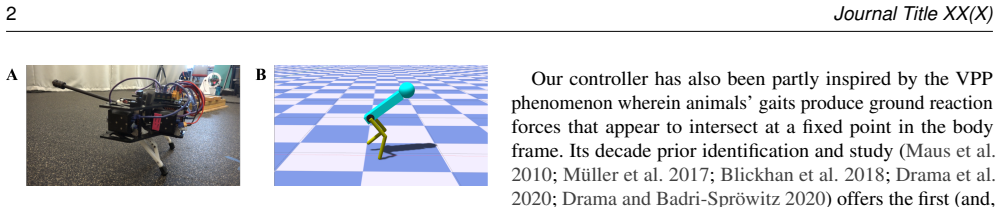


Figures from the paper (8 more)



Reference graph
Works this paper leans on
-
[1]
Shamsah, Abdulaziz and De, Avik and Koditschek, Daniel , month = jul, year =. Analytically-. doi:10.1109/IROS.2018.8593677 , journal =
arXiv 2018
-
[2]
2016 IEEE/RSJ International Conference on Intelligent Robots and Systems (IROS) , author =
Frontal plane stabilization and hopping with a 2DOF tail , url =. 2016 IEEE/RSJ International Conference on Intelligent Robots and Systems (IROS) , author =. 2016 , file =
2016
- [3]
-
[4]
Averaged
De, Avik and Koditschek, Daniel , booktitle=. Averaged. 2018 , doi =
2018
-
[5]
Technical Reports (ESE) , author =
The. Technical Reports (ESE) , author =. 2015 , file =
2015
-
[6]
, year =
Raibert, Marc H. , year =. Legged robots that balance , publisher =
-
[7]
The International Journal of Robotics Research , author =
Vertical hopper compositions for preflexive and feedback-stabilized quadrupedal bounding, pacing, pronking, and trotting , volume =. The International Journal of Robotics Research , author =. 2018 , pages =. doi:10.1177/0278364918779874 , abstract =
-
[8]
De, Avik and Burden, Samuel and Koditschek, Daniel , month = mar, year =. A hybrid dynamical extension of averaging and its application to the analysis of legged gait stability , url =. doi:10.1177/0278364918756498 , journal =
Show all 114 references
-
[9]
Chaos: An Interdisciplinary Journal of Nonlinear Science , author =
Stride-to-stride energy regulation for robust self-stability of a torque-actuated dissipative spring-mass hopper , volume =. Chaos: An Interdisciplinary Journal of Nonlinear Science , author =. 2010 , pages =. doi:10.1063/1.3486803 , abstract =
2010 doi
-
[10]
IEEE Transactions on Robotics , author =
Clock-. IEEE Transactions on Robotics , author =. 2018 , keywords =. doi:10.1109/TRO.2018.2862903 , abstract =
2018
-
[11]
Model-based bounding on a quadruped robot , doi =. 2016. 2016 , keywords =
2016
-
[12]
A torque-actuated dissipative spring loaded inverted pendulum model with rolling contact and its use as the template for design and dynamic behavior generation on a hexapod robot , doi =. 2015. 2015 , keywords =
2015
-
[13]
Nonlinear Dynamics , author =
Approximate analytic solutions to non-symmetric stance trajectories of the passive. Nonlinear Dynamics , author =. 2010 , keywords =. doi:10.1007/s11071-010-9757-8 , abstract =
2010 doi
-
[14]
Autonomous Robots , author =
Control of underactuated planar pronking through an embedded spring-mass. Autonomous Robots , author =. 2011 , keywords =. doi:10.1007/s10514-010-9216-x , abstract =
2011 doi
-
[15]
Ankarali, M. M. and Arslan, O. and Saranli, U. , month = aug, year =. An. Mobile. doi:10.1142/9789814291279_0085 , pages =
-
[16]
Ankarali, M. M. and Sayginer, E. and Yazicioglu, Y. and Saranli, A. and Saranli, U. , month = may, year =. A dynamic model of running with a half-circular compliant leg , isbn =. Adaptive. doi:10.1142/9789814415958_0055 , pages =
-
[17]
Analysis and
Ankaralı, M Mert and Saranlı, Uluc , pages =. Analysis and. 2010 , language =
2010
-
[18]
Mert and Saranlı, Uluc̣ and Saranlı, Afṣar , month = may, year =
Ankaralı, M. Mert and Saranlı, Uluc̣ and Saranlı, Afṣar , month = may, year =. Control of underactuated planar hexapedal pronking through a dynamically embedded. 2010. doi:10.1109/ROBOT.2010.5509450 , abstract =
2010
-
[19]
Ankarali, Mustafa Mert , pages =
-
[20]
SIAM Review , author =
A. SIAM Review , author =. 2005 , pages =. doi:10.1137/050626594 , abstract =
2005 doi
-
[21]
The International Journal of Robotics Research , author =
Stability. The International Journal of Robotics Research , author =. 2004 , keywords =. doi:10.1177/0278364904047389 , abstract =
2004 doi
-
[22]
and Koditschek, D.E
Altendorfer, R. and Koditschek, D.E. and Holmes, P. , month = sep, year =. Towards a factored analysis of legged locomotion models , volume =. 2003. doi:10.1109/ROBOT.2003.1241570 , abstract =
2003 arXiv
-
[23]
The International Journal of Robotics Research , author =
Stability. The International Journal of Robotics Research , author =. 2004 , keywords =. doi:10.1177/0278364904047390 , abstract =
2004 doi
-
[24]
IEEE Transactions on Automatic Control , author =
The. IEEE Transactions on Automatic Control , author =. 2009 , keywords =. doi:10.1109/TAC.2009.2024565 , abstract =
2009
-
[25]
and Saranli, U
Arslan, O. and Saranli, U. and Morgul, O. , month = may, year =. An approximate stance map of the spring mass hopper with gravity correction for nonsymmetric locomotions , isbn =. 2009. doi:10.1109/ROBOT.2009.5152470 , abstract =
2009
-
[26]
Journal of Nonlinear Science , author =
Approximating the. Journal of Nonlinear Science , author =. 2000 , pages =. doi:10.1007/s004530010001 , abstract =
2000 doi
-
[27]
Force control for spring-mass walking and running , doi =
Koepl, Devin and Kemper, Kevin and Hurst, Jonathan , month = jul, year =. Force control for spring-mass walking and running , doi =. 2010
2010
-
[28]
Huang, Ke-Jung and Lin, Pei-Chun , month = jul, year =. Rolling. 2012. doi:10.1109/AIM.2012.6266018 , abstract =
2012
-
[29]
Body attitude control of a planar one-legged hopping robot using a novel air drag assisted reaction wheel , school =
Akmandor, Neşet Ünver , year =. Body attitude control of a planar one-legged hopping robot using a novel air drag assisted reaction wheel , school =
-
[30]
Bioinspiration & Biomimetics , author =
A fundamental mechanism of legged locomotion with hip torque and leg damping , volume =. Bioinspiration & Biomimetics , author =. 2012 , pages =. doi:10.1088/1748-3182/7/4/046010 , abstract =
2012 doi
-
[31]
Enlarging the region of stability using the torque-enhanced active
Hamzacebi, Hasan and Morgul, Omer , month = jul, year =. Enlarging the region of stability using the torque-enhanced active. 2015. doi:10.1109/ICAR.2015.7251478 , abstract =
2015
-
[32]
Regular and Chaotic Dynamics , author =
A simple model for clock-actuated legged locomotion , volume =. Regular and Chaotic Dynamics , author =. 2007 , keywords =. doi:10.1134/S1560354707050048 , abstract =
2007 doi
-
[33]
Bioinspiration & Biomimetics , author =
Rotary and radial forcing effects on center-of-mass locomotion dynamics , volume =. Bioinspiration & Biomimetics , author =. 2014 , pages =. doi:10.1088/1748-3182/9/3/036020 , abstract =
2014 doi
-
[34]
Introducing rotary force to a template model can explain human compliant slope walking , doi =
Wang, Xiaochen and Geng, Tao , month = may, year =. Introducing rotary force to a template model can explain human compliant slope walking , doi =. 2017
2017
-
[35]
Katz, Benjamin and Carlo, Jared Di and Kim, Sangbae , month = may, year =. Mini. 2019. doi:10.1109/ICRA.2019.8793865 , abstract =
2019
-
[36]
and Katz, Benjamin and Di Carlo, Jared and Wensing, Patrick M
Bledt, Gerardo and Powell, Matthew J. and Katz, Benjamin and Di Carlo, Jared and Wensing, Patrick M. and Kim, Sangbae , month = oct, year =. 2018. doi:10.1109/IROS.2018.8593885 , abstract =
2018
-
[37]
Hutter, Marco and Gehring, Christian and Jud, Dominic and Lauber, Andreas and Bellicoso, C. Dario and Tsounis, Vassilios and Hwangbo, Jemin and Bodie, Karen and Fankhauser, Peter and Bloesch, Michael and Diethelm, Remo and Bachmann, Samuel and Melzer, Amir and Hoepflinger, Mar...
2016
-
[38]
IEEE Robotics and Automation Letters , author =
Design. IEEE Robotics and Automation Letters , author =. 2016 , pages =. doi:10.1109/LRA.2016.2528294 , number =
2016
-
[39]
Chung, Timothy , month = sep, year =
-
[40]
The International Journal of Robotics Research , author =
A. The International Journal of Robotics Research , author =. 2016 , note =. doi:10.1177/0278364916639380 , abstract =
2016 doi
-
[41]
, month = sep, year =
Strogatz, Steven H. , month = sep, year =. Nonlinear
-
[42]
Physics Reports , author =
Poincaré, celestial mechanics, dynamical-systems theory and “chaos” , volume =. Physics Reports , author =. 1990 , pages =. doi:10.1016/0370-1573(90)90012-Q , abstract =
1990 doi
-
[43]
IEEE Transactions on Automatic Control , author =
Decomposition techniques for large-scale systems with nonadditive interactions:. IEEE Transactions on Automatic Control , author =. 1980 , note =. doi:10.1109/TAC.1980.1102422 , abstract =
1980
-
[44]
IEEE Transactions on Circuits and Systems , author =
On structure and stability of interconnected dynamical systems , volume =. IEEE Transactions on Circuits and Systems , author =. 1980 , note =. doi:10.1109/TCS.1980.1084828 , abstract =
1980
-
[45]
Technical Reports (ESE) , author =
Extended. Technical Reports (ESE) , author =
-
[46]
Departmental Papers (ESE) , author =
Modular. Departmental Papers (ESE) , author =. 2017 , file =
2017
-
[47]
Control of hopping speed and height over unknown rough terrain using a single actuator , doi =
Cherouvim, Nicholas and Papadopoulos, Evangelos , month = may, year =. Control of hopping speed and height over unknown rough terrain using a single actuator , doi =. 2009
2009
-
[48]
and Papadopoulos, Evangelos G
Vasilopoulos, Vasileios and Paraskevas, Iosif S. and Papadopoulos, Evangelos G. , month = sep, year =. Compliant terrain legged locomotion using a viscoplastic approach , doi =. 2014
2014
-
[49]
Departmental Papers (ESE) , author =
Towards a. Departmental Papers (ESE) , author =. 2014 , file =
2014
-
[50]
Boston Dynamics , file =. Spot®
-
[51]
, year =
Apgar, Taylor and Clary, Patrick and Green, Kevin and Fern, Alan and Hurst, Jonathan W. , year =. Fast. Robotics:
-
[52]
2015 IEEE/RSJ International Conference on Intelligent Robots and Systems , author =
Tail-. 2015 IEEE/RSJ International Conference on Intelligent Robots and Systems , author =
2015
-
[53]
2001 , note =
The International Journal of Robotics Research , author =. 2001 , note =. doi:10.1177/02783640122067570 , abstract =
2001 doi
-
[54]
Journal of Theoretical Biology , author =
Spring-mass running: simple approximate solution and application to gait stability , volume =. Journal of Theoretical Biology , author =. 2005 , pmid =. doi:10.1016/j.jtbi.2004.08.015 , abstract =
2005 doi
-
[55]
IEEE Transactions on Robotics , author =
Comparative. IEEE Transactions on Robotics , author =. 2016 , pages =. doi:10.1109/TRO.2016.2597316 , number =
2016
-
[56]
Topping, Turner and Vasilopoulos, Vasileios and De, Avik and Koditschek, Daniel , month = may, year =. Towards. doi:10.1117/12.2231103 , journal =
-
[57]
and Lawrence, Douglas A
Williams, Robert L. and Lawrence, Douglas A. , year =. Linear state-space control systems , publisher =
-
[58]
and Silva, R
Kurtz, V. and Silva, R. R. da and Wensing, P. M. and Lin, H. , month = oct, year =. Formal. 2019. doi:10.1109/Humanoids43949.2019.9035022 , abstract =
2019
-
[59]
and Caron, S
Samy, V. and Caron, S. and Bouyarmane, K. and Kheddar, A. , month = nov, year =. Post-impact adaptive compliance for humanoid falls using predictive control of a reduced model , doi =. 2017
2017
-
[61]
Journal of Experimental Biology , author =
Templates and anchors: neuromechanical hypotheses of legged locomotion on land , volume =. Journal of Experimental Biology , author =. 1999 , pages =
1999
-
[62]
arXiv:2006.09921 [cs] , author =
Approximate. arXiv:2006.09921 [cs] , author =. 2020 , note =
2006 arXiv
-
[63]
and Tedrake, R
Dai, H. and Tedrake, R. , month = nov, year =. Planning robust walking motion on uneven terrain via convex optimization , doi =. 2016
2016
-
[64]
Di and Wensing, P
Carlo, J. Di and Wensing, P. M. and Katz, B. and Bledt, G. and Kim, S. , month = oct, year =. Dynamic. 2018. doi:10.1109/IROS.2018.8594448 , abstract =
2018
-
[65]
Technical Reports (ESE) , author =
X-. Technical Reports (ESE) , author =. 2010 , file =
2010
-
[66]
ghostrobotics , file =
Ghost Robotics , url =. ghostrobotics , file =
-
[67]
TMotor U8 , author=
U8 KV100 , url=. TMotor U8 , author=
-
[68]
and Koditschek, Daniel E
Schwind, William J. and Koditschek, Daniel E. , year=. Control of forward velocity for a simplified planar hopping robot , volume=. Robotics and Automation, 1995. Proceedings., 1995 IEEE International Conference on , publisher=
1995
-
[69]
2015 IEEE/RSJ International Conference on Intelligent Robots and Systems (IROS) , author =
Dynamic similarity and scaling for the design of dynamical legged robots , doi =. 2015 IEEE/RSJ International Conference on Intelligent Robots and Systems (IROS) , author =
2015
-
[70]
Design, Control, and Energetics of an Electrically Actuated Legged Robot , volume =
Gregorio, Pedro and Ahmadi, Mojtaba and Buehler, Martin , year =. Design, Control, and Energetics of an Electrically Actuated Legged Robot , volume =. IEEE Transactions on Systems Man and Cybernetics , doi =
- [71]
-
[72]
2020 , journal =
Rozen-Levy, Shane and Koditschek, Dan , title = ". 2020 , journal =
2020
-
[73]
The International Journal of Robotics Research , author=
Analysis of a simplified hopping robot , volume=. The International Journal of Robotics Research , author=. 1991 , pages=
1991
-
[74]
SIAM Journal on Applied Dynamical Systems , author=
A Simply Stabilized Running Model , volume=. SIAM Journal on Applied Dynamical Systems , author=. 2003 , pages=
2003
-
[75]
Kaan and Sever, Izel and Saranli, Uluc and Ankarali, M
Karagoz, O. Kaan and Sever, Izel and Saranli, Uluc and Ankarali, M. Mert , month = jul, year =. Analysis and. 2020. doi:10.1109/AIM43001.2020.9158892 , abstract =
2020
-
[76]
Moritz and Seyfarth, Andre and Ahmadabadi, Majid Nili and Yazdanpanah, Mohammad Javad , month = oct, year =
Sharbafi, Maziar Ahmad and Maufroy, Christophe and Maus, H. Moritz and Seyfarth, Andre and Ahmadabadi, Majid Nili and Yazdanpanah, Mohammad Javad , month = oct, year =. Controllers for robust hopping with upright trunk based on the. 2012. doi:10.1109/IROS.2012.6385892 , abstract =
2012
-
[77]
Bioinspiration & Biomimetics , author =
Robust hopping based on virtual pendulum posture control , volume =. Bioinspiration & Biomimetics , author =. 2013 , pages =. doi:10.1088/1748-3182/8/3/036002 , abstract =
2013 doi
-
[78]
Control strategy for stabilization of the biped trunk-
Vu, Minh Nhat and Lee, Jongwoo and Oh, Yonghwan , month = jun, year =. Control strategy for stabilization of the biped trunk-. 2017 14th. doi:10.1109/URAI.2017.7992875 , abstract =
2017
-
[79]
Stable running by leg force-modulated hip stiffness , doi =
Sharbafi, Maziar Ahmad and Seyfarth, Andre , month = aug, year =. Stable running by leg force-modulated hip stiffness , doi =. 5th
-
[80]
Proceedings of the Royal Society A: Mathematical, Physical and Engineering Sciences , author =
Force direction patterns promote whole body stability even in hip-flexed walking, but not upper body stability in human upright walking , volume =. Proceedings of the Royal Society A: Mathematical, Physical and Engineering Sciences , author =. 2017 , keywords =. doi:10.1098/rs...
2017
-
[81]
Journal of Experimental Biology , author =
Global dynamics of bipedal macaques during grounded and aerial running , volume =. Journal of Experimental Biology , author =. 2018 , keywords =. doi:10.1242/jeb.178897 , abstract =
2018 doi
-
[82]
, month = nov, year =
Firouzi, Vahid and Seyfarth, Andre and Sharbafi, Maziar A. , month = nov, year =. 2019. doi:10.1109/IROS40897.2019.8967792 , abstract =
2019
-
[83]
Nature Communications , author =
Upright human gait did not provide a major mechanical challenge for our ancestors , volume =. Nature Communications , author =. 2010 , note =. doi:10.1038/ncomms1073 , abstract =
2010 doi
-
[84]
Royal Society open science , author =
Postural stability in human running with step-down perturbations: an experimental and numerical study , volume =. Royal Society open science , author =. 2020 , note =
2020
-
[85]
Secer, Gorkem and Cinar, Ali Levent , month = oct, year =. A. 2020. doi:10.1109/IROS45743.2020.9340980 , abstract =
2020
-
[86]
Frontiers in Bioengineering and Biotechnology , author =
Virtual. Frontiers in Bioengineering and Biotechnology , author =. 2020 , pmid =. doi:10.3389/fbioe.2020.586534 , abstract =
2020
-
[87]
A force direction control method for robotic bipedal walking based on a reduced order model , doi =
Lee, Jongwoo and Vu, Minh Nhat and Oh, Yonghwan , month = jul, year =. A force direction control method for robotic bipedal walking based on a reduced order model , doi =. 2017
2017
-
[88]
Nonlinear
Guckenheimer, John and Holmes, Philip , month = nov, year =. Nonlinear
-
[89]
and Seyfarth, Andre , month = nov, year =
Sharbafi, Maziar A. and Seyfarth, Andre , month = nov, year =. 2016. doi:10.1109/HUMANOIDS.2016.7803387 , abstract =
2016
-
[90]
Bioinspiration & biomimetics , author =
Leg-adjustment strategies for stable running in three dimensions , volume =. Bioinspiration & biomimetics , author =. 2012 , pages =. doi:10.1088/1748-3182/7/3/036002 , abstract =
2012 doi
- [91]
-
[92]
Extracting
Bledt, Gerardo and Kim, Sangbae , month = may, year =. Extracting. 2020. doi:10.1109/ICRA40945.2020.9197488 , abstract =
2020
-
[93]
, year =
Peekema, Andrew T. , year =. Template-based control of the bipedal robot
-
[94]
The exponentially weighted moving average applied to the control and monitoring of varying sample sizes , volume =
Everett, Jim , booktitle=. The exponentially weighted moving average applied to the control and monitoring of varying sample sizes , volume =. Computational Methods and Experimental Measurements XV , month = May, year =. doi:10.2495/CMEM110011 , abstract =
-
[95]
International Business Times , url =
Russon, Mary-Ann , date =. International Business Times , url =. 2016 , title =
2016
-
[96]
and Schwind, W
Saranli, U. and Schwind, W. J. and Koditschek, D. E. , year=. Toward the control of a multi-jointed, monoped runner , volume=. Robotics and Automation, 1998. Proceedings. 1998 IEEE International Conference on , publisher=
1998
-
[97]
Sontag, E. , year=. Input to state stability: Basic concepts and results , journal=
- [98]
-
[99]
Journal of Bionic Engineering , author =
Posture. Journal of Bionic Engineering , author =. 2023 , keywords =. doi:10.1007/s42235-023-00410-5 , abstract =
2023 doi
-
[100]
Journal of Bionic Engineering , author =
Spring-. Journal of Bionic Engineering , author =. 2023 , keywords =. doi:10.1007/s42235-022-00269-y , abstract =
2023 doi
-
[101]
Life at OSU , year=
Bipedal robot developed at Oregon State achieves Guinness World Record in 100 meters , url=. Life at OSU , year=
-
[102]
Science Robotics , author =
Learning agile and dynamic motor skills for legged robots , volume =. Science Robotics , author =. 2019 , note =
2019
-
[103]
Science robotics , author =
Learning quadrupedal locomotion over challenging terrain , volume =. Science robotics , author =. 2020 , note =
2020
-
[104]
Blind bipedal stair traversal via sim-to-real reinforcement learning , journal =
Siekmann, Jonah and Green, Kevin and Warila, John and Fern, Alan and Hurst, Jonathan , year =. Blind bipedal stair traversal via sim-to-real reinforcement learning , journal =
-
[105]
and Ren, Jiming and Ologan, David and Gonzalez, Selvin Garcia and Johnson, Aaron M
Yim, Justin K. and Ren, Jiming and Ologan, David and Gonzalez, Selvin Garcia and Johnson, Aaron M. , month = apr, year =. Proprioception and reaction for walking among entanglements , url =. doi:10.48550/arXiv.2304.02129 , abstract =
- [106]
- [107]
- [108]
-
[109]
Atlas , url =
Boston Dynamics , year =. Atlas , url =. Boston Dynamics , file =
-
[110]
SCOUT: A simple quadruped that walks, climbs, and runs , publisher=
Buehler, M and Battaglia, R and Cocosco, A and Hawker, G and Sarkis, J and Yamazaki, K , year=. SCOUT: A simple quadruped that walks, climbs, and runs , publisher=
-
[111]
Industrial Robot: An International Journal , author =
On designing an active tail for legged robots: simplifying control via decoupling of control objectives , volume =. Industrial Robot: An International Journal , author =. 2016 , note =. doi:10.1108/IR-10-2015-0190 , abstract =
2016 doi
-
[112]
An, Jiajun and Chung, T. Y. and Lo, Chun Ho David and Ma, Carlos and Chu, Xiangyu and Samuel Au, K. W. , month = nov, year =. Development of a. 2020 8th. doi:10.1109/BioRob49111.2020.9224428 , abstract =
2020
-
[113]
Feedback
Liu, Yujiong and Ben-Tzvi, Pinhas , month = nov, year =. Feedback. doi:10.1115/DETC2021-71611 , abstract =
-
[114]
Nonlinear Dynamics , author =
How a serpentine tail assists agile motions of kangaroo rats: a dynamics and control approach , volume =. Nonlinear Dynamics , author =. 2023 , keywords =. doi:10.1007/s11071-023-08646-w , abstract =
2023 doi
-
[115]
, year =
Greco, Timothy and Koditschek, Daniel E. , year =. Anchoring sagittal plane templates in a spatial quadruped , url =. 2023
2023
Reviewed August 12, 2026 · model on record in the stance chip above.
Discussion (0). Continue with ORCID to comment.