REVIEW 3 major objections 5 minor 36 references
Deciding When to Rely on Visual Information: Gated Multimodal Fusion in Sequential Recommendation
T0 review · 3 major / 5 minor · reviewed 2026-08-12 · deepseek-v4-flash
Pith's one-line read Visual utility in sequential recommendation is a latent, context-dependent variable that a learned gate can both adapt to and measure.
desk verdict Genuinely new item-level gating idea and a useful diagnostic framing, but the unstated temporal split in the contrastive projector pretraining is a load-bearing leak that must be fixed and rerun before the numbers can be trusted. read the letter →
The pith
A machine-rendered reading of the paper's core claim, the machinery that carries it, and where it could break.
The reading
What carries the argument
The central mechanism is the context-aware adaptive gate: a two-layer MLP, $g_i = \sigma(\mathrm{MLP}_{\mathrm{gate}}([\mathrm{LN}(e_i); \mathrm{LN}(f_{\theta^*}(v_i)); \mathrm{LN}(z)]))$, that outputs an element-wise weight between a collaborative embedding and a visual projection, conditioned on the transformer's hidden state at the masked position. The visual projection itself comes from an MLP projector trained with a contrastive loss over item pairs that co-occur within a temporal window in user sequences, which anchors visual features to interaction patterns while deliberately keeping them out of the collaborative embedding space. This two-stage design—frozen co-occurrence-grounded projector, then trainable gate—is what allows the gate to serve as a measurement tool: fusion behaviour can be read as an estimate of visual utility rather than as a by-product of joint optimisation.
What would settle it
Re-run VisGate with a strict temporal split that excludes each user's validation and test items from the co-occurrence pre-training, then re-measure the Hit@10 gains and the gate-versus-sparsity and gate-versus-distinctiveness patterns; if the gains or patterns vanish, the claim that the gate measures visual utility rather than memorised co-occurrence is refuted.
Extended reading notes
Core claim
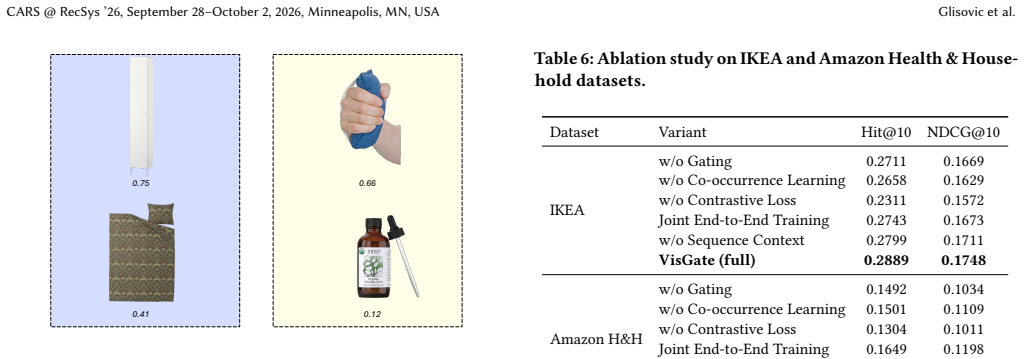
VisGate's central claim is that visual utility is a latent contextual variable determined jointly by the item and the user's interaction state, and that this variable can be estimated by a learned gate. The gate takes the layer-normalised collaborative embedding, the layer-normalised co-occurrence-grounded visual projection, and the transformer hidden state at the masked position, and outputs a weight $g_i$ per dimension; the final item representation blends the two modalities as $h_i = g_i \odot \mathrm{LN}(e_i) + (1-g_i) \odot (\alpha \cdot \mathrm{LN}(f_{\theta^*}(v_i)))$. Because the visual projector is frozen after contrastive pre-training on temporally co-occurring pairs, the gate values are interpretable as measurements rather than as mere fitting artifacts. The evidence offered is that VisGate achieves the strongest overall performance on four datasets, that the gate's decisions are broadly distributed and shift with interaction sparsity, and that low-gated items are visually distinctive while high-gated ones are generic-looking, which the authors read as confirmation that gate behaviour tracks semantically meaningful visual utility.
Load-bearing premise
The load-bearing premise is that the contrastive pre-training of the visual projector uses only training interactions, so that the held-out validation and test items never leak into the visual representations the gate is built on.
Editorial extensions
If this is right
- No single fusion weight, or even a sequence-level routing policy, can be optimal if visual utility varies per item and per user state; fusion must be decided at the item level with access to the user's context.
- The largest relative gains on the sparsest datasets (up to 19.2 percent Hit@5 improvement on Amazon Scientific) indicate that content features deliver the most value precisely when collaborative signals are weakest.
- The learned gate can be read as a diagnostic tool: low gate values flag visually distinctive items, high gate values flag generic-looking items whose appearance adds little, and the gate's temporal behaviour shows visual reliance is higher early in a user's history.
- The identified failure mode—visually distinctive but interactionally sparse items—shows the gate is imperfect as a utility meter, and the paper's proposed interaction-count threshold is a concrete post-hoc correction that successive work can test.
Reading between the lines
- The same latent-context gating logic should transfer to other modality pairs, such as text versus collaborative signals; a gate that measures when a description matters more than interaction history would answer the analogous 'when' question for text.
- If the co-occurrence projector was pre-trained on sequences that include the held-out validation and test interactions, the reported gains and gate patterns could be inflated; enforcing a strict temporal split and re-running the analysis is a direct test the authors should make explicit.
- The quadrant analysis based on embedding $\ell^2$ norms suggests a stronger falsifiable prediction: if visual utility truly tracks collaborative-signal weakness, gate values should decrease monotonically with collaborative embedding norm within product categories, not merely differ above and below the median.
- The failure mode for sparse-but-distinctive items suggests the gate is really estimating signal reliability rather than pure visual utility, which implies that a calibrated uncertainty estimate per modality could replace the post-hoc interaction-count threshold.
Signed reviews
Editorial analysis
A structured set of objections, weighed in public.
Referee Report
Summary. The paper proposes VisGate, a sequential recommender that fuses collaborative ID embeddings with visual features through an item-level gating mechanism conditioned on both the item and the user's current sequence context. Visual features are projected via a contrastively trained MLP over temporal co-occurrence pairs, and the gate is trained jointly with a masked-language-modeling objective plus sparsity and utilization regularizers. The authors claim competitive recommendation performance on four datasets and, more centrally, that the learned gate serves as a measurement tool for 'visual utility', supporting three research questions: visual utility is item-dependent, increases under interaction sparsity, and correlates with visual distinctiveness. The paper also includes an ablation study and a failure-case analysis.
Significance. If the central claims hold, the paper makes a useful conceptual contribution by reframing modality fusion as a latent contextual decision rather than a fixed architectural choice, and by proposing an interpretable gate as a diagnostic. The empirical design is generally thoughtful: the authors include a range of baselines, use a leave-one-out protocol, average over five seeds, and attempt a direct counterfactual validation of the gate in Table 5. The co-occurrence-grounded projector is an interesting alternative to aligning visual and collaborative spaces. However, the measurement claim rests on an unstated temporal-hygiene condition in the contrastive pretraining, which, if violated, would invalidate both the performance comparison and the gate-based analyses. The statistical support for RQ2 is also thinner than the narrative suggests, and the counterfactual validation is underspecified. With the identified issues addressed, the paper could be a solid contribution to multimodal sequential recommendation.
major comments (3)
- [§3.1, Eq. (2) and §4.1.3–4.1.4] The contrastive projector is trained on positive pairs P extracted from user sequences, but the manuscript never states that P excludes the interactions later held out as validation and test. Under the leave-one-out protocol of Section 4.1.3, if P is built from full sequences, then for a test item j of user u, every history item within w positions forms a positive pair (i, j); the contrastive loss in Eq. (3) then makes f_theta(v_j) similar to exactly the history used to predict j, leaking the answer into the score and contaminating both Table 2 and all gate analyses in Sections 4.3–4.5. Please state unambiguously how the temporal split is applied when constructing P, and if the current implementation uses full sequences, rerun the experiments with a training-only P.
- [§4.4, Table 4] The RQ2 temporal analysis reports mean gate values for early versus recent interactions with deltas between 0.014 and 0.028, but provides no standard deviations, confidence intervals, or paired significance tests. Given the small magnitude of the differences and the fact that all results are averaged over only five seeds, the statement that the effect is 'most pronounced' on IKEA and Amazon Scientific is not statistically supported by this table. Please report the variability across users or sequences and apply an appropriate test (e.g., paired bootstrap or permutation test) to substantiate the RQ2 claim.
- [§4.5, Table 5] The direct validation of the gate as a measurement tool is described in a single sentence and is underspecified. It is not clear how 'removing visual features' is implemented: whether the gate is set to 1, the visual term is zeroed, or a separate ablated model is trained; nor is it clear whether the Hit@10 differences in each quadrant are statistically reliable and how interaction counts are thresholded. Because Table 5 is the main evidence that gate values track counterfactual visual utility, the exact procedure, thresholds, and uncertainty measures must be reported.
minor comments (5)
- [Table 2] Several values in Table 2 are missing separating spaces (e.g., '0.12370.1882' and '0.15770.1225'), making the table difficult to read; please fix the formatting.
- [§4.5] The text contains a typo: 'bookself' should be 'bookshelf'.
- [Figure 3] The caption 'Percentage of images used for the datasets based on the item-level gating function' does not match the described content, which appears to be a distribution of gate values; please clarify the caption and axes.
- [§3.1] The reported Mann–Whitney U test (p < 10^-10, r ≈ 0.2–0.3) lacks details on the number of pairs, how negative items were sampled, and across which datasets this validation was performed; please add these details.
- [General] The manuscript does not include a statement on code or data availability; given the emphasis on the gate as an interpretable measurement tool, a reproducibility statement would be valuable.
Circularity Check
Co-occurrence projector pretraining may fit test items to the same user's history, making the 'predictions' and gate 'measurements' partially forced; gate-distribution breadth is also partly imposed by auxiliary losses.
-
fitted input called prediction
[Section 3.1 Eq. 2; Section 4.1.3; Section 4.1.4; Eq. 5]
"P={(i,j)|∃u,t1,t2 : s_u^{t1}=i, s_u^{t2}=j, |t1−t2|≤w} (2) ... We follow the leave-one-out evaluation protocol [9, 14, 32]. Specifically, for each user sequence, we reserve the last interacted item as the test instance and the second-to-last item for validation, using all preceding interactions for model training. ... The visual projector fθ is pre-trained separately using the contrastive objective and subsequently frozen."
Under the leave-one-out split, the test item j (last in the sequence) and the validation item (second-to-last) are inside s_u. Eq. 2 defines P over all user sequences without excluding these positions, so (i,j) is a positive pair for every history item i within w positions of j. Eq. 3 trains f_theta to make f_theta(v_j) similar to f_theta(v_i) for exactly the history items used to predict j. Since Eq. 5 places f_theta(v_j) into the gated item vector h_j, and L_MLM scores candidates by z^T H, the test item's score inherits this pretraining alignment.
-
other
[Section 3.3; Section 4.3 (RQ1)]
"Lsparsity = E_i[4g_i(1−g_i)] encourages decisive gating decisions, and Lutil = |E_i[g_i]−0.5| prevents collapse to a single modality by encouraging balanced utilization across the item set. ... from Figure 3 we identify that within each dataset, the distribution of learned gate values is broad rather than peaked, showing that the gate makes genuinely item-level decisions."
Lsparsity is minimized when g_i is 0 or 1, so the regularizer itself drives the gate distribution toward the extremes, while Lutil pins the mean to 0.5. The paper then cites the resulting 'broad rather than peaked' distribution as evidence for RQ1 that 'the gate makes genuinely item-level decisions.' The breadth is thus partly engineered by the objective rather than an independent empirical finding. The learned item-specific assignment (which items receive low versus high gates) is not directly forced, so this is a partial, not total, circularity; it weakens the measurement interpretation but does not by itself determine the item-level pattern.
full rationale
VisGate's core architecture is self-contained: the gate is trained with MLM plus auxiliary losses, and performance is compared against external baselines, so there is no self-citation chain or imported uniqueness theorem. However, two reductions undermine the central 'measurement tool' claim. First, the co-occurrence projector (Eq. 2–3) is defined over user sequences without any statement that held-out test/validation positions are excluded; under the leave-one-out protocol (Section 4.1.3), this would make the test item's visual representation fit the same user's history, so the recommendation score for that item is partly a retrieval of the pretraining signal. This contaminates both Table 2 and the RQ1–RQ3 gate analyses, and the paper never states the needed temporal split (Section 4.1.4 only says the projector is 'pre-trained separately'). Second, the gate-distribution evidence for RQ1 ('broad rather than peaked') is partly manufactured by Lsparsity and Lutil, which explicitly push gates to 0/1 with mean 0.5; what remains learned is the item-specific assignment, so this circularity is partial. Table 5 provides one independent check of the gate as a proxy, but it cannot repair the potential pretraining leakage. Overall, there is one load-bearing fitted-input-as-prediction issue plus one partial measurement artifact, warranting a score of 6.
Assumptions & free parameters
free parameters (5)
- alpha (visual scale) =
learned (not reported)
- lambda_1 (sparsity reg weight) =
sampled log-uniformly from [0.001, 0.05] per dataset
- lambda_2 (utilization reg weight) =
sampled log-uniformly from [0.001, 0.05] per dataset
- w (co-occurrence window) =
selected from {1,2,3,5,7} per dataset
- tau (contrastive temperature) =
learnable (not reported)
assumptions (3)
- domain assumption Temporally co-occurring items share visual characteristics that influence user preferences.
- domain assumption The co-occurrence projector pretraining does not use the held-out validation/test interactions.
- domain assumption Layer normalization and additive gated fusion preserve the semantic comparability needed for the gate to reflect modality utility.
invented entities (1)
-
modality utility
independent evidence
Cite this review
Pith. "Pith review of Deciding When to Rely on Visual Information: Gated Multimodal Fusion in Sequential Recommendation." pith.science (2026). https://pith.science/paper/RH2CCTWL
@misc{pith2026260810700,
  author       = {Pith},
  title        = {Pith review of: Deciding When to Rely on Visual Information: Gated Multimodal Fusion in Sequential Recommendation},
  year         = {2026},
  howpublished = {\url{https://pith.science/paper/RH2CCTWL}},
  note         = {Machine review of arXiv:2608.10700}
}
read the original abstract
Multimodal sequential recommender systems commonly fuse visual and collaborative signals uniformly, treating visual features as generically informative regardless of item or user context. We argue that visual utility, defined as the contribution of visual signals to recommendation quality, is a latent contextual variable that depends on both the item and the user's interaction history rather than a fixed item property. To model this variability, we introduce VisGate, a framework that makes adaptive item-level fusion decisions conditioned on item embeddings and the user's current sequence context. Visual representations are learned through a contrastive objective over sequential co-occurrence patterns, preserving complementarity with collaborative embeddings rather than aligning them into a shared space. Beyond achieving competitive recommendation performance, VisGate's learned gate serves as a measurement tool for understanding when and why visual information is beneficial. Our analyses show that visual utility varies across items, increases under interaction sparsity when collaborative signals are weak, and correlates with visual distinctiveness in semantically meaningful ways. Together, these findings highlight the importance of both fine-grained fusion and modality complementarity, while demonstrating that item-level visual utility can be estimated and interpreted through learned gating behaviour.
Figures


Figures from the paper (3 more)


Reference graph
Works this paper leans on
-
[1]
Gediminas Adomavicius, Konstantin Bauman, Alexander Tuzhilin, and Moshe Unger. 2022. Context-Aware Recommender Systems: From Foundations to Recent Developments. InRecommender Systems Handbook(3rd ed.). Springer US, 211– 250
work page 2022
-
[2]
Gediminas Adomavicius, Bamshad Mobasher, Francesco Ricci, and Alexander Tuzhilin. 2011. Context-Aware Recommender Systems.AI Magazine32, 3 (2011), 67–80. doi:10.1609/aimag.v32i3.2364
-
[3]
Alex Beutel, Paul Covington, Sagar Jain, Can Xu, Jia Li, Vince Gatto, and Ed H. Chi. 2018. Latent Cross: Making Use of Context in Recurrent Recommender Systems. InProceedings of the Eleventh ACM International Conference on Web Search and Data Mining (WSDM ’18). ACM, 46–54
work page 2018
-
[4]
Simone Borg Bruun, Krisztian Balog, and Maria Maistro. 2024. Dataset and Models for Item Recommendation Using Multi-Modal User Interactions. InProceedings of the 47th International ACM SIGIR Conference on Research and Development in Information Retrieval (SIGIR ’24). Association for Computing Machinery, New York, NY, USA, 709–718. doi:10.1145/3626772.3657881
arXiv 2024
-
[5]
Bo Chang, Alexandros Karatzoglou, Yuyan Wang, Xu Can, Ed. H. Chi, and Minmin Chen. 2023. Latent User Intent Modeling for Sequential Recommenders. In Companion Proceedings of the ACM Web Conference 2023 (WWW ’23 Companion). ACM, 427–431
work page 2023
-
[6]
Hao Ding, Yan Hu, et al . 2023. Adaptive Multi-Modalities Fusion in Sequen- tial Recommendation Systems. InProceedings of the 32nd ACM International Conference on Information and Knowledge Management (CIKM ’23). ACM
work page 2023
-
[7]
D. J. Gupta, D. C. S. Rao, D. R. M R, and M. P. P. 2025. The Psychology of Color in Marketing: How Visual Elements Affect Consumer Perception.Journal of Marketing & Social Research2, 3 (2025), 128–133. doi:10.61336/jmsr/25-03-14
-
[8]
Ruining He and Julian McAuley. 2016. VBPR: Visual Bayesian Personalized Ranking from Implicit Feedback. InProceedings of the Thirtieth AAAI Conference on Artificial Intelligence (AAAI ’16). AAAI Press, Phoenix, Arizona, 144–150
work page 2016
Show all 36 references
-
[9]
Liam Hebert, Marialena Kyriakidi, Hubert Pham, Krishna Sayana, James Pine, Sukhdeep Sodhi, and Ambarish Jash. 2025. FLARE: Fusing Language Models and Collaborative Architectures for Recommender Enhancement. InCompanion Proceedings of the ACM Web Conference 2025 (WWW Companion ...
2025 doi
-
[10]
Balázs Hidasi, Alexandros Karatzoglou, Linas Baltrunas, and Domonkos Tikk
-
[11]
Yu Hou, Sheng Mu, Wayne Xin Zhao, Yali Li, Bolin Ding, and Ji-Rong Wen. 2022. Towards Universal Sequence Representation Learning for Recommender Systems. InProceedings of the 28th ACM SIGKDD Conference on Knowledge Discovery and Data Mining (KDD ’22). ACM, 585–593
2022
-
[12]
Wang-Cheng Kang, Chen Fang, Zhaowen Wang, and Julian McAuley. 2017. Visually-Aware Fashion Recommendation and Design with Generative Image Models. In2017 IEEE International Conference on Data Mining (ICDM ’17). IEEE, New Orleans, LA, USA, 207–216
2017
-
[13]
Wang-Cheng Kang and Julian McAuley. 2018. Self-Attentive Sequential Recom- mendation. InProceedings of the 12th ACM Conference on Recommender Systems (RecSys ’18). Association for Computing Machinery, New York, NY, USA, 238–246. doi:10.1145/3240323.3240374
2018
-
[14]
Kibum Kim, Sein Kim, Hongseok Kang, Jiwan Kim, Heewoong Noh, Yeonjun In, Kanghoon Yoon, Jinoh Oh, and Chanyoung Park. 2025. Image is All You Need: Towards Efficient and Effective Large Language Model-Based Recommender Systems. arXiv:2503.06238 [cs.IR] https://arxiv.org/abs/2503.06238
2025
-
[15]
Malliaros
Daniele Malitesta, Emanuele Rossi, Claudio Pomo, Tommaso Di Noia, and Fragkiskos D. Malliaros. 2024. Do We Really Need to Drop Items with Missing Modalities in Multimodal Recommendation?. InProceedings of the 33rd ACM International Conference on Information and Knowledge Manag...
2024
-
[16]
Pablo Mateos and Alejandro Bellogín. 2025. A systematic literature review of recent advances on context-aware recommender systems.Artificial Intelligence Review(2025)
2025
-
[17]
Jianmo Ni, Jiacheng Li, and Julian McAuley. 2019. Justifying Recommendations Using Distantly-Labeled Reviews and Fine-Grained Aspects. InProceedings of the 2019 Conference on Empirical Methods in Natural Language Processing and the 9th International Joint Conference on Natural...
2019
-
[18]
Sergio Oramas, Oriol Nieto, Mohamed Sordo, and Xavier Serra. 2017. A Deep Multimodal Approach for Cold-start Music Recommendation. InProceedings of the 1st Workshop on Deep Learning for Recommender Systems (DLRS ’17). Association for Computing Machinery, New York, NY, USA, 1–6...
2017
-
[19]
Orquin, Martin P
Jacob L. Orquin, Martin P. Bagger, Erik S. Lahm, Klaus G. Grunert, and Joachim Scholderer. 2020. The Visual Ecology of Product Packaging and Its Effects on Consumer Attention.Journal of Business Research111 (2020), 187–195. doi:10. 1016/j.jbusres.2019.01.043
2020
-
[20]
Claudio Pomo, Matteo Attimonelli, Danilo Danese, Fedelucio Narducci, and Tom- maso Di Noia. 2025. Do Recommender Systems Really Leverage Multimodal Content? A Comprehensive Analysis on Multimodal Representations for Recom- mendation. InProceedings of the 34th ACM International...
2025
-
[21]
Weicong Qin, Yi Xu, Weijie Yu, Chenglei Shen, Xiao Zhang, Ming He, Jianping Fan, and Jun Xu. 2025. MoRE: A Mixture of Reflectors Framework for Large Language Model-Based Sequential Recommendation. InProceedings of the Nineteenth ACM Conference on Recommender Systems (RecSys ’2...
2025
-
[22]
Paurav Shukla, Jaywant Singh, and Weisha Wang. 2022. The Influence of Creative Packaging Design on Customer Motivation to Process and Purchase Decisions. Journal of Business Research147 (2022), 338–347. doi:10.1016/j.jbusres.2022.04.026
2022 doi
-
[23]
Fei Sun, Jun Liu, Jian Wu, Changhua Pei, Xiao Lin, Wenwu Ou, and Peng Jiang
-
[24]
Jiaxi Tang, Xin Du, Xiangnan He, Fajie Yuan, Qi Tian, and Tat-Seng Chua. 2020. Adversarial Training Towards Robust Multimedia Recommender System.IEEE Transactions on Knowledge and Data Engineering32, 5 (2020), 855–867. doi:10. 1109/TKDE.2019.2893638
2020
-
[25]
Tianxin Wei, Bowen Jin, Ruirui Li, Hansi Zeng, Zhengyang Wang, Jianhui Sun, Qingyu Yin, Hanqing Lu, Suhang Wang, Jingrui He, and Xianfeng Tang. 2024. Towards Unified Multi-Modal Personalization: Large Vision-Language Models for Generative Recommendation and Beyond. InProceedin...
2024
-
[26]
Yinwei Wei, Xiang Wang, Liqiang Nie, Xiangnan He, Richang Hong, and Tat-Seng Chua. 2019. MMGCN: Multi-Modal Graph Convolution Network for Personalized Recommendation of Micro-Video. InProceedings of the 27th ACM International Conference on Multimedia (MM ’19). ACM, Nice, Franc...
2019
-
[27]
Jinfeng Xu, Zheyu Chen, Shuo Yang, Jinze Li, Hewei Wang, Yijie Li, Jian- heng Tang, Yunhuai Liu, and Edith C. H. Ngai. 2026. CAMMSR: Category- Guided Attentive Mixture of Experts for Multimodal Sequential Recommendation. arXiv:2603.04320 [cs.IR] https://arxiv.org/abs/2603.04320
2026
-
[28]
Lanling Xu, Zhen Tian, Bingqian Li, Junjie Zhang, Jinpeng Wang, Mingchen Cai, and Wayne Xin Zhao. 2024. Sequence-level Semantic Representation Fusion for Recommender Systems. arXiv:2402.18166 [cs.IR] https://arxiv.org/abs/2402.18166 CARS @ RecSys ’26, September 28–October 2, 2...
2024 arXiv
-
[29]
Minglei Yin, Bin Liu, Neil Zhenqiang Gong, and Xin Li. 2025. Securing Visually- Aware Recommender Systems: An Adversarial Image Reconstruction and Detec- tion Framework.ACM Transactions on Management Information Systems16, 3, Article 27 (2025), 29 pages. doi:10.1145/3743681
2025 doi
-
[30]
Lingzi Zhang, Xin Zhou, Zhiwei Zeng, and Zhiqi Shen. 2024. Multimodal Pre- training for Sequential Recommendation via Contrastive Learning.ACM Transac- tions on Recommender Systems3, 1 (October 2024), Article 9. doi:10.1145/3682075
2024 doi
-
[31]
Shengzhe Zhang, Liyi Chen, Dazhong Shen, Chao Wang, and Hui Xiong. 2025. Hierarchical Time-Aware Mixture of Experts for Multi-Modal Sequential Recom- mendation. InProceedings of the ACM Web Conference 2025 (WWW ’25). ACM, Sydney, NSW, Australia
2025
-
[32]
Kun Zhou, Hui Yu, Wayne Xin Zhao, and Ji-Rong Wen. 2022. Filter-enhanced MLP is All You Need for Sequential Recommendation. InProceedings of the ACM Web Conference 2022 (WWW ’22). ACM, 2388–2399. doi:10.1145/3485447.3512141
2022
-
[33]
Xin Zhou and Zhiqi Shen. 2023. A Tale of Two Graphs: Freezing and Denoising Graph Structures for Multimodal Recommendation. InProceedings of the 31st ACM International Conference on Multimedia (MM ’23). ACM, Ottawa, ON, Canada, 1–9. doi:10.1145/3581783.3611943
2023
-
[197]
doi:10.18653/v1/D19-1018
-
[2016]
In4th International Conference on Learning Representations (ICLR ’16)
Session-Based Recommendations with Recurrent Neural Networks. In4th International Conference on Learning Representations (ICLR ’16). OpenReview.net, San Juan, Puerto Rico. https://openreview.net/forum?id=v5gKSgA0
-
[2019]
InProceedings of the 28th ACM International Confer- ence on Information and Knowledge Management (CIKM ’19)
BERT4Rec: Sequential Recommendation with Bidirectional Encoder Repre- sentations from Transformer. InProceedings of the 28th ACM International Confer- ence on Information and Knowledge Management (CIKM ’19). Association for Com- puting Machinery, New York, NY, USA, 1441–1450. ...
Reviewed August 12, 2026 · model on record in the stance chip above.
Discussion (0). Continue with ORCID to comment.