REVIEW 3 major objections 4 minor 66 references
XRISM Spectroscopy of Variable Accretion-driven Disk Winds in NGC 4151: When, Where, and How Fast Outflows are Launched
T0 review · 3 major / 4 minor · reviewed 2026-08-15 · deepseek-v4-flash
Pith's one-line read The fastest winds in NGC 4151 are transient, appearing about 10,000 seconds after X-ray flares and in low-flux hard states, which places their launch site within roughly 60 gravitational radii of the black hole and favors magnetic driving.
desk verdict A careful and genuinely useful variability-selected XRISM study of NGC 4151's winds, but the headline '10 ks response' is a window width, not a measured lag, and the compact 60 r_g conclusion is correspondingly shaky. read the letter →
The pith
A machine-rendered reading of the paper's core claim, the machinery that carries it, and where it could break.
The reading
What carries the argument
The load-bearing instrument is the set of seven variability-selected spectra: four time windows (Flare, Postflare, After, Hard-dip) and three hardness–intensity states (High-Soft, Low-Soft, Low-Hard). The timing device is the Postflare window—a fixed 10 ks interval immediately after each flare, retained only while the count rate stays below the flare peak. Comparing wind strength across these windows converts the 10 ks delay into a causal light-crossing scale of about $60\,GM/c^2$, which is the compactness argument for the launch site. The absorption measure distribution, parameterized as $\log N_{\rm H} = m\log\xi + b$, then connects the observed column–ionization trend to a large-scale density profile and to the magnetocentrifugal wind picture.
What would settle it
Compare wind absorption strength in post-flare windows of different lengths: if a 20–30 ks post-flare window shows equally strong or stronger UFO absorption, the 10 ks timescale is an artifact of window choice rather than a physical response. Alternatively, a lag analysis with time bins much shorter than 520 s would show whether the Fe K absorption indeed peaks 10 ks after continuum flares.
Extended reading notes
Core claim
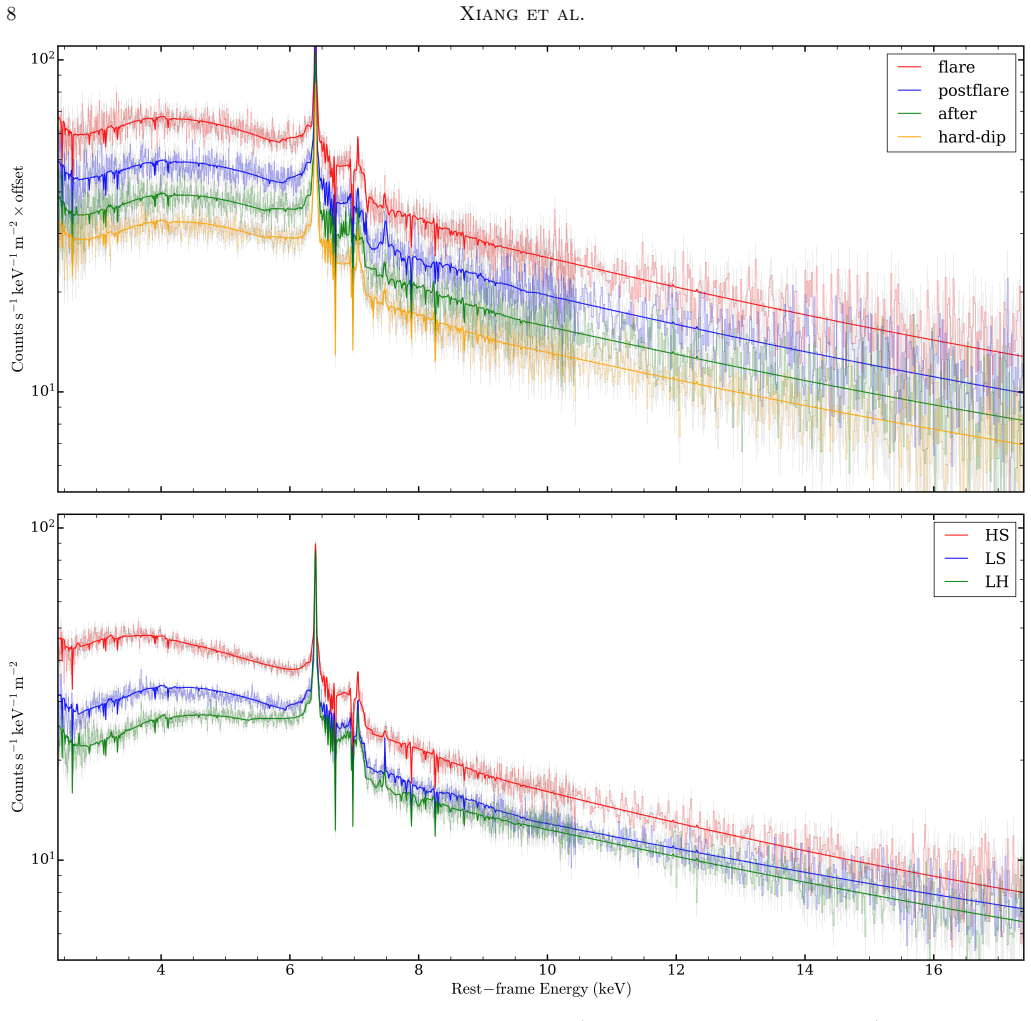
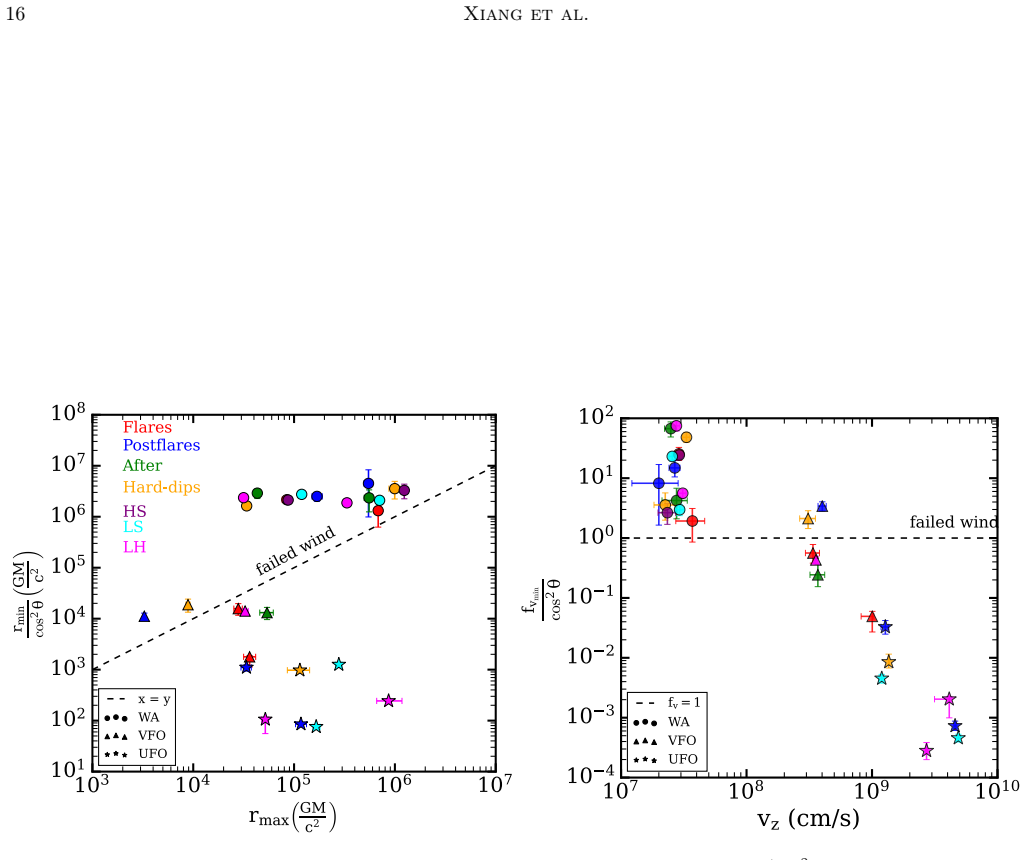
The central discovery is that the fast wind in NGC 4151 is not a steady structure but a transient, flare-triggered one. In spectra selected for the 10 ks after flare peaks, the wind shows its richest structure: two warm absorbers, one very fast outflow, and two ultra-fast outflows, with the fastest component detected only there and in low-flux hard states. The 10 ks delay maps to a light-crossing scale of roughly $60\,GM/c^2$, among the shortest flare–wind response timescales reported in an AGN, so the absorbing gas must be close to the corona that produces the flare. The paper argues from the AMD slope, close to the $n(r)\propto r^{-1.5}$ expectation of a magnetocentrifugal wind, and from momentum rates exceeding the radiation momentum supply, that magnetic driving dominates, while local clumpiness may be shaped by radiation pressure.
Load-bearing premise
The headline 10 ks response time is defined by a fixed post-flare window chosen by the authors; if the true physical delay between flare and wind strengthening is not 10 ks, or if the appearance of absorption tracks line-of-sight coverage rather than a causal response, the compact $\sim 60\,GM/c^2$ launch radius and the timing conclusions change.
Editorial extensions
If this is right
- Fast winds in sub-Eddington Seyferts are intermittent rather than persistent: feedback-level kinetic power, around 0.3–0.5% of $L_{\rm Edd}$, is reached only occasionally, not continuously.
- The 10 ks flare–wind response places the fast wind within roughly 60 gravitational radii, so high-cadence monitoring of similar AGN can directly resolve the causal chain from coronal flare to wind enhancement.
- The persistent warm absorbers are best understood as failed or circulating winds, energetically weak, while the UFOs dominate the kinetic power and remain the plausible feedback channel.
- The AMD slope and momentum-rate arguments favor magnetically driven, locally clumpy winds, suggesting MHD disk-wind models rather than pure radiation-pressure driving as the primary framework.
- The intrinsic “hot” obscurer tracks the global spectral state, implying that the observed “softer when brighter” behavior is partly shaped by obscuration variability, not only by continuum changes.
- Future time-dependent photoionization modeling and lag analyses could distinguish whether the post-flare visibility of the fast wind reflects physical launching, recombination, or line-of-sight motion of clumpy gas.
Reading between the lines
- If the 10 ks delay is truly causal, a lag search between the hard-band continuum and the Fe K absorption lines should recover the same timescale at much finer time resolution than the 520 s bins used here.
- The CINDICITY coordinate, defined as the first principal component of the hardness–intensity diagram, could be ported to other AGN and instruments to compare wind visibility states across sources.
- Coordinated radio and X-ray monitoring could test whether the flare–post-flare cycle that launches the fast wind also couples to jet ejection, given the preference of VFOs for harder, lower-flux states.
- The paper leaves open whether the blue-shifted Fe K excess is wind emission or the blue wing of relativistic disk reflection; a self-consistent reflection fit to the event-resolved spectra would settle that degeneracy.
Signed reviews
Editorial analysis
A structured set of objections, weighed in public.
Referee Report
Summary. The paper analyzes 14 XRISM/Resolve observations of NGC 4151 (0.9 Ms total exposure) by constructing seven spectra selected either by local variability phase (Flare, Postflare, After, Hard-Dip) or by global hardness/intensity state (HS, LS, LH). Using photoionization models in SPEX, the authors identify two persistent warm-absorber zones and transient very-fast and ultra-fast outflow components. The central claims are that the fast winds are strongest roughly 10 ks after flares and in low-flux, hard states; that this 10 ks timescale corresponds to a compact scale of about 60 r_g, locating the wind near the corona; and that the absorption measure distribution and outflow momentum rates favor magnetic driving with local clumpiness. The paper also introduces a new HID-based scalar, CINDICITY, and reports extensive statistical testing, including component-removal significance, AIC comparisons, constant-column tests, and Spearman correlation scans.
Significance. If confirmed, the paper would provide one of the shortest flare-wind response timescales reported in an AGN and would directly constrain where fast disk winds are launched. The dataset is unique: 14 high-resolution XRISM/Resolve observations of a single bright Seyfert galaxy, analyzed with a consistent multi-zone photoionization framework. The statistical treatment is a genuine strength: component-removal tests with AIC, constant-column variability tests, and systematic Spearman scans go well beyond simple line detection. The AMD slope and the momentum-rate argument are largely independent of the timing interpretation and support a magnetically driven, clumpy fast wind. However, the headline '10 ks response' is inherited from the bin width of the Postflare selection window rather than from a measured lag, and the constant-column test for the fastest UFO component is statistically inconclusive. These issues directly affect the 'when' and 'where' conclusions, so the paper's significance as written is lower than its abstract claims.
major comments (3)
- [§3.1, §4.2, §5] The central claim that the fastest winds respond on a ~10 ks timescale is not supported by a lag measurement. In §3.1, the Postflare window is defined as a fixed 10 ks interval immediately following a ±5 ks flare interval and is retained only if the count rate stays below the flare peak; the After window is an analogous 10 ks interval starting 10 ks later. The '10 ks' is therefore the width of the selection window, and the Postflare spectrum actually samples roughly 5–15 ks after the flare peak, not a measured delay. The abstract states that 'Ten kiloseconds is among the shortest flare–wind response timescales reported in an AGN', and §3.5/§4.2 use the same 10 ks as a light-crossing scale of 60 r_g to locate the wind near the coronal region. These claims require a measured or modeled lag. §4.3 itself states that recombination, changing illumination, and line-of-sight motion 'cannot be separated from the spectra alone' and defers to 'a dedicated variability and lag analysis.' The comparison with the After window makes a delayed response plausible, but the specific 10 ks value is an analysis choice. Please either perform a cross-correlation/lag analysis or a time-resolved spectral series with variable bin sizes, or reframe the 10 ks as the adopted sampling window and an upper limit, and adjust the 'when'/'where' conclusions accordingly.
- [§3.3.4, Table 2] The constant-column test does not support the claim that the fastest UFO (pion#5) is transient. In Table 2, the fixed-column model for pion#5 gives ΔC = −19 with ΔAIC = 2, meaning the model with a single column density in all seven windows is statistically indistinguishable from the variable-column final model. The text acknowledges ΔC = −19 but dismisses it because pion#5 is not independently detected in four spectra. However, the component-removal significance in individual windows and the constant-column test answer different questions; as reported, the data do not prefer a variable column for pion#5. This weakens the §3.3.3 statement that the fastest UFO 'appears' in the Postflare spectrum and is absent before and after. The transient-wind claim for the postflare enhancement should rest on the VFO and pion#4, whose ΔAIC values are large, or the pion#5 test should be repeated with a model that allows a constant column plus a variable additional component.
- [Table 3, §3.3.2] Several parameters in Table 3 are frozen or at hard limits, and this affects an interpretive comparison. In particular, the VFO component pion#3 has σv = 1000 km/s with zero positive error in the Flare, Postflare, After, and Hard-Dip windows, and logξ and v_z are frozen in the HS and LS columns (Table 3 note: 'Some values are at the imposed hard limit if it has errors of zero'). Section 3.3.2 contrasts the 'relatively high velocity broadening' of the VFO in Postflare (σv ~ 1000 km/s) with the lower broadening in LH (σv ~ 300 km/s), but the Postflare value is pegged at its upper boundary. Please report which parameters are at physical versus numerical limits, list the actual boundary values, and test whether the broadening difference persists when the boundary is relaxed; also clarify how frozen parameters are counted in the degrees of freedom of the component-removal and AIC tests in Appendix A.
minor comments (4)
- [§3.1, Figure 8] Because the Flare interval is defined as ±5 ks around the peak and the Postflare window begins immediately after the flare, the effective sampling is 5–15 ks after the peak; stating this explicitly in the text and in the Figure 8/15 labels would prevent readers from equating the 10 ks bin width with a measured delay.
- [Appendix B, Appendix C] CINDICITY is constructed from the same count-rate and hardness variables used to define the HS/LS/LH regions, so the Spearman correlations between CINDICITY and L_bol (ρ = 0.79) and N_H,hot (ρ = −0.96) in Appendix C are partly built in by construction; the text should state this caveat or use an independent coordinate for validation.
- [§3.2] The blackbody peak temperature is given as 'kT = 2×16.8 eV'; if this is not a typographical artifact, please define the combination and provide the fixed value in a single consistent notation, since the current rendering is confusing.
- [Table 3] The 'Expected C-values' row repeats 399±28 for all seven windows; please specify how this expectation was computed and whether it is the same global value for each window or should differ with exposure and binning.
Circularity Check
The '10 ks response' is the predefined width of the Postflare bin, not a measured lag; the 60 r_g launch radius is derived from that bin width.
-
self definitional
[Section 3.1 (event-type definitions) and Section 3.5 (compact limiting scale); also abstract and Section 4.2]
"Initial post-flare intervals—Postflares: For every flare interval, we defined the initial post-flare interval as the 10 ks period immediately following the end of the flare. ... For reference, a 10 ks light-crossing time corresponds to 60 r_g for NGC 4151. If the Postflare VFOs and UFOs are located on this compact limiting scale, the ionization parameter implies densities ..."
The paper's headline claim that the fastest winds strengthen '10 ks after the peak of flares' and the derived 'where' conclusion of a compact ~60 r_g launch site are built on a fixed bin width, not on a measured time lag. The Postflare window is defined by construction as a 10 ks interval immediately following the ±5 ks flare window, so the '10 ks response' is the predefined width of the bin (sampling roughly 5–15 ks after the peak), not a delay estimated from the data. Section 3.5 then takes this same predefined 10 ks as a 'causal timescale' and converts it to r = cΔt = 60 r_g, making the compact radius an arithmetic consequence of the bin definition.
full rationale
The central derivations that are independent of the timing claim—the column-density variability tests against constant-column models, the AMD slopes, and the momentum-rate comparisons—are self-contained and do not reduce to their inputs. The circularity burden is concentrated in the 'when' and 'where' narrative. The 10 ks value is introduced in Section 3.1 as the analyst-defined length of the Postflare window, and the abstract and Section 4.2 then treat it as a measured flare–wind response timescale. The 60 r_g compact scale in Section 3.5 is simply the light-crossing distance of that predefined bin width, so the 'most compact causal limiting scale' is not an independent result. However, the paper explicitly acknowledges the degeneracy in Section 4.3 and frames the causal interpretation as one of several possibilities, which reduces the severity. No load-bearing self-citation chain or uniqueness-imported-from-authors pattern is present; citations to Paper I and other prior work are for modeling conventions and external context. The AMD and momentum arguments for magnetic driving rest on the fitted spectral parameters and standard formulae, not on the 10 ks bin. Overall, the paper has one significant self-definitional step affecting the headline timescale and the compact-radius inference, while the bulk of the spectral analysis remains independently grounded.
Assumptions & free parameters
free parameters (8)
- Per-window pion zone N_H (five zones x seven windows) =
10^22.4 to 10^23.5 cm^-2 for detections; upper limits otherwise (Table 3)
- Per-window pion zone log xi (five zones x seven windows) =
2.5-3.8 (Table 3)
- Per-window pion zone v_z and sigma_v (five zones x seven windows) =
v_z -200 to -48,700 km/s; sigma_v 100-5,000 km/s (Table 3)
- Continuum parameters per window: Gamma, DeltaGamma, E0, normalization =
Gamma 1.68-1.77; DeltaGamma -0.47 to -0.26; E0 8.6-9.8 keV; norm 2.0-2.9e7 (Table 3)
- Hot partial-coverer parameters per window: N_H, fcov, T =
N_H 1.3-2.0e23 cm^-2; fcov 0.85-0.88; T 3-5 eV (Table 3)
- Absorber covering fraction fixed at fcov=0.5 =
0.5 (fixed)
- Pion emission components: Omega_emis, v_z, sigma_v_gau (pion emis #2/#4, blue-emis) =
Omega 0.04-0.38; v_z to -11,700 km/s; widths 0-2,040 km/s (Table 3)
- Volume filling factor f_v (nominal = 1; corrected using f_v,min) =
1 nominal; f_v,min as low as 3.8e-4 for fast UFO
assumptions (8)
- domain assumption Photoionization equilibrium for all wind zones
- ad hoc to paper Fixed solar abundances and fixed fcov=0.5 for absorption zones
- domain assumption Static FUV/UV blackbody component from HST STIS
- domain assumption Line-of-sight stratification of pion absorbers from inner fast to outer slow zones
- domain assumption Radial thickness and escape-velocity inequalities (Eqs. 2-4)
- domain assumption AMD density-profile mapping n(r) proportional to r^-alpha with alpha = (1+2m)/(1+m)
- domain assumption Black hole mass MBH = 3.4e7 M_sun from Bentz and Katz
- ad hoc to paper Event selections: Savitzky-Golay filter, 1-sigma thresholds, 10 ks flare/postflare windows, HID divisions at mean values
invented entities (1)
-
CINDICITY
Cite this review
Pith. "Pith review of XRISM Spectroscopy of Variable Accretion-driven Disk Winds in NGC 4151: When, Where, and How Fast Outflows are Launched." pith.science (2026). https://pith.science/paper/M3SCKIPY
@misc{pith2026260811315,
  author       = {Pith},
  title        = {Pith review of: XRISM Spectroscopy of Variable Accretion-driven Disk Winds in NGC 4151: When, Where, and How Fast Outflows are Launched},
  year         = {2026},
  howpublished = {\url{https://pith.science/paper/M3SCKIPY}},
  note         = {Machine review of arXiv:2608.11315}
}
abstract
X-ray observations probe the inner accretion flow within active galactic nuclei, revealing the highest gas column densities and fastest winds. The most diverse winds yet revealed with the Resolve calorimeter spectrometer aboard XRISM are found in NGC~4151, a nearby Seyfert-1 AGN that may qualify as a ``changing-look'' source (CLAGN). Herein, we report on wind variability in 14 XRISM observations of NGC~4151, summing to 0.9~Ms of exposure over a period of 395 days. We examined the dependence of key wind parameters on hardness and intensity selections, and as a function of time relative to flaring and dip events. The results suggest a globally organized but locally complex wind structure. Slow ``warm absorber'' components (WAs; $v_{\rm{out}} \sim 100-1000~\rm{km~s^{-1}}$) are always observed and likely represent failed winds at radius of $10^4 - 10^5 GM/c^2$, within the inner wall of the torus. In contrast, ``very fast'' and ``ultra-fast'' outflows (VFOs and UFOs; $v_{\rm{out}} \sim 10^3-10^4~\rm{km~s^{-1}}$, $v_{\rm{out}} \sim 0.033-0.33~c$) are strongest 10~ks after the peak of flares, and during periods with low flux. Ten kiloseconds is among the shortest flare--wind response timescales reported in an AGN, suggesting that the winds are observed close to the launching site. The absorption measure distribution (AMD) and the large outflow momentum rates suggest that the high-velocity flows visible in the Fe~K band are magnetically driven, while locally clumpy, likely owing to radiation pressure; one or both of these mechanisms may be enhanced following a flare and most visible during low-flux windows.
Figures


Figures from the paper (14 more)




Reference graph
Works this paper leans on
-
[1]
1974, IEEE Transactions on Automatic Control, 19, 716–723
Akaike, H. 1974, IEEE Transactions on Automatic Control, 19, 716–723
work page 1974
-
[2]
Behar, E. 2009, The Astrophysical Journal, 703, 1346–1351, doi: 10.1088/0004-637X/703/2/1346 NGC4151 Winds: When, Where and How33 Figure 16.Spearman rank-correlation matrix for the integrated quantities of the seven time-selected and HID-selected spectra analyzed in this work. Wind properties are calculated from significant components (D.S >3σ). Each cell...
-
[3]
Bentz, M. C., & Katz, S. 2015, Publications of the Astronomical Society of the Pacific, 127, 67, doi: 10.1086/679601
doi:10.1086/679601 2015
-
[4]
Bianchi, S., Meulen, B. V., Bertola, E., et al. 2026, doi: 10.48550/arXiv.2602.16252
-
[5]
Blandford, R. D., & Payne, D. G. 1982, Monthly Notices of the Royal Astronomical Society, 199, 883–903, doi: 10.1093/mnras/199.4.883
-
[6]
Bottorff, M. C., Korista, K. T., & Shlosman, I. 2000, The Astrophysical Journal, 537, 134–151, doi: 10.1086/309006
doi:10.1086/309006 2000
-
[7]
Burnham, K. P., & Anderson, D. R. 2002, Information and Likelihood Theory: A Basis for Model Selection and Inference (New York, NY: Springer), 49–97, doi: 10.1007/978-0-387-22456-5_2
-
[8]
1979, The Astrophysical Journal, 228, 939–947, doi: 10.1086/156922
Cash, W. 1979, The Astrophysical Journal, 228, 939–947, doi: 10.1086/156922
doi:10.1086/156922 1979
Show all 66 references
-
[9]
D., Kraemer, S
Couto, J. D., Kraemer, S. B., Turner, T. J., & Crenshaw, D. M. 2016, The Astrophysical Journal, 833, 191, doi: 10.3847/1538-4357/833/2/191
2016 doi
-
[10]
M., & Kraemer, S
Crenshaw, D. M., & Kraemer, S. B. 2012, The Astrophysical Journal, 753, 75, doi: 10.1088/0004-637X/753/1/75
2012 doi
-
[11]
2017, The Astrophysical Journal, 846, 154, doi: 10.3847/1538-4357/aa8810
Czerny, B., Li, Y.-R., Hryniewicz, K., et al. 2017, The Astrophysical Journal, 846, 154, doi: 10.3847/1538-4357/aa8810
2017 doi
-
[12]
C., Proga, D., Waters, T., & Dyda, S
Dannen, R. C., Proga, D., Waters, T., & Dyda, S. 2020, The Astrophysical Journal Letters, 893, L34, doi: 10.3847/2041-8213/ab87a5
2020 doi
-
[13]
M., Hutchings, J
Das, V., Crenshaw, D. M., Hutchings, J. B., et al. 2005, The Astronomical Journal, 130, 945–956, doi: 10.1086/432255 Di Matteo, T. 1998, MNRAS, 299, L15, doi: 10.1046/j.1365-8711.1998.01950.x Di Matteo, T., Springel, V., & Hernquist, L. 2005, Nature, 433, 604–607, doi: 10.1038...
2005
-
[14]
2017, The Astrophysical Journal, 840, 41, doi: 10.3847/1538-4357/aa6890
Edelson, R., Gelbord, J., Cackett, E., et al. 2017, The Astrophysical Journal, 840, 41, doi: 10.3847/1538-4357/aa6890
2017 doi
-
[15]
E., Epitropakis, A., et al
Emmanoulopoulos, D., Papadakis, I. E., Epitropakis, A., et al. 2016, Monthly Notices of the Royal Astronomical Society, 461, 1642–1655, doi: 10.1093/mnras/stw1359
2016 doi
-
[16]
C., Lohfink, A., Kara, E., et al
Fabian, A. C., Lohfink, A., Kara, E., et al. 2015, Monthly Notices of the Royal Astronomical Society, 451, 4375–4383, doi: 10.1093/mnras/stv1218
2015 doi
-
[17]
M., et al
Feng, H.-C., Li, S.-S., Bai, J. M., et al. 2024, The Astrophysical Journal, 976, 176, doi: 10.3847/1538-4357/ad8568
2024 doi
-
[18]
W., Lang, D., & Goodman, J
Foreman-Mackey, D., Hogg, D. W., Lang, D., & Goodman, J. 2013, Publications of the Astronomical Society of the Pacific, 125, 306–312, doi: 10.1086/670067
2013 doi
-
[19]
2010, The Astrophysical Journal, 715, 636–650, doi: 10.1088/0004-637X/715/1/636
Fukumura, K., Kazanas, D., Contopoulos, I., & Behar, E. 2010, The Astrophysical Journal, 715, 636–650, doi: 10.1088/0004-637X/715/1/636
2010 doi
-
[20]
2018, ApJL, 864, L27, doi: 10.3847/2041-8213/aadd10
Fukumura, K., Kazanas, D., Shrader, C., et al. 2018, ApJL, 864, L27, doi: 10.3847/2041-8213/aadd10
2018 doi
-
[21]
2015, The Astrophysical Journal, 805, 17, doi: 10.1088/0004-637X/805/1/17
Fukumura, K., Tombesi, F., Kazanas, D., et al. 2015, The Astrophysical Journal, 805, 17, doi: 10.1088/0004-637X/805/1/17
2015 doi
- [22]
-
[23]
2026, The Astrophysical Journal, 1000, 3, doi: 10.3847/1538-4357/ae3bce
Ghosh, S., Kharb, P., Costantini, E., et al. 2026, The Astrophysical Journal, 1000, 3, doi: 10.3847/1538-4357/ae3bce
2026 doi
-
[24]
E., Strader, J., & Ho, L
Greene, J. E., Strader, J., & Ho, L. C. 2020, Annual Review of Astronomy and Astrophysics, 58, 257–312, doi: 10.1146/annurev-astro-032620-021835
2020 doi
-
[25]
2025, Astronomy & Astrophysics, 704, A146, doi: 10.1051/0004-6361/202557189
Gu, L., Fukumura, K., Kaastra, J., et al. 2025, Astronomy & Astrophysics, 704, A146, doi: 10.1051/0004-6361/202557189
2025 doi
-
[26]
1994, ApJL, 432, L95, doi: 10.1086/187520
Haardt, F., Maraschi, L., & Ghisellini, G. 1994, ApJL, 432, L95, doi: 10.1086/187520
1994 doi
-
[27]
R., Millman, K
Harris, C. R., Millman, K. J., van der Walt, S. J., et al. 2020, Nature, 585, 357, doi: 10.1038/s41586-020-2649-2
2020 doi
-
[28]
2007, The Astrophysical Journal, 663, 799–807, doi: 10.1086/518416
Holczer, T., Behar, E., & Kaspi, S. 2007, The Astrophysical Journal, 663, 799–807, doi: 10.1086/518416
2007 doi
-
[30]
L., Awaki, H., et al
Ishisaki, Y., Kelley, R. L., Awaki, H., et al. 2022, 12181, 121811S, doi: 10.1117/12.2630654
2022 doi
-
[31]
C., Sanford, P
Ives, J. C., Sanford, P. W., & Penston, M. V. 1976, The Astrophysical Journal, 207, L159–L162, doi: 10.1086/182203
1976 doi
-
[32]
Iwasawa, K., Miniutti, G., & Fabian, A. C. 2004, Monthly Notices of the Royal Astronomical Society, 355, 1073–1079, doi: 10.1111/j.1365-2966.2004.08392.x
2004
-
[33]
S., Mewe, R., & Nieuwenhuijzen, H
Kaastra, J. S., Mewe, R., & Nieuwenhuijzen, H. 1996, SPEX: a new code for spectral analysis of X & UV spectra., 411–414. https://ui.adsabs.harvard.edu/abs/1996uxsa.conf..411K
1996
-
[34]
L., Brenneman, L
Keck, M. L., Brenneman, L. W., Ballantyne, D. R., et al. 2015, The Astrophysical Journal, 806, 149, doi: 10.1088/0004-637X/806/2/149
2015 doi
-
[35]
2015, Annual Review of Astronomy and Astrophysics, 53, 115–154, doi: 10.1146/annurev-astro-082214-122316
King, A., & Pounds, K. 2015, Annual Review of Astronomy and Astrophysics, 53, 115–154, doi: 10.1146/annurev-astro-082214-122316
2015 doi
-
[36]
Kormendy, J., & Ho, L. C. 2013, Annual Review of Astronomy and Astrophysics, 51, 511–653, doi: 10.1146/annurev-astro-082708-101811 36Xiang et al
2013 doi
-
[37]
B., Crenshaw, D
Kraemer, S. B., Crenshaw, D. M., Gabel, J. R., et al. 2006, The Astrophysical Journal Supplement Series, 167, 161–176, doi: 10.1086/508629
2006 doi
-
[38]
2026, Astronomy & Astrophysics, 705, A240, doi: 10.1051/0004-6361/202556131
Laurenti, M., Tombesi, F., Condò, P., et al. 2026, Astronomy & Astrophysics, 705, A240, doi: 10.1051/0004-6361/202556131
2026 doi
-
[39]
L., Kriss, G., Krongold, Y., et al
Longinotti, A. L., Kriss, G., Krongold, Y., et al. 2019, The Astrophysical Journal, 875, 150, doi: 10.3847/1538-4357/ab125a
2019 doi
-
[40]
Thakur, A. L. 2023, Astronomy and Astrophysics, 679, A141, doi: 10.1051/0004-6361/202245600
2023 doi
-
[41]
1969, Nature, 223, 690–694, doi: 10.1038/223690a0
Lynden-Bell, D. 1969, Nature, 223, 690–694, doi: 10.1038/223690a0
1969 doi
-
[42]
H., Knigge, C., Higginbottom, N., et al
Matthews, J. H., Knigge, C., Higginbottom, N., et al. 2020, Monthly Notices of the Royal Astronomical Society, 492, 5540–5560, doi: 10.1093/mnras/staa136
2020 doi
-
[43]
2019, arXiv.org, doi: 10.1051/0004-6361/201935205
Mehdipour, M., & Costantini, E. 2019, arXiv.org, doi: 10.1051/0004-6361/201935205
2019 doi
-
[44]
S., & Kallman, T
Mehdipour, M., Kaastra, J. S., & Kallman, T. 2016, Astronomy and Astrophysics, 596, A65, doi: 10.1051/0004-6361/201628721
2016 doi
-
[45]
S., Kriss, G
Mehdipour, M., Kaastra, J. S., Kriss, G. A., et al. 2017, Astronomy & Astrophysics, 607, A28, doi: 10.1051/0004-6361/201731175
2017 doi
-
[46]
Merloni, A., & Fabian, A. C. 2001, MNRAS, 321, 549, doi: 10.1046/j.1365-8711.2001.04060.x
2001
-
[47]
M., Kaastra, J
Miller, J. M., Kaastra, J. S., Miller, M. C., et al. 2015, Nature, 526, 542–545, doi: 10.1038/nature15708
2015 doi
-
[48]
M., Cackett, E., Zoghbi, A., et al
Miller, J. M., Cackett, E., Zoghbi, A., et al. 2018, The Astrophysical Journal, 865, 97, doi: 10.3847/1538-4357/aadbaa
2018 doi
-
[49]
M., Xiang, X., Mehdipour, M., et al
Miller, J. M., Xiang, X., Mehdipour, M., et al. 2026, arXiv.org. https://arxiv.org/abs/2604.16148v1
2026 arXiv
-
[51]
2018, Monthly Notices of the Royal Astronomical Society, 481, 3563–3572, doi: 10.1093/mnras/sty2535
Peretz, U., & Behar, E. 2018, Monthly Notices of the Royal Astronomical Society, 481, 3563–3572, doi: 10.1093/mnras/sty2535
2018 doi
-
[52]
A., & Reeves, J
Pounds, K. A., & Reeves, J. N. 2009, Monthly Notices of the Royal Astronomical Society, 397, 249–257, doi: 10.1111/j.1365-2966.2009.14971.x
2009
-
[53]
A., Reeves, J
Pounds, K. A., Reeves, J. N., Page, K. L., Wynn, G. A., & O’Brien, P. T. 2003, Monthly Notices of the Royal Astronomical Society, 342, 1147–1155, doi: 10.1046/j.1365-8711.2003.06611.x
2003
-
[54]
Proga, D., & Kallman, T. R. 2004, The Astrophysical Journal, 616, 688–695, doi: 10.1086/425117
2004 doi
-
[55]
2026, doi: 10.48550/arXiv.2602.16496
Reeves, J., Braito, V., Mizumoto, M., et al. 2026, doi: 10.48550/arXiv.2602.16496
2026 doi
-
[56]
2022, The Astrophysical Journal, 940, 122, doi: 10.3847/1538-4357/ac9c01
Rogantini, D., Mehdipour, M., Kaastra, J., et al. 2022, The Astrophysical Journal, 940, 122, doi: 10.3847/1538-4357/ac9c01
2022 doi
-
[57]
Savitzky, A., & Golay, M. J. 1964, Analytical Chemistry, 36, 1627
1964
-
[58]
1982, Monthly Notices of the Royal Astronomical Society, 200, 115–122, doi: 10.1093/mnras/200.1.115
Soltan, A. 1982, Monthly Notices of the Royal Astronomical Society, 200, 115–122, doi: 10.1093/mnras/200.1.115
1982 doi
-
[59]
1995, Computer Physics Communications, 88, 109–120, doi: 10.1016/0010-4655(95)00067-P
Speith, R., Riffert, H., & Ruder, H. 1995, Computer Physics Communications, 88, 109–120, doi: 10.1016/0010-4655(95)00067-P
1995 doi
-
[60]
2025, Publications of the Astronomical Society of Japan, psaf023, doi: 10.1093/pasj/psaf023
Tashiro, M., Kelley, R., Watanabe, S., et al. 2025, Publications of the Astronomical Society of Japan, psaf023, doi: 10.1093/pasj/psaf023
2025 doi
-
[61]
N., et al
Tombesi, F., Cappi, M., Reeves, J. N., et al. 2010, Astronomy and Astrophysics, 521, A57, doi: 10.1051/0004-6361/200913440
2010 doi
-
[62]
Ulrich, M.-H., Maraschi, L., & Urry, C. M. 1997, Annual Review of Astronomy and Astrophysics, 35, 445–502, doi: 10.1146/annurev.astro.35.1.445
1997 doi
-
[63]
S., Wong, D
Ulvestad, J. S., Wong, D. S., Taylor, G. B., Gallimore, J. F., & Mundell, C. G. 2005, The Astronomical Journal, 130, 936–944, doi: 10.1086/432034
2005 doi
- [64]
-
[65]
2011, The Astrophysical Journal, 742, 23, doi: 10.1088/0004-637X/742/1/23
Wang, J., Fabbiano, G., Elvis, M., et al. 2011, The Astrophysical Journal, 742, 23, doi: 10.1088/0004-637X/742/1/23
2011 doi
-
[66]
2021, The Astrophysical Journal, 914, 62, doi: 10.3847/1538-4357/abfbe6
Waters, T., Proga, D., & Dannen, R. 2021, The Astrophysical Journal, 914, 62, doi: 10.3847/1538-4357/abfbe6
2021 doi
-
[67]
M., Behar, E., et al
Xiang, X., Miller, J. M., Behar, E., et al. 2025, doi: 10.3847/2041-8213/adee9b
2025 doi
-
[68]
2024, The Astrophysical Journal Letters, 973, L25, doi: 10.3847/2041-8213/ad7397 XRISM collaboration
XRISM, C., Audard, M., Awaki, H., et al. 2024, The Astrophysical Journal Letters, 973, L25, doi: 10.3847/2041-8213/ad7397 XRISM collaboration. 2025, Nature, doi: 10.1038/s41586-025-08968-2
2024 doi
Reviewed August 15, 2026 · model on record in the stance chip above.
Discussion (0). Continue with ORCID to comment.