REVIEW 4 major objections 6 minor 31 references
Enhancing Visual Domain Robustness in Behaviour Cloning via Saliency-Guided Augmentation
T0 review · 4 major / 6 minor · reviewed 2026-08-16 · deepseek-v4-flash
Pith's one-line read RoboSaGA uses the policy's own per-pixel saliency map to blend training images with unrelated scenes, cutting the visual-domain-shift performance gap from 0.24 to 0.14 in simulation and from 0.18 to 0.05 in real-world tests while keeping…
desk verdict Clean saliency-guided augmentation idea with broad sim evidence, but the real-world headline claim is statistically marginal. read the letter →
The pith
A machine-rendered reading of the paper's core claim, the machinery that carries it, and where it could break.
The reading
What carries the argument
The load-bearing object is the policy's own FullGrad saliency map, defined here as the full-gradient back-propagation from the visual encoder's feature output to the input image, with normalised values clipped to a maximum $\lambda$. It serves as the blending matrix in the superimposition equation, so pixel-level augmentation strength is exactly the inverse of the policy's revealed attention: low-saliency pixels are replaced by out-of-domain content, while high-saliency pixels are kept. Two engineering pieces make this practical: a global saliency buffer that stores each image's map as a low-resolution 8-bit image and refreshes only a small fraction of the batch per step, and a selective augmentation schedule in which only $\alpha$ of the $m$ trajectories in a batch are augmented.
What would settle it
If the gain comes from saliency-guided per-pixel blending, then replacing the saliency matrix $s$ with a random permutation of the same values should destroy most of the improvement over Random Overlay; a training run that keeps the same augmentation budget, out-of-domain image pool, and hyper-parameters but uses shuffled or inverted saliency—and still recovers RoboSaGA's gaps—would falsify the claim that the policy's spatial saliency, rather than the mere presence of a spatially varying mask, is what drives robustness.
Extended reading notes
Core claim
RoboSaGA's central claim is that the right way to decide where an image augmentation may safely corrupt a behaviour-cloning training image is to ask the policy itself. Given an input image $x$, the method computes the FullGrad saliency map $g$ of the visual encoder's feature output, clips it to a threshold $\lambda$ (0.8 in all experiments) to form the per-pixel blending matrix $s = \min(g, \lambda)$, and produces the augmented image $x^* = s \odot x + (1-s) \odot x^O$, where $x^O$ is an unrelated out-of-domain image and $\odot$ is element-wise multiplication. Pixels the policy finds salient are preserved; pixels it ignores are aggressively overlaid. The paper argues—and supports by ablating the two ends of this spectrum (full replacement of low-saliency regions versus a constant blending factor)—that this hybrid of erase and overlay is what lets the policy keep in-domain success while becoming robust to distractors and background changes. With the same saliency maps stored in a global buffer to control cost, RoboSaGA is shown to reduce the mean performance gap from 0.24 to 0.14 in simulation and from 0.18 to 0.05 in real-world tests across BC-MLP, BC-RNN, and Diffusion Policy.
Load-bearing premise
The method assumes the policy's own saliency map reliably marks which pixels the task truly depends on, so that aggressively replacing low-saliency regions with unrelated images is safe and preserving high-saliency regions is sufficient—and the paper's qualitative results show these maps can diverge from intuitive, human-important regions.
Editorial extensions
If this is right
- RoboSaGA can be dropped into existing vision-based BC pipelines without changing the network architecture or adding a training objective; the same mechanism applies per camera view, so multi-view policies inherit it directly.
- Per-pixel saliency-guided blending combines the strengths of erase-style and overlay-style augmentation: it removes distractors as effectively as erasing and handles background and texture shifts as well as or better than constant overlay.
- Directly training on the augmented images matches or slightly beats a representation-learning method that uses a consistency loss, indicating that an auxiliary loss is not required to stabilise aggressive superimposition in BC.
- Because the augmentation budget is controlled by policy-driven saliency rather than human intuition, interpretable maps are not a prerequisite for robustness; history-dependent policies with less human-aligned saliency still gain from the method.
- The method's real-world gains mirror its simulation gains, suggesting that the mechanism transfers beyond synthetic rendering and controlled lighting and shadow settings.
Reading between the lines
- Beyond the paper: the saliency buffer's stale-map design implies the method could run with an even cheaper saliency estimator—for example, computed every few epochs or at reduced input resolution—and still capture most of the gain, since the paper reports no measurable loss from updating only 10% of the batch.
- Beyond the paper: because the blending matrix is a continuous function of the policy's attention, RoboSaGA suggests a testable recipe for attention-controlled regularization, in which the same per-pixel mask gates other corruptions such as noise, cutout patches, or colour shifts to probe how much of the gain is specific to superimposition.
- Beyond the paper: one could deliberately handicap the saliency source, for instance by using a randomly permuted or human-annotation saliency mask, to separate the value of the policy's own saliency from the value of any spatially varying mask; the paper's qualitative results predict that policy-derived maps should matter most for background shifts and may be less critical for distractor robustnes
Signed reviews
Editorial analysis
A structured set of objections, weighed in public.
Referee Report
Summary. The paper introduces RoboSaGA, a data augmentation method for vision-based behaviour cloning that uses FullGrad saliency maps of the policy's own visual encoder, clipped at a threshold λ and stored in a lazily updated global buffer, as per-pixel blending factors between in-domain images and out-of-domain images (Eqs. 1-2, Algorithm 1). The central empirical claim is that RoboSaGA preserves in-domain success while reducing the visual-domain-shift performance gap (Eq. 3) relative to Random Crop and Random Overlay: from 0.24 to 0.14 in simulation, pooled over four Robomimic tasks, three policies, and the top three checkpoints per cell, and from 0.18 to 0.05 in a real-world pick-and-place task with 20 trials per point. The paper also reports an ablation separating overlay and erase components (Table 1), comparisons with SODA and Colour Jitter (Tables 2-3), a saliency-buffer computation trade-off study (Appendix A), and it candidly discusses the Transport task's weak gains for BC-MLP and BC-RNN and the frequent misalignment of saliency maps with human intuition (Section 5, Q6, Appendix D).
Significance. If the headline empirical claims survive the statistical concerns below, this is a useful contribution: the method is architecture-agnostic, requires no structural changes or auxiliary objectives, and the complete algorithm specification plus public code make it reproducible. The empirical coverage is a genuine strength — four simulation tasks, three policy families, lighting, shadow, distractor, and background shifts, a real-robot evaluation, per-cell standard errors in Appendix C, and an honest accounting of limitations including the Transport task and saliency-interpretability failures. The ablation design (Guided Erase vs. Random Overlay vs. RoboSaGA) cleanly isolates the effect of per-pixel soft blending, and the saliency-buffer study (Tables 5-7) addresses the main practical cost of the method.
major comments (4)
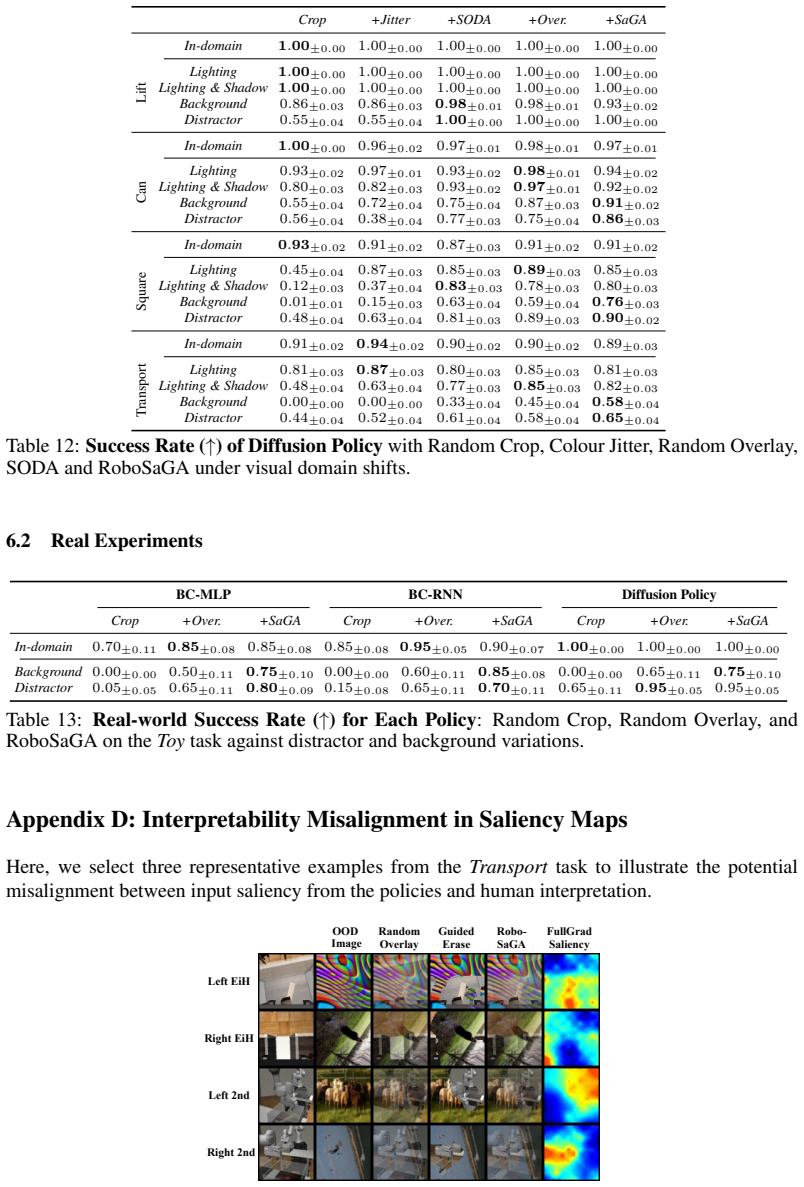
- [§4, Tables 2-4; Appendix C] The headline comparisons — Random Overlay gap 0.24 vs. RoboSaGA 0.14 in simulation, and 0.18 vs. 0.05 in the real world — are pooled point estimates reported without confidence intervals or significance tests, and the pooling treats the three checkpoints per task-policy cell as independent despite their shared training run. For the real-world claim, Table 13 shows per-cell RoboSaGA-vs-Random-Overlay differences between 0.00 and 0.25 with standard errors of the difference around 0.07 to 0.16 at 20 trials per point; an inverse-variance-weighted test over the six policy-by-condition cells gives p ≈ 0.06, so the abstract's 0.18-to-0.05 improvement is not established at the 5% level. The text's use of 'significantly enhance' (Q3) therefore outruns the evidence. I recommend cell-level or mixed-effects inference with task and policy as random effects, explicit confidence intervals for the Eq. (3) gaps, and additional real-world trials or a sequential design. The simulation evidence is directionally strong — RoboSaGA beats Random Overlay in 21 of 24 task-by-policy cells for the distractor and background conditions in Tables 10-12, with 2 ties and 1 loss — but the Transport cells (Tables 10-11) show near-zero improvement for BC-MLP and BC-RNN, indicating that the pooled averages conceal strong task dependence, and the paper should report per-task pooled gaps as well.
- [§4, Eq. (3)] The gap is anchored to the Random Crop baseline's in-domain success for all methods, so it does not 'effectively cancel out the baseline performance' when the compared methods differ in-domain. In Table 13, RoboSaGA's in-domain rate for BC-MLP is 0.85 vs. Random Crop's 0.70, which produces the negative gaps (−0.05 and −0.10) in Table 4 and inflates the apparent improvement; re-computed as each method's own in-domain minus OOD success rate, the pooled real-world gaps are approximately 0.27 (Random Overlay) vs. 0.07 (RoboSaGA) rather than 0.18 vs. 0.05. The relative improvement survives this re-computation, but the absolute headline numbers and the 'negative gap' interpretation depend on the choice of anchor. Please report the VDS success rates themselves (as in Table 13) and per-method generalization gaps alongside the Eq. (3) metric.
- [§2-§3, Tables 1-4] SaliencyMix (ref. [16]), the closest saliency-guided superimposition method from computer vision, is cited and discussed as a method that RoboSaGA 'distinguishes itself' from, yet it is never benchmarked. Without this baseline, or a BC-adapted variant, the empirical contribution of per-pixel, encoder-level saliency blending relative to an existing saliency-guided scheme is not quantified; the current tables separate RoboSaGA only from constant-factor (Random Overlay) and binary-mask (Guided Erase) blending within the authors' own framework. Adding SaliencyMix under the same augmentation protocol would make the positioning claim testable.
- [§4.2 (Q6), Appendix D] The mechanism claim — that aggressive augmentation in low-saliency regions is safe because the policy's FullGrad saliency identifies task-critical pixels — is not directly tested, and the paper's own qualitative results (Fig. 5, Appendix D) show maps that focus on task-trivial regions or the wrong object. Because the saliency maps are computed from the very policy being trained, a control experiment that destroys the spatial structure of the same maps (e.g., permuting pixel values) would test whether the gain over Random Overlay is attributable to the saliency content rather than to per-pixel variability of the blending factor per se; the Random Overlay comparison in Table 1 is the necessary no-guidance control but does not by itself validate the spatial content.
minor comments (6)
- [Abstract; Appendix C] The abstract's claim that RoboSaGA keeps in-domain success rates 'within standard error' of the Random Crop baseline is not supported in all cells; for example, Table 12 shows Diffusion Policy on Can with 1.00±0.00 (Crop) vs. 0.97±0.01 (RoboSaGA), about three standard errors of the difference, and Table 11 shows BC-RNN on Square with 0.66±0.04 vs. 0.75±0.04. Please qualify the claim or provide a summary statistic.
- [§3, Saliency Clipping] The text says the clipping threshold λ was set to 0.8 and refers to 'Section 4.1 for details,' but Section 4.1 does not discuss the choice of λ and no sensitivity analysis is reported for λ, α, β, or γ; please state the selection criterion for λ and add an ablation or a pointer to supplementary results.
- [§4.2, Q4] The claim that RoboSaGA 'consistently' outperforms Random Overlay is too strong given the paper's own tables: Diffusion Policy on Lift background is 0.93 vs. 0.98 (Table 12), and the real-world Diffusion distractor cell is a tie (Table 13); 'on average' would be accurate.
- [§4, Evaluation Protocol] The paper does not state which criterion selects the 'top three checkpoints' among the 600 training epochs; please specify, since selecting checkpoints by in-domain success could bias the gap estimates if in-domain and OOD performance are correlated across checkpoints.
- [§3 and Algorithm 1] The augmentation parameter α is used both as a count ('augments α out of m trajectories') and as a fraction ('50% of the batch'), and Algorithm 1 samples 'uniformly from {1,2,...,n}' while the text says 'targeting α trajectories'; please reconcile the notation and state whether α is a count or a fraction.
- [Appendix B, Table 8; §4.2, Q3] The 'Num. of Demos' column in Table 8 is empty and the number of demonstrations per task is never stated, which limits the reader's ability to judge the data regime; moreover, the word 'translatable' in Q3 should be 'transferable,' and the sentence claiming the real-world experiments 'confirm' the simulation findings should be softened because SODA was not evaluated in the real world and the real-world differences are not individually significant.
Circularity Check
No significant circularity: RoboSaGA's central claims are empirical comparisons under an externally defined performance gap, not derivations from its own saliency inputs.
full rationale
The paper's core quantities are not analytically derived: Eq. (1) defines the augmented image as a pixelwise mixture, Eq. (2) clips FullGrad saliency, and Eq. (3) defines the performance gap as the difference between Random Crop's in-domain success and each method's VDS success. RoboSaGA's headline numbers (0.24 to 0.14 in simulation; 0.18 to 0.05 in real-world tests) are empirical measurements under that externally defined metric, with hyperparameters such as alpha, beta, and lambda fixed rather than fitted to the reported gaps. No equation in the manuscript makes the predicted gap equal to the saliency map or to any fitted quantity by construction. The fact that saliency comes from the policy being trained is a bootstrapping design that requires validation, and the paper supplies some: the buffer-versus-no-buffer comparison (Appendix A, Tables 5-7), the ablation against Guided Erase and Random Overlay (Table 1), and explicit caveats in Q6, Appendix D, and Section 5 (Transport). The skeptical concern that the real-world 0.18-to-0.05 gap may not exceed sampling noise (Appendix C, Table 13) is a statistical robustness issue, not circular reasoning under the stated criteria. There is no load-bearing self-citation: the cited building blocks (FullGrad, KeepAugment, SODA, RoboMimic, Diffusion Policy) are external baselines or components, and no uniqueness theorem or author-imported ansatz is invoked to force the design. I therefore find no step in which a claimed prediction reduces to its own inputs by definition.
Assumptions & free parameters
free parameters (4)
- Saliency clipping threshold lambda =
0.8
- Augmentation ratio alpha =
0.5
- Saliency update ratio beta =
0.1
- Warm-up epochs gamma =
10
assumptions (4)
- domain assumption FullGrad saliency of the policy encoder identifies task-critical pixels.
- domain assumption Overlaying OOD images onto low-saliency regions improves robustness without sacrificing in-domain performance.
- domain assumption Stale saliency maps from the global buffer are a sufficient approximation of current saliency.
- standard math The performance gap metric (Eq. 3) fairly compares augmentation methods with different in-domain success rates.
Cite this review
Pith. "Pith review of Enhancing Visual Domain Robustness in Behaviour Cloning via Saliency-Guided Augmentation." pith.science (2026). https://pith.science/paper/UFNCXV7X
@misc{pith2026260811870,
  author       = {Pith},
  title        = {Pith review of: Enhancing Visual Domain Robustness in Behaviour Cloning via Saliency-Guided Augmentation},
  year         = {2026},
  howpublished = {\url{https://pith.science/paper/UFNCXV7X}},
  note         = {Machine review of arXiv:2608.11870}
}
read the original abstract
In vision-based behavior cloning (BC), conventional image augmentations such as Random Crop and Color Jitter often fall short under substantial visual domain shifts, including changes in shadows, distractors, and backgrounds. Superimposition-based augmentations, which blend in-domain and out-of-domain images, have shown promise for improving generalization in computer vision, but their suitability for BC remains uncertain because task-critical semantics, spatiotemporal relationships, and agent-target interactions must be preserved. To address this, we introduce RoboSaGA, a Saliency-Guided Augmentation method within the superimposition family tailored for vision-based BC. RoboSaGA dynamically adjusts augmentation intensity at the pixel level using policy-driven saliency, enabling aggressive augmentation in task-irrelevant regions while preserving task-critical information. It integrates seamlessly into existing architectures without requiring structural modifications or additional learning objectives. Experiments in both simulated and real-world settings show that RoboSaGA preserves in-domain performance while substantially improving robustness to visual domain shifts, including distractor and background changes, as well as lighting and shadow variations. Code is available at https://github.com/Zheyu-Zhuang/RoboSaGA.
Figures


Figures from the paper (7 more)



Reference graph
Works this paper leans on
-
[16]
A. F. M. S. Uddin, M. S. Monira, W. Shin, T. Chung, and S.-H. Bae. Saliencymix: A saliency guided data augmentation strategy for better regularization. InInternational Con- ference on Learning Representations, 2021. URLhttps://openreview.net/forum?id= -M0QkvBGTTq
work page 2021
-
[1]
Florence, C
P. Florence, C. Lynch, A. Zeng, O. Ramirez, A. Wahid, L. Downs, A. Wong, J. Lee, I. Mor- datch, and J. Tompson. Implicit behavioral cloning.Conference on Robot Learning (CoRL), 2021
2021
-
[2]
C. Chi, S. Feng, Y . Du, Z. Xu, E. Cousineau, B. Burchfiel, and S. Song. Diffusion policy: Visuomotor policy learning via action diffusion. InRobotics: Science and Systems (RSS), 2023
2023
- [3]
- [4]
-
[5]
Mandlekar, S
A. Mandlekar, S. Nasiriany, B. Wen, I. Akinola, Y . Narang, L. Fan, Y . Zhu, and D. Fox. Mimicgen: A data generation system for scalable robot learning using human demonstrations. InConference on Robot Learning (CoRL), 2023
2023
-
[6]
P. Mitrano and D. Berenson. Data Augmentation for Manipulation. InProceedings of Robotics: Science and Systems, New York City, NY , USA, June 2022. doi:10.15607/RSS.2022.XVIII. 031
-
[7]
Mandlekar, D
A. Mandlekar, D. Xu, J. Wong, S. Nasiriany, C. Wang, R. Kulkarni, L. Fei-Fei, S. Savarese, Y . Zhu, and R. Mart´ın-Mart´ın. What matters in learning from offline human demonstrations for robot manipulation. InConference on Robot Learning (CoRL), 2021
2021
Show all 31 references
-
[8]
A. Xie, L. Lee, T. Xiao, and C. Finn. Decomposing the generalization gap in imitation learning for visual robotic manipulation.arXiv preprint arXiv:2307.03659, 2023
2023 arXiv
-
[9]
Zhong, L
Z. Zhong, L. Zheng, G. Kang, S. Li, and Y . Yang. Random erasing data augmentation. In Proceedings of the AAAI conference on artificial intelligence, 2020
2020
-
[10]
DeVries and G
T. DeVries and G. W. Taylor. Improved regularization of convolutional neural networks with cutout.arXiv preprint arXiv:1708.04552, 2017
2017 arXiv
-
[11]
Zhang, M
H. Zhang, M. Cisse, Y . N. Dauphin, and D. Lopez-Paz. mixup: Beyond empirical risk mini- mization.arXiv preprint arXiv:1710.09412, 2017
2017 arXiv
-
[12]
D. A. Pomerleau. Alvinn: An autonomous land vehicle in a neural network. InConference on Advances in Neural Information Processing Systems (NeurIPS), 1988
1988
-
[13]
Rahmatizadeh, P
R. Rahmatizadeh, P. Abolghasemi, L. B ¨ol¨oni, and S. Levine. Vision-based multi-task manip- ulation for inexpensive robots using end-to-end learning from demonstration.International Conference on Robotics and Automation (ICRA), 2018
2018
-
[14]
J. Ho, A. Jain, and P. Abbeel. Denoising diffusion probabilistic models.Conference on Neural Information Processing Systems (NeurIPS), 2020. 9
2020
-
[15]
C. Gong, D. Wang, M. Li, V . Chandra, and Q. Liu. Keepaugment: A simple information- preserving data augmentation approach. InProceedings of the IEEE/CVF conference on com- puter vision and pattern recognition, pages 1055–1064, 2021
2021
-
[17]
Abolghasemi, A
P. Abolghasemi, A. Mazaheri, M. Shah, and L. Boloni. Pay attention!-robustifying a deep visuomotor policy through task-focused visual attention. InProceedings of the IEEE/CVF conference on computer vision and pattern recognition, pages 4254–4262, 2019
2019
-
[18]
T. Yu, T. Xiao, A. Stone, J. Tompson, A. Brohan, S. Wang, J. Singh, C. Tan, J. Peralta, B. Ichter, et al. Scaling robot learning with semantically imagined experience.Robotics: Science and Systems (RSS), 2023
2023
-
[19]
K. Lee, K. Lee, J. Shin, and H. Lee. Network randomization: A simple technique for general- ization in deep reinforcement learning. InInternational Conference on Learning Representa- tions, 2020. URLhttps://openreview.net/forum?id=HJgcvJBFvB
2020
-
[20]
Hansen and X
N. Hansen and X. Wang. Generalization in reinforcement learning by soft data augmentation. In2021 IEEE International Conference on Robotics and Automation (ICRA), pages 13611– 13617. IEEE, 2021
2021
-
[21]
Z. Yuan, G. Ma, Y . Mu, B. Xia, B. Yuan, X. Wang, P. Luo, and H. Xu. Don’t touch what mat- ters: Task-aware lipschitz data augmentation for visual reinforcement learning. InProceedings of the Thirty-First International Joint Conference on Artificial Intelligence, IJCAI-22, 2022
2022
-
[22]
Srinivas and F
S. Srinivas and F. Fleuret. Full-gradient representation for neural network visualization.Ad- vances in neural information processing systems, 32, 2019
2019
-
[23]
R. R. Selvaraju, M. Cogswell, A. Das, R. Vedantam, D. Parikh, and D. Batra. Grad-cam: Visual explanations from deep networks via gradient-based localization. InProceedings of the IEEE international conference on computer vision, pages 618–626, 2017
2017
-
[24]
Smilkov, N
D. Smilkov, N. Thorat, B. Kim, F. Vi ´egas, and M. Wattenberg. Smoothgrad: removing noise by adding noise.arXiv preprint arXiv:1706.03825, 2017
2017 arXiv
-
[25]
Laskin, A
M. Laskin, A. Srinivas, and P. Abbeel. Curl: Contrastive unsupervised representations for reinforcement learning. InInternational conference on machine learning, pages 5639–5650. PMLR, 2020
2020
-
[26]
T.-Y . Lin, M. Maire, S. Belongie, J. Hays, P. Perona, D. Ramanan, P. Doll´ar, and C. L. Zitnick. Microsoft coco: Common objects in context. InEuropean Conference on Computer Vision (ECCV), 2014
2014
-
[27]
K. He, X. Zhang, S. Ren, and J. Sun. Deep residual learning for image recognition. InPro- ceedings of the IEEE conference on computer vision and pattern recognition, pages 770–778, 2016
2016
-
[28]
C. Finn, X. Y . Tan, Y . Duan, T. Darrell, S. Levine, and P. Abbeel. Deep spatial autoencoders for visuomotor learning. In2016 IEEE International Conference on Robotics and Automation (ICRA), pages 512–519. IEEE, 2016
2016
-
[29]
Ioffe and C
S. Ioffe and C. Szegedy. Batch normalization: Accelerating deep network training by reducing internal covariate shift. InInternational conference on machine learning, pages 448–456. pmlr, 2015. 10
2015
-
[30]
Wu and K
Y . Wu and K. He. Group normalization. InProceedings of the European conference on com- puter vision (ECCV), pages 3–19, 2018
2018
-
[31]
D. P. Kingma and J. Ba. Adam: A method for stochastic optimization.arXiv preprint arXiv:1412.6980, 2014. 11 Appendix A: Performance and Computation Trade-off of Saliency Buffer Saliency Buffer Implementation Details •Image Global Index:Each image sample is assigned a global in...
2014 arXiv
Reviewed August 16, 2026 · model on record in the stance chip above.
Discussion (0). Continue with ORCID to comment.