REVIEW 3 major objections 7 minor 116 references
First and Comprehensive Study of V0757 Pup : $\gamma-$Doradus Pulsator in Detached Eclipsing Binary
T0 review · 3 major / 7 minor · reviewed 2026-08-16 · deepseek-v4-flash
Pith's one-line read The paper claims that the F2V primary of the detached eclipsing binary V0757 Pup is a gamma Doradus pulsator, with two independent gravity-mode frequencies near 0.79 and 0.98 cycles per day.
desk verdict Solid single-object characterization, but the gamma Dor claim leans on a 0.98 c/d peak that is more plausibly a rotational combination than an independent g-mode. read the letter →
The pith
A machine-rendered reading of the paper's core claim, the machinery that carries it, and where it could break.
The reading
What carries the argument
The load-bearing machinery is the residual-frequency analysis of an eclipsing-binary light curve. The orbital solution from simultaneous radial-velocity and light-curve modeling removes the binary signal, and iterative prewhitening with a signal-to-noise threshold of 4 isolates the remaining periodicities; persistence across four sectors is the criterion for treating a peak as an independent mode. The pulsation constant is then computed from the binary-calibrated parameters through $\log Q = \log P + \tfrac12\log g + \tfrac1{10}M_\mathrm{bol} + \log T_\mathrm{eff}-6.456$, which connects the observed period to the mean density set by the eclipses. Gamma Doradus pulsators are F–A main-sequence stars oscillating in high-order, low-degree gravity modes, and the resulting $Q\sim0.5$–$0.6$ d places the primary inside that class.
What would settle it
Take a longer, almost continuous photometric series of V0757 Pup and measure the 0.98 c/d peak's amplitude and phase as a function of orbital phase. If the peak is a combination of the orbital and rotation frequencies, it should follow the orbital cycle and dissolve once those two frequencies are removed; if it stays coherent at fixed amplitude and phase, it is an independent g-mode and the two-mode gamma Doradus claim survives.
Extended reading notes
Core claim
The paper's central claim is that V0757 Pup's primary component is a gamma Doradus pulsator. After subtracting a binary light-curve model from four sectors of TESS photometry, two frequencies, $f\sim0.79$ and $0.98\,\mathrm{c/d}$, appear in every sector at signal-to-noise above the adopted threshold, with a pulsation constant $Q\simeq0.5$–$0.6$ d that matches gamma Doradus g-modes. The paper explicitly notes that the 0.98 c/d peak lies close to a possible combination of the orbital and rotation frequencies and treats the independent-mode interpretation as the classification's basis. The same modeling run yields masses and radii of $M_1=1.305\pm0.026\,M_\odot$, $R_1=1.643\pm0.020\,R_\odot$ for the primary and $M_2=0.934\pm0.030\,M_\odot$, $R_2=0.941\pm0.079\,R_\odot$ for the secondary, a system age near 2.2 Gyr, a predicted Roche-lobe overflow in about 1 Gyr, and no third-body signal above the detection threshold.
Load-bearing premise
The gamma Doradus classification depends on assuming the 0.98-per-day oscillation is a true independent pulsation mode; the paper itself notes it could be the sum of the orbital and rotation frequencies, in which case only the 0.79-per-day mode remains as direct pulsation evidence.
Editorial extensions
If this is right
- V0757 Pup becomes one of fewer than 50 gamma Doradus stars in eclipsing binaries with a full orbital solution, so the pulsating primary's mass and radius are known independently of any asteroseismic assumptions.
- Because the binary solution fixes the mean stellar density, the 0.79 and 0.98 c/d frequencies can be used to seek a g-mode identification and test how well standard models predict the low-frequency spectrum.
- The derived age of about 2.2 Gyr and the prediction that the primary reaches its Roche lobe in about 1 Gyr turn this system into a concrete endpoint for detached-binary evolution models.
- The photometric and SED distance of about 350 pc agreeing with the parallax distance corroborates the reddening estimate and the adopted extinction law.
- The non-detection of solar-like oscillations in the G1V secondary sets an upper limit on mode amplitudes in a cool companion inside a 1.99-day orbit.
Reading between the lines
- If the 0.98 c/d peak is the orbital-plus-rotation combination the paper flags, the independent-mode count drops to one; a longer continuous campaign tracking the peak's amplitude and phase across the orbit could distinguish a combination from a true mode.
- The 0.2 dex gap between the spectroscopic and isochrone metallicity, which the paper attributes to non-LTE effects, predicts that higher-resolution iron-line spectra should raise the measured abundance by about that amount; that prediction is directly testable.
- The predicted Roche-lobe overflow in about 1 Gyr implies the system will transition into a semidetached binary; comparing its current rotation and orbital state with known post-mass-transfer binaries would test whether the evolutionary timescale is realistic.
- A longer time series might reveal additional g-modes or a period-spacing pattern, and because the binary fixes the density, that pattern could constrain near-core rotation and the chemical gradient left by core recession.
Signed reviews
Editorial analysis
A structured set of objections, weighed in public.
Referee Report
Summary. The paper presents a comprehensive analysis of V0757 Pup, a detached eclipsing binary observed with TESS (Sectors 7, 34, 61, 88) and followed up with medium-resolution MRES spectroscopy and TRT-net photometry. The authors combine radial-velocity and light-curve modeling with PyWD2015 to derive absolute parameters (M1 = 1.305 ± 0.026 Msun, R1 = 1.643 ± 0.020 Rsun; M2 = 0.934 ± 0.030 Msun, R2 = 0.941 ± 0.079 Rsun), perform a residual frequency analysis, and identify two persistent frequencies at f ≈ 0.79 c/d and 0.98 c/d, which they interpret as independent g-modes that classify the primary as a gamma Doradus pulsator. Additional results include an eclipse timing variation analysis with no detected third body, a proper-motion anomaly significance of 2.56 sigma, an evolutionary age of about 2.2 Gyr, and distance estimates of about 350 pc from SED and photometric methods. The central claim is that this is the first confirmation of gamma Doradus pulsations in this system, supported by the pulsation constants Q ~ 0.5–0.6 d and the primary's position in the gamma Dor instability strip.
Significance. If the central results hold, V0757 Pup becomes a valuable addition to the small sample of gamma Doradus pulsators in detached eclipsing binaries, where precisely measured masses and radii can anchor g-mode asteroseismic modeling and tests of tidal effects. The paper's strengths include the simultaneous RV and light-curve modeling, the use of multiple TESS sectors, the explicit estimate of interstellar extinction from Na I D lines, and a photometric distance that is independent of the Gaia parallax. The pulsation frequencies and the predicted time to Roche-lobe overflow are falsifiable predictions that can be checked with future observations. However, the advertised two-mode confirmation of gamma Doradus pulsation is currently weakened by the uncertain independent status of the 0.98 c/d frequency, and the SED-based distance agreement is partly circular, as discussed in the major comments.
major comments (3)
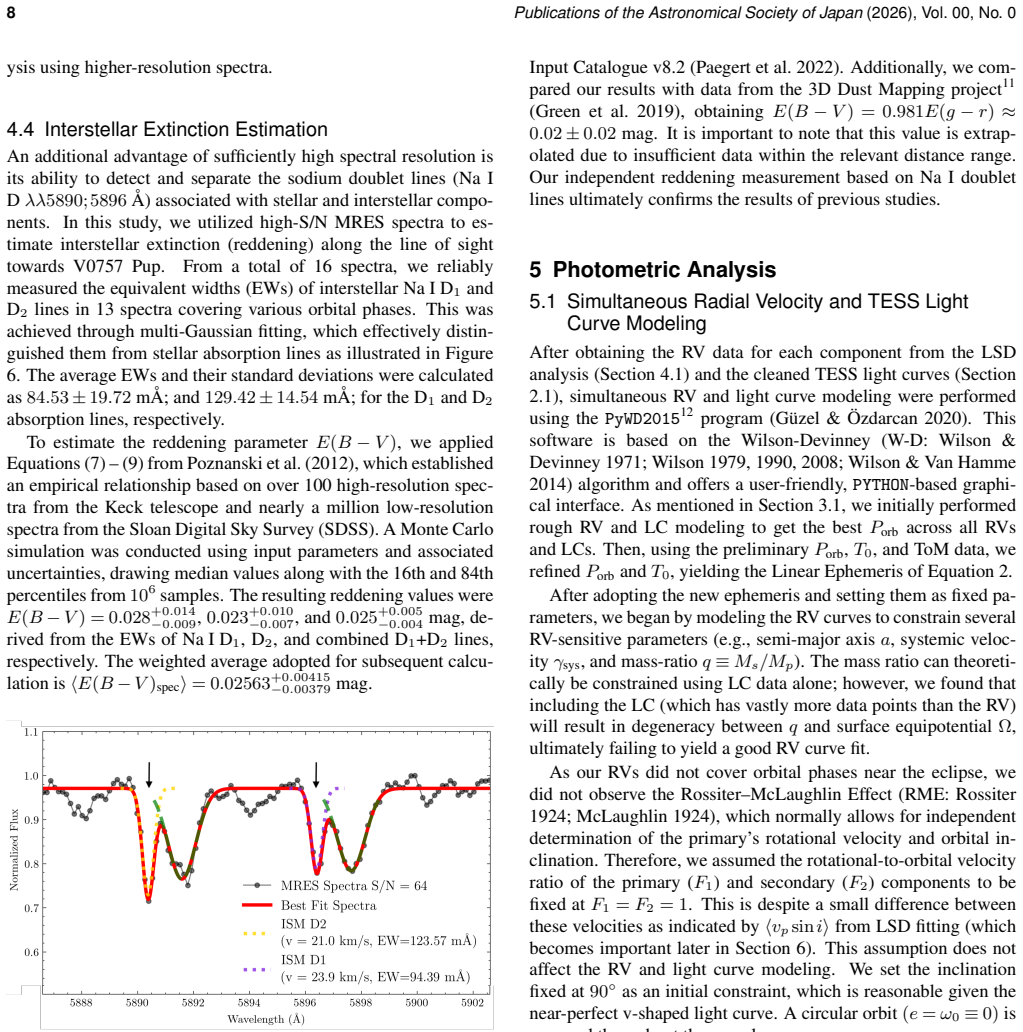
- [Section 6, Table 8, Eq. (11)] The claim that the 0.98 c/d frequency is independent rests on an arithmetic error and on an untested numerical coincidence. The text states that this peak lies near 'a possible f_orb + f_rot ≈ 0.973 combination', but with the paper's own values f_orb = 0.50273613 and f_rot = 0.4967 c/d, the sum is 0.9994, not 0.973. In fact, the 0.98 c/d peaks in Table 8 are closer to 2 f_rot = 0.9934 ± 0.012 and to 3 f_rot − f_orb ≈ 0.987, both low-order combinations in Eq. (11). The paper itself concedes that 'numerical agreement alone was considered insufficient evidence' and that the combination identifications are only 'possible', yet no phase-coherence or phase-relation test is presented to distinguish an independent mode from a rotational combination. Since Sectors 88 and 61 show residual peaks at f_rot and f_orb (e.g., S88 F1 = 0.4994 c/d, 4.9 mmag; S61 F1 = 0.5061 c/d, 5.2 mmag), rotational/orbital modulation is present in the residuals. If the 0.98 c/d peak is a combination, the gamma Doradus classification rests on the single 0.79 c/d mode (Q ≈ 0.68 d), which is plausible but materially weaker than the advertised two-mode confirmation. The abstract and conclusion should be revised to either provide phase-based evidence for independence or clearly state that the classification currently rests on one persistent mode.
- [Section 5.3, Table 7] The SED distance quoted as 'd ≈ 350 pc based on orbital and SED modeling' is not an independent validation of the Gaia parallax. The SPEEDYFIT run uses the Gaia DR3 parallax (ϖ = 2.8610 ± 0.0172 mas) as a direct input, so the excellent agreement between d_SED = 349.59 ± 2.13 pc and d_par = 352.373 ± 2.136 pc is partly circular. The genuinely independent distance estimate is the photometric distance in Section 5.2, which gives d_phot(G) = 357.38 +50.61/−41.58 pc and d_phot(V) = 387.94 +54.21/−45.01 pc, both consistent with the parallax within 1 sigma. The abstract's wording 'based on orbital and SED modeling' conflates these two very different estimates; the 'excellent agreement' claim should be attached to the photometric distance, not to the SED result.
- [Abstract, Section 6, Conclusion] The paper repeatedly states that the pulsation constants Q range from 0.5 to 0.6 d for the independent frequencies, but Table 8 lists Q ≈ 0.68 d for the 0.79 c/d mode in all four sectors (0.674, 0.686, 0.687, 0.679) and Q ≈ 0.55 d for the 0.98 c/d mode. The abstract's 'Q∼0.6 d' is acceptable as a compromise, but the text's 'ranging from 0.5 to 0.6 days' is inconsistent with the tabulated values and should be corrected to avoid confusion. This does not undermine the gamma Doradus classification, since both values exceed the canonical Q > 0.23 d threshold, but the internal inconsistency should be fixed.
minor comments (7)
- [Abstract] The phrase 'important physical informations' should be 'important physical information'; similar grammatical issues appear elsewhere in the text.
- [Section 5.2, Eq. (7)] The symbol X in Eq. (7) is not defined before use; please define the bandpass explicitly when introducing the distance-modulus equation.
- [Section 6, Eq. (10)] The paper adopts v_p sin i = 41.201 ± 0.031 km/s from the spectral analysis (Table 4), while the average from LSD profile fitting (Table 10) is 39.8 ± 2.5 km/s. Please clarify why the more precise value is preferred and discuss the consistency between the two measurements.
- [Section 7 and Figure 13 caption] The spelling 'Hertzprung-Russell' appears in the text and figure caption; the correct spelling is 'Hertzsprung-Russell'. Please correct throughout.
- [Table 5] The secondary effective temperature uncertainties for Sectors 61 and 88 are quoted as 0 K, which likely reflects rounding of very small formal errors; please report a nonzero uncertainty or use a uniform number of significant digits.
- [Section 3.2] The phrase 'O-C Gateway' is capitalized inconsistently; use the official name 'O-C Gateway' or 'OC Gateway' consistently.
- [Section 2.3] The statement about the 2025 MRES CCD upgrade relies on a 'private comm.'; please provide a citable reference or remove the speculative part of the sentence.
Circularity Check
SED-distance 'agreement' uses Gaia parallax as an input; the central gamma-Dor claim is derived independently.
-
fitted input called prediction
[Section 5.3 (SED Fitting), Table 7; echoed in Abstract and Section 8 (Conclusion)]
"We employed SPEEDYFIT (V os et al. 2017), which utilizes integrated SED flux from Kurucz (1979) atmospheric models, alongside all available photometric data and the GaiaDR3 parallax (ϖ = 2.8610±0.0172 mas) as inputs. ... Our SED analysis estimates a distance of dSED = 349.59+2.13−2.08 pc, slightly lower than the previous measurement of dpar = 352.373±2.136 pc (Gaia Collaboration et al. 2023)."
The SED-derived distance is a fitted output of a model whose inputs explicitly include the Gaia DR3 parallax, so dSED ≈ dpar is enforced by the fit, not independently confirmed. The Abstract and Conclusion nevertheless present the agreement as validation of the binary solution ('excellent agreement with the Gaia DR3 parallax distance'; 'validating the robustness of our binary solution'). The paper does contain a genuinely independent photometric distance from absolute parameters and observed magnitudes (Section 5.2), so the circularity is confined to the SED-based agreement claim, not to the central gamma-Dor classification.
full rationale
The central derivation, the gamma-Dor pulsation classification, is not circular: the two candidate frequencies are extracted from residual light curves after subtracting the binary model, and the pulsation constants are computed with the standard Breger relation from independently derived stellar parameters. The paper explicitly labels linear-combination identifications as 'possible' and says numerical agreement alone is insufficient, so the skeptical argument about the 0.98 c/d peak being a rotational combination is a correctness/interpretation concern, not circularity. The only load-bearing circular step is the SED distance agreement: SPEEDYFIT takes the Gaia DR3 parallax as an input and returns a distance, and the paper presents that fitted agreement as an external validation. Because the paper also provides a non-circular photometric distance that agrees with Gaia, and because the circular leg is a secondary claim rather than the pulsation classification, the overall score is moderate (4).
Assumptions & free parameters
free parameters (5)
- Mass ratio q =
0.716(1)
- Orbital inclination i =
86.24(10) deg
- Secondary effective temperature T2 =
5883(52) K
- Primary surface potential Omega1 =
6.071(11)
- Secondary surface potential Omega2 =
8.092(245)
assumptions (7)
- domain assumption Circular orbit (e=0) for both components.
- domain assumption Rotational-to-orbital velocity ratio F1=F2=1 (pseudo-synchronization).
- domain assumption Gravity darkening g=0.32 and bolometric albedo A=0.5 for both stars.
- domain assumption The primary effective temperature is fixed at 7033 K from spectral fitting and treated as invariant.
- domain assumption Residual brightness variability is attributed to primary pulsations rather than star spots.
- domain assumption Each component evolves as a single star until Roche lobe overflow.
- domain assumption Gamma Doradus pulsation criterion Q>0.23 d and the instability strip location classify the primary.
Cite this review
Pith. "Pith review of First and Comprehensive Study of V0757 Pup : $\gamma-$Doradus Pulsator in Detached Eclipsing Binary." pith.science (2026). https://pith.science/paper/Z6K6VI3H
@misc{pith2026260811896,
  author       = {Pith},
  title        = {Pith review of: First and Comprehensive Study of V0757 Pup : $\gamma-$Doradus Pulsator in Detached Eclipsing Binary},
  year         = {2026},
  howpublished = {\url{https://pith.science/paper/Z6K6VI3H}},
  note         = {Machine review of arXiv:2608.11896}
}
abstract
Pulsating stars in detached eclipsing binary (EA) systems are known for providing many important physical informations which constrain both stellar structure and evolution theories. To date, fewer than 50 $\gamma$ Doradus (GDOR) stars have been found in eclipsing binary systems, making them important targets to study \textit{g}-mode pulsation inside the stars. We present a comprehensive physical and pulsational analysis of V0757 Pup (TIC 6939791), a detached eclipsing binary system observed by the TESS mission (Sectors 7, 34, 61, and 88) and followed up with ground-based spectroscopy from the Thai National Telescope. By combining light curve modeling with radial velocities derived from medium-resolution spectra, we determined the fundamental stellar and atmospheric parameters with high precision. The system consists of an F2V primary ($M_1=1.305\pm0.026M_\odot, R_1=1.643\pm0.020R_\odot$) and a G1V secondary ($M_2=0.934\pm0.030M_\odot, R_2=0.941\pm0.079R_\odot$). We performed a detailed frequency analysis of the residual light curves, identifying two dominant independent pulsation frequencies at $f\sim0.79$ c/d and $0.98$ c/d. These frequencies, along with the derived pulsation constant ($Q\sim0.6$ d), confirm the primary component as a $\gamma$ Doradus pulsator. An analysis of Eclipse Timing Variations (ETV) reveals non detection of third body companions with current available dataset, strengthen by the result of \textit{Gaia} astrometric analysis. Evolutionary modeling indicates the system is $\sim2.2$ Gyr old, with the primary expected to fill its Roche lobe in $\sim1$ Gyr. Additionally, we calculate a distance of $d\approx350$ pc based on orbital and SED modeling, which is in excellent agreement with the \textit{Gaia} DR3 parallax distance.
Figures


Figures from the paper (13 more)




Reference graph
Works this paper leans on
-
[1]
Spectropolarimetric observations of active stars. , keywords =. doi:10.1093/mnras/291.4.658 , adsurl =
-
[2]
Microturbulence across the Hertzsprung─Russell Diagram: Setting observational constraints on Milky Way stars. , keywords =. doi:10.1051/0004-6361/202554907 , archivePrefix =. 2508.03576 , primaryClass =
-
[3]
3D non-LTE iron abundances in FG-type dwarfs. , keywords =. doi:10.1051/0004-6361/202244542 , archivePrefix =. 2209.13449 , primaryClass =
-
[4]
On the relationship between the Scuti and Doradus pulsators. , keywords =. doi:10.1046/j.1365-8711.2002.05401.x , archivePrefix =. astro-ph/0202152 , primaryClass =
arXiv 2002
-
[5]
Observational constraints on the origin of the elements. IV. Standard composition of the Sun. , keywords =. doi:10.1051/0004-6361/202142971 , archivePrefix =. 2203.02255 , primaryClass =
-
[6]
Planetary nebulae seen with TESS: Discovery of new binary central star candidates from Cycle 1. , keywords =. doi:10.1051/0004-6361/201937118 , archivePrefix =. 1911.09991 , primaryClass =
arXiv 1911
-
[7]
A Search for Stars of Very Low Metal Abundance. V. Photoelectric UBV Photometry of Metal-weak Candidates from the Northern HK Survey. , keywords =. doi:10.1086/301566 , archivePrefix =. astro-ph/0006178 , primaryClass =
-
[8]
, volume=
Gaia-derived luminosities of Kepler A/F stars and the pulsator fraction across the Scuti instability strip , author=. , volume=. 2019 , publisher=
2019
Show all 116 references
-
[9]
, keywords =
Seismic Study of the Doradus-type Pulsations in the Eclipsing Binary KIC 10486425. , keywords =. doi:10.3847/1538-4357/aadd9a , adsurl =
-
[11]
, keywords =
Exploring the empirical instability strip for Dor-type stars in eclipsing binaries. , keywords =. doi:10.1093/mnras/staf330 , archivePrefix =. 2502.16566 , primaryClass =
-
[12]
, keywords =
Updated pulsation period relations of Dor-type stars in eclipsing binaries: the case of KIC 2557430. , keywords =. doi:10.1093/mnras/stz3302 , adsurl =
-
[13]
Summary of the contents and survey properties
Gaia Data Release 2. Summary of the contents and survey properties. , keywords =. doi:10.1051/0004-6361/201833051 , archivePrefix =. 1804.09365 , primaryClass =
-
[14]
Summary of the content and survey properties
Gaia Data Release 3. Summary of the content and survey properties. , keywords =. doi:10.1051/0004-6361/202243940 , archivePrefix =. 2208.00211 , primaryClass =
-
[15]
, keywords =
MESA Isochrones and Stellar Tracks (MIST) 0: Methods for the Construction of Stellar Isochrones. , keywords =. doi:10.3847/0067-0049/222/1/8 , archivePrefix =. 1601.05144 , primaryClass =
-
[16]
Mesa Isochrones and Stellar Tracks (MIST). I. Solar-scaled Models. , keywords =. doi:10.3847/0004-637X/823/2/102 , archivePrefix =. 1604.08592 , primaryClass =
-
[17]
Living Together: Planets, Host Stars and Binaries , year = 2015, editor =
AbsParEB and InPeVEB: Software for the Calculation of Absolute and Orbital Period Changes Parameters of Eclipsing Binaries. Living Together: Planets, Host Stars and Binaries , year = 2015, editor =
2015
-
[18]
isochrones: Stellar model grid package
-
[19]
, keywords =
The Tycho-2 catalogue of the 2.5 million brightest stars. , keywords =
-
[20]
, keywords =
The Wide-field Infrared Survey Explorer (WISE): Mission Description and Initial On-orbit Performance. , keywords =. doi:10.1088/0004-6256/140/6/1868 , archivePrefix =. 1008.0031 , primaryClass =
- [21]
-
[22]
PASA , keywords =
SkyMapper Southern Survey: First Data Release (DR1). PASA , keywords =. doi:10.1017/pasa.2018.5 , archivePrefix =. 1801.07834 , primaryClass =
2018 arXiv
-
[23]
American Astronomical Society Meeting Abstracts \#225 , year = 2015, series =
APASS - The Latest Data Release. American Astronomical Society Meeting Abstracts \#225 , year = 2015, series =
2015
-
[24]
, keywords =
Model atmospheres for G, F, A, B, and O stars. , keywords =. doi:10.1086/190589 , adsurl =
-
[25]
The orbits of subdwarf-B + main-sequence binaries. III. The period-eccentricity distribution. , keywords =. doi:10.1051/0004-6361/201730958 , archivePrefix =. 1706.02286 , primaryClass =
-
[26]
, keywords =
KIC 6206751: the first R CMa-type eclipsing binary with Doradus pulsations. , keywords =. doi:10.1093/mnras/sty2153 , archivePrefix =. 1808.00183 , primaryClass =
-
[27]
, keywords =
The eclipsing Doradus star V421 Pegasi. , keywords =. doi:10.1093/pasj/psaf116 , archivePrefix =. 2510.00337 , primaryClass =
-
[28]
RMxAA , keywords =
Four New Doradus Variables in Eclipsing Binaries: Revised Pulsation Period Relations. RMxAA , keywords =. doi:10.22201/ia.01851101p.2020.56.02.12 , adsurl =
2020 doi
-
[29]
, pages=
Catalogue and properties of Scuti stars in binaries , author=. , pages=. 2016 , publisher=
2016
-
[30]
Astronomy and Astrophysics Supplement Series , volume=
Evolutionary tracks and isochrones for low-and intermediate-mass stars: From 0.15 to 7, and from to 0.03 , author=. Astronomy and Astrophysics Supplement Series , volume=. 2000 , publisher=
2000
-
[31]
, keywords =
A 3D Dust Map Based on Gaia, Pan-STARRS 1, and 2MASS. , keywords =. doi:10.3847/1538-4357/ab5362 , archivePrefix =. 1905.02734 , primaryClass =
1905 arXiv
-
[32]
, keywords =
Least-squares deconvolution of the stellar intensity and polarization spectra. , keywords =. doi:10.1051/0004-6361/201015429 , archivePrefix =. 1008.5115 , primaryClass =
-
[33]
Summary of the contents and survey properties
Gaia Early Data Release 3. Summary of the contents and survey properties. , keywords =. doi:10.1051/0004-6361/202039657 , archivePrefix =. 2012.01533 , primaryClass =
2012 arXiv
-
[34]
VizieR Online Data Catalog: TESS Input Catalog version 8.2 (TIC v8.2) (Paegert+, 2021)
2021
-
[35]
The Kepler characterization of the variability among A- and F-type stars. I. General overview. , keywords =. doi:10.1051/0004-6361/201117368 , archivePrefix =. 1107.0335 , primaryClass =
-
[36]
, keywords =
Hybrid Doradus- Scuti Pulsators: New Insights into the Physics of the Oscillations from Kepler Observations. , keywords =. doi:10.1088/2041-8205/713/2/L192 , archivePrefix =. 1001.0747 , primaryClass =
-
[37]
, year = 1924, month = jul, volume =
On the detection of an effect of rotation during eclipse in the velocity of the brighter component of beta Lyrae, and on the constancy of velocity of this system. , year = 1924, month = jul, volume =. doi:10.1086/142825 , adsurl =
1924 doi
-
[38]
Open European Journal on Variable Stars , year = 2006, month = feb, volume =
O-C Gateway, a Collection of Minima Timings. Open European Journal on Variable Stars , year = 2006, month = feb, volume =
2006
-
[39]
Astronomical Data Analysis Software and Systems XXVII , year = 2019, editor =
The TESS Science Data Archive. Astronomical Data Analysis Software and Systems XXVII , year = 2019, editor =
2019
-
[40]
Magnetic Activity and Period Variation Studies of the Short-period Eclipsing Binaries. II. V1101 Her, AD Phe, and NSV 455 (J011636.15-394955.7). , keywords =. doi:10.3847/1538-3881/aa9438 , adsurl =
-
[41]
, year = 1959, month = may, volume =
Standard light-time curves. , year = 1959, month = may, volume =. doi:10.1086/107913 , adsurl =
1959 doi
-
[42]
RMxAA , keywords =
A Study of the SX Phe star BL Cam1. RMxAA , keywords =. doi:10.22201/ia.01851101p.2021.57.02.14 , adsurl =
2021 doi
-
[43]
, keywords =
Detection of a period decrease in NN Ser with ULTRACAM: evidence for strong magnetic braking or an unseen companion. , keywords =. doi:10.1111/j.1365-2966.2005.09718.x , archivePrefix =. astro-ph/0510331 , primaryClass =
2005
-
[44]
Lightkurve: Kepler and TESS time series analysis in Python
-
[45]
, keywords =
New Limb-Darkening Coefficients for Modeling Binary Star Light Curves. , keywords =. doi:10.1086/116788 , adsurl =
-
[46]
, year = 1924, month = jul, volume =
Some results of a spectrographic study of the Algol system. , year = 1924, month = jul, volume =. doi:10.1086/142826 , adsurl =
1924 doi
-
[47]
, keywords =
VALD: The Vienna Atomic Line Data Base. , keywords =
-
[48]
, keywords =
Aproximations to the radii of Roche lobes. , keywords =. doi:10.1086/160960 , adsurl =
-
[49]
Baltic Astronomy , keywords =
VALD-2 -- The New Vienna Atomic Line Database. Baltic Astronomy , keywords =. doi:10.1515/astro-2000-0420 , adsurl =
2000 doi
-
[50]
, year = 2015, month = may, volume =
A major upgrade of the VALD database. , year = 2015, month = may, volume =. doi:10.1088/0031-8949/90/5/054005 , adsurl =
2015 doi
-
[51]
MRES: technical evaluation of the spectrograph , url=
Semenko, Eugene and Mkrtichian, David ,year=. MRES: technical evaluation of the spectrograph , url=
-
[52]
doi:10.1017/CBO9781316036570 , adsurl =
The Observation and Analysis of Stellar Photospheres. doi:10.1017/CBO9781316036570 , adsurl =
-
[53]
Collins and John F
Karen A. Collins and John F. Kielkopf and Keivan G. Stassun and others , title =. 2017 , month =
2017
-
[54]
, keywords =
Disentangling of composite spectra. , keywords =
-
[55]
, keywords =
Orbital elements of multiple spectroscopic stars. , keywords =
-
[56]
, keywords =
SUPPNet: Neural network for stellar spectrum normalisation. , keywords =. doi:10.1051/0004-6361/202141480 , archivePrefix =. 2111.15052 , primaryClass =
-
[57]
, keywords =
Non-LTE line formation for heavy elements in four very metal-poor stars. , keywords =. doi:10.1051/0004-6361:20078060 , archivePrefix =. 0711.4454 , primaryClass =
-
[58]
, keywords =
Atomic data for the Gaia-ESO Survey. , keywords =. doi:10.1051/0004-6361/201936291 , archivePrefix =. 2011.02049 , primaryClass =
2011 arXiv
-
[60]
, archivePrefix = "arXiv", eprint =
Astropy: A community Python package for astronomy. , archivePrefix = "arXiv", eprint =. doi:10.1051/0004-6361/201322068 , adsurl =
-
[62]
A benchmark test using the Hyades
Consistent metallicity scale for cool dwarfs and giants. A benchmark test using the Hyades. , keywords =. doi:10.1051/0004-6361/201526783 , archivePrefix =. 1509.07725 , primaryClass =
-
[63]
, keywords =
The Gaia-ESO survey: 3D NLTE abundances in the open cluster NGC 2420 suggest atomic diffusion and turbulent mixing are at the origin of chemical abundance variations. , keywords =. doi:10.1051/0004-6361/202038833 , archivePrefix =. 2007.09153 , primaryClass =
-
[64]
, keywords =
Bayesian inference of stellar parameters and interstellar extinction using parallaxes and multiband photometry. , keywords =. doi:10.1111/j.1365-2966.2010.17699.x , archivePrefix =. 1009.2766 , primaryClass =
2010
-
[65]
, keywords =
emcee: The MCMC Hammer. , keywords =. doi:10.1086/670067 , archivePrefix =. 1202.3665 , primaryClass =
-
[66]
A grid of MARCS model atmospheres for late-type stars. I. Methods and general properties. , keywords =. doi:10.1051/0004-6361:200809724 , archivePrefix =. 0805.0554 , primaryClass =
-
[67]
, keywords =
Non-LTE radiative transfer with Turbospectrum. , keywords =. doi:10.1051/0004-6361/202243673 , archivePrefix =. 2206.00967 , primaryClass =
-
[68]
NLTE analysis of Y II lines in spectra of cool stars and implications for Y as a Galactic chemical clock
Observational constraints on the origin of the elements - VII. NLTE analysis of Y II lines in spectra of cool stars and implications for Y as a Galactic chemical clock. , keywords =. doi:10.1093/mnras/stad2488 , archivePrefix =. 2308.12092 , primaryClass =
-
[69]
Turbospectrum: Code for spectral synthesis
-
[70]
, keywords =
Detached eclipsing binaries in compact hierarchical triples: triple-lined systems BD+442258 and KIC 06525196. , keywords =. doi:10.1093/mnras/stad622 , archivePrefix =. 2303.05272 , primaryClass =
-
[71]
Spectroscopically and Spatially Resolving the Components of the Close Binary Stars , year = 2004, editor =
Obtaining normalised component spectra with FDBinary. Spectroscopically and Spatially Resolving the Components of the Close Binary Stars , year = 2004, editor =
2004
-
[72]
Contributions of the Astronomical Observatory Skalnate Pleso , keywords =
PyWD2015 - A new GUI for the Wilson-Devinney code. Contributions of the Astronomical Observatory Skalnate Pleso , keywords =. doi:10.31577/caosp.2020.50.2.535 , adsurl =
2020 doi
-
[73]
, year = 1971, month = jun, volume =
Realization of Accurate Close-Binary Light Curves: Application to MR Cygni. , year = 1971, month = jun, volume =. doi:10.1086/150986 , adsurl =
1971 doi
-
[74]
, keywords =
Eccentric orbit generalization and simultaneous solution of binary star light and velocity curves. , keywords =. doi:10.1086/157588 , adsurl =
-
[75]
, keywords =
Accuracy and Efficiency in the Binary Star Reflection Effect. , keywords =. doi:10.1086/168867 , adsurl =
-
[76]
, keywords =
Eclipsing Binary Solutions in Physical Units and Direct Distance Estimation. , keywords =. doi:10.1086/523634 , adsurl =
-
[77]
, keywords =
Unification of Binary Star Ephemeris Solutions. , keywords =. doi:10.1088/0004-637X/780/2/151 , adsurl =
-
[78]
The Proximity Effects in Close Binary Systems. II. The Bolometric Reflection Effect for Stars with Deep Convective Envelopes. Acta Astron. , year = 1969, month = jan, volume =
1969
-
[79]
Lmfit: Non-Linear Least-Square Minimization and Curve-Fitting for Python
-
[80]
, year = 1967, month = jan, volume =
Gravity-Darkening for Stars with Convective Envelopes. , year = 1967, month = jan, volume =
1967
-
[81]
, year = 2022, month = jun, volume =
MultiModes: Efficiently analyse pulsating stars. , year = 2022, month = jun, volume =. doi:10.1093/mnras/stac926 , eprint =
2022 doi
-
[82]
, keywords =
Measuring Reddening with Sloan Digital Sky Survey Stellar Spectra and Recalibrating SFD. , keywords =. doi:10.1088/0004-637X/737/2/103 , archivePrefix =. 1012.4804 , primaryClass =
-
[83]
, keywords =
The Relationship between Infrared, Optical, and Ultraviolet Extinction. , keywords =. doi:10.1086/167900 , adsurl =
-
[84]
, keywords =
The Revised TESS Input Catalog and Candidate Target List. , keywords =. doi:10.3847/1538-3881/ab3467 , archivePrefix =. 1905.10694 , primaryClass =
1905 arXiv
-
[85]
, keywords =
An empirical relation between sodium absorption and dust extinction. , keywords =. doi:10.1111/j.1365-2966.2012.21796.x , archivePrefix =. 1206.6107 , primaryClass =
2012
-
[86]
, keywords =
Asteroseismology of Triple-mode Radial Scuti Star: TIC 400562821. , keywords =. doi:10.3847/1538-4357/ad87eb , adsurl =
-
[87]
, year = 1981, month = oct, volume =
L=0, 1, 2, and 3 pulsation constants for evolutionary models of del SCT stars. , year = 1981, month = oct, volume =. doi:10.1086/159278 , adsurl =
1981 doi
-
[88]
, keywords =
Convection and Overshoot in Models of Doradus and Scuti Stars. , keywords =. doi:10.3847/1538-4357/aa8e01 , archivePrefix =. 1709.06857 , primaryClass =
-
[89]
41st Annual Conference of the Society for Astronomical Sciences (SAS-2022) , year = 2022, month = may, pages =
Revisiting the Scuti Star FG Virginis. 41st Annual Conference of the Society for Astronomical Sciences (SAS-2022) , year = 2022, month = may, pages =
2022
-
[90]
Standing on the Shoulders of Dwarfs: the Kepler Asteroseismic LEGACY Sample. I. Oscillation Mode Parameters. , keywords =. doi:10.3847/1538-4357/835/2/172 , archivePrefix =. 1612.00436 , primaryClass =
-
[91]
Extraterrestrial Seismology , year = 2015, editor =
Asteroseismology of red giant stars. Extraterrestrial Seismology , year = 2015, editor =. doi:10.1017/CBO9781107300668.014 , adsurl =
2015 doi
-
[92]
Frontiers in Astronomy and Space Sciences , VOLUME=
Jackiewicz, Jason , TITLE=. Frontiers in Astronomy and Space Sciences , VOLUME=. 2021 , URL=. doi:10.3389/fspas.2020.595017 , ISSN=
2021
-
[93]
, keywords =
The Hipparcos-Gaia Catalog of Accelerations: Gaia EDR3 Edition. , keywords =. doi:10.3847/1538-4365/abf93c , archivePrefix =. 2105.11662 , primaryClass =
-
[94]
Binarity from proper motion anomaly
Stellar and substellar companions of nearby stars from Gaia DR2. Binarity from proper motion anomaly. , keywords =. doi:10.1051/0004-6361/201834371 , archivePrefix =. 1811.08902 , primaryClass =
-
[95]
Delta Scuti Star Newsletter , year = 1990, month = mar, volume =
Uncertainties in the calculated pulsation constant Q. Delta Scuti Star Newsletter , year = 1990, month = mar, volume =
1990
-
[96]
, keywords =
Doradus pulsation in two pre-main sequence stars discovered by CoRoT. , keywords =. doi:10.1051/0004-6361/201220127 , archivePrefix =. 1301.0991 , primaryClass =
-
[97]
M., et al
Price‑Whelan, A. M., et al. , title = ". , year =. doi:10.3847/1538-3881/aabc4f , adsurl =
-
[98]
, keywords =
Improved fundamental parameters for the low-mass pre-main sequence eclipsing system <ASTROBJ>RX J0529.4+0041</ASTROBJ>. , keywords =. doi:10.1051/0004-6361:20040348 , adsurl =
-
[99]
Nature Medicine , keywords =
SciPy 1.0: fundamental algorithms for scientific computing in Python. Nature Medicine , keywords =. doi:10.1038/s41592-019-0686-2 , archivePrefix =. 1907.10121 , primaryClass =
1907 arXiv
-
[100]
Ibanoglu and Ö
C. Ibanoglu and Ö. Çakırlı and E. Sipahi , keywords =. The first comprehensive catalog of γ Dor pulsators and their characteristics , journal =. 2018 , issn =. doi:https://doi.org/10.1016/j.newast.2018.01.004 , url =
2018 doi
-
[101]
, keywords =
Accurate masses and radii of normal stars: modern results and applications. , keywords =. doi:10.1007/s00159-009-0025-1 , archivePrefix =. 0908.2624 , primaryClass =
-
[102]
, keywords =
The mass discrepancy in intermediate- and high-mass eclipsing binaries: The need for higher convective core masses. , keywords =. doi:10.1051/0004-6361/202037452 , archivePrefix =. 2003.08982 , primaryClass =
2003 arXiv
-
[103]
, keywords =
The Dependence of Convective Core Overshooting on Stellar Mass: Additional Binary Systems and Improved Calibration. , keywords =. doi:10.3847/1538-4357/aabd35 , archivePrefix =. 1804.03148 , primaryClass =
-
[104]
, keywords =
Four bright eclipsing binaries with Doradus pulsating components: CM Lac, MZ Lac, RX Dra, and V2077 Cyg. , keywords =. doi:10.1093/mnras/stac1993 , archivePrefix =. 2207.09169 , primaryClass =
-
[105]
Universe , keywords =
A Systematic Search for New Scuti and Doradus Stars Using TESS Data. Universe , keywords =. doi:10.3390/universe11090302 , adsurl =
-
[106]
Journal of Physics Conference Series , year = 2024, series =
BIMA 2.0 Progress on ToM Analysis of Contact Binaries: IR Car, V1370 Tau and GY Pup. Journal of Physics Conference Series , year = 2024, series =. doi:10.1088/1742-6596/2866/1/012075 , adsurl =
2024 doi
-
[107]
Publication of Korean Astronomical Society , year = 2015, month = sep, volume =
The BIMA Project: O-C Diagrams of Eclipsing Binary Systems. Publication of Korean Astronomical Society , year = 2015, month = sep, volume =. doi:10.5303/PKAS.2015.30.2.205 , adsurl =
2015 doi
-
[108]
Volume\_1
General Catalogue of Variable Stars. Volume\_1. Constellations Andromeda - Grus
-
[109]
Astronomy Reports , year = 2017, month = jan, volume =
General catalogue of variable stars: Version GCVS 5.1. Astronomy Reports , year = 2017, month = jan, volume =. doi:10.1134/S1063772917010085 , adsurl =
2017 doi
-
[110]
The first Gaia catalogue of eclipsing-binary candidates
Gaia Data Release 3. The first Gaia catalogue of eclipsing-binary candidates. , keywords =. doi:10.1051/0004-6361/202245330 , archivePrefix =. 2211.00929 , primaryClass =
-
[111]
, keywords =
Non-linear tidal excitation of superharmonic gravity waves in main-sequence stars in binary and exoplanetary systems. , keywords =. doi:10.1093/mnras/stac451 , archivePrefix =. 2202.07450 , primaryClass =
-
[112]
, keywords =
Systematic search for stellar pulsators in the eclipsing binaries observed by Kepler. , keywords =. doi:10.1051/0004-6361/201935821 , archivePrefix =. 1908.06773 , primaryClass =
1908 arXiv
-
[113]
, keywords =
Driving the Gravity-Mode Pulsations in Doradus Variables. , keywords =. doi:10.1086/312908 , adsurl =
-
[114]
, keywords =
Gamma Doradus Stars: Defining a New Class of Pulsating Variables. , keywords =. doi:10.1086/316399 , archivePrefix =. astro-ph/9905042 , primaryClass =
-
[115]
, keywords =
The effect of tides on near-core rotation: analysis of 35 Kepler Doradus stars in eclipsing and spectroscopic binaries. , keywords =. doi:10.1093/mnras/staa2266 , archivePrefix =. 2007.14853 , primaryClass =
2007 arXiv
-
[116]
, keywords =
Interior rotation of a sample of Doradus stars from ensemble modelling of their gravity-mode period spacings. , keywords =. doi:10.1051/0004-6361/201628616 , archivePrefix =. 1607.00820 , primaryClass =
-
[117]
, keywords =
KIC 11285625: A double-lined spectroscopic binary with a Doradus pulsator discovered from Kepler space photometry. , keywords =. doi:10.1051/0004-6361/201321702 , archivePrefix =. 1306.2148 , primaryClass =
-
[118]
, keywords =
Accurate masses and radii of normal stars. , keywords =. doi:10.1007/BF00873538 , adsurl =
-
[119]
, year = 2008, month = mar, volume =
Extrasolar planet detection by binary stellar eclipse timing: evidence for a third body around CM Draconis. , year = 2008, month = mar, volume =. doi:10.1051/0004-6361:20079000 , archivePrefix =
2008 doi
Reviewed August 16, 2026 · model on record in the stance chip above.
Discussion (0). Continue with ORCID to comment.