REVIEW 3 major objections 5 minor 38 references
On-Policy Self-Distillation for Multi-Dialect ASR: Mastering Dialects, Retaining Mandarin
T0 review · 3 major / 5 minor · reviewed 2026-08-16 · deepseek-v4-flash
Pith's one-line read The paper claims that on-policy self-distillation improves dialect recognition in autoregressive Mandarin ASR while keeping Mandarin character error rate flat, and that continued teacher-forced cross-entropy on the same data raises it.
desk verdict A genuinely well-controlled comparison showing on-policy self-distillation beats continued fine-tuning for multi-dialect ASR refinement, with the main caveat being unverified speaker-disjointness and single-run numbers. read the letter →
The pith
A machine-rendered reading of the paper's core claim, the machinery that carries it, and where it could break.
The reading
What carries the argument
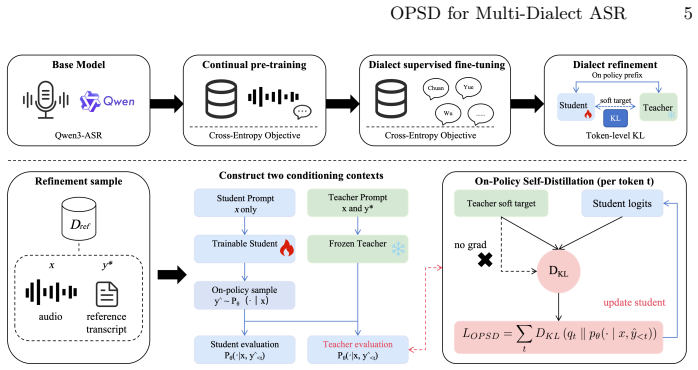
The load-bearing mechanism is the OPSD objective applied to autoregressive ASR. For each utterance, the student first decodes its own prediction $\hat{y}_{\le T}$ from the audio; at each position $t$, the frozen teacher $\bar{\theta}$ computes a distribution $q_t(v) = p_{\bar{\theta}}(v \mid x, c(y^\star), \hat{y}_{<t})$ over the vocabulary, where $c(y^\star)$ is the reference transcript given only to the teacher as a privileged prompt; the student's gradient is $\sum_t D_{KL}(q_t \| p_\theta(\cdot \mid x, \hat{y}_{<t}))$, with no auxiliary cross-entropy term. This combines two things: on-policy states (the student learns from its own decoded prefixes rather than gold prefixes) and soft supervision (the teacher's distribution instead of a one-hot reference), which together address the train–test mismatch and soften the dialect update.
What would settle it
Run an exact and approximate duplicate-audio or duplicate-transcript search between the 5k-hour refinement set and the 13 public test sets; finding any test utterance in the refinement data would mean the OPSD gains could come from memorization rather than from the distillation objective.
Extended reading notes
Core claim
On the paper's own terms, the discovery is that replacing hard cross-entropy updates with on-policy self-distillation in the final refinement stage lets an autoregressive ASR model learn more from dialect speech without overwriting its Mandarin ability. The student samples its own hypothesis for each training utterance; a frozen teacher—initialized from the same SFT checkpoint and given the reference transcript as privileged context—supplies soft token-level targets on those student-decoded prefixes; the student minimizes the KL divergence to those targets. With the same 5k-hour refinement set, same batch size, and same one-epoch schedule, OPSD lowers the Mandarin average CER from 3.40% to 3.27% and the dialect average from 13.16% to 12.79%, while Continued SFT raises the Mandarin average to 4.43%. The paper presents this as evidence that the objective, not extra data or training budget, is responsible for the improved Mandarin–dialect balance.
Load-bearing premise
The central comparison assumes that no development or test utterance appears among the roughly 100k hours of training or the 5k-hour refinement data, with speaker-ID holdout and utterance de-duplication applied only where speaker IDs are available.
Editorial extensions
If this is right
- On matched refinement data, OPSD yields lower CER than continued teacher-forced SFT on all four macro-averages (Mandarin, Dialect, Internal, and Overall), and it lowers Mandarin Avg. to 3.27% while Continued SFT raises it to 4.43%.
- The full staged pipeline (CPT, then dialect SFT, then OPSD) lowers Mandarin Avg. from 3.46% to 3.27%, Dialect Avg. from 15.37% to 12.79%, and Internal Avg. from 21.01% to 12.42%.
- Because the only difference between OPSD and Continued SFT is the supervision signal, the gain comes from distillation on on-policy prefixes rather than from extra data or a different training schedule.
- OPSD is not uniformly best on every test set—SpeechIO-1 and a few dialects such as Shanghai and Sichuan are slightly better under earlier stages—so the appropriate use is as a final refinement on dialects where early-error accumulation dominates.
- Direct dialect SFT without CPT substantially raises Mandarin Avg. to 5.16%, so CPT before SFT is needed for a stable Mandarin–dialect trade-off in this pipeline.
Reading between the lines
- Beyond what the paper tests, the same on-policy self-distillation recipe should transfer to other autoregressive speech tasks—such as dialect text-to-speech or code-switched ASR—because the train–test mismatch it addresses is not specific to Chinese.
- The reference-conditioned teacher acts as an oracle at training time; an interesting extension would be to vary the teacher's privileged context or use multiple teachers to push harder on long-tail dialects such as Kejia and Chaoshan.
- The paper isolates the objective but not the data-selection policy (high-CER utterances, capped per dialect); the interaction between this curation strategy and OPSD is untested and could be probed by swapping the refinement set.
- A testable hypothesis implied but not stated is that OPSD's Mandarin retention depends on the teacher being initialized from the SFT checkpoint; a teacher initialized from the CPT checkpoint might behave differently.
Signed reviews
Editorial analysis
A structured set of objections, weighed in public.
Referee Report
Summary. The paper proposes a three-stage adaptation pipeline for multi-dialect Mandarin ASR: continual pre-training (CPT), dialect supervised fine-tuning (SFT), and on-policy self-distillation (OPSD). In the OPSD stage, the student is trained on its own decoded prefixes while a frozen teacher, conditioned on the reference transcript as privileged context, provides soft token-level KL targets. The authors instantiate the framework with Qwen3-ASR-1.7B and evaluate on public Mandarin/dialect test sets plus an 18-dialect internal suite. The central empirical claim is that, under matched refinement data and schedule, OPSD improves dialect CER without raising Mandarin CER, whereas continued teacher-forced SFT raises Mandarin CER.
Significance. If the empirical claim holds, the paper makes a practical contribution: it shows that the choice of refinement objective, rather than extra data or training budget, can mitigate the dialect/Mandarin trade-off in ASR adaptation. The central comparison in Table 8 is well controlled because Continued SFT and OPSD start from the same SFT checkpoint and share the same Dref, learning rate, schedule, and decoder; the only difference is the supervision signal. The paper also provides a clear evaluation protocol with macro-averages over 31 test sets and promises release of weights and evaluation scripts, which will help reproducibility. The main uncertainties are data-integrity and statistical reliability, not the soundness of the method derivation.
major comments (3)
- [§4.1, Tables 4–8] The paper states that 'when speaker IDs are available, test speakers are held out from training and refinement' but never reports what fraction of the ~34.1k hours of internal data have speaker IDs, how many distinct speakers are represented, or whether any of those speakers appear in the Internal Dialect test suite. Because Tables 4, 6, and 8 all rely on these test sets, and the claimed OPSD gains include large per-dialect drops (e.g., Nanchang 18.63→15.58 and Kejia 32.01→28.60), speaker-level leakage could inflate the headline results. Please report speaker-ID coverage and overlap counts for training/refinement versus development/test, or re-evaluate the affected tables on a verified non-overlapping subset.
- [§6.2, Table 8] All CER numbers are single runs with no confidence intervals or significance tests. The crucial dialect comparison is small: Dialect Avg. CER is 12.89 for Continued SFT versus 12.79 for OPSD, and several per-set differences are well under 0.5 CER. The claim that OPSD 'improves dialect recognition without raising Mandarin CER' therefore rests on differences that may be within run-to-run noise. At minimum, the refinement stage should be repeated with multiple seeds (and ideally several Dref subsamples) and the variance reported.
- [§3.4, Eq. (3)] The objective uses forward KL D_KL(q_t || p_θ) with prefixes sampled from the student. Since the student generates the prefixes, the more common on-policy choice is reverse KL or a sample-weighted objective; the paper gives no justification for forward KL on student-generated states. This is not fatal for the empirical comparison, but it is a load-bearing design decision that should be discussed or ablated.
minor comments (5)
- [Table 1] Report per-dialect hour counts for the internal data; a single 34.1k total makes it impossible to assess coverage of dialects such as Kejia or Nanchang, which are central to the analysis in Section 5.2.
- [§4.4] Report the number of optimizer steps for the refinement stage and the random seeds; 'one epoch' depends on the exact Dref size, and the update count is needed to confirm that Continued SFT and OPSD truly share the same training budget.
- [§5.1] The sentence 'OPSD improves all three evaluation groups after SFT' is true only at the macro-average level; a few internal dialects (e.g., Sichuan 5.13→5.38, Shanghai 11.94→12.07) regress, and this should be stated in the same paragraph for precision.
- [§4.1] Clarify whether the 13 public test sets use the official train/eval splits of their source corpora, and report any deduplication with the training collection beyond utterance-level de-duplication.
- [§2.3, §3.4] The novelty relative to on-policy distillation [1] and self-distilled reasoner [37] should be stated crisply; as written, the relationship is only implicit.
Circularity Check
No significant circularity: the headline comparison is an empirical held-out CER measurement.
full rationale
The paper's central claim — that OPSD refinement lowers dialect CER without the Mandarin CER increase seen under Continued SFT — is established by direct CER evaluation on public and internal test sets (Tables 3-8). The quantities compared are not defined in terms of the paper's own claims: Mandarin Avg., Dialect Avg., Internal Avg., and Overall Avg. are macro-averages over independent test sets (Table 2), and Table 8 compares OPSD vs Continued SFT from the same SFT checkpoint on the same 5k-hour refinement set with the same schedule, so the contrast isolates the training objective. The teacher in OPSD is a frozen copy of the SFT checkpoint, which is self-distillation by design; however, this is a training mechanism, not a circular evaluation, because the reported outcomes are measured CER values rather than quantities that the objective forces by construction. The one self-citation, [37] for the OPSD name and formulation, is not load-bearing for the empirical result; the paper could be read entirely as a controlled comparison of two refinement objectives. The §4.1 caveat that test speakers are held out 'when speaker IDs are available' is a legitimate data-integrity risk that could inflate the internal-suite gains, but it is a leakage risk, not a circularity: it does not make any prediction equivalent to a fitted input by definition. No equation in the paper reduces to its inputs, and no parameter fitted on the evaluation sets is later reported as a prediction. A non-finding is therefore appropriate.
Assumptions & free parameters
free parameters (1)
- OPSD sampling temperature tau =
0.8
assumptions (4)
- domain assumption CER after shared text normalization is a valid and comparable measure of recognition quality across Mandarin and dialect test sets.
- domain assumption The internal evaluation set is disjoint from training and refinement data.
- domain assumption Qwen3-ASR-1.7B is a representative capable base model for Mandarin and dialect ASR.
- ad hoc to paper Soft targets from a frozen teacher conditioned on the reference transcript provide a stable and useful training signal for the student.
Cite this review
Pith. "Pith review of On-Policy Self-Distillation for Multi-Dialect ASR: Mastering Dialects, Retaining Mandarin." pith.science (2026). https://pith.science/paper/Q6UUUGRE
@misc{pith2026260811898,
  author       = {Pith},
  title        = {Pith review of: On-Policy Self-Distillation for Multi-Dialect ASR: Mastering Dialects, Retaining Mandarin},
  year         = {2026},
  howpublished = {\url{https://pith.science/paper/Q6UUUGRE}},
  note         = {Machine review of arXiv:2608.11898}
}
read the original abstract
Recent large-scale ASR models already achieve strong Mandarin recognition accuracy and have some ability to recognize Chinese dialects. However, their dialect recognition accuracy is still limited in real-world speech. Direct dialect adaptation can lower dialect CER, but it may also raise Mandarin CER. We therefore study how to adapt a capable ASR model to improve multi-dialect recognition without degrading Mandarin recognition. We adopt an adaptation pipeline where continual pre-training (CPT) and dialect supervised fine-tuning (SFT) provide a strong foundation, and On-Policy Self-Distillation (OPSD) serves as the final refinement. OPSD addresses the train--test mismatch in autoregressive ASR by training the student model on its own decoded prefixes while a frozen teacher, conditioned on the reference transcript as privileged context, provides soft token-level targets. This replaces hard cross-entropy updates on dialect data with distillation, preserving Mandarin ability while refining dialect recognition. We instantiate the framework with Qwen3-ASR-1.7B and evaluate it on public and internal Mandarin and dialect test sets. Under matched refinement data and schedule, OPSD improves dialect recognition without raising Mandarin CER, whereas continued teacher-forced fine-tuning increases Mandarin CER. We will release the model weights and evaluation scripts.
Figures
Reference graph
Works this paper leans on
- [1]
-
[37]
arXiv preprint arXiv:2601.18734 (2026)
Zhao, S., Xie, Z., Liu, M., Huang, J., Pang, G., et al.: Self-distilled reasoner: On- policy self-distillation for large language models. arXiv preprint arXiv:2601.18734 (2026)
arXiv 2026
- [2]
- [3]
- [4]
-
[5]
arXiv preprint arXiv:2407.04675 (2024)
Bai, Y., Chen, J., Chen, J., Chen, W., Chen, Z., et al.: Seed-asr: Understand- ing diverse speech and contexts with llm-based speech recognition. arXiv preprint arXiv:2407.04675 (2024)
arXiv 2024
- [6]
- [7]
Show all 38 references
-
[8]
In: Proc
Chang, H., Lee, H., Lee, L.: Towards lifelong learning of end-to-end ASR. In: Proc. Interspeech. pp. 2551–2555 (2021)
2021
-
[9]
arXiv preprint arXiv:2601.07274 (2026)
Chang, K., Shao, Y., Li, J., Yu, D.: Towards comprehensive semantic speech em- beddings for chinese dialects. arXiv preprint arXiv:2601.07274 (2026)
2026
-
[10]
arXiv preprint arXiv:2311.07919 (2023)
Chu, Y., Xu, J., Zhou, X., Yang, Q., Zhang, S., et al.: Qwen-audio: Advancing universal audio understanding via unified large-scale audio-language models. arXiv preprint arXiv:2311.07919 (2023)
2023 arXiv
-
[11]
arXiv preprint arXiv:2509.18004 (2025)
Dai, Y., Zhang, Z., Wang, S., Li, L., Guo, Z., et al.: Wenetspeech-chuan: A large- scale sichuanese corpus with rich annotation for dialectal speech processing. arXiv preprint arXiv:2509.18004 (2025)
2025
-
[12]
arXiv preprint arXiv:1808.10583 (2018)
Du, J., Na, X., Liu, X., Bu, H.: AISHELL-2: transforming mandarin ASR research into industrial scale. arXiv preprint arXiv:1808.10583 (2018)
2018 arXiv
-
[13]
In: Proc
Gao, Z., Li, Z., Wang, J., Luo, H., Shi, X., et al.: Funasr: A fundamental end-to-end speech recognition toolkit. In: Proc. Interspeech. pp. 1593–1597 (2023)
2023
-
[14]
In: Proc
Higuchi, Y., Moritz, N., Roux, J.L., Hori, T.: Momentum pseudo-labeling for semi- supervised speech recognition. In: Proc. Interspeech. pp. 726–730 (2021)
2021
-
[15]
arXiv preprint arXiv:2104.10747 (2021) 14 S
Hinsvark, A., Delworth, N., Rio, M.D., McNamara, Q., Dong, J., et al.: Accented speech recognition: A survey. arXiv preprint arXiv:2104.10747 (2021) 14 S. Wang et al
2021 arXiv
-
[16]
In: Proc
Hu, E.J., Shen, Y., Wallis, P., Allen-Zhu, Z., Li, Y., et al.: LoRA: low-rank adap- tation of large language models. In: Proc. ICLR (2022)
2022
-
[17]
In: Proc
Hu, Y., Chen, C., Yang, C., Qin, C., Chen, P., et al.: Self-taught recognizer: Toward unsupervised adaptation for speech foundation models. In: Proc. NeurIPS (2024)
2024
-
[18]
In: Proc
Li, L., Guo, Z., Chen, H., Dai, Y., Zhang, Z., et al.: Wenetspeech-yue: A large-scale cantonese speech corpus with multi-dimensional annotation. In: Proc. AAAI. pp. 31627–31635 (2026)
2026
-
[19]
arXiv preprint arXiv:2605.08961 (2026)
Meng, Y., Zhong, H., Lin, G., Wang, G., Du, H., et al.: Dolphin-cn-dialect: Where chinese dialects matter. arXiv preprint arXiv:2605.08961 (2026)
2026 arXiv
-
[20]
IEEE ACM Trans
Prabhavalkar, R., Hori, T., Sainath, T.N., Schlüter, R., Watanabe, S.: End-to-end speech recognition: A survey. IEEE ACM Trans. Audio Speech Lang. Process.32, 325–351 (2024)
2024
-
[21]
Pratap, V., Tjandra, A., Shi, B., Tomasello, P., Babu, A., et al.: Scaling speech technology to 1, 000+ languages. J. Mach. Learn. Res.25, 97:1–97:52 (2024)
2024
-
[22]
In: Proc
Radford, A., Kim, J.W., Xu, T., Brockman, G., McLeavey, C., et al.: Robust speech recognition via large-scale weak supervision. In: Proc. ICML. vol. 202, pp. 28492–28518 (2023)
2023
-
[23]
arXiv preprint arXiv:2412.15622 (2024)
Song, X., Liang, C., Zhang, B., Zhang, P., Wang, Z., Ma, Y., Xu, M., Wang, L., Wu, D., Pan, F., Zhou, D., Peng, Z.: TouchASP: elastic automatic speech perception that everyone can touch. arXiv preprint arXiv:2412.15622 (2024)
2024 arXiv
-
[24]
In: NeurIPS Datasets and Benchmarks (2021)
Tang, Z., Wang, D., Xu, Y., Sun, J., Lei, X., et al.: Kespeech: An open source speech dataset of mandarin and its eight subdialects. In: NeurIPS Datasets and Benchmarks (2021)
2021
-
[25]
arXiv preprint arXiv:2601.21337 (2026)
Team, Q.: Qwen3-asr technical report. arXiv preprint arXiv:2601.21337 (2026)
2026 arXiv
-
[26]
In: Proc
Trinh, V.A., Ghahremani, P., King, B.J., Droppo, J., Stolcke, A., et al.: Reducing geographic disparities in automatic speech recognition via elastic weight consoli- dation. In: Proc. Interspeech. pp. 1298–1302 (2022)
2022
-
[27]
In: ACL Findings
Wang, C., Shao, M., Hu, J., Zhu, Z., Xue, H., et al.: Wenetspeech-wu: Datasets, benchmarks, and models for a unified chinese wu dialect speech processing ecosys- tem. In: ACL Findings. pp. 27999–28011 (2026)
2026
-
[28]
arXiv preprint arXiv:2501.14350 (2025)
Xu, K., Xie, F., Tang, X., Hu, Y.: Fireredasr: Open-source industrial-grade man- darin speech recognition models from encoder-decoder to LLM integration. arXiv preprint arXiv:2501.14350 (2025)
2025 arXiv
-
[29]
arXiv preprint arXiv:2606.01016 (2026)
Yang, S., Ruan, S., Wu, S., Liu, Y., Fan, L., et al.: Polyspeech-100: A large-scale benchmark for speech understanding across 100+ languages and dialects. arXiv preprint arXiv:2606.01016 (2026)
2026 arXiv
-
[30]
arXiv preprint arXiv:2303.10917 (2023)
Yang, X., Li, Q., Zhang, C., Woodland, P.C.: Knowledge distillation from multiple foundation models for end-to-end speech recognition. arXiv preprint arXiv:2303.10917 (2023)
2023 arXiv
-
[31]
arXiv preprint arXiv:2203.16844 (2022)
Yang, Z., Chen, Y., Luo, L., Yang, R., Ye, L., Cheng, G., Xu, J., Jin, Y., Zhang, Q., Zhang, P., Xie, L., Yan, Y.: Open source MagicData-RAMC: A rich annotated mandarin conversational speech dataset. arXiv preprint arXiv:2203.16844 (2022)
2022 arXiv
-
[32]
In: Proc
Yao, Z., Kang, W., Yang, X., Kuang, F., Guo, L., et al.: CR-CTC: consistency regularization on CTC for improved speech recognition. In: Proc. ICLR (2025)
2025
-
[33]
arXiv preprint arXiv:2110.07393 (2021)
Yu, F., Zhang, S., Fu, Y., Xie, L., Zheng, S., Du, Z., Huang, W., Guo, P., Yan, Z., Ma, B., Xu, X., Bu, H.: M2MeT: the ICASSP 2022 multi-channel multi-party meeting transcription challenge. arXiv preprint arXiv:2110.07393 (2021)
2021 arXiv
-
[34]
arXiv preprint arXiv:2412.02612 (2024) OPSD for Multi-Dialect ASR 15
Zeng, A., Du, Z., Liu, M., Wang, K., Jiang, S., et al.: Glm-4-voice: Towards intelli- gent and human-like end-to-end spoken chatbot. arXiv preprint arXiv:2412.02612 (2024) OPSD for Multi-Dialect ASR 15
2024 arXiv
-
[35]
In: Proc
Zhang, B., Lv, H., Guo, P., Shao, Q., Yang, C., et al.: WENETSPEECH: A 10000+ hours multi-domain mandarin corpus for speech recognition. In: Proc. ICASSP. pp. 6182–6186 (2022)
2022
-
[36]
arXiv preprint arXiv:2303.01037 (2023)
Zhang, Y., Han, W., Qin, J., Wang, Y., Bapna, A., et al.: Google USM: Scaling au- tomatic speech recognition beyond 100 languages. arXiv preprint arXiv:2303.01037 (2023)
2023 arXiv
-
[38]
In: Proc
Zhou, J., Gao, S., Yu, Z., Dong, L., Wang, W.: Dialectmoe: An end-to-end multi- dialect speech recognition model with mixture-of-experts. In: Proc. CCL. vol. 14761, pp. 243–258 (2024)
2024
Reviewed August 16, 2026 · model on record in the stance chip above.
Discussion (0). Continue with ORCID to comment.