REVIEW 4 major objections 6 minor 38 references
The SLT 2026 SmartGlasses Challenge: Benchmarking Egocentric Multi-Talker Speech Recognition and Understanding with Audio-Language Models
T0 review · 4 major / 6 minor · reviewed 2026-08-16 · deepseek-v4-flash
Pith's one-line read A new benchmark jointly tests who said what and what it means in egocentric smart-glasses speech, and finds that dense speaker overlap and acoustic-only reasoning remain unsolved.
desk verdict A genuinely useful new benchmark and corpus for egocentric Mandarin ASR+SLU, with a clean empirical design; the acoustic-difficulty conclusion needs a text-only sanity check. read the letter →
The pith
A machine-rendered reading of the paper's core claim, the machinery that carries it, and where it could break.
The reading
What carries the argument
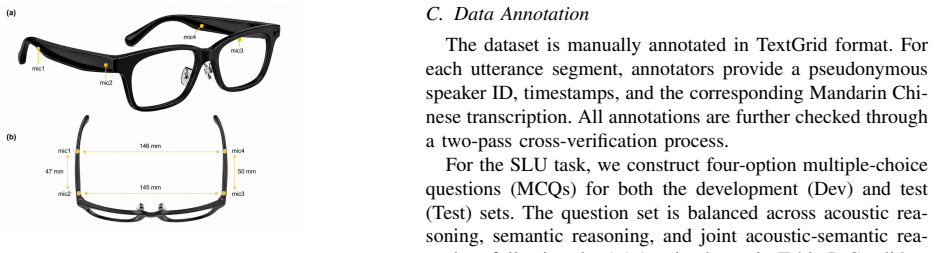
The load-bearing mechanism is the benchmark itself: a fixed four-channel MEMS microphone array on customized smart glasses, an 'Outline-Guided Spontaneous Conversation' collection protocol that uses LLM-generated role and goal outlines to elicit natural overlap without scripting, and two coupled evaluation tasks measured by tcpCER (a turn-constrained character error rate with a 5-second collar) for transcription and multiple-choice accuracy for understanding. The SLU questions are deliberately split 1:1:1 into acoustic, semantic, and acoustic-semantic joint categories, with the acoustic category defined as unresolvable from transcripts alone. This design lets the paper attribute performance gaps to overlap density and to audio-only evidence rather than to transcription errors.
What would settle it
Run the SLU Acoustic-question subset through a strong text-only LLM given oracle, perfectly annotated transcripts. If that text-only system matches or beats the best audio-language model's accuracy on the Acoustic category, then those questions are answerable from text after all, and the paper's conclusion that paralinguistic acoustic understanding is a current bottleneck would be undercut.
Extended reading notes
Core claim
The central discovery, as the authors present it, is that egocentric multi-speaker speech processing from smart glasses can be benchmarked jointly for who-said-what and what-it-means, and that such a benchmark reveals a consistent difficulty hierarchy. On TSA-ASR, top systems reach tcpCER below 7% on dyadic dialogues, but the best system on multi-party meetings sits at 27.95% tcpCER and most others exceed 48%, with session-level errors climbing from a mean of 15.5% in 3-speaker meetings to above 63% in 6–8 speaker meetings. On SLU, top accuracy is high (88.8% on dyadic, 93.0% on meetings), yet the breakdown by question type shows a stable ordering: semantic questions are easiest, acoustic questions hardest, with joint questions in between. The authors read this as evidence that overlap-heavy long-form egocentric recording and fine-grained acoustic reasoning are the two bottlenecks that current end-to-end large models have not yet resolved.
Load-bearing premise
The load-bearing premise is that the 'Outline-Guided Spontaneous Conversation' protocol produces conversations natural enough that the measured difficulties with overlap and acoustic reasoning will carry over to real smart-glasses use; if guided conversations differ systematically from unscripted egocentric interaction, the benchmark's conclusions do not transfer to deployment.
Editorial extensions
If this is right
- Progress on smart-glasses speech interfaces should be measured on both axes—speaker-attributed transcription and acoustic-grounded understanding—rather than on word error rate alone.
- The steep tcpCER degradation in meetings (best 27.95%, most systems above 48%) implies that current end-to-end models cannot yet reliably handle dense overlap and long-context speaker tracking from an egocentric perspective.
- The consistent gap between semantic and acoustic question accuracy implies that audio-language models need explicit work on paralinguistic reasoning—prosody, pitch, event detection—rather than just larger backbones or longer contexts.
- The public 106-hour four-channel Mandarin corpus with paired TSA-ASR and SLU annotations creates a standardized testbed for comparing architectures, multi-channel input strategies, and audio-text fusion in egocentric settings.
- Systems that perform well on overlap-free dyadic dialogues should not be expected to generalize to multi-speaker meetings; participant count and overlap ratio are measurable independent predictors of difficulty.
Reading between the lines
- A transcript-only cascade fed oracle transcripts would likely score near-perfect on the Semantic category but poorly on the Acoustic category; if it instead matched the best audio-language models on Acoustic questions, the paper's categorization would be falsified.
- The outline-guided protocol may under-represent the messiest real-world smart-glasses use—such as the wearer's own speech being quieter or more overlapping—so the reported difficulty gradient could be a lower bound on actual deployment difficulty.
- Because the four-channel array geometry is fixed across all sessions, the paper's implicit claim that spatial modeling is needed could be tested by re-recording a subset of scenarios with different array positions or orientations and checking whether tcpCER shifts.
- The corpus is Mandarin-only, so it remains open whether the acoustic-reasoning gap and overlap effects are language-independent or specific to tonal Mandarin prosody; an English egocentric counterpart would settle that.
Signed reviews
Editorial analysis
A structured set of objections, weighed in public.
Referee Report
Summary. The paper reports the IEEE SLT 2026 SmartGlasses Challenge, a Mandarin benchmark for egocentric multi-talker speech processing. It introduces two tracks (dyadic dialogue and multi-party meeting) and jointly evaluates Time-Stamped Speaker-Attributed ASR (TSA-ASR) and Spoken Language Understanding (SLU) on a new 106-hour, four-channel corpus of 714 sessions. The paper describes the recording setup, the outline-guided spontaneous conversation protocol, annotation procedures, evaluation metrics (tcpCER and Accuracy), and the results of the 15 participating teams. The headline findings are that TSA-ASR degrades strongly with speaker overlap and participant count, and that submitted audio-language models perform substantially worse on Acoustic SLU questions than on Semantic ones. The central claim is that this is the first benchmark to jointly evaluate time-stamped speaker-attributed ASR and SLU in Mandarin egocentric multi-speaker scenarios.
Significance. If the benchmark is sound, this is a valuable community resource: a new four-channel Mandarin egocentric corpus with paired TSA-ASR and SLU tasks, a clearly defined metric, and a public evaluation protocol. The paper's strengths include detailed overlap and participant-count analyses, transparent reporting of submitted system architectures, and a design that does not fit free parameters to the test set. The overlap-based ASR conclusions are well supported by the stratified analyses. However, the acoustic-reasoning conclusion is not yet fully established because the question taxonomy is not independently validated; the paper needs a transcript-only control to show that Acoustic questions are truly unresolvable from text. The missing definition of the Oracle row and the absence of annotation reliability statistics are additional, fixable weaknesses.
major comments (4)
- [IV-C and Table I] The claim that systems are weakest on Acoustic questions because these require 'direct reasoning over raw audio signals' is underdetermined. Table I defines Acoustic questions as unresolvable from text transcriptions alone, but the paper provides no validation of this property: there is no text-only baseline on oracle transcripts, no human transcript-only performance, and Section III-D explicitly forbids text-only cascades in the SLU track. The accuracy gap in Fig. 7 could therefore reflect general question difficulty, answer ambiguity, or an artifact of the taxonomy rather than an acoustic reasoning bottleneck. I recommend adding a transcript-only oracle study (e.g., an LLM or human annotators given ground-truth transcripts) and reporting per-category human performance, or at minimum providing example questions and a manual audit that supports the classification.
- [Table III] The 'Oracle' row in Table III is never defined in the text, the metric section, or the table caption, yet it reports a tcpCER of 57.10 on Track 2. Since this row is presented as a comparison point, the paper must specify what system or protocol produced it (e.g., oracle speaker boundaries, oracle turn segmentation) and how it was computed, or remove it.
- [Section III-C and III-E] The paper reports manual annotations and a two-pass cross-verification process for the TextGrid transcriptions and the MCQ construction, but it reports no inter-annotator agreement, no number of annotators, and no quantitative check of answer uniqueness. Given that tcpCER and SLU Accuracy treat these annotations as ground truth, the absence of reliability statistics makes it difficult to assess how much of the measured performance gap is due to annotation noise.
- [Section III-B] The 'Outline-Guided Spontaneous Conversation' protocol is a sensible compromise, but the paper offers no quantitative evidence that the resulting speech is representative of real egocentric interaction; for instance, no comparison of turn-taking, disfluency, or overlap statistics against natural conversation corpora is provided. Since the benchmark's conclusions are meant to inform real-world smart glasses use, the paper should either supply such comparisons or explicitly state that the findings apply to guided interactions only.
minor comments (6)
- [Section II-C, Eq. (1)] Please define S_i, D_i, and I_i as character counts and specify how the 5-second temporal collar is applied to turn boundaries before edit-distance matching.
- [Section III-B, reference [4]] Citing the Gemini 3.1 Pro model card for the LLM-assisted outline generation is not appropriate; please cite a method or describe the outline generation procedure in-house.
- [Figures 5 and 6] The captions state that the analyses average 'available submitted systems' within each session, but the number of available systems per session is not reported; please state how missing systems are handled.
- [Section IV-A] The statement that 'all other submitted systems remain above 48%' should explicitly say that this refers to Track 2, since the preceding sentence discusses Track 2.
- [Table I] Adding one concrete example question per category would make the taxonomy much easier to audit and would help readers judge whether the Acoustic/Semantic distinction is being applied consistently.
- [Tables III and IV] The paper would benefit from confidence intervals or significance tests for the reported Accuracy and tcpCER differences, especially when comparing systems that differ by only a few points.
Circularity Check
No significant circularity: the paper reports held-out challenge measurements; its conclusions are empirical and do not reduce to fitted or self-cited inputs.
full rationale
The paper is a challenge report whose central claims are empirical measurements on a fixed held-out evaluation set. No parameter is fitted to the test set, no analytic derivation is claimed, and no prediction is generated from an input that already contains the result. Self-citations such as WearVox [24], SoulX-Transcriber [28], and MOSS Transcribe Diarize [31] are descriptive references to related benchmarks and to the winning system architecture; they are not load-bearing evidence for the paper's difficulty conclusions. The acoustic-difficulty finding in Section IV-C is a measured accuracy gap between question categories defined in Table I, not a category definition that entails the gap; the absence of a text-only baseline is an external-validity caveat about interpreting 'unresolvable from text transcriptions alone,' not a circular reduction. The paper also explicitly disclaims causal interpretation of system-design observations ('should not be interpreted as causal explanations for the observed performance,' Section IV-A). No step satisfies the requirement of exhibiting an equation that reduces to its own input or a fitted parameter renamed as a prediction.
Assumptions & free parameters
free parameters (2)
- tcpCER temporal collar =
5 seconds
- SLU question category ratio =
1:1:1
assumptions (4)
- domain assumption Manual annotations of speaker IDs, timestamps, and transcriptions are accurate.
- domain assumption The tcpCER metric with turn-constrained matching is a valid measure of TSA-ASR quality.
- domain assumption The SLU four-option questions are unambiguous and answerable from the recordings.
- domain assumption Outline-guided spontaneous conversations are representative of natural real-world egocentric interactions.
Cite this review
Pith. "Pith review of The SLT 2026 SmartGlasses Challenge: Benchmarking Egocentric Multi-Talker Speech Recognition and Understanding with Audio-Language Models." pith.science (2026). https://pith.science/paper/BD3KNJWZ
@misc{pith2026260812034,
  author       = {Pith},
  title        = {Pith review of: The SLT 2026 SmartGlasses Challenge: Benchmarking Egocentric Multi-Talker Speech Recognition and Understanding with Audio-Language Models},
  year         = {2026},
  howpublished = {\url{https://pith.science/paper/BD3KNJWZ}},
  note         = {Machine review of arXiv:2608.12034}
}
read the original abstract
Recent advances in large language models (LLMs) and multimodal LLMs (MLLMs) have created new opportunities for wearable speech interfaces, with smart glasses providing an egocentric platform for continuous audio sensing and assistance. However, speech recognition and understanding in this setting remain challenging because of dynamic acoustic conditions, speaker overlap, and the spatial ambiguity introduced by wearer-centered recording geometry. To support systematic evaluation in this setting, we introduce the IEEE SLT 2026 SmartGlasses Challenge for egocentric multi-speaker speech processing. The challenge consists of two tracks, Dyadic Dialogue Understanding and Multi-party Meeting Understanding, and jointly evaluates Time-Stamped Speaker-Attributed Automatic Speech Recognition (TSA-ASR) and Spoken Language Understanding (SLU). It is built on a 106-hour four-channel egocentric speech dataset containing 714 sessions collected in real-world scenarios. This paper describes challenge tasks, dataset construction, submissions, and summarizes the main findings from the shared evaluation. The results show that heavy speaker overlap remains a major factor affecting TSA-ASR performance, while paralinguistic acoustic understanding continues to be difficult for current audio-language models in complex SLU settings. Further details can be found on the official challenge website.
Figures


Figures from the paper (2 more)


Reference graph
Works this paper leans on
-
[1]
OpenAI, J. Achiam, S. Adler, S. Agarwalet al., “GPT-4 technical report,”CoRR, vol. abs/2303.08774, 2023
arXiv 2023
-
[2]
A. Grattafiori, A. Dubey, A. Jauhri, A. Pandey, A. Kadianet al., “The Llama 3 herd of models,”CoRR, vol. abs/2407.21783, 2024
arXiv 2024
-
[3]
J. Xu, Z. Guo, H. Hu, Y . Chu, X. Wang, J. Heet al., “Qwen3-Omni technical report,”CoRR, vol. abs/2509.17765, 2025
arXiv 2025
-
[4]
Google DeepMind, “Gemini 3.1 Pro model card,” Google DeepMind, London, U.K., Model Card, Feb. 2026, accessed: Jul. 18, 2026. [Online]. Available: https://storage.googleapis.com/deepmind-media/ Model-Cards/Gemini-3-1-Pro-Model-Card.pdf
work page 2026
-
[5]
SALMONN: Towards generic hearing abilities for large language models,
C. Tang, W. Yu, G. Sun, X. Chen, T. Tanet al., “SALMONN: Towards generic hearing abilities for large language models,” inICLR, 2024
work page 2024
-
[6]
Qwen-Audio: Advancing universal audio understanding via unified large-scale audio- language models,
Y . Chu, J. Xu, X. Zhou, Q. Yang, S. Zhanget al., “Qwen-Audio: Advancing universal audio understanding via unified large-scale audio- language models,”CoRR, vol. abs/2311.07919, 2023
arXiv 2023
-
[7]
Robust speech recognition via large-scale weak supervi- sion,
A. Radford, J. W. Kim, T. Xu, G. Brockman, C. McLeavey, and I. Sutskever, “Robust speech recognition via large-scale weak supervi- sion,” inProceedings of the 40th International Conference on Machine Learning, ser. Proceedings of Machine Learning Research, vol. 202, 2023, pp. 28 492–28 518
2023
-
[8]
Y . Chu, J. Xu, Q. Yang, H. Wei, X. Wei, Z. Guo, Y . Leng, Y . Lv, J. He, J. Linet al., “Qwen2-Audio technical report,”CoRR, vol. abs/2407.10759, 2024
arXiv 2024
Show all 38 references
-
[9]
AudioPaLM: A large language model that can speak and listen,
P. K. Rubenstein, C. Asawaroengchai, D. D. Nguyen, A. Bapna, Z. Borsos, F. de Chaumont Quitry, P. Chen, D. E. Badawy, W. Han, E. Kharitonovet al., “AudioPaLM: A large language model that can speak and listen,”CoRR, vol. abs/2306.12925, 2023
2023 arXiv
-
[10]
SpeechGPT: Empowering large language models with intrinsic cross- modal conversational abilities,
D. Zhang, S. Li, X. Zhang, J. Zhan, P. Wang, Y . Zhou, and X. Qiu, “SpeechGPT: Empowering large language models with intrinsic cross- modal conversational abilities,”CoRR, vol. abs/2305.11000, 2023
2023 arXiv
-
[11]
Pengi: An audio language model for audio tasks,
S. Deshmukh, B. Elizalde, R. Singh, and H. Wang, “Pengi: An audio language model for audio tasks,” inAdvances in Neural Information Processing Systems, vol. 36, 2023
2023
-
[12]
Listen, think, and understand,
Y . Gong, H. Luo, A. H. Liu, L. Karlinsky, and J. Glass, “Listen, think, and understand,” inICLR, 2024
2024
-
[13]
Audio Flamingo: A novel audio language model with few-shot learning and dialogue abilities,
Z. Kong, A. Goel, R. Badlani, W. Ping, R. Valle, and B. Catanzaro, “Audio Flamingo: A novel audio language model with few-shot learning and dialogue abilities,”CoRR, vol. abs/2402.01831, 2024
2024 arXiv
-
[14]
Kimi-Audio technical report,
KimiTeam, D. Ding, Z. Ju, Y . Leng, S. Liu, T. Liu, Z. Shang, K. Shen, W. Song, X. Tan, H. Tang, Z. Wang, C. Wei, Y . Xin, X. Xu, J. Yu, Y . Zhang, X. Zhouet al., “Kimi-Audio technical report,”CoRR, vol. abs/2504.18425, 2025
2025 arXiv
-
[15]
Aria everyday activities dataset,
Z. Lv, N. Charron, P. Moulon, A. Gamino, C. Penget al., “Aria everyday activities dataset,”CoRR, vol. abs/2402.13349, 2024
2024 arXiv
-
[16]
Group conversations in noisy environments (GiN) – multimedia recordings for location-aware speech enhancement,
E. d’Olne, A. H. Moore, P. A. Naylor, T. Lunneret al., “Group conversations in noisy environments (GiN) – multimedia recordings for location-aware speech enhancement,”IEEE Open J. Signal Process., vol. 5, pp. 374–382, 2024
2024
-
[17]
A survey on speech large language models for understanding,
J. Peng, Y . Wang, B. Li, Y . Guo, H. Wang, Y . Fang, Y . Xi, H. Li, X. Li, K. Zhang, S. Wang, and K. Yu, “A survey on speech large language models for understanding,”IEEE J. Sel. Topics Signal Process., vol. 20, no. 1, pp. 71–90, 2025
2025
-
[18]
TagSpeech: End-to-end multi-speaker ASR and diarization with fine-grained temporal grounding,
M. Huo, Y . Shao, and Y . Zhang, “TagSpeech: End-to-end multi-speaker ASR and diarization with fine-grained temporal grounding,” inProceed- ings of the 64th Annual Meeting of the Association for Computational Linguistics, 2026, pp. 41 847–41 862
2026
-
[19]
The AMI meeting corpus: A pre-announcement,
J. Carletta, S. Ashby, S. Bourban, M. Flynn, M. Guillemotet al., “The AMI meeting corpus: A pre-announcement,” inMachine Learning for Multimodal Interaction, ser. Lecture Notes in Computer Science, vol
-
[20]
The ICSI meeting corpus,
A. Janin, D. Baron, J. Edwards, D. Ellis, D. Gelbartet al., “The ICSI meeting corpus,” inProc. ICASSP, vol. 1, 2003, pp. 364–367
2003
-
[21]
AISHELL-4: An open source dataset for speech enhancement, separation, recognition and speaker diarization in conference scenario,
Y . Fu, L. Cheng, S. Lv, Y . Jv, Y . Konget al., “AISHELL-4: An open source dataset for speech enhancement, separation, recognition and speaker diarization in conference scenario,” inProc. Interspeech, 2021, pp. 3665–3669
2021
-
[22]
M2MeT: The ICASSP 2022 multi-channel multi-party meeting transcription challenge,
F. Yu, S. Zhang, Y . Fu, L. Xie, S. Zhenget al., “M2MeT: The ICASSP 2022 multi-channel multi-party meeting transcription challenge,” in Proc. ICASSP, 2022, pp. 6167–6171
2022
-
[23]
NOTSOFAR-1 challenge: New datasets, baseline, and tasks for distant meeting transcription,
A. Vinnikov, A. Ivry, A. Hurvitz, I. Abramovski, S. Koubiet al., “NOTSOFAR-1 challenge: New datasets, baseline, and tasks for distant meeting transcription,” inProc. Interspeech, 2024, pp. 5003–5007
2024
-
[24]
WearV ox: An egocentric multichannel voice assistant benchmark for wearables,
Z. Lin, Y . Xu, K. Sun, J. Zheng, Y . Huanget al., “WearV ox: An egocentric multichannel voice assistant benchmark for wearables,” in ICLR, 2026
2026
-
[25]
The CHiME-8 MMCSG challenge: Multi-modal conversations in smart glasses,
K. Zmolikova, S. Merello, K. Kalgaonkar, J. Lin, N. Moritzet al., “The CHiME-8 MMCSG challenge: Multi-modal conversations in smart glasses,” inProc. 8th International Workshop on Speech Processing in Everyday Environments (CHiME 2024), 2024, pp. 7–12
2024
-
[26]
On the evaluation of speech foundation models for spoken language understanding,
S. Arora, A. Pasad, C.-M. Chien, J. Han, R. Sharma, J. weon Jung, H. Dhamyal, W. Chen, S. Shon, H. yi Lee, K. Livescu, and S. Watanabe, “On the evaluation of speech foundation models for spoken language understanding,” inProc. ACL Findings, 2024
2024
-
[27]
MeetEval: A toolkit for computation of word error rates for meeting transcription systems,
T. von Neumann, C. Boeddeker, M. Delcroix, and R. Haeb-Umbach, “MeetEval: A toolkit for computation of word error rates for meeting transcription systems,” inProc. CHiME Workshop, 2023, pp. 27–32
2023
-
[28]
SoulX-Transcriber: A robust end- to-end framework for multi-speaker speech transcription,
Y . Dai, H. Lin, X. Wanget al., “SoulX-Transcriber: A robust end- to-end framework for multi-speaker speech transcription,”CoRR, vol. abs/2606.02400, 2026
2026 arXiv
-
[29]
VIBEVOICE-ASR technical report,
Z. Peng, J. Yu, Y . Chang, Z. Wang, L. Donget al., “VIBEVOICE-ASR technical report,”CoRR, vol. abs/2601.18184, 2026
2026
-
[30]
WavLM: Large-scale self-supervised pre- training for full stack speech processing,
S. Chen, C. Wang, Z. Chen, Y . Wu, S. Liu, Z. Chen, J. Li, N. Kanda, T. Yoshioka, X. Xiaoet al., “WavLM: Large-scale self-supervised pre- training for full stack speech processing,”IEEE J. Sel. Topics Signal Process., vol. 16, no. 6, pp. 1505–1518, 2022
2022
-
[31]
MOSS transcribe diarize: Accurate transcription with speaker diarization,
M. Yu, Z.-Y . Lin, C. Yang, Y . Zhang, H. Chenet al., “MOSS transcribe diarize: Accurate transcription with speaker diarization,”CoRR, vol. abs/2601.01554, 2026
2026 arXiv
-
[32]
Qwen3 technical report,
A. Yang, A. Li, B. Yang, B. Zhang, B. Huiet al., “Qwen3 technical report,”CoRR, vol. abs/2505.09388, 2025
2025 arXiv
-
[33]
GPU-accelerated guided source separation for meeting transcription,
D. Raj, D. Povey, and S. Khudanpur, “GPU-accelerated guided source separation for meeting transcription,” inProc. Interspeech, 2023, pp. 3507–3511
2023
-
[34]
Dual-path RNN: Efficient long sequence modeling for time-domain single-channel speech separation,
Y . Luo, Z. Chen, and T. Yoshioka, “Dual-path RNN: Efficient long sequence modeling for time-domain single-channel speech separation,” inProc. ICASSP, 2020, pp. 46–50
2020
-
[35]
Qwen2.5-Omni technical report,
J. Xu, Z. Guo, H. Hu, Y . Chu, X. Wang, J. Heet al., “Qwen2.5-Omni technical report,”CoRR, vol. abs/2503.20215, 2025
2025 arXiv
-
[36]
MOSS-Audio technical report,
OpenMOSS Team, “MOSS-Audio technical report,”CoRR, vol. abs/2606.01802, 2026
2026 arXiv
-
[37]
QLoRA: Efficient finetuning of quantized LLMs,
T. Dettmers, A. Pagnoni, A. Holtzman, and L. Zettlemoyer, “QLoRA: Efficient finetuning of quantized LLMs,” inAdvances in Neural Infor- mation Processing Systems, vol. 36, 2023, pp. 10 088–10 115
2023
-
[3869]
Springer, 2006, pp. 28–39
2006
Reviewed August 16, 2026 · model on record in the stance chip above.
Discussion (0). Continue with ORCID to comment.