REVIEW 3 major objections 5 minor 30 references
Network Topology Reconfiguration: Optimal Transition Planning
T0 review · 3 major / 5 minor · reviewed 2026-08-16 · deepseek-v4-flash
Pith's one-line read A receding-horizon framework turns topology reconfiguration into executable, AC-feasible transition plans that cut operating costs by up to 18.4 percent.
desk verdict A genuinely new transition-planning formulation with a credible MPC-plus-cuts scheme and honest case studies, but the 'AC-feasible at every intermediate point' claim is only as strong as the steady-state endpoints because the certifier relaxes the dispatch freeze at switching steps. read the letter →
The pith
A machine-rendered reading of the paper's core claim, the machinery that carries it, and where it could break.
The reading
What carries the argument
The central mechanism is the separation of proposal from certification inside a receding-horizon controller. A mixed-integer linear planner (the DC instantiation) solves a window of $H$ steps under a single-action rule—each step either switches or redispatches, never both—and proposes a trajectory. A single-period AC proxy screens each unique topology for individual AC feasibility, and a multi-period ACOPF verifies the full sequence, relaxing the planner's exact dispatch freeze to a quadratic penalty on the dispatch jump at switching steps because an exact freeze is generally infeasible under AC physics. Rejected topologies are excluded by no-good cuts on the switching binaries, stored in a persistent topology store and re-injected into every planner solve, and the loop commits only the first action before sliding the window forward. A final expansion stage inserts intermediate redispatch steps so that every consecutive dispatch pair respects the ramp budget.
What would settle it
Run a time-domain transient simulation of the planned 118-bus transition, including the switching events and the rapid dispatch adjustments, and check whether any branch flow or voltage violates its limit between the certified steady-state points; a violation would show that steady-state AC feasibility does not guarantee a physically executable plan.
Extended reading notes
Core claim
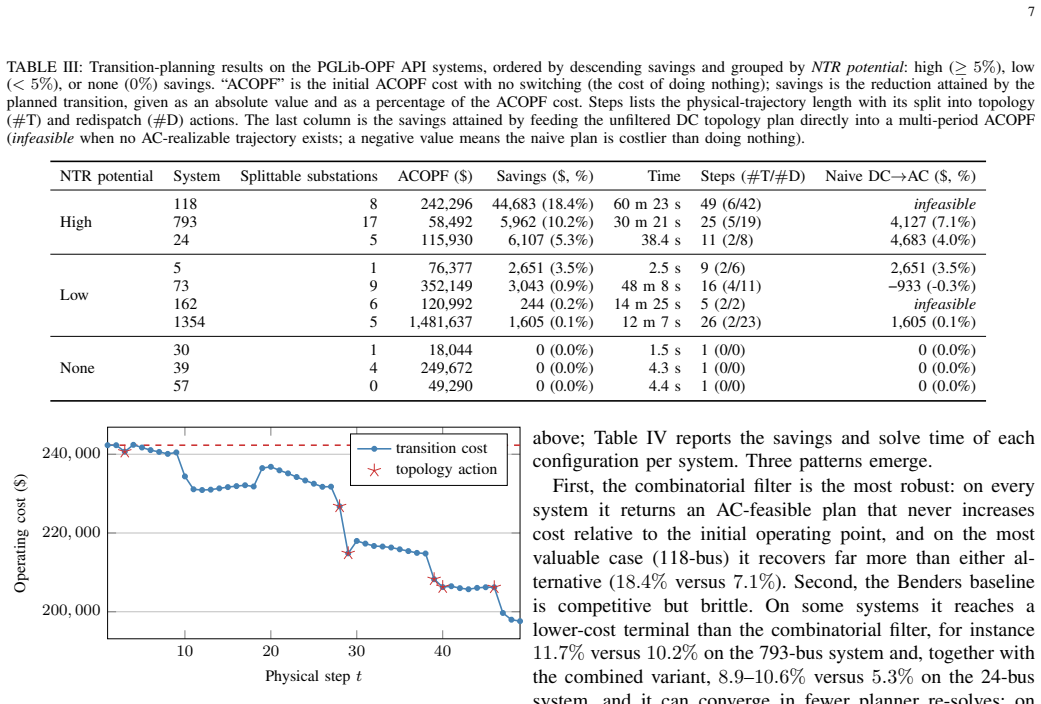
The paper establishes that a topology reconfiguration target can be turned into an executable sequence of operating points, each satisfying the AC power flow equations and thermal limits, by co-optimizing the switching sequence and the dispatch trajectory. The key geometric fact is that each topology has its own feasible dispatch region, so a valid transition must pass through an intermediate dispatch in the intersection $\mathcal{F}(\tau_0) \cap \mathcal{F}(\tau^\star)$, and when the regions do not intersect, through intermediate topologies that connect them. The proposed method—a receding-horizon loop with a DC planner, a single-period AC proxy, a multi-period ACOPF certifier, and no-good cuts that permanently exclude infeasible topologies—finds such transitions on systems up to 1354 buses and reduces operating cost by up to 18.4 percent over the no-switching ACOPF baseline. In the most valuable test case, an unfiltered DC plan is not AC-realizable at all, so the feasibility filter is what makes the saving accessible.
Load-bearing premise
The plan is certified by steady-state AC power flow and thermal limits at each step, with the dispatch change across a switch treated as a single atomic action; if switching transients or the dynamic response between steady states violate limits, the certified plan may not be physically executable.
Editorial extensions
If this is right
- On the most valuable test case (118 buses), feeding the unfiltered DC plan into a multi-period ACOPF is infeasible, so the AC feasibility filter is what makes the 18.4 percent saving executable at all.
- The method returns a near-trivial plan when reconfiguration offers no congestion relief, giving operators a direct signal about whether NTR is worth executing.
- An optional destination term lets the same framework drive toward a prescribed target topology, converting a snapshot NTR solution into a target-guided transition plan.
- Solve times range from seconds to about an hour on laptop-class hardware, placing the computation within offline operational planning horizons.
- A dual-based cut baseline can outperform the combinatorial filter on some systems but is brittle—on one system it commits no switching at all—while the combinatorial filter certifies an AC-feasible plan on every system.
Reading between the lines
- Because the cut store persists across receding windows and the paper notes reuse as promising, reusing the same cuts across consecutive operating points or load conditions may cut solve times substantially; this is a testable extension, not a demonstrated result.
- The steady-state certificate leaves electromechanical switching transients and the dynamic response to dispatch jumps out of scope; a time-domain simulation of the planned sequence is the natural next test of whether the plans survive dynamic criteria.
- The single-action rule is conservative by design, and the paper notes it relaxes to bounded simultaneous actions; quantifying the cost or feasibility gain of such a relaxation would clarify its operational value.
- Each topology's feasible dispatch region is non-convex, and the receding-horizon loop terminates at a local optimum, so the saved-cost numbers are lower bounds on what a globally optimal transition could achieve; the gap is not quantified.
Signed reviews
Editorial analysis
A structured set of objections, weighed in public.
Referee Report
Summary. The paper proposes Optimal Transition Planning (OTP): co-optimizing a sequence of generation redispatch and substation switching actions so that every intermediate operating point satisfies AC power flow and thermal limits, while respecting per-step switch budgets and ramp limits. The solution method is a two-stage receding-horizon scheme: an MPC-DC planner proposes a window trajectory, a single-period AC proxy and a multi-period ACOPF (Model 3) certify it, and combinatorial no-good cuts exclude infeasible topologies. The paper reports case studies on ten congested PGLib-OPF API systems up to 1354 buses, with up to 18.4% cost savings on the 118-bus system, zero savings on three uncongested systems, and comparisons against a Benders-cut baseline and a no-filter DC-to-AC baseline.
Significance. If the feasibility certificate were exact, this would be a valuable contribution: it turns a static NTR target into an executable plan, demonstrates that an unfiltered DC plan is not AC-realizable on the most valuable cases, and provides a reusable-cut framework that is a natural multi-period extension of existing snapshot decomposition schemes. The paper is honest in reporting zero-savings cases and in comparing against a literature-derived Benders baseline, and the benchmark set is standard and external. The main concern is that the certifier's soft freeze weakens the exactness of the 'AC-feasible transition' claim; with the exact-freeze issue fixed or reframed, the contribution is significant for transmission-system operational planning.
major comments (3)
- [Section IV-C, Model 3 (Eq. (3a))] Replacing the exact dispatch freeze of Model 2 (Eq. (2f)) with the quadratic penalty in Eq. (3a), with gamma=1e-3 in Table II, allows a dispatch change to occur in the same step as a topology change. Since the single-action rule in Section II is what makes each intermediate operating point well defined and checkable, the AC feasibility certificate now covers only the discrete pre- and post-switch steady states, not the transition between them. The paper should either enforce the exact freeze in the certifier (e.g., by requiring that the same dispatch be AC-feasible under both topologies at the switching step) or explicitly model and verify the dispatch movement during switching; otherwise the abstract's claim of 'AC-feasible transitions' is stronger than what Model 3 certifies.
- [Section IV-D] The expansion states that 'switching steps are passed through unchanged' and that the dispatch adjustment they carry is 'treated as an atomic part of the switching action rather than a ramp-limited redispatch', yet the same paragraph concludes that the result is 'a physically realizable trajectory in which every consecutive dispatch pair respects the ramp budget'. These statements are contradictory, and Section VI concedes that the dispatch jump requires a dynamic response to be judged under the corresponding criteria. This is load-bearing because the paper's conclusion and Table III present the expanded trajectory as ramp-feasible and AC-feasible at every step. Please revise the claims, and either enforce ramp limits across switching steps or report the switching-step dispatch jumps separately from the ramp-limited redispatch steps.
- [Section IV-C] The assertion that an exact freeze P_t=P_{t-1} is 'generally infeasible under AC physics, because their losses differ' is not substantiated and appears overstated; a fixed generator dispatch can often be accommodated by the slack bus, with infeasibility arising only when limits are binding. Since this assertion is the stated reason for relaxing the freeze, please provide a concrete counterexample or a more precise condition under which the freeze is infeasible; if no such condition is needed, the exact freeze should be retained in the certifier.
minor comments (5)
- [Table I] The combined check/cross markers in the table cells are hard to parse; separate columns for each power-flow model and for technical/physical constraints would improve readability.
- [Table III] The naive DC-to-AC column mixes the entry 'infeasible' with signed percentages; please define a clear convention for infeasible cases (e.g., an em dash) and state explicitly that a negative savings value means the naive plan is costlier than doing nothing.
- [Section VI] The statement that the single-action restriction 'relaxes directly to a bounded number of simultaneous actions within the same MPC structure' appears without a concrete mechanism; a brief example or reference would clarify how simultaneous actions would be handled without losing the feasibility certificate.
- [Title and Abstract] The word 'Optimal' is used for a receding-horizon heuristic whose termination condition in Algorithm 1 only guarantees a local optimum under fixed hyperparameters; a qualifier such as 'locally optimal' or 'heuristic' would prevent overstatement.
- [Section IV-C] The single-period topology proxy uses a drift tolerance (Table II), but the text does not specify how the relaxed switch values are compared to the target pattern; please state the metric (e.g., Hamming distance or a continuous norm) and the acceptance threshold in the same units.
Circularity Check
No significant circularity: the 18.4% savings is an algorithmic output on external PGLib-OPF benchmarks, not a fitted target, and the only author-overlapping citation ([6], the ANR model) is a modular modeling ingredient rather than a load-bearing premise.
full rationale
The central derivation chain is self-contained. Model 1 defines the OTP problem; Model 2 instantiates it as a DC planner with an exact dispatch freeze across switching steps; Model 3 certifies the proposed topology sequence against the AC power flow equations (7) and operational limits, with the freeze relaxed to a quadratic penalty. The reported cost savings are computed directly from solving these models on standard PGLib-OPF API systems, and the method returns exactly zero savings on systems 30, 39, and 57, demonstrating that the numbers are not forced by a fitted constant. The naive DC-to-AC baseline is infeasible on systems 118 and 162, providing an external falsification test that the AC filter is doing real work rather than merely reciting its own assumptions. The only author-overlapping reference, [6], supplies the augmented network representation (ANR) for substation switching in the planner; it is a published, externally usable modeling representation and is not invoked as a uniqueness theorem or as evidence for the feasibility claim, so it does not introduce circularity. The paper's own limitations are also not circular: Section VI states that 'the feasibility certificate is steady-state: intermediate operating points are AC-feasible, but switching transients are not modeled and N-1 security is not enforced along the transition', and Section IV-C explains that the certifier's soft penalty 'discourages but does not forbid movement', with Section IV-D treating the resulting dispatch adjustment as an atomic part of a switching action. These are scoping and modeling-fidelity caveats about what the certificate covers, not reductions of any derived quantity to an input by construction. The score of 1 reflects only the presence of a minor, non-load-bearing self-citation for the ANR representation; no circular step is identified.
Assumptions & free parameters
free parameters (9)
- look-ahead horizon H =
5
- per-step reconfiguration budget lambda_r =
4
- per-step coupler budget lambda_c =
1
- ramp budget factor alpha =
0.1
- convergence tolerance epsilon =
1e-4
- AC proxy drift tolerance =
1e-2
- max re-solve attempts per iteration =
6
- soft-freeze penalty weight gamma =
1e-3
- big-M constants M_delta and M_E =
M_delta = 1.2 rad, M_E = 50 S_base
assumptions (6)
- domain assumption The AC power flow equations (7) are the correct steady-state physical model of the transmission network.
- domain assumption The DC power flow model is an adequate planning relaxation for proposing candidate trajectories.
- ad hoc to paper Each transition step performs exactly one action, either a redispatch or a switch.
- ad hoc to paper Steady-state AC feasibility of the intermediate operating points is sufficient to certify an executable transition.
- ad hoc to paper Only substations adjacent to thermally congested lines are candidates for splitting.
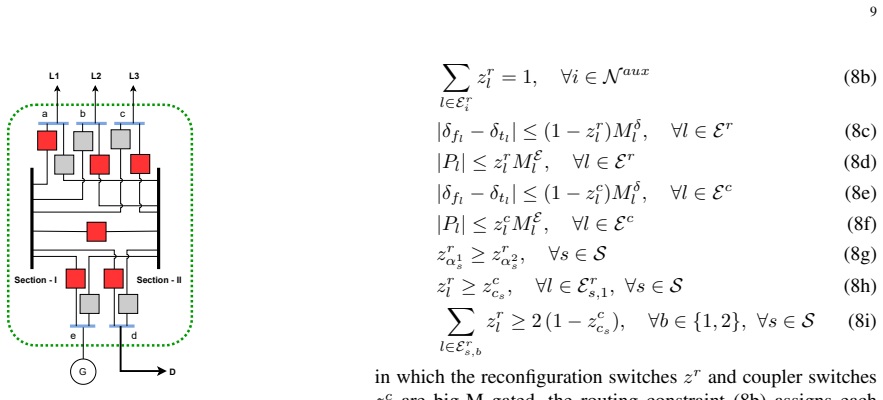
- standard math The augmented network representation and its big-M switching constraints (8) correctly model substation switching.
Cite this review
Pith. "Pith review of Network Topology Reconfiguration: Optimal Transition Planning." pith.science (2026). https://pith.science/paper/EE2ETPCC
@misc{pith2026260812047,
  author       = {Pith},
  title        = {Pith review of: Network Topology Reconfiguration: Optimal Transition Planning},
  year         = {2026},
  howpublished = {\url{https://pith.science/paper/EE2ETPCC}},
  note         = {Machine review of arXiv:2608.12047}
}
read the original abstract
Network topology reconfiguration (NTR) can reduce power system operating costs by co-optimizing generation dispatch and substation switching, but the reported savings describe a target operating point rather than a way to reach it. Reaching this operating point requires a sequence of intermediate operating points, each satisfying the AC power flow equations and thermal limits; because each topology admits its own feasible dispatch region, a naive transition that switches or redispatches first can drive intermediate flows past their thermal limits. Existing methods leave this gap open: snapshot NTR identifies a target but not a route. We formulate the Optimal Transition Planning (OTP) problem, co-optimizing the switching sequence and dispatch trajectory subject to AC feasibility at every intermediate point. We solve this problem with a receding-horizon framework: a DC planner proposes a trajectory that is certified against an AC feasibility filter, and infeasible topologies are excluded using reusable combinatorial cuts. Case studies on congested PGLib-OPF systems up to 1354-bus show that the method produces AC-feasible transitions that reduce operating cost by up to 18.4% compared to the no-switching ACOPF solution on commodity hardware.
Figures


Figures from the paper (2 more)
Reference graph
Works this paper leans on
-
[11]
T. Han, D. J. Hill, and Y . Song, “Optimal topology transition,”IEEE Transactions on Power Systems, vol. 38, no. 4, pp. 3029–3042, 2023
work page 2023
-
[12]
Static Switching Security in Multi– Period Transmission Switching,
C. Liu, J. Wang, and J. Ostrowski, “Static Switching Security in Multi– Period Transmission Switching,”IEEE Transactions on Power Systems, vol. 27, no. 4, pp. 1850–1858, Nov. 2012
work page 2012
-
[17]
Day-ahead transmission grid topology optimization considering renewable energy sources’ uncertainty,
G. Bastianel, D. Van Hertem, H. Ergun, and L. Roald, “Day-ahead transmission grid topology optimization considering renewable energy sources’ uncertainty,”International Journal of Electrical Power & Energy Systems, vol. 174, p. 111527, 2026
work page 2026
-
[1]
Optimal Transmission Switching,
E. B. Fisher, R. P. O’Neill, and M. C. Ferris, “Optimal Transmission Switching,”IEEE Transactions on Power Systems, vol. 23, no. 3, pp. 1346–1355, Aug. 2008
work page 2008
-
[2]
Co-Optimization of Generation Unit Commitment and Transmission Switching With N-1 Reliability,
K. W. Hedman, M. C. Ferris, R. P. O’Neill, E. B. Fisher, and S. S. Oren, “Co-Optimization of Generation Unit Commitment and Transmission Switching With N-1 Reliability,”IEEE Transactions on Power Systems, vol. 25, no. 2, pp. 1052–1063, May 2010
work page 2010
-
[3]
Congestion management through topologi- cal corrections: A case study of Central Western Europe,
J. Han and A. Papavasiliou, “Congestion management through topologi- cal corrections: A case study of Central Western Europe,”Energy Policy, vol. 86, pp. 470–482, Nov. 2015
work page 2015
-
[4]
Toward online bus-bar splitting for increas- ing load margins to static stability limit,
L. Wang and H.-D. Chiang, “Toward online bus-bar splitting for increas- ing load margins to static stability limit,”IEEE Transactions on Power Systems, vol. 32, no. 5, pp. 3715–3725, 2017. 10 Algorithm 1Receding-horizon MPC-DC with AC filtering Require:grid, optional target topology, horizon𝐻, switching budgets𝜆 𝑟,𝜆𝑐, tolerances𝜖and drift 1:Solve DC and A...
work page 2017
-
[5]
E. Nasrolahpour and H. Ghasemi, “A stochastic security constrained unit commitment model for reconfigurable networks with high wind power penetration,”Electric Power Systems Research, vol. 121, pp. 341–350, Apr. 2015
work page 2015
Show all 30 references
-
[6]
Security constrained OPF utilizing substation reconfiguration and busbar splitting,
B. Morsy, A. Hinneck, D. Pozo, and J. Bialek, “Security constrained OPF utilizing substation reconfiguration and busbar splitting,”Electric Power Systems Research, vol. 212, p. 108507, Nov. 2022
2022
-
[7]
Day-Ahead Contingency- Constrained Unit Commitment With Co-Optimized Post-Contingency Transmission Switching,
R. Saavedra, A. Street, and J. M. Arroyo, “Day-Ahead Contingency- Constrained Unit Commitment With Co-Optimized Post-Contingency Transmission Switching,”IEEE Transactions on Power Systems, vol. 35, no. 6, pp. 4408–4420, Nov. 2020
2020
-
[8]
Optimal bus splitting for short- circuit current limitation in metropolitan area,
S. Namchoat and N. Hoonchareon, “Optimal bus splitting for short- circuit current limitation in metropolitan area,” in2013 10th Inter- national Conference on Electrical Engineering/Electronics, Computer, Telecommunications and Information Technology, May 2013, pp. 1–5
2013
-
[9]
Review on optimization methodologies in transmission network reconfiguration of power systems for grid resilience,
T. Aziz, Z. Lin, M. Waseem, and S. Liu, “Review on optimization methodologies in transmission network reconfiguration of power systems for grid resilience,”International Transactions on Electrical Energy Systems, vol. 31, no. 3, p. e12704, 2021
2021
-
[10]
The Role of Optimal Transmission Switching in Enhancing Grid Flexibility: A Review,
M. Numan, M. F. Abbas, M. Yousif, S. S. M. Ghoneim, A. Mohammad, and A. Noorwali, “The Role of Optimal Transmission Switching in Enhancing Grid Flexibility: A Review,”IEEE Access, vol. 11, pp. 32 437–32 463, 2023
2023
-
[13]
Power Grid Congestion Management via Topology Optimization with AlphaZero,
M. Dorfer, A. R. Fuxjäger, K. Kozak, P. M. Blies, and M. Wasserer, “Power Grid Congestion Management via Topology Optimization with AlphaZero,” Nov. 2022, arXiv:2211.05612 [cs]
2022 arXiv
-
[14]
Subramanian, J
M. Subramanian, J. Viebahn, S. Tindemans, B. Donnot, and A. Marot, Exploring grid topology reconfiguration using a simple deep reinforce- ment learning approach, Nov. 2020
2020
-
[15]
Corrective model-predictive control in large electric power systems,
J. A. Martin and I. A. Hiskens, “Corrective model-predictive control in large electric power systems,”IEEE Transactions on Power Systems, vol. 32, no. 2, pp. 1651–1662, 2017
2017
-
[16]
Switching device-cognizant sequential distribution system restoration,
A. Arif, B. Cui, and Z. Wang, “Switching device-cognizant sequential distribution system restoration,”IEEE Transactions on Power Systems, vol. 37, no. 1, pp. 317–329, 2022
2022
-
[18]
Tractable Transmission Topology Control Using Sensitivity Analysis,
P. A. Ruiz, J. M. Foster, A. Rudkevich, and M. C. Caramanis, “Tractable Transmission Topology Control Using Sensitivity Analysis,” IEEE Transactions on Power Systems, vol. 27, no. 3, pp. 1550–1559, Aug. 2012
2012
-
[19]
Fast Heuristics for Transmission- Line Switching,
J. D. Fuller, R. Ramasra, and A. Cha, “Fast Heuristics for Transmission- Line Switching,”IEEE Transactions on Power Systems, vol. 27, no. 3, pp. 1377–1386, Aug. 2012
2012
-
[20]
On fast transmission topology control heuristics,
P. A. Ruiz, J. M. Foster, A. Rudkevich, and M. C. Caramanis, “On fast transmission topology control heuristics,” in2011 IEEE Power and Energy Society General Meeting, Jul. 2011, pp. 1–8
2011
-
[21]
Heuristic Prescreening Switchable Branches in Optimal Transmission Switching,
C. Liu, J. Wang, and J. Ostrowski, “Heuristic Prescreening Switchable Branches in Optimal Transmission Switching,”IEEE Transactions on Power Systems, vol. 27, no. 4, pp. 2289–2290, Nov. 2012
2012
-
[22]
Computationally efficient optimal Transmission Switching: Solution space reduction,
C. Barrows, S. Blumsack, and R. Bent, “Computationally efficient optimal Transmission Switching: Solution space reduction,” in2012 IEEE Power and Energy Society General Meeting, Jul. 2012, pp. 1– 8
2012
-
[23]
Column Generation for Transmis- sion Switching of Electricity Networks with Unit Commitment,
J. C. Villumsen and A. B. Philpott, “Column Generation for Transmis- sion Switching of Electricity Networks with Unit Commitment,”Hong Kong, 2011
2011
-
[24]
Optimal transmission congestion management by means of substation reconfiguration,
E. Nasrolahpour, H. Ghasemi, and M. Khanabadi, “Optimal transmission congestion management by means of substation reconfiguration,” in20th Iranian Conference on Electrical Engineering (ICEE2012), 2012, pp. 416–421
2012
-
[25]
An optimal transmission line switching and bus splitting heuristic incorporating ac and n-1 contingency constraints,
M. Heidarifar, P. Andrianesis, P. Ruiz, M. C. Caramanis, and I. C. Paschalidis, “An optimal transmission line switching and bus splitting heuristic incorporating ac and n-1 contingency constraints,”Interna- tional Journal of Electrical Power & Energy Systems, vol. 133, p. 107278, 2021
2021
-
[26]
A Bound Strengthening Method for Optimal Transmission Switching in Power Systems,
S. Fattahi, J. Lavaei, and A. Atamtürk, “A Bound Strengthening Method for Optimal Transmission Switching in Power Systems,”IEEE Transac- tions on Power Systems, vol. 34, no. 1, pp. 280–291, Jan. 2019
2019
-
[27]
Security-Constrained Transmission Topol- ogy Control MILP Formulation Using Sensitivity Factors,
P. A. Ruiz, E. A. Goldis, A. Rudkevich, M. C. Caramanis, C. R. Philbrick, and J. M. Foster, “Security-Constrained Transmission Topol- ogy Control MILP Formulation Using Sensitivity Factors,”IEEE Trans- actions on Power Systems, pp. 1–1, 2016
2016
-
[28]
Learning-Based Topology Optimization of Power Networks,
T. Han and D. Hill, “Learning-Based Topology Optimization of Power Networks,”IEEE Transactions on Power Systems, pp. 1–1, 2022
2022
-
[29]
Real-time transmission switching with neural networks,
A.-A. B. Bugaje, J. L. Cremer, and G. Strbac, “Real-time transmission switching with neural networks,”IET Generation, Transmission & Distribution, vol. 17, no. 3, pp. 696–705, 2023
2023
-
[30]
The power grid library for benchmarking ac optimal power flow algorithms,
S. Babaeinejadsarookolaeeet al., “The power grid library for benchmarking ac optimal power flow algorithms,” 2021. [Online]. Available: https://arxiv.org/abs/1908.02788
2021 arXiv
Reviewed August 16, 2026 · model on record in the stance chip above.
Discussion (0). Continue with ORCID to comment.