REVIEW 4 major objections 5 minor 295 references
SPURS: Massive Stars, Dense Gas, and Ly$\alpha$ Escape in GN-z11 at $z = 10.6$
T0 review · 4 major / 5 minor · reviewed 2026-08-16 · deepseek-v4-flash
Pith's one-line read Ultra-deep JWST spectroscopy of GN-z11 finds stellar-wind features that require very massive stars (>100 solar masses) at low metallicity and ≤3 Myr age, pointing to the first directly probed very-massive-star population at z>10.
desk verdict Deep SPURS data deliver genuinely new empirical results on GN-z11, but the headline very-massive-star claim rides on an assumed IGM bubble size and stellar metallicity; the paper is transparent about this, so it deserves serious refereeing rather than desk rejection. read the letter →
The pith
A machine-rendered reading of the paper's core claim, the machinery that carries it, and where it could break.
The reading
What carries the argument
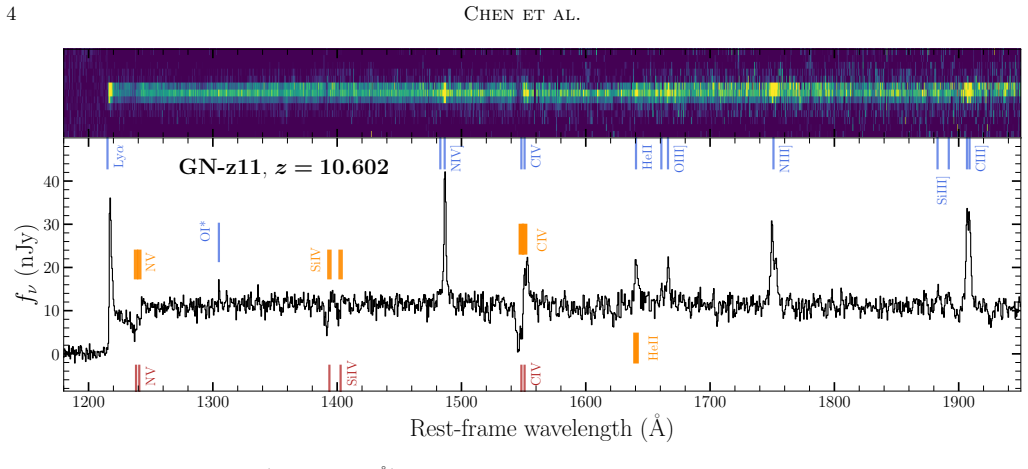
The load-bearing objects are the stellar-wind P-Cygni features ($\mathrm{N\,V}\,\lambda\lambda1238,1242$; $\mathrm{Si\,IV}\,\lambda\lambda1393,1402$; $\mathrm{C\,IV}\,\lambda\lambda1548,1550$) and broad $\mathrm{He\,II}\,\lambda1640$, fitted with the FiCUS continuum-fitting code as linear combinations of simple stellar populations from two model families that include very massive stars (the CB19 and M25 grids). These features are sharply age-, metallicity-, and IMF-sensitive: $\mathrm{N\,V}$ appears only in populations younger than about 3 Myr, $\mathrm{Si\,IV}$ and $\mathrm{C\,IV}$ track metallicity, and the P-Cygni troughs plus $\mathrm{He\,II}$ strengthen considerably when the IMF is extended from $100\,M_\odot$ to $300\,M_\odot$. The IGM damping-wing correction, computed assuming fully neutral gas beginning $0.5$ pMpc from the galaxy, sets the intrinsic $\mathrm{N\,V}$ profile that the models must reproduce.
What would settle it
Measure the size of GN-z11's ionized bubble—for example with a higher-resolution Ly$\alpha$ profile and independent IGM damping-wing modeling—and show that the neutral gas begins more than about $2$ Mpc away; the paper's own grids then no longer require stars above $100\,M_\odot$. A second decisive check is a deeper spectrum around $\mathrm{N\,IV}\,\lambda1719$: a broad detection would rule out the proposed dense WN/LBV origin of the broad $\mathrm{N\,IV]}$ component.
Extended reading notes
Core claim
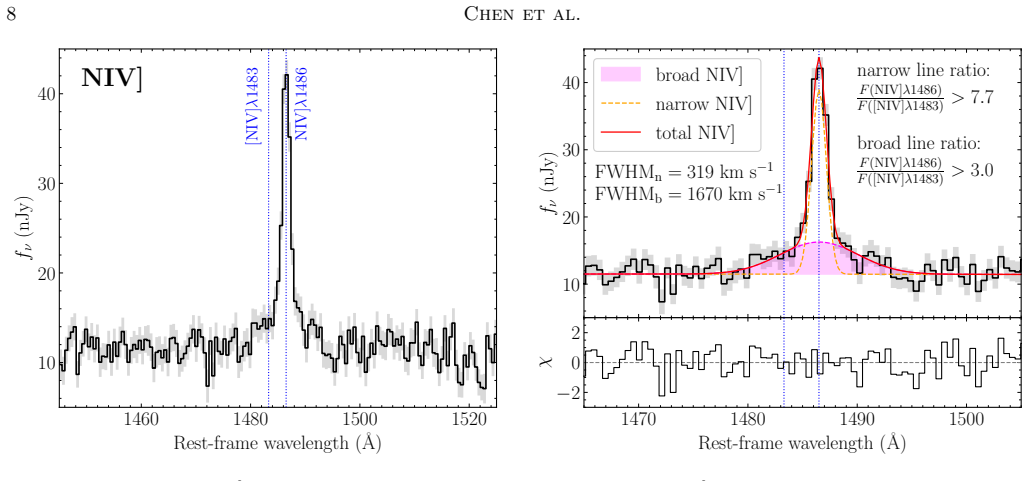
The paper's central claim is that the rest-UV spectrum of GN-z11 is a stellar-wind spectrum: the strong $\mathrm{N\,V}$ P-Cygni profile survives IGM damping-wing correction, and the joint fit of $\mathrm{N\,V}$, $\mathrm{Si\,IV}$, $\mathrm{C\,IV}$, and $\mathrm{He\,II}$ succeeds with two independent stellar-population model families only when the IMF extends to $300\,M_\odot$, the stellar metallicity is near $0.04\,Z_\odot$, and a substantial fraction of the UV light comes from $2$–$3$ Myr old populations. Models capped at $100\,M_\odot$ underproduce the P-Cygni emission at the fiducial distance to the neutral IGM ($0.5$ pMpc); they match only if that distance exceeds about $2$ pMpc, which the paper argues is unlikely given reionization-era Ly$\alpha$ constraints. The broad $\mathrm{N\,IV]}$ component, with no accompanying broad $\mathrm{N\,IV}\,\lambda1719$, is reproduced by adding a dense, relatively cool WN atmosphere or an LBV-outburst spectrum at roughly 13–35% of the UV continuum, suggesting N-rich outflows from a very-massive-star population in a dense cluster environment, though an AGN-driven wind cannot be excluded.
Load-bearing premise
The load-bearing premise is that GN-z11 sits in a small ionized bubble (neutral intergalactic gas starting about $0.5$ Mpc away) and has very low stellar metallicity; if the neutral gas starts more than about $2$ Mpc away, the paper's own fiducial models without very massive stars can fit the spectrum, and the VMS conclusion collapses.
Editorial extensions
If this is right
- If GN-z11 does host very massive stars, its super-solar N/O ratio (3.9× solar) can be explained by CNO-cycle winds and LBV-like eruptions from these stars within the first few million years, rather than by an AGN.
- Lyα visibility at z>10 does not require a very large ionized bubble: GN-z11's red wing, carrying 44% of the Lyα flux at >500 km/s, encounters 16–32% IGM transmission versus 0.3–7% at line center.
- The combination of O I* λ1304 fluorescence with weak low-ionization absorption implies that dense neutral gas is confined to a compact nuclear region, with the bulk of the UV continuum emerging from surrounding star-forming clusters.
- The failure of 100 M⊙-truncated IMF models at the fiducial IGM parameters identifies R~2700 spectroscopy as the next test, since it can separate stellar-wind and nebular contributions to He II and N V and distinguish between VMS wind prescriptions.
- If very massive stars assemble through runaway collisions in dense, low-metallicity clusters, their collapse after ~2.5–5 Myr would seed intermediate-mass black holes, linking GN-z11's starburst to black-hole formation in the early universe.
Reading between the lines
- A natural extension, not carried out in this paper, is to search the same broad N IV] component in the full sample of known z>8 nitrogen emitters; if it is common, dense WN/LBV winds may be a standard phase of early massive-star formation rather than a peculiarity of GN-z11.
- Because the VMS inference is degenerate with the assumed ionized-bubble size, independent reionization constraints at z≈10.6 (from Lyα damping wings of other galaxies or 21-cm observations) could either strengthen or overturn the stellar-population conclusion without changing the spectrum.
- If the paper's WN/LBV interpretation is right, population-synthesis models that omit eruptive mass loss may misclassify similar UV spectra in other high-redshift sources as AGN, since a dense, N-rich outflow can mimic the broad-line signatures of an active nucleus.
Signed reviews
Editorial analysis
A structured set of objections, weighed in public.
Referee Report
Summary. The paper presents ultra-deep JWST/NIRSpec medium-resolution spectroscopy of the z=10.6 galaxy GN-z11 from the SPURS program, combined with JADES data. The authors measure a suite of rest-UV and rest-optical emission lines, resolve the Lyα profile, detect interstellar absorption lines, and infer gas densities, temperatures, and abundances. They then fit the rest-UV continuum with stellar population synthesis models and claim that the P-Cygni wind features (NV, SiIV, CIV) and broad HeII require very massive stars (>100 M_sun) at low metallicity (0.04 Z_sun) and young ages (<=3 Myr), after correcting for IGM damping-wing attenuation assuming a small ionized bubble (Db=0.5 pMpc). The paper also reports a broad component to NIV] lambda1486, seen in several nitrogen emitters, and proposes dense WN winds or LBV-like outbursts as a possible origin, while acknowledging that an AGN wind cannot be excluded.
Significance. If the VMS interpretation is correct, this is the first direct spectroscopic probe of very massive stars at z>10, with implications for stellar evolution, nitrogen enrichment, and the seeding of intermediate-mass black holes. The empirical measurements are carefully executed: line fluxes and widths are derived with resampling uncertainties, model selection uses BIC, and the paper is transparent about caveats. The rest-UV absorption-line results (fast highly ionized outflow, weak low-ionization covering fraction) and the resolved Lyα profile (broad red wing, low escape fraction) are robust and valuable regardless of the stellar population modeling. However, the headline VMS conclusion is conditional on the assumed IGM bubble size and stellar metallicity, and the paper's own analysis shows that non-VMS models can fit the data for larger bubbles or higher metallicities. The manuscript would be greatly strengthened by a quantitative treatment of these degeneracies.
major comments (4)
- [§6.3–6.4] The central claim that very massive stars (VMS) are required to reproduce the rest-UV wind features is not robust to the assumed distance to the nearest neutral IGM, Db. The paper adopts Db=0.5 pMpc but states in §6.4 that non-VMS models (Mup=100 M_sun) can reproduce the spectrum for Db>2 pMpc, and labels such bubbles 'unlikely' on the basis of reionization simulations rather than a quantitative posterior from the combined Lyα and NV data. Because the IGM damping-wing correction directly shapes the NV profile used to infer the stellar population, the authors should either provide a joint constraint on Db from the observed Lyα profile and NV profile under a physical prior on the IGM neutral fraction, or explicitly present the VMS result as conditional on Db and temper the abstract and summary accordingly.
- [§6.2 and §6.4] The adopted stellar metallicity Z*=0.04 Z_sun is an assumption derived from the gas-phase oxygen abundance (0.18 Z_sun) and an assumed alpha-enhancement factor of about 5, and the VMS inference is conditional on this value. The paper shows that at Db=0.1 pMpc the VMS models at Z*=0.04 fail to match the NV emission, requiring higher metallicity, and that at Db=0.5 pMpc the VMS models with Z*=0.1–0.2 Z_sun fit comparably well. A formal sensitivity analysis or joint fit over Z* and Db is needed to establish whether the data actually require low-metallicity VMS, or whether the conclusion is an artifact of the adopted priors.
- [§7.2] The proposed origin of the broad NIV] component in dense WN winds or LBV-like outbursts is supported by a single PoWR atmosphere and the HD 5980 spectrum that were selected specifically to match the observed line strengths, with no exploration of the parameter space or statistical comparison to alternative models. The paper states that this is a 'simple experiment' with future work planned, but the abstract presents the WN/LBV interpretation as a plausible finding. The authors should clearly label this part of the analysis as an illustrative hypothesis and either provide a quantitative exploration of the WN parameter space or soften the abstract's claim.
- [§6.4] The paper asserts that without VMS the fits to the wind lines are 'considerably worse' at the fiducial Db=0.5 pMpc and Z*=0.04 Z_sun, but does not report the goodness-of-fit statistics for the non-VMS models or a formal model comparison (e.g., BIC or AIC) that accounts for the number of free parameters. Given the degeneracies with Db and Z*, a quantitative comparison of VMS and non-VMS models over the allowed parameter space is necessary to support the claim that VMS are 'very important' to the fit.
minor comments (5)
- [§6.3] There is a typo in the sentence 'The weak low-ionization absorption lines (§4) imply either the total HI column density in front of the UV continuum is lowWe also consider damped Lyα absorption...'; the text appears to be missing a period or conjunction.
- [Figure 10] The caption contains a typo: 'T oppanel' should read 'Top panel'.
- [§2.2] The factor 1.3 applied to the in-flight line spread function should be justified with a reference or a brief explanation of its origin.
- [§6.3] The choice of Db=0.5 pMpc as the fiducial value is the upper end of the 68% range from Lu et al. (2024); the paper should explain why the median value of 0.3 pMpc was not adopted for the fiducial model.
- [§2 and §8] The paper mentions that an independent analysis of the SPURS spectrum is presented by Nakane et al. (2026) but does not compare its conclusions; a brief discussion of any differences or agreements would help the reader evaluate potential systematic effects.
Circularity Check
No significant circularity; the VMS claim is parameter-dependent but explicitly stated and the key additions are acknowledged as fits rather than predictions.
full rationale
The paper's empirical measurements (line fluxes, equivalent widths, velocity profiles, and non-detections) are model-independent and serve as the primary data. The central inference that very massive stars are present is drawn from a stellar-population model comparison (Section 6.4) using the CB19, M25, and BPASS models, including explicit non-VMS (Mup=100 Msun) alternatives; the failure of the non-VMS models depends on the adopted low stellar metallicity (Z*=0.04 Zsun) and small IGM ionized bubble (Db=0.5 pMpc), and the paper transparently shows that non-VMS models can fit if Db>2 pMpc. This is an assumption-sensitivity analysis rather than a circular reduction: the bubble size is set from external reionization simulations and the Ly-alpha EW, not derived from the stellar wind features. The broad N IV] component is first identified as an unexplained spectral feature; the later addition of a PoWR WN atmosphere (Section 7.2) is explicitly described as 'a simple experiment' and the atmosphere is 'chosen from the PoWR grids specifically as a visually close approximation of the observed line strengths,' so it is a fit used to illustrate a possible origin, not a prediction claimed to be derived from first principles. Self-citations appear (e.g., Lu et al. 2024 for bubble sizes, Plat et al. 2019 for CB19 models, Tang et al. 2024a for IGM neutrality) but these are external published simulations and models, not a chain that forces the conclusion by definition. No equation or fitted parameter is shown to reduce to its own input. The paper is therefore not circular, though the VMS conclusion is conditional on the small-bubble and low-metallicity assumptions, which are stated explicitly and tested for sensitivity.
Assumptions & free parameters
free parameters (5)
- Stellar metallicity Z* =
0.04 Zsun (fiducial)
- Distance to nearest neutral IGM Db =
0.5 pMpc (fiducial)
- SSP age light fractions =
dominated by 2-3 Myr SSPs
- Ionization parameter log U =
-1.82
- V-band dust optical depth tau_V =
0.01
assumptions (6)
- domain assumption CB19 and M25 stellar population models with VMS up to 300 Msun, and their wind and mass-loss prescriptions, describe real low-metallicity massive stars.
- domain assumption The IGM is fully neutral beyond a spherical ionized bubble, and the damping-wing transmission follows the adopted Mason and Gronke model with z_reion=5.5.
- domain assumption Gas-phase oxygen abundance maps to stellar metallicity with roughly a factor of 5 alpha/Fe enhancement.
- domain assumption The stellar IMF is a Chabrier IMF with mass limits 0.1-300 Msun, or a Salpeter-like slope above 0.5 Msun for the M25 models.
- domain assumption Case B recombination ratios apply to the Balmer lines and Ly alpha/H gamma relation.
- standard math PyNeb atomic data and transition probabilities used for density and temperature diagnostics are accurate.
Cite this review
Pith. "Pith review of SPURS: Massive Stars, Dense Gas, and Ly$\alpha$ Escape in GN-z11 at $z = 10.6$." pith.science (2026). https://pith.science/paper/3REAR2KC
@misc{pith2026260812699,
  author       = {Pith},
  title        = {Pith review of: SPURS: Massive Stars, Dense Gas, and Ly$\alpha$ Escape in GN-z11 at $z = 10.6$},
  year         = {2026},
  howpublished = {\url{https://pith.science/paper/3REAR2KC}},
  note         = {Machine review of arXiv:2608.12699}
}
abstract
We present ultra-deep {\it JWST} spectroscopy of GN-z11 ($z=10.6$) obtained through the SPURS Cycle 4 Large Program, providing the deepest rest-UV view yet obtained of a galaxy at $z>10$. GN-z11 was previously found to be nitrogen-enhanced with detectable Ly$\alpha$. The SPURS spectrum reveals P-Cygni stellar wind features and broad He II emission that are jointly reproduced by stellar population models incorporating very massive stars (VMS; $>100\,M_\odot$) at low metallicity and young ages ($\lesssim3$ Myr). We also detect a broad ($\rm FWHM=1670$ km s$^{-1}$) component to N IV] $\lambda1486$, now seen in several nitrogen emitters, potentially arising from dense WN winds or LBV-like outbursts associated with a population of VMS in a dense environment, though an AGN-driven wind cannot be excluded. In either scenario, this broad component may trace the gas producing GN-z11's nitrogen enhancement. Rest-UV absorption lines reveal a fast ($\sim500$~km~s$^{-1}$), highly ionized outflow and a negligible neutral gas covering fraction. We resolve the weak Ly$\alpha$ emission (EW=5.6 \AA, $f_{\rm esc,Ly\alpha}=2.7$\%), finding a broad red wing (44\% of flux at $>500$ km s$^{-1}$) that should experience reduced IGM damping wing suppression and help explain Ly$\alpha$ visibility at $z>10$. Fine-structure O I* $\lambda1304$ emission indicates dense neutral gas near a subset of the ionizing sources, which may also scatter Ly$\alpha$ to the large observed velocities. The weak low-ionization absorption favors a picture in which this dense neutral gas is confined to a compact nuclear region. Together, these results are consistent with a rapid burst of star formation building up the dense nuclear regions and surrounding clusters in GN-z11.
Figures


Figures from the paper (17 more)


Reference graph
Works this paper leans on
-
[1]
The Low-redshift Lyman Continuum Survey: Optically Thin and Thick Mg II Lines as Probes of Lyman Continuum Escape. , keywords =. doi:10.3847/1538-4357/aca89a , archivePrefix =. 2301.04087 , primaryClass =
-
[2]
The Structure and Kinematics of the Circumgalactic Medium from Far-ultraviolet Spectra of z -0.5ex = 2-3 Galaxies. , keywords =. doi:10.1088/0004-637X/717/1/289 , archivePrefix =. 1003.0679 , primaryClass =
-
[3]
The James Webb Space Telescope Mission. , keywords =. doi:10.1088/1538-3873/acd1b5 , archivePrefix =. 2304.04869 , primaryClass =
-
[4]
The Science Performance of JWST as Characterized in Commissioning. , keywords =. doi:10.1088/1538-3873/acb293 , archivePrefix =. 2207.05632 , primaryClass =
-
[5]
Encyclopedia of Astrophysics, Volume 4 , year = 2026, volume =
Observations of the first galaxies in the Era of JWST. Encyclopedia of Astrophysics, Volume 4 , year = 2026, volume =. doi:10.1016/B978-0-443-21439-4.00128-0 , archivePrefix =. 2501.17078 , primaryClass =
arXiv 2026
-
[6]
JADES NIRSpec Spectroscopy of GN-z11: Lyman- emission and possible enhanced nitrogen abundance in a z = 10.60 luminous galaxy. , keywords =. doi:10.1051/0004-6361/202346159 , archivePrefix =. 2302.07256 , primaryClass =
-
[7]
JWST absorption line spectroscopy with SPURS: ISM covering fractions and kinematics in individual galaxies at z=5-9. arXiv e-prints , keywords =. doi:10.48550/arXiv.2606.06609 , archivePrefix =. 2606.06609 , primaryClass =
-
[8]
UV Luminosity Functions at Redshifts z 4 to z 10: 10,000 Galaxies from HST Legacy Fields. , keywords =. doi:10.1088/0004-637X/803/1/34 , archivePrefix =. 1403.4295 , primaryClass =
Show all 295 references
-
[9]
, keywords =
New Determinations of the UV Luminosity Functions from z 9 to 2 Show a Remarkable Consistency with Halo Growth and a Constant Star Formation Efficiency. , keywords =. doi:10.3847/1538-3881/abf83e , archivePrefix =. 2102.07775 , primaryClass =
-
[10]
, keywords =
The Evolution of the Galaxy Rest-frame Ultraviolet Luminosity Function over the First Two Billion Years. , keywords =. doi:10.1088/0004-637X/810/1/71 , archivePrefix =. 1410.5439 , primaryClass =
-
[11]
, keywords =
The Dearth of z 10 Galaxies in All HST Legacy Fields The Rapid Evolution of the Galaxy Population in the First 500 Myr. , keywords =. doi:10.3847/1538-4357/aab03f , archivePrefix =. 1710.11131 , primaryClass =
-
[12]
, keywords =
A lack of evolution in the very bright end of the galaxy luminosity function from z ≃ 8 to 10. , keywords =. doi:10.1093/mnras/staa313 , archivePrefix =. 1911.12832 , primaryClass =
1911 arXiv
-
[13]
Early Results from GLASS-JWST. III. Galaxy Candidates at z 9-15. , keywords =. doi:10.3847/2041-8213/ac94d0 , archivePrefix =. 2207.09436 , primaryClass =
-
[14]
, keywords =
Two Remarkably Luminous Galaxy Candidates at z 10-12 Revealed by JWST. , keywords =. doi:10.3847/2041-8213/ac9b22 , archivePrefix =. 2207.09434 , primaryClass =
-
[15]
, keywords =
Discovery and properties of ultra-high redshift galaxies (9 < z < 12) in the JWST ERO SMACS 0723 Field. , keywords =. doi:10.1093/mnras/stac3347 , archivePrefix =. 2207.11217 , primaryClass =
-
[16]
CEERS Key Paper. I. An Early Look into the First 500 Myr of Galaxy Formation with JWST. , keywords =. doi:10.3847/2041-8213/acade4 , archivePrefix =. 2211.05792 , primaryClass =
-
[17]
, keywords =
A Comprehensive Study of Galaxies at z 9-16 Found in the Early JWST Data: Ultraviolet Luminosity Functions and Cosmic Star Formation History at the Pre-reionization Epoch. , keywords =. doi:10.3847/1538-4365/acaaa9 , archivePrefix =. 2208.01612 , primaryClass =
-
[18]
, keywords =
JWST PRIMER: a new multifield determination of the evolving galaxy UV luminosity function at redshifts z ≃ 9 - 15. , keywords =. doi:10.1093/mnras/stae2037 , archivePrefix =. 2403.03171 , primaryClass =
-
[19]
, keywords =
Earliest Galaxies in the JADES Origins Field: Luminosity Function and Cosmic Star Formation Rate Density 300 Myr after the Big Bang. , keywords =. doi:10.3847/1538-4357/ad463d , archivePrefix =. 2312.10033 , primaryClass =
-
[20]
, keywords =
The z 9 Galaxy UV Luminosity Function from the JWST Advanced Deep Extragalactic Survey: Insights into Early Galaxy Evolution and Reionization. , keywords =. doi:10.3847/1538-4357/adfddc , archivePrefix =. 2501.00984 , primaryClass =
-
[21]
, keywords =
Efficient formation of massive galaxies at cosmic dawn by feedback-free starbursts. , keywords =. doi:10.1093/mnras/stad1557 , archivePrefix =. 2303.04827 , primaryClass =
-
[22]
, keywords =
Implications of z 12 JWST galaxies for galaxy formation at high redshift. , keywords =. doi:10.1093/mnras/stad2448 , archivePrefix =. 2305.17959 , primaryClass =
-
[23]
, keywords =
Elevated UV luminosity density at Cosmic Dawn explained by non-evolving, weakly mass-dependent star formation efficiency. , keywords =. doi:10.1093/mnras/stae2633 , archivePrefix =. 2407.02674 , primaryClass =
-
[24]
, keywords =
Density-modulated star formation efficiency: implications for the observed abundance of ultraviolet luminous galaxies at z > 10. , keywords =. doi:10.1093/mnras/staf1824 , archivePrefix =. 2505.05442 , primaryClass =
-
[25]
, keywords =
The brightest galaxies at cosmic dawn. , keywords =. doi:10.1093/mnras/stad035 , archivePrefix =. 2207.14808 , primaryClass =
-
[26]
, keywords =
Balancing the efficiency and stochasticity of star formation with dust extinction in z 10 galaxies observed by JWST. , keywords =. doi:10.1093/mnras/stac3578 , archivePrefix =. 2208.12826 , primaryClass =
-
[27]
, keywords =
The impact of UV variability on the abundance of bright galaxies at z 9. , keywords =. doi:10.1093/mnras/stad2508 , archivePrefix =. 2305.05679 , primaryClass =
- [28]
-
[29]
, keywords =
Blue monsters at z > 10: Where all their dust has gone. , keywords =. doi:10.1051/0004-6361/202452707 , archivePrefix =. 2410.19042 , primaryClass =
-
[30]
, keywords =
Impact of the cosmic background radiation on the initial mass function of metal-poor stars. , keywords =. doi:10.1093/mnras/stac1549 , archivePrefix =. 2205.15328 , primaryClass =
-
[31]
, keywords =
A JWST/NIRSpec First Census of Broad-line AGNs at z = 4-7: Detection of 10 Faint AGNs with M _ BH 10 ^ 6 - 10 ^ 8 M _ ☉ and Their Host Galaxy Properties. , keywords =. doi:10.3847/1538-4357/ad029e , archivePrefix =. 2303.11946 , primaryClass =
-
[32]
, keywords =
A hidden population of active galactic nuclei can explain the overabundance of luminous z > 10 objects observed by JWST. , keywords =. doi:10.1088/1475-7516/2024/08/025 , archivePrefix =. 2405.01629 , primaryClass =
2024 arXiv
-
[33]
, keywords =
Templates for Fitting Photometry of Ultra-high-redshift Galaxies. , keywords =. doi:10.3847/2041-8213/acdef6 , archivePrefix =. 2208.07879 , primaryClass =
-
[34]
III star formation and metallicity evolution - I
Semi-analytic modelling of Pop. III star formation and metallicity evolution - I. Impact on the UV luminosity functions at z = 9-16. , keywords =. doi:10.1093/mnras/stae567 , archivePrefix =. 2401.07396 , primaryClass =
-
[35]
, keywords =
JWST Identification of Extremely Low C/N Galaxies with [N/O] 0.5 at z 6-10 Evidencing the Early CNO-cycle Enrichment and a Connection with Globular Cluster Formation. , keywords =. doi:10.3847/1538-4357/ad09be , archivePrefix =. 2307.00710 , primaryClass =
-
[36]
, keywords =
GN-z11 in Context: Possible Signatures of Globular Cluster Precursors at Redshift 10. , keywords =. doi:10.3847/1538-4357/ad235e , archivePrefix =. 2303.04179 , primaryClass =
-
[37]
, keywords =
Connecting JWST discovered N/O-enhanced galaxies to globular clusters: evidence from chemical imprints. , keywords =. doi:10.1093/mnras/staf2110 , archivePrefix =. 2505.12505 , primaryClass =
-
[38]
, keywords =
A small and vigorous black hole in the early Universe. , keywords =. doi:10.1038/s41586-024-07052-5 , archivePrefix =. 2305.12492 , primaryClass =
-
[39]
, keywords =
Insight into the starburst nature of Galaxy GN-z11 with JWST MIRI spectroscopy. , keywords =. doi:10.1051/0004-6361/202451731 , archivePrefix =. 2412.12826 , primaryClass =
-
[40]
, keywords =
The chemical make-up of the Sun: A 2020 vision. , keywords =. doi:10.1051/0004-6361/202140445 , archivePrefix =. 2105.01661 , primaryClass =
2020 arXiv
-
[41]
, year = 1985, month = sep, volume =
Multiconfiguration Hartree-Fock Results with Breit-Pauli Corrections for Transitions in the Carbon Sequence. , year = 1985, month = sep, volume =. doi:10.1088/0031-8949/32/3/004 , adsurl =
1985 doi
-
[42]
PyNeb: a new tool for analyzing emission lines. I. Code description and validation of results. , keywords =. doi:10.1051/0004-6361/201323152 , archivePrefix =. 1410.6662 , primaryClass =
-
[43]
Astrophysics of gaseous nebulae and active galactic nuclei
-
[44]
, keywords =
The chemical composition of metal-poor emission-line galaxies in the Data Release 3 of the Sloan Digital Sky Survey. , keywords =. doi:10.1051/0004-6361:20053763 , archivePrefix =. astro-ph/0511644 , primaryClass =
-
[45]
High signal-to-noise optical spectroscopy
The stellar populations and evolution of H II galaxies - I. High signal-to-noise optical spectroscopy. , keywords =. doi:10.1093/mnras/223.4.811 , adsurl =
-
[46]
, keywords =
Direct T _ e -based Metallicities of z = 2 9 Galaxies with JWST/NIRSpec: Empirical Metallicity Calibrations Applicable from Reionization to Cosmic Noon. , keywords =. doi:10.3847/1538-4357/ad15fc , archivePrefix =. 2303.08149 , primaryClass =
-
[47]
, keywords =
The AURORA survey: the evolution of multiphase electron densities at high redshift. , keywords =. doi:10.1093/mnras/staf903 , archivePrefix =. 2502.08712 , primaryClass =
-
[48]
, keywords =
Under Pressure: Decoding the Effect of High Densities on Derived Nebular Properties. , keywords =. doi:10.3847/1538-4357/ae17c6 , archivePrefix =. 2510.21960 , primaryClass =
-
[49]
, keywords =
The Chemical Evolution of Carbon, Nitrogen, and Oxygen in Metal-poor Dwarf Galaxies. , keywords =. doi:10.3847/1538-4357/ab020a , archivePrefix =. 1901.08160 , primaryClass =
1901 arXiv
-
[50]
, keywords =
Metal-poor star formation at z > 6 with JWST: new insight into hard radiation fields and nitrogen enrichment on 20 pc scales. , keywords =. doi:10.1093/mnras/stae682 , archivePrefix =. 2401.08764 , primaryClass =
-
[51]
, keywords =
A CEERS Discovery of an Accreting Supermassive Black Hole 570 Myr after the Big Bang: Identifying a Progenitor of Massive z > 6 Quasars. , keywords =. doi:10.3847/2041-8213/ace619 , archivePrefix =. 2303.08918 , primaryClass =
-
[52]
Evidence for a star formation-driven outflow at z = 8.6
GA-NIFS: Understanding the ionization nature of EGSY8p7/CEERS-1019. Evidence for a star formation-driven outflow at z = 8.6. arXiv e-prints , keywords =. doi:10.48550/arXiv.2512.09022 , archivePrefix =. 2512.09022 , primaryClass =
-
[53]
, keywords =
JWST Census for the Mass-Metallicity Star Formation Relations at z = 4-10 with Self-consistent Flux Calibration and Proper Metallicity Calibrators. , keywords =. doi:10.3847/1538-4365/acd556 , archivePrefix =. 2301.12825 , primaryClass =
-
[54]
, keywords =
JWST/NIRSpec spectroscopy of z = 7-9 star-forming galaxies with CEERS: new insight into bright Ly emitters in ionized bubbles. , keywords =. doi:10.1093/mnras/stad2763 , archivePrefix =. 2301.07072 , primaryClass =
-
[55]
, keywords =
JWST/NIRSpec Observations of High-ionization Emission Lines in Galaxies at High Redshift. , keywords =. doi:10.3847/1538-4357/adfd57 , archivePrefix =. 2505.06359 , primaryClass =
-
[56]
, keywords =
Deep JWST spectroscopy of galaxies in a candidate ionized bubble at z = 8.7: probing reionization at pMpc scales with Ly emission. , keywords =. doi:10.1093/mnras/stag639 , archivePrefix =. 2510.12019 , primaryClass =
-
[57]
, keywords =
Witnessing the onset of reionization through Lyman- emission at redshift 13. , keywords =. doi:10.1038/s41586-025-08779-5 , archivePrefix =. 2408.16608 , primaryClass =
-
[58]
The MUSE Hubble Ultra Deep Field Survey. XIV. Evolution of the Ly emitter fraction from z = 3 to z = 6. , keywords =. doi:10.1051/0004-6361/201937340 , archivePrefix =. 2003.12083 , primaryClass =
2003 arXiv
-
[59]
, keywords =
JADES: The production and escape of ionizing photons from faint Lyman-alpha emitters in the epoch of reionization. , keywords =. doi:10.1051/0004-6361/202347132 , archivePrefix =. 2306.04536 , primaryClass =
-
[60]
, keywords =
Ly emission in galaxies at z ≃ 5-6: new insight from JWST into the statistical distributions of Ly properties at the end of reionization. , keywords =. doi:10.1093/mnras/stae1338 , archivePrefix =. 2402.06070 , primaryClass =
-
[61]
, keywords =
Peering into cosmic reionization: Ly visibility evolution from galaxies at z = 4.5-8.5 with JWST. , keywords =. doi:10.1051/0004-6361/202449644 , archivePrefix =. 2402.11220 , primaryClass =
-
[62]
, keywords =
JADES: measuring reionization properties using Lyman-alpha emission. , keywords =. doi:10.1093/mnras/stae2670 , archivePrefix =. 2409.06405 , primaryClass =
-
[63]
, keywords =
Photoionization Models for the Semi-forbidden C III] 1909 Emission in Star-forming Galaxies. , keywords =. doi:10.3847/1538-4357/833/2/136 , archivePrefix =. 1610.03778 , primaryClass =
1909 arXiv
-
[64]
, keywords =
Rest-frame UV spectroscopy of extreme [O III] emitters at 1.3 < z < 3.7: toward a high-redshift UV reference sample for JWST. , keywords =. doi:10.1093/mnras/staa3454 , archivePrefix =. 2007.12197 , primaryClass =
2007 arXiv
-
[65]
, keywords =
Rest-Frame Ultraviolet Spectra of z -0.5ex 3 Lyman Break Galaxies. , keywords =. doi:10.1086/373922 , archivePrefix =. astro-ph/0301230 , primaryClass =
-
[66]
, keywords =
C III] Emission in Star-forming Galaxies at z 1. , keywords =. doi:10.3847/1538-4357/aa64cf , archivePrefix =. 1612.06866 , primaryClass =
-
[67]
, keywords =
The VIMOS Ultra-Deep Survey: evidence for AGN feedback in galaxies with CIII]- 1908 A emission 10.8 to 12.5 Gyr ago. , keywords =. doi:10.1051/0004-6361/201732197 , archivePrefix =. 1710.10715 , primaryClass =
1908 arXiv
-
[68]
, keywords =
The VANDELS survey: Global properties of CIII] 1908 A emitting star-forming galaxies at z 3. , keywords =. doi:10.1051/0004-6361/202141651 , archivePrefix =. 2107.00660 , primaryClass =
1908 arXiv
-
[69]
, keywords =
Between the Extremes: A JWST Spectroscopic Benchmark for High-redshift Galaxies Using 500 Confirmed Sources at z 5. , keywords =. doi:10.3847/1538-4357/ad85d3 , archivePrefix =. 2403.07103 , primaryClass =
-
[70]
, keywords =
The JWST Spectroscopic Properties of Galaxies at z = 9 - 14. , keywords =. doi:10.3847/1538-4357/ae4edb , archivePrefix =. 2507.08245 , primaryClass =
-
[71]
More Evidence for Bursting Star Formation in the Early Universe
CAPERS Observations of Two UV-bright Galaxies at z > 10. More Evidence for Bursting Star Formation in the Early Universe. , keywords =. doi:10.3847/2041-8213/ade8f5 , archivePrefix =. 2504.12504 , primaryClass =
- [72]
-
[73]
, keywords =
JWST spectroscopic insights into the diversity of galaxies in the first 500 Myr: short-lived snapshots along a common evolutionary pathway. , keywords =. doi:10.1093/mnras/stag701 , archivePrefix =. 2508.21708 , primaryClass =
-
[74]
, keywords =
JWST NIRSpec Spectroscopy of the Remarkable Bright Galaxy GHZ2/GLASS-z12 at Redshift 12.34. , keywords =. doi:10.3847/1538-4357/ad5f88 , archivePrefix =. 2403.10238 , primaryClass =
-
[75]
The Open Journal of Astrophysics , keywords =
Investigating ionising sources and the complex interstellar medium of GHZ2 at z = 12.3. The Open Journal of Astrophysics , keywords =. doi:10.33232/001c.160281 , archivePrefix =. 2512.08490 , primaryClass =
-
[76]
, keywords =
A Remarkably Luminous Galaxy at z=11.1 Measured with Hubble Space Telescope Grism Spectroscopy. , keywords =. doi:10.3847/0004-637X/819/2/129 , archivePrefix =. 1603.00461 , primaryClass =
-
[77]
, keywords =
Overview of the JWST Advanced Deep Extragalactic Survey (JADES). , keywords =. doi:10.3847/1538-4365/ae3163 , archivePrefix =. 2306.02465 , primaryClass =
-
[78]
, keywords =
JADES Imaging of GN-z11: Revealing the Morphology and Environment of a Luminous Galaxy 430 Myr after the Big Bang. , keywords =. doi:10.3847/1538-4357/acdbc6 , archivePrefix =. 2302.07234 , primaryClass =
-
[79]
, keywords =
z 7 Galaxies with Red Spitzer/IRAC [3.6]-[4.5] Colors in the Full CANDELS Data Set: The Brightest-Known Galaxies at z -0.5ex 7-9 and a Probable Spectroscopic Confirmation at z = 7.48. , keywords =. doi:10.3847/0004-637X/823/2/143 , archivePrefix =. 1506.00854 , primaryClass =
-
[80]
, keywords =
Lyman Emission from a Luminous z = 8.68 Galaxy: Implications for Galaxies as Tracers of Cosmic Reionization. , keywords =. doi:10.1088/2041-8205/810/1/L12 , archivePrefix =. 1507.02679 , primaryClass =
-
[81]
, keywords =
The Cosmic Evolution Early Release Science Survey (CEERS). , keywords =. doi:10.3847/2041-8213/adbbd3 , archivePrefix =. 2501.04085 , primaryClass =
-
[82]
, keywords =
RUBIES: A complete census of the bright and red distant Universe with JWST/NIRSpec. , keywords =. doi:10.1051/0004-6361/202452186 , archivePrefix =. 2409.05948 , primaryClass =
-
[83]
, keywords =
The JWST-PRIMAL archival survey: A JWST/NIRSpec reference sample for the physical properties and Lyman- absorption and emission of 600 galaxies at z = 5.0 - 13.4. , keywords =. doi:10.1051/0004-6361/202450243 , archivePrefix =. 2404.02211 , primaryClass =
-
[84]
, keywords =
Gas outflows in two recently quenched galaxies at z = 4 and 7. , keywords =. doi:10.1051/0004-6361/202553908 , archivePrefix =. 2503.01990 , primaryClass =
-
[85]
, keywords =
Modelling and interpreting spectral energy distributions of galaxies with BEAGLE. , keywords =. doi:10.1093/mnras/stw1756 , archivePrefix =. 1603.03037 , primaryClass =
-
[86]
, keywords =
Modelling the nebular emission from primeval to present-day star-forming galaxies. , keywords =. doi:10.1093/mnras/stw1716 , archivePrefix =. 1607.06086 , primaryClass =
-
[87]
, keywords =
Stellar population synthesis at the resolution of 2003. , keywords =. doi:10.1046/j.1365-8711.2003.06897.x , archivePrefix =. astro-ph/0309134 , primaryClass =
2003
-
[88]
, keywords =
The 2013 Release of Cloudy. , keywords =
2013
-
[89]
, keywords =
Galactic Stellar and Substellar Initial Mass Function. , keywords =. doi:10.1086/376392 , archivePrefix =. astro-ph/0304382 , primaryClass =
-
[90]
, keywords =
PARSEC evolutionary tracks of massive stars up to 350 M _ at metallicities 0.0001 Z 0.04. , keywords =. doi:10.1093/mnras/stv1281 , archivePrefix =. 1506.01681 , primaryClass =
-
[92]
, keywords =
An updated analytic model for attenuation by the intergalactic medium. , keywords =. doi:10.1093/mnras/stu936 , archivePrefix =. 1402.0677 , primaryClass =
-
[93]
, keywords =
Interstellar Dust from the Milky Way to the Magellanic Clouds. , keywords =. doi:10.1086/171637 , adsurl =
-
[94]
, keywords =
The star-forming and ionizing properties of dwarf z 6-9 galaxies in JADES: insights on bursty star formation and ionized bubble growth. , keywords =. doi:10.1093/mnras/stae1857 , archivePrefix =. 2306.05295 , primaryClass =
-
[95]
and Topping, Michael W
Endsley, Ryan and Chisholm, John and Stark, Daniel P. and Topping, Michael W. and Whitler, Lily , journal =. The Burstiness of Star Formation at z. 2025 , month = jul, number =. arXiv , doi =:2410.01905 , keywords =
2025 arXiv
-
[96]
Annals of Statistics , year = 1978, month = jul, volume =
Estimating the Dimension of a Model. Annals of Statistics , year = 1978, month = jul, volume =
1978
-
[97]
, keywords =
Information criteria for astrophysical model selection. , keywords =. doi:10.1111/j.1745-3933.2007.00306.x , archivePrefix =. astro-ph/0701113 , primaryClass =
2007
-
[98]
, keywords =
Probing cold gas with Mg II and Ly radiative transfer. , keywords =. doi:10.1093/mnras/stae1664 , archivePrefix =. 2403.11524 , primaryClass =
-
[99]
, keywords =
A Close Relationship between Ly and Mg II in Green Pea Galaxies. , keywords =. doi:10.3847/1538-4357/aab099 , archivePrefix =. 1803.10243 , primaryClass =
-
[100]
, keywords =
Optically thin spatially resolved Mg II emission maps the escape of ionizing photons. , keywords =. doi:10.1093/mnras/staa2470 , archivePrefix =. 2008.06059 , primaryClass =
2008 arXiv
-
[101]
, keywords =
Extreme N-emitters at high redshift: Possible signatures of supermassive stars and globular cluster or black hole formation in action. , keywords =. doi:10.1051/0004-6361/202347411 , archivePrefix =. 2307.04234 , primaryClass =
- [102]
-
[103]
, keywords =
Very massive stars at low metallicity: Evolution, synthetic spectroscopy, and impact on the integrated light of starbursts. , keywords =. doi:10.1051/0004-6361/202554421 , archivePrefix =. 2505.02993 , primaryClass =
-
[104]
Mass loss, envelope inflation, and a variable upper stellar mass limit
Physics and evolution of the most massive stars in 30 Doradus. Mass loss, envelope inflation, and a variable upper stellar mass limit. , keywords =. doi:10.1051/0004-6361/202040037 , archivePrefix =. 2101.03837 , primaryClass =
-
[105]
, keywords =
Binary Population and Spectral Synthesis Version 2.1: Construction, Observational Verification, and New Results. , keywords =. doi:10.1017/pasa.2017.51 , archivePrefix =. 1710.02154 , primaryClass =
2017 arXiv
-
[106]
, keywords =
The VANDELS survey: the ionizing properties of star-forming galaxies at 3 z 5 using deep rest-frame ultraviolet spectroscopy. , keywords =. doi:10.1093/mnras/stad1283 , archivePrefix =. 2211.01351 , primaryClass =
-
[107]
Lmfit: Non-Linear Least-Square Minimization and Curve-Fitting for Python
-
[108]
, keywords =
Discovery of the high-ionization emission line [Ne V] 3426 in the blue compact dwarf galaxy Tol 1214-277. , keywords =. doi:10.1051/0004-6361:20040006 , archivePrefix =. astro-ph/0401174 , primaryClass =
-
[110]
, keywords =
Large binocular telescope observations of new six compact star-forming galaxies with [Ne V] 3426 A emission. , keywords =. doi:10.1093/mnras/stab2798 , archivePrefix =. 2109.12971 , primaryClass =
-
[111]
, keywords =
High-Ionization Emission in Metal-deficient Blue Compact Dwarf Galaxies. , keywords =. doi:10.1086/491657 , archivePrefix =. astro-ph/0507209 , primaryClass =
-
[112]
New insights into the most distant Ly detection
GN-z11: The environment of an active galactic nucleus at z = 10.603. New insights into the most distant Ly detection. , keywords =. doi:10.1051/0004-6361/202347187 , archivePrefix =. 2306.09142 , primaryClass =
-
[113]
, keywords =
JADES ─ the small blue bump in GN-z11: insights into the nuclear region of a galaxy at z = 10.6. , keywords =. doi:10.1093/mnras/staf1083 , archivePrefix =. 2405.05772 , primaryClass =
- [114]
-
[115]
, keywords =
Strong Lyman- emission in an overdense region at z = 6.8: a very large (R 3 physical Mpc) ionized bubble in COSMOS?. , keywords =. doi:10.1093/mnras/stac524 , archivePrefix =. 2112.14779 , primaryClass =
-
[116]
, keywords =
Nucleosynthesis yields of core-collapse supernovae and hypernovae, and galactic chemical evolution. , keywords =. doi:10.1016/j.nuclphysa.2006.05.008 , archivePrefix =. astro-ph/0605725 , primaryClass =
2006 arXiv
-
[118]
, keywords =
Probing reionization with Lyman emission lines. , keywords =. doi:10.1111/j.1365-2966.2004.07594.x , archivePrefix =. astro-ph/0308196 , primaryClass =
2004
-
[119]
, keywords =
Dynamics of a Galaxy at z > 10 Explored by JWST Integral Field Spectroscopy: Hints of Rotating Disk Suggesting Weak Feedback. , keywords =. doi:10.3847/1538-4357/ad82dd , archivePrefix =. 2404.16963 , primaryClass =
-
[120]
, keywords =
Nitrogen enhancements 440 Myr after the big bang: supersolar N/O, a tidal disruption event, or a dense stellar cluster in GN-z11?. , keywords =. doi:10.1093/mnras/stad1579 , archivePrefix =. 2302.10142 , primaryClass =
-
[121]
, keywords =
MIRI spectrophotometry of GN-z11: Detection and nature of an optical red continuum component. , keywords =. doi:10.1051/0004-6361/202556814 , archivePrefix =. 2512.02997 , primaryClass =
-
[122]
, keywords =
Modelling ultraviolet-line diagnostics of stars, the ionized and the neutral interstellar medium in star-forming galaxies. , keywords =. doi:10.1093/mnras/stx1324 , archivePrefix =. 1705.10320 , primaryClass =
-
[123]
, keywords =
Direct Constraints on the Extremely Metal-poor Massive Stars Underlying Nebular C IV Emission from Ultra-deep HST/COS Ultraviolet Spectroscopy. , keywords =. doi:10.3847/1538-4357/ac5d38 , archivePrefix =. 2111.11508 , primaryClass =
-
[124]
A comprehensive analysis of the WN class
The Wolf-Rayet stars in the Large Magellanic Cloud. A comprehensive analysis of the WN class. , keywords =. doi:10.1051/0004-6361/201322696 , archivePrefix =. 1401.5474 , primaryClass =
-
[125]
and Dawoodbhoy, Taha and Iliev, Ilian T
Park, Hyunbae and Jung, Intae and Song, Hyunmi and Ocvirk, Pierre and Shapiro, Paul R. and Dawoodbhoy, Taha and Iliev, Ilian T. and Ahn, Kyungjin and Bianco, Michele and Kim, Hyo Jeong , journal =. Crucial Factors for Ly. 2021 , month = dec, number =. arXiv , doi =:2105.10770 ...
2021 arXiv
-
[126]
arXiv e-prints , keywords =
JWST Advanced Deep Extragalactic Survey (JADES) Data Release 5: Photometric Catalog. arXiv e-prints , keywords =. doi:10.48550/arXiv.2601.15956 , archivePrefix =. 2601.15956 , primaryClass =
-
[127]
Possible Population III signatures at z = 10.6 in the halo of GN-z11
JADES. Possible Population III signatures at z = 10.6 in the halo of GN-z11. , keywords =. doi:10.1051/0004-6361/202347087 , archivePrefix =. 2306.00953 , primaryClass =
-
[128]
, keywords =
The Universe Is Reionizing at z 7: Bayesian Inference of the IGM Neutral Fraction Using Ly Emission from Galaxies. , keywords =. doi:10.3847/1538-4357/aab0a7 , archivePrefix =. 1709.05356 , primaryClass =
-
[129]
, keywords =
Mass-loss predictions for O and B stars as a function of metallicity. , keywords =. doi:10.1051/0004-6361:20010127 , archivePrefix =. astro-ph/0101509 , primaryClass =
-
[130]
, keywords =
The reionizing bubble size distribution around galaxies. , keywords =. doi:10.1093/mnras/stae266 , archivePrefix =. 2304.11192 , primaryClass =
-
[131]
, keywords =
Searching for Extremely Blue UV Continuum Slopes at z = 7-11 in JWST/NIRCam Imaging: Implications for Stellar Metallicity and Ionizing Photon Escape in Early Galaxies. , keywords =. doi:10.3847/1538-4357/aca522 , archivePrefix =. 2208.01610 , primaryClass =
-
[132]
, keywords =
Inferring the presence of very massive stars in local star-forming regions. , keywords =. doi:10.1051/0004-6361/202346732 , archivePrefix =. 2308.14489 , primaryClass =
-
[133]
, keywords =
Wind modelling of very massive stars up to 300 solar masses. , keywords =. doi:10.1051/0004-6361/201116614 , archivePrefix =. 1105.0556 , primaryClass =
-
[134]
arXiv e-prints , keywords =
Lyman-alpha emission at the end of reionization: line strengths and profiles from MMT and JWST observations at z -0.5ex 5-6. arXiv e-prints , keywords =. doi:10.48550/arXiv.2509.18302 , archivePrefix =. 2509.18302 , primaryClass =
-
[135]
, keywords =
CANDELSz7: a large spectroscopic survey of CANDELS galaxies in the reionization epoch. , keywords =. doi:10.1051/0004-6361/201732465 , archivePrefix =. 1808.01847 , primaryClass =
-
[136]
Spectral Shapes of the Ly Emission from Galaxies. I. Blueshifted Emission and Intrinsic Invariance with Redshift. , keywords =. doi:10.3847/1538-4357/abd246 , archivePrefix =. 2006.03232 , primaryClass =
2006 arXiv
-
[137]
, keywords =
Ionised gas kinematics and dynamical masses of z 6 galaxies from JADES/NIRSpec high-resolution spectroscopy. , keywords =. doi:10.1051/0004-6361/202347755 , archivePrefix =. 2308.09742 , primaryClass =
-
[138]
, keywords =
An accurate measurement of the spectral resolution of the JWST Near Infrared Spectrograph. , keywords =. doi:10.1051/0004-6361/202556281 , archivePrefix =. 2507.03746 , primaryClass =
-
[139]
, keywords =
Keck Spectroscopy of Faint 3>z>7 Lyman Break Galaxies: A High Fraction of Line Emitters at Redshift Six. , keywords =. doi:10.1088/2041-8205/728/1/L2 , archivePrefix =. 1009.5471 , primaryClass =
-
[140]
New constraints on cosmic reionization from the luminosity and redshift-dependent fraction of Lyman emission
Keck spectroscopy of faint 3 < z < 7 Lyman break galaxies - I. New constraints on cosmic reionization from the luminosity and redshift-dependent fraction of Lyman emission. , keywords =. doi:10.1111/j.1365-2966.2010.17227.x , archivePrefix =. 1003.5244 , primaryClass =
2010
-
[141]
, keywords =
New Observations of z -0.5ex 7 Galaxies: Evidence for a Patchy Reionization. , keywords =. doi:10.1088/0004-637X/793/2/113 , archivePrefix =. 1403.5466 , primaryClass =
-
[142]
, keywords =
Inferences on the Distribution of Ly Emission of z -0.5ex 7 and z -0.5ex 8 Galaxies. , keywords =. doi:10.1088/0004-637X/747/1/27 , archivePrefix =. 1201.0016 , primaryClass =
-
[143]
, keywords =
Constraints on the z 6 - 13 intergalactic medium from JWST spectroscopy of Lyman-alpha damping wings in galaxies. , keywords =. doi:10.1051/0004-6361/202553820 , archivePrefix =. 2501.11702 , primaryClass =
-
[144]
, keywords =
Redshift Evolution of Electron Density in the Interstellar Medium at z 0-9 Uncovered with JWST/NIRSpec Spectra and Line-spread Function Determinations. , keywords =. doi:10.3847/1538-4357/acf376 , archivePrefix =. 2301.06811 , primaryClass =
-
[145]
, keywords =
JWST observations of galaxy-damping wings during reionization interpreted with cosmological simulations. , keywords =. doi:10.1093/mnras/stae1530 , archivePrefix =. 2308.05800 , primaryClass =
-
[146]
, keywords =
JWST/NIRSpec Observations of Lyman Emission in Star-forming Galaxies at 6.5 z 13. , keywords =. doi:10.3847/1538-4357/ad7eb7 , archivePrefix =. 2408.01507 , primaryClass =
-
[147]
, keywords =
Census of Ly Emission from 600 Galaxies at z = 5─14: Evolution of the Ly Luminosity Function and a Late Sharp Cosmic Reionization. , keywords =. doi:10.3847/1538-4365/adc690 , archivePrefix =. 2501.05834 , primaryClass =
-
[148]
, keywords =
A Deep Dive down the Broad-line Region: Permitted O I, Ca II, and Fe II Emission in an Active Galactic Nucleus Little Red Dot at z = 5.3. , keywords =. doi:10.3847/2041-8213/ae13a9 , archivePrefix =. 2507.20684 , primaryClass =
-
[149]
, keywords =
The formation of emission lines in quasars and Seyfert nuclei. , keywords =. doi:10.1086/159395 , adsurl =
-
[150]
, keywords =
Observations of O I and Ca II Emission Lines in Quasars: Implications for the Site of Fe II Line Emission. , keywords =. doi:10.1086/518399 , archivePrefix =. astro-ph/0703659 , primaryClass =
-
[151]
, keywords =
Starburst99: Synthesis Models for Galaxies with Active Star Formation. , keywords =. doi:10.1086/313233 , archivePrefix =. astro-ph/9902334 , primaryClass =
-
[152]
, keywords =
Ultraviolet spectra of extreme nearby star-forming regions: Evidence for an overabundance of very massive stars. , keywords =. doi:10.1093/mnras/stab884 , archivePrefix =. 2008.09780 , primaryClass =
2008 arXiv
-
[153]
, keywords =
A Systematic Study of Galactic Outflows via Fluorescence Emission: Implications for Their Size and Structure. , keywords =. doi:10.3847/1538-4357/ab88b4 , archivePrefix =. 2004.06105 , primaryClass =
2004 arXiv
-
[154]
, keywords =
Fine-structure Fe II* Emission and Resonant Mg II Emission in z -0.5ex 1 Star-forming Galaxies. , keywords =. doi:10.1088/0004-637X/774/1/50 , archivePrefix =. 1302.6997 , primaryClass =
-
[155]
3D Ly radiation transfer. I. Understanding Ly line profile morphologies. , keywords =. doi:10.1051/0004-6361:20065554 , archivePrefix =. astro-ph/0608075 , primaryClass =
-
[156]
3D Ly radiation transfer. III. Constraints on gas and stellar properties of z -0.5ex 3 Lyman break galaxies (LBG) and implications for high-z LBGs and Ly emitters. , keywords =. doi:10.1051/0004-6361:200809648 , archivePrefix =. 0805.3601 , primaryClass =
-
[157]
Ly Radiation from Collapsing Protogalaxies. I. Characteristics of the Emergent Spectrum. , keywords =. doi:10.1086/506243 , archivePrefix =. astro-ph/0510407 , primaryClass =
-
[158]
, keywords =
The Transfer of Resonance-Line Radiation in Static Astrophysical Media. , keywords =. doi:10.1086/168375 , adsurl =
-
[159]
, keywords =
Galactic Outflows in Absorption and Emission: Near-ultraviolet Spectroscopy of Galaxies at 1 < z < 2. , keywords =. doi:10.1088/0004-637X/759/1/26 , archivePrefix =. 1209.4903 , primaryClass =
-
[160]
, keywords =
Understanding Galaxy Evolution Through Emission Lines. , keywords =. doi:10.1146/annurev-astro-081817-051832 , archivePrefix =. 1910.09730 , primaryClass =
1910 arXiv
-
[161]
, keywords =
Reconciling the Stellar and Nebular Spectra of High-redshift Galaxies. , keywords =. doi:10.3847/0004-637X/826/2/159 , archivePrefix =. 1605.07186 , primaryClass =
-
[162]
, keywords =
The redshift evolution of rest-UV spectroscopic properties to z 5. , keywords =. doi:10.1093/mnras/staa355 , archivePrefix =. 1910.04179 , primaryClass =
1910 arXiv
-
[163]
, keywords =
The Redshift Evolution of Rest-UV Spectroscopic Properties in Lyman-break Galaxies at z 2-4. , keywords =. doi:10.3847/1538-4357/aabfcf , archivePrefix =. 1803.05912 , primaryClass =
-
[164]
, keywords =
Keck Spectroscopy of Gravitationally Lensed z -0.5ex = 4 Galaxies: Improved Constraints on the Escape Fraction of Ionizing Photons. , keywords =. doi:10.1088/0004-637X/779/1/52 , archivePrefix =. 1304.7015 , primaryClass =
-
[165]
, keywords =
The COS Legacy Archive Spectroscopy Survey (CLASSY) Treasury Atlas. , keywords =. doi:10.3847/1538-4365/ac6c03 , archivePrefix =. 2203.07357 , primaryClass =
-
[166]
The James Webb Space Telescope Absolute Flux Calibration. III. Mid-infrared Instrument Medium Resolution Integral Field Unit Spectrometer. , keywords =. doi:10.3847/1538-3881/ad9685 , archivePrefix =. 2409.15435 , primaryClass =
-
[167]
, keywords =
The Ultraviolet Spectrum of MS 1512-CB58: An Insight into Lyman-Break Galaxies. , keywords =. doi:10.1086/308176 , archivePrefix =. astro-ph/9908007 , primaryClass =
-
[168]
, keywords =
New Observations of the Interstellar Medium in the Lyman Break Galaxy MS 1512-cB58. , keywords =. doi:10.1086/339355 , archivePrefix =. astro-ph/0110637 , primaryClass =
-
[169]
, keywords =
Spectroscopy of CASSOWARY gravitationally lensed galaxies in SDSS: characterization of an extremely bright reionization-era analogue at z = 1.42. , keywords =. doi:10.1093/mnras/stad387 , archivePrefix =. 2301.11264 , primaryClass =
-
[170]
, keywords =
The low-mass end of the fundamental relation for gravitationally lensed star-forming galaxies at 1 < z < 6. , keywords =. doi:10.1111/j.1365-2966.2012.22006.x , archivePrefix =. 1209.0767 , primaryClass =
2012
-
[171]
, keywords =
Deep Rest-UV JWST/NIRSpec Spectroscopy of Early Galaxies: The Demographics of C IV and N-emitters in the Reionization Era. , keywords =. doi:10.3847/1538-4357/ada95c , archivePrefix =. 2407.19009 , primaryClass =
-
[172]
Exploring UV Diagnostics of the Interstellar Medium in Local High-z Analogs at the Dawn of the JWST Era
CLASSY IV. Exploring UV Diagnostics of the Interstellar Medium in Local High-z Analogs at the Dawn of the JWST Era. , keywords =. doi:10.3847/1538-4357/ac952c , archivePrefix =. 2209.09047 , primaryClass =
-
[173]
, keywords =
Testing metallicity indicators at z 1.4 with the gravitationally lensed galaxy CASSOWARY 20. , keywords =. doi:10.1093/mnras/stu287 , archivePrefix =. 1311.5092 , primaryClass =
-
[174]
The MUSE Hubble Ultra Deep Field Survey. IV. Global properties of C III] emitters. , keywords =. doi:10.1051/0004-6361/201730985 , archivePrefix =. 1710.06432 , primaryClass =
-
[175]
, keywords =
Bound star clusters observed in a lensed galaxy 460 Myr after the Big Bang. , keywords =. doi:10.1038/s41586-024-07703-7 , archivePrefix =. 2401.03224 , primaryClass =
-
[176]
, keywords =
JWST/NIRCam Probes Young Star Clusters in the Reionization Era Sunrise Arc. , keywords =. doi:10.3847/1538-4357/acb59a , archivePrefix =. 2211.09839 , primaryClass =
-
[177]
, keywords =
The Spectroscopic Properties of Ly -Emitters at z 2.7: Escaping Gas and Photons from Faint Galaxies. , keywords =. doi:10.1088/0004-637X/809/1/89 , archivePrefix =. 1506.08205 , primaryClass =
-
[178]
, keywords =
Predicting Ly Emission from Galaxies via Empirical Markers of Production and Escape in the KBSS. , keywords =. doi:10.3847/1538-4357/ab4993 , archivePrefix =. 1908.04794 , primaryClass =
1908 arXiv
-
[179]
Weak Interstellar Medium Absorption and Implications for Ionizing Photon Escape at z 7
Stacking PANCAKEZ: Spectroscopic Analysis with NIRSpec Stacks in the Epoch of Reionization. Weak Interstellar Medium Absorption and Implications for Ionizing Photon Escape at z 7. , keywords =. doi:10.3847/1538-4357/ae0194 , archivePrefix =. 2504.21080 , primaryClass =
-
[180]
, keywords =
The Effects of Stellar Population and Gas Covering Fraction on the Emergent Ly Emission of High-redshift Galaxies. , keywords =. doi:10.3847/1538-4357/ac3b4c , archivePrefix =. 2108.05363 , primaryClass =
-
[181]
, keywords =
Discovery of the most metal-poor damped Lyman- system. , keywords =. doi:10.1093/mnras/stx037 , archivePrefix =. 1701.03103 , primaryClass =
-
[182]
, keywords =
GA-NIFS: an extremely nitrogen-loud and chemically stratified galaxy at z 5.55. , keywords =. doi:10.1093/mnras/stae2375 , archivePrefix =. 2404.04148 , primaryClass =
-
[183]
, keywords =
The MOSDEF survey: direct-method metallicities and ISM conditions at z 1.5-3.5. , keywords =. doi:10.1093/mnras/stz3032 , archivePrefix =. 1907.00013 , primaryClass =
1907 arXiv
-
[184]
and Shapley, Alice E
Topping, Michael W. and Shapley, Alice E. and Reddy, Naveen A. and Sanders, Ryan L. and Coil, Alison L. and Kriek, Mariska and Mobasher, Bahram and Siana, Brian , journal =. The MOSDEF-LRIS Survey: the interplay between massive stars and ionized gas in high-redshift star-formi...
1912 arXiv
-
[185]
The MOSDEF survey: a comprehensive analysis of the rest-optical emission-line properties of z ∼ 2.3 star-forming galaxies , year =
Runco, Jordan N and Shapley, Alice E and Sanders, Ryan L and Topping, Michael W and Kriek, Mariska and Reddy, Naveen A and Coil, Alison L and Mobasher, Bahram and Siana, Brian and Freeman, William R and Shivaei, Irene and Azadi, Mojegan and Price, Sedona H and Leung, Gene C K ...
-
[186]
, keywords =
Extreme broad He II emission at high and low redshifts: the dominant role of VMS in NGC 3125-A1 and CDFS131717. , keywords =. doi:10.1093/mnras/stad1622 , archivePrefix =. 2305.14563 , primaryClass =
-
[187]
, keywords =
Ly Emission Line Profiles of Extreme [O III]- emitting Galaxies at z 2: Implications for Ly Visibility in the Reionization Era. , keywords =. doi:10.3847/1538-4357/ad5ae0 , archivePrefix =. 2404.06569 , primaryClass =
-
[188]
, keywords =
Beacons into the Cosmic Dark Ages: Boosted Transmission of Ly from UV Bright Galaxies at z 7. , keywords =. doi:10.3847/2041-8213/aabbab , archivePrefix =. 1801.01891 , primaryClass =
-
[189]
, keywords =
The detectability of Ly emission from galaxies during the epoch of reionization. , keywords =. doi:10.1111/j.1365-2966.2011.18530.x , archivePrefix =. 1101.5160 , primaryClass =
2011
-
[190]
Gas Kinematics and Distribution of Ly Emitters
What is the Physical Origin of Strong Ly Emission? II. Gas Kinematics and Distribution of Ly Emitters. , keywords =. doi:10.1088/0004-637X/788/1/74 , archivePrefix =. 1402.1168 , primaryClass =
-
[191]
, keywords =
The Connection Between Reddening, Gas Covering Fraction, and the Escape of Ionizing Radiation at High Redshift. , keywords =. doi:10.3847/0004-637X/828/2/108 , archivePrefix =. 1606.03452 , primaryClass =
-
[192]
, keywords =
Lyman- escape through anisotropic media. , keywords =. doi:10.1093/mnras/stag330 , archivePrefix =. 2509.19184 , primaryClass =
-
[193]
, keywords =
Extended red wings and the visibility of reionization-epoch Lyman- emitters. , keywords =. doi:10.1093/mnras/staf1252 , archivePrefix =. 2412.07970 , primaryClass =
-
[194]
, keywords =
A Young Super Star Cluster Powering a Nebula of Retained Massive Star Ejecta. , keywords =. doi:10.3847/1538-4357/ad7732 , archivePrefix =. 2404.10755 , primaryClass =
-
[195]
, keywords =
Inferring the intergalactic medium neutral fraction at z 6-8 with low-luminosity Lyman break galaxies. , keywords =. doi:10.1093/mnras/stac1963 , archivePrefix =. 2111.14912 , primaryClass =
-
[196]
, keywords =
Chasing the Beginning of Reionization in the JWST Era. , keywords =. doi:10.3847/1538-4357/ada152 , archivePrefix =. 2409.02989 , primaryClass =
-
[197]
, keywords =
The REBELS ALMA Survey: efficient Ly transmission of UV-bright z ≃ 7 galaxies from large velocity offsets and broad line widths. , keywords =. doi:10.1093/mnras/stac3064 , archivePrefix =. 2202.01219 , primaryClass =
-
[198]
, keywords =
Super-early JWST galaxies, outflows, and Ly visibility in the Epoch of Reionization. , keywords =. doi:10.1051/0004-6361/202348321 , archivePrefix =. 2310.12197 , primaryClass =
-
[199]
, keywords =
The Impact of Mass-dependent Stochasticity at Cosmic Dawn. , keywords =. doi:10.3847/1538-4357/ad7b36 , archivePrefix =. 2405.13108 , primaryClass =
-
[200]
Indications of a top-heavy initial mass function in highly star-forming galaxies from JWST observations at z > 10
ASTRAEUS: X. Indications of a top-heavy initial mass function in highly star-forming galaxies from JWST observations at z > 10. , keywords =. doi:10.1051/0004-6361/202452460 , archivePrefix =. 2410.00730 , primaryClass =
-
[201]
The Open Journal of Astrophysics , keywords =
21 Balmer Jump Street: The Nebular Continuum at High Redshift and Implications for the Bright Galaxy Problem, UV Continuum Slopes, and Early Stellar Populations. The Open Journal of Astrophysics , keywords =. doi:10.33232/001c.142570 , archivePrefix =. 2408.03189 , primaryClass =
-
[202]
Wolf-Rayet stars in the Small Magellanic Cloud. I. Analysis of the single WN stars. , keywords =. doi:10.1051/0004-6361/201526241 , archivePrefix =. 1507.04000 , primaryClass =
-
[203]
, keywords =
HST FUV Spectroscopy of Super Star Cluster A in the Green Pea Analog Mrk 71: Revealing the Presence of Very Massive Stars. , keywords =. doi:10.3847/1538-4357/ad00b4 , archivePrefix =. 2310.03413 , primaryClass =
-
[204]
, keywords =
The Treatment of Non-LTE Line Blanketing in Spherically Expanding Outflows. , keywords =. doi:10.1086/305350 , adsurl =
-
[205]
, keywords =
Constraining the Metallicities, Ages, Star Formation Histories, and Ionizing Continua of Extragalactic Massive Star Populations. , keywords =. doi:10.3847/1538-4357/ab3104 , archivePrefix =. 1905.04314 , primaryClass =
1905 arXiv
-
[206]
, keywords =
A Quantitative Comparison of the Small Magellanic Cloud, Large Magellanic Cloud, and Milky Way Ultraviolet to Near-Infrared Extinction Curves. , keywords =. doi:10.1086/376774 , archivePrefix =. astro-ph/0305257 , primaryClass =
-
[207]
, keywords =
Constraints on the production and escape of ionizing radiation from the emission-line spectra of metal-poor star-forming galaxies. , keywords =. doi:10.1093/mnras/stz2616 , archivePrefix =. 1909.07386 , primaryClass =
1909 arXiv
-
[208]
Improvements of the theory and first results
Radiation-driven winds of hot luminous stars. Improvements of the theory and first results. , keywords =
-
[210]
Nature Astronomy , keywords =
A massive interacting galaxy 510 million years after the Big Bang. Nature Astronomy , keywords =. doi:10.1038/s41550-024-02218-7 , archivePrefix =. 2303.00306 , primaryClass =
-
[211]
, keywords =
Spectroscopic confirmation of two luminous galaxies at a redshift of 14. , keywords =. doi:10.1038/s41586-024-07860-9 , archivePrefix =. 2405.18485 , primaryClass =
-
[212]
and Oesch, Pascal A
Naidu, Rohan P. and Oesch, Pascal A. and Brammer, Gabriel and Weibel, Andrea and Li, Yijia and Matthee, Jorryt and Chisolm, John and Pollock, Clara L. and Heintz, Kasper E. and Johnson, Benjamin D. and Shan, Xuejian and Hviding, Raphael E. and Leja, Joel and Tacchella, Sandro ...
-
[213]
and McLeod, Derek J
Donnan, Callum T. and McLeod, Derek J. and McLure, Ross J. and Dunlop, James S. and Cullen, Fergus and Dickinson, Mark and Haro, Pablo Arrabal and Taylor, Anthony J. and Bondestam, Cecilia and Liu, Feng-Yuan and Arellano-Córdova, Karla Z. and Barrufet, Laia and Begley, Ryan an...
-
[214]
, keywords =
Reionization of the Intergalactic Medium and the Damping Wing of the Gunn-Peterson Trough. , keywords =. doi:10.1086/305799 , archivePrefix =. astro-ph/9708253 , primaryClass =
-
[215]
, keywords =
Measuring the properties of reionized bubbles with resolved Ly spectra. , keywords =. doi:10.1093/mnras/staa2910 , archivePrefix =. 2004.13065 , primaryClass =
2004 arXiv
-
[217]
, keywords =
Spectroscopic evolution of very massive stars at Z = 1/2.5 Z _ ☉. , keywords =. doi:10.1051/0004-6361/202243048 , archivePrefix =. 2202.13703 , primaryClass =
- [218]
-
[219]
, keywords =
New insights into the stellar content and physical conditions of star-forming galaxies at z = 2-3 from spectral modelling. , keywords =. doi:10.1111/j.1365-2966.2008.12914.x , archivePrefix =. 0801.1678 , primaryClass =
2008
-
[220]
, keywords =
NGC 3125-1: The Most Extreme Wolf-Rayet Star Cluster Known in the Local Universe. , keywords =. doi:10.1086/381723 , adsurl =
-
[221]
, keywords =
Exploring He II 1640 emission line properties at z 2-4. , keywords =. doi:10.1051/0004-6361/201834565 , archivePrefix =. 1902.05960 , primaryClass =
1902 arXiv
-
[222]
, keywords =
Scaling Relations Between Warm Galactic Outflows and Their Host Galaxies. , keywords =. doi:10.1088/0004-637X/811/2/149 , archivePrefix =. 1412.2139 , primaryClass =
-
[223]
, keywords =
The Implications of Extreme Outflows from Extreme Starbursts. , keywords =. doi:10.3847/0004-637X/822/1/9 , archivePrefix =. 1603.03036 , primaryClass =
-
[224]
The Properties of Starburst-driven Warm Ionized Outflows
CLASSY III. The Properties of Starburst-driven Warm Ionized Outflows. , keywords =. doi:10.3847/1538-4357/ac6d56 , archivePrefix =. 2204.09181 , primaryClass =
-
[225]
, keywords =
The Rest-frame Ultraviolet Spectra of UV-selected Active Galactic Nuclei at z -0.5ex 2-3. , keywords =. doi:10.1088/0004-637X/733/1/31 , archivePrefix =. 1012.0075 , primaryClass =
-
[226]
Nature Astronomy , keywords =
The case for super-Eddington accretion in JWST broad-line active galactic nuclei during the first billion years. Nature Astronomy , keywords =. doi:10.1038/s41550-026-02813-w , archivePrefix =. 2409.13047 , primaryClass =
-
[227]
, keywords =
JADES: A large population of obscured, narrow-line active galactic nuclei at high redshift. , keywords =. doi:10.1051/0004-6361/202348804 , archivePrefix =. 2311.18731 , primaryClass =
-
[228]
, keywords =
A long time ago in an LAE far, far away: A signpost of early reionisation or a nascent AGN at z = 13?. , keywords =. doi:10.1017/pasa.2026.10166 , archivePrefix =. 2508.05739 , primaryClass =
2026
-
[229]
, keywords =
The Universe is at Most 88\. , keywords =. doi:10.3847/2041-8213/acd5d0 , archivePrefix =. 2303.03419 , primaryClass =
-
[230]
, keywords =
Reionization morphology and intrinsic velocity offsets allow transmission of Lyman- emission from JADES-GS-z13-1-LA. , keywords =. doi:10.1093/mnrasl/slaf001 , archivePrefix =. 2409.07356 , primaryClass =
-
[231]
Texas Spectroscopic Search for Ly Emission at the End of Reionization. III. The Ly Equivalent-width Distribution and Ionized Structures at z > 7. , keywords =. doi:10.3847/1538-4357/abbd44 , archivePrefix =. 2009.10092 , primaryClass =
2009
-
[232]
, keywords =
The THESAN project: connecting ionized bubble sizes to their local environments during the Epoch of Reionization. , keywords =. doi:10.1093/mnras/stae1325 , archivePrefix =. 2310.03783 , primaryClass =
-
[233]
, keywords =
The morphology of HII regions during reionization. , keywords =. doi:10.1111/j.1365-2966.2007.11489.x , archivePrefix =. astro-ph/0610094 , primaryClass =
2007
-
[234]
Observations of an Eta Carinae analog at z = 2.37
The Sunburst Arc with JWST: II. Observations of an Eta Carinae analog at z = 2.37. , keywords =. doi:10.1051/0004-6361/202450685 , archivePrefix =. 2405.06953 , primaryClass =
-
[235]
, keywords =
Radiation Hydrodynamics of Turbulent H II Regions in Molecular Clouds: A Physical Origin of LyC Leakage and the Associated Ly Spectra. , keywords =. doi:10.3847/1538-4357/abc2d9 , archivePrefix =. 1905.02480 , primaryClass =
1905 arXiv
-
[236]
, keywords =
Turbulence-dominated CGM: the origin of UV absorbers with equivalent widths of 1 A. , keywords =. doi:10.1093/mnras/staf1516 , archivePrefix =. 2504.17001 , primaryClass =
-
[237]
arXiv e-prints , keywords =
Characterizing Lyman alpha emission from high-redshift galaxies. arXiv e-prints , keywords =. doi:10.48550/arXiv.2602.13389 , archivePrefix =. 2602.13389 , primaryClass =
-
[238]
Characterizing Extreme Emission-line Galaxies. I. A Four-zone Ionization Model for Very High-ionization Emission. , keywords =. doi:10.3847/1538-4357/ac141b , archivePrefix =. 2105.12765 , primaryClass =
-
[239]
, keywords =
Physical Properties of Wolf-Rayet Stars. , keywords =. doi:10.1146/annurev.astro.45.051806.110615 , archivePrefix =. astro-ph/0610356 , primaryClass =
-
[240]
, keywords =
Evidence for very massive stars in extremely UV-bright star-forming galaxies at z 2.2-3.6. , keywords =. doi:10.1051/0004-6361/202449184 , archivePrefix =. 2401.16165 , primaryClass =
-
[241]
The R136 star cluster dissected with Hubble Space Telescope/STIS. I. Far-ultraviolet spectroscopic census and the origin of He II 1640 in young star clusters. , keywords =. doi:10.1093/mnras/stw273 , archivePrefix =. 1603.04994 , primaryClass =
-
[242]
, keywords =
A Library of Theoretical Ultraviolet Spectra of Massive, Hot Stars for Evolutionary Synthesis. , keywords =. doi:10.1088/0067-0049/189/2/309 , archivePrefix =. 1006.5624 , primaryClass =
-
[243]
, keywords =
Extremely ultraviolet-bright starbursts at the end of cosmic reionization. , keywords =. doi:10.1051/0004-6361/202557740 , archivePrefix =. 2510.12411 , primaryClass =
-
[244]
, keywords =
Atlas of Synthetic Ultraviolet Spectra of Massive Star Populations. , keywords =. doi:10.1086/192183 , adsurl =
-
[245]
, keywords =
Spectral Modeling of Star-forming Regions in the Ultraviolet: Stellar Metallicity Diagnostics for High-Redshift Galaxies. , keywords =. doi:10.1086/424031 , archivePrefix =. astro-ph/0407296 , primaryClass =
-
[246]
, keywords =
Ultraviolet Line Spectra of Metal-poor Star-forming Galaxies. , keywords =. doi:10.1086/319814 , archivePrefix =. astro-ph/0012358 , primaryClass =
-
[247]
NASA Reference Publication , keywords =
International Ultraviolet Explorer Atlas of O-type Spectra from 1200 to 1900 A. NASA Reference Publication , keywords =
1900
-
[248]
, keywords =
An Ultraviolet Spectroscopic Atlas of Local Starbursts and Star-forming Galaxies: The Legacy of FOS and GHRS. , keywords =. doi:10.1088/0004-6256/141/2/37 , archivePrefix =. 1011.0385 , primaryClass =
-
[249]
, keywords =
The Formation of Nitrogen and Carbon Emission Lines in HD 50896 (WN5). , keywords =. doi:10.1086/166240 , adsurl =
- [250]
-
[251]
doi:10.5281/zenodo.7299500 , version =
msaexp: NIRSpec analyis tools. doi:10.5281/zenodo.7299500 , version =
-
[252]
arXiv e-prints , keywords =
A cosmological framework for stellar collisions at high redshift in proto-globular clusters, nuclear star clusters, and Little Red Dots. arXiv e-prints , keywords =. doi:10.48550/arXiv.2603.26872 , archivePrefix =. 2603.26872 , primaryClass =
-
[253]
arXiv , Author =:1307.6212 , Journal =
doi:10.1051/0004-6361/201322068 , Eid =. arXiv , Author =:1307.6212 , Journal =
-
[254]
, keywords =
The Astropy Project: Building an Open-science Project and Status of the v2.0 Core Package. , keywords =. doi:10.3847/1538-3881/aabc4f , archivePrefix =. 1801.02634 , primaryClass =
-
[255]
apj , keywords =
The Astropy Project: Sustaining and Growing a Community-oriented Open-source Project and the Latest Major Release (v5.0) of the Core Package. apj , keywords =. doi:10.3847/1538-4357/ac7c74 , archivePrefix =. 2206.14220 , primaryClass =
-
[256]
Hunter, J. D. , Title =. Computing in Science & Engineering , Volume =
-
[257]
Harris and K
Charles R. Harris and K. Jarrod Millman and St. Array programming with. 2020 , month = sep, journal =. doi:10.1038/s41586-020-2649-2 , publisher =
2020 doi
-
[258]
and Haberland, Matt and Reddy, Tyler and Cournapeau, David and Burovski, Evgeni and Peterson, Pearu and Weckesser, Warren and Bright, Jonathan and
Virtanen, Pauli and Gommers, Ralf and Oliphant, Travis E. and Haberland, Matt and Reddy, Tyler and Cournapeau, David and Burovski, Evgeni and Peterson, Pearu and Weckesser, Warren and Bright, Jonathan and. Nature Methods , year =
-
[259]
, keywords =
emcee: The MCMC Hammer. , keywords =. doi:10.1086/670067 , archivePrefix =. 1202.3665 , primaryClass =
-
[260]
IOS Press , year = 2016, pages =
Jupyter Notebooks a publishing format for reproducible computational workflows. IOS Press , year = 2016, pages =. doi:10.3233/978-1-61499-649-1-87 , adsurl =
2016 doi
-
[261]
arXiv e-prints , keywords =
An OASIS of Lyman- α within a neutral intergalactic desert: reaffirmed line and blue continuum reveal efficient ionising agents at z = 13. arXiv e-prints , keywords =. doi:10.48550/arXiv.2603.18775 , archivePrefix =. 2603.18775 , primaryClass =
- [262]
-
[263]
, keywords =
Observations of the Lyman- Universe. , keywords =. doi:10.1146/annurev-astro-032620-021859 , archivePrefix =. 2012.07960 , primaryClass =
2012 arXiv
-
[264]
, keywords =
Ly Emitting Galaxies as a Probe of Reionisation. , keywords =. doi:10.1017/pasa.2014.33 , archivePrefix =. 1406.7292 , primaryClass =
2014 arXiv
-
[265]
, keywords =
Little Red Dot Progenitors from Compact Starbursts: A Natural Path to Early AGN Formation. , keywords =. doi:10.3847/1538-4357/ae7710 , archivePrefix =. 2606.03375 , primaryClass =
-
[266]
, keywords =
From Nuclear Star Clusters to Little Red Dots: Black Hole Growth, Mergers, and Tidal Disruptions. , keywords =. doi:10.3847/1538-4357/ae731c , archivePrefix =. 2510.21709 , primaryClass =
-
[267]
Metallicity-dependent intermediate-mass black hole formation by runaway collisions in dense star clusters
FROST-CLUSTERS ─ III. Metallicity-dependent intermediate-mass black hole formation by runaway collisions in dense star clusters. , keywords =. doi:10.1093/mnras/stag986 , archivePrefix =. 2601.07917 , primaryClass =
-
[268]
Massive stars, binaries, and triples boost supermassive black hole seed formation in assembling star clusters
FROST-CLUSTERS ─ II. Massive stars, binaries, and triples boost supermassive black hole seed formation in assembling star clusters. , keywords =. doi:10.1093/mnras/staf1519 , archivePrefix =. 2506.04330 , primaryClass =
-
[269]
Hierarchical star cluster assembly boosts intermediate-mass black hole formation
FROST-CLUSTERS - I. Hierarchical star cluster assembly boosts intermediate-mass black hole formation. , keywords =. doi:10.1093/mnras/stae1413 , archivePrefix =. 2403.10602 , primaryClass =
-
[270]
, keywords =
Evolution and fate of very massive stars. , keywords =. doi:10.1093/mnras/stt794 , archivePrefix =. 1305.2099 , primaryClass =
-
[271]
Crowther, P. A. and Smith, L. J. and Hillier, D. J. , year = 1995, month = oct, journal =. Fundamental Parameters of
1995
-
[272]
Crowther, P. A. and Smith, L. J. , year = 1997, month = apr, journal =. Fundamental Parameters of
1997
-
[273]
Nitrogen Line Spectroscopy in
Rivero Gonz. Nitrogen Line Spectroscopy in. Astronomy and Astrophysics , volume =. doi:10.1051/0004-6361/201218955 , urldate =
-
[274]
, volume =
Line-blanketed model atmospheres for WR stars , author =. , volume =. doi:10.1051/0004-6361:20020269 , keywords =
-
[275]
Hamann, W.-R. and Gr. Grids of Model Spectra for. Astronomy and Astrophysics , volume =. doi:10.1051/0004-6361:20040506 , urldate =
-
[276]
Astronomy and Astrophysics , volume =
On the Consistent Treatment of the Quasi-Hydrostatic Layers in Hot Star Atmospheres , author =. Astronomy and Astrophysics , volume =. doi:10.1051/0004-6361/201425356 , urldate =
-
[277]
, volume =
Potsdam Wolf-Rayet model atmosphere grids for WN stars , author =. , volume =. doi:10.1051/0004-6361/201526253 , keywords =
-
[278]
The Evolution of Rotating Very Massive Stars with
K. The Evolution of Rotating Very Massive Stars with. Astronomy and Astrophysics , volume =. doi:10.1051/0004-6361/201424356 , urldate =
-
[279]
Sander, Andreas A. C. and Vink, Jorick S. , year = 2020, month = nov, journal =. On the Nature of Massive Helium Star Winds and. doi:10.1093/mnras/staa2712 , urldate =
2020 doi
-
[280]
Low-Metallicity Massive Single Stars with Rotation
Sz. Low-Metallicity Massive Single Stars with Rotation. doi:10.48550/arXiv.2506.21442 , urldate =. arXiv , keywords =:2506.21442 , primaryclass =
-
[281]
and Vestergaard, Marianne and Jannuzi, Buell T
Kaspi, Shai and Maoz, Dan and Netzer, Hagai and Peterson, Bradley M. and Vestergaard, Marianne and Jannuzi, Buell T. , year = 2005, month = aug, journal =. The. doi:10.1086/431275 , urldate =
2005 doi
-
[282]
Baldwin, J. A. and Hamann, F. and Korista, K. T. and Ferland, G. J. and Dietrich, M. and Warner, C. , year = 2003, month = feb, journal =. Chemical. doi:10.1086/345449 , urldate =
2003 doi
-
[283]
, year = 2008, month = jun, journal =
Jiang, Linhua and Fan, Xiaohui and Vestergaard, M. , year = 2008, month = jun, journal =. A. doi:10.1086/587868 , urldate =
2008 doi
-
[284]
Astronomy and Astrophysics , volume =
Chemical Enrichment and Accretion of Nitrogen-Loud Quasars , author =. Astronomy and Astrophysics , volume =. doi:10.1051/0004-6361/201629878 , urldate =
-
[285]
Chisholm, John and Berg, Danielle A. and. Little. The Astrophysical Journal Letters , volume =. doi:10.3847/2041-8213/ae6dae , urldate =
-
[286]
, keywords =
Secondary standard stars for absolute spectrophotometry. , keywords =. doi:10.1086/160817 , adsurl =
-
[287]
, keywords =
The growth of massive stars via stellar collisions in ensemble star clusters. , keywords =. doi:10.1093/mnras/sts673 , archivePrefix =. 1210.3732 , primaryClass =
-
[288]
, keywords =
Discovery of a new N-emitter in the epoch of reionization. , keywords =. doi:10.1051/0004-6361/202450721 , archivePrefix =. 2406.08408 , primaryClass =
-
[289]
, keywords =
A Fleeting GLIMPSE of N/O Enrichment at Cosmic Dawn: Evidence for Wolf Rayet N Stars in a z = 6.1 Galaxy. , keywords =. doi:10.3847/1538-4357/ae5e4c , archivePrefix =. 2511.13591 , primaryClass =
-
[290]
, keywords =
Rapid Chemical Enrichment by Intermittent Star Formation in GN-z11. , keywords =. doi:10.3847/2041-8213/ad1de1 , archivePrefix =. 2308.15583 , primaryClass =
-
[291]
, keywords =
The THESAN-ZOOM project: mystery N/O more ─ uncovering the origin of peculiar chemical abundances and a not-so-fundamental metallicity relation at 3 < z < 12. , keywords =. doi:10.1093/mnras/stag016 , archivePrefix =. 2507.08787 , primaryClass =
-
[292]
, keywords =
Very Massive Stars and High N/O: A Tale of the Nitrogen-enriched Super Star Cluster in the Sunburst Arc. , keywords =. doi:10.3847/1538-4357/ae3150 , archivePrefix =. 2510.15823 , primaryClass =
-
[293]
, keywords =
Very massive stars and nitrogen-emitting galaxies. , keywords =. doi:10.1051/0004-6361/202347827 , archivePrefix =. 2310.10725 , primaryClass =
-
[294]
, keywords =
N-enhancement in GN-z11: First evidence for supermassive stars nucleosynthesis in proto-globular clusters-like conditions at high redshift?. , keywords =. doi:10.1051/0004-6361/202346410 , archivePrefix =. 2303.07955 , primaryClass =
-
[295]
, keywords =
Multiple Channels for Nitrogen Pollution by Metal-enriched Supermassive Stars and Implications for GN-z11. , keywords =. doi:10.3847/2041-8213/acd550 , archivePrefix =. 2304.05013 , primaryClass =
-
[296]
, keywords =
Globular cluster formation from inertial inflows: accreting extremely massive stars as the origin of abundance anomalies. , keywords =. doi:10.1093/mnras/staf1314 , archivePrefix =. 2501.12138 , primaryClass =
-
[297]
, keywords =
The Runaway Growth of Intermediate-Mass Black Holes in Dense Star Clusters. , keywords =. doi:10.1086/341798 , archivePrefix =. astro-ph/0201055 , primaryClass =
-
[298]
Formation of Massive Black Holes in Dense Star Clusters. I. Mass Segregation and Core Collapse. , keywords =. doi:10.1086/381968 , archivePrefix =. astro-ph/0308449 , primaryClass =
-
[299]
Numerical results
Runaway collisions in young star clusters - II. Numerical results. , keywords =. doi:10.1111/j.1365-2966.2006.10096.x , archivePrefix =. astro-ph/0503130 , primaryClass =
2006
-
[300]
Formation of Massive Black Holes in Dense Star Clusters. II. Initial Mass Function and Primordial Mass Segregation. , keywords =. doi:10.1088/0004-637X/752/1/43 , archivePrefix =. 1105.5884 , primaryClass =
Reviewed August 16, 2026 · model on record in the stance chip above.
Discussion (0). Continue with ORCID to comment.