REVIEW 3 major objections 5 minor 47 references
DrEM: Dual-Side Robust Ensemble Ranking from Noisy User Preference Predictions in Video Recommendation
T0 review · 3 major / 5 minor · reviewed 2026-08-15 · deepseek-v4-flash
Pith's one-line read Video recommendation ranking can be made robust to noisy user-preference predictions by correcting both supervision and features under one shared noise model.
desk verdict Useful industrial recipe for dual-side noise correction, but Theorem 1 overclaims; the empirics may still hold. read the letter →
The pith
A machine-rendered reading of the paper's core claim, the machinery that carries it, and where it could break.
The reading
What carries the argument
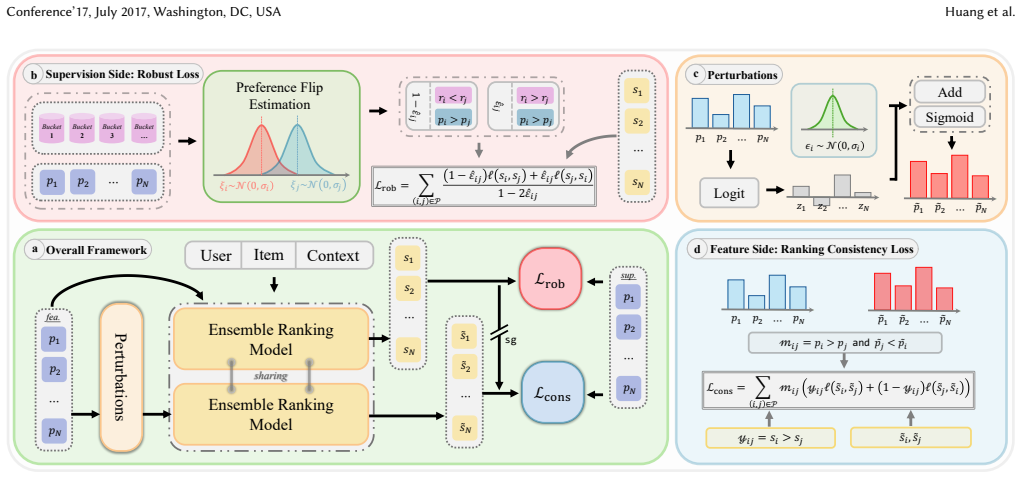
The shared engine is the logit-space additive Gaussian noise model $z_i = z_i^* + \xi_i$, $\xi_i \sim \mathcal{N}(0,\sigma_i^2)$, independent across items. On the supervision side it yields the maximum-likelihood flip probability $\hat{\varepsilon}_{ij} = \Phi(-(z_i-z_j)/\sqrt{\sigma_i^2+\sigma_j^2})$ (Theorem 2), which enters the risk-denoising robust loss $L_{\text{rob}} = \sum_{(i,j)\in P}\frac{(1-\hat{\varepsilon}_{ij})\ell(s_i,s_j)-\hat{\varepsilon}_{ij}\ell(s_j,s_i)}{1-2\hat{\varepsilon}_{ij}}$ and makes the expected loss equal to the clean risk when $\hat{\varepsilon}_{ij}=\varepsilon_{ij}$ (Theorem 1). On the feature side the same variances sample perturbations $\tilde{z}_i = z_i + \epsilon_i$, $\epsilon_i\sim\mathcal{N}(0,\sigma_i^2)$, and the preference-preserving regularizer $L_{\text{cons}}$ applies a pairwise order-consistency loss only to pairs whose order is unchanged by the perturbation, preventing conflict with the main ranking objective. The two sides are coupled by Theorem 3's probit bucketing estimator $\hat{\sigma}_k^2 = \lambda^{-2}\left[\left(\Phi^{-1}(E_{B_k}[p_i])/\Phi^{-1}(E_{B_k}[y_i])\right)^2 - 1\right]$ with $\lambda=\sqrt{\pi/8}$, which extracts per-bucket variance from the systematic gap between predicted pxtrs and observed feedback.
What would settle it
On logged production data where an item's pxtr predictions can be compared with its long-run observed behavior in narrow prediction buckets, compute the empirical logit residuals $z_i - \logit(\bar{y}_i)$. If those residuals have nonzero mean, cross-item correlation, or variance that the probit estimator $\hat{\sigma}_k^2$ cannot reproduce, then Eq. (10) mis-estimates the flip probabilities; a direct test would inject noise of known non-Gaussian shape into held-out pxtrs and check whether the robust loss still recovers the clean-risk behavior predicted by Theorem 1.
Extended reading notes
Core claim
The central claim is that the noise in upstream pxtr predictions can be summarized by one quantity per item, a logit-space noise variance $\sigma_i^2$, and that this single summary drives two aligned corrections. Writing the observed pxtr logit as $z_i = z_i^* + \xi_i$ with $\xi_i \sim \mathcal{N}(0,\sigma_i^2)$ independent across items, the probability that a preference pair flips is approximately $\hat{\varepsilon}_{ij} = \Phi(-(z_i-z_j)/\sqrt{\sigma_i^2+\sigma_j^2})$. Substituting this pair-specific estimate into the risk-denoising loss $L_{\text{rob}}$ cancels the reverse-loss contamination: with exact estimates the risk equals the clean risk, and with any estimates in $(0,1/2)$ the robust loss is strictly closer to the clean risk than the basic pairwise loss, monotonically improving as the estimate sharpens. The same $\sigma_i^2$ values feed the feature-side regularizer, which adds sampled perturbations to the pxtr logits and enforces ranking consistency only on pairs whose order survives perturbation. The variances themselves are estimated by a bucketing probit method that compares average predicted pxtr with average observed behavior within narrow prediction buckets, so the whole scheme needs no extra labels beyond the posterior feedback industrial systems already log.
Load-bearing premise
Everything hinges on the assumption that prediction noise is additive, zero-mean, independent across items, and Gaussian in logit space; if the real upstream noise is biased, correlated, or heavy-tailed, the flip probabilities and perturbation scales point at the wrong target.
Editorial extensions
If this is right
- DrEM is a plug-in module: the backbone ranking model, the upstream pxtr model, and the final ranking formula are all unchanged; the only added cost is one perturbed forward pass during training.
- Tasks with sparse user interactions (follow, comment, forward) should gain the most, since their pxtrs carry larger noise variance and hence higher flip probabilities.
- Even a rough flip-probability estimate lying anywhere in $(0,1/2)$ makes the robust loss strictly closer to the clean risk than the basic pairwise loss, so the method degrades gracefully when the variance estimator is imperfect.
- The two corrections are additive because they address two independent propagation paths of the same noise; the full method outperforms either side alone at every tested perturbation strength.
- Because the variance estimator needs only posterior user behavior, the whole pipeline is deployable with the feedback data industrial recommendation systems already log.
Reading between the lines
- If correct, the same dual-side correction scheme transfers to any multi-stage system whose upstream outputs are reused as both features and supervision, such as ad scoring or LLM-as-judge pipelines, whenever those outputs are noisy.
- The preference-preserving filtering rule, regularize only pairs whose order survives perturbation, is a generic recipe for consistency training under input noise and could be applied to other pairwise ranking objectives.
- A direct test of the Gaussian assumption would be to compare DrEM's bucketing variance estimates with empirical residual variances computed from logged pxtrs and observed behavior; the theory predicts they should match closely, so large mismatches would indicate mis-specified noise.
- The stratification result in Figure 3 suggests a monitoring diagnostic for production: the GAUC gain over the base model should increase with estimated flip probability; a deviation from that monotone pattern would flag noise-model miscalibration.
Signed reviews
Editorial analysis
A structured set of objections, weighed in public.
Referee Report
Summary. The paper studies the ensemble ranking stage of an industrial short-video recommender, where upstream multi-task predictions (pxtrs) are used both as input features and as proxy supervision. It models upstream prediction noise as additive zero-mean Gaussian in logit space and proposes DrEM, which (i) corrects the pairwise ranking loss by reweighting forward and reverse terms with estimated preference-flip probabilities and (ii) regularizes the model to be stable under noise-consistent perturbations on the input pxtrs. The authors provide theorems for the flip probability and noise variance estimation, report offline GAUC experiments on an industrial dataset under injected perturbation strengths, and present 7-day online A/B results with statistically significant gains on both EMER and EASQ backbones.
Significance. If the theoretical claims held, DrEM would be a practically valuable and reasonably principled solution to a real industrial problem. The strongest parts are the clear problem decomposition (supervision-side versus feature-side), the pair-level and item-level adaptation through a shared noise model, and the unusually complete empirical evaluation, including online A/B tests with p<0.005 and a flip-probability-stratified analysis (Figure 3) that gives a checkable mechanism for the gains. The paper does not provide code or public data, and the central theoretical guarantee requires correction, but the empirical contribution is solid and the proposed framework is coherent.
major comments (3)
- [Section 4, Theorem 1 and Section 3.2] The theorem as stated is false. The proof defines c(\hat{\varepsilon}_{ij})=(1-\varepsilon_{ij}-\hat{\varepsilon}_{ij})/(1-2\hat{\varepsilon}_{ij}) and shows c(\hat{\varepsilon})>c(0) and c'(\hat{\varepsilon})>0. However, the expected risk of the robust loss differs from the clean risk by |c(\hat{\varepsilon})-1| \cdot |\ell_clean-\ell_rev|, and the basic loss corresponds to \hat{\varepsilon}=0 with deviation \varepsilon \cdot |\ell_clean-\ell_rev|. For \hat{\varepsilon}>\varepsilon, we have c(\hat{\varepsilon})>1 and the robust loss overshoots; for example, with \varepsilon=0.1 and \hat{\varepsilon}=0.4, the deviation is 1.5 \cdot |\ell_clean-\ell_rev| versus 0.1 \cdot |\ell_clean-\ell_rev| for the basic loss, i.e., 15 times farther from the clean risk. Thus the universal superiority guarantee claimed in the abstract and in Section 3.2 is unsupported. Please either restrict the claim to a safe region (e.g., \hat{\varepsilon} below the crossing point where |c(\hat{\varepsilon})-1|=\varepsilon), prove an explicit bound with estimation-error dependence, or replace Theorem 1 with a statement that only asserts monotone improvement as \hat{\varepsilon} approaches \varepsilon from below.
- [Section 4, Theorem 3, Eq. (12)] The variance estimator is not guaranteed to be nonnegative. If in a bucket the empirical behavior rate exceeds the predicted pxtr rate, then |\Phi^{-1}(E_B[p_i]) / \Phi^{-1}(E_B[y_i])| < 1 and \hat{\sigma}_k^2 is negative; no clipping or sign-restricted estimator is specified. Since \hat{\sigma}_k^2 feeds both the flip-probability formula (Eq. (10)) and the perturbation sampler (Section 3.3), this is a load-bearing gap. Please add a nonnegative estimator or explicitly define the regime in which the formula applies, and discuss the behavior under systematic pxtr miscalibration.
- [Section 4, Assumption 1] The paper provides no diagnostic for the assumed additive zero-mean Gaussian, independent noise on the industrial pxtr logits. The justification via asymptotic normality of parametric models does not transfer automatically to the upstream multi-task model, and any bias or cross-item correlation would be absorbed by the Theorem 3 estimator and then mis-specify Eq. (10) and the perturbation distribution. Because the same pxtr-behavior discrepancy is used both to estimate the noise and to correct it, this is not a cosmetic concern. Please add an empirical validation of Assumption 1 on the actual data (e.g., residual analysis or calibration checks) or explicitly state this as a limitation with a sensitivity analysis.
minor comments (5)
- [Section 4, Theorem 3] The notation in the proof is confusing: 'E[r_i]=E[\sigma(z_i+\xi_i)]' mixes the latent clean value r_i with the observed noisy logit; the derivation should be written in terms of p_i, z_i^*, and the conditional expectation of y_i.
- [Eq. (12)] The probit approximation \sigma(x)\approx\Phi(\lambda x) with \lambda=\sqrt{\pi/8} is used before it is explicitly defined; state it before Theorem 3 for readability.
- [Section 5.1] The evaluation perturbation \tilde{z}_i = z_i + \alpha \epsilon_i uses a sampled Gaussian perturbation, but it is not clear whether \epsilon_i is drawn with the estimated \hat{\sigma}_i^2 or with unit variance; please clarify the relation between \alpha and the estimated noise scale.
- [Table 2] With many online metrics and two backbones, it would be helpful to state whether any multiple-testing correction was applied, even if all individual p-values are below 0.005.
- [Figure 3] The explanation that high-flip-probability buckets for dense tasks are dominated by statistical noise would be more checkable if the number of pairs per bucket were reported.
Circularity Check
No significant circularity: the robust loss, flip-probability estimator, and consistency regularizer are derived from stated assumptions and evaluated against independent online A/B metrics.
full rationale
The derivation chain is self-contained. Equation (3) is the standard noise-aware loss-correction identity: when the estimated flip probability equals the true flip probability, the expected robust loss coincides with the clean risk, and this is algebra, not a fitted prediction. Equation (10) follows from Assumption 1 via the probit approximation, and Equation (12) is a moment-based estimator of the logit-space noise variance from pxtr-behavior discrepancies. The paper does not define its target ranking performance in terms of these estimated quantities: offline GAUC is measured against the unperturbed pxtr ordering, and the online A/B tests use independent production business metrics, so the empirical claims are externally evaluated. The self-citations [10, 15, 20] supply background and baselines for the ensemble-ranking setup and are not load-bearing for the correction derivation; Assumption 1 is justified by an independent citation [39]. The principal theoretical defect is Theorem 1's 'closer to clean risk' claim, which is not generally true for overestimated flip probabilities (e.g., ε=0.1, ε_hat=0.4 makes the robust risk farther from the clean risk than the basic pairwise loss). That is a correctness and proof-validity problem, not a circular reduction of the method to its own inputs, so it should be weighed in a correctness review rather than in the circularity score.
Assumptions & free parameters
free parameters (2)
- per-item logit noise variance sigma_i^2 (aggregated per bucket) =
estimated via Eq. (12) from pxtr-behavior discrepancies
- consistency weight lambda_cons =
tuned in {0.1, 0.3, 0.6}
assumptions (4)
- domain assumption Additive zero-mean Gaussian logit-space noise, independent across items (Assumption 1).
- domain assumption Observed behavior y_i is Bernoulli with mean equal to the latent clean pxtr r_i.
- domain assumption Items within a bucket share the same logit noise variance and bucket diameter tends to 0.
- standard math Probit approximation of sigmoid: sigma(x) approx Phi(lambda x) with lambda = sqrt(pi/8).
Cite this review
Pith. "Pith review of DrEM: Dual-Side Robust Ensemble Ranking from Noisy User Preference Predictions in Video Recommendation." pith.science (2026). https://pith.science/paper/KNNSX4SD
@misc{pith2026260812778,
  author       = {Pith},
  title        = {Pith review of: DrEM: Dual-Side Robust Ensemble Ranking from Noisy User Preference Predictions in Video Recommendation},
  year         = {2026},
  howpublished = {\url{https://pith.science/paper/KNNSX4SD}},
  note         = {Machine review of arXiv:2608.12778}
}
read the original abstract
Industrial video recommendation systems typically adopt a multi-stage architecture. At the ensemble ranking stage, multi-dimensional user preference predictions (pxtrs) from an upstream multi-task model are fused into a unified ranking score to reflect user satisfaction. Since users' true satisfaction is difficult to observe directly, ensemble ranking models commonly use pxtrs both as input features and as a source for constructing proxy preferences. However, as outputs of an upstream prediction model, pxtrs inevitably contain prediction noise, which propagates to downstream learning across two sides. On the supervision side, noisy pxtrs may flip proxy preferences and introduce erroneous gradients. On the feature side, pxtr noise may propagate through model inputs and destabilize ranking scores. Existing ensemble ranking methods typically treat pxtrs as reliable signals and overlook such prediction noise. To address this, we propose DrEM, a dual-side robust ensemble ranking framework. Our DrEM introduces a risk-denoising robust loss that corrects the empirical risk using estimated preference flip probability. Meanwhile, it samples perturbations from the distribution of prediction noise and introduces a preference-preserving ranking consistency regularizer to improve feature-side output stability. Theoretically, we obtain an approximate distribution of the prediction noise and prove that the robust loss remains superior under flip probability estimation error. Extensive offline experiments and large-scale online A/B tests demonstrate the effectiveness and robustness of our DrEM.
Figures


Reference graph
Works this paper leans on
-
[1]
Jiangxia Cao, Pengbo Xu, Yin Cheng, Kaiwei Guo, Jian Tang, Shijun Wang, Dewei Leng, Shuang Yang, Zhaojie Liu, Yanan Niu, Guorui Zhou, and Kun Gai
-
[2]
Yang Cao, Changhao Zhang, Xiaoshuang Chen, Kaiqiao Zhan, and Ben Wang
-
[3]
Huiyuan Chen, Xiaoting Li, Vivian Lai, Chin-Chia Michael Yeh, Yujie Fan, Yan Zheng, Mahashweta Das, and Hao Yang. 2023. Adversarial Collaborative Filtering for Free. InProceedings of the 17th ACM Conference on Recommender Systems (RecSys’23). 245–255
work page 2023
-
[4]
InProceedings of the ACM Web Conference 2025 (WWW’25)
xMTF: A Formula-Free Model for Reinforcement-Learning-Based Multi- Task Fusion in Recommender Systems. InProceedings of the ACM Web Conference 2025 (WWW’25). 3840–3849
work page 2025
-
[5]
Sayak Ray Chowdhury, Anush Kini, and Nagarajan Natarajan. 2024. Provably Robust DPO: Aligning Language Models with Noisy Feedback. InProceedings of the 41st International Conference on Machine Learning (ICML’24), Vol. 235. 42258–42274
work page 2024
-
[6]
Hai Chen, Fulan Qian, Chang Liu, Yanping Zhang, Hang Su, and Shu Zhao
-
[7]
Roberto Cipolla, Yarin Gal, and Alex Kendall. 2018. Multi-Task Learning Using Uncertainty to Weigh Losses for Scene Geometry and Semantics. InProceedings of the IEEE Conference on Computer Vision and Pattern Recognition (CVPR’18). 7482–7491
work page 2018
-
[8]
Chongming Gao, Shijun Li, Wenqiang Lei, Jiawei Chen, Biao Li, Peng Jiang, Xiangnan He, Jiaxin Mao, and Tat-Seng Chua. 2022. KuaiRec: A Fully-Observed Dataset and Insights for Evaluating Recommender Systems. InProceedings of the 31st ACM International Conference on Information and Knowledge Management (CIKM’22). 540–550
work page 2022
Show all 47 references
-
[9]
Haoyan Chua, Yingpeng Du, Zhu Sun, Ziyan Wang, Jie Zhang, and Yew-Soon Ong. 2024. Unified Denoising Training for Recommendation. InProceedings of the 18th ACM Conference on Recommender Systems (RecSys’24). 612–621
2024
-
[10]
Tiantian He, Minzhi Xie, Runtong Li, Xiaoxiao Xu, Jiaqi Yu, Zixiu Wang, Lantao Hu, Han Li, and Kun Gai. 2025. An End-to-End Multi-objective Ensemble Ranking Framework for Video Recommendation. arXiv:2508.05093 [cs.IR]
2025 arXiv
-
[11]
Xiangnan He, Zhankui He, Xiaoyu Du, and Tat-Seng Chua. 2018. Adversarial Personalized Ranking for Recommendation. InProceedings of the 41st International ACM SIGIR Conference on Research and Development in Information Retrieval (SIGIR’18). 355–364
2018
-
[12]
Yunjun Gao, Yuntao Du, Yujia Hu, Lu Chen, Xinjun Zhu, Ziquan Fang, and Baihua Zheng. 2022. Self-Guided Learning to Denoise for Robust Recommendation. In Proceedings of the 45th International ACM SIGIR Conference on Research and Development in Information Retrieval (SIGIR’22). ...
2022
-
[13]
Kingma and Jimmy Ba
Diederik P. Kingma and Jimmy Ba. 2015. Adam: A Method for Stochastic Optimiza- tion. InProceedings of the 3rd International Conference on Learning Representations (ICLR’15)
2015
-
[14]
Jiayu Li, Peijie Sun, Zhefan Wang, Weizhi Ma, Yangkun Li, Min Zhang, Zhoutian Feng, and Daiyue Xue. 2023. Intent-aware Ranking Ensemble for Personalized Recommendation. InProceedings of the 46th International ACM SIGIR Conference on Research and Development in Information Retr...
2023
-
[15]
Zhuangzhuang He, Yifan Wang, Yonghui Yang, Peijie Sun, Le Wu, Haoyue Bai, Jinqi Gong, Richang Hong, and Min Zhang. 2024. Double Correction Frame- work for Denoising Recommendation. InProceedings of the 30th ACM SIGKDD Conference on Knowledge Discovery and Data Mining (KDD’24)....
2024
-
[16]
Bin Liu, Xiaohong Liu, Qin Luo, Ziqiao Shang, Jielei Chu, Lin Ma, Zhaoyu Li, Fei Teng, Guangtao Zhai, and Tianrui Li. 2026. Variational Bayesian Personalized Ranking.IEEE Transactions on Pattern Analysis and Machine Intelligence48, 8 (2026), 8936–8952
2026
-
[17]
Dhillon, Pradeep K
Nagarajan Natarajan, Inderjit S. Dhillon, Pradeep K. Ravikumar, and Ambuj Tewari. 2013. Learning with Noisy Labels. InProceedings of the 27th International Conference on Neural Information Processing Systems (NeurIPS’13), Vol. 26. 1196– 1204
2013
-
[18]
Na Li, Jiaqi Yu, Minzhi Xie, Tiantian He, Xiaoxiao Xu, Zixiu Wang, Lantao Hu, Yongqi Liu, Han Li, Kaiqiao Zhan, and Kun Gai. 2026. Towards End-to-End Alignment of User Satisfaction via Questionnaire in Video Recommendation. InProceedings of the 49th International ACM SIGIR Con...
2026
-
[19]
Ilqar Ramazanli, Hamid Eghbalzadeh, Xiaoyi Liu, Yang Wang, Kaushik Ran- gadurai, Sem Park, Bo Long, and Xue Feng. 2024. Beyond Self-Consistency: Loss-Balanced Perturbation-Based Regularization Improves Industrial-Scale Ads Ranking. InProceedings of the 2024 IEEE International ...
2024
-
[20]
Zonghe Shao, Tiantian He, Xiaoxiao Xu, Jiaqi Yu, Minzhi Xie, Jinfang Gu, Yongqi Liu, Kaiqiao Zhan, and Kun Gai. 2026. Uncertainty as Remedy: Miti- gating Satisfaction Label Bias in Short Video Multi-Objective Ensemble Ranking. arXiv:2607.17092 [cs.IR]
2026 arXiv
-
[21]
Yongxin Ni, Yu Cheng, Xiangyan Liu, Junchen Fu, Youhua Li, Xiangnan He, Yongfeng Zhang, and Fajie Yuan. 2025. A Content-Driven Micro-Video Rec- ommendation Dataset at Scale. InProceedings of the 34th ACM International Conference on Information and Knowledge Management (CIKM’25...
2025
-
[22]
Juntao Tan, Shelby Heinecke, Zhiwei Liu, Yongjun Chen, Yongfeng Zhang, and Huan Wang. 2024. Towards More Robust and Accurate Sequential Recommenda- tion with Cascade-Guided Adversarial Training. InProceedings of the 2024 SIAM International Conference on Data Mining (SDM’24). 743–751
2024
-
[23]
Jinhui Tang, Xiaoyu Du, Xiangnan He, Fajie Yuan, Qi Tian, and Tat-Seng Chua
-
[24]
Zhongxiang Sun, Zihua Si, Xiaoxue Zang, Dewei Leng, Yanan Niu, Yang Song, Xiao Zhang, and Jun Xu. 2023. KuaiSAR: A Unified Search and Recommendation Dataset. InProceedings of the 32nd ACM International Conference on Information and Knowledge Management (CIKM’23). 5407–5411
2023
-
[25]
Wenjie Wang, Fuli Feng, Xiangnan He, Liqiang Nie, and Tat-Seng Chua
-
[26]
Jose, Fuli Feng, and Xiangnan He
Yu Wang, Xin Xin, Zaiqiao Meng, Joemon M. Jose, Fuli Feng, and Xiangnan He. 2022. Learning Robust Recommenders through Cross-Model Agreement. In Proceedings of the ACM Web Conference 2022 (WWW’22). 2015–2025
2022
-
[27]
Zhenlei Wang and Xu Chen. 2023. Robust Recommendation with Adversarial Gaussian Data Augmentation. InProceedings of the ACM Web Conference 2023 (WWW’23). 897–905
2023
-
[28]
Gomez, Lukasz Kaiser, and Illia Polosukhin
Ashish Vaswani, Noam Shazeer, Niki Parmar, Jakob Uszkoreit, Llion Jones, Aidan N. Gomez, Lukasz Kaiser, and Illia Polosukhin. 2017. Attention Is All You Need. InProceedings of the 31st International Conference on Neural Informa- tion Processing Systems (NeurIPS’17). 6000–6010
2017
-
[29]
Jiancan Wu, Xiang Wang, Xingyu Gao, Jiawei Chen, Hongcheng Fu, and Tianyu Qiu. 2024. On the Effectiveness of Sampled Softmax Loss for Item Recommenda- tion.ACM Transactions on Information Systems42, 4 (2024), 98:1–98:26
2024
-
[30]
Chenxiao Yang, Qitian Wu, Jipeng Jin, Xiaofeng Gao, Junwei Pan, and Guihai Chen. 2022. Trading Hard Negatives and True Negatives: A Debiased Contrastive Collaborative Filtering Approach. InProceedings of the 31st International Joint Conference on Artificial Intelligence (IJCAI...
2022
-
[31]
Weiqin Yang, Jiawei Chen, Xin Xin, Sheng Zhou, Binbin Hu, Yan Feng, Chun Chen, and Can Wang. 2024. PSL: Rethinking and Improving Softmax Loss from Pairwise Perspective for Recommendation. InProceedings of the 38th International Conference on Neural Information Processing Syste...
2024
-
[32]
Weiqin Yang, Jiawei Chen, Shengjia Zhang, Peng Wu, Yuegang Sun, Yan Feng, Chun Chen, and Can Wang. 2025. Breaking the Top-𝐾 Barrier: Advancing Top-𝐾 Ranking Metrics Optimization in Recommender Systems. InProceedings of the 31st ACM SIGKDD Conference on Knowledge Discovery and ...
2025
-
[33]
Junkang Wu, Jiawei Chen, Jiancan Wu, Wentao Shi, Jizhi Zhang, and Xiang Wang
-
[34]
InProceedings of the 40th IEEE International Conference on Data Engineering (ICDE’24)
BSL: Understanding and Improving Softmax Loss for Recommendation. InProceedings of the 40th IEEE International Conference on Data Engineering (ICDE’24). 816–830
-
[35]
An Zhang, Leheng Sheng, Zhibo Cai, Xiang Wang, and Tat-Seng Chua. 2023. Empowering Collaborative Filtering with Principled Adversarial Contrastive Loss. InProceedings of the 37th International Conference on Neural Information Processing Systems (NeurIPS’23). 6242–6266
2023
-
[36]
Kaike Zhang, Qi Cao, Yunfan Wu, Fei Sun, Huawei Shen, and Xueqi Cheng
-
[37]
Kaike Zhang, Qi Cao, Yunfan Wu, Fei Sun, Huawei Shen, and Xueqi Cheng. 2025. Personalized Denoising Implicit Feedback for Robust Recommender System. In Proceedings of the ACM Web Conference 2025 (WWW’25). 4470–4481
2025
-
[38]
Qihua Zhang, Junning Liu, Yuzhuo Dai, Yiyan Qi, Yifan Yuan, Kunlun Zheng, Fan Huang, and Xianfeng Tan. 2022. Multi-Task Fusion via Reinforcement Learning for Long-Term User Satisfaction in Recommender Systems. InProceedings of the 28th ACM SIGKDD Conference on Knowledge Discov...
2022
-
[39]
Wenhui Yu, Bingqi Liu, Bin Xia, Xiaoxiao Xu, Ying Chen, Yongchang Li, and Lantao Hu. 2024. Unsupervised Ranking Ensemble Model for Recommendation. InProceedings of the 30th ACM SIGKDD Conference on Knowledge Discovery and Data Mining (KDD’24). 6181–6189
2024
-
[40]
Wenhui Yu and Zheng Qin. 2020. Sampler Design for Implicit Feedback Data by Noisy-label Robust Learning. InProceedings of the 43rd International ACM SIGIR Conference on Research and Development in Information Retrieval (SIGIR’20). 861–870
2020
-
[43]
InProceedings of the 18th ACM Conference on Recommender Systems (RecSys’24)
Improving the Shortest Plank: Vulnerability-Aware Adversarial Training for Robust Recommender System. InProceedings of the 18th ACM Conference on Recommender Systems (RecSys’24). 680–689
-
[46]
Ivan Zhigalskii, Andrey Pudovikov, Aleksandr Katrutsa, and Egor Samosvat
-
[2020]
IEEE Transactions on Knowledge and Data Engineering32, 5 (2020), 855–867
Adversarial Training Towards Robust Multimedia Recommender System. IEEE Transactions on Knowledge and Data Engineering32, 5 (2020), 855–867
2020
-
[2021]
arXiv:2112.01160 [cs.IR]
Learning Robust Recommender from Noisy Implicit Feedback. arXiv:2112.01160 [cs.IR]
-
[2024]
Training Robust Deep Collaborative Filtering Models via Adversarial Noise Propagation.ACM Transactions on Information Systems42, 1 (2024), 9:1–9:27
2024
-
[2025]
InProceedings of the 34th ACM International Conference on Information and Knowledge Management (CIKM’25)
Pantheon: Personalized Multi-objective Ensemble Sort via Iterative Pareto Policy Optimization. InProceedings of the 34th ACM International Conference on Information and Knowledge Management (CIKM’25). 5575–5582
-
[2026]
arXiv:2603.01825 [cs.IR] Conference’17, July 2017, Washington, DC, USA Huang et al
Uncertainty Quantification of Click and Conversion Estimates for the Autobidding. arXiv:2603.01825 [cs.IR] Conference’17, July 2017, Washington, DC, USA Huang et al. A Details of Baselines EMER[ 10] is an end-to-end framework that models interactions among candidate items via ...
2017
Reviewed August 15, 2026 · model on record in the stance chip above.
Discussion (0). Continue with ORCID to comment.