REVIEW 3 major objections 4 minor 137 references
Gal3D: Superellipsoid Modeling of Radial 3D Galaxy Structure in IllustrisTNG and EAGLE Simulations
T0 review · 3 major / 4 minor · reviewed 2026-08-15 · deepseek-v4-flash
Pith's one-line read Gal3D fits superellipsoids to simulated galaxies' density surfaces, and its shape indices $S_a$, $S_b$, $S_c$ separate disks, bars, bulges, and triaxial components, exposing a TNG–EAGLE difference in box/peanut bulge prevalence.
desk verdict Gal3D is a genuine methodological step forward for measuring 3D boxiness/diskiness in simulated galaxies; the TNG-EAGLE comparison is plausible but presently under-supported by statistics. read the letter →
The pith
A machine-rendered reading of the paper's core claim, the machinery that carries it, and where it could break.
The reading
What carries the argument
The load-bearing object is the superellipsoid isodensity surface $f(x,y,z)=[(x/a)^2]^{S_a}+[(y/b)^2]^{S_b}+[(z/c)^2]^{S_c}=1$, with semi-axes $a\ge b\ge c$ and shape indices $S_a$, $S_b$, $S_c$ controlling boxiness ($S>1$) versus diskiness/pointedness ($S<1$). The paper constructs the density field with adaptive kernel density estimation, samples it along a golden-ratio Fibonacci lattice of rays, forces each ray's radial density profile to be monotonic via envelope interpolation, inverts to get one isodensity point per ray, and fits the superellipsoid by minimizing an area-weighted surface-radius-ratio mismatch $(r'^2 (D-1)^2)$. This parameterization allows each density level to have its own center, orientation, and higher-order shape, which is what lets one radial profile separate nuclear disks, bulges, main disks, bars, box/peanut bulges, and triaxial spheroids.
What would settle it
Build a synthetic galaxy whose density is a known superellipsoid plus an X-shaped or ring-like perturbation, run Gal3D's ray-inversion pipeline on it, and check whether the fitted $S_a$ and $S_c$ recover the input values; if they are systematically biased when the radial density profile is non-monotonic, the box/peanut claims derived from TNG would be called into question.
Extended reading notes
Core claim
The central discovery is that superellipsoid fitting of isodensity surfaces recovers higher-order, non-ellipsoidal structure that iterative shape-tensor methods miss, and that this structure is physically informative. Fitting the implicit surface $(x/a)^{2S_a} + (y/b)^{2S_b} + (z/c)^{2S_c} = 1$ to each density level returns axis ratios, Euler angles, center offsets, and shape indices; values $S>1$ correspond to boxy surfaces and $S<1$ to pointed, disky ones. In the TNG and EAGLE samples, the method shows the outer parts of TNG bars carry elevated $S_a$ and $S_c$, the signature of box/peanut bulges, while EAGLE bars do not, and it traces the expansion and collapse of disk regions with stellar mass. The paper presents these results as evidence that Gal3D can serve as a practical standard for quantifying intrinsic radial 3D structure in simulations.
Load-bearing premise
The method assumes that every ray from the galaxy center hits any given density level exactly once, so non-monotonic structures like X-shaped box/peanut bulges are forced into a single radius per direction and the fitted $S_a$ and $S_c$ could be biased.
Editorial extensions
If this is right
- A single Gal3D radial profile can flag the presence of a bar, a box/peanut bulge, a disk, and a spheroid without separate component-by-component decompositions.
- The result that flattened disk extent peaks near $M_* \sim 10^{11}\,M_\odot$ and then declines sets a quantitative benchmark that galaxy formation models should reproduce.
- The systematic TNG–EAGLE difference in box/peanut bulge strength implies that subgrid feedback implementations shape the vertical structure of bars, a prediction that can be compared with edge-on observations of barred galaxies.
- Because Gal3D can project its 3D models, it offers a route to translating intrinsic shape indices into predicted isophotal boxiness/diskyness, linking simulations to observable quantities.
Reading between the lines
- One could test whether the same superellipsoid indices, applied to dark matter or gas components, trace assembly history more directly than the stellar shapes alone.
- The monotonicity regularisation used in ray inversion could be relaxed (e.g., allowing two radii per direction for X-shaped bulges) to see whether the TNG box/peanut signatures become even stronger.
- If Gal3D were applied to observed galaxies via deprojection of edge-on images, the inferred $S_c$ might serve as a new observational discriminator between boxy and disky bulges.
- The resolution dependence seen within TNG (thinner disks at higher resolution) warns that the EAGLE–TNG differences could be partly numerical; a resolution-matched EAGLE run would settle this.
Signed reviews
Editorial analysis
A structured set of objections, weighed in public.
Referee Report
Summary. The paper presents Gal3D, an open-source framework that reconstructs a smoothed stellar density field from particle data using adaptive kernel density estimation and fits superellipsoids to iso-density surfaces, extracting radial profiles of axis ratios, orientation angles, center offsets, and superellipsoid shape indices S_a, S_b, S_c. The method is applied to z=0 galaxy samples from IllustrisTNG (TNG50-1, TNG50-2, TNG100-1) and EAGLE100, and the resulting mean profiles are used to compare disk extents, bar strengths, box/peanut bulge signatures, and outer triaxiality as functions of stellar mass. The paper also includes numerical sensitivity tests for the fitting objective and for the smoothing and angular-sampling parameters, and makes the code and shape-profile data publicly available.
Significance. If the method performs as claimed, Gal3D offers a substantially more flexible description of intrinsic 3D galaxy structure than the standard iterative inertia tensor, with the potential to separate boxiness and diskiness in a single radial profile. The reported TNG versus EAGLE differences in box/peanut bulge signatures and outer triaxiality are of direct interest for galaxy formation comparisons. Strengths of the paper include the public code and data releases, the careful sensitivity analysis in Appendix A, and the explicit acknowledgment in Section 2.5 of the limitation imposed by the single-valued isodensity assumption. However, the absence of synthetic recovery tests and the lack of uncertainties on the population maps currently leave the central quantitative claims under-supported.
major comments (3)
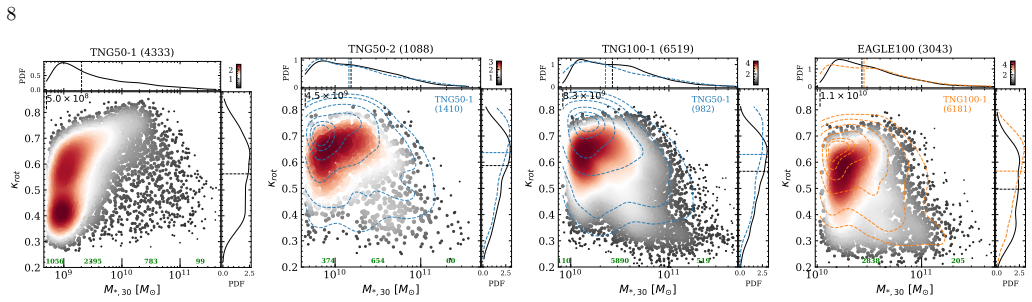
- [Section 5 / Figure 7] The population conclusions in Sections 5.1-5.3 rest on the mean maps in Figure 7, which are shown without any estimate of the uncertainty in the mean (for example, bootstrap or jackknife over galaxies) or a significance test for the TNG versus EAGLE differences. Please add per-bin uncertainties and perform a two-sample significance test in the relevant mass-radius bins, especially for the claims that EAGLE has less extended disks, weaker bars, and weaker box/peanut signatures; without these, the reported offsets may be within sampling noise.
- [Appendix A] The numerical tests in Appendix A compare the two objective functions and vary k and N_ray, but they never test whether the fitting recovers known input parameters. Because the core claim of the paper is that the superellipsoid indices S_a, S_b, S_c are recovered from simulated galaxies, the manuscript should include synthetic recovery tests in which density fields with known superellipsoid shape parameters (including S<1 and S>1, and with additional particle noise) are fitted and the input values are recovered. This would directly support the interpretation of S_a>1 and S_c>1 as box/peanut signatures and S_c<1 as a vertically disky morphology used in Sections 4.3 and 5.2.
- [Section 2.4.1 / 2.5] The monotonic regularization of the radial density profile in Section 2.4.1 enforces a single isodensity radius per ray, which suppresses genuine non-monotonic structures such as X-shaped box/peanut bulges. The paper acknowledges this in Section 2.5, but the comparison in Section 5.2 between TNG and EAGLE box/peanut signatures relies on the S_a and S_c values obtained from these regularized profiles. Please quantify the impact of this approximation on the fitted indices for representative X-shaped or multi-component morphologies, or add an explicit caveat that the measured box/peanut differences refer to the regularized single-valued description.
minor comments (4)
- [Section 2.3 / Equation (5)] The statement that the eigenvalues scale as lambda_i proportional to a^2, b^2, c^2 is made for a uniform ellipsoidal shell; please state the assumed surface density and the normalization convention so that readers can reproduce the relationship.
- [Section 2.4.3 / Equation (10)] The area-weighting factor (r'_i)^2 in the objective function is described as approximate; a brief derivation of why this factor corresponds to an equal-area weighting for the Fibonacci-sampled rays would improve transparency.
- [Section 4.3] The terms 'boxiness' and 'diskiness' are used to describe the superellipsoid shape indices, but these could be confused with the standard isophotal shape coefficients a_4/a; please add a sentence clarifying that S>1 and S<1 refer to the superellipsoid's departure from a purely ellipsoidal surface, not to Fourier isophote coefficients.
- [Section 3.3] The iterative shrinking-sphere centering method is cited but not described; adding a one-sentence summary of the algorithm and its convergence criterion would aid reproducibility.
Circularity Check
No significant circularity: the shape indices are direct measurements from the reconstructed density field, and the TNG versus EAGLE trends are empirical summaries of those measurements.
full rationale
The central derivation chain is self-contained. Gal3D reconstructs a density field, extracts iso-density points along Fibonacci-sampled rays, and fits a 12-parameter superellipsoid to those points. The parameters a, b, c, S_a, S_b, S_c, center offsets, and Euler angles are all fitted from the particle data in a bounded least-squares problem (Section 2.4), so there is no quantity that is first fitted to a subset of data and then predicted as a closely related output. The TNG versus EAGLE comparisons in Section 5 are mean radial profiles of these fitted parameters; they are observational summaries of the measurements, not derivations that re-enter their own inputs. The interpretation of S_a > 1 and S_c > 1 as boxiness is a semantic reading of Equation (7) and Figure 2, but the paper does not claim to derive boxiness from the definition; it measures the indices and then interprets them, with one galaxy cross-checked against an external box/peanut identification (Anderson et al. 2023). Similarly, the bar-related quantity epsilon_ab = 1 - b/a is a direct ratio of fitted semi-axes, and the claim that it strengthens with stellar mass is an empirical trend, not a forced consequence of the fitting procedure. The self-citations to Zhao et al. (2020) and Lu et al. (2025) appear only as corroborative context for bar fraction trends in the same simulations and are not load-bearing for the method or for the new shape-index results. The acknowledged limitation in Section 2.5 that a single superellipsoid cannot exactly represent strongly X-shaped box/peanut bulges is an honest scope statement and is weighed as such; it flags a modeling approximation, not a circular step. Numerical sensitivity tests in Appendix A establish stability of the fitted profiles to the objective function, smoothing length, and ray number, and the code and data are publicly released. No step in the paper reduces to its own input by construction, and no prediction is equivalent to a fitted parameter renamed.
Assumptions & free parameters
free parameters (8)
- k (KDE neighbor number) =
32
- N_ray (Fibonacci directions) =
1024
- n (radial samples per ray) =
500
- S index bounds =
0.2 to 2
- bar threshold epsilon_ab=0.4 =
0.4
- disk threshold epsilon_ac=0.6 and bulge threshold 0.4 =
0.6 / 0.4
- outer density limit rho_outer =
100 Msun/kpc^3
- weighting parameter w_m =
formula (1 + N_above)/(2 + N_m)
assumptions (5)
- standard math Fibonacci lattice on the sphere yields nearly uniform directions with Voronoi cell areas within about 2% of the mean.
- domain assumption The unweighted shape tensor (w=1) recovers the principal axes of an ellipsoidal shell.
- domain assumption The shrinking-sphere center is a valid origin for every fitted isodensity surface, with only small offsets.
- domain assumption Density along each ray is monotonic once regularized, so each isodensity surface has exactly one radius per direction.
- domain assumption The TRF solver converges to the global optimum of the bounded least-squares objective.
Cite this review
Pith. "Pith review of Gal3D: Superellipsoid Modeling of Radial 3D Galaxy Structure in IllustrisTNG and EAGLE Simulations." pith.science (2026). https://pith.science/paper/ABRBAKHL
@misc{pith2026260812933,
  author       = {Pith},
  title        = {Pith review of: Gal3D: Superellipsoid Modeling of Radial 3D Galaxy Structure in IllustrisTNG and EAGLE Simulations},
  year         = {2026},
  howpublished = {\url{https://pith.science/paper/ABRBAKHL}},
  note         = {Machine review of arXiv:2608.12933}
}
abstract
Galaxy morphology and structure are key tracers of galaxy formation and evolution, making accurate measurements of intrinsic three-dimensional (3D) shape essential for linking morphology to galaxy assembly and for comparing numerical simulations. We present Gal3D, a framework that reconstructs smoothed density fields from particle data and quantifies the radial 3D structure of simulated galaxies by fitting superellipsoids to iso-density surfaces. The method recovers axis ratios, orientations, center offsets, and superellipsoid indices ($S_a$, $S_b$, $S_c$), enabling a flexible characterization of diverse galactic structures such as disks, classical bulges, box/peanut bulges, and triaxial components. Applying Gal3D to galaxies in the IllustrisTNG and EAGLE simulations, we find that the radial extent of flattened disk regions increases with stellar mass up to $M_{*,30}\sim10^{11}\,M_\odot$ and then declines sharply, with EAGLE galaxies showing a saturation at $M_{*,30}\sim10^{10.5}\,M_\odot$. The bar-related $ \varepsilon_{ab}\equiv 1-b/a$ strengthens above $M_{*,30}\sim10^{10.5}\,M_\odot$ in both simulations, but remains systematically weaker in EAGLE. In TNG, outer bar regions are commonly associated with elevated $S_a$ and $S_c$, indicating enhanced boxiness and more prominent box/peanut-shaped bulges, whereas such higher-order signatures are weak or absent in EAGLE. At the highest stellar masses, flattened disks become less prominent, while inner prolate or triaxial structures remain common and massive EAGLE galaxies have more prolate or triaxial outer stellar bodies than their TNG counterparts. These results demonstrate that Gal3D provides a practical framework for quantifying intrinsic radial 3D structure and comparing morphology across cosmological simulations.
Figures


Figures from the paper (8 more)


Reference graph
Works this paper leans on
-
[1]
Algorry, D. G., Navarro, J. F., Abadi, M. G., et al. 2017 MNRAS, 469, 1054, doi: 10.1093/mnras/stx1008
-
[2]
The interplay between accretion, galaxy downsizing and the formation of box/peanut bulges in TNG50
Anderson, S. R., Gough-Kelly, S., Debattista, V. P., et al. 2023, The Interplay between Accretion, Galaxy Downsizing and the Formation of Box/Peanut Bulges in TNG50, arXiv, doi: 10.48550/arXiv.2302.12788
work page Pith review arXiv doi:10.48550/arxiv.2302.12788 2023
-
[3]
2024, Nature Astronomy, 8, 1310, doi: 10.1038/s41550-024-02327-3
Angeloudi, E., Falc´ on-Barroso, J., Huertas-Company, M., et al. 2024, Nature Astronomy, 8, 1310, doi: 10.1038/s41550-024-02327-3
-
[4]
Ann, H. B., & Park, J.-C. 2006, New Astronomy, 11, 293, doi: 10.1016/j.newast.2005.08.006 18 Sa = 0.50 Sa = 1.00 Sa = 2.00 Sb = 2.00Sb = 1.00Sb = 0.50 Figure 10.Superellipsoids with fixed axis ratiosa:b:c= 10 : 5 : 4 andS c = 1, varying the shape indicesS a andS b independently. This figure complements Figure 2 in the main text, which shows the restricted...
-
[5]
1992, Monthly Notices of the Royal Astronomical Society, 259, 328, doi: 10.1093/mnras/259.2.328
Athanassoula, E. 1992, Monthly Notices of the Royal Astronomical Society, 259, 328, doi: 10.1093/mnras/259.2.328
-
[7]
2016, 418, 391, doi: 10.1007/978-3-319-19378-6 14
Athanassoula, E. 2016, 418, 391, doi: 10.1007/978-3-319-19378-6 14
-
[8]
2005, The Astrophysical Journal, 627, 647, doi: 10.1086/430397
Bailin, J., & Steinmetz, M. 2005, The Astrophysical Journal, 627, 647, doi: 10.1086/430397
doi:10.1086/430397 2005
-
[9]
Bak, J., & Statler, T. S. 2000, The Astronomical Journal, 120, 110, doi: 10.1086/301437
doi:10.1086/301437 2000
Show all 137 references
-
[10]
2019, Monthly Notices of the Royal Astronomical Society, 487, 2354, doi: 10.1093/mnras/stz1440
Bassett, R., & Foster, C. 2019, Monthly Notices of the Royal Astronomical Society, 487, 2354, doi: 10.1093/mnras/stz1440
2019 doi
-
[11]
S., & Widrow, L
Bauer, J. S., & Widrow, L. M. 2019, Monthly Notices of the Royal Astronomical Society, 486, 523, doi: 10.1093/mnras/stz478
2019 doi
-
[12]
2011, Computing in Science and Engineering, 13, 31, doi: 10.1109/MCSE.2010.118
Behnel, S., Bradshaw, R., Citro, C., et al. 2011, Computing in Science and Engineering, 13, 31, doi: 10.1109/MCSE.2010.118
2011 doi
-
[13]
1980, Monthly Notices of the Royal Astronomical Society, 193, 885, doi: 10.1093/mnras/193.4.885
Benacchio, L., & Galletta, G. 1980, Monthly Notices of the Royal Astronomical Society, 193, 885, doi: 10.1093/mnras/193.4.885
1980 doi
-
[14]
1992, Annual Review of Astronomy and Astrophysics, 30, 51, doi: 10.1146/annurev.aa.30.090192.000411
Binney, J. 1992, Annual Review of Astronomy and Astrophysics, 30, 51, doi: 10.1146/annurev.aa.30.090192.000411
1992
-
[15]
1981, Monthly Notices of the Royal Astronomical Society, 194, 679, doi: 10.1093/mnras/194.3.679
Binney, J., & de Vaucouleurs, G. 1981, Monthly Notices of the Royal Astronomical Society, 194, 679, doi: 10.1093/mnras/194.3.679
1981 doi
-
[16]
1987, Galactic Dynamics
Binney, J., & Tremaine, S. 1987, Galactic Dynamics
1987
-
[17]
2008, Galactic Dynamics: Second Edition
Binney, J., & Tremaine, S. 2008, Galactic Dynamics: Second Edition
2008
-
[18]
A., et al
Bittner, A., de Lorenzo-C´ aceres, A., Gadotti, D. A., et al. 2021, Astronomy and Astrophysics, 646, A42, doi: 10.1051/0004-6361/202039505
2021 doi
-
[19]
A., Coleman, T
Branch, M. A., Coleman, T. F., & Li, Y. 1999, SIAM J. Sci. Comput., 21, 1, doi: 10.1137/S1064827595289108
1999 doi
-
[20]
Busko, I. C. 1996, in Astronomical Data Analysis Software and Systems V, Vol. 101, 139
1996
-
[21]
2009, Robust and Efficient Delaunay Triangulations of Points on or Close to a Sphere, Research Report RR-7004, INRIA
Caroli, M., Machado Manh˜ aes de Castro, P., Loriot, S., et al. 2009, Robust and Efficient Delaunay Triangulations of Points on or Close to a Sphere, Research Report RR-7004, INRIA
2009
- [23]
-
[24]
2019, Monthly Notices of the Royal Astronomical Society, 484, 476, doi: 10.1093/mnras/sty3531
Hernquist, L. 2019, Monthly Notices of the Royal Astronomical Society, 484, 476, doi: 10.1093/mnras/sty3531
2019 doi
-
[25]
Ciambur, B. C. 2015, The Astrophysical Journal, 810, 120, doi: 10.1088/0004-637X/810/2/120
2015 doi
-
[26]
Combes, F., & Sanders, R. H. 1981, Astronomy and Astrophysics, 96, 164
1981
-
[27]
1989, Astronomy and Astrophysics Review, 1, 261, doi: 10.1007/BF00873080
Contopoulos, G., & Grosbol, P. 1989, Astronomy and Astrophysics Review, 1, 261, doi: 10.1007/BF00873080
1989 doi
-
[28]
M., et al
Costantin, L., M´ endez-Abreu, J., Corsini, E. M., et al. 2018, Astronomy & Astrophysics, 609, A132, doi: 10.1051/0004-6361/201731823
2018 doi
-
[29]
A., & van de Voort, F
Crain, R. A., & van de Voort, F. 2023, Annual Review of Astronomy and Astrophysics, 61, 473, doi: 10.1146/annurev-astro-041923-043618
2023 doi
-
[30]
A., Schaye, J., Bower, R
Crain, R. A., Schaye, J., Bower, R. G., et al. 2015, Monthly Notices of the Royal Astronomical Society, 450, 1937, doi: 10.1093/mnras/stv725
2015 doi
-
[31]
A., Norris, M
Davison, T. A., Norris, M. A., Pfeffer, J. L., Davies, J. J., & Crain, R. A. 2020, Monthly Notices of the Royal Astronomical Society, 497, 81, doi: 10.1093/mnras/staa1816 de Souza, R. E., Gadotti, D. A., & dos Anjos, S. 2004, The Astrophysical Journal Supplement Series, 153, 4...
2020
-
[32]
P., Moore, B., Quinn, T., et al
Debattista, V. P., Moore, B., Quinn, T., et al. 2008, The Astrophysical Journal, 681, 1076, doi: 10.1086/587977
2008 doi
-
[33]
P., & Sellwood, J
Debattista, V. P., & Sellwood, J. A. 1999, The Astrophysical Journal, 513, L107, doi: 10.1086/311913
1999 doi
-
[34]
2023, Monthly Notices of the Royal Astronomical Society, 523, 1556, doi: 10.1093/mnras/stad1502
Dehnen, W., Semczuk, M., & Sch¨ onrich, R. 2023, Monthly Notices of the Royal Astronomical Society, 523, 1556, doi: 10.1093/mnras/stad1502
2023 doi
-
[35]
2026, Revisiting the Excess of Bar-like Structures in TNG50 Early-Type Galaxies: Consistency and Tension with Observations, arXiv, doi: 10.48550/arXiv.2603.21279
Du, H., Wang, Y., & Ge, J. 2026, Revisiting the Excess of Bar-like Structures in TNG50 Early-Type Galaxies: Consistency and Tension with Observations, arXiv, doi: 10.48550/arXiv.2603.21279
-
[36]
C., Debattista, V
Du, M., Ho, L. C., Debattista, V. P., et al. 2021, The Astrophysical Journal, 919, 135, doi: 10.3847/1538-4357/ac0e98
2021 doi
-
[37]
C., Debattista, V
Du, M., Ho, L. C., Debattista, V. P., et al. 2020, The Astrophysical Journal, 895, 139, doi: 10.3847/1538-4357/ab8fa8 20
2020 doi
-
[38]
C., Zhao, D., et al
Du, M., Ho, L. C., Zhao, D., et al. 2019, ApJ, 884, 129, doi: 10.3847/1538-4357/ab43cc
2019 doi
-
[39]
Du, M., Shen, J., & Debattista, V. P. 2015, The Astrophysical Journal, 804, 139, doi: 10.1088/0004-637X/804/2/139
2015 doi
-
[40]
Dubinski, J., & Carlberg, R. G. 1991, The Astrophysical Journal, 378, 496, doi: 10.1086/170451
1991 doi
-
[41]
2004, A&A, 415, 941, doi: 10.1051/0004-6361:20034408
Erwin, P. 2004, A&A, 415, 941, doi: 10.1051/0004-6361:20034408
2004 doi
-
[42]
2015, The Astrophysical Journal, 799, 226, doi: 10.1088/0004-637X/799/2/226
Erwin, P. 2015, The Astrophysical Journal, 799, 226, doi: 10.1088/0004-637X/799/2/226
2015 doi
-
[43]
2018, Monthly Notices of the Royal Astronomical Society, 474, 5372, doi: 10.1093/mnras/stx3117
Erwin, P. 2018, Monthly Notices of the Royal Astronomical Society, 474, 5372, doi: 10.1093/mnras/stx3117
2018 doi
-
[44]
Erwin, P., & Debattista, V. P. 2013, MNRAS, 431, 3060, doi: 10.1093/mnras/stt385
2013 doi
-
[45]
Erwin, P., & Debattista, V. P. 2016, ApJL, 825, L30, doi: 10.3847/2041-8205/825/2/L30
2016 doi
-
[46]
2024, The Astrophysical Journal, 978, 63, doi: 10.3847/1538-4357/ad932e
Favaro, J., Courteau, S., Comer´ on, S., & Stone, C. 2024, The Astrophysical Journal, 978, 63, doi: 10.3847/1538-4357/ad932e
2024 doi
-
[47]
2026, in Encyclopedia of
Feldmann, R., & Bieri, R. 2026, in Encyclopedia of
2026
-
[48]
4, eprint: arXiv:2507.08925, 576–599, doi: 10.1016/B978-0-443-21439-4.00111-5
Astrophysics, Volume 4, Vol. 4, eprint: arXiv:2507.08925, 576–599, doi: 10.1016/B978-0-443-21439-4.00111-5
-
[49]
2025, The Astrophysical Journal, 983, 119, doi: 10.3847/1538-4357/adbe31
Folsom, D., Lisanti, M., Necib, L., et al. 2025, The Astrophysical Journal, 983, 119, doi: 10.3847/1538-4357/adbe31
2025 doi
-
[50]
Freeman, K. C. 1970, The Astrophysical Journal, 160, 811, doi: 10.1086/150474
1970 doi
-
[51]
N., & Butland, J
Fritsch, F. N., & Butland, J. 1984, SIAM J. Sci. and Stat. Comput., 5, 300, doi: 10.1137/0905021 Garc´ ıa-Ruiz, I., Sancisi, R., & Kuijken, K. 2002, Astronomy and Astrophysics, 394, 769, doi: 10.1051/0004-6361:20020976
1984 doi
-
[52]
D., Monachesi, A., G´ omez, F
Gargiulo, I. D., Monachesi, A., G´ omez, F. A., et al. 2022, Monthly Notices of the Royal Astronomical Society, 512, 2537, doi: 10.1093/mnras/stac629
2022 doi
-
[53]
2014 MNRAS, 445, 175, doi: 10.1093/mnras/stu1654
Genel, S., Vogelsberger, M., Springel, V., et al. 2014 MNRAS, 445, 175, doi: 10.1093/mnras/stu1654
2014 doi
-
[54]
2026, Astronomy and Astrophysics, 706, A340, doi: 10.1051/0004-6361/202558400
Giocoli, C., Despali, G., Moscardini, L., et al. 2026, Astronomy and Astrophysics, 706, A340, doi: 10.1051/0004-6361/202558400
2026 doi
-
[55]
P., Valentini, M., & Dolag, K
Groth, F., Steinwandel, U. P., Valentini, M., & Dolag, K. 2023, Monthly Notices of the Royal Astronomical Society, 526, 616, doi: 10.1093/mnras/stad2717
2023 doi
-
[56]
J., Semenov, V., Conroy, C., & Hernquist, L
Han, J. J., Semenov, V., Conroy, C., & Hernquist, L. 2023, The Astrophysical Journal, 957, L24, doi: 10.3847/2041-8213/ad0641
2023 doi
-
[57]
R., Millman, K
Harris, C. R., Millman, K. J., van der Walt, S. J., et al. 2020, Nature, 585, 357, doi: 10.1038/s41586-020-2649-2
2020 doi
-
[58]
2025, Astronomy and Astrophysics, 699, A99, doi: 10.1051/0004-6361/202554551
He, W.-T., Du, M., Li, Z.-Y., & Li, Y. 2025, Astronomy and Astrophysics, 699, A99, doi: 10.1051/0004-6361/202554551
2025 doi
-
[59]
Hubble, E. P. 1926, The Astrophysical Journal, 64, 321, doi: 10.1086/143018
1926 doi
-
[60]
Hunter, J. D. 2007, Computing in Science & Engineering, 9, 90, doi: 10.1109/MCSE.2007.55
2007 doi
-
[61]
Jedrzejewski, R. I. 1987, Monthly Notices of the Royal Astronomical Society, 226, 747, doi: 10.1093/mnras/226.4.747 J´ onsson, V. H., & McMillan, P. J. 2024, Astronomy and Astrophysics, 688, A38, doi: 10.1051/0004-6361/202449744
1987 doi
-
[62]
1991, The Astrophysical Journal, 368, 325, doi: 10.1086/169696
Katz, N. 1991, The Astrophysical Journal, 368, 325, doi: 10.1086/169696
1991 doi
-
[63]
D., Xia, L
Klein, C., Wang, J. D., Xia, L. Y., et al. 2026, The Astrophysical Journal, 998, 125, doi: 10.3847/1538-4357/ae31f4
2026 doi
- [64]
-
[65]
Kormendy, J., & Kennicutt, Jr., R. C. 2004, Annual Review of Astronomy and Astrophysics, 42, 603, doi: 10.1146/annurev.astro.42.053102.134024
2004
-
[66]
Lagos, C. d. P., Emsellem, E., van de Sande, J., et al. 2022, Monthly Notices of the Royal Astronomical Society, 509, 4372, doi: 10.1093/mnras/stab3128
2022 doi
-
[67]
G., Maddox, S
Lambas, D. G., Maddox, S. J., & Loveday, J. 1992, Monthly Notices of the Royal Astronomical Society, 258, 404, doi: 10.1093/mnras/258.2.404
1992 doi
-
[68]
2018, Monthly Notices of the Royal Astronomical Society, 473, 1489, doi: 10.1093/mnras/stx2374 Lokas, E
Li, H., Mao, S., Emsellem, E., et al. 2018, Monthly Notices of the Royal Astronomical Society, 473, 1489, doi: 10.1093/mnras/stx2374 Lokas, E. L. 2021, Astronomy and Astrophysics, 647, A143, doi: 10.1051/0004-6361/202040056
2018 doi
-
[69]
2026, Gal3D: Superellipsoid-Based 3D Galaxy Morphology Modeling, v1.0.0 Zenodo, doi: 10.5281/zenodo.21471285
Lu, S. 2026, Gal3D: Superellipsoid-Based 3D Galaxy Morphology Modeling, v1.0.0 Zenodo, doi: 10.5281/zenodo.21471285
2026 doi
-
[70]
Lu, S., Du, M., & Debattista, V. P. 2025, A&A, 697, A236, doi: 10.1051/0004-6361/202453143
2025 doi
-
[71]
Maneewongvatana, S., & Mount, D. M. 1999, Analysis of Approximate Nearest Neighbor Searching with Clustered Point Sets, arXiv, doi: 10.48550/arXiv.cs/9901013
1999 doi
-
[72]
2018 MNRAS, 480, 5113, doi: 10.1093/mnras/sty2206 M´ endez-Abreu, J., Costantin, L., Aguerri, J
Marinacci, F., Vogelsberger, M., Pakmor, R., et al. 2018 MNRAS, 480, 5113, doi: 10.1093/mnras/sty2206 M´ endez-Abreu, J., Costantin, L., Aguerri, J. A. L., de Lorenzo-C´ aceres, A., & Corsini, E. M. 2018, Monthly Notices of the Royal Astronomical Society, 479, 4172, doi: 10.10...
2018 doi
-
[73]
2017, The Astrophysical Journal, 834, 109, doi: 10.3847/1538-4357/834/2/109
Mitsuda, K., Doi, M., Morokuma, T., et al. 2017, The Astrophysical Journal, 834, 109, doi: 10.3847/1538-4357/834/2/109
2017 doi
-
[74]
Moler, C. B. 2004, Numerical Computing with Matlab, Other Titles in Applied Mathematics (Society for Industrial and Applied Mathematics), doi: 10.1137/1.9780898717952
2004 doi
-
[75]
J., & Lattanzio, J
Monaghan, J. J., & Lattanzio, J. C. 1985, Astronomy and Astrophysics, 149, 135
1985
-
[76]
2025, The Astrophysical Journal, 988, 138, doi: 10.3847/1538-4357/ade0ba
Monteiro-Oliveira, R., Lin, Y.-T., Chen, W.-H., et al. 2025, The Astrophysical Journal, 988, 138, doi: 10.3847/1538-4357/ade0ba
2025 doi
-
[77]
E., Romanowsky, A
Moody, C. E., Romanowsky, A. J., Cox, T. J., Novak, G. S., & Primack, J. R. 2014, Monthly Notices of the Royal Astronomical Society, 444, 1475, doi: 10.1093/mnras/stu1444
2014 doi
-
[78]
1999, The Astrophysical Journal, 523, L133, doi: 10.1086/312275
Naab, T., Burkert, A., & Hernquist, L. 1999, The Astrophysical Journal, 523, L133, doi: 10.1086/312275
1999 doi
-
[79]
2006, The Astrophysical Journal, 636, L81, doi: 10.1086/500205
Naab, T., Khochfar, S., & Burkert, A. 2006, The Astrophysical Journal, 636, L81, doi: 10.1086/500205
2006 doi
-
[80]
2014, Monthly Notices of the Royal Astronomical Society, 444, 3357, doi: 10.1093/mnras/stt1919
Naab, T., Oser, L., Emsellem, E., et al. 2014, Monthly Notices of the Royal Astronomical Society, 444, 3357, doi: 10.1093/mnras/stt1919
2014 doi
-
[81]
P., Pillepich, A., Springel, V., et al
Naiman, J. P., Pillepich, A., Springel, V., et al. 2018 MNRAS, 477, 1206, doi: 10.1093/mnras/sty618
2018 doi
-
[82]
2015 Astronomy and Computing, 13, 12, doi: 10.1016/j.ascom.2015.09.003
Nelson, D., Pillepich, A., Genel, S., et al. 2015 Astronomy and Computing, 13, 12, doi: 10.1016/j.ascom.2015.09.003
2015 doi
-
[83]
2018, Monthly Notices of the Royal Astronomical Society, 475, 624, doi: 10.1093/mnras/stx3040
Nelson, D., Pillepich, A., Springel, V., et al. 2018, Monthly Notices of the Royal Astronomical Society, 475, 624, doi: 10.1093/mnras/stx3040
2018 doi
-
[84]
2019 Computational Astrophysics and Cosmology, 6, 2, doi: 10.1186/s40668-019-0028-x
Nelson, D., Springel, V., Pillepich, A., et al. 2019 Computational Astrophysics and Cosmology, 6, 2, doi: 10.1186/s40668-019-0028-x
2019 doi
-
[85]
2025, LMFIT: Non-Linear Least-Squares Minimization and Curve-Fitting for Python, 1.3.4 Zenodo, doi: 10.5281/zenodo.16175987
Newville, M., Otten, R., Nelson, A., et al. 2025, LMFIT: Non-Linear Least-Squares Minimization and Curve-Fitting for Python, 1.3.4 Zenodo, doi: 10.5281/zenodo.16175987
2025 doi
-
[86]
L., Bender, R., Poulain, P., & Surma, P
Nieto, J. L., Bender, R., Poulain, P., & Surma, P. 1992, Astronomy and Astrophysics, 257, 97
1992
-
[87]
D., & Strauss, M
Padilla, N. D., & Strauss, M. A. 2008, Monthly Notices of the Royal Astronomical Society, 388, 1321, doi: 10.1111/j.1365-2966.2008.13480.x
2008
-
[88]
2011 MNRAS, 418, 1392, doi: 10.1111/j.1365-2966.2011.19591.x
Pakmor, R., Bauer, A., & Springel, V. 2011 MNRAS, 418, 1392, doi: 10.1111/j.1365-2966.2011.19591.x
2011
-
[89]
2016 MNRAS, 455, 1134, doi: 10.1093/mnras/stv2380
Pakmor, R., Springel, V., Bauer, A., et al. 2016 MNRAS, 455, 1134, doi: 10.1093/mnras/stv2380
2016 doi
-
[90]
Y., Ho, L
Peng, C. Y., Ho, L. C., Impey, C. D., & Rix, H.-W. 2002, The Astronomical Journal, 124, 266, doi: 10.1086/340952
2002 doi
-
[91]
Y., Ho, L
Peng, C. Y., Ho, L. C., Impey, C. D., & Rix, H.-W. 2010, The Astronomical Journal, 139, 2097, doi: 10.1088/0004-6256/139/6/2097
2010 doi
-
[92]
2006, Astronomy and Astrophysics, 446, 373, doi: 10.1051/0004-6361:20041704
Pignatelli, E., Fasano, G., & Cassata, P. 2006, Astronomy and Astrophysics, 446, 373, doi: 10.1051/0004-6361:20041704
2006 doi
-
[93]
2018 MNRAS, 475, 648, doi: 10.1093/mnras/stx3112
Pillepich, A., Nelson, D., Hernquist, L., et al. 2018 MNRAS, 475, 648, doi: 10.1093/mnras/stx3112
2018 doi
-
[94]
2019 MNRAS, 490, 3196, doi: 10.1093/mnras/stz2338
Pillepich, A., Nelson, D., Springel, V., et al. 2019 MNRAS, 490, 3196, doi: 10.1093/mnras/stz2338
2019 doi
-
[95]
S., et al
Pontzen, A., Roˇ skar, R., Stinson, G. S., et al. 2013, pynbody: Astrophysics Simulation Analysis for Python,
2013
-
[96]
2026, pynbody/pynbody: Version 2.4.1, v2.4.1 Zenodo, doi: 10.5281/zenodo.18148085
Pontzen, A., Rokar, R., Cadiou, C., et al. 2026, pynbody/pynbody: Version 2.4.1, v2.4.1 Zenodo, doi: 10.5281/zenodo.18148085
2026 doi
-
[97]
F., Jenkins, A., et al
Power, C., Navarro, J. F., Jenkins, A., et al. 2003, Monthly Notices of the Royal Astronomical Society, 338, 14, doi: 10.1046/j.1365-8711.2003.05925.x
2003
-
[98]
2020, Astronomy and Astrophysics, 641, A60, doi: 10.1051/0004-6361/202038253
Pulsoni, C., Gerhard, O., Arnaboldi, M., et al. 2020, Astronomy and Astrophysics, 641, A60, doi: 10.1051/0004-6361/202038253
2020 doi
-
[99]
A., James, R
Raha, N., Sellwood, J. A., James, R. A., & Kahn, F. D. 1991, Nature, 352, 411, doi: 10.1038/352411a0 Roca-F` abrega, S., Kim, J.-H., Hausammann, L., et al. 2021, The Astrophysical Journal, 917, 64, doi: 10.3847/1538-4357/ac088a Rodr´ ıguez, S., & Padilla, N. D. 2013, Monthly N...
1991 doi
-
[100]
V., Genel, S., et al
Rodriguez-Gomez, V., Sales, L. V., Genel, S., et al. 2017, Monthly Notices of the Royal Astronomical Society, 467, 3083, doi: 10.1093/mnras/stx305
2017 doi
-
[102]
Kaisina, E. I. 2013, Monthly Notices of the Royal Astronomical Society, 436, L104, doi: 10.1093/mnrasl/slt123
2013 doi
-
[103]
Ryden, B. S. 2006, The Astrophysical Journal, 641, 773, doi: 10.1086/500497
2006 doi
-
[104]
V., Navarro, J
Sales, L. V., Navarro, J. F., Schaye, J., et al. 2010 MNRAS, 409, 1541, doi: 10.1111/j.1365-2966.2010.17391.x S´ anchez-Saavedra, M. L., Battaner, E., & Florido, E. 1990, Monthly Notices of the Royal Astronomical Society, 246, 458 22
2010
-
[105]
1994, The Carnegie Atlas of
Sandage, A., & Bedke, J. 1994, The Carnegie Atlas of
1994
-
[106]
C., & Stokes, N
Sandage, A., Freeman, K. C., & Stokes, N. R. 1970, The Astrophysical Journal, 160, 831, doi: 10.1086/150475
1970 doi
-
[107]
H., et al
Scannapieco, C., Wadepuhl, M., Parry, O. H., et al. 2012, Monthly Notices of the Royal Astronomical Society, 423, 1726, doi: 10.1111/j.1365-2966.2012.20993.x
2012
-
[108]
A., Bower, R
Schaye, J., Crain, R. A., Bower, R. G., et al. 2015 MNRAS, 446, 521, doi: 10.1093/mnras/stu2058
2015 doi
-
[109]
C., & Gadotti, D
Schultheis, M., Sormani, M. C., & Gadotti, D. A. 2025, Astronomy and Astrophysics Review, 33, 7, doi: 10.1007/s00159-025-00163-6
2025 doi
-
[110]
2018, Monthly Notices of the Royal Astronomical Society, 480, 4636, doi: 10.1093/mnras/sty2090
Schulze, F., Remus, R.-S., Dolag, K., et al. 2018, Monthly Notices of the Royal Astronomical Society, 480, 4636, doi: 10.1093/mnras/sty2090
2018 doi
-
[111]
Sellwood, J. A. 2014a, Rev. Mod. Phys., 86, 1, doi: 10.1103/RevModPhys.86.1
- [112]
-
[113]
A., & Wilkinson, A
Sellwood, J. A., & Wilkinson, A. 1993, Rep. Prog. Phys., 56, 173, doi: 10.1088/0034-4885/56/2/001
1993 doi
-
[114]
L., D’Onghia, E., et al
Semczuk, M., Lokas, E. L., D’Onghia, E., et al. 2020, Monthly Notices of the Royal Astronomical Society, 498, 3535, doi: 10.1093/mnras/staa2609
2020 doi
-
[115]
2024, The Astrophysical Journal, 962, 84, doi: 10.3847/1538-4357/ad150a
Nelson, D. 2024, The Astrophysical Journal, 962, 84, doi: 10.3847/1538-4357/ad150a
2024 doi
-
[116]
M., Kormendy, J., et al
Shen, J., Rich, R. M., Kormendy, J., et al. 2010, The Astrophysical Journal, 720, L72, doi: 10.1088/2041-8205/720/1/L72
2010 doi
-
[117]
Shen, J., & Sellwood, J. A. 2006, Monthly Notices of the Royal Astronomical Society, 370, 2, doi: 10.1111/j.1365-2966.2006.10477.x
2006
-
[118]
2015 MNRAS, 452, 575, doi: 10.1093/mnras/stv1340
Sijacki, D., Vogelsberger, M., Genel, S., et al. 2015 MNRAS, 452, 575, doi: 10.1093/mnras/stv1340
2015 doi
-
[119]
1998, in Astronomical Data Analysis Software and Systems VII, Vol
Simard, L. 1998, in Astronomical Data Analysis Software and Systems VII, Vol. 145, 108
1998
-
[120]
2023, Monthly Notices of the Royal Astronomical Society, 523, 3915, doi: 10.1093/mnras/stad1485
Sotillo-Ramos, D., Donnari, M., Pillepich, A., et al. 2023, Monthly Notices of the Royal Astronomical Society, 523, 3915, doi: 10.1093/mnras/stad1485
2023 doi
-
[121]
2005, Monthly Notices of the Royal Astronomical Society, 364, 1105, doi: 10.1111/j.1365-2966.2005.09655.x
Springel, V. 2005, Monthly Notices of the Royal Astronomical Society, 364, 1105, doi: 10.1111/j.1365-2966.2005.09655.x
2005
-
[122]
2010 MNRAS, 401, 791, doi: 10.1111/j.1365-2966.2009.15715.x
Springel, V. 2010 MNRAS, 401, 791, doi: 10.1111/j.1365-2966.2009.15715.x
2010
-
[123]
Springel, V., Yoshida, N., & White, S. D. M. 2001, New Astronomy, 6, 79, doi: 10.1016/S1384-1076(01)00042-2
2001 doi
-
[124]
2018 MNRAS, 475, 676, doi: 10.1093/mnras/stx3304
Springel, V., Pakmor, R., Pillepich, A., et al. 2018 MNRAS, 475, 676, doi: 10.1093/mnras/stx3304
2018 doi
-
[125]
2019, Monthly Notices of the Royal Astronomical Society, 487, 5416, doi: 10.1093/mnras/stz1657
Tacchella, S., Diemer, B., Hernquist, L., et al. 2019, Monthly Notices of the Royal Astronomical Society, 487, 5416, doi: 10.1093/mnras/stz1657
2019 doi
-
[126]
2025, Numerical Cosmology, arXiv, doi: 10.48550/arXiv.2510.13129
Teyssier, R. 2025, Numerical Cosmology, arXiv, doi: 10.48550/arXiv.2510.13129
2025 doi
- [127]
-
[128]
2017, Monthly Notices of the Royal Astronomical Society, 470, 3167, doi: 10.1093/mnras/stx1352
Valentini, M., Murante, G., Borgani, S., et al. 2017, Monthly Notices of the Royal Astronomical Society, 470, 3167, doi: 10.1093/mnras/stx1352
2017 doi
-
[129]
Valluri, M., Shen, J., Abbott, C., & Debattista, V. P. 2016, The Astrophysical Journal, 818, 141, doi: 10.3847/0004-637X/818/2/141 van de Sande, J., Scott, N., Bland-Hawthorn, J., et al. 2018, Nature Astronomy, 2, 483, doi: 10.1038/s41550-018-0436-x van der Kruit, P. C., & Fre...
2016 doi
-
[130]
E., et al
Virtanen, P., Gommers, R., Oliphant, T. E., et al. 2020, Nature Methods, 17, 261, doi: 10.1038/s41592-019-0686-2
2020 doi
-
[131]
2013 MNRAS, 436, 3031, doi: 10.1093/mnras/stt1789
Vogelsberger, M., Genel, S., Sijacki, D., et al. 2013 MNRAS, 436, 3031, doi: 10.1093/mnras/stt1789
2013 doi
-
[132]
2020, Nature Reviews Physics, 2, 42, doi: 10.1038/s42254-019-0127-2
Vogelsberger, M., Marinacci, F., Torrey, P., & Puchwein, E. 2020, Nature Reviews Physics, 2, 42, doi: 10.1038/s42254-019-0127-2
2020 doi
-
[133]
2014a Nature, 509, 177, doi: 10.1038/nature13316
Vogelsberger, M., Genel, S., Springel, V., et al. 2014a Nature, 509, 177, doi: 10.1038/nature13316
-
[134]
2014b MNRAS, 444, 1518, doi: 10.1093/mnras/stu1536
Vogelsberger, M., Genel, S., Springel, V., et al. 2014b MNRAS, 444, 1518, doi: 10.1093/mnras/stu1536
-
[135]
T., Emsellem, E., et al
Weijmans, A.-M., de Zeeuw, P. T., Emsellem, E., et al. 2014, Monthly Notices of the Royal Astronomical Society, 444, 3340, doi: 10.1093/mnras/stu1603
2014 doi
-
[136]
Y., Harborne, K
Yong, S. Y., Harborne, K. E., Foster, C., et al. 2024, Publications of the Astronomical Society of Australia, 41, e033, doi: 10.1017/pasa.2024.32
2024 doi
-
[137]
G., Yoon, S.-J., Moon, J.-S., et al
Zee, W.-B. G., Yoon, S.-J., Moon, J.-S., et al. 2022, The Astrophysical Journal, 935, 48, doi: 10.3847/1538-4357/ac7462
2022 doi
-
[138]
Y., Gnedin, N
Zemp, M., Gnedin, O. Y., Gnedin, N. Y., & Kravtsov, A. V. 2011, ApJS, 197, 30, doi: 10.1088/0067-0049/197/2/30
2011 doi
-
[139]
2025, Astronomy and Astrophysics, 699, A320, doi: 10.1051/0004-6361/202451292
Zhang, L., Zhu, L., Pillepich, A., et al. 2025, Astronomy and Astrophysics, 699, A320, doi: 10.1051/0004-6361/202451292
2025 doi
-
[140]
C., Debattista, V
Zhao, D., Du, M., Ho, L. C., Debattista, V. P., & Shi, J. 2020 ApJ, 904, 170, doi: 10.3847/1538-4357/abbe1b
2020 doi
Reviewed August 15, 2026 · model on record in the stance chip above.
Discussion (0). Continue with ORCID to comment.