REVIEW 5 minor 27 references
Rainbow percolation
T0 review · 0 major / 5 minor · reviewed 2026-08-15 · deepseek-v4-flash
Pith's one-line read A dependent long-range percolation model on the line has a genuine phase transition, with β_c between 1 and 31.
desk verdict A genuine resolution of the excluded p=1 endpoint in one-dimensional long-range percolation, with a credible proof that the continuum model has beta_c in [1,31] while its lattice skeleton never percolates; deserves serious refereeing. read the letter →
The pith
A machine-rendered reading of the paper's core claim, the machinery that carries it, and where it could break.
The reading
What carries the argument
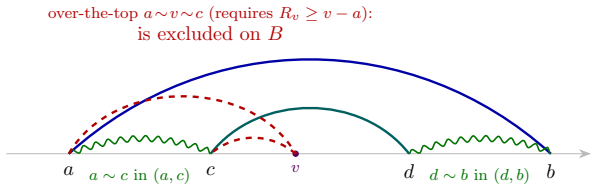
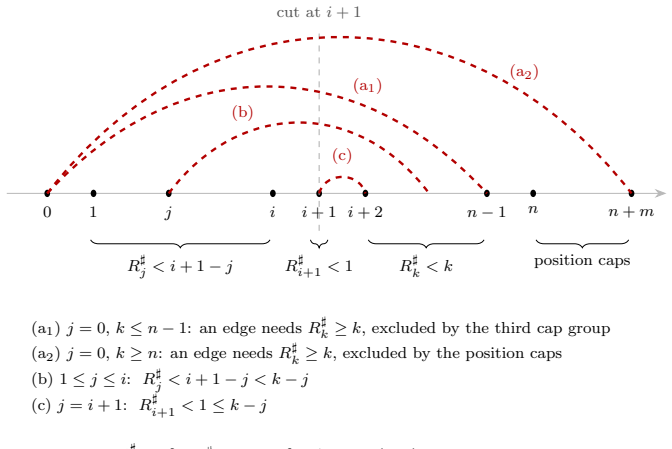
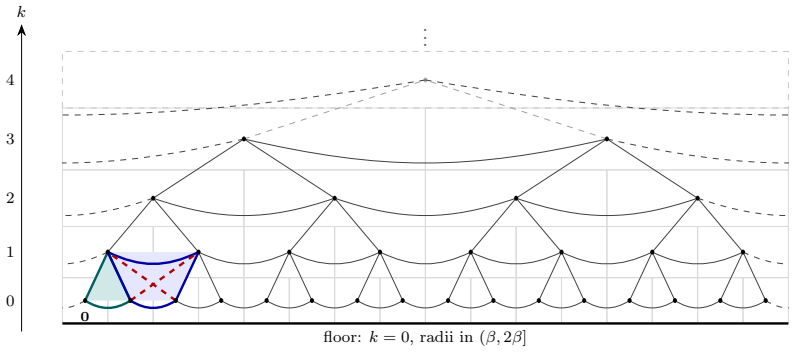
The rainbow is a pair of nested edges $\{a,b\}$ and $\{c,d\}$ with $a<c<d<b$ whose diagonals $\{a,c\}$ and $\{d,b\}$ are missing and whose overhangs $\ell=c-a$, $m=d-c$, $r=b-d$ satisfy the balance condition $|\ell-r|\le m$. Balance ensures that the outer arch is the only edge allowed to cross a cut, so on a containment event the component of every vertex between two cut positions is trapped (Lemma 3.4); cut-point certificates are cap events whose probabilities are exact products, and Kochen–Stone plus the zero–one law turn uniform per-scale probability into almost sure confinement at infinitely many scales. For the supercritical direction, the mark space is split into dyadic bands $X_k$ with radii in $(\beta 2^k,\beta 2^{k+1}]$, each band being a dilated, dense bounded-range graph; the min-rule makes a chain of band-$k$ points absorb every larger-radius point in its span, and independent site percolation on the floored binary tiling of the hyperbolic half-plane, controlled by a Peierls contour bound using a boundary-connectivity lemma, yields the infinite cluster.
What would settle it
Simulate the model at $\lambda=1$, $\beta=0.9$ on a window of length $10^9$: Theorem 1 predicts the largest component fraction decays to zero with window size, so a reproducible spanning component would falsify it; symmetrically, at $\beta=31$ the construction predicts a percolating cluster, so observing none on large windows would falsify Theorem 2. A sharper check is to measure the per-scale probability of the balanced-rainbow event of Definition 3.1: it should stay uniformly positive in the scale, and if it decays to zero the lower-bound mechanism is broken.
Extended reading notes
Core claim
The central claim is that the weight-dependent random connection model on $\mathbb{R}\times(0,1)$ with edge condition $(t\vee s)|x-y|\le\beta$ undergoes a non-degenerate phase transition. Theorem 1 states that when $\lambda\beta<1$, almost surely every connected component is finite; Theorem 2 states that when $\lambda\beta\ge 31$, an infinite connected component exists almost surely; together with the scaling to intensity one these give $1\le\beta_c\le 31$. Theorem 3 states that the discrete skeleton on $\mathbb{Z}$—vertices at integer sites carrying independent Pareto radii of scale $x_m$, joined when $|i-j|\le R_i\wedge R_j$—has no supercritical phase: for every $x_m\in(0,1)$ all components are finite, even though almost surely infinitely many edges cross every site, and the only transition is the degenerate one to full connectivity at $x_m\ge 1$. The paper also proves that infinitely many edges cross every point of the line almost surely, so fragmentation is achieved not by avoiding long edges but by confining every component between the cuts of rainbows.
Load-bearing premise
The subcritical bound rests on the assertion that balanced rainbows—nested edge pairs whose left and right overhangs differ by at most the inner span—form at every geometric scale with probability bounded below uniformly; if that block construction ever fails at a scale, the confinement argument and the lower bound $\beta_c\ge 1$ collapse.
Editorial extensions
If this is right
- At unit intensity every $\beta<1$ gives only finite components, while every $\beta\ge 31$ gives an infinite component; the critical point is genuinely between 1 and 31, with numerics near 2.
- The discrete skeleton shows that infinite components are not forced by the heavy-tailed radii alone: on $\mathbb{Z}$, with $x_m<1$, all components are finite and yet their diameters are unbounded, and infinitely many edges cross every site.
- The boundary case $\gamma=0$ of the weight-dependent random connection model in one dimension is decided: a supercritical phase exists, closing a case where percolation-threshold criteria were silent.
- The supercritical proof is quantitative: the site-open probability $(1-e^{-\lambda\beta/4})^{16}$ controls the failure rate, and optimising the contour constants would lower the 31 to about 15, still above the numerical critical value.
- The numerical curves indicate a jump in percolation density at the threshold, with crossing heights 0.7–0.9, consistent with the known discontinuity for independent $1/|x-y|^2$ percolation.
Reading between the lines
- The balance condition $|\ell-r|\le m$ appears to be the load-bearing geometric constraint; one could test whether relaxing it to $|\ell-r|\le cm$ for a large constant $c$ preserves a uniform per-scale confinement probability, which would pinpoint what the lattice skeleton's geometry contributes beyond the radius law.
- The sharp contrast between the discrete and continuum models suggests that the same percolation mechanism should appear on any vertex set with unbounded local density per connection range, such as a Poisson process, but not on lattices; this is an editorial extrapolation, since the paper only proves the $\mathbb{Z}$ and $\mathbb{R}$ cases.
- If the reported jump in the percolation density is confirmed rigorously, the model would extend the Aizenman–Newman discontinuity phenomenon from independent to dependent edges; proving or disproving that jump is a natural next step.
- The dyadic renormalisation may carry to other one-dimensional models with scale-invariant connection kernels, since only the min-rule and the band density enter; testing it on a kernel with a different boundary exponent would show whether the mechanism is specific to Pareto radii.
Signed reviews
Editorial analysis
A structured set of objections, weighed in public.
Referee Report
Summary. The paper studies a weight-dependent random connection model on a Poisson point process of intensity λ on R×(0,1), with the deterministic edge rule (t∨s)|x−y|≤β, equivalently min-rule connection of Pareto radii with scale β. The main results are Theorem 1 (for λβ<1, almost surely every connected component is finite) and Theorem 2 (for λβ≥31, almost surely an infinite component exists), giving β_c∈[1,31] at intensity one. The lower bound is proved through a discrete skeleton on Z with i.i.d. Pareto radii, for which Theorem 3 establishes total fragmentation for every admissible scale x_m∈(0,1); the proof uses balanced rainbow events at independent scales, cut-point certificates with exact product probabilities, a confinement lemma, and a Kochen–Stone plus zero–one-law assembly. The continuum transfer replaces exact products by exact void probabilities of Poisson regions. The supercritical proof is a dyadic-band renormalization: independent band processes are glued deterministically by the min-rule, and the resulting site-percolation problem on a floored binary tiling is solved by a Peierls contour argument. A numerical appendix, clearly separated from the proofs, estimates β_c near 2.
Significance. If the results hold, this is a substantial contribution to dependent long-range percolation at the critical inverse-square decay. The paper gives a genuine phase transition in a model where edges through a common vertex are strongly dependent and where classical independent-edge results do not apply. The proofs are largely parameter-free and deliver explicit constants: the construction fixes 1 and 31 as rigorous bounds, with no fitted parameter entering the proofs. The discrete skeleton result is of independent interest and is surprising: total fragmentation coexists with almost surely infinitely many edges crossing every site. The supercritical argument uses only exact products over disjoint regions and deterministic gluing, avoiding correlation inequalities. The numerical study is clearly labeled as non-rigorous, and the ancillary code, seeds, and manifests make it reproducible; it is not used in any proof. The paper is careful to separate proven statements from numerical extrapolations, and its claims are falsifiable.
minor comments (5)
- [Section 2, proof of Proposition 2.1] In the displayed computation of E[X] after Eq. (1), the expression β^2/2+β^2∫_β^∞ dd/d appears to contain a typesetting artifact; it should read β^2/2+β^2∫_β^∞ d^{-1} dd.
- [Notation section] The glossary omits several later central objects, including the graph H and H⋆ of Section 5.3, the site events O_{k,i}, and the events D_k and E_k used throughout Sections 3 and 4; adding these would improve usability.
- [Figure 12, left panel] The caption states that the spanning threshold extrapolates to about 1.08, below β_c, without explaining that the per-sample spanning threshold is not a consistent estimator of β_c; the surrounding text explains this, but the caption alone is misleading.
- [Section 5.3, Lemma 5.6] The assertion that the bounded face boundaries generate the cycle space of H is stated without proof; since the application of Timár's lemma depends on it, a one-sentence justification for locally finite planar graphs, or a reference, would make the argument self-contained.
- [Remark 1.1(iv)] The phrase 'the dependence costs an exponent' could be misread: since x_m>x_m^2, the certificate exponent 1−x_m is smaller than the independent-pairs exponent 1−x_m^2, so the cost is a decrease of the exponent; the intended meaning is clear but the wording is terse.
Circularity Check
No significant circularity: Theorems 1-3 are proved from explicit multi-scale constructions and arithmetic constants (1, 31); the numerical appendix is explicitly not used in the proofs.
full rationale
The derivation chain is self-contained. The lower bound rests on an explicit discrete-skeleton proof: rainbows are formed at independent scales with uniform probability (Proposition 3.1), cut-point certificates give gaps with probability bounded below (Propositions 3.2 and 4.1), and the Kochen-Stone plus zero-one-law assembly (Propositions 3.4 and 4.3) yields almost-sure confinement. No fitted parameter appears. The constant 1 enters only through the exponent 1-beta>0 in the cut-certificate count (Proposition 4.1), and 31 enters only through the elementary bound 16 e^{-31/4} <= 2^{-7} in Lemma 5.2; both are arithmetic, not tuned to data. The numerical appendix is expressly separated ('a numerical study included as an appendix places it near 2') and is not invoked in any theorem proof, so no fitted value is relabeled as a prediction. Self-citations ([14], [15], [17], [16]) appear solely as literature context or as remarks that prior criteria are silent on this boundary case (Remark 4.2), and are not load-bearing; the externally cited tools (Timár's boundary-connectivity lemma, Kochen-Stone, Last-Penrose) are standard and stated with their hypotheses. There is no uniqueness theorem imported from the authors and no ansatz adopted by self-citation. The discrete skeleton result (Theorem 3) is proved by its own nontrivial argument rather than assumed, and is cross-checked, not derived, against the classical independent-edge threshold in Remark 1.1. Honest non-finding: no circularity.
Assumptions & free parameters
assumptions (6)
- standard math Kolmogorov zero-one law
- standard math Kochen-Stone lemma
- standard math Harris-FKG inequality for Poisson processes (Last-Penrose Theorem 20.4)
- standard math Timár's boundary-connectivity lemma
- standard math Ergodicity of the Poisson process under spatial translations
- standard math Poisson restriction theorem and marking theorem
Cite this review
Pith. "Pith review of Rainbow percolation." pith.science (2026). https://pith.science/paper/KHE4GLET
@misc{pith2026260812954,
  author       = {Pith},
  title        = {Pith review of: Rainbow percolation},
  year         = {2026},
  howpublished = {\url{https://pith.science/paper/KHE4GLET}},
  note         = {Machine review of arXiv:2608.12954}
}
abstract
We consider the weight-dependent random connection model on a Poisson point process of intensity $\lambda$ on $\mathbb{R}\times(0,1)$ in which the vertices $(x,t)$ and $(y,s)$ are joined precisely when $(t\vee s)|x-y|\leq\beta$. Points at distance $d$ are joined with probability $\min(1,\beta/d)^2$, the critical decay of one-dimensional long-range percolation, and edges sharing a vertex are dependent through the common mark. We prove that the model has a genuine phase transition: for $\lambda\beta<1$ almost surely all connected components are finite, while for $\lambda\beta\geq 31$ an infinite component exists, so at intensity one the critical value satisfies $\beta_c\in[1,31]$; a numerical study included as an appendix places it near $2$. The lower bound is proved via a discrete skeleton of the model, obtained by pinning the vertices to $\mathbb{Z}$, which is of independent interest: it has no supercritical phase at all, jumping at a degenerate transition from total fragmentation to trivial connectivity, even though almost surely infinitely many edges cross every fixed site.
Figures


Figures from the paper (10 more)







Reference graph
Works this paper leans on
-
[1]
Disconti- nuity of the magnetization in one-dimensional 1/|x−y| 2 Ising and Potts models
Michael Aizenman, Jennifer T. Chayes, Lincoln Chayes, and Charles M. Newman. “Disconti- nuity of the magnetization in one-dimensional 1/|x−y| 2 Ising and Potts models”. In:Journal of Statistical Physics50.1–2 (1988), pp. 1–40.doi:10.1007/BF01022985
-
[2]
Discontinuity of the percolation density in one dimensional 1/|x−y| 2 percolation models
Michael Aizenman and Charles M. Newman. “Discontinuity of the percolation density in one dimensional 1/|x−y| 2 percolation models”. In:Communications in Mathematical Physics107 (1986), pp. 611–647.doi:10.1007/BF01205489
-
[3]
Distances in 1/|x−y| 2d percolation models for all dimensions
Johannes B¨ aumler. “Distances in 1/|x−y| 2d percolation models for all dimensions”. In:Com- munications in Mathematical Physics404.3 (2023), pp. 1495–1570.doi:10.1007/s00220- 023-04861-z
doi:10.1007/s00220- 2023
-
[4]
Isoperimetric lower bounds for critical exponents for long-range percolation
Johannes B¨ aumler and Noam Berger. “Isoperimetric lower bounds for critical exponents for long-range percolation”. In:Annales de l’Institut Henri Poincar´ e, Probabilit´ es et Statistiques 60.1 (2024), pp. 721–730.doi:10.1214/22-AIHP1342
-
[5]
Percolation in the hyperbolic plane
Itai Benjamini and Oded Schramm. “Percolation in the hyperbolic plane”. In:Journal of the American Mathematical Society14.2 (2001), pp. 487–507.doi:10.1090/S0894- 0347- 00- 00362-3. 40
doi:10.1090/s0894- 2001
-
[6]
Transience, recurrence and critical behavior for long-range percolation
Noam Berger. “Transience, recurrence and critical behavior for long-range percolation”. In: Communications in Mathematical Physics226.3 (2002), pp. 531–558.doi:10.1007/s002200200617
-
[7]
Graph diameter in long-range percolation
Marek Biskup. “Graph diameter in long-range percolation”. In:Random Structures & Algo- rithms39.2 (2011), pp. 210–227.doi:10.1002/rsa.20349
-
[8]
On the scaling of the chemical distance in long-range percolation models
Marek Biskup. “On the scaling of the chemical distance in long-range percolation models”. In: The Annals of Probability32.4 (2004), pp. 2938–2977.doi:10.1214/009117904000000577
Show all 27 references
-
[9]
Sharp asymptotic for the chemical distance in long-range percolation
Marek Biskup and Jeffrey Lin. “Sharp asymptotic for the chemical distance in long-range percolation”. In:Random Structures & Algorithms55.3 (2019), pp. 560–583.doi:10.1002/ rsa.20849
2019
-
[10]
Geometric inhomogeneous random graphs
Karl Bringmann, Ralph Keusch, and Johannes Lengler. “Geometric inhomogeneous random graphs”. In:Theoretical Computer Science760 (2019), pp. 35–54.doi:10.1016/j.tcs.2018. 08.014
2019 doi
-
[11]
Scale-free percolation
Maria Deijfen, Remco van der Hofstad, and Gerard Hooghiemstra. “Scale-free percolation”. In:Annales de l’Institut Henri Poincar´ e, Probabilit´ es et Statistiques49.3 (2013), pp. 817–838. doi:10.1214/12-AIHP480
2013 doi
-
[12]
Jian Ding and Allan Sly.Distances in critical long range percolation. 2013. arXiv:1303.3995 [math.PR]
2013 arXiv
-
[13]
Long-range models in 1D revisited
Hugo Duminil-Copin, Christophe Garban, and Vincent Tassion. “Long-range models in 1D revisited”. In:Annales de l’Institut Henri Poincar´ e, Probabilit´ es et Statistiques60.1 (2024), pp. 232–241.doi:10.1214/22-AIHP1355
2024 doi
-
[14]
The age-dependent random connection model
Peter Gracar, Arne Grauer, Lukas L¨ uchtrath, and Peter M¨ orters. “The age-dependent random connection model”. In:Queueing Systems93 (2019), pp. 309–331.doi:10.1007/s11134-019- 09625-y
2019 doi
-
[15]
Recurrence ver- sus transience for weight-dependent random connection models
Peter Gracar, Markus Heydenreich, Christian M¨ onch, and Peter M¨ orters. “Recurrence ver- sus transience for weight-dependent random connection models”. In:Electronic Journal of Probability27 (2022). Paper no. 60, pp. 1–31.doi:10.1214/22-EJP748
2022 doi
-
[16]
Finiteness of the percolation threshold for inhomogeneous long-range models in one dimension
Peter Gracar, Lukas L¨ uchtrath, and Christian M¨ onch. “Finiteness of the percolation threshold for inhomogeneous long-range models in one dimension”. In:Electronic Journal of Probability 30 (2025). Paper no. 134, pp. 1–29.doi:10.1214/25-EJP1399
2025 doi
-
[17]
Percolation phase transition in weight- dependent random connection models
Peter Gracar, Lukas L¨ uchtrath, and Peter M¨ orters. “Percolation phase transition in weight- dependent random connection models”. In:Advances in Applied Probability53.4 (2021), pp. 1090– 1114.doi:10.1017/apr.2021.13
2021 doi
-
[18]
A lower bound for the critical probability in a certain percolation pro- cess
Theodore E. Harris. “A lower bound for the critical probability in a certain percolation pro- cess”. In:Proceedings of the Cambridge Philosophical Society56.1 (1960), pp. 13–20.doi: 10.1017/S0305004100034241
1960 doi
-
[19]
An intermediate phase with slow decay of correla- tions in one dimensional 1/|x−y| 2 percolation, Ising and Potts models
John Z. Imbrie and Charles M. Newman. “An intermediate phase with slow decay of correla- tions in one dimensional 1/|x−y| 2 percolation, Ising and Potts models”. In:Communications in Mathematical Physics118.2 (1988), pp. 303–336.doi:10.1007/BF01218582
1988 doi
-
[20]
Cluster-size decay in supercritical kernel-based spatial random graphs
Joost Jorritsma, J´ ulia Komj´ athy, and Dieter Mitsche. “Cluster-size decay in supercritical kernel-based spatial random graphs”. In:The Annals of Probability53.4 (2025), pp. 1537– 1597.doi:10.1214/24-AOP1742
2025 doi
-
[21]
A note on the Borel–Cantelli lemma
Simon Kochen and Charles Stone. “A note on the Borel–Cantelli lemma”. In:Illinois Journal of Mathematics8.2 (1964), pp. 248–251.doi:10.1215/ijm/1256059668
1964
-
[22]
G¨ unter Last and Mathew Penrose.Lectures on the Poisson Process. Vol. 7. Institute of Math- ematical Statistics Textbooks. Cambridge: Cambridge University Press, 2017.doi:10.1017/ 9781316104477. 41
2017
-
[23]
One dimensional 1/|j−i| s percolation models: The existence of a transition fors≤2
Charles M. Newman and Lawrence S. Schulman. “One dimensional 1/|j−i| s percolation models: The existence of a transition fors≤2”. In:Communications in Mathematical Physics 104 (1986), pp. 547–571.doi:10.1007/BF01211064
1986 doi
-
[24]
Fast Monte Carlo algorithm for site or bond perco- lation
Mark E. J. Newman and Robert M. Ziff. “Fast Monte Carlo algorithm for site or bond perco- lation”. In:Physical Review E64 (2001), p. 016706.doi:10.1103/PhysRevE.64.016706
2001 doi
-
[25]
Long range percolation in one dimension
Lawrence S. Schulman. “Long range percolation in one dimension”. In:Journal of Physics A: Mathematical and General16.17 (1983), pp. L639–L641.doi:10.1088/0305- 4470/16/17/ 001
1983 doi
-
[26]
Boundary-connectivity via graph theory
´Ad´ am Tim´ ar. “Boundary-connectivity via graph theory”. In:Proceedings of the American Mathematical Society141.2 (2013), pp. 475–480.doi:10.1090/S0002-9939-2012-11333-4
2013 doi
-
[27]
Ultra-small scale-free geometric networks
Joseph E. Yukich. “Ultra-small scale-free geometric networks”. In:Journal of Applied Proba- bility43.3 (2006), pp. 665–677.doi:10.1239/jap/1158784937. 42
2006
Reviewed August 15, 2026 · model on record in the stance chip above.
Discussion (0). Continue with ORCID to comment.