REVIEW 3 major objections 5 minor
TIEM: Temporal Integration of Hypergraph Evidence and Skill Memory for Event-Driven Financial Forecasting
T0 review · 3 major / 5 minor · reviewed 2026-08-15 · deepseek-v4-flash
Pith's one-line read TIEM claims that timestamp-gating all evidence and stored skills — admitting only what was truly available before the decision — improves event-driven financial forecasting and beats ten baselines on five benchmarks.
desk verdict Worth a referee and possibly a reading group, but the main empirical claim is suspect until the baseline prompt asymmetry is resolved. read the letter →
The pith
A machine-rendered reading of the paper's core claim, the machinery that carries it, and where it could break.
The reading
What carries the argument
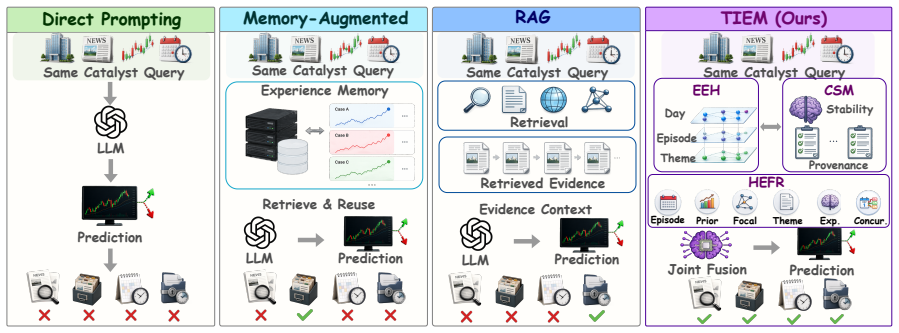
The load-bearing mechanism is the temporal availability gate, made operational by three coordinated components. The Event-Evidence Hypergraph (EEH) organizes timestamped text into Day-tier atomic facts, Episode-tier windows (bounded multi-day causal chains per stock), and Theme-tier clusters (cross-stock co-movements), each record carrying an explicit temporal extent [τs, τe], so retrieval at decision time T admits only facts with ts ≤ T and Episodes/Themes with τe < T. The Case-based Skill Memory (CSM) stores outcome-derived IF-THEN skills tagged with domain, an EMA-updated advantage score, a stability state, and complete source ancestry A; its ancestry gate requires every ancestor's resolve time to precede T and fails closed otherwise, which is what keeps reused experience temporally honest. Heterogeneous Evidence-Experience Fusion Reasoning (HEFR) then packs five budgeted streams — focal, prior, Episode, Theme, experience — plus a budget-exempt concurrent block into one joint LLM call, using a character-allocation scheme that conserves the total budget across the streams. The gate is the active ingredient: it converts retrieval from pure similarity matching into similarity restricted to records whose availability is verifiable, and the temporal-gate ablation in the paper shows that removing it costs roughly six accuracy points on one backbone and ten on the other.
What would settle it
Independently audit all 640 test instances: for each catalyst, verify against wire-level or exchange-level timing that every focal and concurrent record's timestamp precedes its decision time, that every retrieved Episode and Theme ends strictly before it, and that every skill ancestor's resolve time does too — rather than trusting the corpus's own stamps or the paper's self-reported audit of 1,280 cases from an unspecified subset. If a single test instance contains a record that became available after its decision time, or if recomputing FinPURE labels directly from the stored price windows changes any direction, the leakage-free claim fails as stated.
Extended reading notes
Core claim
The central claim is that temporal leakage and training-data contamination, not model capability, are the binding constraint on trustworthy event-driven catalyst-outcome forecasting, and that the constraint can be addressed by construction rather than by hoping a model's training cutoff protects the evaluation. TIEM enforces at every step that nothing entering the prediction context postdates the decision: focal and same-day concurrent evidence may be dated at or before T, prior day records, Episodes, and Themes must end strictly before T, and each retrieved skill carries a complete ancestry of the outcomes it was distilled from, all resolving before T, with missing or late ancestry failing closed. On this gated substrate, evidence is organized at three temporal scales — atomic Day facts, per-stock Episode chains, and cross-stock Theme clusters — and fused with retrieved skills by Heterogeneous Evidence-Experience Fusion Reasoning in a single budgeted LLM call. The reported results are that TIEM achieves the strongest average accuracy, Matthews correlation, and macro-F1 on both of two backbone LLMs across all five benchmarks, leads in cross-dataset and recent-period transfer, and that ablations attribute the gain to each of the three components in turn. The authors frame the contribution as a transferable recipe: timestamped evidence and provenance-tracked experience remain effective across markets, periods, and model choices, under a contamination-inspection protocol that does not assume a universal training cutoff.
Load-bearing premise
The load-bearing premise is that timestamps are trustworthy: the paper assumes that record timestamps, and the end-of-day semantics applied to date-only records, accurately reflect when information truly became available, so that the temporal gates genuinely exclude future evidence. If timestamps are missing, coarse, or misassigned, the leakage-free claim collapses and the reported gains could be contamination rather than forecasting skill.
Editorial extensions
If this is right
- If TIEM's results hold, timestamp-gated evidence with provenance-tracked skill reuse is a transferable recipe rather than a dataset-specific trick: it leads on two distinct LLM backbones (DeepSeek-V4-Flash and GPT-5.4-mini) and across Chinese and U.S. equity benchmarks with three- and five-day horizons.
- The lead persists under cross-market, cross-time, and recent-period evaluations, including the FinPURE holdout whose labels can be recomputed from stored price windows, so the reported advantage is not confined to in-distribution examples.
- Component ablations attribute the gain to all three pieces — EEH's multi-tier temporal organization, CSM's outcome-informed skill reuse, and HEFR's single-call joint fusion — implying the three mechanisms do complementary work rather than one carrying the result.
- The Name-Date Probe shows names and dates alone stay at the base rate while event-content gains are positive, supporting the paper's claim that the forecasts are content-grounded rather than driven by identity shortcuts.
- The accuracy gain is not bought with unbounded context: TIEM sits on the accuracy–token Pareto frontier and leads the log-adjusted and per-1k-token trade-offs across the five benchmarks.
Reading between the lines
- My inference: the three-gate audit discipline — admit evidence only if verifiably available, require complete ancestry, fail closed on missing metadata — transfers beyond finance to any time-sensitive prediction task (clinical outcomes, geopolitical risk, supply-chain disruption), where the honest metric is accuracy after an availability audit, not accuracy on a static benchmark.
- My inference: the paper does not isolate whether cross-dataset transfer comes from evidence transfer or skill transfer; ablating CSM specifically on the CMIN-US, EDT, and CSMD shift benchmarks would settle whether outcome-derived skills carry the cross-market gain or the hypergraph evidence does.
- My inference: the appendix proofs are existence witnesses — a Gaussian signal-detection setting for EEH, a stability analysis of the EMA advantage for CSM, and a repetition-code argument for HEFR — so they show each component can help under favorable conditions, not that it must help on arbitrary natural-language evidence; the five-benchmark results are the primary evidence.
Signed reviews
Editorial analysis
A structured set of objections, weighed in public.
Referee Report
Summary. TIEM is a timestamp-gated framework for event-driven catalyst-outcome forecasting. It combines an Event-Evidence Hypergraph (EEH) with Day, Episode, and Theme tiers; a Case-based Skill Memory (CSM) with EVOKE, REVISE, MERGE, and RETIRE primitives; and Heterogeneous Evidence-Experience Fusion Reasoning (HEFR) for a single-call fusion of retrieved evidence and skills. The paper also introduces FinPURE, a recent-period A-share holdout benchmark, a three-gate Contamination Inspection Protocol (CIP), and a Name-Date Probe (NDP) for per-model contamination sensitivity. Experiments on five benchmarks with two backbone LLMs report consistent gains for TIEM over ten baselines, together with ablations, cross-dataset shift analyses, token-efficiency analyses, and cross-backbone consistency analyses. The authors release code and data.
Significance. If the empirical claims hold, TIEM is a valuable contribution to trustworthy financial LLM forecasting: it directly addresses temporal leakage and contamination, which are central concerns in this area; the FinPURE benchmark and the Name-Date Probe are reusable evaluation resources; and the framework is modular and clearly specified. The three-gate protocol and the ancestry-based skill gating are sensible design choices, and the consistency of the reported gains across datasets and backbones is encouraging. The release of code and data is a concrete reproducibility strength. However, the empirical support is currently weakened by the absence of uncertainty quantification on the 128-instance test sets and by an unresolved fairness question about whether baselines receive the same event text as TIEM. These issues are load-bearing for the headline claim and need to be addressed before the paper can be accepted.
major comments (3)
- [§5.2, Table 1] Table 1 reports only point estimates (means over three runs) for test sets of 128 instances, with no confidence intervals, standard deviations, or significance tests. For example, on Astock with GPT-5.4-mini the gap between TIEM (65.62) and HyperGraphRAG (61.72) is 3.9 percentage points; with n=128 a paired proportion difference has a standard error in the 4-6 percentage-point range, so several reported differences are not distinguishable from sampling noise. Please report per-run variability and paired bootstrap or McNemar tests for the headline comparisons, and apply the same uncertainty quantification to the ablation results in Table 2.
- [Appendix E and Fig. 12] The evaluation may be unfair to the baselines: the HEFR prompt in Fig. 9 includes a dedicated focal-event block, and §5.3 reports that focal-event text contributes positive signal (Delta_content > 0 in Fig. 5), yet the case study in Fig. 12 shows MemGPT, Mem0, and A-MEM stating that 'The event content for Alphabet Inc. ... is unavailable' and Vanilla RAG and HippoRAG using an older earnings article as the catalyst. If this reflects the actual evaluation harness, the baselines were not given the decision-day event text while TIEM received it through Phi(c) in Eq. (1), so the reported lead could be an input-asymmetry artifact rather than evidence of method superiority. Please state explicitly whether all baseline prompts contain the focal event text, and if not, rerun the comparison with identical focal-event input to all methods.
- [§3 and Appendix H] The temporal-leakage-free claim rests on timestamp granularity and end-of-day semantics, but the audit in Appendix H is self-reported over one run and does not describe how timestamp correctness was verified against an independent source. Since the CIP protocol and the entire contribution are motivated by leakage prevention, please clarify the provenance and verification of timestamps for each dataset, and quantify sensitivity to timestamp noise (e.g., shifting date-only records by one day) in the main results.
minor comments (5)
- [Appendix A.1-A.3] Propositions 1-3 are stated in the main text with 'Proof', but the proofs are existential witnesses: Eq. (18) assumes X_j = zeta_j Y_c + epsilon_j with zeta_j >= 0, so the error reduction Pe(I1) < Pe(I0) follows by construction. The paper acknowledges this in the appendix; I recommend moving these to a clearly labeled 'Illustrative sufficiency analysis' and removing the 'Proof' marker from the main text.
- [Table 2] Table 2 reports ablations on Astock only; since the test set is 128 instances, the small differences (e.g., 65.62 vs 64.84) should be interpreted with the same uncertainty quantification requested in the major comment on Table 1.
- [Fig. 12] Figure 12 is a single case study; the paper already states it is not aggregate evidence. Please add a sentence in the main text pointing readers to the aggregate results so the case is not read as representative.
- [Section 4] Some notation is inconsistent: Eq. (1) uses Phi(c) for the focal text while Eq. (14) uses F(c); H_c in Eq. (5) is clear from context but not defined before use. A table of symbols would help.
- [Table 3 and Appendix G] The appendix lists many hyperparameters; a small sensitivity study over the most influential ones (e.g., B_char, k1, tau) would strengthen the claim that results are not tuned per dataset.
Circularity Check
Theoretical 'can improve' proofs assume outcome-correlated evidence; the empirical benchmark evaluation remains a genuine holdout.
-
self definitional
[Appendix A.1, proof of Proposition 1, equations (18) and (26)]
"Consider a sufficient setting in which the decision-relevant content exposed by component j admits the scalar statistic Xj = ζjYc + εj ... Here ζj = 0 represents an uninformative component. ... Hence a timestamp-admissible component carrying a finite-noise, outcome-relevant signal strictly improves the binary forecast ... Thus EEH can improve forecasting through timestamp-gated multi-tier retrieval under these sufficient conditions."
The proof defines the evidence statistic X_j as a noisy function of the outcome label Y_c itself, so the informativeness of each EEH component is assumed rather than derived from the timestamp-gated retrieval mechanism. The conclusion that adding components with ζ_j > 0 lowers Bayes error is an algebraic restatement of that assumption: it shows only that label-correlated features help a Bayes classifier. It does not establish that EEH's Day, Episode, or Theme tiers supply such signal. Proposition 1's 'can improve' is thus equivalent to the assumed existence of outcome-informative evidence, putting the conclusion into the premise.
-
self definitional
[Appendix A.2, proof of Proposition 2, equation (37)]
"Finally, consider a positive-probability family Wσ of cross-case catalysts for which σ passes the time, cosine, and realized score-margin gates, and its IF–THEN rule is applicable and returns Yc exactly. Suppose the EEH-only decision dE is conditionally uninformative on Wσ, so its error is 1/2, the CSM-conditioned decision dC follows the matched rule there, and both decisions agree outside Wσ. Then Acc(dC)−Acc(dE) = 1/2 Pr(c∈Wσ)>0."
The skill is assumed to return the true outcome exactly on the witness family Wσ, and the alternative EEH-only decision is assumed to be a coin flip on that same family. Under those assumptions the accuracy gain is immediate. The proof does not derive from CSM's lifecycle, ancestry gates, or retrieval that the distilled IF–THEN rule contains outcome information; that information is placed into the witness by construction. The proposition's conclusion is therefore a restatement of 'a perfect skill beats an uninformative baseline on some cases.'
1 more flagged steps
-
self definitional
[Appendix A.3, proof of Proposition 3, equations (44)–(48)]
"Suppose each packed stream exposes a cue χi = YcNi, Pr(Ni = −1|Yc = y) = ε_ch, Pr(Ni = +1|Yc = y) = 1−ε_ch ... A joint HEFR call can realize this decoder as dJ = sign(Σ_i χ_i) ... Hence the joint decoder is strictly more reliable than any single cue."
Each HEFR stream is modeled as a binary-symmetric-channel copy of the outcome label Y_c with independent noise below 1/2. The gain of the joint majority decoder over a single cue is the standard repetition-code inequality. This proves only that label-correlated streams fuse well; it does not show that the actual focal, prior, episode, theme, and experience streams are such cues or that HEFR's budget allocation extracts them. The 'fusion can improve' conclusion is built into the definition of the cues, so the proof reduces to its own assumption.
full rationale
The paper's empirical core is not circular: Table 1 is a temporal holdout on Astock, FinPURE, CMIN-US, EDT, and CSMD with fixed hyperparameters and three-run means, and the ablations in Table 2 are measured differences rather than derived quantities. FinPURE's labels are recomputable from stored price windows, so introducing a new benchmark is not a fitted-input-called-prediction case. HyperGraphRAG appears as a baseline, not as load-bearing support, so self-citation does not drive the central claim. The Appendix A propositions, however, are first-principles results that reduce by construction: each proof defines the evidence, skill, or stream as a function of the outcome label and then derives that using it improves a Bayes decision. That is a valid existence argument but not a derivation from the proposed mechanisms, and it does not independently support the empirical gains. The skeptical input-asymmetry concern about baselines lacking the focal event block is an evaluation-fairness issue rather than a circularity of the derivation chain, so it is not counted in the score beyond the theoretical circularity already noted. Overall: partial circularity in the theoretical justifications, while the central benchmark claims retain independent empirical content.
Assumptions & free parameters
free parameters (8)
- HEFR raw-character budget B_char =
8000
- HEFR stream shares ω =
(0.20, 0.30, 0.18, 0.12, 0.20)
- EVOKE similarity threshold τ =
0.85
- EMA retention λ_a =
0.90
- CSM retrieval similarity gate μ =
0.30
- EEH retrieval budgets (k1,k2,k3) =
(6,3,2)
- Theme window and step (Δth, δth) =
(90,30) days
- Label deadband =
(-0.5%, +0.55%)
assumptions (5)
- domain assumption Timestamp metadata and date-only end-of-day semantics accurately reflect real information availability.
- domain assumption LLM extraction of Day facts, Episodes, and Themes is sufficiently accurate for retrieval.
- domain assumption Training-data contamination in the backbone LLMs does not produce the observed gains.
- domain assumption The random 128-instance samples are representative of each dataset's test-candidate pool.
- standard math Standard probability and signal-detection results used in Appendix A proofs.
Cite this review
Pith. "Pith review of TIEM: Temporal Integration of Hypergraph Evidence and Skill Memory for Event-Driven Financial Forecasting." pith.science (2026). https://pith.science/paper/N3RNDTJN
@misc{pith2026260813024,
  author       = {Pith},
  title        = {Pith review of: TIEM: Temporal Integration of Hypergraph Evidence and Skill Memory for Event-Driven Financial Forecasting},
  year         = {2026},
  howpublished = {\url{https://pith.science/paper/N3RNDTJN}},
  note         = {Machine review of arXiv:2608.13024}
}
read the original abstract
Event-driven catalyst-outcome forecasting increasingly uses retrieval- and memory-augmented large language model agents for prediction. However, training-data contamination and temporal leakage can create an Evidence Chasm between reported accuracy and true predictive ability. We propose TIEM, a timestamp-gated framework with three coordinated components: an Event-Evidence Hypergraph (EEH) for timestamp-filtered multi-tier retrieval; a Case-based Skill Memory (CSM) for source-tagged temporal skills; and Heterogeneous Evidence-Experience Fusion Reasoning (HEFR) for evidence-experience fusion and prediction. We also introduce FinPURE, a recent-period A-share holdout benchmark, and use a Name-Date Probe to assess per-model name-date sensitivity rather than assuming training cutoffs. Results on five financial forecasting benchmarks show TIEM outperforms current baselines. Our project is available at https://github.com/QwenQKing/Fin_TIEM.
Figures


Figures from the paper (9 more)


Reviewed August 15, 2026 · model on record in the stance chip above.
Discussion (0). Continue with ORCID to comment.