REVIEW 3 major objections 5 minor 105 references
Forecast for the detectability of patchy hydrogen reionization in WEAVE-QSO measurements of the Lyman-$\alpha$ forest power spectrum at redshift $z \geq 4$
T0 review · 3 major / 5 minor · reviewed 2026-08-15 · deepseek-v4-flash
Pith's one-line read With the forecast uncertainties adopted here, WEAVE-QSO measurements of the 1D Lyman-$\alpha$ forest power spectrum at $z \geq 4$ should detect the large-scale relic imprint of patchy hydrogen reionization at $4.5\sigma$ significance.
desk verdict A careful, honest forecast whose headline 4.5σ is an injection-recovery that depends on the lowest-k bin and on Sherwood-Relics being right; deserves peer review, but the abstract needs to state the model-conditional nature. read the letter →
The pith
A machine-rendered reading of the paper's core claim, the machinery that carries it, and where it could break.
The reading
What carries the argument
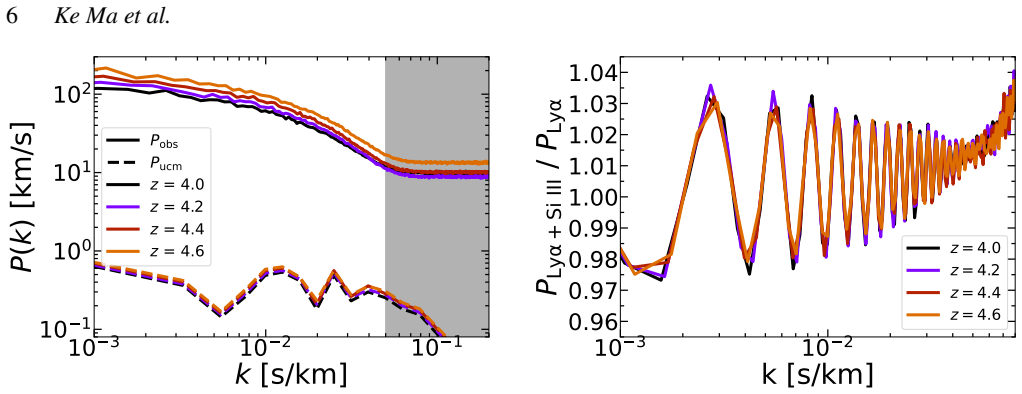
The mechanical core is the patchy reionization correction of Molaro et al. (2022, 2023), encoded as a dimensionless amplitude $A_p = (z-3.45)/2.55$ that multiplies the ratio of $P_{\mathrm{Ly}\alpha}$ from hybrid radiative-transfer reionization simulations to the uniform-background model. The correction is applied to mock sightlines drawn from the Sherwood-Relics simulations and processed by the WEAVEify instrument model, which adds resolution, noise, and continuum effects. The forecast covariance is built from bootstrap resampling for the statistical errors plus quadrature-added systematics for resolution, noise subtraction, uncorrelated metals, incomplete high-column-density absorber removal, and continuum shape; the detection statistic is the $\Delta\chi^2$ between fits with and without the four $A_p$ parameters.
What would settle it
Compare the real WEAVE-QSO measurement in the lowest-wavenumber bin ($k \sim 10^{-3}\,\mathrm{s\,km^{-1}}$) against the forecast covariance: if the scatter of that bin across independent line-of-sight subsamples exceeds the forecast systematic error, or if the recovered $A_p$ posterior at $z=4.6$ does not include 0.45 within the 95% credible interval, the central claim is falsified. A direct null test is to fit the observed $P_{\mathrm{Ly}\alpha}$ at $z=4$ with and without $A_p$ and check whether $\Delta\chi^2$ remains above about 25.
Extended reading notes
Core claim
The central claim is that a WEAVE-QSO measurement of the 1D Lyman-$\alpha$ forest power spectrum at $z \geq 4$, with the covariance forecast in this paper, can recover the redshift-dependent amplitude of patchy reionization at $4.5\sigma$ significance. The mock analysis finds $\chi^2/\mathrm{dof}$ improving from $65.28/32$ without the patchy correction to $36.07/28$ with one $A_p$ parameter per redshift bin. The expected amplitudes $A_p = 0.216, 0.294, 0.373, 0.451$ at $z=4.0, 4.2, 4.4, 4.6$ fall inside the recovered 68% credible intervals, and the recovery persists when the thermal-history priors are broadened. The largest-scale modes ($k \lesssim 0.0033\,\mathrm{s\,km^{-1}}$) carry most of the constraining power, and the lowest-wavenumber bin is where systematic uncertainties from high-column-density absorber damping wings and continuum placement dominate.
Load-bearing premise
The forecast significance assumes that the systematic uncertainty in the lowest-wavenumber bin---dominated by damping wings from high-column-density absorbers and by continuum placement---is correctly modeled; if the true completeness of absorber removal or the continuum errors differ from the adopted models, the $4.5\sigma$ preference would drop toward the $1.2\sigma$ the paper finds when that bin is omitted.
Editorial extensions
If this is right
- WEAVE-QSO should detect the large-scale relic imprint of patchy reionization at $z \geq 4$ at roughly $4.5\sigma$ if the forecast covariance is achieved.
- Per-redshift-bin recovery of $A_p$ means the survey can characterise how the imprint fades from $z=4.6$ to $z=4.0$, not just detect it.
- Because the signal lives at $k \lesssim 0.0033\,\mathrm{s\,km^{-1}}$, survey pipelines should concentrate systematic control on that single largest-scale bin.
- If the lowest-wavenumber bin cannot be protected from damping-wing and continuum systematics, the patchy-reionization signature would not rise above about $1.2\sigma$.
- Other forthcoming massive spectroscopic surveys targeting $k \sim 10^{-3}\,\mathrm{s\,km^{-1}}$ at $z>4$ should be able to make the same measurement.
Reading between the lines
- Inference: a non-detection at $z=4.0$ combined with a detection at $z=4.6$ would effectively measure the redshift at which relic thermal fluctuations fade, adding a reionization-timing observable complementary to 21-cm and CMB probes.
- Inference: re-running the same pipeline with reionization models that differ in bubble size or duration would translate the $A_p$ posterior width into a constraint on reionization geometry rather than amplitude alone.
- Inference: because high-column-density absorber completeness dominates the lowest-wavenumber systematics, independent spectroscopic calibration of the completeness function toward the same QSOs could directly shrink the error bar that sets the detection significance.
- Inference: the forecast implies that survey strategy---exposure time, magnitude cut, and sky coverage---could be optimised for lowest-wavenumber sensitivity rather than total sightline count.
Signed reviews
Editorial analysis
A structured set of objections, weighed in public.
Referee Report
Summary. Ma et al. present a forecast for detecting the large-scale imprint of patchy hydrogen reionization in the 1D Lyman-alpha forest power spectrum with the WEAVE-QSO survey at z=4.0-4.6. They generate mock spectra from the Sherwood-Relics simulations, process them with the WEAVEify instrument forward model, and construct a forecast covariance that includes statistical errors and systematics from spectral resolution, noise subtraction, metals, high-column-density (HCD) damping wings, and continuum placement. They then perform an MCMC injection-recovery analysis with an A_p amplitude parameter for the patchy reionization correction, finding Delta chi^2 = 29.21 between models with and without A_p (about 4.5 sigma). Removing the lowest-k bin reduces this to Delta chi^2 = 5.40 (about 1.2 sigma), which the paper reports transparently.
Significance. This is a useful and unusually transparent forecast for a key observable. Its strengths include an end-to-end forward model for WEAVE-QSO spectra, a systematic budget that goes beyond most Lyman-alpha forest forecasts, explicit tests of robustness to thermal priors, and honest reporting of the critical role of the lowest-k bin. If the adopted systematics and the Sherwood-Relics reionization model are correct, the paper provides a concrete, falsifiable prediction: WEAVE-QSO will recover the redshift-dependent A_p amplitude at about 4.5 sigma. However, the significance is conditional on external HCD completeness and continuum models and on the Sherwood-Relics patchy reionization morphology; it is an injection-recovery forecast rather than a model-independent detection claim. With revisions that address the treatment of large-scale systematics and the framing of the headline claim, this would be a valuable benchmark for the community.
major comments (3)
- [Section 4.2, Figs 10-11] The headline significance of about 4.5 sigma is almost entirely carried by the lowest-wavenumber bin in each redshift bin. Removing the bin at k less than about 0.0033 s/km reduces Delta chi^2 from 29.21 to 5.40, corresponding to about 1.2 sigma. The paper itself states that the uncertainties in those bins are dominated by incomplete HCD identification and, to a lesser extent, continuum placement. The HCD residual term in Section 3.5 is computed using the Wang et al. (2022) completeness function applied at z about 4-4.6 with R about 5000 and the Prochaska et al. (2014) column-density distribution; if the real completeness is lower, or the HCD population differs, the residual damping-wing power at k about 10^-3 s/km is underestimated. Because the patchy reionization signal is itself a smooth large-scale enhancement, residual HCD power can partially mimic or absorb it. The 4.5 sigma claim is therefore only as secure as these external inputs, and the paper should demonstrate robustness to plausible variations, for example by treating an HCD normalization amplitude as a nuisance parameter in the fits.
- [Section 3.7, Fig. 9] The covariance matrix used for the Delta chi^2 statistic appears to be diagonal, with the HCD and continuum systematic terms added in quadrature to the statistical variance in each k bin. The HCD and continuum systematics are smooth functions of wavenumber (Figs 7 and 8), so an error in their amplitude or shape produces correlated shifts across the large-scale bins that dominate the A_p constraint. A diagonal covariance underweights such a coherent systematic and will tend to overstate the significance of a smooth signal. The authors should either marginalize over the amplitudes of these systematics in the MCMC or construct a non-diagonal systematic covariance before quoting a single detection significance.
- [Sections 2.1 and 4.1] The mock data vector is generated from the same Sherwood-Relics simulations and the same Molaro et al. (2022, 2023) patchy reionization correction used to define A_p in the inference. The reported significance is therefore an injection-recovery consistency check under the assumed model, not an external validation of the model or of the systematic inputs. This is not itself an error, since injection-recovery is a standard forecasting tool, but the abstract's statement that WEAVE-QSO should be able to directly detect the relic imprint should be explicitly conditioned on the fidelity of the Sherwood-Relics reionization morphology and on the adopted systematic models, so that the headline significance is not misread as a model-independent detection claim.
minor comments (5)
- [Section 4.2, last paragraph] The text refers to a survey configuration of approximately 10,000 deg2 with m_r < 22, but the adopted cut throughout the paper is m_r < 21.9 (Section 2.4); please reconcile this inconsistency.
- [Appendix A, Fig. A2 caption] The caption reads 'The posterior for A_p is does not change significantly'; this should read 'does not change significantly'.
- [Section 3.5] The synthetic HCDs are inserted at locations where the Lyman-alpha optical depth is largest; this clustering assumption should be justified or tested, because it affects the large-scale residual power that enters the systematic budget.
- [Section 3.6] The flat-continuum test is a useful bounding exercise, but it does not necessarily bracket the wavelength-dependent PCA continuum errors of WEAVEify; the continuum systematic term should be described as a forecast-level estimate rather than a calibrated error.
- [Section 4.2] The use of Wilks' theorem for the Delta chi^2 statistic is not strictly regular because the A_p parameters are constrained to A_p >= 0 and the null model lies on the boundary. In the present case the best-fit values are well away from the boundary, so the correction would not weaken the conclusion, but the statement should be qualified.
Circularity Check
No significant circularity: the forecast is an explicit injection-recovery calculation, not a measurement claiming to validate the reionization model.
full rationale
The paper's central claim is a detectability forecast, not a derivation of the patchy reionization signal from first principles. In Sections 4.1 and 4.2, mock data are generated by applying the Molaro et al. (2022) table-2 correction with Ap values set by Eq. (7), and the same correction is used as the fitting model; the resulting Δχ²=29.21 therefore measures the statistical power of the proposed WEAVE-QSO measurement under the assumed signal model. This is a standard injection-recovery sensitivity calculation: the output (4.5σ significance) is a property of the pipeline and covariance, not an independent confirmation of the model. The paper is transparent about this, using the phrase 'forecast covariance' and 'mock data vector containing the fiducial patchy reionization signal,' and it reports the honest fragility test that removing the lowest-k bin reduces the preference to 1.2σ (Section 4.2). The covariance forecast is built from an instrument-level forward model (WEAVEify) plus external inputs (Wang et al. 2022 completeness, Prochaska et al. 2014 CDDF, Palanque-Delabrouille et al. 2016 luminosity function); none of these is fitted to the mock data being scored. Self-citations (Molaro et al. 2022/2023, Puchwein et al. 2023, Ma et al. 2026) supply the adopted signal and simulation models, but they are used as stated model assumptions rather than as evidence that the model is true. Concerns about HCD completeness, continuum systematics, and the dominance of the lowest-k bin are correctness or model-dependence risks, not circular reasoning.
Assumptions & free parameters
free parameters (2)
- Patchy reionization amplitude A_p (injected signal) =
0.216, 0.294, 0.373, 0.451 at z=4.0, 4.2, 4.4, 4.6
- r-band magnitude cut m_r < 21.9 =
21.9
assumptions (6)
- domain assumption The Sherwood-Relics simulation suite (Puchwein et al. 2023) accurately models both the small-scale Lyman-alpha forest and the large-scale patchy reionization thermal relics.
- domain assumption The tabulated patchy reionization correction in table 2 of Molaro et al. (2022) represents the true effect of inhomogeneous reionization on the 1D Lyman-alpha power spectrum at z=4 to 4.6.
- domain assumption Wilks' theorem provides the null distribution for the likelihood ratio test between the no-Ap and Ap models.
- domain assumption The forecast covariance model in Section 3.7 captures the true systematic error budget of WEAVE-QSO observations.
- domain assumption The QSO luminosity function of Palanque-Delabrouille et al. (2016) describes the z>4 quasar population targeted by WEAVE-QSO.
- domain assumption The effective optical depth normalization of Becker et al. (2013) is used to scale the simulated skewers to the observed mean transmission.
Cite this review
Pith. "Pith review of Forecast for the detectability of patchy hydrogen reionization in WEAVE-QSO measurements of the Lyman-$\alpha$ forest power spectrum at redshift $z \geq 4$." pith.science (2026). https://pith.science/paper/D5UV5HLB
@misc{pith2026260813153,
  author       = {Pith},
  title        = {Pith review of: Forecast for the detectability of patchy hydrogen reionization in WEAVE-QSO measurements of the Lyman-$\alpha$ forest power spectrum at redshift $z \geq 4$},
  year         = {2026},
  howpublished = {\url{https://pith.science/paper/D5UV5HLB}},
  note         = {Machine review of arXiv:2608.13153}
}
abstract
We present the first detailed forecasts for the detectability of patchy hydrogen reionization in the one-dimensional Ly$\alpha$ forest power spectrum to be measured by the WEAVE-QSO survey. Using the Sherwood-relics reionization simulations and a WEAVE-QSO survey configuration, we generate mock spectra in four redshift bins, $z=4.0,4.2,4.4,$ and $4.6$, in which relic ionization and temperature fluctuations from patchy hydrogen reionization enhance the Ly$\alpha$ forest power spectrum on large scales (i.e., at wavenumber $k\sim 10^{-3},\mathrm{s\,km^{-1}}$). Our Ly$\alpha$ forest pipeline forecasts the power spectrum covariance by considering sample size, spectral resolution, noise subtraction, continuum placement, metal contamination, and damping wings from high-column density absorbers. Applying our covariance forecast within a Bayesian parameter inference framework, we find that the signature of patchy hydrogen reionization should be detectable at a significance of $\simeq 4.5\sigma$. The forthcoming WEAVE-QSO 1D power spectrum measurements should therefore be able to directly detect and characterize the large-scale relic imprint of patchy hydrogen reionization in the Ly$\alpha$ forest power spectrum at $z\geq 4$.
Figures


Figures from the paper (5 more)


Reference graph
Works this paper leans on
-
[1]
Metallicity of the Intergalactic Medium Using Pixel Statistics. III. Silicon. , keywords =. doi:10.1086/380961 , archivePrefix =. astro-ph/0310664 , primaryClass =
-
[2]
A non-linear solution to the S _ 8 tension?. , keywords =. doi:10.1093/mnras/stac2429 , archivePrefix =. 2206.11794 , primaryClass =
-
[3]
The Chemical Composition of the Sun. , keywords =. doi:10.1146/annurev.astro.46.060407.145222 , archivePrefix =. 0909.0948 , primaryClass =
-
[4]
Impact of systematic redshift errors on the cross-correlation of the Lyman- forest with quasars at small scales using DESI Early Data. , keywords =. doi:10.1088/1475-7516/2025/01/130 , archivePrefix =. 2402.18009 , primaryClass =
arXiv 2025
-
[5]
A refined measurement of the mean transmitted flux in the Ly forest over 2 < z < 5 using composite quasar spectra. , keywords =. doi:10.1093/mnras/stt031 , archivePrefix =. 1208.2584 , primaryClass =
-
[6]
Revealing Reionization with the Thermal History of the Intergalactic Medium: New Constraints from the Ly Flux Power Spectrum. , keywords =. doi:10.3847/1538-4357/aafee4 , archivePrefix =. 1809.06980 , primaryClass =
-
[7]
Spectral Classification and Redshift Measurement for the SDSS-III Baryon Oscillation Spectroscopic Survey. , keywords =. doi:10.1088/0004-6256/144/5/144 , archivePrefix =. 1207.7326 , primaryClass =
-
[9]
The Sherwood simulation suite: overview and data comparisons with the Lyman forest at redshifts 2 z 5. , keywords =. doi:10.1093/mnras/stw2397 , archivePrefix =. 1605.03462 , primaryClass =
Show all 105 references
-
[10]
, keywords =
Limits on non-canonical heating and turbulence in the intergalactic medium from the low redshift Lyman forest. , keywords =. doi:10.1093/mnras/stac862 , archivePrefix =. 2111.09600 , primaryClass =
-
[11]
, keywords =
A comparison of quasar emission reconstruction techniques for z 5.0 Lyman and Lyman transmission. , keywords =. doi:10.1093/mnras/stab572 , archivePrefix =. 2006.10744 , primaryClass =
2006 arXiv
-
[12]
, keywords =
Resolving the high redshift Ly forest in smoothed particle hydrodynamics simulations. , keywords =. doi:10.1111/j.1745-3933.2009.00700.x , archivePrefix =. 0906.2861 , primaryClass =
2009
-
[13]
, keywords =
The hydrodynamic response of small-scale structure to reionization drives large IGM temperature fluctuations that persist to z = 4. , keywords =. doi:10.1093/mnrasl/slae067 , archivePrefix =. 2405.02397 , primaryClass =
-
[14]
, keywords =
MEGS: Morphological Evaluation of Galactic Structure: Principal component analysis as a galaxy morphology model. , keywords =. doi:10.1051/0004-6361/202451262 , archivePrefix =. 2409.10346 , primaryClass =
-
[15]
, keywords =
Probing the Epoch of Reionization with the Ly Forest at z -0.5ex 4-5. , keywords =. doi:10.1088/0004-637X/706/1/L164 , archivePrefix =. 0907.0735 , primaryClass =
-
[16]
, keywords =
Cosmological analysis of the DESI DR1 Ly 1D power spectrum. , keywords =. doi:10.1088/1475-7516/2026/06/040 , archivePrefix =. 2601.21432 , primaryClass =
2026 arXiv
-
[17]
, keywords =
The one-dimensional power spectrum from the SDSS DR14 Ly forests. , keywords =. doi:10.1088/1475-7516/2019/07/017 , archivePrefix =. 1812.03554 , primaryClass =
2019 arXiv
-
[18]
, keywords =
The 2023 Release of Cloudy. , keywords =. doi:10.22201/ia.01851101p.2023.59.02.12 , archivePrefix =. 2308.06396 , primaryClass =
2023 arXiv
-
[19]
, keywords =
Recovery of the Power Spectrum of Mass Fluctuations from Observations of the Ly Forest. , keywords =. doi:10.1086/305289 , archivePrefix =. astro-ph/9708018 , primaryClass =
-
[20]
, keywords =
Toward a Precise Measurement of Matter Clustering: Ly Forest Data at Redshifts 2-4. , keywords =. doi:10.1086/344099 , archivePrefix =. astro-ph/0012324 , primaryClass =
-
[21]
, keywords =
Observations of the spectra of Q0122-380 and Q1101-264. , keywords =. doi:10.1093/mnras/198.1.91 , adsurl =
- [22]
-
[23]
The Messenger , keywords =
4MOST: Project overview and information for the First Call for Proposals. The Messenger , keywords =. doi:10.18727/0722-6691/5117 , archivePrefix =. 1903.02464 , primaryClass =
1903 arXiv
- [24]
-
[25]
, keywords =
Metals in the IGM approaching the re-ionization epoch: results from X-shooter at the VLT. , keywords =. doi:10.1093/mnras/stt1365 , archivePrefix =. 1306.4604 , primaryClass =
-
[26]
, keywords =
The evolution of the Si IV content in the Universe from the epoch of reionization to cosmic noon. , keywords =. doi:10.1093/mnras/stac545 , archivePrefix =. 2202.12206 , primaryClass =
-
[27]
, keywords =
Large Opacity Variations in the High-redshift Ly Forest: The Signature of Relic Temperature Fluctuations from Patchy Reionization. , keywords =. doi:10.1088/2041-8205/813/2/L38 , archivePrefix =. 1509.02523 , primaryClass =
-
[28]
, year = 1998, month = jul, volume =
CLOUDY 90: Numerical Simulation of Plasmas and Their Spectra. , year = 1998, month = jul, volume =. doi:10.1086/316190 , adsurl =
1998 doi
-
[29]
, keywords =
The Lyman-limit photon mean free path at the end of late reionization in the Sherwood-Relics simulations. , keywords =. doi:10.1093/mnras/stae1636 , archivePrefix =. 2406.19184 , primaryClass =
-
[30]
, keywords =
LyaCoLoRe: synthetic datasets for current and future Lyman- forest BAO surveys. , keywords =. doi:10.1088/1475-7516/2020/03/068 , archivePrefix =. 1912.02763 , primaryClass =
2020 arXiv
-
[31]
, keywords =
Probing the thermal state of the intergalactic medium at z > 5 with the transmission spikes in high-resolution Ly forest spectra. , keywords =. doi:10.1093/mnras/staa907 , archivePrefix =. 2001.10018 , primaryClass =
2001 arXiv
-
[32]
, keywords =
A consistent and robust measurement of the thermal state of the IGM at 2 z 4 from a large sample of Ly forest spectra: evidence for late and rapid He II reionization. , keywords =. doi:10.1093/mnras/stab2017 , archivePrefix =. 2009.00016 , primaryClass =
- [33]
-
[34]
arXiv e-prints , keywords =
Post-inflationary axion constraints from the Lyman- α forest. arXiv e-prints , keywords =. doi:10.48550/arXiv.2603.04401 , archivePrefix =. 2603.04401 , primaryClass =
-
[35]
, keywords =
Constraining mixed dark matter models with high-redshift Lyman-alpha forest data. , keywords =. doi:10.1103/4k29-h99l , archivePrefix =. 2504.06367 , primaryClass =
-
[36]
Clusters of Galaxies and the High Redshift Universe Observed in X-rays , year = 2001, editor =
Modelling the UV/X-ray cosmic background with CUBA. Clusters of Galaxies and the High Redshift Universe Observed in X-rays , year = 2001, editor =. doi:10.48550/arXiv.astro-ph/0106018 , archivePrefix =. astro-ph/0106018 , primaryClass =
- [37]
-
[38]
, keywords =
Small-scale structure and the Lyman- forest baryon acoustic oscillation feature. , keywords =. doi:10.1093/mnras/stx2854 , archivePrefix =. 1707.03358 , primaryClass =
-
[39]
, keywords =
One likelihood to bind them all: Lyman- constraints on non-standard dark matter. , keywords =. doi:10.1088/1475-7516/2022/10/032 , archivePrefix =. 2206.08188 , primaryClass =
2022 arXiv
-
[40]
, keywords =
Equation of state of the photoionized intergalactic medium. , keywords =. doi:10.1093/mnras/292.1.27 , archivePrefix =. astro-ph/9612232 , primaryClass =
-
[41]
, keywords =
The b Distribution and the Velocity Structure of Absorption Peaks in the Ly Forest. , keywords =. doi:10.1086/307202 , archivePrefix =. astro-ph/9709100 , primaryClass =
-
[42]
The Astrophysical Journal , abstract =
Hui, Lam and Haiman, Zoltán , title =. The Astrophysical Journal , abstract =. 2003 , month =. doi:10.1086/377229 , url =
2003 doi
-
[43]
, keywords =
New constraints on the free-streaming of warm dark matter from intermediate and small scale Lyman- forest data. , keywords =. doi:10.1103/PhysRevD.96.023522 , archivePrefix =. 1702.01764 , primaryClass =
-
[44]
, keywords =
The Lyman forest power spectrum from the XQ-100 Legacy Survey. , keywords =. doi:10.1093/mnras/stw3372 , archivePrefix =. 1702.01761 , primaryClass =
-
[45]
, keywords =
Unveiling dark matter free streaming at the smallest scales with the high redshift Lyman-alpha forest. , keywords =. doi:10.1103/PhysRevD.109.043511 , archivePrefix =. 2309.04533 , primaryClass =
-
[46]
, keywords =
The wide-field, multiplexed, spectroscopic facility WEAVE: Survey design, overview, and simulated implementation. , keywords =. doi:10.1093/mnras/stad557 , archivePrefix =. 2212.03981 , primaryClass =
-
[47]
DESI-lite spectra
Optimal 1D Ly forest power spectrum estimation - I. DESI-lite spectra. , keywords =. doi:10.1093/mnras/staa2331 , archivePrefix =. 2008.06421 , primaryClass =
2008 arXiv
-
[48]
KODIAQ, SQUAD, and XQ-100
Optimal 1D Ly forest power spectrum estimation - II. KODIAQ, SQUAD, and XQ-100. , keywords =. doi:10.1093/mnras/stab3201 , archivePrefix =. 2108.10870 , primaryClass =
-
[49]
DESI early data
Optimal 1D Ly forest power spectrum estimation - III. DESI early data. , keywords =. doi:10.1093/mnras/stae171 , archivePrefix =. 2306.06316 , primaryClass =
- [50]
-
[51]
, keywords =
Spatial fluctuations of the intergalactic temperature-density relation after hydrogen reionization. , keywords =. doi:10.1093/mnras/sty968 , archivePrefix =. 1709.05351 , primaryClass =
-
[53]
, keywords =
An improved measurement of the flux distribution of the Ly forest in QSO absorption spectra: the effect of continuum fitting, metal contamination and noise properties. , keywords =. doi:10.1111/j.1365-2966.2007.12406.x , archivePrefix =. 0711.1862 , primaryClass =
2007
-
[54]
, keywords =
XQ-100: A legacy survey of one hundred 3.5 z 4.5 quasars observed with VLT/X-shooter. , keywords =. doi:10.1051/0004-6361/201628161 , archivePrefix =. 1607.08776 , primaryClass =
- [55]
-
[56]
, keywords =
The Observed Probability Distribution Function, Power Spectrum, and Correlation Function of the Transmitted Flux in the Ly Forest. , keywords =. doi:10.1086/317079 , archivePrefix =. astro-ph/9911196 , primaryClass =
-
[57]
, keywords =
The Linear Theory Power Spectrum from the Ly Forest in the Sloan Digital Sky Survey. , keywords =. doi:10.1086/497563 , archivePrefix =. astro-ph/0407377 , primaryClass =
-
[58]
, keywords =
The Ly Forest Power Spectrum from the Sloan Digital Sky Survey. , keywords =. doi:10.1086/444361 , archivePrefix =. astro-ph/0405013 , primaryClass =
-
[59]
, keywords =
The Evolution of the Intergalactic Medium. , keywords =. doi:10.1146/annurev-astro-082214-122355 , archivePrefix =. 1512.00086 , primaryClass =
-
[60]
, keywords =
On the intergalactic temperature-density relation. , keywords =. doi:10.1093/mnras/stv2675 , archivePrefix =. 1505.07875 , primaryClass =
-
[61]
Reviews of Modern Physics , keywords =
The physics of the intergalactic medium. Reviews of Modern Physics , keywords =. doi:10.1103/RevModPhys.81.1405 , archivePrefix =. 0711.3358 , primaryClass =
-
[62]
, keywords =
Hyper Suprime-Cam: System design and verification of image quality. , keywords =. doi:10.1093/pasj/psx063 , adsurl =
-
[63]
, keywords =
The effect of inhomogeneous reionization on the Lyman forest power spectrum at redshift z > 4: implications for thermal parameter recovery. , keywords =. doi:10.1093/mnras/stab3416 , archivePrefix =. 2109.06897 , primaryClass =
-
[64]
, keywords =
Possible evidence for a large-scale enhancement in the Lyman- forest power spectrum at redshift z 4. , keywords =. doi:10.1093/mnras/stad598 , archivePrefix =. 2303.05167 , primaryClass =
-
[65]
, keywords =
Ly-= forest power spectrum as an emerging window into the epoch of reionization and cosmic dawn. , keywords =. doi:10.1093/mnras/staa2918 , archivePrefix =. 2003.10077 , primaryClass =
2003 arXiv
-
[66]
, keywords =
Extracting the astrophysics of reionization from the Ly forest power spectrum: a first forecast. , keywords =. doi:10.1093/mnras/stab2569 , archivePrefix =. 2106.14492 , primaryClass =
-
[67]
Atomic Data for Resonance Absorption Lines. III. Wavelengths Longward of the Lyman Limit for the Elements Hydrogen to Gallium. , keywords =. doi:10.1086/377639 , adsurl =
-
[68]
, keywords =
The UVES Spectral Quasar Absorption Database (SQUAD) data release 1: the first 10 million seconds. , keywords =. doi:10.1093/mnras/sty2834 , archivePrefix =. 1810.06136 , primaryClass =
-
[69]
, keywords =
Searching for the shadows of giants: characterizing protoclusters with line of sight Lyman- absorption. , keywords =. doi:10.1093/mnras/stz2504 , archivePrefix =. 1909.02513 , primaryClass =
1909 arXiv
-
[70]
Absorption Spectrum of the Z = 3.78 QSO 2000-330. II. The Redshift and Equivalent Width Distributions of Primordial Hydrogen Clouds. , keywords =. doi:10.1086/164573 , adsurl =
2000 doi
- [71]
-
[72]
, keywords =
An improved model for the effect of correlated Si III absorption on the one-dimensional Lyman- forest power spectrum. , keywords =. doi:10.1093/mnras/staf2262 , archivePrefix =. 2509.08613 , primaryClass =
-
[73]
, keywords =
Inferring the IGM thermal history during reionization with the Lyman forest power spectrum at redshift z ≃ 5. , keywords =. doi:10.1093/mnras/stw2147 , archivePrefix =. 1605.04155 , primaryClass =
-
[74]
, keywords =
The First Data Release of the KODIAQ Survey. , keywords =. doi:10.1088/0004-6256/150/4/111 , archivePrefix =. 1505.03529 , primaryClass =
-
[75]
, keywords =
The one-dimensional Ly forest power spectrum from BOSS. , keywords =. doi:10.1051/0004-6361/201322130 , archivePrefix =. 1306.5896 , primaryClass =
-
[76]
, keywords =
The extended Baryon Oscillation Spectroscopic Survey: Variability selection and quasar luminosity function. , keywords =. doi:10.1051/0004-6361/201527392 , archivePrefix =. 1509.05607 , primaryClass =
-
[77]
, keywords =
A principal component analysis of quasar UV spectra at z -0.5ex 3. , keywords =. doi:10.1051/0004-6361/201016233 , archivePrefix =. 1104.2024 , primaryClass =
2024 arXiv
-
[78]
SF2A-2016: Proceedings of the Annual meeting of the French Society of Astronomy and Astrophysics , year = 2016, editor =
WEAVE-QSO: A Massive Intergalactic Medium Survey for the William Herschel Telescope. SF2A-2016: Proceedings of the Annual meeting of the French Society of Astronomy and Astrophysics , year = 2016, editor =. doi:10.48550/arXiv.1611.09388 , archivePrefix =. 1611.09388 , primaryClass =
-
[79]
, keywords =
Automated quasar continuum estimation using neural networks: A comparative study of deep-learning architectures. , keywords =. doi:10.1051/0004-6361/202453377 , archivePrefix =. 2505.10976 , primaryClass =
-
[80]
, keywords =
Towards a unified description of the intergalactic medium at redshift z 2.5. , keywords =. doi:10.1093/mnras/stt2218 , archivePrefix =. 1310.0052 , primaryClass =
-
[81]
, keywords =
The photoheating of the intergalactic medium in synthesis models of the UV background. , keywords =. doi:10.1093/mnras/stv773 , archivePrefix =. 1410.1531 , primaryClass =
-
[82]
, keywords =
The Sherwood-Relics simulations: overview and impact of patchy reionization and pressure smoothing on the intergalactic medium. , keywords =. doi:10.1093/mnras/stac3761 , archivePrefix =. 2207.13098 , primaryClass =
-
[83]
, keywords =
Consistent modelling of the meta-galactic UV background and the thermal/ionization history of the intergalactic medium. , keywords =. doi:10.1093/mnras/stz222 , archivePrefix =. 1801.04931 , primaryClass =
-
[84]
Constraints on Primordial Magnetic Fields from the Lyman-
Pavi. Constraints on Primordial Magnetic Fields from the Lyman-. Phys. Rev. Lett. , volume =. 2025 , month =. doi:10.1103/77rd-vkpz , url =
2025 doi
-
[85]
, keywords =
The Dark Energy Spectroscopic Instrument: one-dimensional power spectrum from first Ly forest samples with Fast Fourier Transform. , keywords =. doi:10.1093/mnras/stad3008 , archivePrefix =. 2306.06311 , primaryClass =
-
[86]
arXiv e-prints , keywords =
DESI DR1 Ly 1D power spectrum: The Fast Fourier Transform estimator measurement. arXiv e-prints , keywords =. doi:10.48550/arXiv.2505.09493 , archivePrefix =. 2505.09493 , primaryClass =
-
[87]
, keywords =
Simulating the effect of high column density absorbers on the one-dimensional Lyman forest flux power spectrum. , keywords =. doi:10.1093/mnras/stx2942 , archivePrefix =. 1706.08532 , primaryClass =
-
[88]
, keywords =
The Opacity of the Ly Forest and Implications for _ b and the Ionizing Background. , keywords =. doi:10.1086/304765 , archivePrefix =. astro-ph/9612245 , primaryClass =
-
[89]
Physical Review Research , keywords =
5 tension between Planck cosmic microwave background and eBOSS Lyman-alpha forest and constraints on physics beyond CDM. Physical Review Research , keywords =. doi:10.1103/PhysRevResearch.7.L012018 , archivePrefix =. 2311.16377 , primaryClass =
-
[90]
Metallicity of the Intergalactic Medium Using Pixel Statistics. II. The Distribution of Metals as Traced by C IV. , keywords =. doi:10.1086/378044 , archivePrefix =. astro-ph/0306469 , primaryClass =
-
[91]
, keywords =
The cosmological simulation code GADGET-2. , keywords =. doi:10.1111/j.1365-2966.2005.09655.x , archivePrefix =. astro-ph/0505010 , primaryClass =
2005
-
[92]
, keywords =
The BarYon Cycle project (ByCycle): identifying and localizing Mg II metal absorbers with machine learning. , keywords =. doi:10.1093/mnras/stad2431 , archivePrefix =. 2305.17970 , primaryClass =
-
[93]
, keywords =
The thermal history of the intergalactic medium ^ *. , keywords =. doi:10.1046/j.1365-8711.2000.03815.x , archivePrefix =. astro-ph/9912432 , primaryClass =
2000
-
[94]
, keywords =
Voigt profile fitting to quasar absorption lines: an analytic approximation to the Voigt-Hjerting function. , keywords =. doi:10.1111/j.1365-2966.2006.10450.x , archivePrefix =. astro-ph/0602124 , primaryClass =
2006
-
[95]
, keywords =
P\^3M-SPH simulations of the Lyalpha forest. , keywords =. doi:10.1046/j.1365-8711.1998.02040.x , archivePrefix =. astro-ph/9805119 , primaryClass =
1998
-
[96]
The Astrophysical Journal , abstract =
Theuns, Tom and Schaye, Joop and Zaroubi, Saleem and Kim, Tae-Sun and Tzanavaris, Panayiotis and Carswell, Bob , title =. The Astrophysical Journal , abstract =. 2002 , month =. doi:10.1086/339998 , url =
2002 doi
-
[97]
, keywords =
New Measurements of the Ly Forest Continuum and Effective Optical Depth with LyCAN and DESI Y1 Data. , keywords =. doi:10.3847/1538-4357/ad8239 , archivePrefix =. 2405.06743 , primaryClass =
-
[98]
, keywords =
Inferring the dark matter power spectrum from the Lyman forest in high-resolution QSO absorption spectra. , keywords =. doi:10.1111/j.1365-2966.2004.08224.x , archivePrefix =. astro-ph/0404600 , primaryClass =
2004
-
[99]
, keywords =
How Cold Is Cold Dark Matter? Small-Scales Constraints from the Flux Power Spectrum of the High-Redshift Lyman- Forest. , keywords =. doi:10.1103/PhysRevLett.100.041304 , archivePrefix =. 0709.0131 , primaryClass =
-
[100]
, keywords =
Warm dark matter as a solution to the small scale crisis: New constraints from high redshift Lyman- forest data. , keywords =. doi:10.1103/PhysRevD.88.043502 , archivePrefix =. 1306.2314 , primaryClass =
-
[101]
Instrumentation in Astronomy VIII , year = 1994, editor =
HIRES: the high-resolution echelle spectrometer on the Keck 10-m Telescope. Instrumentation in Astronomy VIII , year = 1994, editor =. doi:10.1117/12.176725 , adsurl =
1994 doi
-
[102]
, keywords =
New constraints on warm dark matter from the Lyman- forest power spectrum. , keywords =. doi:10.1103/PhysRevD.108.023502 , archivePrefix =. 2209.14220 , primaryClass =
-
[103]
, keywords =
Deep Learning of Dark Energy Spectroscopic Instrument Mock Spectra to Find Damped Ly Systems. , keywords =. doi:10.3847/1538-4365/ac4504 , archivePrefix =. 2201.00827 , primaryClass =
-
[104]
, keywords =
Imprints of temperature fluctuations on the z 5 Lyman- forest: a view from radiation-hydrodynamic simulations of reionization. , keywords =. doi:10.1093/mnras/stz2807 , archivePrefix =. 1907.04860 , primaryClass =
1907 arXiv
- [105]
-
[106]
2025 , eprint=
MUltiplexed Survey Telescope: Perspectives for Large-Scale Structure Cosmology in the Era of Stage-V Spectroscopic Survey , author=. 2025 , eprint=
2025
-
[107]
, keywords =
Tantalizing evidence of reionization relics in the eBOSS DR16 Ly forest correlations: a preference for early reionization. , keywords =. doi:10.1093/mnras/staf2014 , archivePrefix =. 2503.09971 , primaryClass =
Reviewed August 15, 2026 · model on record in the stance chip above.
Discussion (0). Continue with ORCID to comment.