REVIEW 2 major objections 6 minor 22 references
$g$-vector fans and picture categories for 0-Auslander extriangulated categories
T0 review · 2 major / 6 minor · reviewed 2026-08-15 · deepseek-v4-flash
Pith's one-line read Every Hom-finite Krull–Schmidt 0-Auslander extriangulated category with a projective silting object carries a g-vector fan whose partitioned-fan category is the common object behind the τ-cluster morphism category and all earlier…
desk verdict Solid unification of picture-category constructions via g-vector fans, with a genuinely new thick/tau-perpendicular bijection; one lemma is under-proved but easily repaired. read the letter →
The pith
A machine-rendered reading of the paper's core claim, the machinery that carries it, and where it could break.
The reading
What carries the argument
The central object is the g-vector fan $\mathcal{F}_g(\mathcal{C})$: for a presilting object $X$ with indecomposable summands $X_i$, one forms the cone spanned by the g-vectors $g_{X_i}=\mathrm{ind}_T(X_i)\otimes 1$ in $K_0(\mathrm{add}\,T)_{\mathbb{R}}$, where $\mathrm{ind}_T$ is the index of an object obtained from a resolution by the projective silting object $T$. The paper proves these cones satisfy the intersection property, so they form a rational simplicial fan. The second load-bearing object is the thick partition $P_{\mathrm{thick}}$, which identifies two cones exactly when their presilting objects generate the same thick subcategory; the shifted silting-completion triangle (Lemma 1.14) provides the left approximations by the completion of a presilting object $U$ needed to prove admissibility and to make the reduction diagrams commute. The picture category $\mathcal{W}(\mathcal{C})$ is then the category of the partitioned fan $(\mathcal{F}_g(\mathcal{C}),P_{\mathrm{thick}})$, with morphisms given by equivalence classes of cone inclusions under orthogonal projection, and Theorem 3.9 renders the comparison with $\tau$-perpendicular subcategories explicit.
What would settle it
One concrete check would be to find a Hom-finite Krull–Schmidt $0$-Auslander extriangulated category satisfying Setting 1.11 in which two g-vector cones $\mathcal{C}(R)$ and $\mathcal{C}(S)$ intersect in a cone strictly larger than $\mathcal{C}(U)$, where $U$ is the largest common direct summand of $R$ and $S$; this would falsify Theorem 2.5 and the fan structure. A more targeted test is to look for an indecomposable $T_0$ and presilting $U$ for which no triangle as in Lemma 1.14 exists, since the commutativity of diagram (3.l) and the resulting $\tau$-perpendicular bijection would break.
Extended reading notes
Core claim
For $\mathcal{C}$ in Setting 1.11, the collection $\mathcal{F}_g(\mathcal{C})$ of cones $\mathcal{C}(X)$ spanned by g-vectors of indecomposable summands of presilting objects is a rational simplicial polyhedral fan in the real Grothendieck group $K_0(\mathrm{add}\,T)_{\mathbb{R}}$, and its maximal cones are exactly the silting objects. The paper's central discovery is that the relation '$\mathrm{thick}(U)=\mathrm{thick}(V)$' is an admissible partition of this fan, so the category of the partitioned fan is well defined; this is the picture category $\mathcal{W}(\mathcal{C})$. Theorem 0.1 then asserts that $\mathcal{W}(K[-1,0](\mathrm{proj}\,\Lambda))$ is equivalent to the $\tau$-cluster morphism category of $\Lambda$, that $\mathcal{W}(\mathcal{C})\simeq \mathcal{W}(K[-1,0](\mathrm{proj}\,\mathrm{End}_{\mathcal{C}}(T)))$ whenever $\mathcal{C}$ has no nonzero projective-injective objects, and that $\mathcal{W}(\mathcal{C})$ agrees with the earlier dg picture category when an exact dg enhancement exists. The load-bearing comparison is Theorem 3.9, an inclusion-reversing bijection between thick subcategories generated by presilting objects that contain all projective-injective objects and $\tau$-perpendicular subcategories of $\mathrm{mod}(\Lambda)$, together with a theory of morphisms of partitioned fans that turns such maps into functors between picture categories.
Load-bearing premise
The load-bearing premise is Lemma 1.14, which says that for every presilting object $U$, every indecomposable summand of the projective silting object can be placed in an extriangulated triangle $T_0\to X_0\to U_0$ with $U_0$ in $\mathrm{add}(U)$ and the first map a left approximation by the silting completion of $U$; if this lemma fails, the $\tau$-perpendicular bijection and the main equivalences of Theorem 0.1(1) do not follow from the given proof.
Editorial extensions
If this is right
- For a finite-dimensional algebra $\Lambda$, the $\tau$-cluster morphism category $\mathcal{T}(\Lambda)$ is exactly the category of the partitioned g-vector fan of $K[-1,0](\mathrm{proj}\,\Lambda)$, so cubical structure, rank, and the fact that every morphism is monic and epic are consequences of the fan.
- If $\mathcal{C}$ is reduced, $\mathcal{W}(\mathcal{C})\simeq \mathcal{W}(\Lambda)$ for $\Lambda=\mathrm{End}_{\mathcal{C}}(T)$; picture categories of reduced 0-Auslander categories are thus determined by finite-dimensional algebras.
- Thick subcategories generated by presilting objects containing all projective-injective objects are in inclusion-reversing bijection with $\tau$-perpendicular wide subcategories of $\mathrm{mod}(\Lambda)$, making silting reduction and $\tau$-tilting reduction the same operation.
- Morphisms of partitioned fans induce functors between picture categories, with injectivity on cones giving faithful functors and surjectivity giving dense functors; this reproduces the known faithful functor for base field extensions, for factor algebras, and for subcategory inclusions.
- $\mathcal{W}(\mathcal{C})$ admits a faithful group functor if and only if $\mathcal{W}(\Lambda)$ does, so existing results on classifying spaces and $K(\pi,1)$ questions for algebras transfer to the whole setting.
Reading between the lines
- One consequence the authors leave implicit is that $\mathcal{W}(\mathcal{C})$ can be studied for 0-Auslander categories that admit no exact dg enhancement, since the definition uses only the fan and the thick partition; such examples would test whether the dg picture category was the right level of generality.
- Because any linear map of Grothendieck groups that preserves cone inclusions and thick-equivalence induces a functor, there may be functors between picture categories that do not come from extriangulated functors; constructing one would show the fan-theoretic category is strictly more flexible than the categorical one.
- A natural test of the partition's canonicity is whether $P_{\mathrm{thick}}$ is the coarsest admissible partition whose category is cubical; if so, $\mathcal{W}(\mathcal{C})$ would be an intrinsic invariant of $\mathcal{F}_g(\mathcal{C})$ rather than a chosen structure.
- The bijection with $\tau$-perpendicular subcategories suggests that lattice-theoretic invariants of wide subcategories of $\mathrm{mod}(\Lambda)$ can be read off from the face poset of $\mathcal{F}_g(\mathcal{C})$; computing examples beyond the A2 cases in the paper would clarify which numerical invariants transfer.
Signed reviews
Editorial analysis
A structured set of objections, weighed in public.
Referee Report
Summary. The paper develops a general framework of g-vector fans and picture categories for Hom-finite Krull–Schmidt 0-Auslander extriangulated k-categories with a basic projective silting object (Setting 1.11). It defines the fan F_g(C) via indices relative to T, proves in Theorem 2.5 that it is a rational simplicial fan whose maximal cones correspond to silting objects, introduces the thick partition P_thick, and defines the picture category W(C) as the category of the resulting partitioned fan. The central bijection Theorem 3.9 identifies thick subcategories of C generated by presilting objects containing all projective-injective objects with τ-perpendicular subcategories of mod(Λ), where Λ = End_C(T)/[N]. This is then used to prove Theorem 0.1: W(C) recovers the τ-cluster morphism category when C = K^{[-1,0]}(proj Λ), is compatible with reduction when C is reduced, and agrees with Børve's dg picture category under an exact dg enhancement. Section 4 introduces morphisms of partitioned fans, shows that they induce functors on picture categories, recovers several known functoriality results, and proves Theorem 4.13 reducing the existence of faithful group functors for W(C) to the corresponding property for W(Λ).
Significance. Should the results stand, this is a substantive unification: a single partitioned-fan construction simultaneously explains τ-cluster morphism categories, previous dg picture categories, and the reduction functors between them, and it extends these notions to all 0-Auslander extriangulated categories satisfying Setting 1.11. The manuscript is commendably explicit about its definitions and imports, and the main equivalences are proven from the fan partition rather than assumed; there are no fitted parameters or definitionally circular steps. The main technical risk is the under-proved approximation claim in Lemma 1.14, which is load-bearing for Theorem 3.9(6) and hence for Theorem 0.1(1); because a short repair is available, the central claims are plausible. A second, more local gap occurs in the proof of full faithfulness in Proposition 3.11, which supports Theorem 0.1(3).
major comments (2)
- [Lemma 1.14] The proof of Lemma 1.14 does not establish the stated add(U^+)-approximation property. The displayed exact sequence C(X_0,U) → C(T_0,U) → E(U_0,U) = 0 only shows that morphisms from T_0 to U factor through α; it says nothing about morphisms from T_0 to N or to V_U, although add(U^+) = add(U ⊕ N ⊕ V_U). This is not merely cosmetic: the construction of x′ in diagram (3.r) in the proof of Theorem 3.9(6) uses that α_1 is a left add(U^+)-approximation in order to lift α_0 ∘ x, and Theorem 0.1(1) inherits this dependence. The gap is repairable: since U_0 ∈ add(U) and U^+ is silting, E(U_0, U^+) = 0, so the same long-exact-sequence argument with U replaced by U^+ gives the stronger property; the manuscript should supply this step explicitly.
- [Proposition 3.11] The proof of full faithfulness in Proposition 3.11 is not complete. After fixing representatives U and V, the authors assert that the domain of the Hom-set map (3.x) can be interpreted as the subset of presilt_U(H^0A) consisting of objects V′ with thick(V′) = thick(V), while the codomain can be interpreted as the subset consisting of V′ for which the dg localisations L_U A → L_{V′}(L_U A) and L_U A → L_V(L_U A) are equivalent, and then state that the map 'can be taken to be the identity map'. This identification is the crux of full faithfulness and is not demonstrated. The paper should either prove that the two conditions coincide or cite the precise statement from [Bør24, §5–6] that yields this correspondence; as written, the proof of Theorem 0.1(3) is not fully established.
minor comments (6)
- [Theorem 2.5 proof] In the final paragraph of the proof, the text says 'We are left with proving that they are not strongly-convex'; this should read 'are strongly convex'.
- [Theorem 3.9(2) proof] In the proof of part (2), the displayed formula TC(Y) = ⋂_{Y∈Y} WC({Y}) is formally wrong: it should be TC(Y) = ⋂_{Y∈Y} TC({Y}). The surrounding sentences also use WC({Y}) where TC({Y}) is clearly intended.
- [Theorem 3.9(6) proof] The notation thk_U C is used in diagram (3.l) and the surrounding text but is never defined; please define it explicitly, e.g., as the poset of thick subcategories of C containing U.
- [Definition 3.1] The phrase 'finite lattice' is ambiguous; in Definition 1.24 a lattice is a free abelian group, so Definition 3.1 should say 'free abelian group of finite rank'.
- [Lemma 1.14, diagram (1.k)] The displayed diagram (1.k) is very hard to read because the rows and columns are not visibly aligned in the text; redrawing it with explicit arrows and labelled rows/columns would substantially improve the presentation.
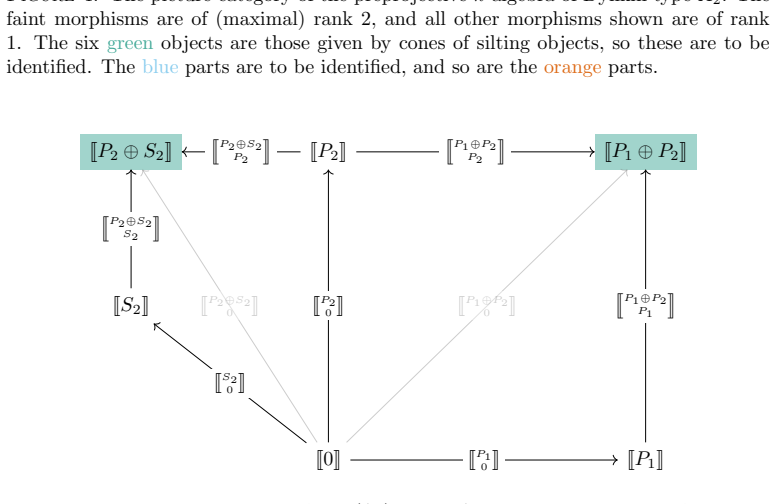
- [Example 3.7(1)] The sentence explaining why C(P_i) ∼ C(ΣP_i) is unclear; please spell out the relevant E-triangles (for instance, the conflations exhibiting P_i and ΣP_i as mutually linked) or point to the corresponding cones in Figure 1.
Circularity Check
No circular derivation: the picture category is defined from the g-vector fan, and the equivalences with prior constructions are proved rather than assumed.
full rationale
The derivation chain is not circular. Fg(C) is constructed from index/g-vector data and shown to be a fan in Theorem 2.5; the thick partition is defined by equality of thick subcategories and proved admissible in Proposition 3.3. W(C) is then defined as the category of this partitioned fan, so the existence of W(C) is not assumed from the equivalences. Theorem 0.1 is proved through Propositions 3.10 and 3.11, which in turn use the Galois bijection of Theorem 3.9; that bijection is established by a semistability argument independent of the W(C) construction. Citations to [Kai25], [Bør24], [BHK25], and [Kai26] provide earlier definitions and results (partitioned-fan categories, silting reduction, dg picture categories, base-change and factor-algebra functors) rather than assuming the target equivalences, so they do not create a self-citation chain that forces the conclusions. The main caveat surfaced in the manuscript is a proof gap in Lemma 1.14: the displayed exact-sequence verification establishes only a left add(U)-approximation, while the stated lemma requires a left add(U+)-approximation; the later use in Theorem 3.9 inherits this missing justification. This is a correctness/support issue, not a circularity, because the lemma's conclusion is not identical to any input hypothesis and no parameter is fitted and then renamed as a prediction. No step reduces by definition to its own input, so the circularity score is 0.
Assumptions & free parameters
assumptions (6)
- domain assumption Every presilting object in Setting 1.11 admits a Bongartz completion.
- domain assumption The silting reduction equivalence Z_U/[U] to C/thick(U) holds for Setting 1.11.
- standard math The index map is injective on presilting objects of a finite-dimensional algebra, and this lifts to reduced 0-Auslander categories.
- standard math The category of a partitioned fan is well defined and cubical.
- standard math The 4x4 lemma and its variants hold in extriangulated categories.
- domain assumption Jasso's tau-tilting reduction and the equivalence between tau-perpendicular subcategories and module categories of reduced algebras hold.
Cite this review
Pith. "Pith review of $g$-vector fans and picture categories for 0-Auslander extriangulated categories." pith.science (2026). https://pith.science/paper/GSPPHZ7Z
@misc{pith2026260813175,
  author       = {Pith},
  title        = {Pith review of: $g$-vector fans and picture categories for 0-Auslander extriangulated categories},
  year         = {2026},
  howpublished = {\url{https://pith.science/paper/GSPPHZ7Z}},
  note         = {Machine review of arXiv:2608.13175}
}
abstract
We extend the notion of $\mathbf{g}$-vector fan so that it is defined for a Hom-finite Krull-Schmidt 0-Auslander $k$-linear extriangulated category $\mathcal{C}$ with a projective silting object $T$. Moreover, we show that the $\mathbf{g}$-vector fan admits an admissible partition, in the sense of the second-named author, which is induced by thick subcategories. One can thus define the picture category of $\mathcal{C}$. We establish a bijection between thick subcategories of $\mathcal{C}$ generated by presilting objects containing all projective-injective objects and $\tau$-perpendicular subcategories of the endomorphism $k$-algebra of $T$. This shows that our construction unifies all previous constructions of picture categories and $\tau$-cluster morphism categories of finite-dimensional algebras. We introduce morphisms of partitioned fans to provide a common framework for the functorial relationships between picture categories of different algebras and categories.
Figures


Figures from the paper (2 more)

Reference graph
Works this paper leans on
-
[6]
Iyama-Solberg correspondence for exact dg categories
[Che24] X. Chen, “Iyama–Solberg correspondence for exact dg categories,” 2024, arXiv:2401.02064. [Che26] X. Chen, “Exact dg categories I: Foundations,” Adv. Math., vol. 489, p. 110809,
work page Pith review arXiv 2024
-
[9]
On the combinatorics of rigid objects in 2–Calabi–Yau categories,
[DK08] R. Dehy and B. Keller, “On the combinatorics of rigid objects in 2–Calabi–Yau categories,” Int. Math. Res. Not., vol. 2008, p. rnn029,
work page 2008
-
[13]
[GZ12] P. Gabriel and M. Zisman, Calculus of fractions and homotopy theory . Springer Science & Business Media, 2012, vol
work page 2012
-
[19]
Silting interval reduction and 0-Auslander extriangulated categories,
[PZ25] J. Pan and B. Zhu, “Silting interval reduction and 0-Auslander extriangulated categories,” J. Pure Appl. Algebra, vol. 229, no. 6, p. 32, 2025, id/No 107978. [Qui73] D. Quillen, “Higher algebraic K-theory: I,” in Higher K-theories. Springer, 1973, pp. 85–147. [RS09] N. Reading and D. E. Speyer, “Cambrian fans.” J. Eur. Math. Soc. (JEMS) , vol. 11, ...
work page 2025
-
[21]
[Zie95] G. M. Ziegler, Lectures on polytopes, ser. Graduate Texts in Mathematics. Springer-Verlag, New York, 1995, vol
work page 1995
-
[152]
Homotopic morphisms and diagram theorems in extriangulated categories
44 E. D. BØRVE AND M. KAIPEL [ZLZ26] C. Zhang, X.-S. Lu, and P. Zhang, “Homotopic morphisms and diagram theorems in extriangulated categories,” 2026, arXiv:2604.22186. [ZZ21] B. Zhu and X. Zhuang, “Grothendieck groups in extriangulated categories,” J. Algebra, vol. 574, pp. 206–232, 2021
work page Pith review arXiv 2026
-
[1966]
τ-tilting finite algebras, bricks, and g-vectors,
[DIJ19] L. Demonet, O. Iyama, and G. Jasso, “ τ-tilting finite algebras, bricks, and g-vectors,” Int. Math. Res. Not. , vol. 2019, pp. 852–892,
work page 2019
-
[1979]
Cluster algebras III: Upper bounds and double Bruhat cells,
, ser. Lecture Notes in Math. Springer, Berlin, 1980, vol. 832, pp. 103–169. [BFZ05] A. Berenstein, S. Fomin, and A. Zelevinsky, “Cluster algebras III: Upper bounds and double Bruhat cells,” Duke Math. J. , vol. 126, no. 1, pp. 1–52,
work page 1980
Show all 22 references
-
[1982]
A category of noncrossing partitions,
[Igu25] K. Igusa, “A category of noncrossing partitions,” Appl. Categ. Struct. , vol. 33, no. 6, p. 41, 2025, id/No
2025
-
[2002]
0-Auslander correspondence,
[Che23a] X. Chen, “0-Auslander correspondence,” 2023, arXiv:2306.15958. [Che23b] X. Chen, “On exact dg categories,” Ph.D. dissertation, Universit´ e Paris Cit´ e,
2023 arXiv
-
[2006]
[CLS24] D. A. Cox, J. B. Little, and H. K. Schenck, Toric varieties. American Mathematical Society, 2024, vol
2024
-
[2007]
On g-finiteness in the category of projective presentations,
[Gar24] M. Garcia, “On g-finiteness in the category of projective presentations,” 2024, arXiv:2406.04134. [Gar26] M. Garcia, “On thick subcategories of the category of projective presentations,” Math. Z., vol. 312, no. 4, p. 39, 2026, id/No
2024 arXiv
-
[2008]
Picture groups and green sequences from the perspective of Ringel–Hall algebras,
[Bø] E. D. Børve, “Picture groups and green sequences from the perspective of Ringel–Hall algebras,” in preparation. [Bør21] E. D. Børve, “Two-term silting and τ-cluster morphism categories,” 2021, arXiv:2110.03472. [Bør24] E. D. Børve, “Silting reduction and picture categorie...
2021 arXiv
-
[2012]
Presilting sequences for 0-auslander extriangulated categories,
[Non26] I. Nonis, “Presilting sequences for 0-auslander extriangulated categories,” 2026, arXiv:2605.20957. [NOS22] H. Nakaoka, Y. Ogawa, and A. Sakai, “Localization of extriangulated categories,” J. Algebra, vol. 611, pp. 341–398,
2026 arXiv
-
[2013]
Scattering diagrams for artin algebras,
[Tre26] H. Treffinger, “Scattering diagrams for artin algebras,” 2026, arXiv:2608.04233. [Ver96] J.-L. Verdier, “Des cat´ egories d´ eriv´ ees des cat´ egories ab´ eliennes,”Ast´ erisque, no. 239, pp. xii+253 pp. (1997), 1996, with a preface by Luc Illusie, Edited and with a n...
1997 arXiv
-
[2014]
Signed exceptional sequences and the cluster morphism category,
[IT17] K. Igusa and G. Todorov, “Signed exceptional sequences and the cluster morphism category,” 2017, arXiv:1706.02041. [ITW16] K. Igusa, G. Todorov, and J. Weyman, “Picture groups of finite type and cohomology in type an,” 2016, arXiv:1609.02636. [IY08] O. Iyama and Y. Yosh...
2017 arXiv
-
[2015]
Aisles in derived categories,
[KV88] B. Keller and D. Vossieck, “Aisles in derived categories,” 1988, vol. 40, no. 2, pp. 239–253, deuxi` eme Contact Franco-Belge en Alg` ebre (Faulx-les-Tombes, 1987). [Mac12] S. MacLane, Homology. Springer Science & Business Media,
1988
-
[2018]
Hereditary extriangulated categories: Silting objects, mutation, negative extensions,
[GNP23] M. Gorsky, H. Nakaoka, and Y. Palu, “Hereditary extriangulated categories: Silting objects, mutation, negative extensions,” 2023, arXiv:2303.07134. [GNP26] M. Gorsky, H. Nakaoka, and Y. Palu, “Positive and negative extensions in extriangulated categories,” Math. Z., vo...
2023 arXiv
-
[2020]
Reduction of τ-tilting modules and torsion pairs,
[Jas15] G. Jasso, “Reduction of τ-tilting modules and torsion pairs,” Int. Math. Res. Not. , vol. 2015, no. 16, pp. 7190–7237,
2015
-
[2022]
An assortment of properties of silting subcategories of extriangulated cate- gories,
[AT25] T. Adachi and M. Tsukamoto, “An assortment of properties of silting subcategories of extriangulated cate- gories,” Bull. Sci. Math. , vol. 203, 2025, id/No 103647. [BB80] S. Brenner and M. C. R. Butler, “Generalizations of the Bernstein-Gel’ fand-Ponomarev reflection fu...
2025
-
[2023]
Bricks and τ-tilting theory under base field extensions,
[BHK25] E. D. Børve, E. J. Hanson, and M. Kaipel, “Bricks and τ-tilting theory under base field extensions,” 2025, arXiv:2508.01040. [BM21a] A. B. Buan and B. R. Marsh, “A category of wide subcategories,” Int. Math. Res. Not. , vol. 2021, no. 13, pp. 10 278–10 338,
2025 arXiv
-
[2026]
Fulton, Introduction to toric varieties
[Ful93] W. Fulton, Introduction to toric varieties . Princeton university press, 1993, no
1993
Reviewed August 15, 2026 · model on record in the stance chip above.
Discussion (0). Continue with ORCID to comment.