REVIEW 1 major objections 3 minor 22 references
The Gromov-Hausdorff Distance Between Consecutive Spheres
T0 review · 1 major / 3 minor · reviewed 2026-08-14 · deepseek-v4-flash
Pith's one-line read For every n ≥ 1, the Gromov–Hausdorff distance between consecutive unit spheres equals half of ζ_n = arccos(−1/(n+1)), the edge length of a regular simplex inscribed in S^n; the paper exhibits the correspondence that attains it.
desk verdict The main theorem, exact GH distance between consecutive spheres, looks solid and is a genuine advance; but the secondary circle-factor constructions in Section 2 have a floor/ceil error that needs fixing before publication. read the letter →
The pith
A machine-rendered reading of the paper's core claim, the machinery that carries it, and where it could break.
The reading
What carries the argument
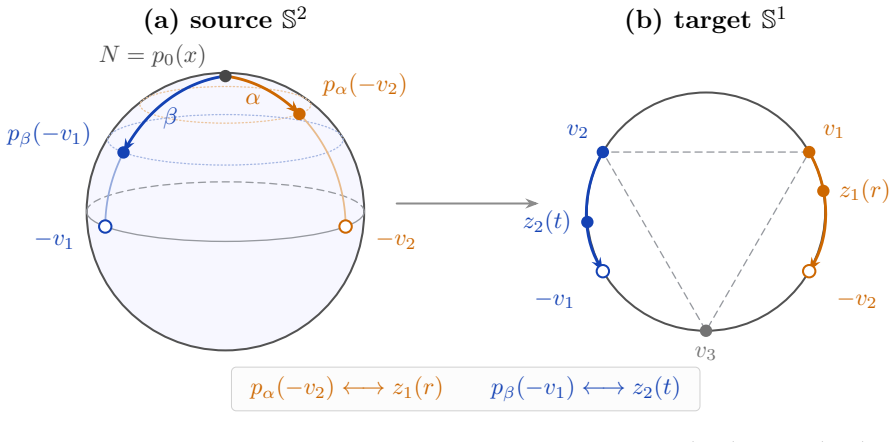
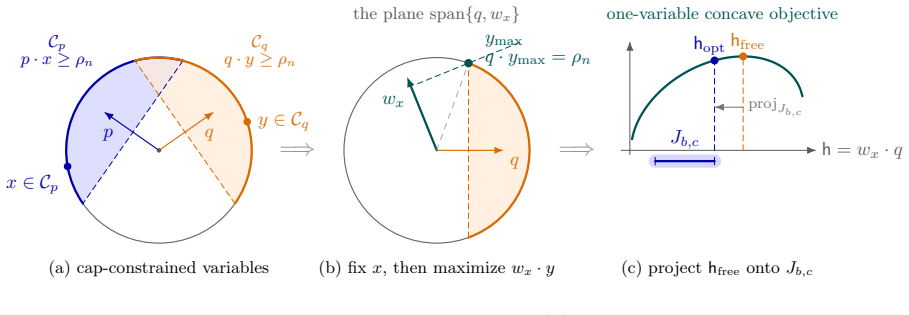
The load-bearing object is the anchored–chord correspondence $R_n$, built from the vertices $v_1, \ldots, v_{n+2}$ of a regular simplex inscribed in $S^n$ (the anchors), their closed spherical Voronoi cells $M_i$, and the normalized-chord map $H_{\alpha,i}(x)$, which radially projects the Euclidean chord point $(v_i + r_n(\alpha)x)/(1 + r_n(\alpha))$ onto the sphere. The scalar $r_n(\alpha)$ is the canonical gain: the unique continuous choice that makes the equal-level swapped-anchor comparisons sharp and satisfies the reciprocal identity $r_n(\alpha) r_n(F_n(\alpha)) = 1$, where the critical involution $F_n$ is defined by $\cos\alpha \cos F_n(\alpha) - \rho_n \sin\alpha \sin F_n(\alpha) = \rho_n$ with $\rho_n = 1/(n+1)$. The proof that this correspondence attains distortion $\zeta_n$ runs through the admissible $(Q,R)$-region of source and target inner products: same-anchor pairs are controlled by a vertex-dependent isometric embedding of $S^n$ into $S^{n+1}$ that keeps each embedded target within $(\pi-\zeta_n)/2$ of its source; distinct-anchor pairs with $Q \geq \rho_n$ are controlled by a lower-boundary estimate whose proof uses Ptolemy's inequality and reduces to the sign of a specific polynomial (Lemma 5.9); and pairs with $Q \leq -\rho_n$ are controlled by an exact dimension reduction of an optimization over two spherical caps to a one-variable concave maximization. The matching lower bound is proved self-containedly as a quantitative Borsuk–Ulam theorem for adjacent spheres, combining a helmet trick that converts arbitrary maps into odd maps with a sharp spherical Jung lemma; on top of the consecutive case, the synchronized spherical join operation is the mechanism that converts the sharp relations into bounds for nonconsecutive dimensions.
What would settle it
Check the explicit relation $R_4$ directly: either evaluate the polynomial $P_{\rho_n}$ of Lemma 5.9 on a dense grid of parameters satisfying condition (52) for $n = 4$ and look for a positive value, or compute the realized defect maxima of $R_4$ on fine finite nets of $S^4$ and $S^5$. Any parameter point that satisfies the condition yet gives a positive polynomial would refute the lower-boundary proof, and any matched pair whose defect exceeds $\zeta_4$ would refute optimality of the constructed correspondence.
Extended reading notes
Core claim
The central claim is Theorem A: for every integer $n \geq 1$, $d_{\mathrm{GH}}(S^n, S^{n+1}) = \zeta_n/2 = \tfrac{1}{2}\arccos(-1/(n+1))$, where the two spheres carry their geodesic distances. The paper proves this by constructing, for each $n$, one anchored–chord correspondence $R_n \subseteq S^{n+1} \times S^n$ whose distortion equals $\zeta_n$, exactly matching the quantitative Borsuk–Ulam lower bound that any correspondence between adjacent spheres has distortion at least $\zeta_n$. The matching construction is uniform: a point of the upper hemisphere at colatitude $\alpha$ from the north pole is paired with the radial projection onto $S^n$ of a point on the Euclidean chord joining a regular-simplex vertex to its target, with a canonical gain function $r_n(\alpha)$ forced by sharpness on the swapped-anchor family and by a reciprocal identity under a critical radial involution. The distortion analysis splits into same-anchor comparisons, where an isometric embedding of $S^n$ into $S^{n+1}$ keeps each embedded target within $(\pi-\zeta_n)/2$ of its source, and distinct-anchor comparisons, controlled by two boundary estimates in the plane $(Q,R)$ of source and target inner products: a lower boundary proved through Ptolemy's inequality and a polynomial sign lemma, and an upper boundary proved by reducing an optimization over two spherical caps to a one-variable concave maximization. The paper also proves that synchronized spherical joins of correspondences have distortion exactly equal to the maximum distortion of their factors, so suspension preserves distortion; joining and suspending the sharp relations yields bounds for arbitrary sphere pairs, including $\lim_{m\to\infty} d_{\mathrm{GH}}(S^m, S^{m+d(m)}) = \pi/4$ whenever $d(m) \geq 1$ and $d(m) = o(m)$.
Load-bearing premise
The load-bearing premise is a single algebraic inequality at the heart of the upper-bound proof: an explicitly written polynomial must never be positive when its parameters satisfy a stated condition, a sign claim verified only by a long symbolic factorization — if that sign claim were wrong for some n ≥ 2, the lower-boundary estimate and with it the main theorem would collapse.
Editorial extensions
If this is right
- Every consecutive-sphere distance is now exactly known from a single construction, including the previously open cases n ≥ 4, and the same relation also reproduces the three cases n = 1, 2, 3 that had been treated by different arguments.
- For every fixed gap d ≥ 1, the distance m ↦ d_GH(S^m, S^{m+d}) is nonincreasing in m and converges to π/4, and the same limit holds when the gap grows sublinearly with d = o(m).
- Suspension of a correspondence preserves its distortion, so any comparison between S^m and S^n transfers to S^{m+1} and S^{n+1} at no extra cost.
- Balanced joins of the sharp relations yield the upper bound d_GH(S^m, S^{m+d}) ≤ (1/2) arccos(−1/⌊(m+1)/d⌋) whenever 2d ≤ m+1, while joins of exact circle correspondences give the staircase bound d_GH(S^m, S^n) ≤ πk/(2k+1) whenever the codimension n−m lies in the k-th band of width 2⌊(m+1)/2⌋.
- The stabilization to π/4 as m grows contrasts with the infinite-dimensional sphere, from which every finite-dimensional sphere remains at the maximal possible distance π/2.
Reading between the lines
- Read as a general principle, the join theorem turns the sphere-distance problem into a finite minimax allocation — distribute the dimension gap as evenly as possible among sharp factors — and the same max-rule is a natural test case for other symmetric families, such as real or complex projective spaces, for which no exact consecutive-pair distances are known.
- Because R_n is fully explicit, it supplies a concrete ground-truth object: numerically evaluating defect maxima over fine nets of S^4 and S^5 and comparing with ζ_4 would give a computation-based check of the algebraic bottleneck, and the same nets could calibrate practical shape-matching heuristics that approximate the Gromov–Hausdorff distance.
- The fact that sharpness on one extremal family (the swapped-anchor equal-level pairs) determines the gain uniquely suggests that near-optimal correspondences might be characterized by their (Q,R)-boundary curves; a testable consequence is that any correspondence with distortion within ε of ζ_n must have its realized inner-product pairs confined to a thin neighborhood of the region bounded by the t
Signed reviews
Editorial analysis
A structured set of objections, weighed in public.
Referee Report
Summary. The paper determines the Gromov–Hausdorff distance between consecutive unit round spheres with their geodesic metrics, proving that d_GH(S^n, S^{n+1}) = (1/2) arccos(-1/(n+1)) for every n ≥ 1. The upper bound is established by an explicit anchored–chord correspondence R_n whose distortion is exactly the simplex edge length ζ_n, and the matching lower bound is re-proved self-containedly through a quantitative Borsuk–Ulam argument. The paper also introduces synchronized spherical joins and suspensions of correspondences, proves that distortion is preserved under the maximum of factor distortions, and derives bounds for spheres of nonconsecutive dimensions, including a π/4 stabilization for fixed or sublinear codimension.
Significance. If correct, the main theorem resolves a conjecture of Lim, Mémoli, and Smith and provides a uniform construction of an optimal correspondence in every dimension. A noteworthy strength is that the construction is genuinely parameter-free: the gain is forced by sharpness on the swapped-anchor family and by the involution F_n, rather than fitted to the target value. The self-contained lower-bound proof, the exact distortion formula for spherical joins, and the explicit suspension results are independently useful. I found no defect in the proof of Theorem A; however, the nonconsecutive-sphere section contains a concrete false statement that must be corrected before publication.
major comments (1)
- [§2.5, Proposition 2.10] The definition K(m,n) := floor((n-m)/L_m) is internally inconsistent with the existence claim made in the proof. For the floor definition, the inequality 2K(m,n) b(m,2) ≥ n-m used in the proof is reversed: K ≤ (n-m)/(2b(m,2)) implies 2K b(m,2) ≤ n-m. The counterexample m=2, n=5 has b(m,2)=1, L_m=2, K=1, so the constraint d_i ≤ 2K bounds the sum of the d_i by 2, whereas n-m=3; no admissible choice of d_i exists. The proof and the claimed equivalence in Corollary 2.11 use K = ceil((n-m)/L_m), not floor, and Figures 4–5 are drawn according to the ceiling convention. As written, Proposition 2.10, Eqs. (29)–(30), and Corollary 2.11 are false. The fix is local: replace floor by ceiling in the definition of K(m,n) and adjust the surrounding inequalities accordingly. This issue does not affect Theorem A, whose proof is independent of Section 2.
minor comments (3)
- [Appendix B.2, Lemma 5.9] The sign of the polynomial P_{ρ_n} is the decisive algebraic step in Proposition 5.5. I checked the printed factorization and the endpoint cases for several small values of n and found them consistent, but the verification is lengthy enough that a reader cannot realistically check every coefficient by hand. I recommend that the authors supply a computer-algebra verification or a notebook certifying the factorization in Eq. (58) and the sign analysis in Appendix B.2.
- [Notation throughout] The notation bζ_n for π - ζ_n is easy to misread as a product b ζ_n, especially in plain-text discussion. Please introduce a symbol such as \widehat\zeta_n or \bar\zeta_n and use it consistently in the final version.
- [Figure 2] In the caption of Figure 2, the sentence 'the highlighted pair has x ∈ M_2 and r_1(α)=2' could be misunderstood because r_1(α) is an extended-real gain; specifying that this is the finite gain value for the drawn α, rather than the bounded chord fraction λ_1(α), would improve clarity.
Circularity Check
No circularity: the lower bound is rederived in the paper and the upper bound is an explicit correspondence whose distortion is proved directly.
full rationale
The central derivation is self-contained. The lower bound d_GH(S^n,S^{n+1}) >= zeta_n/2 is not imported from the authors' prior work as an unproved premise: Proposition 1.5 gives a direct proof from the Borsuk–Ulam theorem using a self-contained spherical Jung lemma, so the lower bound is re-derived rather than assumed. The upper bound is an explicit construction: R_n is defined in Definition 1.4, and Theorem A is completed by proving that every realized (Q,R) pair lies in the admissible region A_n. The gain r_n is derived from sharpness and involution conditions, but those conditions are design constraints on the constructed correspondence; they do not assume the global upper bound. The proof then bounds all realized comparisons through Corollary 5.4, Proposition 5.5, Corollary 6.14, and Lemma 7.1, and the north-pole fiber provides the matching lower bound dis(R_n) >= zeta_n. No fitted parameter is renamed as a prediction, and no uniqueness theorem is imported from a self-citation. Prior self-citations, such as the Lim–Mémoli–Smith relation L_{3,1} used in Corollary 2.5, concern noncentral applications and are not load-bearing for Theorem A. The Proposition 2.10 floor/ceil issue noted by the skeptic is a genuine internal correctness concern for some nonconsecutive-sphere bounds, but it is not a circularity of the derivation chain.
Assumptions & free parameters
assumptions (4)
- standard math Borsuk-Ulam theorem: there is no continuous odd map S^n → S^{n-1}.
- standard math Spherical Jung theorem (open-hemisphere containment if pairwise distances < ζ_n).
- standard math Ptolemy's inequality in Euclidean space.
- domain assumption Spheres are equipped with the geodesic metric d(x,y)=arccos(x·y).
Cite this review
Pith. "Pith review of The Gromov-Hausdorff Distance Between Consecutive Spheres." pith.science (2026). https://pith.science/paper/WCR23N7W
@misc{pith2026260813264,
  author       = {Pith},
  title        = {Pith review of: The Gromov-Hausdorff Distance Between Consecutive Spheres},
  year         = {2026},
  howpublished = {\url{https://pith.science/paper/WCR23N7W}},
  note         = {Machine review of arXiv:2608.13264}
}
abstract
We determine the Gromov-Hausdorff distance between consecutive unit round spheres equipped with their geodesic metrics. Put $\zeta_n:=\arccos(-\tfrac{1}{n+1}),$ the common geodesic distance between distinct vertices of a regular simplex with $n+2$ vertices inscribed in $\mathbb{S}^n$. We prove that $$ d_{\mathrm{GH}}(\mathbb{S}^n,\mathbb{S}^{n+1})=\frac{\zeta_n}{2} \qquad(n\geq1), $$ resolving a conjecture of Lim, M\'emoli, and Smith. All cases $n\geq4$ were previously open. This equality is established by explicitly constructing a family of correspondences $\mathcal R_n\subseteq \mathbb{S}^{n+1}\times \mathbb{S}^n$, whose distortion matches the known quantitative Borsuk-Ulam lower bound $\zeta_n$. We also introduce synchronized spherical joins and suspensions of correspondences and prove that the distortion of a join is exactly the maximum of the distortions of its factors. In particular, suspension preserves distortion. Applying these join and suspension operations to the optimal correspondences $\mathcal R_n$ yields new bounds for spheres of nonconsecutive dimensions, including $$ \lim_{m\to\infty} d_{\mathrm{GH}}\bigl(\mathbb{S}^m,\mathbb{S}^{m+d(m)}\bigr) = \frac{\pi}{4} \qquad\text{whenever } d(m)\geq1,\ \text{and }d(m)=o(m).$$
Figures


Figures from the paper (10 more)





Reference graph
Works this paper leans on
-
[1]
Clark, Sunhyuk Lim, Facundo M \'e moli, and Daniel Packer
Shreya Arya, Arnab Auddy, Ranthony A. Clark, Sunhyuk Lim, Facundo M \'e moli, and Daniel Packer. The Gromov--Wasserstein distance between spheres. Foundations of Computational Mathematics , 26(1):75--130, 2026
work page 2026
-
[2]
Henry Adams, Johnathan Bush, Nate Clause, Florian Frick, Mario G \'o mez, Michael Harrison, R. Amzi Jeffs, Evgeniya Lagoda, Sunhyuk Lim, Facundo M \'e moli, Michael Moy, Nikola Sadovek, Matt Superdock, Daniel Vargas, Qingsong Wang, and Ling Zhou. Gromov- H ausdorff distances, B orsuk- U lam theorems, and V ietoris- R ips complexes. Algebraic & Geometric T...
work page 2026
-
[3]
A Course in Metric Geometry , volume 33 of Graduate Studies in Mathematics
Dmitri Burago, Yuri Burago, and Sergei Ivanov. A Course in Metric Geometry , volume 33 of Graduate Studies in Mathematics . American Mathematical Society, 2001
2001
-
[4]
Gromov--Hausdorff stable signatures for shapes using persistence
Fr \'e d \'e ric Chazal, David Cohen-Steiner, Leonidas J Guibas, Facundo M \'e moli, and Steve Y Oudot. Gromov--Hausdorff stable signatures for shapes using persistence. Computer Graphics Forum , 28(5):1393--1403, 2009
work page 2009
-
[5]
Characterization, stability and convergence of hierarchical clustering methods
Gunnar Carlsson and Facundo M \'e moli. Characterization, stability and convergence of hierarchical clustering methods. Journal of Machine Learning Research , 11(47):1425--1470, 2010
work page 2010
-
[6]
Boris V. Dekster. The J ung theorem for spherical and hyperbolic spaces. Acta Mathematica Hungarica , 67(4):315--331, 1995
work page 1995
-
[7]
Equidiscontinuity of B orsuk- U lam functions
Lester Dubins and Gideon Schwarz. Equidiscontinuity of B orsuk- U lam functions. Pacific Journal of Mathematics , 95(1):51--59, 1981
work page 1981
-
[8]
David A. Edwards. The structure of superspace. In Studies in Topology , pages 121--133. Academic Press, 1975
work page 1975
Show all 22 references
-
[9]
Metric Structures for R iemannian and Non- R iemannian Spaces , volume 152 of Progress in Mathematics
Mikhail Gromov. Metric Structures for R iemannian and Non- R iemannian Spaces , volume 152 of Progress in Mathematics . Birkh\"auser, 1999. Based on the 1981 French original, with appendices by M. Katz, P. Pansu, and S. Semmes
1999
-
[10]
Amzi Jeffs
Michael Harrison and R. Amzi Jeffs. Quantitative upper bounds on the G romov- H ausdorff distance between spheres. arXiv preprint arXiv:2309.11237 , 2023
2023 arXiv
-
[11]
Vietoris- R ips persistent homology, injective metric spaces, and the filling radius
Sunhyuk Lim, Facundo M \'e moli, and Osman Berat Okutan. Vietoris- R ips persistent homology, injective metric spaces, and the filling radius. Algebraic & Geometric Topology , 24(2):1019--1100, 2024
2024
-
[12]
The G romov-- H ausdorff distance between spheres
Sunhyuk Lim, Facundo M \'e moli, and Zane Smith. The G romov-- H ausdorff distance between spheres. Geometry & Topology , 27(9):3733--3800, 2023
2023
-
[13]
Gromov--Wasserstein distances and the metric approach to object matching
Facundo M \'e moli. Gromov--Wasserstein distances and the metric approach to object matching. Foundations of Computational Mathematics , 11(4):417--487, 2011
2011
-
[14]
Some properties of G romov-- H ausdorff distances
Facundo M \'e moli. Some properties of G romov-- H ausdorff distances. Discrete & Computational Geometry , 48(2):416--440, 2012
2012
-
[15]
A theoretical and computational framework for isometry invariant recognition of point cloud data
Facundo M \'e moli and Guillermo Sapiro. A theoretical and computational framework for isometry invariant recognition of point cloud data. Foundations of Computational Mathematics , 5(3):313--347, 2005
2005
-
[16]
Facundo M \'e moli and Zane T. Smith. Embedding--projection correspondences for the estimation of the G romov-- H ausdorff distance. arXiv preprint arXiv:2407.03295 , 2024
2024 arXiv
-
[17]
Persistent cup product structures and related invariants
Facundo M \'e moli, Anastasios Stefanou, and Ling Zhou. Persistent cup product structures and related invariants. Journal of Applied and Computational Topology , 8:93--148, 2024
2024
-
[18]
Persistent homotopy groups of metric spaces
Facundo M \'e moli and Ling Zhou. Persistent homotopy groups of metric spaces. Journal of Topology and Analysis , 17(5):1481--1542, 2025
2025
-
[19]
Some novel constructions of G romov-- H ausdorff-optimal correspondences between spheres
Sa \'u l Rodr \'i guez Mart \'i n. Some novel constructions of G romov-- H ausdorff-optimal correspondences between spheres. Experimental Mathematics , 2026. Published online 11 April 2026
2026
-
[20]
L. A. Santal \'o . Convex regions on the \(n\)-dimensional spherical surface. Annals of Mathematics , 47(3):448--459, 1946
1946
-
[21]
Computational aspects of the G romov-- H ausdorff distance and its application in non-rigid shape matching
Felix Schmiedl. Computational aspects of the G romov-- H ausdorff distance and its application in non-rigid shape matching. Discrete & Computational Geometry , 57(4):854--880, 2017
2017
-
[22]
The Space of Spaces: Curvature Bounds and Gradient Flows on the Space of Metric Measure Spaces , volume 290, no
Karl-Theodor Sturm. The Space of Spaces: Curvature Bounds and Gradient Flows on the Space of Metric Measure Spaces , volume 290, no. 1443 of Memoirs of the American Mathematical Society . American Mathematical Society, Providence, RI, 2023
2023
Reviewed August 14, 2026 · model on record in the stance chip above.
Discussion (0). Continue with ORCID to comment.