REVIEW 4 major objections 5 minor 51 references
Before You Say It: Anticipating Verbal Behavior from Longitudinal Everyday Conversations with LLMs
T0 review · 4 major / 5 minor · reviewed 2026-08-14 · deepseek-v4-flash
Pith's one-line read Person-specific verbal behavior can be predicted from a user's own conversation history using mined IF-THEN-EXCEPT patterns, beating both zero-shot and all-in-context baselines on an LLM judge.
desk verdict A substantial wearable-conversation dataset and an interpretable pattern-conditioning method, but the evaluation never states that pattern mining is out-of-sample, so the headline gains may be inflated. read the letter →
The pith
A machine-rendered reading of the paper's core claim, the machinery that carries it, and where it could break.
The reading
What carries the argument
The central object is the contrastive IF-THEN-EXCEPT behavioral pattern: IF [situational condition], THEN [behavioral tendency], BUT NOT when [exception situation]. Each pattern links a situation (when, where, with whom, internal state) to a VRM-grounded communicative tendency, carries a probability estimated from the balance of supporting and contradicting instances, and is merged and refined as new conversations accumulate. At inference time, patterns whose antecedents match the current context and whose exception conditions are absent are activated, weighted by probability, and fed to an LLM together with the current conversation to generate a natural-language prediction of the user's next verbal tendency. This representation is the load-bearing piece: it converts raw long-form history into a small, interpretable, situation-specific rule set that the LLM can reason over, avoiding the brittleness of conditioning directly on long transcripts.
What would settle it
Re-run the evaluation with an explicit temporal cutoff that forbids pattern mining from any conversation overlapping the target turn, and generate ground-truth behavioral descriptions with human annotators or a different model rather than the VRM prompt shared with the predictor; if the 0.597 vs 0.463 margin collapses or reverses, the claim of person-specific prediction is not supported.
Extended reading notes
Core claim
The paper's central claim is that person-specific verbal behavior can be predicted from longitudinal conversational data by representing the user's behavioral regularities as contrastive situational rules of the form 'IF [situation], THEN [verbal behavior], BUT NOT when [exception]' and conditioning an LLM's prediction on the subset of rules that match the current conversational context. The authors call this Situational Reasoning and evaluate it as Pattern-Conditioned Prediction. Against ground-truth behavioral descriptions generated from the actual next utterance using the same VRM prompt, Pattern-Conditioned Prediction achieves an LLM-judge score of 0.597 (SD 0.350), beating zero-shot (0.463) and all-in-context (0.502); on turns flagged by participants as reflecting behaviors they want to change, the gain is larger (0.858 vs 0.607 zero-shot). A cross-participant transfer condition drops to 0.460, and the approach's performance improves with accumulated data while baselines stay flat—evidence that the improvement comes from person-specific pattern mining rather than generic conversational ability.
Load-bearing premise
The evaluation assumes the mined patterns come only from conversations that happened before the target turn and that the LLM judge does not favor predictions that share its own text-generation style; the paper does not explicitly state the temporal split for pattern mining, and ground-truth labels are produced by an LLM using the same prompt as the predictors, so a leak of target-episode information or shared stylistic priors would inflate the reported margins.
Editorial extensions
If this is right
- Assistants could issue just-in-time, in-the-moment nudges when a recognized situation begins to unfold, before the user's habitual response occurs.
- The same pattern representation could let users inspect, correct, and set goals for their own inferred behavioral tendencies, since patterns are readable rules rather than opaque embeddings.
- Performance improving with accumulation implies longer deployments would yield better anticipation, and that the approach should keep getting more personalized over time.
- The larger gains on intention-to-change turns suggest behavior-change support is the most promising near-term application.
- The cross-participant drop to 0.460 indicates the effect is person-specific rather than a generic conversation-modeling boost.
Reading between the lines
- A direct extension would be to test whether the same IF-THEN-EXCEPT representation transfers to non-verbal behavior, such as spending or procrastination, captured by other sensors, since the representation is not speech-specific.
- The pattern-activation fallback mechanism suggests a natural test: measure prediction quality as a function of how many patterns are activated per turn, since the paper hints that low activation correlates with weaker performance.
- One could design a prospective study where the system's predictions are shown to the user in real time and the user's ability to change the predicted behavior is measured, testing the implicit assumption that anticipation creates a window for intervention.
- Because the judge rewards specificity and compositionality, the 0.597 score may partly reflect the judge's stylistic preferences; an adversarial evaluation with a judge trained to detect pattern-based generic descriptions would separate pattern fidelity from judge artifact.
Signed reviews
Editorial analysis
A structured set of objections, weighed in public.
Referee Report
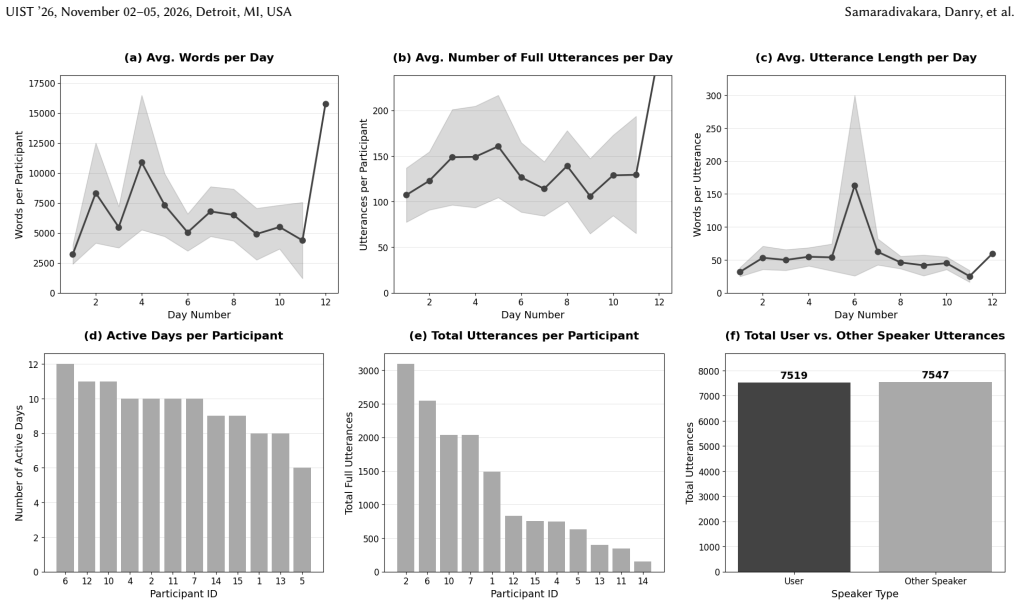
Summary. The paper introduces Pattern-Conditioned Prediction ("Situational Reasoning"), a training-free LLM-based method that mines interpretable IF-THEN-EXCEPT behavioral patterns from longitudinal smartwatch conversations and uses those patterns to predict a user's next verbal behavior, framed as a Verbal Response Mode (VRM) communicative intention rather than surface wording. The manuscript contributes a longitudinal dataset of 1,000+ hours from 14 participants (9,901 utterances after cleaning), an evaluation comparing the method against Zero-Shot, All-In-Context, and Natural-Language Summary baselines using an LLM judge and a human-rater validation, a cross-participant transfer condition, and semi-structured interviews on users' perceptions of anticipatory behavioral support. The headline result is an LLM-judge score of 0.597 for Pattern-Conditioned Prediction versus 0.463 for Zero-Shot and 0.502 for All-In-Context, with a drop to 0.460 in the cross-participant condition, plus larger gains on participant-flagged intention-to-change patterns. The central claim is that person-specific verbal behavior can be predicted from longitudinal conversational data.
Significance. If the evaluation evidence holds, this is a useful step toward anticipatory, context-aware personal AI: the paper combines a real longitudinal wearable dataset with an interpretable, inspectable pattern representation, and it attempts several good validation practices, including a cross-participant control and a human-rater study with 40 raters. The direction is novel relative to reactive assistants and to fixed dialogue-act predictors, and the emphasis on situation-conditioned regularities is theoretically grounded in Mischel and Shoda's cognitive-affective system theory. However, the current evidence is not yet sufficient to support the central claim because the evaluation protocol leaves open a leakage path between pattern mining and prediction, the ground-truth labels and the primary judge share the same LLM and VRM prior, a fallback component is undefined, and the reported statistical significance is unsupported. These are fixable issues, but they are load-bearing for the paper's main conclusion.
major comments (4)
- [§4.1, §5, Fig. 3] The temporal split between pattern mining and prediction is never stated. Section 4.1 describes patterns as mined "from longitudinal conversations" and updated "as new interactions arrive," and the extraction prompt in Appendix B.1.1 supplies "Conversation Data" without any instruction to exclude the target episode or later episodes; Section 5 reports prediction scores without documenting the split. If the pattern store for a given target turn includes evidence from that same episode, the reported +28.9% gain over Zero-Shot and the +29.8% gap over the cross-participant condition can be explained by memorization rather than by person-specific generalization. The cross-participant control does not rule this out, because own-condition patterns can contain the target episode while transferred patterns cannot. Figure 3's accumulated-performance curve suggests a chronological evaluation, but the paper does not state that the pattern store at time t excludes episodes after time t. Please specify the split explicitly and report results under a strictly out-of-sample protocol, e.g., patterns mined only from episodes that end before the target turn begins.
- [§5, Appendix B.1.2] The ground-truth behavioral descriptions are LLM-generated with the same VRM prompt used for predictions, and the primary judge is also an LLM prompted with the same taxonomy. The paper states that the ground truth B_t is "generated from the actual utterance using the same prompt," and the GPT-5 judge evaluates pragmatic function, specificity, and compositionality using the same VRM categories. This shared prior can inflate alignment scores: the predictor, the ground-truth generator, and the judge may all prefer the same stylistic and categorical conventions. The human evaluation partially mitigates this concern and the cross-participant condition helps, but the human raters evaluate predictions against the same LLM-generated ground truths on only 200 sampled scenarios, and the paper does not report human VRM annotations of the ground truths themselves. Please report agreement between LLM-generated ground truths and independent human VRM annotations, and/or report results on a subset with human-annotated ground truth.
- [§5.1] The claim that Pattern-Conditioned Prediction "significantly outperforms" the baselines is not supported by any inferential statistic. Means and standard deviations are reported (C3: M=0.597, SD=0.350; Zero-Shot: M=0.463, SD=0.330; All-In-Context: M=0.502, SD=0.339), but there are no p-values, confidence intervals, effect sizes, or statement of the unit of analysis (turns versus participants). With 14 participants and repeated per-turn measurements, a per-participant paired test (e.g., Wilcoxon signed-rank or paired t-test on participant-level means) with the corresponding test statistic and effect size is needed to justify "significantly outperforms" in the abstract and Section 5.1.
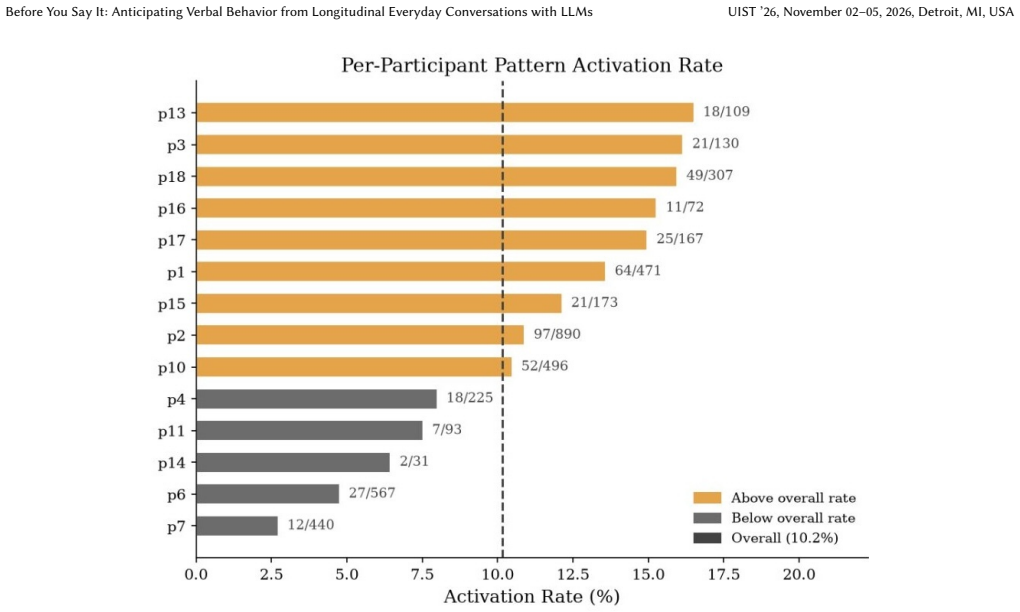
- [§4.1, Fig. 6] The fallback mechanism used when no behavioral pattern activates is undefined. Figure 6 states that participants with lower activation rates "rely more frequently on the fallback prediction mechanism when no relevant behavioral pattern is activated," but the method description in Section 4.1 never defines this fallback or explains how it is invoked during evaluation. Because the reported C3 score aggregates cases with and without activated patterns, the result depends on this unspecified component. Please specify the fallback behavior, and report performance separately for turns with at least one activated pattern and turns handled by the fallback.
minor comments (5)
- [§5.1] The Natural-Language Summary baseline is introduced in Section 4 and included in the human evaluation, but its LLM-judge scores are not reported in the Section 5.1 results table; please add them for completeness.
- [§5.1] The text refers to "Appendix 4" for per-participant results and examples, but the appendix is labeled "A Additional Results" and the relevant material appears in Figures 5 and 6; the cross-reference should be corrected.
- [Appendix B.1.2] The judge prompt asks for "a single aggregated score weighting dimensions by relevance to this case" without a fixed aggregation rule; please specify the aggregation formula or report dimension-wise scores separately, since the aggregate is central to the reported numbers.
- [§5.1] The human evaluation reports Kendall's tau = 0.83 as agreement among raters, but Kendall's tau is a rank-correlation coefficient; please clarify whether this is inter-rater agreement or agreement between human rankings and the LLM judge, and report an appropriate inter-rater reliability statistic such as Krippendorff's alpha.
- [§3] The data-cleaning step removes turns with fewer than 4 words, which the paper justifies as excluding trivial exchanges; please report how many of the excluded turns were user turns versus other-speaker turns, since the final user/other balance (57%/43%) may shift after cleaning.
Circularity Check
Evaluation loop and undocumented temporal split inflate the claimed prediction—but cross-participant and human checks keep the central claim partly independent.
-
self definitional
[Section 5 (Evaluation) and Appendix B.1.2 (Judge Prompts)]
"We evaluated the four prediction methods (Zero Shot, All-in-Context, NL-Summaries, Pattern-Conditioned Prediction) by comparing the predicted behavioral description B̂_t against the ground-truth behavioral description B_t with the conversational context, generated from the actual utterance using the same prompt."
The ground-truth behavioral description is not an independent human label; it is an LLM-generated paraphrase of the actual utterance, produced with the same VRM taxonomy and prompt family as the predictor. The LLM judge then scores whether the prediction 'captures the same verbal intention' as that same-generated description. This makes the evaluation measure self-consistency between two LLM outputs sharing stylistic and taxonomic priors. A prediction that adopts the prompt's preferred register can score high even if it would not match independently coded behavior. The agreement of human raters with the LLM judge mitigates but does not remove the fact that the target itself is defined by the same generative framework.
-
fitted input called prediction
[Section 4.1 (Situational Reasoning) and Appendix B.1.1 (Behavioral Pattern Extraction & Pattern-Conditioned Prediction Prompts)]
"Conversation Data : { conversation } ... Patterns are updated as new interactions arrive, allowing their evidence, confidence, and estimated probability to be refined over time. ... The activated patterns, weighted by their estimated probability θ_k are provided to an LLM alongside the current conversational context to generate a prediction of the user's next verbal behavior."
The only personalization channel in C3 is the set of activated patterns. If the pattern-mining prompt's 'Conversation Data' includes the episode containing the target turn—the paper states no exclusion and reports no temporal split between mining and prediction—then the activated pattern's THEN-behavior is induced from the very utterance being predicted. The reported +28.9% over Zero-Shot and +29.8% over the cross-participant condition can then be explained by memorization rather than by person-specific generalization. The cross-participant control does not rule this out, because own-condition patterns can contain the target episode while transferred patterns cannot.
full rationale
The central derivation—mining IF-THEN-EXCEPT patterns from longitudinal conversation and using their activations to condition a next-behavior prediction—is not circular in itself. Pattern probability θ_k is estimated from supporting and contradicting instances, and prediction is a rule-based application of those patterns to a new context; that is a legitimate predictive model, not a tautology. The cross-participant transfer condition (C3-cross = 0.460) and the 40-rater human evaluation provide independent checks that break any complete evaluative loop. However, two features partially compromise the claim. First, the ground-truth labels are generated by an LLM using the same VRM prompt family as the predictor, so the automated judge is measuring agreement between same-style LLM outputs; human ratings temper but do not eliminate this concern. Second, the paper never documents a temporal split between pattern mining and prediction, and the extraction prompt's 'Conversation Data' placeholder contains no instruction to exclude the target episode. If patterns are mined from the same episode being predicted, C3's advantage reduces to retrieval of a label already present in the pattern store. Because the paper's text permits this reading, the out-of-sample claim is not fully secured as written. These issues warrant a score of 4: the claimed gains are plausibly inflated by definitional and protocol choices, but the method and evaluation retain substantial independent content.
Assumptions & free parameters
free parameters (5)
- Pattern extraction confidence threshold =
>=5 (on a 1-10 scale)
- Pattern activation confidence threshold =
>=8
- Utterance word count filter =
>=4 words
- History truncation length =
500,000 characters
- LLM judge aggregation weights =
unspecified, chosen by the judge for each case
assumptions (5)
- domain assumption VRM taxonomy is a valid and sufficient representation of communicative intention.
- domain assumption Human behavior follows stable, situation-specific regularities.
- domain assumption LLM-generated behavioral descriptions and LLM-as-judge scores align with human judgment.
- domain assumption Transcriptions and diarizations accurately capture the participant's verbal behavior.
- domain assumption Participants obtained informed consent from all interlocutors before each recorded interaction.
Cite this review
Pith. "Pith review of Before You Say It: Anticipating Verbal Behavior from Longitudinal Everyday Conversations with LLMs." pith.science (2026). https://pith.science/paper/IHKT4HV2
@misc{pith2026260813454,
  author       = {Pith},
  title        = {Pith review of: Before You Say It: Anticipating Verbal Behavior from Longitudinal Everyday Conversations with LLMs},
  year         = {2026},
  howpublished = {\url{https://pith.science/paper/IHKT4HV2}},
  note         = {Machine review of arXiv:2608.13454}
}
read the original abstract
Knowing someone deeply means not just understanding what they say or do but also how they will likely think, react, and engage across situations. Such predictions could eventually inform systems to anticipate when the individual is about to deviate from their goal, catch regrettable behaviors before they are made, and surface blind spots before they take hold. While many interactive systems model users to enable more personalized interactions, most cannot make such behavioral predictions, as this often requires longitudinal observation and inference of how the individual's behaviors unfold across various everyday situations. In this work, we introduce a novel LLM-based predictive behavioral modeling approach that anticipates a user's likely behavior across everyday conversational situations. We (1) collect a longitudinal dataset of over 1000 hours of naturalistic conversations from 14 participants using a wearable smartwatch; (2) evaluate LLM-based predictions against ground truth behaviors; and (3) use semi-structured interviews to explore participants perceptions of behavioral predictions and their views on possible forms of future behavioral support. Altogether, our findings provide evidence that person-specific verbal behavior can be predicted from longitudinal conversational data. This opens up new possibilities for potential future context-aware, anticipatory, proactive and personalized AI systems.
Figures


Figures from the paper (4 more)


Reference graph
Works this paper leans on
-
[1]
Caterina Bérubé, Marcia Nißen, Rasita Vinay, Alexa Geiger, Tobias Budig, Aashish Bhandari, Catherine Rachel Pe Benito, Nathan Ibarcena, Olivia Pistolese, Pan Li, et al. 2024. Proactive behavior in voice assistants: A systematic review and conceptual model.Computers in human behavior reports14 (2024), 100411
work page 2024
-
[2]
Tom Brown et al. 2020. Language models are few-shot learners.NeurIPS(2020)
work page 2020
-
[3]
Tom Brown, Benjamin Mann, Nick Ryder, Melanie Subbiah, Jared D Kaplan, Prafulla Dhariwal, Arvind Neelakantan, Pranav Shyam, Girish Sastry, Amanda Askell, et al. 2020. Language models are few-shot learners.Advances in neural information processing systems33 (2020), 1877–1901
2020
-
[4]
Jin Chen, Zheng Liu, Xu Huang, Chenwang Wu, Qi Liu, Gangwei Jiang, Yuanhao Pu, Yuxuan Lei, Xiaolong Chen, Xingmei Wang, et al. 2024. When large language models meet personalization: Perspectives of challenges and opportunities.World Wide Web27, 4 (2024), 42
2024
-
[5]
Valdemar Danry, Jean Ghislain Billa, Yasith Samaradivakara, Paul Pu Liang, and Pattie Maes. 2026. Mind Mapper: Modeling and Predicting Behavioral Patterns from Everyday Conversations with Wearable AI Systems and LLMs. InProceedings of the 31st International Conference on Intelligent User Interfaces. 2059–2083
work page 2026
-
[6]
Yang Deng, Lizi Liao, Zhonghua Zheng, Grace Hui Yang, and Tat-Seng Chua
-
[7]
Cathy Mengying Fang, Yasith Samaradivakara, Pattie Maes, and Suranga Nanayakkara. 2025. Mirai: A Wearable Proactive AI "Inner-Voice" for Contextual Nudging. InProceedings of the Extended Abstracts of the CHI Conference on Human Factors in Computing Systems (CHI EA ’25). Association for Computing Machinery, New York, NY, USA, Article 399, 9 pages. doi:10.1...
arXiv 2025
-
[8]
2025.Gemini 2.5 Pro Model Card
Google DeepMind. 2025.Gemini 2.5 Pro Model Card. Technical Report. Google DeepMind. https://storage.googleapis.com/deepmind-media/Model- Cards/Gemini-2-5-Pro-Model-Card.pdf
work page 2025
Show all 51 references
-
[9]
Gabriella M Harari and Samuel D Gosling. 2023. Understanding behaviours in context using mobile sensing.Nature Reviews Psychology2 (2023), 684–697
2023
-
[10]
Gabriella M Harari, Nicholas D Lane, Rui Wang, Benjamin S Crosier, Andrew T Campbell, and Samuel D Gosling. 2016. Using smartphones to collect behav- ioral data in psychological science: Opportunities, practical considerations, and challenges.Perspectives on Psychological Scie...
2016
-
[11]
Paria Jamshid Lou and Mark Johnson. 2020. Improving Disfluency Detection by Self-Training a Self-Attentive Model. InProceedings of the 58th Annual Meeting of the Association for Computational Linguistics. Association for Computational Linguistics, Online, 3754–3763. doi:10.186...
2020 doi
-
[12]
Zijian Ji, Nayeon Lee, Rita Frieske, Tianyi Yu, Dan Su, Yan Xu, Etsuko Ishii, Yanqi Bang, Andrea Madotto, and Pascale Fung. 2023. Survey of Hallucination in Natural Language Generation.Comput. Surveys(2023)
2023
-
[13]
Geonsun Lee, Min Xia, Nels Numan, Xun Qian, David Li, Yanhe Chen, Achin Kulshrestha, Ishan Chatterjee, Yinda Zhang, Dinesh Manocha, David Kim, and Ruofei Du. 2025. Sensible Agent: A Framework for Unobtrusive Interaction with Proactive AR Agents. InProceedings of the 38th Annua...
2025 doi
-
[14]
Chenyi Li, Guande Wu, Gromit Yeuk-Yin Chan, Dishita Gdi Turakhia, Sonia Castelo Quispe, Dong Li, Leslie Welch, Claudio Silva, and Jing Qian. 2025. Satori: Towards Proactive AR Assistant with Belief-Desire-Intention User Modeling. In Proceedings of the 2025 CHI Conference on Hu...
2025
-
[15]
Jiahao Nick Li, Zhuohao (Jerry) Zhang, and Jiaju Ma. 2025. OmniQuery: Contex- tually Augmenting Captured Multimodal Memories to Enable Personal Question Answering. InProceedings of the 2025 CHI Conference on Human Factors in Com- puting Systems (CHI ’25). Association for Compu...
2025
-
[16]
Liu, Kevin Lin, John Hewitt, Ashwin Paranjape, Michele Bevilacqua, Fabio Petroni, and Percy Liang
Nelson F. Liu, Kevin Lin, John Hewitt, Ashwin Paranjape, Michele Bevilacqua, Fabio Petroni, and Percy Liang. 2024. Lost in the Middle: How Language Models Use Long Contexts.Transactions of the Association for Computational Linguistics (2024)
2024
-
[17]
Natasha Maniar, Samantha WT Chan, Wazeer Zulfikar, Scott Ren, Christine Xu, and Pattie Maes. 2025. MemPal: Leveraging Multimodal AI and LLMs for Voice- Activated Object Retrieval in Homes of Older Adults. InProceedings of the 30th International Conference on Intelligent User I...
2025
-
[18]
Matthias R Mehl, James W Pennebaker, D Michael Crow, James Dabbs, and John H Price. 2001. The Electronically Activated Recorder (EAR): A device for sampling naturalistic daily activities and conversations.Behavior research methods, instruments, & computers33, 4 (2001), 517–523
2001
-
[19]
Benjamin Minixhofer, Jonas Pfeiffer, and Ivan Vulić. 2023. Where’s the Point? Self-Supervised Multilingual Punctuation-Agnostic Sentence Segmentation. In Proceedings of the 61st Annual Meeting of the Association for Computational Linguis- tics (Volume 1: Long Papers). Associat...
2023
-
[20]
Walter Mischel and Yuichi Shoda. 1995. A cognitive-affective system theory of personality: reconceptualizing situations, dispositions, dynamics, and invariance in personality structure.Psychological review102, 2 (1995), 246
1995
-
[21]
Inbal Nahum-Shani, Eric B Hekler, and Donna Spruijt-Metz. 2015. Building health behavior models to guide the development of just-in-time adaptive interventions: A pragmatic framework.Health Psychology34, S (2015), 1209–1219
2015
-
[22]
Inbal Nahum-Shani, Shawna N Smith, Bonnie J Spring, Linda M Collins, Katie Witkiewitz, Ambuj Tewari, and Susan A Murphy. 2016. Just-in-time adaptive interventions (JITAIs) in mobile health: key components and design principles for ongoing health behavior support.Annals of beha...
2016
-
[23]
Lin Ning, Changlong Wu, Tengyu Yang, et al. 2024. User-LLM: Efficient LLM Contextualization with User Embeddings.arXiv preprint arXiv:2402.13598(2024)
2024 arXiv
-
[24]
Jeesun Oh, Wooseok Kim, Sungbae Kim, Hyeonjeong Im, and Sangsu Lee. 2024. Better to ask than assume: Proactive voice assistants’ communication strategies that respect user agency in a smart home environment. InProceedings of the 2024 CHI Conference on Human Factors in Computin...
2024
-
[25]
Bernstein
Joon Sung Park, Joseph O’Brien, Carrie Jun Cai, Meredith Ringel Morris, Percy Liang, and Michael S. Bernstein. 2023. Generative Agents: Interactive Simulacra of Human Behavior. InProceedings of the 36th Annual ACM Symposium on User Interface Software and Technology(San Francis...
2023
-
[26]
O’Brien, Carrie J
Joon Sung Park, Joseph C. O’Brien, Carrie J. Cai, Meredith Ringel Morris, Percy Liang, and Michael S. Bernstein. 2023. Generative Agents: Interactive Simulacra of Human Behavior.arXiv preprint arXiv:2304.03442(2023)
2023 arXiv
-
[27]
Joon Sung Park, Carolyn Q Zou, Aaron Shaw, Benjamin Mako Hill, Carrie Cai, Meredith Ringel Morris, Robb Willer, Percy Liang, and Michael S Bernstein. 2024. Generative agent simulations of 1,000 people.arXiv preprint arXiv:2411.10109 (2024)
2024 arXiv
-
[28]
Jian Qi, Yizhe Zhang, et al. 2020. Stay Hungry, Stay Focused: Generating Infor- mative and Specific Responses in Dialogue Systems. InProceedings of EMNLP
2020
-
[29]
Bradley J. Rhodes. 1997. The Wearable Remembrance Agent: A System for Augmented Memory.Pers. Ubiquitous Comput.1, 3 (1997), 218–224. doi:10.1007/ BF01682024
1997
-
[30]
Alireza Salemi, Sheshera Mysore, Michael Bendersky, and Hamed Zamani. 2024. LaMP: When Large Language Models Meet Personalization. InProceedings of the 62nd Annual Meeting of the Association for Computational Linguistics
2024
-
[31]
Bernstein
Omar Shaikh, Shardul Sapkota, Shan Rizvi, Eric Horvitz, Joon Sung Park, Diyi Yang, and Michael S. Bernstein. 2025. Creating General User Models from Com- puter Use. InProceedings of the 38th Annual ACM Symposium on User Interface Software and Technology (UIST ’25). Association...
2025
-
[32]
1992.Describing talk: A taxonomy of verbal response modes
William B Stiles. 1992.Describing talk: A taxonomy of verbal response modes. Sage Publications Newbury Park
1992
-
[33]
Andreas Stolcke, Klaus Ries, Noah Coccaro, Elizabeth Shriberg, Rebecca Bates, Dan Jurafsky, Paul Taylor, Rachel Martin, Carol Van Ess-Dykema, and Marie Meteer. 2000. Dialogue act modeling for automatic tagging and recognition of conversational speech.Computational linguistics2...
2000
-
[34]
Amos Tversky and Daniel Kahneman. 1974. Judgment under Uncertainty: Heuris- tics and Biases: Biases in judgments reveal some heuristics of thinking under uncertainty.science185, 4157 (1974), 1124–1131
1974
-
[35]
Robin R Vallacher and Daniel M Wegner. 1987. What do people think they’re doing? Action identification and human behavior.Psychological Review94, 1 (1987), 3–15
1987
-
[36]
Sunil Vemuri, Chris Schmandt, and Walter Bender. 2006. iRemember: A Personal Long-term Memory Prosthesis. InProceedings of CARPE 2006
2006
-
[37]
Sunil Vemuri, Chris Schmandt, Walter Bender, Stefanie Tellex, and Brad Lassey
-
[38]
Liaoyaqi Wang, Zhengping Jiang, Anqi Liu, and Benjamin Van Durme. 2025. Always Tell Me The Odds: Fine-grained Conditional Probability Estimation. In Second Conference on Language Modeling. https://openreview.net/forum?id= xhDcG8qtw9
2025
-
[39]
Jason Wei, Xuezhi Wang, Dale Schuurmans, Maarten Bosma, Fei Xia, Ed Chi, Quoc V Le, Denny Zhou, et al. 2022. Chain-of-thought prompting elicits reasoning in large language models.Advances in neural information processing systems35 (2022), 24824–24837
2022
-
[40]
Wendy Wood, Jeffrey M Quinn, and Deborah A Kashy. 2002. Habits in everyday life: Thought, emotion, and action.Journal of Personality and Social Psychology 83, 6 (2002), 1281–1297
2002
-
[41]
Zonglin Yang, Li Dong, Xinya Du, Hao Cheng, Erik Cambria, Xiaodong Liu, Jianfeng Gao, and Furu Wei. 2022. Language models as inductive reasoners. arXiv preprint arXiv:2212.10923(2022)
2022 arXiv
-
[42]
Saizheng Zhang, Emily Dinan, Jack Urbanek, Arthur Szlam, Douwe Kiela, and Jason Weston. 2018. Personalizing Dialogue Agents: I have a dog, do you have pets too?. InProceedings of the 56th Annual Meeting of the Association for Computational Linguistics. 2204–2213
2018
-
[43]
Lianmin Zheng, Wei-Lin Chiang, Ying Sheng, Siyuan Zhuang, Zhanghao Wu, Yonghao Zhuang, Zi Lin, Zhuohan Li, Dacheng Li, Eric Xing, et al. 2023. Judging llm-as-a-judge with mt-bench and chatbot arena.Advances in neural information processing systems36 (2023), 46595–46623
2023
-
[44]
When discussing personal struggles , [ User ] tends to Disclose rather than deflect
Wazeer Deen Zulfikar, Samantha Chan, and Pattie Maes. 2024. Memoro: Us- ing large language models to realize a concise interface for real-time memory augmentation. InProceedings of the 2024 CHI Conference on Human Factors in Computing Systems. 1–18. A Additional Results B Prom...
2024
-
[47]
Example :'If [ WITH WHOM : authority figure ] + [ STATE : user feels defensive ] , the user tends to deflect ; but not when [ WITH WHOM : peer ].'
logic_formula : The full IF - THEN - EXCEPT rule as a natural language sentence . Example :'If [ WITH WHOM : authority figure ] + [ STATE : user feels defensive ] , the user tends to deflect ; but not when [ WITH WHOM : peer ].'
-
[48]
h e u r i s t i c _ o r _ p a t t e r n : A short label ( e . g . ,'Deflects - Under - Authority - Pressure')
-
[49]
description : One sentence --'When __ , [ User ] tends to __ [ VRM act ] , but not when __'
-
[50]
evidence : Quotes from the conversation where the behavior activates , each with : - quote : exact text - context_label : active IF factors present - conversation_id : 4 - char ID - chain_link : what the quote reveals ( trigger , internal state , or verbal act )
-
[51]
{ other_turn }
confidence : Integer 1 -10. 1 -2 = never (0.0 -0.25) 3 -5 = sometimes (0.25 -0.5) 6 -8 = often (0.5 -0.75) 9 -10 = always (0.75 -1.0) Only extract patterns with confidence >= 5. Conversation Data : { conversation } Given the following behavioral pattern and its evidence and co...
-
[2004]
InProceedings of UbiComp 2004
An Audio-Based Personal Memory Aid. InProceedings of UbiComp 2004. 400–417
2004
-
[2024]
InProceedings of the 47th International ACM SIGIR Conference on Research and Development in Information Retrieval
Towards human-centered proactive conversational agents. InProceedings of the 47th International ACM SIGIR Conference on Research and Development in Information Retrieval. 807–818
Reviewed August 14, 2026 · model on record in the stance chip above.
Discussion (0). Continue with ORCID to comment.