REVIEW 2 major objections 10 minor 27 references
Supersolid properties of a Bose-Einstein condensate in a ring resonator
T0 review · 2 major / 10 minor · reviewed 2026-08-14 · deepseek-v4-flash
Pith's one-line read A Bose-Einstein condensate in a ring resonator forms a stable supersolid phase when two counterpropagating pump beams are nearly equal in strength.
desk verdict A clean first demonstration of a stable ring-cavity supersolid, with the main caveat that the supersolid label rests on indirect evidence and a theory calculation done away from the experimental parameters. read the letter →
The pith
A machine-rendered reading of the paper's core claim, the machinery that carries it, and where it could break.
The reading
What carries the argument
The theoretical description is a one-dimensional mean-field model in which the condensate wavefunction $\psi(x,t)$ is coupled to four cavity mode amplitudes ($a_\pm$, $b_\pm$) through a bunching parameter $\Theta = \int dx\, e^{-2ikx}|\psi(x,t)|^2$. The two counterpropagating mode pairs have orthogonal polarizations and a frequency separation of 160 MHz, so they do not interfere directly; they interact only through the condensate density. The model is invariant under spatial translations $x \to x + \Delta x$ compensated by phase shifts of the mode amplitudes, which is the symmetry whose spontaneous breaking produces the crystalline order. The stabilizing mechanism is an effective friction: for the chosen detuning, atoms moving toward a pump beam scatter pump photons more often than atoms moving away, pushing them back toward the center of the momentum distribution and compensating the pump asymmetry. In the supplemental material, a Bogoliubov linearization of the mean-field equations around the stationary solution yields the collective excitation spectrum, including the gapless Goldstone mode.
What would settle it
An experiment that images the in-situ density while the momentum distribution is stationary and symmetric, and finds no periodic modulation, would refute the supersolid claim; likewise, an excitation-spectrum measurement that finds a finite gap where the gapless Goldstone mode is predicted would do the same.
Extended reading notes
Core claim
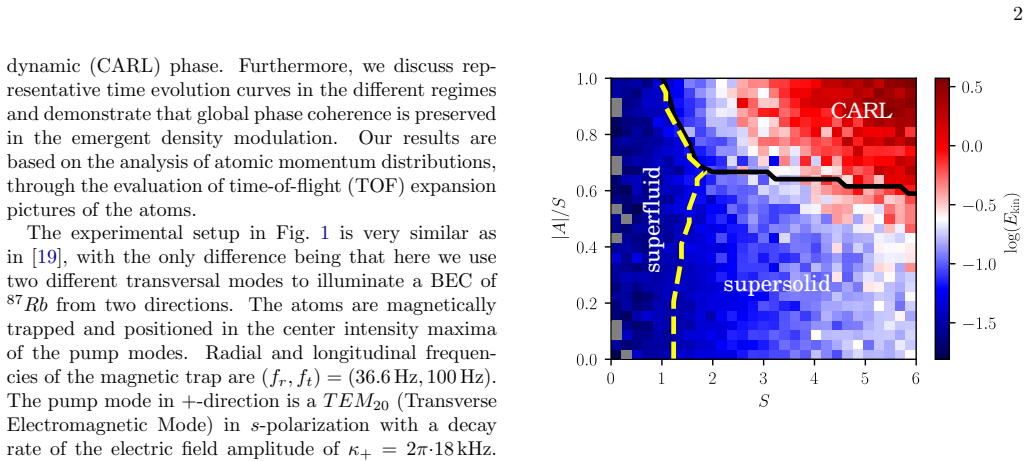
The central claim is that balancing two non-interfering counterpropagating pump fields suppresses the runaway collective atomic recoil instability and produces a time-independent atomic density modulation that spontaneously breaks the continuous translational symmetry of the ring. The supersolid character is inferred from two observations: the stationary, near-symmetric occupation of the n=0 and n=±1 momentum states in time-of-flight images, and the reversibility of the superfluid-to-supersolid transition when the pump power is ramped up and back down, which the authors take as evidence that global phase coherence is preserved. In the same system, sufficiently asymmetric pumping drives the system into the accelerating, run-away CARL regime, so the phase diagram contains three regions separated by thresholds defined by 10% depletion of the zero-momentum condensate. A linearized Bogoliubov analysis in the supplemental material shows a gapless Goldstone mode appearing at the phase transition, whose imaginary part vanishes in the supersolid regime, indicating undamped center-of-mass motion along the cavity axis.
Load-bearing premise
The weakest load-bearing premise is that the symmetric, steady population of the first-order momentum peaks seen after free expansion, together with the reversible pump ramp, actually proves a rigid density wave with coherent phase across the whole condensate; the paper never images the in-situ density, never measures the superfluid fraction, and computes the Goldstone mode only under simplifying assumptions.
Editorial extensions
If this is right
- The balanced ring-cavity geometry provides a supersolid whose crystalline order is self-organized rather than imprinted by an external lattice potential, so no standing-wave trap is needed to define the period.
- The gapless, undamped Goldstone mode implies that the supersolid's center of mass can move without friction along the cavity axis, a property the paper identifies as robustness against dissipation.
- Because the ordering depends only on relative phases between cavity modes and the condensate, the supersolid state should survive particle and photon loss better than supersolids in other geometries.
- The same cavity-mediated stabilization could be used as a cooling mechanism for atom clouds, and a spinor version of the geometry is predicted to produce cavity-induced spin-orbit coupling, spin waves, and topological phase transitions.
Reading between the lines
- If the supersolid interpretation is right, the momentum peaks at $\pm 2\hbar k$ should be phase-coherent; a direct interference experiment between the two diffracted clouds after time of flight could test this without imaging the in-trap density.
- The analytical threshold condition for symmetric pumping in the supplemental material could be turned into a quantitative prediction for where the superfluid-supersolid boundary sits for other atomic species, cavity finesses, or detunings, and checked against the measured phase diagram.
- The paper's evidence for global phase coherence is an adiabatic ramp; a stronger test would be a direct measurement of the excitation spectrum, which should show the predicted gapless mode and no gap across the transition.
- The robustness claim suggests ring-cavity supersolids may be easier to maintain under continuous pumping than crossed-cavity or dipolar supersolids, which could make them practical for cavity-based sensing such as the proposed gravimeter.
Editorial analysis
A structured set of objections, weighed in public.
Referee Report
Summary. The paper reports an experimental and theoretical study of a Bose-Einstein condensate coupled to two counterpropagating, non-interfering modes of an optical ring resonator. The authors map a phase diagram from time-of-flight momentum distributions as a function of total pump strength S and pump asymmetry A, identifying three regimes: a superfluid phase, a self-organized phase for nearly symmetric pumping that they identify as a supersolid, and a collective atomic recoil lasing (CARL) unstable regime. The evidence for the supersolid is: (i) a stable, near-symmetric occupation of the n=0 and n=±1 momentum states after about 600 microseconds, interpreted as a crystalline density modulation with spontaneously broken continuous translational symmetry; and (ii) the reversibility of a pump ramp between the superfluid and self-organized regimes, interpreted as conservation of global phase coherence. A one-dimensional mean-field model (Eq. 3) with no fitted free parameters reproduces the phase boundaries and the time evolution of the momentum populations. The supplemental material contains a linearized excitation analysis that predicts a gapless Goldstone mode, but under the simplifying assumptions of equal cavity decay rates and zero pump asymmetry.
Significance. The observation of a stable, stationary momentum distribution in a ring-resonator geometry with two non-interfering pumps is new and potentially important; if the supersolid interpretation holds, it would be the first stable supersolid in a ring cavity and would open a novel dissipation-robust platform. The model and data are presented clearly, and the absence of free parameters in the comparison is a strength. However, the central claim is not yet fully established because the two defining properties of a supersolid—long-range crystalline order and superfluidity—are not directly measured: the real-space density modulation is inferred from momentum populations, and phase coherence is inferred from ramp reversibility, with no direct measurement of the superfluid fraction or the collective excitation spectrum at the experimental parameters.
major comments (2)
- [Abstract; Figs. 3 and 4] The measurements of |c_n|^2 in time-of-flight do not distinguish a coherent superposition of momentum states (which yields a real-space density modulation with a fixed relative phase) from an incoherent mixture with the same populations. The real-space density shown in Fig. 3(f) is from simulation, not from a measurement, and the ramp reversal in Fig. 4 shows that the procedure is approximately reversible but does not directly measure the phase coherence of the state during the supersolid period. Therefore the abstract's claim that supersolidity is 'demonstrated' by the conservation of global phase coherence is too strong; the evidence is indirect and should be explicitly labeled as such.
- [Supplemental Material, 'Collective excitations - Goldstone mode'] The gapless Goldstone mode is computed under two explicit simplifying assumptions: equal cavity decay rates κ_+=κ_-≡κ and zero pump asymmetry A=0 (η_+=η_-). The experiment uses κ_+=2π×18 kHz and κ_-=2π×5 kHz, and the reported supersolid measurements are at |A|/S=0.008 (Fig. 3) and 0.06 (Fig. 4), i.e., with nonzero asymmetry. The statement that the equal-decay assumption 'does not affect the fundamental physics' is not justified. Because this Goldstone mode is the theoretical backbone of the supersolid interpretation, the authors should either extend the calculation to the actual experimental parameters (and nonzero A) and show that the lowest branch remains gapless and undamped, or restrict the central claim to the symmetric case and provide dedicated experimental evidence for that case.
minor comments (10)
- [Abstract] The phrase 'demonstrated by the conservation of global phase coherence' should be tempered to 'supported by the conservation of global phase coherence implied by the ramp-reversal measurement'.
- [Page 2] The sentence 'In fact, this phase marks the first experimental realization of a stable phase in a ring resonator geometry' is ambiguous; presumably 'stable supersolid phase' is intended.
- [Eq. (3)] The mean-field model neglects local particle-particle interactions; a brief estimate of the interaction energy relative to the cavity potential, or a note on why the omission is justified, would strengthen the paper.
- [Fig. 2 caption] The phrase 'By numerical analysis of (3), we are able to distinguish three fundamentally different phases' is confusing because the phase diagram is a measurement and the numerical analysis provides the boundaries; please rephrase.
- [Fig. 3(d)] The error bars are described as the standard deviation of the mean, but the number of data points per time bin is not stated.
- [Supplemental Material, Eqs. (S1)-(S4)] The notation for the starred variables A_±, A_±*, and the matrix elements of M_B is inconsistent; a clean set of definitions and a clear statement of the vector ordering would greatly improve readability.
- [Page 4, Def. of 10% depletion] The phrase 'the resting BEC (n=0 momentum state) is depleted by 10%' is potentially misleading, as in the CARL regime the n=0 state is not a resting state; consider rephrasing.
- [Conclusions] The conclusion that the supersolid is 'very robust against dissipation' is based on the supplemental calculation for symmetric, equal-decay conditions; the present experimental data do not directly establish this robustness and the claim should be qualified accordingly.
- [Final paragraph] Typo: 'high-precission' should be 'high-precision'.
- [Fig. 2] The color scale for the logarithmic kinetic energy is not explicitly defined; a grayscale bar with units would help the reader interpret the phase diagram.
Circularity Check
No significant circularity: the theoretical and experimental claims are independently derived from a stated mean-field model and measured observables.
full rationale
The paper's central supersolid claim rests on a comparison between time-of-flight momentum-population measurements and numerical solutions of the explicitly stated mean-field model in Eq. (3). No free parameter is fitted to the supersolid region: the cavity decay rates, detunings, and atom number are independently specified experimental parameters, and the numerical phase boundaries are computed from that same model rather than imported from a self-citation. The S and A normalization uses single-mode CARL thresholds defined by a 10% depletion criterion, and the plotted phase boundaries also use a 10% depletion criterion; this is a detection convention and a choice of units, not a fitted parameter that forces the predicted boundary. The Goldstone-mode calculation in the Supplemental Material is a direct linearization of Eq. (3) around the numerically found stationary state, and its restriction to equal decay rates and zero pump asymmetry is explicitly stated as a simplifying assumption; this limits the theoretical support at the measured parameters but does not make the derivation circular. The self-citations to prior ring-cavity work provide background and the proposed geometry, but the present paper's phase identification, time-evolution data, ramp-reversibility test, and linearized excitation calculation are self-contained. Therefore no circular step satisfies the quoted-reduction standard.
Assumptions & free parameters
free parameters (2)
- 10% depletion threshold criterion =
10%
- Normalizing critical pump powers |a_crit|^2 and |b_crit|^2 =
not stated in the paper
assumptions (5)
- standard math Bogoliubov linearization and matrix diagonalization give the collective excitation spectrum.
- domain assumption The BEC dynamics is one-dimensional and local atom-atom interactions can be neglected.
- domain assumption The two counterpropagating mode pairs do not interfere and do not form an optical lattice.
- domain assumption Time-of-flight momentum occupations reflect the coherent real-space density modulation.
- ad hoc to paper Equal cavity decay rates in the supplemental Goldstone calculation do not change the physics.
Cite this review
Pith. "Pith review of Supersolid properties of a Bose-Einstein condensate in a ring resonator." pith.science (2026). https://pith.science/paper/26MXUING
@misc{pith2026190810932,
  author       = {Pith},
  title        = {Pith review of: Supersolid properties of a Bose-Einstein condensate in a ring resonator},
  year         = {2026},
  howpublished = {\url{https://pith.science/paper/26MXUING}},
  note         = {Machine review of arXiv:1908.10932}
}
read the original abstract
We investigate the dynamics of a Bose-Einstein condensate interacting with two non-interfering and counterpropagating modes of a ring resonator. Superfluid, supersolid and dynamic phases are identified experimentally and theoretically. The supersolid phase is obtained for sufficiently equal pump strengths for the two modes. In this regime we observe the emergence of a steady state with crystalline order, which spontaneously breaks the continuous translational symmetry of the system. The supersolidity of this state is demonstrated by the conservation of global phase coherence at the superfluid to supersolid phase transition. Above a critical pump asymmetry the system evolves into a dynamic run-away instability commonly known as collective atomic recoil lasing. We present a phase diagram and characterize the individual phases by comparing theoretical predictions with experimental observations.
Figures


Figures from the paper (1 more)

Reference graph
Works this paper leans on
-
[1]
Unified theory of interacting bosons,
Eugene P. Gross, “Unified theory of interacting bosons,” Phys. Rev. 106, 161–162 (1957)
work page 1957
-
[2]
Quantum theory of defects in crystals,
AF Andreev and IM Lifshits, “Quantum theory of defects in crystals,” Zhur Eksper Teoret Fiziki 56, 2057–2068 (1969)
work page 1969
-
[3]
Speculations on bose-einstein condensa- tion and quantum crystals,
G. V. Chester, “Speculations on bose-einstein condensa- tion and quantum crystals,” Phys. Rev. A 2, 256–258 (1970)
work page 1970
-
[4]
A. J. Leggett, “Can a solid be ”superfluid”?” Phys. Rev. Lett. 25, 1543–1546 (1970)
work page 1970
-
[5]
Probable observation of a supersolid helium phase,
E. Kim and M. H. W. Chan, “Probable observation of a supersolid helium phase,” Nature 427, 225–227 (2004)
work page 2004
-
[6]
Sebastien Balibar, “The enigma of supersolidity,” Nature 464, 176–182 (2010)
work page 2010
-
[7]
Collo- quium: Supersolids: What and where are they?
Massimo Boninsegni and Nikolay V. Prokof’ev, “Collo- quium: Supersolids: What and where are they?” Rev. Mod. Phys. 84, 759–776 (2012)
work page 2012
-
[8]
Supersolid for- mation in a quantum gas breaking a continuous transla- tional symmetry,
Julian L´ eonard, Andrea Morales, Philip Zupancic, Tilman Esslinger, and Tobias Donner, “Supersolid for- mation in a quantum gas breaking a continuous transla- tional symmetry,” Nature 543, 87–90 (2017)
work page 2017
Show all 27 references
-
[9]
Monitoring and manipulating higgs and goldstone modes in a supersolid quantum gas,
Julian L´ eonard, Andrea Morales, Philip Zupancic, To- bias Donner, and Tilman Esslinger, “Monitoring and manipulating higgs and goldstone modes in a supersolid quantum gas,” Science 358, 1415–1418 (2017)
2017
-
[10]
A stripe phase with supersolid prop- erties in spin–orbit-coupled bose–einstein condensates,
Jun-Ru Li, Jeongwon Lee, Wujie Huang, Sean Burchesky, Boris Shteynas, Furkan C ¸ a˘ grı Top, Alan O. Jamison, and Wolfgang Ketterle, “A stripe phase with supersolid prop- erties in spin–orbit-coupled bose–einstein condensates,” Nature 543, 91–94 (2017)
2017
-
[11]
Long-lived and transient supersolid behaviors in dipolar quantum gases,
L. Chomaz, D. Petter, P. Ilzh¨ ofer, G. Natale, A. Traut- mann, C. Politi, G. Durastante, R. M. W. van Bijnen, A. Patscheider, M. Sohmen, M. J. Mark, and F. Fer- laino, “Long-lived and transient supersolid behaviors in dipolar quantum gases,” Phys. Rev. X 9, 021012 (2019)
2019
-
[12]
Transient supersolid properties in an ar- ray of dipolar quantum droplets,
Fabian B¨ ottcher, Jan-Niklas Schmidt, Matthias Wen- zel, Jens Hertkorn, Mingyang Guo, Tim Langen, and Tilman Pfau, “Transient supersolid properties in an ar- ray of dipolar quantum droplets,” Phys. Rev. X9, 011051 (2019)
2019
-
[13]
Excitation spectrum of a trapped dipolar supersolid and its experi- mental evidence,
G. Natale, R. M. W. van Bijnen, A. Patscheider, D. Pet- ter, M. J. Mark, L. Chomaz, and F. Ferlaino, “Excitation spectrum of a trapped dipolar supersolid and its experi- mental evidence,” Phys. Rev. Lett. 123, 050402 (2019)
2019
-
[14]
Observation of a dipolar quantum gas with metastable supersolid properties,
L. Tanzi, E. Lucioni, F. Fam` a, J. Catani, A. Fioretti, C. Gabbanini, R. N. Bisset, L. Santos, and G. Modugno, “Observation of a dipolar quantum gas with metastable supersolid properties,” Phys. Rev. Lett. 122, 130405 (2019)
2019
-
[15]
Driven-dissipative supersolid in a ring cavity,
Farokh Mivehvar, Stefan Ostermann, Francesco Piazza, and Helmut Ritsch, “Driven-dissipative supersolid in a ring cavity,” Phys. Rev. Lett. 120, 123601 (2018)
2018
-
[16]
Atomic self- ordering in a ring cavity with counterpropagating pump fields,
S. Ostermann, T. Grießer, and H. Ritsch, “Atomic self- ordering in a ring cavity with counterpropagating pump fields,” EPL (Europhys. Lett.) 109, 43001 (2015)
2015
-
[17]
Superradiant rayleigh scattering and collective atomic recoil lasing in a ring cavity,
S. Slama, S. Bux, G. Krenz, C. Zimmermann, and Ph. W. Courteille, “Superradiant rayleigh scattering and collective atomic recoil lasing in a ring cavity,” Phys. Rev. Lett. 98, 053603 (2007)
2007
-
[18]
Dynamical instability of a bose-einstein conden- sate in an optical ring resonator,
D. Schmidt, H. Tomczyk, S. Slama, and C. Zimmer- mann, “Dynamical instability of a bose-einstein conden- sate in an optical ring resonator,” Phys. Rev. Lett. 112, 115302 (2014)
2014
-
[19]
Pinning transition of bose-einstein condensates in optical ring resonators,
S. C. Schuster, P. Wolf, D. Schmidt, S. Slama, and C. Zimmermann, “Pinning transition of bose-einstein condensates in optical ring resonators,” Phys. Rev. Lett. 121, 223601 (2018)
2018
-
[20]
Exponential gain and self-bunching in a col- lective atomic recoil laser,
R. Bonifacio, L. De Salvo, L. M. Narducci, and E. J. D’Angelo, “Exponential gain and self-bunching in a col- lective atomic recoil laser,” Phys. Rev. A 50, 1716–1724 (1994)
1994
-
[21]
Collective atomic recoil laser (carl) optical gain without inversion by collective atomic recoil and self-bunching of two-level atoms,
R. Bonifacio and L. De Salvo, “Collective atomic recoil laser (carl) optical gain without inversion by collective atomic recoil and self-bunching of two-level atoms,” Nucl. Instr. and Meth. in Phy. Res. A 341, 360–362 (1994)
1994
-
[22]
Cold atoms in a high- q ring cavity,
Markus Gangl and Helmut Ritsch, “Cold atoms in a high- q ring cavity,” Phys. Rev. A 61, 043405 (2000)
2000
-
[23]
Cavity cooling below the recoil limit,
Matthias Wolke, Julian Klinner, Hans Keßler, and An- dreas Hemmerich, “Cavity cooling below the recoil limit,” Science 337, 75–78 (2012)
2012
-
[24]
Subrecoil cavity cooling towards degeneracy: A numerical study,
R. M. Sandner, W. Niedenzu, and H. Ritsch, “Subrecoil cavity cooling towards degeneracy: A numerical study,” EPL (Europhysics Letters) 104, 43001 (2013)
2013
-
[25]
Probing and characterizing the growth of a crystal of ultracold bosons and light,
S Ostermann, F Piazza, and H Ritsch, “Probing and characterizing the growth of a crystal of ultracold bosons and light,” New Journal of Physics 19, 125002 (2017)
2017
-
[26]
Supersolid-based gravimeter in a ring cavity,
Karol Gietka, Farokh Mivehvar, and Helmut Ritsch, “Supersolid-based gravimeter in a ring cavity,” Phys. Rev. Lett. 122, 190801 (2019)
2019
-
[27]
Cavity-induced emergent topological spin textures in a bose–einstein condensate,
S Ostermann, H-W Lau, H Ritsch, and F Mivehvar, “Cavity-induced emergent topological spin textures in a bose–einstein condensate,” New J. Phys. 21, 013029 (2019). 6 SUPPLEMENT AL MA TERIAL Here we perform some additional analysis of the system. In particular we focus on the ca...
2019
Reviewed August 14, 2026 · model on record in the stance chip above.
Discussion (0). Continue with ORCID to comment.