REVIEW 3 major objections 5 minor 53 references
Is the Fermi source 4FGL J1824.2+1231 a transitional millisecond pulsar?
T0 review · 3 major / 5 minor · reviewed 2026-08-07 · deepseek-v4-flash
Pith's one-line read This paper argues that the unassociated gamma-ray source 4FGL J1824.2+1231 is a promising transitional millisecond pulsar candidate, whose likely X-ray/optical counterpart shows all the spectral and variability hallmarks of the…
desk verdict A solid, carefully hedged tMSP candidate identification; the missing chance-coincidence probability is a fixable gap, not a fatal one. read the letter →
The pith
A machine-rendered reading of the paper's core claim, the machinery that carries it, and where it could break.
The reading
What carries the argument
The central diagnostic is the X-ray-to-gamma-ray flux ratio $F_X/F_\gamma\approx 0.2$ plotted against the X-ray photon index $\Gamma\approx 1.7$, a parameter space that separates tMSPs in the subluminous disk state from redbacks and pulsar-state sources, adopted from the Miller et al. comparison sample. Around this sit the supporting signatures: double-peaked Doppler-broadened H and He emission lines from the accretion disk, rapid optical flickering with hour-long flares, significant proper motion, and the absence of X-ray variability within the short available exposures.
What would settle it
A high-resolution X-ray observation that resolves the 3.6-arcsecond error circle into two sources, one coinciding with the optical object and one not, or a gamma-ray localization (such as millisecond pulsations in Fermi-LAT data) that places the gamma-ray emission elsewhere in the ellipse, would directly falsify the counterpart association on which the tMSP classification rests.
Extended reading notes
Core claim
On its own terms, the paper establishes that the likely X-ray/optical counterpart to 4FGL J1824.2+1231 is SRGe J182408.9+123234 with optical counterpart PSO J276.0370+12.5426, a Galactic source at 1.3-3.8 kpc whose rapid optical flickering and flares, double-peaked H and He emission lines, X-ray photon index $\Gamma\approx 1.74$, and X-ray-to-gamma-ray flux ratio $F_X/F_\gamma = 0.21\pm0.08$ reproduce the multiwavelength fingerprint of a tMSP in the subluminous disk state. The authors stress the conditional nature of the identification: if the X-ray source is indeed the gamma-ray emitter, the classification follows, but it remains a promising candidate until a transition to the pulsar state or X-ray bimodality is observed.
Load-bearing premise
That the lone X-ray source found inside the Fermi error ellipse is the actual emitter of the gamma rays from 4FGL J1824.2+1231; no chance-coincidence probability is computed.
Editorial extensions
If this is right
- If the association holds, J1824 becomes a fourth tMSP candidate in the subluminous disk state, expanding the small sample that anchors the evolutionary link between low-mass X-ray binaries and radio millisecond pulsars.
- The source's position on the $F_X/F_\gamma$ versus $\Gamma$ diagram places it in the disk-state region, so future X-ray monitoring should search for the high/low mode switches that are a unique marker of tMSPs.
- Optical monitoring is the proposed path to catch a transition to the pulsar state, which would convert the candidate into a confirmed tMSP.
- An independent study reported by Kyer et al. reached compatible conclusions, reinforcing the likelihood that this source is a genuine subluminous-disk-state tMSP.
Reading between the lines
- If J1824 is confirmed, it would suggest that a sizable fraction of the roughly 2600 unassociated Fermi sources could host tMSPs, since the discovery relied only on catalog cross-matching plus follow-up of a single X-ray source.
- The measured ~630 km/s peak separation in the double-peaked emission lines could be used to estimate the projected Keplerian velocity of the accretion disk and, combined with future radial-velocity curves, to constrain the binary mass ratio.
- The lack of detected X-ray bimodality may simply reflect the short sub-kilosecond exposures; longer monitoring could reveal the high/low mode switches expected for a tMSP.
- If the hour-long optical flares trace the pulsar's interaction with inflowing plasma, this system could serve as a natural laboratory for studying the disk-pulsar transition in real time.
Editorial analysis
A structured set of objections, weighed in public.
Referee Report
Summary. The paper searches for the multiwavelength counterpart of the unassociated Fermi-LAT source 4FGL J1824.2+1231. Using eROSITA and Swift X-ray catalogues together with Pan-STARRS, Gaia, ZTF, WISE, and GALEX data, the authors find a unique X-ray source inside the Fermi 68% error ellipse, SRGe J182408.9+123234, with a plausible optical counterpart, and propose it as the likely counterpart. They present new time-series photometry from OAN-SPM, Maidanak, and RTT-150, and optical spectroscopy from RTT-150 and Gemini-North. The optical source shows strong variability and significant proper motion, and its spectra show double-peaked H and He emission lines; the X-ray spectrum is fit by a power law with photon index 1.74 +/- 0.19, and the X-ray-to-gamma-ray flux ratio is 0.21 +/- 0.08. The authors conclude that, if the X-ray/optical source is the true counterpart, its properties suggest a tMSP in the subluminous disk state, and they propose J1824 as a promising candidate while explicitly acknowledging that a cataclysmic variable cannot be completely excluded and that confirmation requires future observations.
Significance. If the proposed association with 4FGL J1824.2+1231 is correct, the paper adds a valuable new candidate to the small sample of transitional millisecond pulsars. The work is useful in combining archival data with new multi-site photometry and spectroscopy, and the authors are careful to state the conditional nature of their classification. The paper is transparent about its limitations: low X-ray photon statistics, absence of detected orbital modulation or bimodality, and the CV alternative. It also places the measured X-ray flux ratio and photon index in the published tMSP parameter space, which is a constructive way to frame the result. The main deficit is that the load-bearing X-ray/gamma-ray association is asserted on the basis of positional uniqueness inside a 68% containment ellipse without a quantified chance-coincidence probability, so the strength of the central claim is currently hard to evaluate.
major comments (3)
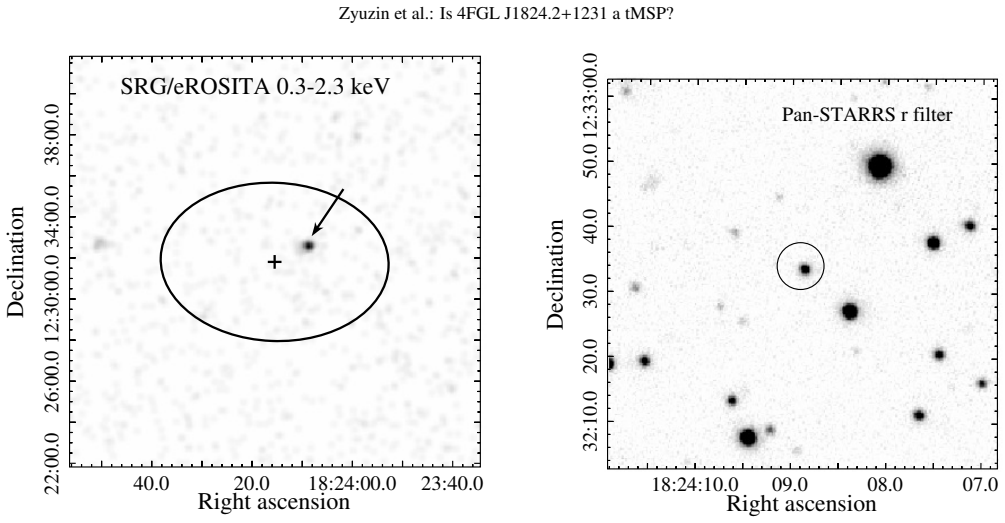
- [Section 2] The identification of SRGe J182408.9+123234 as the counterpart of 4FGL J1824.2+1231 is the foundation of the paper, but no chance-coincidence probability is provided. The Fermi 68% error ellipse is only a containment region: there is a 32% chance that the true gamma-ray position lies outside it, and the search does not cover the 95% ellipse. Please compute the expected number of unrelated X-ray sources inside the adopted ellipse from the local eROSITA and Swift source density and report the Poisson probability that the observed source is a chance coincidence; if possible, repeat the search in the 95% error region. This is essential because all subsequent quantities, including FX/Fgamma and the derived luminosities, assume the association.
- [Section 5] The CV alternative is acknowledged but is ultimately discounted in part by arguing that few CVs are gamma-ray emitters. This argument is only as strong as the gamma-ray association itself; if the chance-coincidence probability is not quantified, then the claim that J1824 is a 'promising tMSP candidate' relies on an association that has not been independently tested. Please make explicit how the gamma-ray detection strengthens the tMSP interpretation relative to the X-ray and optical evidence alone, and ideally quantify the posterior odds of the association.
- [Section 4.3] The X-ray spectral fit is based on only 28 and 83 net counts from Swift/XRT and eROSITA, with the absorption column fixed to the maximum reddening value in the source direction. The resulting photon index of 1.74 +/- 0.19 is typical of several classes of accreting sources, not only tMSPs. Given the low count statistics, please show confidence contours for the spectral parameters or a fit with NH free, and state explicitly how much of the tMSP-versus-CV discrimination is contributed by the X-ray spectrum alone as opposed to the gamma-ray association.
minor comments (5)
- [Section 1] In the first paragraph, 'accreation' should be spelled 'accretion'.
- [Section 4.1] The photometric light-curve figures do not show error bars; please clarify whether the error bars are smaller than the plotted symbols or were omitted for clarity.
- [Section 4.2] The Gaia colour G_BP - G_RP = 1.43 mag is quoted without an uncertainty; please provide the formal uncertainty or state that it is negligible for the argument.
- [Figure 8] The figure caption says the spectra were grouped to at least 3 counts per bin for display, while the fit used bins with at least 1 count per bin; please state this distinction explicitly in the text so that readers do not conflate the two groupings.
- [Section 5] The sentence 'The reddening quickly increases with the distance and reaches its maximum at about 1.45 kpc, which is close to the lower limit on the distance of the source' is slightly ambiguous because the adopted E(B-V) is the maximum value in the source direction; please clarify whether this choice is conservative for the X-ray absorption correction.
Circularity Check
No significant circularity: the tMSP classification rests on independent measured quantities compared with external tMSP parameter space, not on a fitted input renamed as a prediction.
full rationale
The paper's central claim is explicitly conditional ("If the X-ray/optical source is the true counterpart to 4FGL J1824.2+1231, then all its properties suggest that it is a tMSP in the subluminous disk state"), and the classification logic is a comparison of independently measured quantities (Fermi catalog gamma-ray flux, fitted X-ray photon index and flux, optical variability and emission-line properties) against published tMSP parameter space from Papitto & de Martino 2022 and Miller et al. 2020. The X-ray-to-gamma-ray flux ratio is computed from two independent measurements, not recovered from a fitted parameter. The only author-overlapping citation found is Kolbin et al. 2024, used to note that polars and intermediate polars show prolonged low-emission states; this is peripheral to the tMSP conclusion and not load-bearing. The absence of a chance-coincidence probability for the X-ray counterpart inside the Fermi 68% ellipse is a real association weakness, but it is an observational identification uncertainty, not a circular derivation step. No equation or parameter is defined in terms of the target conclusion, so the chain of reasoning is self-contained apart from standard external anchoring in the literature.
Assumptions & free parameters
free parameters (3)
- Interstellar reddening E(B-V) =
0.14 mag (adopted maximum in source direction)
- X-ray photon index Gamma =
1.74 +/- 0.19
- Power-law normalization (unabsorbed 0.5-10 keV flux) =
FX = 5.8(+1.2,-1.0) x 10^-13 erg s^-1 cm^-2
assumptions (6)
- domain assumption The only X-ray source inside the Fermi 68% error ellipse is the true gamma-ray counterpart to 4FGL J1824.2+1231.
- domain assumption The Pan-STARRS optical source PSO J276.0370+12.5426 is the same physical object as the X-ray source.
- domain assumption The Gaia proper motion of 18.5 mas/yr indicates a Galactic source.
- domain assumption E(B-V) = 0.14 mag is the maximum reddening along the line of sight and is used to fix the X-ray absorption column.
- domain assumption The classification criteria for tMSPs in the subluminous disk state from Papitto & de Martino (2022) and Miller et al. (2020) are correct and applicable.
- domain assumption Few cataclysmic variables are gamma-ray emitters, so a CV interpretation is unlikely for a source associated with a Fermi object.
Cite this review
Pith. "Pith review of Is the Fermi source 4FGL J1824.2+1231 a transitional millisecond pulsar?." pith.science (2026). https://pith.science/paper/2A5AG465
@misc{pith2026250521142,
  author       = {Pith},
  title        = {Pith review of: Is the Fermi source 4FGL J1824.2+1231 a transitional millisecond pulsar?},
  year         = {2026},
  howpublished = {\url{https://pith.science/paper/2A5AG465}},
  note         = {Machine review of arXiv:2505.21142}
}
read the original abstract
Transitional millisecond pulsars (tMSPs) in tight binary systems represent an important evolutionary link between low-mass X-ray binaries and radio millisecond pulsars. To date, only three confirmed tMSPs and a few candidates have been discovered. Most of them are gamma-ray sources. For this reason, searching for multiwavelength counterparts to unassociated Fermi gamma-ray sources can help to find new tMSPs. Here we investigate whether the unassociated gamma-ray source 4FGL J1824.2+1231 belongs to the tMSP family. To find the counterpart to 4FGL J1824.2+1231, we used data from SRG/eROSITA and Swift X-ray catalogues, and from different optical catalogues. We also performed time-series photometric optical observations of the source with the 2.1-m telescope of the Observatorio Astronomico Nacional San Pedro Martir, the 1.5-m telescope of the Maidanak Astronomical Observatory and the 1.5-m Russian-Turkish telescope. In addition, we carried out optical spectroscopic observations with the Russian-Turkish telescope and used archival spectroscopic data obtained with the Gemini-North telescope. Within the position error ellipse of 4FGL J1824.2+1231, we found only one X-ray source which coincides with an optical object. We consider it as a likely multiwavelength counterpart to 4FGL J1824.2+1231. The source shows strong optical variability and significant proper motion. The latter strongly implies that this is a Galactic source. Double-peaked H and He emission lines are detected in its spectrum with a flat continuum, as often observed in accretion disks of compact binary systems. The X-ray spectrum is well fitted by a power law with the photon index 1.7. The derived intrinsic X-ray-to-gamma-ray flux ratio is about 0.2. If the X-ray/optical source is the true counterpart to 4FGL J1824.2+1231, then all its properties suggest that it is a tMSP in the subluminous disk state.
Figures


Figures from the paper (6 more)


Reference graph
Works this paper leans on
-
[1]
A., Cheng, A
Alpar, M. A., Cheng, A. F., Ruderman, M. A., & Shaham, J. 1982, Nature, 300, 728
1982
-
[2]
M., Stairs, I
Archibald, A. M., Stairs, I. H., Ransom, S. M., et al. 2009, Science, 324, 1411
2009
-
[3]
Arnaud, K. A. 1996, in Astronomical Society of the Pacific Conference Series, V ol. 101, Astronomical Data Analysis Software and Systems V , ed. G. H. Jacoby & J. Barnes, 17
1996
-
[4]
Bailer-Jones, C. A. L., Rybizki, J., Fouesneau, M., Demleitner, M., & Andrae, R. 2021, AJ, 161, 147
2021
-
[5]
H., Lott, B., & The Fermi-LAT collaboration
Ballet, J., Bruel, P., Burnett, T. H., Lott, B., & The Fermi-LAT collaboration. 2023, arXiv e-prints, arXiv:2307.12546
arXiv 2023
-
[6]
G., Patruno, A., Hessels, J
Bassa, C. G., Patruno, A., Hessels, J. W. T., et al. 2014, MNRAS, 441, 1825
2014
-
[7]
Bisnovatyi-Kogan, G. S. & Komberg, B. V . 1974, Soviet Astronomy, 18, 217
work page 1974
-
[8]
2016, ApJ, 826, 28
Bogdanov, S. 2016, ApJ, 826, 28
2016
Show all 53 references
-
[9]
T., Miller-Jones, J
Bogdanov, S., Deller, A. T., Miller-Jones, J. C. A., et al. 2018, ApJ, 856, 54 Article number, page 8 of 9 Zyuzin et al.: Is 4FGL J1824.2+1231 a tMSP?
2018
-
[10]
E., White, R
Bond, H. E., White, R. L., Becker, R. H., & O’Brien, M. S. 2002, PASP, 114, 1359
2002
-
[11]
1979, ApJ, 228, 939 Coti Zelati, F., Papitto, A., de Martino, D., et al
Cash, W. 1979, ApJ, 228, 939 Coti Zelati, F., Papitto, A., de Martino, D., et al. 2019, A&A, 622, A211
1979
-
[12]
E., Shaw, A
Covington, A. E., Shaw, A. W., Mukai, K., et al. 2022, ApJ, 928, 164
2022
-
[13]
2024, arXiv e-prints, arXiv:2403.03127
Doroshenko, V . 2024, arXiv e-prints, arXiv:2403.03127
2024 arXiv
-
[14]
A., Beardmore, A
Evans, P. A., Beardmore, A. P., Page, K. L., et al. 2009, MNRAS, 397, 1177
2009
-
[15]
A., Page, K
Evans, P. A., Page, K. L., Beardmore, A. P., et al. 2023, MNRAS, 518, 174
2023
-
[16]
P., Padmanabhan, N., Schlegel, D
Finkbeiner, D. P., Padmanabhan, N., Schlegel, D. J., et al. 2004, AJ, 128, 2577
2004
-
[17]
A., Magnier, E
Flewelling, H. A., Magnier, E. A., Chambers, K. C., et al. 2020, ApJS, 251, 7
2020
-
[18]
R., Güver, T., Özel, F., & Slane, P
Foight, D. R., Güver, T., Özel, F., & Slane, P. O. 2016, ApJ, 826, 66 Gaia Collaboration, Prusti, T., de Bruijne, J. H. J., et al. 2016, A&A, 595, A1 Gaia Collaboration, Vallenari, A., Brown, A. G. A., et al. 2023, A&A, 674, A1
2016
-
[19]
Galazutdinov, G. A. 2022, Astrophysical Bulletin, 77, 519
2022
-
[20]
M., Schlafly, E., Zucker, C., Speagle, J
Green, G. M., Schlafly, E., Zucker, C., Speagle, J. S., & Finkbeiner, D. 2019, ApJ, 887, 93
2019
-
[21]
D., et al
Kerby, S., Kaur, A., Falcone, A. D., et al. 2021, ApJ, 923, 75
2021
-
[22]
I., Karpova, A
Kolbin, A. I., Karpova, A. V ., Suslikov, M. V ., et al. 2024, Astronomy Letters, 50, 351
2024
-
[23]
2025, ApJ, 983, 112
Kyer, R., Roy, S., Strader, J., et al. 2025, ApJ, 983, 112
2025
-
[24]
2023, Research Notes of the American Astronomical Society, 7, 214
Labrie, K., Simpson, C., Cardenes, R., et al. 2023, Research Notes of the American Astronomical Society, 7, 214
2023
-
[25]
Landolt, A. U. 1992, AJ, 104, 340
1992
-
[26]
Lomb, N. R. 1976, Ap&SS, 39, 447
1976
-
[27]
C., Fanson, J., Schiminovich, D., et al
Martin, D. C., Fanson, J., Schiminovich, D., et al. 2005, ApJ, 619, L1
2005
-
[28]
J., Laher, R
Masci, F. J., Laher, R. R., Rusholme, B., et al. 2019, PASP, 131, 018003
2019
-
[29]
2006, A&A, 459, 21
Masetti, N., Morelli, L., Palazzi, E., et al. 2006, A&A, 459, 21
2006
-
[30]
Mason, P. A. & Santana, J. B. 2015, in The Golden Age of Cataclysmic Variables and Related Objects - III (Golden2015), 16
2015
-
[31]
Mayer, M. G. F. & Becker, W. 2024, A&A, 684, A208
2024
-
[32]
J., Madzime, S
Meintjes, P. J., Madzime, S. T., Kaplan, Q., & van Heerden, H. J. 2023, Galaxies, 11, 14
2023
-
[33]
M., Swihart, S
Miller, J. M., Swihart, S. J., Strader, J., et al. 2020, ApJ, 904, 49
2020
-
[34]
2020, Advances in Space Research, 66, 1202
Ness, J.-U. 2020, Advances in Space Research, 66, 1202
2020
-
[35]
& de Martino, D
Papitto, A. & de Martino, D. 2022, in Astrophysics and Space Science Library, V ol. 465, Astrophysics and Space Science Library, ed. S. Bhattacharyya, A. Papitto, & D. Bhattacharya, 157–200
2022
-
[36]
2013, Nature, 501, 517
Papitto, A., Ferrigno, C., Bozzo, E., et al. 2013, Nature, 501, 517
2013
-
[37]
2021, A&A, 647, A1
Predehl, P., Andritschke, R., Arefiev, V ., et al. 2021, A&A, 647, A1
2021
-
[38]
Roberts, M. S. E. 2013, in IAU Symposium, V ol. 291, Neutron Stars and Pulsars: Challenges and Opportunities after 80 years, ed. J. van Leeuwen, 127–132
2013
-
[39]
Rodriguez, A. C. 2024, PASP, 136, 054201
2024
-
[40]
S., Bhattacharyya, B., et al
Roy, J., Ray, P. S., Bhattacharyya, B., et al. 2015, ApJ, 800, L12
2015
-
[41]
P., De Luca, A., et al
Salvetti, D., Mignani, R. P., De Luca, A., et al. 2017, MNRAS, 470, 466
2017
-
[42]
Scargle, J. D. 1982, ApJ, 263, 835
1982
-
[43]
V ., Johnson, T
Sokolovsky, K. V ., Johnson, T. J., Buson, S., et al. 2023, MNRAS, 521, 5453
2023
-
[44]
V ., Li, K.-L., Lopes de Oliveira, R., et al
Sokolovsky, K. V ., Li, K.-L., Lopes de Oliveira, R., et al. 2022, MNRAS, 514, 2239
2022
-
[45]
2016, ApJ, 831, 89
Strader, J., Li, K.-L., Chomiuk, L., et al. 2016, ApJ, 831, 89
2016
-
[46]
J., Urquhart, R., et al
Strader, J., Swihart, S. J., Urquhart, R., et al. 2021, ApJ, 917, 69
2021
-
[47]
2021, A&A, 656, A132
Sunyaev, R., Arefiev, V ., Babyshkin, V ., et al. 2021, A&A, 656, A132
2021
-
[48]
J., Strader, J., Chomiuk, L., et al
Swihart, S. J., Strader, J., Chomiuk, L., et al. 2022, ApJ, 941, 199
2022
-
[49]
1997, in Accretion Disks - New Aspects, ed
Tanaka, Y . 1997, in Accretion Disks - New Aspects, ed. E. Meyer-Hofmeister & H. Spruit, V ol. 487, 1
1997
-
[50]
1986, in Society of Photo-Optical Instrumentation Engineers (SPIE) Con- ference Series, V ol
Tody, D. 1986, in Society of Photo-Optical Instrumentation Engineers (SPIE) Con- ference Series, V ol. 627, Instrumentation in astronomy VI, ed. D. L. Crawford, 733
1986
-
[51]
1993, in Astronomical Society of the Pacific Conference Series, V ol
Tody, D. 1993, in Astronomical Society of the Pacific Conference Series, V ol. 52, Astronomical Data Analysis Software and Systems II, ed. R. J. Hanisch, R. J. V . Brissenden, & J. Barnes, 173
1993
-
[52]
2000, MNRAS, 319, 771
Wegner, W. 2000, MNRAS, 319, 771
2000
-
[53]
2000, ApJ, 542, 914 Article number, page 9 of 9
Wilms, J., Allen, A., & McCray, R. 2000, ApJ, 542, 914 Article number, page 9 of 9
2000
Reviewed August 7, 2026 · model on record in the stance chip above.
Discussion (0). Sign in to comment.