REVIEW 2 major objections 3 minor 45 references
Spectral estimates for saddle point matrices arising in weak constraint four-dimensional variational data assimilation
T0 review · 2 major / 3 minor · reviewed 2026-08-14 · deepseek-v4-flash
Pith's one-line read The paper establishes that the spectra of the 3x3 and reduced saddle point systems of weak constraint 4D-Var move in predictable directions as observations are added, with explicit eigenvalue bounds.
desk verdict A solid, carefully scoped spectral analysis of weak constraint 4D-Var saddle point systems; the observation-count monotonicity theorems survive scrutiny, and the diagonal-R restriction is explicit, not hidden. read the letter →
The pith
A machine-rendered reading of the paper's core claim, the machinery that carries it, and where it could break.
The reading
What carries the argument
The argument runs on two mechanisms. Adding an observation appends one row and one column to A3, so the interlacing theorem for principal submatrices directly forces the extreme-eigenvalue shifts of Theorem 3 without any structural assumptions on the blocks. For A2 and A1 the entry point is block algebra: when R is diagonal, adding an observation splits H^T $R^{{-1}}$H into the old term plus a rank-one term $alpha^{{-1}}$ h h^T, and the eigenvalue perturbation inequalities then imply the monotonicity in Theorems 5 and 7. The eigenvalue bounds in Theorems 4, 6, and 8 are obtained from energy arguments applied to the eigenvector equations: for a positive eigenvalue zeta of A2 one solves inequalities built from the extreme eigenvalues psi_min, psi_max of D, nu_min, nu_max of H^T $R^{{-1}}$H, and the smallest and largest singular values sigma_min, sigma_max of L and theta_min, theta_max of (L^T H^T); the 3x3 interval follows from the standard saddle point bound applied to the block diagonal C = diag(D,R) and off-diagonal block (L^T H^T), and the 1x1 interval comes from compressing the generalised Rayleigh quotient of A1.
What would settle it
Check containment for small allowed instances: generate random diagonal-R weak-constraint systems with two or three time steps, compute all eigenvalues of A3, A2, and A1, and verify they lie in the intervals of Theorems 4, 6, and 8; a single eigenvalue outside would refute a bound. Separately, to test the boundary of the diagonal-R assumption, set R with a positive off-diagonal correlation between two observation errors, add one observation, and track the extreme eigenvalues of A2 and A1; if a positive eigenvalue of A2 moves away from zero or an eigenvalue of A1 moves toward zero, the monotonicity results do not survive correlated errors.
Extended reading notes
Core claim
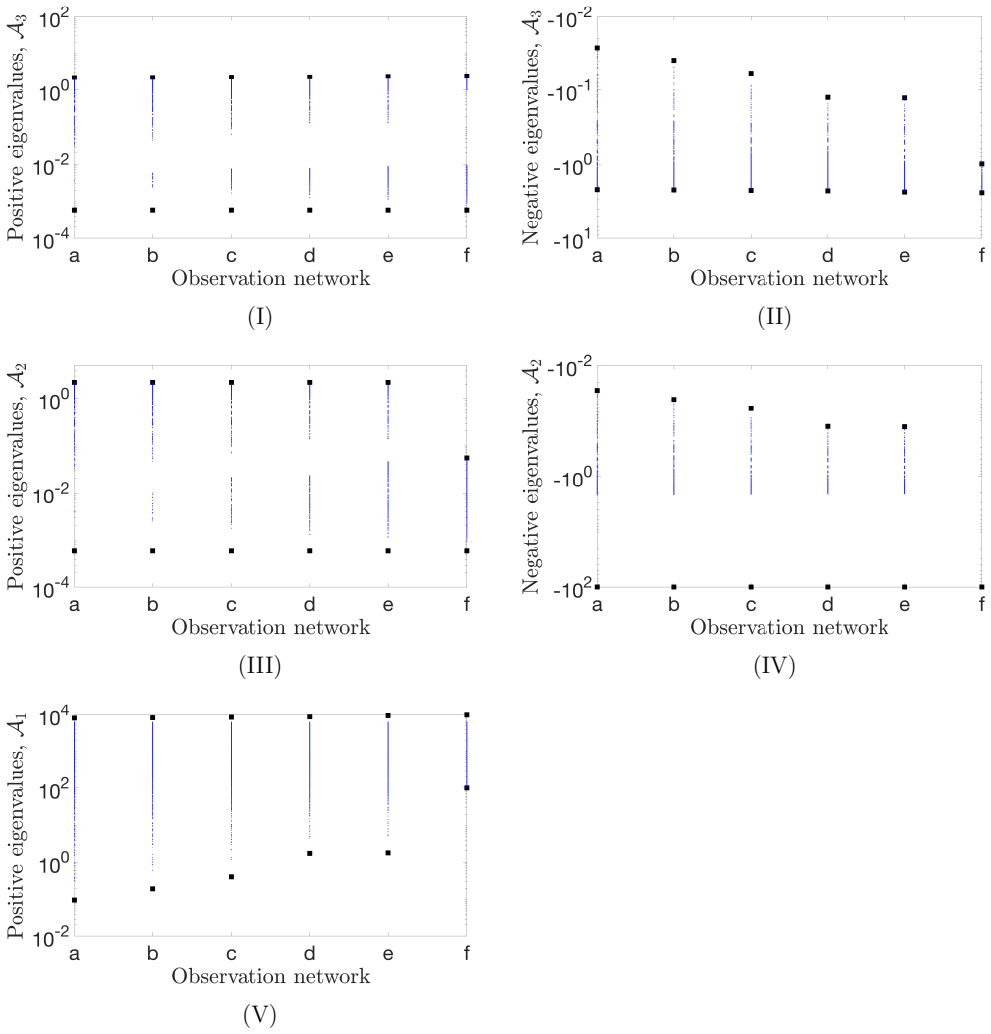
On its own terms, the paper establishes that the spectra of A3, A2, and A1 are sensitive to the number of observations, and quantifies that sensitivity. Theorem 3 states that for A3 the smallest and largest negative eigenvalues and the largest positive eigenvalue move away from zero or are unchanged when observations are added, while the smallest positive eigenvalue approaches zero or is unchanged. Theorem 5 states that, provided R is diagonal, the extreme negative eigenvalues of A2 move away from zero and the extreme positive eigenvalues approach zero; Theorem 7 states that under the same diagonal-R condition the eigenvalues of A1 move away from zero. Theorems 4, 6, and 8 supply containment intervals for the spectra using only extreme eigenvalues of the covariance blocks and singular values of the stacked operator (L^T H^T). The numerical experiments with different observation networks reproduce the predicted directions of motion and show that the saddle point intervals are tight, while the upper bound for A1 is pessimistic.
Load-bearing premise
The load-bearing premise is that observation errors are uncorrelated, so R is diagonal and adding an observation adds a rank-one term to H^T $R^{{-1}}$H; without that, the stated eigenvalue shifts for A2 and A1 are unproved and may fail, while the 3x3 results stand.
Editorial extensions
If this is right
- The numerical experiments show the outer bounds on A3 are tight, so the intervals in Theorem 4 can serve as a priori spectral estimates for a given observation network before forming the full matrix.
- As observations are added, the negative eigenvalues of A3 and A2 cluster away from zero, which helps MINRES, while the positive eigenvalues of A2 and the smallest positive eigenvalue of A3 move toward zero, which can stall it; effective preconditioning must target the small positive part.
- For diagonal R, the eigenvalues of A1 all move away from zero as the observation count grows, so CG on the 1x1 formulation is expected to converge faster for denser observation networks.
- In the fully observed numerical case the largest positive eigenvalue of A2 drops from about 2.1 to about 0.05, a change large enough to alter practical stopping criteria and condition number estimates.
- Only the A3 monotonicity holds for general R; any transfer of the A2/A1 conclusions to an operational setting with correlated observation errors would need new analysis.
Reading between the lines
- Because the proof mechanism for A2 and A1 is a rank-one update, the same analysis transfers to any saddle point system whose (2,2) block is a weighted observation Gram matrix; the 4D-Var application is the test case, not the boundary of the result.
- A direct testable extension is to allow R to be diagonal plus a low-rank correlation matrix; the perturbation would no longer be rank-one, but the partial order of the bounds may still imply monotonicity for the extreme eigenvalues under mild conditions.
- The spectral intervals suggest a pragmatic preconditioning route: estimate theta_min, theta_max, psi_max, and rho_max cheaply, then choose a shift or deflation for the small positive eigenvalues of A2 without ever forming H^T R^{-1}H explicitly.
- Operational weather-prediction systems frequently use thinned or superobbed observations whose errors are correlated; the paper's diagonal-R restriction means the A2/A1 guarantees should not be assumed there until tested, and A3 is the safer formulation when correlations are present.
Signed reviews
Editorial analysis
A structured set of objections, weighed in public.
Referee Report
Summary. The paper studies the spectra of three symmetric linear systems that arise in incremental weak-constraint 4D-Var data assimilation: the 3x3 saddle point matrix A3, the reduced 2x2 saddle point matrix A2, and the 1x1 symmetric positive definite matrix A1. Its main results are monotonicity statements for extreme eigenvalues when observations are added (Theorem 3 for A3 via Cauchy interlacing; Theorems 5 and 7 for A2 and A1 in the case of diagonal observation error covariance R via rank-one updates), interval bounds for the spectra of all three matrices (Theorems 4, 6, and 8), and comparisons with alternative bounds of Axelsson and Neytcheva. Numerical experiments with the Lorenz 96 model confirm the monotonicity and illustrate the sharpness of the bounds, and the paper also discusses implications for MINRES and CG convergence.
Significance. If the main results are correct, they provide practically useful information for the design and preconditioning of iterative solvers in weak-constraint 4D-Var, where the number of observations changes between assimilation cycles. The 2x2 formulation and its spectral bounds appear to be new, and the proofs are transparent, using standard tools such as Cauchy interlacing, Weyl inequalities, Sylvester's law of inertia, and energy arguments. A notable strength is that the bounds are expressed entirely in terms of eigenvalues and singular values of the problem blocks and contain no fitted parameters. The paper is also honest about the scope of the monotonicity results: the A2 and A1 results explicitly require diagonal R, and the numerical convergence for the single-observation network is acknowledged as not explained by the spectrum. However, the appendix contains indexing errors in the individual eigenvalue bounds that need to be corrected before the paper can be accepted.
major comments (2)
- [Appendix A, Theorem 14 and Corollary 9] There is a systematic index error in the statement of Theorem 14 and in the subsequent Corollary 9. With eigenvalues sorted as zeta_1 <= ... <= zeta_{2n}, the n positive eigenvalues of A2 are zeta_{n+1}, ..., zeta_{2n}, whereas Theorem 14 claims that the D-block eigenvalues psi_k bound zeta_k for k = 1, ..., n, and that the negative eigenvalues are bounded by -nu_k +/- sigma_max for zeta_{k+n}. As stated, the theorem is false. For example, take n = 1, D = [1], L = [1], and H^T R^{-1} H = [100]; the eigenvalues of A2 are approximately -100.01 and 1.01, but the 'negative eigenvalue' bound in Theorem 14 gives zeta_2 in [-101, -99], which excludes the actual positive eigenvalue 1.01. Corollary 9 inherits the same misindexing and is false in the fully observed case. The numerical discussion in Section 4.2 uses Corollary 9 to place p eigenvalues of A2 in [-110, -90]; the observed statement about the spectrum is correct, but the supporting indexing in the corollary needs to be corrected so that the bounds apply to the correct sorted positions of the eigenvalues.
- [Appendix A, Theorem 13] Theorem 13 has the same reindexing problem as Theorem 14. For the 3x3 matrix A3, the sorted eigenvalues are gamma_1 <= ... <= gamma_n < 0 < gamma_{n+1} <= ... <= gamma_{2n+p}, so the negative eigenvalues are the first n entries and the positive eigenvalues are the last n+p entries. The theorem instead labels the bounds involving the D- and R-eigenvalues as being for gamma_k, k = 1, ..., n+p, and puts the 'negative eigenvalue' bounds on gamma_{k+n+p}, k = 1, ..., n. Already in the no-observation case p = 0, n = 1, the matrix A3 = [[d, l], [l, 0]] has one negative and one positive eigenvalue, while the stated 'positive' bound is applied to the negative eigenvalue and the stated 'negative' bound to the positive eigenvalue. The proof by Weyl's theorem gives valid intervals for every sorted index, but the identification of which indices correspond to positive and negative eigenvalues is shifted by n in the statement. This affects Corollary 9 and also the interpretation in Section 4.2, so the authors should restate Theorems 13 and 14 with the correct sorted indices.
minor comments (3)
- [Corollary 3] The statement of Corollary 3 contains a typo: it reads sqrt(psi_max^2 + theta_min^2) in the condition, but the proof and the preceding inequality use sqrt(psi_max^2 + 4 theta_min^2). The factor 4 should be restored in the corollary statement.
- [Title] The title in the manuscript text contains a typo: 'wea k constraint' should read 'weak constraint'.
- [Section 4.2] The statement that nu_max does not change across observation networks is correct for the described setup only because observations at different time instants occupy different diagonal blocks of H^T R^{-1} H; it would help the reader if this structural reason were stated explicitly in the text.
Circularity Check
No significant circularity: all spectral bounds and sensitivity results are proved from external interlacing/Weyl theorems with no fitted parameters or load-bearing self-citations.
full rationale
The paper's central derivations are Theorem 3 (monotonicity of extreme eigenvalues of A3 under added observations), Theorems 5 and 7 (same for A2 and A1 under diagonal R), and the interval bounds Theorems 4, 6, and 8. Theorem 3 is proved directly by Cauchy's interlace theorem applied to A3,k as a principal submatrix of A3,k+1; no quantity is defined in terms of the claimed conclusion. Theorems 5 and 7 reduce, for diagonal R, to the rank-one update H_{k+1}^T R_{k+1}^{-1} H_{k+1} = H_k^T R_k^{-1} H_k + alpha^{-1} h_{k+1} h_{k+1}^T, and then apply Weyl's eigenvalue perturbation theorem; the diagonal-R restriction is explicitly stated in each theorem and in the conclusions, so it is a scoped limitation, not a hidden assumption. The interval bounds are applications of external results (Rusten-Winther Lemma 2.1, Silvester-Wathen energy arguments, Jordan-Wielandt plus Weyl) to the block structure; every bound is expressed in terms of eigenvalues/singular values of the problem blocks D, R, L, H, which are inputs, not outputs. There are no fitted parameters, no 'predictions' that are statistically forced by a subset of the data, and no load-bearing self-citations: the papers by the authors (e.g., Gratton-Lawless-Nichols [17]) appear only as background on Gauss-Newton methods and are not used to justify the spectral claims. The honest admission that MINRES convergence for one observation network is not explained by spectra (Section 4.3) is a limitation of a convergence comment, not a circular step. The minor typo in Corollary 3's statement (theta_min^2 versus 4 theta_min^2 in the displayed square root) does not affect any derivation, since the proof correctly uses 4 theta_min^2. Overall the derivation chain is self-contained against external benchmarks, so the circularity score is 0.
Assumptions & free parameters
assumptions (8)
- standard math Weyl eigenvalue inequalities for Hermitian matrices.
- standard math Cauchy interlacing theorem for principal submatrices.
- standard math Sylvester's law of inertia.
- standard math Rusten-Winther Lemma 2.1 eigenvalue intervals for saddle point matrices.
- standard math Silvester-Wathen energy inequalities for block SPD matrices and singular values.
- standard math Jordan-Wielandt theorem on eigenvalues of off-diagonal block matrices.
- domain assumption The covariance matrices D and R are symmetric positive definite and the model errors are uncorrelated in time.
- domain assumption For Theorems 5 and 7, R is diagonal, meaning observation errors are uncorrelated.
Cite this review
Pith. "Pith review of Spectral estimates for saddle point matrices arising in weak constraint four-dimensional variational data assimilation." pith.science (2026). https://pith.science/paper/2A7EKGD4
@misc{pith2026190807949,
  author       = {Pith},
  title        = {Pith review of: Spectral estimates for saddle point matrices arising in weak constraint four-dimensional variational data assimilation},
  year         = {2026},
  howpublished = {\url{https://pith.science/paper/2A7EKGD4}},
  note         = {Machine review of arXiv:1908.07949}
}
read the original abstract
We consider the large-sparse symmetric linear systems of equations that arise in the solution of weak constraint four-dimensional variational data assimilation, a method of high interest for numerical weather prediction. These systems can be written as saddle point systems with a 3x3 block structure but block eliminations can be performed to reduce them to saddle point systems with a 2x2 block structure, or further to symmetric positive definite systems. In this paper, we analyse how sensitive the spectra of these matrices are to the number of observations of the underlying dynamical system. We also obtain bounds on the eigenvalues of the matrices. Numerical experiments are used to confirm the theoretical analysis and bounds.
Figures

Reference graph
Works this paper leans on
-
[1]
Assimilation of operational data
Andersson, E., and Th ´ epaut, J.-N. Assimilation of operational data. In Data Assimilation. Making Sense of Observations , W. Lahoz, B. Khattatov, and R. Menard, Eds. Springer-Verlag B erlin Heidelberg, 2010, pp. 283 – 299
work page 2010
-
[2]
Eigenvalue estimates for preconditioned saddle point matrices
Axelsson, O., and Neytcheva, M. Eigenvalue estimates for preconditioned saddle point matrices. Numerical Linear Algebra with Applications 13 , 4 (2006), 339 – 360
work page 2006
-
[3]
Benzi, M., Golub, G. H., and Liesen, J. Numerical solution of saddle point problems. Acta Numerica 14 (2005), 1 – 137
work page 2005
-
[4]
Inexact constraint preconditioners for linear systems arising in interior point methods
Bergamaschi, L., Gondzio, J., Venturin, M., and Zilli, G. Inexact constraint preconditioners for linear systems arising in interior point methods. Computational Optimization and Applications 36 , 2 (2007), 137 – 147
work page 2007
-
[5]
Bonavita, M., Tr ´ emolet, Y., H ´olm, E., Lang, S. T. K., Chrust, M., Janiskova, M., Lopez, P., Laloyaux, P., de Rosnay, P., Fisher, M., Hamrud, M., and Engl ish, S. A strategy for data assimilation. ECMWF Technical Memoranda, 800 (2017)
work page 2017
-
[6]
Butcher, J. C. The Numerical Analysis of Ordinary Differential Equations: Runge-Kutta and General Linear Methods. Wiley-Interscience, 1987
work page 1987
-
[7]
Chen, H., Yang, D., Hong, Y., Gourley, J. J., and Zhang, Y. Hydrological data assimilation with the Ensemble Square-Root-Filter: Use of streamflow observations to update model states for real-time flash flood forecasting. Advances in Water Resources 59 (2013), 209 – 220
work page 2013
-
[8]
A strategy for operational implementation of 4D- Var, using an incremental approach
Courtier, P., Th ´ epaut, J.-N., and Hollingsworth, A. A strategy for operational implementation of 4D- Var, using an incremental approach. Quarterly Journal of the Royal Meteorological Society 120 , 519 (1994), 1367 – 1387
work page 1994
Show all 45 references
-
[9]
Atmospheric Data Analysis , vol
Daley, R. Atmospheric Data Analysis , vol. 2. Cambridge University Press, 1993. 19
1993
-
[10]
Conditioning of the weak-constraint variational data assi milation problem for numerical weather prediction
El-Said, A. Conditioning of the weak-constraint variational data assi milation problem for numerical weather prediction. PhD thesis, Department of Mathematics and Statistics, Universit y of Reading, 2015. PhD thesis
2015
-
[11]
Variational data assimilation for tropospheric chemistry modeling
Elbern, H., Schmidt, H., and Ebel, A. Variational data assimilation for tropospheric chemistry modeling. Journal of Geophysical Research: Atmospheres 102 , D13 (1997), 15967 – 15985
1997
-
[12]
Minimization algorithms for variational data assimilation
Fisher, M. Minimization algorithms for variational data assimilation. In Proceedings of the Seminar on Recent Developments in Numerical Methods for Atmospheric Modelli ng (1998), European Centre for Medium Range Weather Forecasts, pp. 364 – 385
1998
-
[13]
Parallelisation in the time dimension of four-dimensional variational da ta assimi- lation
Fisher, M., and G ¨urol, S. Parallelisation in the time dimension of four-dimensional variational da ta assimi- lation. Quarterly Journal of the Royal Meteorological Society 143 , 703 (2017), 1136 – 1147
2017
-
[14]
A., and Green, D
Freitag, M. A., and Green, D. L. A low-rank approach to the solution of weak constraint variational data assimilation problems. Journal of Computational Physics 357 (2018), 263 – 281
2018
-
[15]
H., and V an Loan, C
Golub, G. H., and V an Loan, C. F. Matrix Computations , 4th ed. JHU Press, 2013
2013
-
[16]
Gratton, S., G ¨urol, S., Simon, E., and Toint, P. L. Guaranteeing the convergence of the saddle formulation for weakly-constrained 4D-Var data assimilation. Quarterly Journal of the Royal Meteorological Society 144 , 717 (2018), 2592 – 2602
2018
-
[17]
Approximate gauss-newton methods for nonlinear least squares problems
Gratton, S., Lawless, A., and Nichols, N. Approximate gauss-newton methods for nonlinear least squares problems. SIAM Journal on Optimization 18 , 1 (2007), 106 – 132
2007
-
[18]
Any nonincreasing convergence curve is possible for GMRES
Greenbaum, A., Pt ´ak, V., and Strako ˇs, Z. Any nonincreasing convergence curve is possible for GMRES. SIAM Journal on Matrix Analysis and Applications 17 , 3 (1996), 465 – 469
1996
-
[19]
Bounds on eigenvalues of matrices arising from interior-point methods
Greif, C., Moulding, E., and Orban, D. Bounds on eigenvalues of matrices arising from interior-point methods. SIAM Journal on Optimization 24 , 1 (2014), 49 – 83
2014
-
[20]
Adjoint methods in data assimilation for estimating model error
Griffith, A., and Nichols, N. Adjoint methods in data assimilation for estimating model error. Flow, Turbulence and Combustion 65 , 3 - 4 (2000), 469 – 488
2000
-
[21]
R., and Stiefel, E
Hestenes, M. R., and Stiefel, E. Methods of conjugate gradients for solving linear systems. Journal of Research of the National Bureau of Standards 49 , 6 (1952), 409 – 436
1952
-
[22]
A., Cohn, S
Janji´c, T., Bormann, N., Bocquet, M., Carton, J. A., Cohn, S. E., Da nce, S. L., Losa, S. N., Nichols, N. K., Potthast, R., W aller, J. A., and Weston, P. On the representation error in data assimilation. Quarterly Journal of the Royal Meteorological Society 144 , 713 (2018),...
2018
-
[23]
J., and Nichols, N
Johnson, C., Hoskins, B. J., and Nichols, N. K. A singular vector perspective of 4D-Var: Filtering and interpolation. Quarterly Journal of the Royal Meteorological Society 131 , 605 (2005), 1 – 19
2005
-
[24]
Atmospheric Modeling, Data Assimilation and Predictabili ty
Kalnay, E. Atmospheric Modeling, Data Assimilation and Predictabili ty. Cambridge University Press, 2002
2002
-
[25]
Variational data assimilation for very large environmental problems
Lawless, A. Variational data assimilation for very large environmental problems . In Large Scale Inverse Prob- lems: Computational Methods and Applications in the Earth S ciences, M. Cullen, M. A. Freitag, S. Kindermann, and R. Scheichl, Eds., Radon Series on Computational and...
2013
-
[26]
Predictability - a problem partly solved
Lorenz, E. Predictability - a problem partly solved. In Proceedings of the Seminar on Predictability (1996), vol. 1, European Centre for Medium Range Weather Forecasts, pp . 1 – 18
1996
-
[27]
Spectral estimates for unreduced symmetric KKT systems arising from interior point methods
Morini, B., Simoncini, V., and Tani, M. Spectral estimates for unreduced symmetric KKT systems arising from interior point methods. Numerical Linear Algebra with Applications 23 , 5 (2016), 776 – 800
2016
-
[28]
A comparison of reduced and unreduced KKT systems arising from interior point methods
Morini, B., Simoncini, V., and Tani, M. A comparison of reduced and unreduced KKT systems arising from interior point methods. Computational Optimization and Applications 68 , 1 (2017), 1 – 27
2017
-
[29]
J., and Diekman, C
Moye, M. J., and Diekman, C. O. Data assimilation methods for neuronal state and parameter estim ation. The Journal of Mathematical Neuroscience 8 , 11 (2018)
2018
-
[30]
Nichols, N. K. Mathematical concepts of data assimilation. In Data Assimilation. Making Sense of Observations , W. Lahoz, B. Khattatov, and R. Menard, Eds. Springer-Verlag Be rlin Heidelberg, 2010, pp. 13 – 39
2010
-
[31]
Nocedal, J., and Wright, S. J. Numerical Optimization , 2nd ed. World Scientific, 2006
2006
-
[32]
C., and Saunders, M
Paige, C. C., and Saunders, M. A. Solution of sparse indefinite systems of linear equations. SIAM Journal on Numerical Analysis 12 , 4 (1975), 617 – 629. 20
1975
-
[33]
The role of the model in the data assimilation system
Rood, R. The role of the model in the data assimilation system. In Data Assimilation. Making Sense of Observations, W. Lahoz, B. Khattatov, and R. Menard, Eds. Springer-Verlag B erlin Heidelberg, 2010, pp. 351 – 379
2010
-
[34]
A preconditioned iterative method for saddlepoint problems
Rusten, T., and Winther, R. A preconditioned iterative method for saddlepoint problems. SIAM Journal on Matrix Analysis and Applications 13 , 3 (1992), 887 – 904
1992
-
[35]
Iterative Methods for Sparse Linear Systems , 2nd ed
Saad, Y. Iterative Methods for Sparse Linear Systems , 2nd ed. Society for Industrial and Applied Mathematics, 2003
2003
-
[36]
Saad, Y., and Schultz, M. H. GMRES: A generalized minimal residual algorithm for solving nonsymme tric linear systems. SIAM Journal on Scientific and Statistical Computing 7 , 3 (1986), 856 – 869
1986
-
[37]
Fast iterative solution of stabilised Stokes systems
Silvester, D., and W athen, A. Fast iterative solution of stabilised Stokes systems. Part II: using general block preconditioners. SIAM Journal on Numerical Analysis 31 , 5 (1994), 1352 – 1367
1994
-
[38]
Determinants of block matrices
Silvester, J. Determinants of block matrices. Mathematical Gazette 84 , 501 (2000), 460 – 467
2000
-
[39]
Simoncini, V., and Szyld, D. B. On the superlinear sonvergence of MINRES. In Numerical Mathematics and Advanced Applications 2011. Proceedings of ENUMATH 2011 (2013), A. Cangiani, R. Davidchack, E. Georgoulis, A. Gorban, J. Levesley, and M. Tretyakov, Eds., Springer, pp. 73 3 – 740
2013
-
[40]
Matrix Perturbation Theory
Stewart, G., and Sun, J.-G. Matrix Perturbation Theory . Computer Science and Scientific Computing. Academic Press, 1990
1990
-
[41]
Numerical weather prediction
Swinbank, R. Numerical weather prediction. In Data Assimilation. Making Sense of Observations , W. Lahoz, B. Khattatov, and R. Menard, Eds. Springer-Verlag Berlin Heidelbe rg, 2010, pp. 381 – 406
2010
-
[42]
Variational assimilation
Talagrand, O. Variational assimilation. In Data Assimilation. Making Sense of Observations , W. Lahoz, B. Khattatov, and R. Menard, Eds. Springer-Verlag Berlin Heidelbe rg, 2010, pp. 41 – 68
2010
-
[43]
N., and Bau, III, D
Trefethen, L. N., and Bau, III, D. Numerical Linear Algebra . SIAM, 1997
1997
-
[44]
Accounting for an imperfect model in 4D-Var
Tr´ emolet, Y. Accounting for an imperfect model in 4D-Var. Quarterly Journal of the Royal Meteorological Society 132, 621 (2006), 2483 – 2504
2006
-
[45]
Model-error estimation in 4D-Var
Tr´ emolet, Y. Model-error estimation in 4D-Var. Quarterly Journal of the Royal Meteorological Society 133 , 626 (2007), 1267 – 1280. 21
2007
Reviewed August 14, 2026 · model on record in the stance chip above.
Discussion (0). Continue with ORCID to comment.