REVIEW 3 major objections 6 minor 17 references
Incorporating Structural Stigma into Network Analysis
T0 review · 3 major / 6 minor · reviewed 2026-08-14 · deepseek-v4-flash
Pith's one-line read A new network statistic detects active ostracism behind classroom segregation, beyond plain homophily.
desk verdict A genuinely new ERGM term for structural stigma, with a correct changescore derivation and a suggestive but fragile classroom illustration. read the letter →
The pith
A machine-rendered reading of the paper's core claim, the machinery that carries it, and where it could break.
The reading
What carries the argument
The load-bearing object is the inhomogeneous 2-star statistic $t_{I2S}$, a sum over directed two-paths of the form in-group tie followed by out-group tie: a friend inside the group who themselves befriends someone outside. It works through its changescore, which converts each edge toggle into a count of relevant boundary-spanning ties, so that a single negative parameter $\theta_{I2S}$ controls both sides of the mechanism: boundary spanners become less attractive to in-group members, and in-group embeddedness inhibits further boundary spanning. This one statistic is what lets the model separate active ostracism from constant-rate mixing.
What would settle it
Fit an alternative ERGM in which the changescore also counts incoming cross-group ties (a symmetric version of $t_{I2S}$) to the same classroom data; if the asymmetric term's negative coefficient disappears or the symmetric version fits the data better, the claim that the term captures ostracism of boundary spanners would be undermined.
Extended reading notes
Core claim
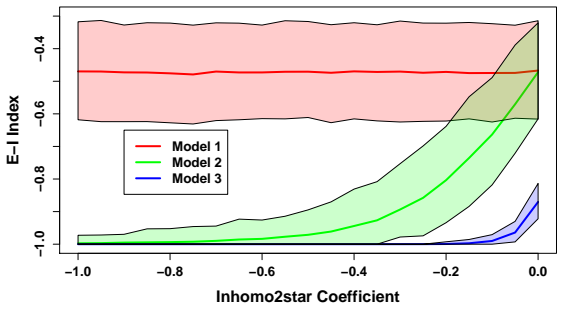
The paper claims that active boundary maintenance—the ostracism of people who bridge group boundaries—can be detected with a single ERGM statistic, the inhomogeneous 2-star $t_{I2S}(y,X)=$ $\sum_{i,j,k} y_{ij} y_{jk} I(X_i=X_j) I(X_j\neq X_k)$. Its changescore has two branches: when $i$ and $j$ are in the same group it counts $j$'s outgoing ties to out-group members, and when they are in different groups it counts $i$'s incoming ties from in-group members. A negative coefficient on this term therefore suppresses cross-group ties for actors embedded in their own group and suppresses in-group ties to actors who reach across, implementing stigma by association. In simulations the term pushes the E-I index toward segregation well beyond what mixing parameters produce, and in the empirical classroom network the fitted coefficient is about $-0.4$ ($p<0.001$), which the paper interprets as evidence of active boundary maintenance by gender.
Load-bearing premise
The statistic assumes stigma is triggered only by an actor's outgoing ties to the out-group: incoming cross-group ties received by an actor are never penalized, and the empirical stigma coefficient depends on that one-sided treatment.
Editorial extensions
If this is right
- Adding $t_{I2S}$ to a model that already contains mixing terms gives a direct significance test for active boundary maintenance over and above homophilous nomination rates.
- A negative estimate means the same ties that bind a person to their group are predicted to suppress cross-group ties, so even mild boundary spanning is costly in terms of in-group acceptance.
- Simulations show boundary maintenance amplifies the segregation produced by mixing, and the amplification grows when there is already some inhibition of cross-group ties.
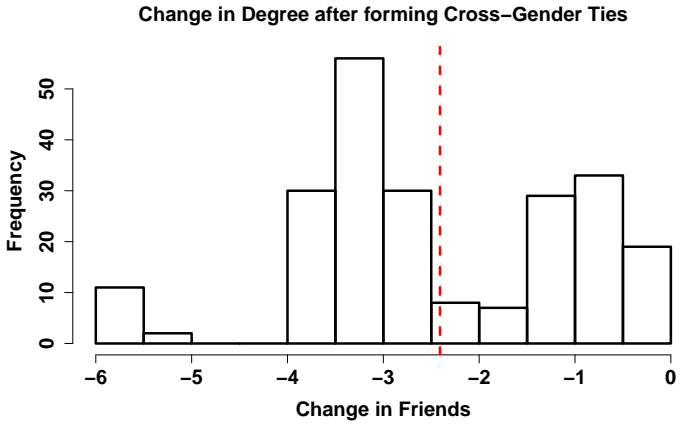
- In the classroom network, the fitted model predicts that forming one new cross-gender tie costs the actor, on average, about 2.4 friendship nominations, roughly half of their current friends.
- The absence of an inhomogeneous 2-star effect would suggest homophily arises from neutral contact or positive selection rather than stigmatization.
Reading between the lines
- Because the statistic as defined penalizes only outgoing cross-group ties, a natural extension is a symmetric variant that also penalizes actors who receive out-group ties; fitting both on the same data would reveal whether the one-sided assumption is justified.
- The same term could be applied to other ascriptive attributes—race, ethnicity, religion, HIV status—where stigma operates, and the perturbation framework gives a per-actor 'cost of crossing' that could be compared across settings.
- In longitudinal data, one could test the mechanism directly by asking whether actors who add out-group ties subsequently lose in-group nominations; the paper's cross-sectional design can only identify the implied structure, not the temporal sequence.
- Boundary maintenance terms should slow diffusion across groups; simulations of contagion on networks fitted with and without $t_{I2S}$ could quantify how much stigma impedes the spread of information or disease.
Signed reviews
Editorial analysis
A structured set of objections, weighed in public.
Referee Report
Summary. The paper introduces a new ERGM statistic, the inhomogeneous 2-star (t_I2S), designed to capture active boundary maintenance (structural stigma) that goes beyond standard differential mixing. The statistic counts directed two-stars in which the central actor has a within-group tie and an out-group tie, so that a negative coefficient suppresses both cross-group ties from well-embedded actors and within-group nominations to boundary spanners. The authors derive the changescore, demonstrate via simulation that the E-I index becomes more negative as the coefficient becomes more negative, fit an ERGM to the Parker and Asher classroom friendship network (22 students) and report a significant negative coefficient, and use conditional perturbation to estimate the expected loss of incoming nominations after a cross-group tie or a gender change. The paper concludes that the statistic provides a way to model and detect active boundary maintenance in empirical networks.
Significance. If the central claims hold, this is a useful addition to the ERGM toolbox: it provides a simple, transparent parametric term for modeling a mechanism (ostracism of boundary spanners) that is theoretically important but rarely directly represented. The changescore derivations are straightforward, the statistic is easy to interpret, and the simulation study confirms the expected qualitative behavior. The paper also makes a useful methodological point by distinguishing mixing effects from active boundary maintenance and by illustrating how conditional perturbation can translate fitted ERGM coefficients into tangible predictions about tie gains and losses. The main limitations are the strongly directional formulation of the statistic, which is not fully justified, and the fragility of the empirical illustration, which rests on a single small network and effectively on one anomalous student. These issues are fixable and do not undermine the core methodological contribution.
major comments (3)
- [Section 2, Eqs. (6)-(8)] The inhomogeneous 2-star statistic is deliberately asymmetric: for a same-group edge i->j the changescore counts only j's outgoing cross-group ties (sum_k y_jk I(X_j != X_k)), and for a cross-group edge i->j it counts only i's incoming in-group ties (sum_k y_ki I(X_k = X_i)). Thus an actor who receives many out-group nominations is not penalized for receiving them, and the model cannot represent ostracism triggered by incoming cross-group ties. The paper does not justify this directional choice, even though the Goffman/Heider mechanisms cited in the introduction are phrased symmetrically ("interacting with" or "consorting with" out-group members). Because the empirical coefficient (-0.386) is interpreted as evidence of active boundary maintenance, this asymmetry is load-bearing; the authors should either defend it on directed-nomination grounds or fit a symmetric alternative and show that the conclusion is robust.
- [Section 4, Table 2] The empirical demonstration rests on a single 22-node network, and the inhomogeneous 2-star effect is identified almost entirely by one boy who sends ties to girls and receives no ties from boys. With such a small sample and a term that is nonzero for a handful of configurations, the reported p-value and the claim that "mechanisms are operative in at least some settings" are fragile. The authors should report sensitivity analyses (e.g., leave-one-out estimation, comparison with a model using a symmetric variant) and temper the concluding claim accordingly.
- [Section 2, Eq. (5)] As displayed, the changescore for t_AB uses logical OR where AND is clearly intended: the first case should be "Xi = A and Xj = A", and the second should be "Xi = A and Xj = B". As written the equation is mathematically incorrect and must be fixed; since this changescore defines the proposed statistic, the error is in a load-bearing location.
minor comments (6)
- [Section 2] "Sigmatized" should be "stigmatized".
- [Section 2, Eq. (6)] The statistic is labeled t_I2P in the displayed equation but referred to as t_I2S in the text; the notation should be unified.
- [Section 3, Table 1] Model 3 is described as penalizing between-group mixing, but its nodemix coefficient (-1) is less negative than Model 1's (-2.5); the description of the simulation design is confusing and should be clarified.
- [Section 4] The model selection procedure ("best subset selection" over eight terms, then the 50 lowest-AIC models) is not described in enough detail to be replicated; a list of candidate models or the AIC table would help.
- [Section 5, Eq. (9)] The conditioning notation is ambiguous; it is not clear which tie variables are fixed, which are toggled, and which are integrated out when computing the expected in-degree change. A precise algorithmic description (e.g., MCMC or exact enumeration for this small network) is needed.
- [Section 5] The claim that forming a cross-gender tie leads to a loss of 2.41 nominations (51%) is presented as a point prediction without uncertainty; adding a measure of variability would strengthen the perturbation analysis.
Circularity Check
No significant circularity: the inhomogeneous 2-star statistic is defined to implement boundary maintenance, and the negative coefficient is estimated from data rather than forced by construction.
full rationale
The paper's central contribution is a new ERGM statistic, t_I2S (Eq. 6), whose changescore (Eq. 8) literally counts outgoing cross-group ties from the center of a 2-star. This is a definition by construction, not a derivation of a result from an assumed conclusion. The claim that a negative parameter captures boundary maintenance is then tested empirically: the coefficient is estimated from the Parker and Asher friendship data (Table 2) and reported as approximately -0.4 with p < 0.001. Nothing in the normalization or the statistic forces this estimate to be negative; the model could have returned a null or positive effect. The simulation study varies the coefficient exogenously to show model behavior, and the perturbation analysis (Section 5) computes expectations from the fitted model, which the authors explicitly label as thought experiments rather than independent predictions ('Both scenarios should be viewed as thought experiments rather than actionable predictions'). The self-citations present (Butts 2007, Butts 2011, Handcock et al. 2008, Hunter et al. 2008, Hunter et al. 2013) are methodological or software references, not load-bearing 'uniqueness theorems' that forbid alternatives. The skeptic's concern about directional asymmetry (only outgoing cross-group ties trigger the penalty) is a substantive construct-validity or model-specification question, but it is not circular reasoning: it does not reduce the empirical estimate to an input tautology. The paper does not rename a known result, nor does it smuggle an ansatz in via citation. The derivation chain is self-contained, and the empirical claim is data-driven.
Assumptions & free parameters
free parameters (2)
- GWESP alpha-decay parameter =
0.803
- Simulation coefficients (edges, nodematch, nodemix, inhomogeneous 2-star) =
Model 1: -2, 0.75, -2.5, 0; Model 2: -2, 0.75, -2.5, varying -1 to 0; Model 3: -2, 3, -1, varying -1 to 0
assumptions (3)
- domain assumption The ERGM family with the specified sufficient statistics is an appropriate generative model for the friendship nomination network.
- domain assumption MCMC estimation via the ergm package converges to the target distribution with the reported settings (10,000 sample size, 10,000 interval).
- domain assumption Group memberships (gender) and friendship nominations are measured without error.
Cite this review
Pith. "Pith review of Incorporating Structural Stigma into Network Analysis." pith.science (2026). https://pith.science/paper/2ANXBC6U
@misc{pith2026190801500,
  author       = {Pith},
  title        = {Pith review of: Incorporating Structural Stigma into Network Analysis},
  year         = {2026},
  howpublished = {\url{https://pith.science/paper/2ANXBC6U}},
  note         = {Machine review of arXiv:1908.01500}
}
read the original abstract
A rich literature has explored the modeling of homophily and other forms of nonuniform mixing associated with individual-level covariates within the exponential family random graph (ERGM) framework. Such differential mixing does not fully explain phenomena such as stigma, however, which involve the active maintenance of social boundaries by ostracism of persons with out-group ties. Here, we introduce a new statistic that allows for such effects to be captured, making it possible to probe for the potential presence of boundary maintenance above and beyond simple differences in nomination rates. We demonstrate this statistic in the context of gender segregation in a school classroom.
Figures


Figures from the paper (5 more)



Reference graph
Works this paper leans on
-
[1]
Blau, P. M. (1994). Structural contexts of opportunities . University of Chicago Press
work page 1994
-
[2]
Butts, C. T. (2007). Models for generalized location systems. Sociological Methodology , 37(1):283--348
work page 2007
-
[3]
Butts, C. T. (2011). Bernoulli graph bounds for general random graphs. Sociological Methodology , 41:299--345
work page 2011
-
[4]
Goffman, E. (1963). Stigma: Notes on the Management of Spoiled Identity . Simon and Schuster, New York
work page 1963
-
[5]
Goodreau, S. M., Rosenberg, E. S., Jenness, S. M., Luisi, N., Stansfield, S. E., Millett, G. A., and Sullivan, P. S. (2017). Sources of racial disparities in hiv prevalence in men who have sex with men in A tlanta, GA , USA : a modelling study. The Lancet HIV , 4(7):e311--e320
work page 2017
-
[6]
Handcock, M. S. (2003). Statistical models for social networks: Inference and degeneracy. In Breiger, R., Carley, K. M., and Pattison, P., editors, Dynamic Social Network Modeling and Analysis , pages 229--240. National Academies Press, Washington, DC
2003
-
[7]
S., Hunter, D
Handcock, M. S., Hunter, D. R., Butts, C. T., Goodreau, S. M., and Morris, M. (2008). statnet : Software tools for the representation, visualization, analysis and simulation of network data. Journal of Statistical Software , 24(1):1--11
2008
-
[8]
Heider, F. (1946). Attitudes and cognitive organization. Journal of Psychology , 21:107--112
work page 1946
Show all 17 references
-
[9]
Hunter, D. R. (2007). Curved exponential family models for social networks. Social Networks , 29:216--230
2007
-
[10]
R., Goodreau, S
Hunter, D. R., Goodreau, S. M., and Handcock, M. S. (2013). ergm.userterms: A template package for extending statnet. Journal of Statistical Software , 52(2):1--25
2013
-
[11]
R., Handcock, M
Hunter, D. R., Handcock, M. S., Butts, C. T., Goodreau, S. M., and Morris, M. (2008). ergm: A package to fit, simulate and diagnose exponential-family models for networks. Journal of Statistical Software , 24(3)
2008
-
[12]
and Stern, R
Krackhardt, D. and Stern, R. N. (1988). Informal networks and organizational crises: An experimental simulation. Social Psychology Quarterly , 51:123--140
1988
-
[13]
McPherson, M., Smith-Lovin, L., and Cook, J. M. (2001). Birds of a feather: Homophily in social networks. Annual review of sociology , 27(1):415--444
2001
-
[14]
Parker, J. G. and Asher, S. R. (1993). Friendship and friendship quality in middle childhood: Links with peer group acceptance and feelings of loneliness and social dissatisfaction. Developmental psychology , 29(4):611
1993
-
[15]
Sakoda, J. M. (1971). The checkerboard model of social interaction. Journal of Mathematical Sociology , 1(1):119--132
1971
-
[16]
R., Bouchard, M., Young, J
Schaefer, D. R., Bouchard, M., Young, J. T., and Kreager, D. A. (2017). Friends in locked places: an investigation of prison inmate network structure. Social networks , 51:88--103
2017
-
[17]
Schelling, T. C. (1971). Dynamic models of segregation. Journal of mathematical sociology , 1(2):143--186
1971
Reviewed August 14, 2026 · model on record in the stance chip above.
Discussion (0). Continue with ORCID to comment.