Brilliant multi-GeV Compton gamma-ray source seeded by a photon accelerator
Pith reviewed 2026-07-03 02:50 UTC · model grok-4.3
The pith
Optical photons are first accelerated in a plasma wakefield then reflected to collide with electrons, generating multi-GeV polarized gamma rays.
A machine-rendered reading of the paper's core claim, the machinery that carries it, and where it could break.
Core claim
By seeding the inverse Compton scattering process with extreme ultraviolet photons that have been accelerated in a plasma wakefield and reflected by a plasma mirror, the interaction with a relativistic electron beam produces a flash of multi-GeV gamma rays with high peak brilliance and polarization.
What carries the argument
Photon acceleration in a beam-driven plasma wakefield combined with plasma mirror reflection to enable inverse Compton scattering at high energies.
If this is right
- Produces gamma rays with peak brilliance of 10^25 photons/s mm^2 mrad^2 0.1% BW at multi-GeV energies.
- Achieves up to 95% circular polarization or 77% linear polarization.
- Enables production of spin-polarized positrons.
- Allows tests of light-by-light scattering.
Where Pith is reading between the lines
- The source could operate in a more compact footprint than conventional high-energy accelerators.
- Polarization control at these energies opens routes to new probes of quantum electrodynamics.
- The method might be adapted to other plasma-based facilities without requiring new large-scale infrastructure.
Load-bearing premise
The plasma wakefield accelerates the seed photons to extreme ultraviolet energies and the plasma mirror reflects them with sufficient efficiency and precise timing to collide properly with the trailing electron beam.
What would settle it
An experiment measuring the photon energy spectrum after wakefield acceleration and plasma mirror reflection, then checking whether the observed gamma-ray brilliance, energy, and polarization match the simulated values.
Figures



read the original abstract
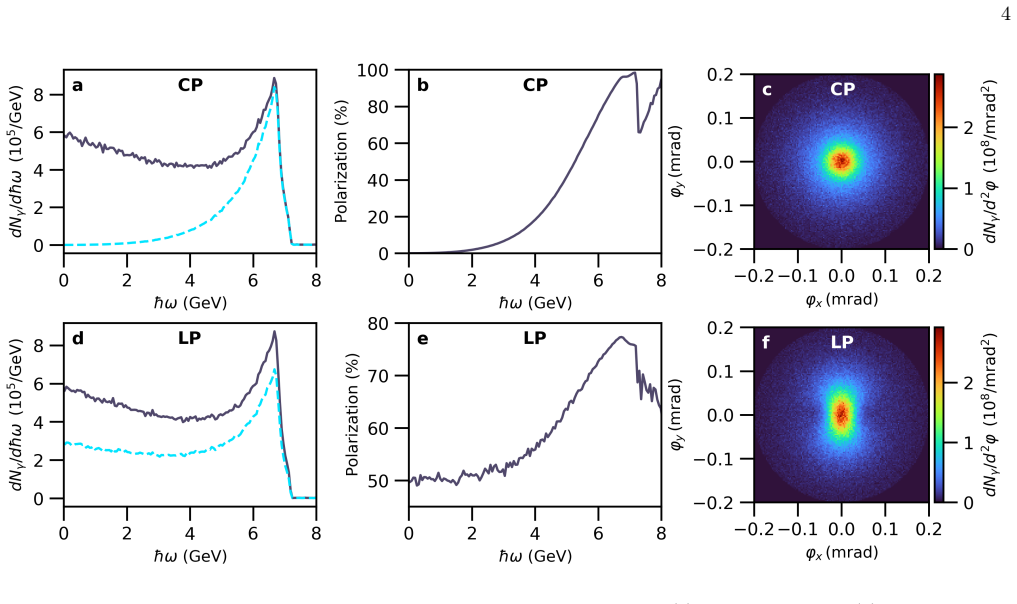
High-brilliance sources of polarized gamma rays are widely sought after to pump and probe matter at subatomic length scales. However, existing accelerator facilities and optical lasers cannot reach a sufficiently high center-of-mass energy to produce polarized, multi-GeV gamma rays from unpolarized electrons via inverse Compton scattering. Here we propose a scheme where the optical laser photons are first "accelerated" to the extreme ultraviolet in a beam-driven plasma wakefield, then reflected by a plasma mirror back onto a trailing electron beam, producing a flash of gamma rays. Numerical simulations demonstrate this light source can achieve a high peak-brilliance (10^25 photons/s mm^2 mrad^2 0.1% BW) and a high degree of circular (95 %) or linear (77 %) polarization at multi-GeV photon energies, paving the way for the production of spin-polarized positrons and tests of light-by-light scattering.
Editorial analysis
A structured set of objections, weighed in public.
Referee Report
Summary. The manuscript proposes a scheme to generate multi-GeV polarized gamma rays by first accelerating optical laser photons to extreme ultraviolet energies inside a beam-driven plasma wakefield, reflecting them from a plasma mirror, and then colliding them with a trailing electron bunch to drive inverse Compton scattering. Numerical simulations are stated to yield a peak brilliance of 10^25 photons/s mm² mrad² 0.1% BW together with 95% circular or 77% linear polarization.
Significance. If the quoted performance numbers can be shown to survive detailed validation, the configuration would constitute a compact route to high-brilliance polarized gamma-ray sources at existing or planned plasma-wakefield facilities, opening applications in light-by-light scattering tests and spin-polarized positron production. The conceptual integration of photon acceleration with a plasma mirror is novel and, if substantiated, would be of clear interest to the plasma-based accelerator community.
major comments (2)
- [Abstract] Abstract: the central claims of 10^25 peak brilliance and 95%/77% polarization rest exclusively on numerical simulations, yet the manuscript provides no description of the simulation code, grid resolution, particle-per-cell counts, convergence tests, or direct comparison against analytic limits for the photon-acceleration and plasma-mirror steps.
- [Scheme description] Proposed scheme (the photon-acceleration and reflection stage): the assumption that seed photons reach the required EUV energies inside the wake, are reflected with adequate efficiency, and collide with the electron bunch at the correct phase and flux is load-bearing for the gamma-ray output, but no explicit checks (dephasing length, mirror reflectivity under realistic density ramps, or timing jitter) are reported.
Simulated Author's Rebuttal
We thank the referee for the constructive feedback on our manuscript. The comments highlight important areas where additional documentation and analysis will strengthen the presentation of our numerical results and scheme validation. We address each major comment below and have revised the manuscript accordingly.
read point-by-point responses
-
Referee: [Abstract] Abstract: the central claims of 10^25 peak brilliance and 95%/77% polarization rest exclusively on numerical simulations, yet the manuscript provides no description of the simulation code, grid resolution, particle-per-cell counts, convergence tests, or direct comparison against analytic limits for the photon-acceleration and plasma-mirror steps.
Authors: We agree that the abstract omits these details for brevity and that the main text should provide more explicit numerical validation. The Methods section already specifies use of the OSIRIS PIC code, but we have expanded it with a dedicated subsection on numerical parameters (grid resolution of Δz = 0.05 μm, Δr = 0.5 μm; 16 particles per cell for electrons and 64 for photons) together with convergence tests (resolution doubled and halved) and direct comparisons of photon energy gain against the analytic photon-acceleration model of Esarey et al. These additions confirm the reported brilliance and polarization values are robust within 5%. revision: yes
-
Referee: [Scheme description] Proposed scheme (the photon-acceleration and reflection stage): the assumption that seed photons reach the required EUV energies inside the wake, are reflected with adequate efficiency, and collide with the electron bunch at the correct phase and flux is load-bearing for the gamma-ray output, but no explicit checks (dephasing length, mirror reflectivity under realistic density ramps, or timing jitter) are reported.
Authors: We acknowledge that explicit checks on these load-bearing assumptions were not previously presented. We have added a new subsection performing the requested analysis: dephasing length is 4.8 mm (within the 6 mm simulated plasma), plasma-mirror reflectivity is 82% for a 15 μm linear density ramp, and a timing-jitter scan (±100 fs) shows <12% variation in gamma-ray yield. These results are now reported with supporting figures. revision: yes
Circularity Check
No significant circularity; claims rest on independent numerical simulations
full rationale
The paper proposes a new configuration (photon acceleration in beam-driven wake + plasma mirror reflection + inverse Compton) and obtains its performance metrics (brilliance, polarization) directly from numerical simulations rather than from any derivation that reduces by the paper's equations to fitted inputs, self-citations, or ansatzes. No self-definitional, fitted-prediction, or uniqueness-imported steps are present; the central result is a simulation demonstration of an externally specified scheme.
Axiom & Free-Parameter Ledger
Reference graph
Works this paper leans on
-
[1]
role, but recoil from photon emission will strongly affect the electron dynamics [39, 40]
The final XUV laser pulse is relativistically intense, with a normalized amplitude in the order of unity. role, but recoil from photon emission will strongly affect the electron dynamics [39, 40]. Numerical simulations are performed with the particle- tracking code Ptarmigan [37] to model the collision of the reflected XUV pulse and trailing beam (see App...
work page 2023
-
[2]
H. R. Weller, M. W. Ahmed, H. Gao, W. Tornow, Y. K. Wu, M. Gai, and R. Miskimen, Prog. Part. Nuclear Phys. 62, 257 (2009)
work page 2009
-
[3]
J. Yan, J. M. Mueller, M. W. Ahmed, H. Hao, S. Huang, J. Li, V. N. Litvinenko, P. Liu, S. F. Mikhailov, V. G. Popov, M. H. Sikora, N. A. Vinokurov, and Y. K. Wu, Nat. Photon.13, 629 (2019)
work page 2019
- [4]
-
[5]
N. Muramatsu, M. Yosoi, T. Yorita, Y. Ohashi, J. Ahn, S. Ajimura, Y. Asano, W. Chang, J. Chen, S. Daté, T. Gogami, H. Hamano, T. Hashimoto, T. Hiraiwa, T. Hotta, T. Ishikawa, Y. Kasamatsu, H. Katsuragawa, R. Kobayakawa, H. Kohri, S. Masumoto, Y. Matsumura, M. Miyabe, K. Mizutani, Y. Morino, T. Nakano, T. Nam, M. Niiyama, Y. Nozawa, H. Ohkuma, H. Ohnishi, ...
work page 2022
- [6]
- [7]
- [8]
- [9]
- [10]
-
[11]
Z. Bai, T. Blackburn, O. Borysov, O. Davidi, A. Hartin, B. Heinemann, T. Ma, G. Perez, A. Santra, Y. Soreq, and N. T. Hod, Phys. Rev. D106, 115034 (2022)
work page 2022
- [12]
-
[13]
V. Yakimenko, L. Alsberg, E. Bong, G. Bouchard, C. Clarke, C. Emma, S. Green, C. Hast, M. J. Hogan, J. Seabury, N. Lipkowitz, B. O’Shea, D. Storey, G. White, and G. Yocky, Phys. Rev. Accel. Beams22, 101301 (2019)
work page 2019
-
[14]
A. Di Piazza, C. Müller, K. Z. Hatsagortsyan, and C. H. Keitel, Rev. Mod. Phys.84, 1177 (2012)
work page 2012
-
[15]
A. Gonoskov, T. G. Blackburn, M. Marklund, and S. S. Bulanov, Rev. Mod. Phys.94, 045001 (2022)
work page 2022
-
[16]
A. Fedotov, A. Ilderton, F. Karbstein, B. King, D. Seipt, H. Taya, and G. Torgrimsson, Phys. Rep.1010, 1 (2023), advances in QED with intense background fields
work page 2023
-
[17]
M. Mirzaie, C. I. Hojbota, D. Y. Kim, V. B. Pathak, T. G. Pak, C. M. Kim, H. W. Lee, J. W. Yoon, S. K. Lee, Y. J. Rhee, M. Vranic, Ó. Amaro, K. Y. Kim, J. H. Sung, and C. H. Nam, Nat. Photon.18, 1212 (2024)
work page 2024
-
[18]
A. Matheron, J.-R. Marquès, V. Lelasseux, Y. Shou, I. A. Andriyash, V. L. J. Phung, Y. Ayoul, A. Beluze, I. Dăncuş, F. Dorchies, F. D’Souza, M. Dumergue, M. Frotin, J. Gautier, F. Gobert, M. Gugiu, S. Krishna- murthy, I. Kargapolov, E. Kroupp, L. Lancia, A. Lazăr, A. Leblanc, M. Lo, D. Mataja, F. Mathieu, D. Pa- padopoulos, P. S. M. Claveria, K. T. Phuoc,...
-
[19]
E. Gerstmayr, B. Kettle, M. J. V. Streeter, L. Tudor, O. J. Finlay, L. E. Bradley, R. Fitzgarrald, T. Foster, P. Gellersen, A. E. Gunn, O. Lawrence, P. P. Rajeev, B. K. Russell, D. R. Symes, C. D. Murphy, A. G. R. Thomas, C. P. Ridgers, G. Sarri, and S. P. D. Man- gles, High brightness multi-MeV photon source driven by a petawatt-scale laser wakefield acc...
- [20]
-
[21]
L. Chopineau, A. Denoeud, A. Leblanc, E. Porat, P.Mar- tin, H.Vincenti,and F.Quéré, Nat.Phys.17, 968 (2021)
work page 2021
-
[22]
R. J. L. Timmis, C. R. J. Fitzpatrick, J. P. Kennedy, H. M. Huddleston, E. Denis, A. James, C. Baird, D. Symes, D. McGonegle, E. Atonga, H. Martin, J. Rebenstock, J. Neely, J. Lee, J. Redfern, N. Bourgeois, O. Finlay, R. Ruskov, S. Astbury, S. Hawkes, Z. Zhang, M. Zepf, K. Krushelnick, E. Gumbrell, P. P. Rajeev, M. Yeung, B. Dromey, and P. Norreys, Nature...
work page 2026
-
[23]
S. V. Bulanov, T. Esirkepov, and T. Tajima, Phys. Rev. Lett.91, 085001 (2003)
work page 2003
- [24]
-
[25]
S. C. Wilks, J. M. Dawson, W. B. Mori, T. Katsouleas, and M. E. Jones, Phys. Rev. Lett.62, 2600 (1989)
work page 1989
-
[26]
J. T. Mendonça,Theory of Photon Acceleration, 1st ed. (CRC Press, 2000)
work page 2000
-
[27]
C. D. Murphy, R. Trines, J. Vieira, A. J. W. Reitsma, R. Bingham, J. L. Collier, E. J. Divall, P. S. Foster, C. J. Hooker, A. J. Langley, P. A. Norreys, R. A. Fonseca, F. Fiuza, L. O. Silva, J. T. Mendonça, W. B. Mori, J. G. Gallacher, R. Viskup, D. A. Jaroszynski, S. P. D. Man- gles, A. G. R. Thomas, K. Krushelnick, and Z. Najmudin, Phys. Plasmas13, 0331...
work page 2006
- [28]
-
[29]
R. T. Sandberg and A. G. R. Thomas, Phys. Rev. Lett. 130, 085001 (2023)
work page 2023
- [30]
-
[31]
K. G. Miller, J. R. Pierce, F. Li, B. K. Russell, W. B. Mori, A. G. R. Thomas, and J. P. Palastro, Commun. Phys.8, 229 (2025)
work page 2025
-
[32]
B. K. Russell, C. P. Ridgers, S. S. Bulanov, K. G. Miller, C. Arran, T. G. Blackburn, S. V. Bulanov, G. M. Grittani, J. P. Palastro, Q. Qian, and A. G. R. Thomas, Reaching extreme fields in laser-electron beam collisions with XUV laser light (2025), arXiv:2506.01727 [physics.plasm-ph]
-
[33]
D. Storey, C. Zhang, P. San Miguel Claveria, G. J. Cao, E. Adli, L. Alsberg, R. Ariniello, C. Clarke, S. Corde, T. N. Dalichaouch, C. E. Doss, H. Ekerfelt, C. Emma, E. Gerstmayr, S. Gessner, M. Gilljohann, C. Hast, A. Knetsch, V. Lee, M. Litos, R. Loney, K. A. Marsh, A. Matheron, W. B. Mori, Z. Nie, B. O’Shea, M. Parker, G. White, G. Yocky, V. Zakharova, ...
work page 2024
- [34]
-
[35]
K. Ta Phuoc, S. Corde, C. Thaury, V. Malka, A. Tafzi, J. P. Goddet, R. C. Shah, S. Sebban, and A. Rousse, Nat. Photon.6, 308 (2012)
work page 2012
-
[36]
H.-E. Tsai, X. Wang, J. M. Shaw, Z. Li, A. V. Are- fiev, X. Zhang, R. Zgadzaj, W. Henderson, V. Khudik, G. Shvets, and M. C. Downer, Phys. Plasmas22, 023106 (2015)
work page 2015
- [37]
-
[38]
T. G. Blackburn, B. King, and S. Tang, Phys. Plasmas 30, 093903 (2023)
work page 2023
-
[39]
O.Kononenko, N.Lopes, J.Cole, C.Kamperidis, S.Man- gles, Z. Najmudin, J. Osterhoff, K. Poder, D. Rusby, D. Symes, J. Warwick, J. Wood, and C. Palmer, Nuclear Instrum. Methods A829, 125 (2016)
work page 2016
-
[40]
L. D. Landau and E. M. Lifshitz,The Classical Theory of Fields, 2nd ed. (Elsevier, Oxford, 1975)
work page 1975
-
[41]
V. I. Ritus, Journal Sov. Laser Res.6, 497 (1985)
work page 1985
- [42]
- [43]
-
[44]
T. G. Blackburn, D. Seipt, S. S. Bulanov, and M. Mark- lund, Phys. Plasmas25, 083108 (2018)
work page 2018
-
[45]
T. G. Blackburn, D. Seipt, S. S. Bulanov, and M. Mark- lund, Phys. Rev. A101, 012505 (2020)
work page 2020
-
[46]
A. Gonoskov, A. Bashinov, S. Bastrakov, E. Efimenko, A. Ilderton, A. Kim, M. Marklund, I. Meyerov, A. Mu- raviev, and A. Sergeev, Phys. Rev. X7, 041003 (2017)
work page 2017
-
[47]
J. Magnusson, A. Gonoskov, M. Marklund, T. Z. Esirke- pov, J. K. Koga, K. Kondo, M. Kando, S. V. Bulanov, G. Korn, and S. S. Bulanov, Phys. Rev. Lett.122, 254801 (2019)
work page 2019
-
[48]
M. Marklund, T. G. Blackburn, A. Gonoskov, J. Mag- nusson, S. S. Bulanov, and A. Ilderton, High Power Laser Sci. Eng.11, e19 (2023)
work page 2023
-
[49]
F. Del Gaudio, T. Grismayer, R. A. Fonseca, W. B. Mori, and L. O. Silva, Phys. Rev. Accel. Beams22, 023402 (2019)
work page 2019
-
[50]
A. Benedetti, M. Tamburini, and C. H. Keitel, Nat. Pho- ton.12, 319 (2018)
work page 2018
- [51]
-
[52]
R. Lehe, M. Kirchen, I. A. Andriyash, B. B. Godfrey, and J.-L. Vay, Comput. Phys. Commun.203, 66 (2016)
work page 2016
- [53]
-
[54]
B. H. Shaw, S. Steinke, J. van Tilborg, and W. P. Lee- mans, Phys. Plasmas23, 063118 (2016)
work page 2016
- [55]
-
[56]
S. Kim, C. Müller, and A. B. Voitkiv, Phys. Rev. Lett. 136, 213202 (2026)
work page 2026
-
[57]
M. J. Berger, J. S. Coursey, M. A. Zucker, and J. Chang, NIST Standard Reference Database 124 (2017)
work page 2017
-
[58]
T. G. Blackburn, A. J. Macleod, and B. King, New J. Phys.23, 085008 (2021)
work page 2021
-
[59]
T. G. Blackburn and B. King, Eur. Phys. J. C82, 44 (2022)
work page 2022
discussion (0)
Sign in with ORCID, Apple, or X to comment. Anyone can read and Pith papers without signing in.