REVIEW 5 minor 113 references
Interaction Control of Ultracold Alkaline-Earth Atoms
T0 review · 0 major / 5 minor · reviewed 2026-08-14 · deepseek-v4-flash
Pith's one-line read This perspective argues that two resonance tools now give ultracold alkaline-earth atoms full control of their interactions, opening the way to quantum simulation of strongly interacting Fermi gases, topological superfluids, and Kondo…
desk verdict A clear, honest perspective on interaction control in alkaline-earth atoms, whose central claims are independently confirmed, but whose one quantitative comparison rests on an unreviewed preprint. read the letter →
The pith
A machine-rendered reading of the paper's core claim, the machinery that carries it, and where it could break.
The reading
What carries the argument
The central object is the two-body Hamiltonian for two alkaline-earth atoms in the orbital-singlet/triplet basis |±⟩. The interaction V(r) = V+(r)P+ + V-(r)P- is diagonal in this basis; when rewritten in the free-atom channel basis |α⟩,|β⟩ it splits into the diagonal spin-independent term and the off-diagonal spin-exchanging term that the paper wants to control. For the orbital Feshbach resonance, the three conditions of a Feshbach resonance are satisfied with the orbital doublet playing the role of the spin channels: |α⟩ is open and |β⟩ is closed, the magnetic field tunes their energy separation through δ = Δm μB δg B, and the interaction-potential difference V-(r) - V+(r) couples them at short range. The resonance is experimentally accessible only because 173Yb has a shallow bound state about 4 kHz below the interorbital threshold, so the small tuning rate of a few hundred hertz per gauss suffices. For the confinement-induced resonance, a magic-wavelength two-dimensional lattice confines both orbitals identically with transverse length a⊥, and the resonance condition a⊥ = C a±, with C = 1.4603..., selectively amplifies one of the two scattering lengths, thereby enhancing the spin-exchange term. Together the two tools give independent dials for the two interaction types.
What would settle it
Measure the near-threshold bound state energy of 173Yb directly with radio-frequency or photoassociation spectroscopy: if the bound state is not within roughly a kilohertz of the interorbital threshold, the claimed resonance position and the OFR explanation would be wrong. A second check is to test the B/Δm scaling of the resonance position across different nuclear-spin pairs; a violation would indicate nuclear-spin-dependent potentials and break the SU(N) premise.
Extended reading notes
Core claim
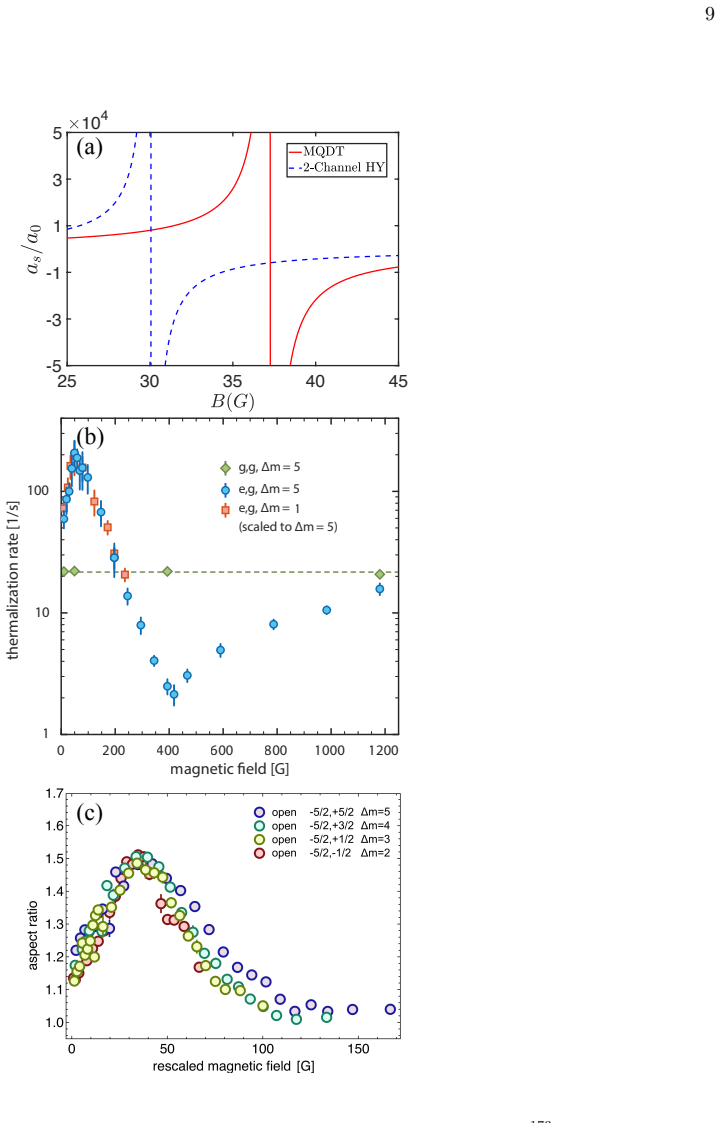
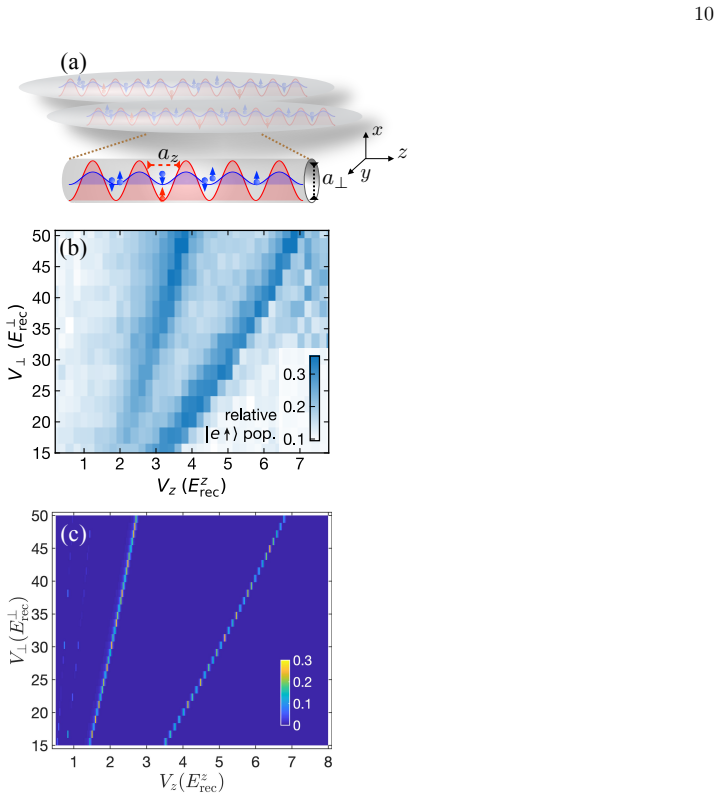
The central claim is that both parts of the two-body interaction between a ground-state (1S0) and a metastable (3P0) alkaline-earth atom can be resonantly controlled. In the channel basis |α⟩ and |β⟩, the interaction decomposes into a diagonal, nuclear-spin-independent term and an off-diagonal, spin-exchanging term. The spin-independent term is tuned by the orbital Feshbach resonance, where the orbital degree of freedom plays the role that electronic spin plays in conventional Feshbach resonances, and the magnetic field tunes the channel separation δ = Δm μB δg B through the small difference in g-factors between orbitals. The spin-exchanging term is amplified by a confinement-induced resonance in a mixed-dimensional optical lattice, where transverse confinement selectively enhances one of the two orbital interaction potentials V±(r). The paper argues that these two controls, combined with the two-orbital and SU(N) structure of alkaline-earth atoms, open the way to strongly interacting Fermi gases whose 'closed' channel is occupied by scattering states, two-band superfluids with a Leggett mode, topological superfluids, and tunable strong-coupling Kondo physics.
Load-bearing premise
The proposal for tuning the spin-independent interaction stands on the empirical fact that 173Yb has a shallow bound state whose energy is about 4 kHz below the interorbital threshold; if that bound state were instead many kilohertz away, the orbital Feshbach resonance would not be reachable with laboratory magnetic fields, and the central demonstration would fail.
Editorial extensions
If this is right
- Near the OFR, a degenerate Fermi gas of 173Yb becomes a strongly interacting two-channel system whose closed channel is populated by scattering states, leading to two-band BEC-BCS crossover physics and a predicted Leggett mode (the collective oscillation of the relative phase of the two order parameters).
- 173Yb becomes a leading candidate for realizing a topological superfluid, because orbital spin-orbit coupling can be produced by a clock transition without the heating that plagues Raman schemes, and the OFR supplies the resonant pairing interaction.
- The B/Δm scaling of the OFR position across different nuclear-spin pairs is a direct test of the SU(N) symmetry of the interaction, since the resonance curves collapse onto one another only if the potentials V± are independent of the nuclear-spin combination.
- The CIR in mixed dimensions provides a knob for the Kondo coupling, allowing the Kondo temperature to be enhanced to a strong-coupling regime and enabling SU(N) Kondo and non-equilibrium quench studies.
- Varying the magnetic field and the lattice depths in one apparatus can sweep from a spin-exchange-dominated regime to a spin-independent-dominated regime, joining polaron physics and Kondo physics in a single system.
Reading between the lines
- The same orbital-Feshbach mechanism could be searched for in other fermionic alkaline-earth-like isotopes (for example 87Sr) if a similarly shallow interorbital bound state is found; a systematic bound-state survey would test how generic the 4 kHz accident in 173Yb is.
- The two independent dials suggest an experimental protocol for mapping the crossover from BCS-like pairing to Kondo screening as a function of the ratio of spin-exchange to spin-independent coupling, something no current platform offers.
- The mixed-dimensional CIR could be extended to heteronuclear alkaline-earth mixtures or to higher metastable orbitals, potentially turning spin-exchange resonances into a tool for controlling chemical reaction outcomes.
Signed reviews
Editorial analysis
A structured set of objections, weighed in public.
Referee Report
Summary. This perspective reviews recent theoretical and experimental progress on interaction control in ultracold alkaline-earth (and ytterbium) atoms. The authors first lay out the two-orbital and SU(N) structure of such atoms and derive a two-channel Hamiltonian for two atoms in the ground and clock states, separating the interaction into a spin-independent (diagonal) term and a spin-exchanging (off-diagonal) term. They then discuss two control tools: the orbital Feshbach resonance (OFR), which tunes the spin-independent interaction and has been observed in 173Yb near 40 G by two independent experiments, and the confinement-induced resonance (CIR) in mixed dimensions, which enhances the spin-exchanging interaction and has been observed by the Munich group. The final sections list prospective applications, including strongly interacting Fermi gases with two order parameters, topological superfluids, polaron-to-Kondo crossover physics, and SU(N) Kondo physics.
Significance. If the review's assessments are correct, it provides a useful and timely synthesis of an important development: alkaline-earth atoms are no longer limited to weakly interacting quantum simulation platforms because both interaction types can now be tuned to resonance. The central experimental facts are independently confirmed: the OFR in 173Yb is supported by the Munich and Florence experiments, and CIR-enhanced spin exchange is supported by the Munich experiment. The manuscript is not a new primary result, but it serves a valuable role by organizing the theoretical framework, collecting the relevant references, and identifying the most promising directions for quantum simulation. The derived two-channel decomposition is standard and internally consistent once a sign typo in Eq. (6) is corrected.
minor comments (5)
- [Section II, Eq. (6)] Equation (6) is printed as |±> = (|α> ± |β>)/√2, but this is inconsistent with the definitions in Eqs. (1)–(4). From those definitions one obtains |+> = (|α> − |β>)/√2 and |−> = (|α> + |β>)/√2, and with this corrected relation Eq. (7) follows exactly. The sign error should be fixed because it will mislead readers who attempt to re-derive the interaction decomposition.
- [Section IV and Fig. 3(c)] The statement that the theoretical results 'are compared with the experimental results quite well' relies on Ref. [56], an arXiv preprint by the same group that was not peer-reviewed at the time of submission. Because the qualitative existence of CIR-enhanced spin exchange is already established by the published experiment [45], this does not undermine the paper's central claim, but the authors should either cite the published version of the calculation or explicitly identify it as an unreviewed preprint and temper the quantitative wording accordingly.
- [Fig. 2 caption] In the caption of Fig. 2, the third panel is labeled '(b)', but it should be '(c)' to match the main text and the reprinted source; the second and third panels currently share the same label.
- [Abstract and Introduction] The phrase 'these progress' appears in the abstract and introduction and should read 'this progress'.
- [Section V and references] There are several minor typos: 'A natural equation is' in Section V should be 'A natural question is'; 'In practices' in Section IV should be 'In practice'; Reference [29] misspells 'Science' as 'Sciemce'; and the author list in Reference [45] appears malformed, with an apparent duplication of the author sequence.
Circularity Check
No circularity: OFR and CIR claims are anchored by independent experiments; the only self-cited preprint supports a secondary quantitative comparison.
full rationale
This paper is a perspective rather than a new derivation, and its central claims are anchored by external experiments rather than by the authors' own definitions. The OFR discussion derives the resonance mechanism from the two-channel Hamiltonian (Eqs. 3-7) and then uses an empirical bound-state energy (~4 kHz) as an input; the resonance position around 40 G is not fitted in this paper but is cited from peer-reviewed calculations [39,47] and independently confirmed by the Munich [40] and Florence [41] groups, including the B/Delta-m scaling and the zero crossing of the scattering length. The CIR spin-exchange enhancement follows from the standard Olshanii CIR condition and the different scattering lengths of the |+> and |-> channels, and the qualitative prediction was directly observed in Ref. [45]. The one place where the paper leans on an unreviewed same-group preprint, Fig. 3(c) from Ref. [56], supports a secondary quantitative comparison and does not constitute a fitted input renamed as a prediction; the experiment [45] independently establishes the qualitative effect. A sign inconsistency in Eq. (6) is a typographical/correctness issue, not a circularity. No load-bearing step reduces to its own input by construction, so the circularity score is 0.
Assumptions & free parameters
free parameters (3)
- 173Yb interorbital bound state energy =
~4 kHz
- Landé g-factor difference δg between 1S0 and 3P0 =
small (not quantified)
- s-wave scattering lengths a± in the |+> and |-> channels =
not given in this paper
assumptions (4)
- standard math Quantum scattering theory and the Feshbach resonance framework apply to two-atom collisions in quasi-1D and 3D.
- domain assumption The two-orbital interaction is diagonal in the nuclear-spin-rotationally invariant basis |±> and s-wave dominates.
- domain assumption At the magic wavelength, both orbitals experience the same transverse confinement, and at zero field the |+> and |-> channels decouple.
- domain assumption Atoms in the 3P0 state in a deep lattice can be approximated as localized harmonic oscillators with length az.
Cite this review
Pith. "Pith review of Interaction Control of Ultracold Alkaline-Earth Atoms." pith.science (2026). https://pith.science/paper/2BLK4D3S
@misc{pith2026190804973,
  author       = {Pith},
  title        = {Pith review of: Interaction Control of Ultracold Alkaline-Earth Atoms},
  year         = {2026},
  howpublished = {\url{https://pith.science/paper/2BLK4D3S}},
  note         = {Machine review of arXiv:1908.04973}
}
abstract
Ultracold alkaline-earth atoms have now been widely explored for precision measurements and quantum simulation. Because of its unique atomic structure, alkaline earth atoms possess great advantages for quantum simulation and studying quantum many-body matters, such as simulating synthetic gauge field, Kondo physics and $SU(N)$ physics. To fully explore the potential of ultracold alkaline-earth atoms, these systems also need to be equipped with the capability of tuning the inter-atomic interaction to the strongly interacting regime. Recently several theoretical proposals and experimental demonstrations have shown that both spin-independent and spin-exchanging interaction can be tuned to resonance. In this perspective, we will review these progress and discuss the new opportunities brought by these interaction control tools for future quantum simulation studies with ultracold alkaline-earth atoms.
Figures

Reference graph
Works this paper leans on
-
[56]
Regal, C. A., Ticknor, C., Bohn, J. L. & Jin, D. S. Cre- ation of ultracold molecules from a Fermi gas of atoms. Nature, 424 47 (2003)
work page 2003
-
[45]
C., Pieri, P., Roepke, G., Schuck, P
Strinati, G. C., Pieri, P., Roepke, G., Schuck, P. & Urban, M. The BCS?BEC crossover: From ultra-cold Fermi gases to nuclear systems. Phys. Rep. 738, 1 (2018)
work page 2018
-
[1]
The strongly interacting many-body systems nearby the OFR display novel features. For a typ- ical magnetic FR in the alkaline-metal atom, the energy separation between open and closed channels is of the order of 10 8− 109 Hz, which is a few orders of magni- tude larger than the typical Fermi energy of a degenerate fermionic atomic gas. Therefore, such a s...
-
[2]
Topological superfluid can be realized by introducing spin-orbit coupling into Fermi superfluid [75]
An important application of OFR is to real- ize topological superfluid. Topological superfluid can be realized by introducing spin-orbit coupling into Fermi superfluid [75]. Since currently, the lowest temperature that can be reached in degenerate fermionic atom gas is about 0.1 times of the Fermi temperature, one has to rely on the FR to reach Fermi superflu...
-
[3]
Impurity physics is an im- portant subject in quantum many-body physics
AE atomic gas, in particular, cold 173Yb atom gas, provides a unique platform for study- ing impurity physics. Impurity physics is an im- portant subject in quantum many-body physics. For spin-independent interaction, a moving impurity can be dressed up the background particle and forms a quasi- particle called “polaron” [82, 83]. In the Fermi liquid phas...
-
[4]
There is an increasing interests of simulating Kondo physics with ultracold atoms [89–103]
Realizing Kondo effect with cold atomic gas can enrich our understanding of Kondo physics it- self. There is an increasing interests of simulating Kondo physics with ultracold atoms [89–103]. First of all, for the Kondo effect observed in condensed matter materi- als, the spin-exchanging coupling is usually much weaker than the Fermi energy and therefore th...
-
[5]
There have to be at least two interaction channels defined by different eigenstates when two atoms are far separated from each other
-
[6]
The energy difference between these two channels can be tuned by an external control parameter
Show all 113 references
-
[7]
Usually, when two atoms are far separated, they both stay at their single-particle eigenstate
At a short distance, these two channels are coupled. Usually, when two atoms are far separated, they both stay at their single-particle eigenstate. The channel with lower threshold energy is called the open channel, and the one with higher threshold energy is called the closed...
-
[8]
A rigorous calculation taking into account contributions from all high transverse modes gives precise results that CIR occurs at as =a⊥/C, withC = 1.4603···
-
[9]
& Zwerger, W
Bloch, I., Dalibard, J. & Zwerger, W. Many-body physics with ultracold gases. Rev. Mod. Phys. 80, 885 (2008)
2008
-
[10]
& Nascimb` ene, S
Bloch, I., Dalibard, J. & Nascimb` ene, S. Quantum sim- ulations with ultracold quantum gases. Nat. Phys. 8, 267 (2012)
2012
-
[11]
Quantum simulations with ultra- cold atoms in optical lattices Science 357, 995 (2017)
Gross, C.& Bloch, I. Quantum simulations with ultra- cold atoms in optical lattices Science 357, 995 (2017)
2017
-
[12]
Goldman, N., Budich, J. C. & Zoller, P. Topological quantum matter with ultracold gases in optical lattices. Nat. Phys. 12, 639 (2016)
2016
-
[13]
Although Ytterbium (Yb) atom is not AE atom in the periodic table, it has the same out-shell electronic struc- ture as the AE atoms, therefore our discussion will in- clude Yb atoms
-
[14]
Spin-Singlet Bose-Einstein Conden- sation of Two-Electron Atoms
Takasu, Y., et al. Spin-Singlet Bose-Einstein Conden- sation of Two-Electron Atoms. Phys. Rev. Lett. 91, 040404 (2003)
2003
-
[15]
& Takahashi, Y
Fukuhara, T., Takasu, Y., Kumakura, M. & Takahashi, Y. Degenerate Fermi Gases of Ytterbium. Phys. Rev. Lett. 98, 030401(2007)
2007
-
[16]
& Sterr, U
Kraft, S., Vogt, F., Appel, O., Riehle, F. & Sterr, U. Bose-Einstein Condensation of Alkaline Earth Atoms: 40Ca. Phys. Rev. Lett. 103, 130401(2009)
2009
-
[17]
K., Huang, B., Grimm, R
Stellmer, S., Tey, M. K., Huang, B., Grimm, R. & Schreck, F. Bose-Einstein Condensation of Strontium. Phys. Rev. Lett. 103, 200401 (2009)
2009
-
[18]
N., et al
Martinez de Escobar,Y. N., et al. Bose-Einstein Conden- sation of Sr 84. Phys. Rev. Lett. 103, 200402 (2009)
2009
-
[19]
J., Yan, M., Mickelson, P
DeSalvo, B. J., Yan, M., Mickelson, P. G., Martinez de Escobar, Y. N. & Killian, T. C. Degenerate Fermi Gas of Sr 87. Phys. Rev. Lett. 105, 030402 (2010)
2010
-
[20]
Lifetimes of Lev- els of Neutral and Singly Ionized Lanthanide Atoms
Blagoev, K.B.& Komarovskii, V.A. Lifetimes of Lev- els of Neutral and Singly Ionized Lanthanide Atoms. Atomic Data and Nuclear Data Tables, 56, 1 (1994)
1994
-
[21]
J., et al
Bloom, B. J., et al. An optical lattice clock with accu- racy and stability at the 10 −18 level. Nature 506, 71 (2014)
2014
-
[22]
D., Boyd, M
Ludlow, A. D., Boyd, M. M., Ye, J., Peik, E. & Schmidt, P. O. Optical atomic clocks. Rev. Mod. Phys. 87, 637 (2015)
2015
-
[23]
& Ka- tori, H
Ushijima, I., Takamoto, M., Das, M., Ohkubo, T. & Ka- tori, H. Cryogenic optical lattice clocks. Nat. Photonics 9, 185 (2015). 8 δg δe |g↑⟩ |g↓⟩ |e↑⟩ |e↓⟩(a) R V(R) closed channel open channel |+⟩ |−⟩ Eb (b) FIG. 1: (a): Single atom energy level diagram of alkaline-earth(AE) a...
2015
-
[24]
L., et al
Nicholson, T. L., et al. Systematic evaluation of an atomic clock at 2 10 −18 total uncertainty. Nat. Com- mun. 6, 6896 (2015)
2015
-
[25]
Ultra-stable optical clock with two cold-atom ensembles
Schioppo, M., et al. Ultra-stable optical clock with two cold-atom ensembles. Nat. Photonics 11, 48 (2017)
2017
-
[26]
L., et al
Campbell, S. L., et al. A Fermi-degenerate three- dimensional optical lattice clock. Science 358, 90 (2017)
2017
-
[27]
E., et al
Marti, G. E., et al. Imaging Optical Frequencies with 100muHz Precision and 1.1 µm Resolution. Phys. Rev. Lett. 120, 103201 (2018)
2018
-
[28]
F., et al
Livi, L. F., et al. Synthetic Dimensions and Spin-Orbit Coupling with an Optical Clock Transition. Phys. Rev. Lett. 117, 220401(2016)
2016
-
[29]
Spin-orbit-coupled fermions in an optical lattice clock
Kolkowitz, S., et al. Spin-orbit-coupled fermions in an optical lattice clock. Nature, 542, 66 (2017)
2017
-
[30]
spin” and “orbit
To classify the terminology of spin-orbit coupling, here the internal orbital degree of freedom is used to simulate “spin” and “orbit” means the spatial motion of atoms
-
[31]
& Speilman, I
Goldman, N., Juzeliunas, G., ¨Ohberg, P. & Speilman, I. B. Light-induced gauge fields for ultracold atoms. Rep. Prog. Phys. 77, 126401 (2014)
2014
-
[32]
Degenerate quantum gases with spin-orbit cou- pling: a review
Zhai, H. Degenerate quantum gases with spin-orbit cou- pling: a review. Rep. Prog. Phys. 78 026001 (2015)
2015
-
[33]
Spectroscopic observation of SU(N)- symmetric interactions in Sr orbital magnetism
Zhang, X., et al. Spectroscopic observation of SU(N)- symmetric interactions in Sr orbital magnetism. Science 345, 1467 (2014)
2014
-
[34]
A one-dimensional liquid of fermions with tunable spin
Pagano, G., et al. A one-dimensional liquid of fermions with tunable spin. Nat. Phys. 10, 198 (2014)
2014
-
[35]
Direct Probing of the Mott Crossover in the SU (N) Fermi-Hubbard Model
Hofrichter, C., et al. Direct Probing of the Mott Crossover in the SU (N) Fermi-Hubbard Model. Phys. Rev. X 6, 021030 (2016)
2016
-
[36]
Resolved Atomic Interaction Side- bands in an Optical Clock Transition
Bishof, M., et al. Resolved Atomic Interaction Side- bands in an Optical Clock Transition. Phys. Rev. Lett. 106, 250801(2011)
2011
-
[37]
J., et al
Martin, M. J., et al. A Quantum Many-Body Spin System in an Optical Lattice Clock. Sciemce, 341, 632(2013)
2013
-
[38]
Measuring absolute frequencies beyond the GPS limit via long-haul optical frequency dissemi- nation
Clivati, C., et al. Measuring absolute frequencies beyond the GPS limit via long-haul optical frequency dissemi- nation. Optics Express 24 11865 (2016)
2016
-
[39]
State-dependent interactions in ultra- cold 174Yb probed by optical clock spectroscopy
Franchi, L., et al. State-dependent interactions in ultra- cold 174Yb probed by optical clock spectroscopy. New Journal of Physics 19, 103037 (2017)
2017
-
[40]
Emergence of multi-body interactions in a fermionic lattice clock
Goban, A., et al. Emergence of multi-body interactions in a fermionic lattice clock. Nature 563, 369 (2018)
2018
-
[41]
L., et al
Bromley, S. L., et al. Dynamics of interacting fermions under spin-orbit coupling in an optical lattice clock. Nat. Phys. 14, 399 (2018)
2018
-
[42]
& Julienne, P
K¨ ohler, T., G´ oral, K. & Julienne, P. S. Production of cold molecules via magnetically tunable Feshbach reso- nances. Rev. Mod. Phys. 78, 1311 (2006)
2006
-
[43]
Chin, C., Grimm, R., Julienne, P. S. & Tiesinga, E., Feshbach resonances in ultracold gases. Rev. Mod. Phys. 82, 1225 (2010)
2010
-
[44]
Giorgini, S., Pitaevskii, L. P. & Stringari, S. Theory of ultracold atomic Fermi gases. Rev. Mod. Phys. 80, 1215 (2008)
2008
-
[46]
Atomic Scattering in the Presence of an External Confinement and a Gas of Impenetrable Bosons
Olshanii, M. Atomic Scattering in the Presence of an External Confinement and a Gas of Impenetrable Bosons. Phys. Rev. Lett. 81, 938 (1998)
1998
-
[47]
& Zhang, P
Zhang, R., Cheng, Y., Zhai, H. & Zhang, P. Orbital Feshbach Resonance in Alkali-Earth Atoms. Phys. Rev. Lett. 115, 135301(2015)
2015
-
[48]
Observation of an Orbital Interaction- Induced Feshbach Resonance in 173Yb
H¨ ofer, M.,et al. Observation of an Orbital Interaction- Induced Feshbach Resonance in 173Yb. Phys. Rev. Lett. 115, 265302 (2015)
2015
-
[49]
Strongly Interacting Gas of Two- Electron Fermions at an Orbital Feshbach Resonance
Pagano, G., et al. Strongly Interacting Gas of Two- Electron Fermions at an Orbital Feshbach Resonance. Phys. Rev. Lett. 115, 265301 (2015)
2015
-
[50]
D., et al
Oppong, N. D., et al. Observation of Coherent Multior- bital Polarons in a Two-Dimensional Fermi Gas. Phys. Rev. Lett. 122, 193604 (2019)
2019
-
[51]
Kondo effect in alkaline-earth-metal atomic gases with confinement-induced resonances
Zhang, R., et al. Kondo effect in alkaline-earth-metal atomic gases with confinement-induced resonances. Phys. Rev. A 93, 043601 (2016)
2016
-
[52]
/yC5CBsokcZ4fNzuCQvA9VY7qvI=
Cheng, Y., Zhang, R., Zhang, P. & Zhai, H. Enhanc- ing Kondo coupling in alkaline-earth-metal atomic gases 9 25 30 35 40 45-5 -3 -1 1 3 5104 0 200 400 600 800 1000 1200 magnetic field [G] 1 10 100 thermalization rate [1/s] e,g, ∆m = (scaled to ∆m = 5) 1 g,g, ∆m = 5 e,g, ∆m = 5...
2017
-
[53]
Riegger, L. et al. Localized Magnetic Moments with Tunable Spin Exchange in a Gas of Ultracold Fermions. Oppong, D.,N., H¨ ofer, M., Fernandes, D. R., Bloch, I., and F¨ olling, S., Phys. Rev. Lett.120,143601 (2018)
2018
-
[54]
M., et al
Boyd, M. M., et al. Nuclear spin effects in optical lattice clocks. Phys. Rev. A 76, 022510 (2007)
2007
-
[55]
& Zhang, P
Cheng, Y., Zhang, R. & Zhang, P. Quantum defect the- ory for the orbital Feshbach resonance. Phys. Rev. A 95, 013624 (2017)
2017
-
[57]
M., Hemmer, S
O’Hara, K. M., Hemmer, S. L., Gehm, M. E., Granade, S. R. & Thomas, J. E. Observation of a Strongly In- teracting Degenerate Fermi Gas of Atoms. Science 298, 2179 (2002)
2002
-
[58]
Observation of two-orbital spin- exchange interactions with ultracold SU(N)-symmetric fermions
Scazza, F., et al. Observation of two-orbital spin- exchange interactions with ultracold SU(N)-symmetric fermions. Nat. Phys. 10, 779 (2014) and Nat. Phys. 11, 514 (2015)
2014
-
[59]
Direct Observation of Coherent Interorbital Spin-Exchange Dynamics
Cappellini, G., et al. Direct Observation of Coherent Interorbital Spin-Exchange Dynamics. Phys. Rev. Lett. 113, 120402 (2014) and Phys. Rev. Lett. 114, 239903 (2015)
2014
-
[60]
W., et al
Barber, Z. W., et al. Optical Lattice Induced Light Shifts in an Yb Atomic Clock. Phys. Rev. Lett. 100, 11 103002 (2008)
2008
-
[61]
Dzuba, V. A. & Derevianko, A. Dynamic polarizabili- ties and related properties of clock states of the ytter- bium atom. J. Phys. B: At., Mol. Opt. Phys. 43, 074011 (2010)
2010
-
[62]
C., The Kondo Problem to Heavy Fermions (Cambridge University Press, Cambridge, 1993)
Hewson, A. C., The Kondo Problem to Heavy Fermions (Cambridge University Press, Cambridge, 1993)
1993
-
[63]
& Zhang, P
Zhang, R. & Zhang, P. Control of spin-exchange interac- tion between alkali-earth-metal atoms via confinement- induced resonances in a quasi-(1+0)-dimensional sys- tem. Phys. Rev. A 98, 043627 (2018)
2018
-
[64]
& Zhang, P
Zhang, R. & Zhang, P. Tight-Binding Kondo Model and Spin-Exchange Collision Rate of Alkaline-Earth Atoms in a Mixed-Dimensional Optical Lattice. arXiv: 1908.04482
1908 arXiv
-
[65]
& Zhang, W
Ji, Q., Zhang, R., Zhang, X. & Zhang, W. Confinement- induced resonance of alkaline-earth-metal-like atoms in anisotropic quasi-one-dimensional traps. Phys. Rev. A 98 053613 (2018)
2018
-
[66]
Reaching a Fermi-superfluid state near an orbital Feshbach resonance
Xu, J., et al. Reaching a Fermi-superfluid state near an orbital Feshbach resonance. Phys. Rev. A 94 033609 (2016)
2016
-
[67]
Two-band superfluidity and intrinsic Joseph- son effect in alkaline-earth-metal Fermi gases across an orbital Feshbach resonance
Iskin, M. Two-band superfluidity and intrinsic Joseph- son effect in alkaline-earth-metal Fermi gases across an orbital Feshbach resonance. Phys. Rev. A 94 011604 (2016)
2016
-
[68]
Trapped 173Yb Fermi gas across an orbital Feshbach resonance
Iskin, M. Trapped 173Yb Fermi gas across an orbital Feshbach resonance. Phys. Rev. A 95 013618 (2017)
2017
-
[69]
& Ohashi, Y
Mondal, S., Inotani, D. & Ohashi, Y. Photoemission Spectrum in the BCS?BEC Crossover Regime of a Rare- Earth Fermi Gas with an Orbital Feshbach Resonance. J. Phys. Soc. Jpn. 87 094301 (2018)
2018
-
[70]
& Ohashi, Y
Mondal, S., Inotani, D. & Ohashi, Y. Single-particle Excitations and Strong Coupling Effects in the BCS- BEC Crossover Regime of a Rare-Earth Fermi Gas with an Orbital Feshbach Resonance. J. Phys. Soc. Jpn. 87 084302 (2018)
2018
-
[71]
& Ohashi, Y
Mondal, S., Inotani, D. & Ohashi, Y. Closed-channel contribution in the BCS-BEC crossover regime of an ultracold Fermi gas with an orbital Feshbach resonance. J. Phys.: Conf. Ser. 969 012017 (2018)
2018
-
[72]
N., Tempere, J
Klimin, S. N., Tempere, J. & Miloˇ sevi´ c, M. V. Diversi- fied vortex phase diagram for a rotating trapped two- band Fermi gas in the BCS-BEC crossover. New J. Phys. 20 025010 (2018)
2018
-
[73]
K., Shi, Z.-Y., Parish, M
Laird, E. K., Shi, Z.-Y., Parish, M. M. & Levinsen, J. Frustrated orbital Feshbach resonances in a Fermi gas. arXiv:1908.04495
1908 arXiv
-
[74]
He, L., Wang, J., Peng, S.-G., Liu, X.-J. & Hu, H. Strongly correlated Fermi superfluid near an orbital Feshbach resonance: Stability, equation of state, and Leggett mode. Phys. Rev. A 94 043624 (2016)
2016
-
[75]
& Zhang, S
Zhang, Y.-C., Ding, S. & Zhang, S. Collective modes in a two-band superfluid of ultracold alkaline-earth-metal atoms close to an orbital Feshbach resonance. Phys. Rev. A 95 041603 (2017)
2017
-
[76]
& Ge, G.-Q
Zhang, H., Badshah, F., Basit, A. & Ge, G.-Q. Fermi gas of orbital Feshbach resonance in synthetic 1D+1 dimensional optical lattice. Laser Phys. Lett. 15 115501 (2018)
2018
-
[77]
Deng, T.-S., Zhang, W. & Yi, W. Tuning Feshbach reso- nances in cold atomic gases with interchannel coupling. Phys. Rev. A 96 050701(R) (2017)
2017
-
[78]
Wang, S., Pan, J.-S., Cui, X., Zhang, W. & Yi, W. Topological Fulde-Ferrell states in alkaline-earth-metal- like atoms near an orbital Feshbach resonance. Phys. Rev. A 95 043634 (2017)
2017
-
[79]
& Jia, S
Zhou, X., Pan, J.-S., Yi, W., Chen, G. & Jia, S. Interaction-induced exotic vortex states in an optical lattice clock with spin-orbit coupling. Phys. Rev. A 96 023627 (2017)
2017
-
[80]
& Jia, S
Zhou, X., Pan, J.-S., Liu, Z.-X., Zhang, W., Yi, W., Chen, G. & Jia, S. Symmetry-Protected Topological States for Interacting Fermions in Alkaline-Earth-Like Atoms. Phys. Rev. Lett. 119 185701 (2017)
2017
-
[81]
Zou, P., He, L., Liu, X.-J. & Hu, H. Strongly interact- ing Sarma superfluid near orbital Feshbach resonances. Phys. Rev. A 97 043616 (2018)
2018
-
[82]
Coherent Manipulation of Orbital Feshbach Molecules of Two-Electron Atoms
Cappellini, G., et al. Coherent Manipulation of Orbital Feshbach Molecules of Two-Electron Atoms. Phys. Rev. X 9 011028 (2019)
2019
-
[83]
Qi, X. L. & Zhang, S. C. Topological insulators and superconductors. Rev. Mod. Phys. 83, 1057 (2011)
2011
-
[84]
Cui, X., Lian, B., Ho, T.-L., Lev, B. L. & Zhai, H. Synthetic gauge field with highly magnetic lanthanide atoms. Phys. Rev. A 88, 011601(R) (2013)
2013
-
[85]
Q., Tang, Y
Burdick, N. Q., Tang, Y. & Lev, B. L. Long-Lived Spin- Orbit-Coupled Degenerate Dipolar Fermi Gas. Phys. Rev. X 6 031022 (2016)
2016
-
[86]
Science, 349, 1510 (2015)
Mancini, M., et al, Observation of chiral edge states with neutral fermions in synthetic Hall ribbons. Science, 349, 1510 (2015)
2015
-
[87]
Song, S., et al, Spin-orbit-coupled two-electron Fermi gases of ytterbium atoms. Phys. Rev. A 94, 061604(R) (2016)
2016
-
[88]
Science Ad- vances 4 4748 (2018)
Song, S., et al, Observation of symmetry-protected topological band with ultracold fermions. Science Ad- vances 4 4748 (2018)
2018
-
[89]
Song, S., et al, Observation of nodal-line semimetal with ultracold fermions in an optical lattice. Nat. Phys. (2019). doi:10.1038/s41567-019-0564-y
2019 doi
-
[90]
Universal phase diagram of a strongly in- teracting Fermi gas with unbalanced spin populations
Chevy, F. Universal phase diagram of a strongly in- teracting Fermi gas with unbalanced spin populations. Phys. Rev. A 74, 063628(2006)
2006
-
[91]
& Zhai, H
Cui, X. & Zhai, H. Stability of a fully magnetized ferro- magnetic state in repulsively interacting ultracold Fermi gases. Phys. Rev. A 81, 041602(R) (2010)
2010
-
[92]
& Bruun, G
Massignan, P., Zaccanti, M. & Bruun, G. M. Polarons, Dressed Molecules, and Itinerant Ferromagnetism in ul- tracold Fermi gases. Rep. Prog. Phys. 77 034401(2014)
2014
-
[93]
& Zhang, W
Chen, J.-G., Deng, T.-S., Yi, W. & Zhang, W. Polarons and molecules in a Fermi gas with orbital Feshbach res- onance. Phys. Rev. A 94 053627 (2016)
2016
-
[94]
Xu, J. & Qi, R. Polaronic and dressed molecular states in orbital Feshbach resonances. Eur. Phys. J. D 72 65 (2018)
2018
-
[95]
& Zhang, W
Chen, J.-G., Shi, Y.-R., Zhang, X. & Zhang, W. Po- larons in alkaline-earth-like atoms with multiple back- ground Fermi surfaces. Front. Phys. 13 136702 (2018)
2018
-
[96]
Repulsive polarons in alkaline-earth- metal-like atoms across an orbital Feshbach resonance
Deng, T.-S., et al. Repulsive polarons in alkaline-earth- metal-like atoms across an orbital Feshbach resonance. Phys. Rev. A 97 013635 (2018)
2018
-
[97]
M., Duine, R
Falco, G. M., Duine, R. A. & Stoof, H. T. C. Molecular Kondo Resonance in Atomic Fermi Gases. Phys. Rev. Lett. 92, 140402 (2004)
2004
-
[98]
Euro- phys
Duan, L.-M., Controlling ultracold atoms in multi-band optical lattices for simulation of Kondo physics. Euro- phys. Lett. 67, 721 (2004). 12
2004
-
[99]
V., et al
Gorshkov, A. V., et al. Two-orbital SU (N) magnetism with ultracold alkaline-earth atoms. Nat. Phys. 6, 289 (2010)
2010
-
[100]
& Berkooz, M
Carmi, A., Oreg, Y. & Berkooz, M. Realization of the SU(N) Kondo Effect in a Strong Magnetic Field. Phys. Rev. Lett. 106, 106401 (2011)
2011
-
[101]
& Demler, E
Bauer, J., Salomon, C. & Demler, E. Realizing a Kondo- Correlated State with Ultracold Atoms. Phys. Rev. Lett. 111, 215304 (2013)
2013
-
[102]
SU(3) Orbital Kondo Effect with Ultracold Atoms
Nishida, Y. SU(3) Orbital Kondo Effect with Ultracold Atoms. Phys. Rev. Lett. 111, 135301 (2013)
2013
-
[103]
& Kawakami, N
Nakagawa, M. & Kawakami, N. Laser-Induced Kondo Effect in Ultracold Alkaline-Earth Fermions Phys. Rev. Lett. 115, 165303 (2015)
2015
-
[104]
Isaev, L., & Rey, A. M. Heavy-Fermion Valence-Bond Liquids in Ultracold Atoms: Cooperation of the Kondo Effect and Geometric Frustration. Phys. Rev. Lett.115, 165302 (2015)
2015
-
[105]
& Kikoin, K
Kuzmenko, I., Kuzmenko, T., Avishai, Y. & Kikoin, K. Model for overscreened Kondo effect in ultracold Fermi gas. Phys. Rev. B 91, 165131(2015)
2015
-
[106]
& Rey, A
Isaev, L., Schachenmayer, J. & Rey, A. M. Spin-Orbit- Coupled Correlated Metal Phase in Kondo Lattices: An Implementation with Alkaline-Earth Atoms. Phys. Rev. Lett. 117 135302 (2016)
2016
-
[107]
& Jo, G.-B
Kuzmenko, I., Kuzmenko, T., Avishai, Y. & Jo, G.-B. Coqblin-Schrieffer model for an ultracold gas of ytter- bium atoms with metastable state. Phys. Rev. B 93, 115143(2016)
2016
-
[108]
& Jo, G.-B
Kuzmenko, I., Kuzmenko, T., Avishai, Y. & Jo, G.-B. Multipolar Kondo effect in a 1S0−3P0 mixture of 173Yb atoms. Phys. Rev. B 97 075124 (2018)
2018
-
[109]
& Ueda, M
Nakagawa, M., Kawakami, N. & Ueda, M. Non- Hermitian Kondo Effect in Ultracold Alkaline-Earth Atoms. Phys. Rev. Lett. 121 203001 (2018)
2018
-
[110]
Exploring the anisotropic Kondo model in and out of equilibrium with alkaline- earth atoms
Kan´ asz-Nagy, M., et al. Exploring the anisotropic Kondo model in and out of equilibrium with alkaline- earth atoms. Phys. Rev. B 97 155156 (2018)
2018
-
[111]
C., Cirac, J
Ashida, Y., Shi, T., Banuls, M. C., Cirac, J. I. & Dem- ler, E. Solving Quantum Impurity Problems in and out of Equilibrium with the Variational Approach. Phys. Rev. Lett. 121, 026805 (2018)
2018
-
[112]
N., et al
Wenz, A. N., et al. From Few to Many: Observing the Formation of a Fermi Sea One Atom at a Time. Science, 342 457(2013)
2013
-
[113]
Bergeman, T., Moore, M. G. & Olshanii, M. Atom- Atom Scattering under Cylindrical Harmonic Confine- ment: Numerical and Analytic Studies of the Confine- ment Induced Resonance. Phys. Rev. Lett. 91, 163201 (2003)
2003
Reviewed August 14, 2026 · model on record in the stance chip above.
Discussion (0). Continue with ORCID to comment.