REVIEW 3 major objections 5 minor 42 references
Modularity and Projection of Bipartite Networks
T0 review · 3 major / 5 minor · reviewed 2026-08-14 · deepseek-v4-flash
Pith's one-line read A new modularity function for projected bipartite networks, using a null model that rewires the original two-mode graph before projecting, recovers planted communities at least as well as standard modularity and supports a simple…
desk verdict A mathematically sound new modularity for projected bipartite networks, paired with a useful but under-tested heuristic; worth refereeing. read the letter →
The pith
A machine-rendered reading of the paper's core claim, the machinery that carries it, and where it could break.
The reading
What carries the argument
The central object is the projected modularity $$Q_P=\frac{1}{2E}\sum_{ij}A_{ij}\,\delta(c(i),c(j))-\sum_{ij}\frac{q_i q_j}{$F^{2}$}\,\delta(c(i),c(j)),$$ where $A_{ij}=\sum_m B_{im}B_{jm}$ is the weighted projection, $q_i$ is the bipartite degree of the kept node, $d_m$ is the degree of the projected-away node, $F=\sum_i q_i=\sum_m d_m$, and $2E=\sum_m d_m^2$. The null model rewires the bipartite graph with degrees fixed and then projects, giving expected projected weight $q_i q_j/F^2$, so high-degree projected-away nodes contribute as clique sources rather than independent links. The paper also proves that forming the induced bipartite graph on a community partition and then projecting commutes with projecting first and then aggregating, which allows a greedy modularity-maximizing algorithm to evaluate local gains for $Q_P$ efficiently.
What would settle it
Take a two-mode network with known planted communities, set the projected-away degree distribution to be heavier-tailed than the kept one ($\mu_2 > \mu_1$), but arrange the high-degree nodes so that they connect across communities rather than within them. If a projected method recovers the planted partition while bipartite methods fail, the paper's rule that heavy-tail top nodes force bipartite detection would be wrong; looking for such a counterexample directly tests the mechanism.
Extended reading notes
Core claim
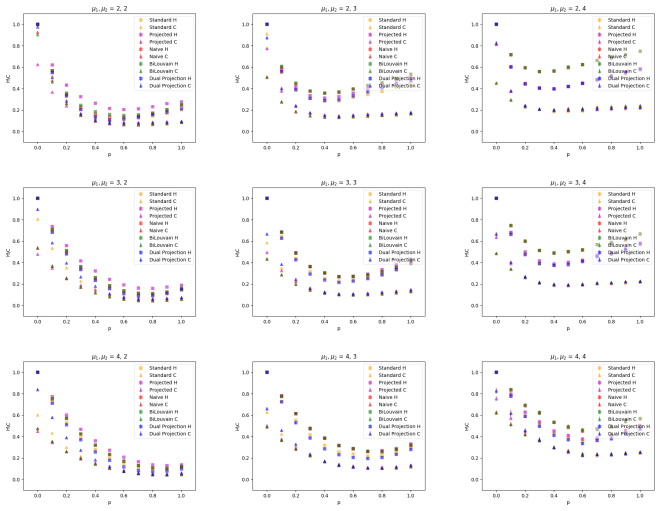
The central claim is that standard modularity on a projected two-mode network uses the wrong null model, and that the correct null model—rewire the bipartite network and only then project—yields a projected modularity $Q_P$ that better matches the communities present before projection. The difference shows up sharply around high-degree nodes: a top node with $n$ links induces about $n^2$ projected edges, so cliques appear that are artifacts of projection; the $Q_P$ null model assigns the correct expected weight to those cliques. The paper demonstrates on synthetic networks with planted communities that optimizing $Q_P$ recovers the target partition with accuracy comparable to the best bipartite methods, and that when the degree distributions are power laws the optimal strategy flips according to the exponents: if the projected-away side has a heavier tail ($\mu_2 > \mu_1$), projection hides structure and bipartite detection wins; if the kept side has the heavier tail ($\mu_2 \le \mu_1$), projection is safe and $Q_P$ performs best. These patterns are confirmed on four real two-mode networks without ground truth by comparing partitions across algorithms.
Load-bearing premise
The load-bearing premise is that real bipartite communities look like the synthetic benchmark: $C$ planted components with a fraction $p$ of edges rewired uniformly at random and independent power-law degree sequences whose exponents can be read off the data; if real networks contain degree correlations, nestedness, or heterogeneous community sizes, the $\mu_2$-versus-$\mu_1$ rule can break.
Editorial extensions
If this is right
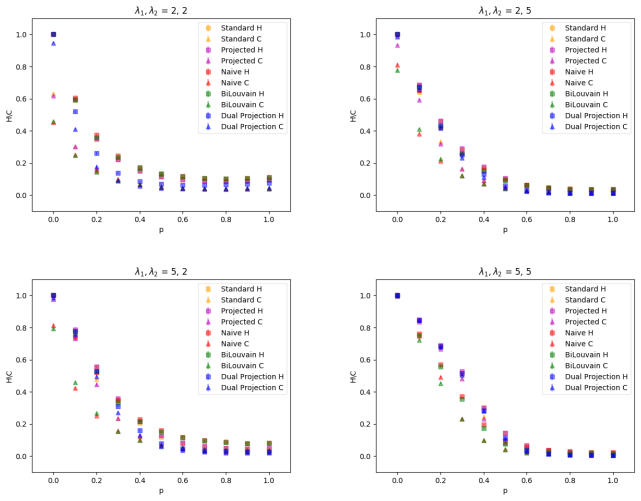
- Projection does not destroy community structure for Poisson-degree bipartite networks: communities found on the projection agree with the planted ones about as well as communities found on the full bipartite graph.
- When the projected-away node set has a heavier-tailed degree distribution, projection fabricates cliques that hide real communities, so the bipartite graph itself should be clustered.
- When the kept node set has the heavier tail, projected methods—$Q_P$ or even standard modularity—recover the planted communities well, so projection is a safe simplification.
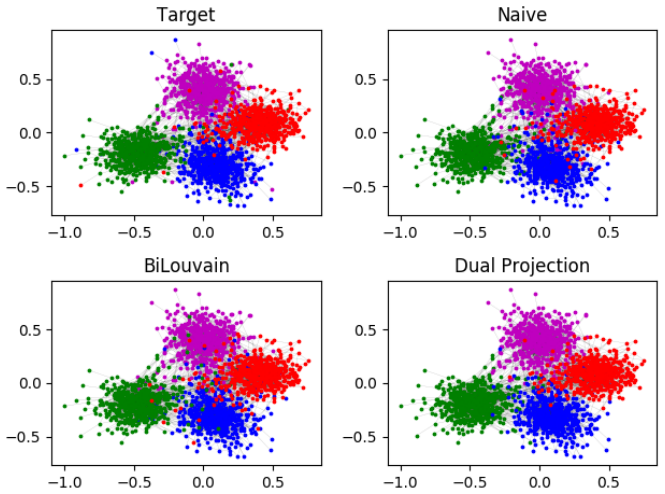
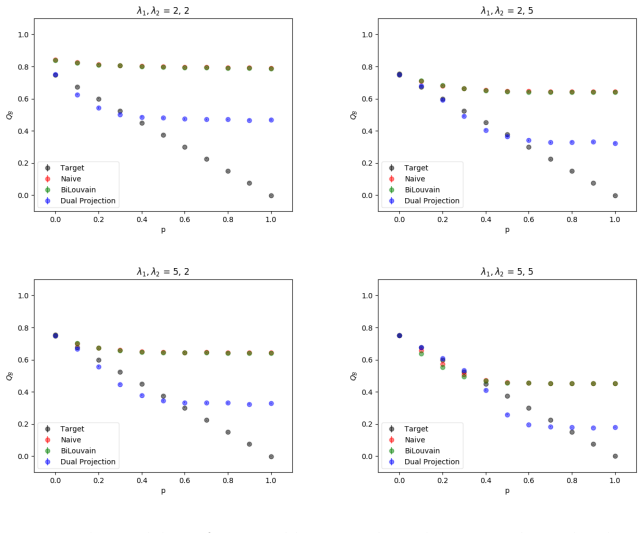
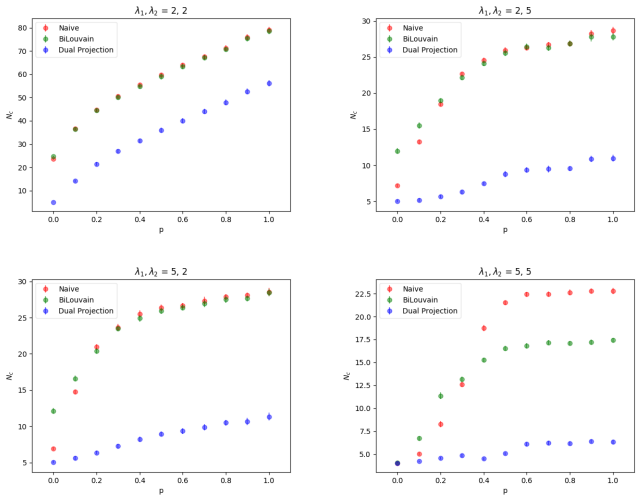
- A dual-projection approach that clusters both projections and merges them by bipartite modularity gives the closest overall match to the target structure, with higher completeness than other methods.
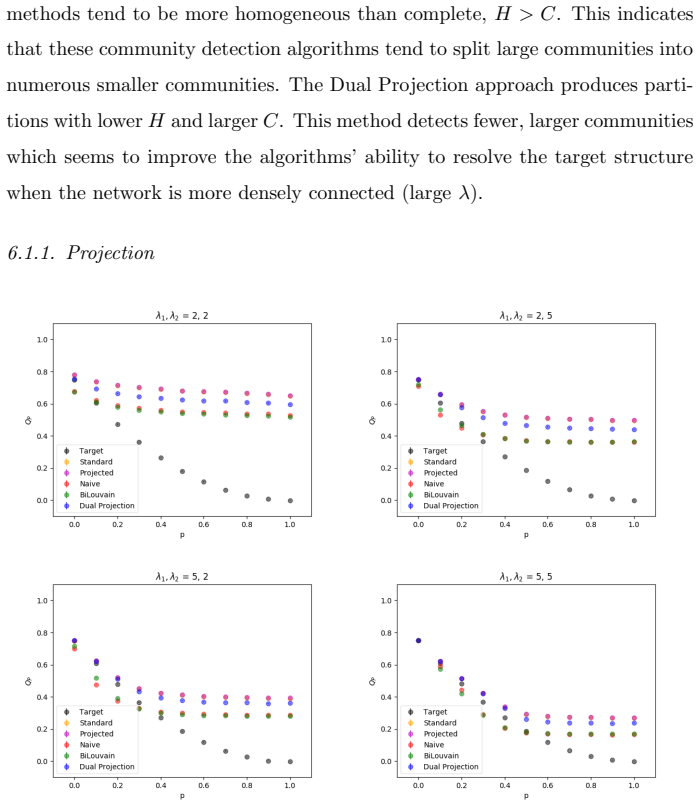
- Even when only the projected graph is available, optimizing standard modularity produces partitions nearly as good as optimizing $Q_P$, so practitioners are not locked into a specialized algorithm.
Reading between the lines
- One natural extension is to replace the visual inspection of degree exponents with a maximum-likelihood estimator, making the $\mu_2$-versus-$\mu_1$ rule a fully automated model-selection criterion for real networks.
- The $Q_P$ null model should extend to weighted projections with more sophisticated weighting than the simple co-occurrence count; testing it on recommendation-style weighted projections would show whether the clique correction remains the dominant effect.
- A sharp testable prediction follows from the paper's mechanism: in a two-mode network with $\mu_2 > \mu_1$, the projected graph's clique structure should inflate standard modularity of the planted partition even as recovery fails, so comparing $Q_P$ and standard $Q$ on the planted partition should reveal a characteristic gap.
- The commutativity result suggests $Q_P$ could be plugged into hierarchical or overlapping community detection without changing the null model, since induced subgraphs and projection can be interchanged at any resolution.
Signed reviews
Editorial analysis
A structured set of objections, weighed in public.
Referee Report
Summary. This paper studies community detection in bipartite networks via modularity maximisation, focusing on how one-mode projection interacts with community structure. The author defines a projected modularity QP (Eq. 7) whose null model rewires the original bipartite graph and then projects, derives the corresponding Louvain gain formula (Eq. 9), and proves that forming an induced graph and projecting commute (Eqs. 10-12). Five algorithms are compared on synthetic bipartite graphs with planted communities and either Poisson or power-law degree distributions, using homogeneity, completeness, and V-measure; the same algorithms are applied to four real networks. The main practical output is a heuristic: use the Dual Projection method, or, when that is unavailable and homogeneity is the priority, use bipartite methods when the top-node degree exponent µ2 exceeds the bottom-node exponent µ1 and projected methods when µ2 ≤ µ1.
Significance. The derivation of QP is self-contained, and the Louvain gain formula and commutation result are mathematically sound; the experimental protocol is careful, using 100 graph realisations, 10 Louvain runs per graph, bootstrap confidence intervals, and three complementary metrics. If the proposed heuristic is valid, it provides practitioners with a simple and actionable rule, and the comparative findings—in particular that detected partitions tend to be more homogeneous than complete—are informative. However, the practical recommendation rests on synthetic data generated by the same configuration-model family that underlies QP's null model, and the real-data analysis offers no ground truth or quantitative exponent estimates; moreover, the experiments show that Q- and QP-based methods often give very similar partitions. The significance is therefore conditional on additional validation outside the configuration-model family.
major comments (3)
- [§6.2 and §8] The heuristic 'µ2 > µ1 use the bipartite graph; µ2 ≤ µ1 project and use QP' is derived from the synthetic benchmark described in Section 3, whose generative process—fixed degree sequences with stubs joined at random within and across communities—is the same configuration-model null used to define QP in Eqs. (6) and (7). The experiments use only equal-size planted communities (250 nodes per community, as stated for the Poisson case) and, as far as the text indicates, power-law exponents in a narrow range; they do not include degree correlations, nestedness, or heterogeneous community sizes. The rule is therefore not demonstrated for networks that violate these configuration-model assumptions, and the practical conclusion in Section 8 is stronger than the evidence. I ask for either additional experiments with these structural variations or a substantially more conditional statement of the heuristic.
- [§7 and Fig. 11] The exponents µ1 and µ2 for the four real datasets are estimated by visual inspection ('roughly map to'), with no fitting procedure, confidence intervals, or sensitivity analysis. Because the heuristic switches regimes at µ2 = µ1, an incorrect ordering from a plausible alternative fit could reverse the recommendation. In addition, Table 1 reports only pairwise similarities between the detected partitions and QP values; there is no ground truth for these networks, so the real-data section does not actually validate the heuristic. A quantitative degree-exponent fit with uncertainty, and a discussion of how sensitive the recommendation is to the estimated ordering, are needed before the practical advice can be accepted.
- [§2.1 and Conclusions] The paper claims that QP is 'more appropriate' for projected bipartite networks than standard modularity, but the experiments in Fig. 6 and Table 1 show that optimising QP (Projected) and optimising standard Q (Standard) produce nearly identical partitions: they overlap completely in the Poisson case and have V-measures between 0.87 and 1.00 on the real datasets. The text should explicitly characterise the conditions, if any, under which QP and Q lead to materially different partitions. Otherwise the claim should be moderated to state that QP is a principled modularity for projections which, in the settings tested, yields partitions very similar to those found by standard modularity.
minor comments (5)
- [§5] The sentence 'H is reduced whenever two nodes from the same target community are assigned by the algorithms to different communities' is incorrect: splitting a target class across clusters reduces completeness C, not homogeneity H. H is reduced when a detected cluster mixes nodes from different target classes. The subsequent interpretation in the results (H > C indicates splitting) is consistent with the correct definitions, so this is a local correction.
- [§2.1, Eq. (6)] The text describes the null term as 'the probability of having a link between i and j' in the projected randomly rewired network, but the formula is the expected proportion of edge weight in the projected configuration model; the expected number of common neighbours is q_i q_j (∑_m d_m^2)/F^2. Please rephrase the derivation so that the normalisation by 2E is explained clearly.
- [§6.2] The values of µ1 and µ2 used in the power-law experiments are not stated in the text or the figure captions of Figs. 8-10; the later mention of µ = 2, 3, 4 should be made explicit together with the network sizes, the number of communities, and the number of realisations, so that the results are reproducible.
- [§4] The Dual Projection algorithm is recommended first in the conclusions, but its agglomerative clustering step is described only as 'use agglomerative clustering [14] to join the top and bottom communities'. Please specify the linkage criterion and any weighting used, or provide a precise reference to the implementation, since this is the method the paper ultimately recommends.
- [Throughout] There are minor typographical issues, e.g., 'synthethic' in Section 8 and a duplicated 'References' heading; I assume these will be corrected in revision.
Circularity Check
No circularity: QP is a self-contained modularity definition and the heuristic is an empirical rule tested against planted ground truth, not a fitted parameter or self-citation.
full rationale
The derivation of QP (Eq. 7) is self-contained: its null model follows from configuration-model rewiring of the original bipartite graph (Eq. 6), and the Louvain gain formula (Eq. 9) is an algebraic consequence of Eq. 8. No parameter is fitted to the target communities. In the synthetic evaluation (Sections 3 and 6), communities are independently planted and quality is measured with homogeneity, completeness, and V-measure against that planted target, not by agreement with QP. The practical heuristic in Section 8 is an empirical summary of Figures 9 and 10, not a construction-level identity. There are no self-citations, no imported uniqueness theorem, and no renaming of a known result. The main weaknesses are methodological rather than circular: the synthetic generative process (stubs joined uniformly at random, Section 3) matches QP's own configuration-model null, so the simulations are in-sample for QP's assumptions, and in Section 7 the exponents are estimated visually ('We simply note that the degree distribution ... roughly map to...'), which limits the strength of the real-data application. These are correctness risks, not equivalence-by-construction, so the circularity score is 0.
Assumptions & free parameters
free parameters (1)
- Degree distribution exponents mu1, mu2 for real networks =
by visual inspection: Crime mu1~mu2, Collaborations mu2>mu1, Writers mu2<mu1, Southern Women no simple pattern
assumptions (3)
- domain assumption Configuration-model null model: rewiring stubs uniformly at random in the bipartite graph gives the expected projected edge weight q_i q_j / F^2.
- domain assumption The synthetic generative process (planted communities with a fraction p of edges randomly rewired) models real bipartite community structure.
- standard math The operations of projecting a bipartite graph and taking an induced subgraph commute (Eqs. 10-12).
Cite this review
Pith. "Pith review of Modularity and Projection of Bipartite Networks." pith.science (2026). https://pith.science/paper/2CSDEQDB
@misc{pith2026190802520,
  author       = {Pith},
  title        = {Pith review of: Modularity and Projection of Bipartite Networks},
  year         = {2026},
  howpublished = {\url{https://pith.science/paper/2CSDEQDB}},
  note         = {Machine review of arXiv:1908.02520}
}
read the original abstract
This paper investigates community detection by modularity maximisation on bipartite networks. In particular we are interested in how the operation of projection, using one node set of the bipartite network to infer connections between nodes in the other set, interacts with community detection. We first define a notion of modularity appropriate for a projected bipartite network and outline an algorithm for maximising it in order to partition the network. Using both real and synthetic networks we compare the communities found by five different algorithms, where each algorithm maximises a different modularity function and sees different aspects of the bipartite structure. Based on these results we suggest a simple heuristic for finding communities in bipartite networks.
Figures

Figures from the paper (8 more)




Reference graph
Works this paper leans on
-
[1]
A.-L. Barabsi, R. Albert, Emergence of scaling in random networks, Science 286 (5439) (1999) 509–512
work page 1999
-
[2]
M. E. J. Newman, The structure of scientific collaboration networks, Pro- ceedings of the National Academy of Sciences 98 (2) (2001) 404–409. 27
work page 2001
-
[3]
I. S. Dhillon, Co-clustering documents and words using bipartite spectral graph partitioning, in: Proceedings of the Seventh ACM SIGKDD Inter- national Conference on Knowledge Discovery and Data Mining, KDD ’01, ACM, New York, NY, USA, 2001, pp. 269–274. doi:10.1145/502512. 502550. URL http://doi.acm.org/10.1145/502512.502550
arXiv 2001
-
[4]
K.-I. Goh, M. E. Cusick, D. Valle, B. Childs, M. Vidal, A.-L. Barab´ asi, The human disease network, Proceedings of the National Academy of Sciences 104 (21) (2007) 8685–8690. arXiv:http://www.pnas.org/content/104/ 21/8685.full.pdf, doi:10.1073/pnas.0701361104. URL http://www.pnas.org/content/104/21/8685
- [5]
-
[6]
M. Bastian, S. Heymann, M. Jacomy, Gephi: An open source software for exploring and manipulating networks, 2009. URL http://www.aaai.org/ocs/index.php/ICWSM/09/paper/view/154
work page 2009
-
[7]
D. A. S. Aric A. Hagberg, P. J. Swart, Exploring network structure, dy- namics, and function using networkx, in: Proceedings of the 7th Python in Science Conference (SciPy2008), 2008, pp. 11–715
work page 2008
-
[8]
M. E. Newman, Scientific collaboration networks. ii. shortest paths, weighted networks, and centrality, Physical review E 64 (1) (2001) 016132
work page 2001
Show all 42 references
-
[9]
T. Zhou, J. Ren, M. c. v. Medo, Y.-C. Zhang, Bipartite network projection and personal recommendation, Phys. Rev. E 76 (2007) 046115. doi:10. 1103/PhysRevE.76.046115. URL https://link.aps.org/doi/10.1103/PhysRevE.76.046115 28
2007 doi
-
[10]
Y. Li, C. You, What is the difference of research collaboration network under different projections: Topological measurement and analysis, Physica A: Statistical Mechanics and its Applications 392 (15) (2013) 3248 – 3259. doi:https://doi.org/10.1016/j.physa.2013.03.021. URL http...
2013 doi
-
[11]
Lehmann, M
S. Lehmann, M. Schwartz, L. K. Hansen, Biclique communities, Phys. Rev. E 78 (2008) 016108. doi:10.1103/PhysRevE.78.016108. URL https://link.aps.org/doi/10.1103/PhysRevE.78.016108
2008 doi
-
[12]
M. G. Everett, S. P. Borgatti, The dual-projection approach for two-mode networks, Social Networks 35 (2013) 204–210
2013
-
[13]
Melamed, Community structures in bipartite networks: A dual- projection approach, PloS one 9 (5) (2014) e97823
D. Melamed, Community structures in bipartite networks: A dual- projection approach, PloS one 9 (5) (2014) e97823
2014
-
[14]
Girvan, M
M. Girvan, M. E. J. Newman, Community structure in social and biological networks, Proceedings of the National Academy of Sciences 99 (12) (2002) 7821–7826. doi:10.1073/pnas.122653799. URL http://dx.doi.org/10.1073/pnas.122653799
2002 doi
-
[15]
Fortunato, Community detection in graphs, Physics Reports 486 (3) (2010) 75 – 174
S. Fortunato, Community detection in graphs, Physics Reports 486 (3) (2010) 75 – 174. doi:https://doi.org/10.1016/j.physrep.2009.11. 002. URL http://www.sciencedirect.com/science/article/pii/ S0370157309002841
2010 doi
-
[16]
Palla, I
G. Palla, I. Dernyi, I. Farkas, T. Vicsek, Uncovering the overlapping community structure of complex networks in nature and society, Nature 435 (7043) (2005) 814–818. URL http://dx.doi.org/10.1038/nature03607
2005 doi
-
[17]
P. W. Holland, K. B. Laskey, S. Leinhardt, Stochastic blockmodels: First steps, Social networks 5 (2) (1983) 109–137. 29
1983
-
[18]
M. E. Newman, Spectral methods for community detection and graph par- titioning, Physical Review E 88 (4) (2013) 042822
2013
-
[19]
M. E. Newman, Fast algorithm for detecting community structure in net- works, Physical review E 69 (6) (2004) 066133
2004
-
[20]
Lancichinetti, S
A. Lancichinetti, S. Fortunato, F. Radicchi, Benchmark graphs for testing community detection algorithms, Physical review E 78 (4) (2008) 046110
2008
-
[21]
Fortunato, M
S. Fortunato, M. Barth´ elemy, Resolution limit in community detection, Proceedings of the National Academy of Sciences 104 (1) (2007) 36–
2007
-
[22]
Lambiotte, J.-C
R. Lambiotte, J.-C. Delvenne, M. Barahona, Laplacian dynamics and mul- tiscale modular structure in networks, arXiv preprint arXiv:0812.1770
-
[23]
M. J. Barber, Modularity and community detection in bipartite networks, Physical Review E 76 (6) (2007) 066102
2007
-
[24]
Guimera, M
R. Guimera, M. Sales-Pardo, L. A. N. Amaral, Modularity from fluctua- tions in random graphs and complex networks, Physical Review E 70 (2) (2004) 025101
2004
-
[25]
Murata, Detecting communities from bipartite networks based on bi- partite modularities, in: Computational Science and Engineering, 2009
T. Murata, Detecting communities from bipartite networks based on bi- partite modularities, in: Computational Science and Engineering, 2009. CSE’09. International Conference on, Vol. 4, IEEE, 2009, pp. 50–57
2009
-
[26]
M. E. J. Newman, S. H. Strogatz, D. J. Watts, Random graphs with arbi- trary degree distributions and their applications, Phys. Rev. E 64 (2001) 026118. doi:10.1103/PhysRevE.64.026118. URL https://link.aps.org/doi/10.1103/PhysRevE.64.026118
2001 doi
-
[27]
Nacher, T
J. Nacher, T. Akutsu, On the degree distribution of projected networks mapped from bipartite networks, Physica A: Statisti- cal Mechanics and its Applications 390 (23) (2011) 4636 – 4651. 30 doi:https://doi.org/10.1016/j.physa.2011.06.073. URL http://www.sciencedirect.com/scie...
2011 doi
-
[28]
Mukherjee, M
A. Mukherjee, M. Choudhury, N. Ganguly, Understanding how both the partitions of a bipartite network affect its one-mode projection, Physica A: Statistical Mechanics and its Applications 390 (20) (2011) 3602 – 3607. doi:https://doi.org/10.1016/j.physa.2011.05.007. URL http://ww...
2011 doi
-
[29]
Vasques Filho, D
D. Vasques Filho, D. R. O’Neale, Degree distributions of bipartite networks and their projections, Physical Review E 98 (2) (2018) 022307
2018
-
[30]
Reichardt, M
J. Reichardt, M. Leone, (un)detectable cluster structure in sparse net- works, Phys. Rev. Lett. 101 (2008) 078701. doi:10.1103/PhysRevLett. 101.078701. URL https://link.aps.org/doi/10.1103/PhysRevLett.101.078701
2008 doi
-
[31]
R. R. Nadakuditi, M. E. J. Newman, Graph spectra and the detectability of community structure in networks, Phys. Rev. Lett. 108 (2012) 188701. doi:10.1103/PhysRevLett.108.188701. URL https://link.aps.org/doi/10.1103/PhysRevLett.108.188701
2012 doi
-
[32]
Decelle, F
A. Decelle, F. Krzakala, C. Moore, L. Zdeborov´ a, Inference and phase transitions in the detection of modules in sparse networks, Phys. Rev. Lett. 107 (2011) 065701. doi:10.1103/PhysRevLett.107.065701. URL https://link.aps.org/doi/10.1103/PhysRevLett.107.065701
2011 doi
-
[33]
Reichardt, S
J. Reichardt, S. Bornholdt, Statistical mechanics of community detection, Physical Review E 74 (1) (2006) 016110
2006
-
[34]
V. D. Blondel, J.-L. Guillaume, R. Lambiotte, E. Lefebvre, Fast unfolding of communities in large networks, Journal of statistical mechanics: theory and experiment 2008 (10) (2008) P10008. 31
2008
-
[35]
C. Zhou, L. Feng, Q. Zhao, A novel community detection method in bipar- tite networks, Physica A: Statistical Mechanics and its Applications 492 (2018) 1679–1693
2018
-
[36]
Rosenberg, J
A. Rosenberg, J. Hirschberg, V-measure: A conditional entropy-based ex- ternal cluster evaluation measure, in: 2007 joint conference on empirical methods in natural language processing and computational natural lan- guage learning, EMNLP-CoNLL, 2007
2007
-
[37]
Kunegis, KONECT – The Koblenz Network Collection, in: Proc
J. Kunegis, KONECT – The Koblenz Network Collection, in: Proc. Int. Conf. on World Wide Web Companion, 2013, pp. 1343–1350
2013
-
[38]
S. Auer, C. Bizer, G. Kobilarov, J. Lehmann, R. Cyganiak, Z. Ives, DBpe- dia: A nucleus for a web of open data, in: Proc. Int. Semantic Web Conf., 2008, pp. 722–735
2008
-
[39]
Crime network dataset – KONECT (Sep. 2016). URL http://konect.uni-koblenz.de/networks/moreno_crime
2016
-
[40]
Davis, B
A. Davis, B. B. Gardner, M. R. Gardner, Deep South; a Social Anthropo- logical Study of Caste and Class, The University of Chicago Press, Chicago, 1941
1941
-
[41]
URL http://www.pnas.org/content/104/1/36
arXiv:http://www.pnas.org/content/104/1/36.full.pdf, doi: 10.1073/pnas.0605965104. URL http://www.pnas.org/content/104/1/36
-
[42]
Kojaku, N
S. Kojaku, N. Masuda, Finding multiple core-periphery pairs in networks, Physical Review E 96 (5) (2017) 052313. 32
2017
Reviewed August 14, 2026 · model on record in the stance chip above.
Discussion (0). Continue with ORCID to comment.