On jump relations of anisotropic elliptic interface problems
Pith reviewed 2026-05-24 18:15 UTC · model grok-4.3
The pith
A systematic derivation produces explicit jump relations for anisotropic elliptic interface problems in two and three dimensions.
A machine-rendered reading of the paper's core claim, the machinery that carries it, and where it could break.
Core claim
Interface relations of anisotropic elliptic partial differential equations involving discontinuities across interfaces are derived in two and three dimensions. A systematic approach to derive the interface relations is established for anisotropic elliptic interface problems.
What carries the argument
Systematic derivation of jump relations that accounts for the loss of orthogonal-coordinate invariance.
If this is right
- Explicit jump conditions are obtained for both two- and three-dimensional anisotropic cases.
- The relations apply to elliptic equations with discontinuous coefficients or solutions across an interface.
- The derived conditions support construction of high-order accurate numerical discretizations.
- The method replaces coordinate-transformation shortcuts that are invalid for anisotropy.
Where Pith is reading between the lines
- The same derivation steps could be tested on time-dependent or nonlinear anisotropic problems to check whether the same structure persists.
- Implementation in existing interface-capturing codes would allow direct accuracy comparisons against isotropic jump formulas.
- The approach may generalize to other linear operators whose coefficients break rotational symmetry.
Load-bearing premise
The standard isotropic derivation via coordinate transformation cannot be used, so a new first-principles procedure must be applied to the anisotropic coefficients.
What would settle it
A concrete anisotropic elliptic problem whose exact solution is known across a curved interface; the derived jump relations must match the actual discontinuities in that solution.
Figures
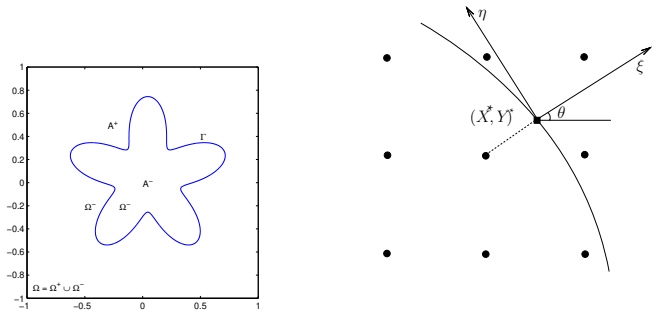
read the original abstract
Almost all materials are anisotropic. In this paper, interface relations of anisotropic elliptic partial differential equations involving discontinuities across interfaces are derived in two and three dimensions. Compared with isotropic cases, the invariance of partial differential equations and the jump conditions under orthogonal coordinates transformation is not valid anymore. A systematic approach to derive the interface relations is established in this paper for anisotropic elliptic interface problems, which can be important for deriving high order accurate numerical methods.
Editorial analysis
A structured set of objections, weighed in public.
Referee Report
Summary. The paper derives jump relations across interfaces for anisotropic elliptic PDEs in 2D and 3D. It establishes a systematic derivation approach that does not rely on the orthogonal coordinate transformation invariance used in the isotropic case, motivated by the prevalence of anisotropy in materials and the need for high-order numerical methods.
Significance. If the derivations hold, the work supplies explicit interface conditions that can underpin accurate discretizations for anisotropic interface problems, a setting common in applications. The provision of a coordinate-independent systematic procedure and explicit 2D/3D formulas constitutes a concrete, usable contribution to the numerical analysis literature.
minor comments (2)
- §2: the statement that the PDE and jump conditions lose invariance under orthogonal transformations would benefit from an explicit counter-example (even a simple 2D tensor) to illustrate the failure of the isotropic argument.
- The manuscript would be strengthened by a short remark comparing the derived jump relations to the classical isotropic ones (e.g., continuity of the normal flux) to highlight the new anisotropic terms.
Simulated Author's Rebuttal
We thank the referee for the positive summary, significance assessment, and recommendation of minor revision. No specific major comments were provided in the report.
Circularity Check
No significant circularity; derivation is self-contained
full rationale
The paper presents an explicit derivation of jump relations for anisotropic elliptic interface problems in 2D/3D, motivated by the breakdown of coordinate-invariance arguments that work for isotropic cases. No fitted parameters are renamed as predictions, no self-citations serve as load-bearing uniqueness theorems, and no ansatz is smuggled in via prior work. The central claim reduces to direct manipulation of the PDE and interface conditions under the stated anisotropy, which is independent of the result itself. This is the normal case of a first-principles derivation with no reduction to inputs by construction.
Axiom & Free-Parameter Ledger
Reference graph
Works this paper leans on
- [1]
-
[2]
S. Bergmann, K. Albe, E. Flegel, D. A. Barragan-Yani, and B. Wagner, Anisotropic solidliquid interface kinetics in silicon: an atomistically informed phase-field model, Modelling Simul. Mater. Sci. Eng. 25 (2017)
work page 2017
-
[3]
S. Deng, K. Ito, and Z. Li, Three dimensional elliptic solvers for interface problems and applications, J. Comput. Phys. 184 (2003), 215–243
work page 2003
-
[4]
M. Dumett and J. Keener, A numerical method for solving anisotropic elliptic boundary value problems on an irregular domain in 2D , SIAM J. Sci. Comput. 25 (2003), 348–367
work page 2003
-
[5]
S. Hou, W. Wang, and L. Wang,Numerical method for solving matrix coefficient elliptic equation with sharp-edged interfaces , J. Comput. Phys. 229 (2010), no. 19, 7162–7179. 6
work page 2010
-
[6]
W. Huang and S. I. Rokhlin, Interface waves along an anisotropic imperfect interface between anisotropic solids , J. Nondestructive Evaluation 11 (1992), 185–198
work page 1992
-
[7]
R. J. LeVeque and Z. Li, The immersed interface method for elliptic equations with discontinuous coefficients and singular sources , SIAM J. Numer. Anal. 31 (1994), 1019–1044
work page 1994
-
[8]
V. I. Levitas and J. A. Warren, Phase field approach with anisotropic interface energy and interface stresses: Large strain formulation , J. Mech. Phy. Solids 91 (2016), 94–125
work page 2016
- [9]
-
[10]
G. B. McFadden, A. A. Wheeler, R. J. Braun, S. R. Coriell, and R. F. Sekerka, Phase-field models for anisotropic interfaces , Physical review E 48 (1993)
work page 1993
-
[11]
Z. Suo, Singularities, interfaces and cracks in dissimilar anisotropic media , Proceedings of the royal society A 427 (1990)
work page 1990
-
[12]
N. G. Tuncel and A. H. Serbest, Reflection and refraction by an anisotropic metamaterial slab with diagonal anisotropy , IEEE, 2015. 7
work page 2015
discussion (0)
Sign in with ORCID, Apple, or X to comment. Anyone can read and Pith papers without signing in.