REVIEW 6 minor 43 references
Hamiltonian preserving nonlinear optics
T0 review · 0 major / 6 minor · reviewed 2026-08-14 · deepseek-v4-flash
Pith's one-line read A beam line can be designed to preserve a chosen Hamiltonian by realizing a symplectic integrator with rotations and beta-scaled kicks.
desk verdict Genuinely new finite-h integrator-as-lattice design, sound core with a minor scaling-derivation gap; the FODO stress-test worry does not hold up under calculation. read the letter →
The pith
A machine-rendered reading of the paper's core claim, the machinery that carries it, and where it could break.
The reading
What carries the argument
The load-bearing object is the rotation-kick splitting of a Hamiltonian: the linear part generates rotations $R_{\psi}$ in each canonical pair, while the nonlinear part generates kicks $K_h$ that change only momenta. The paper uses the Baker--Campbell--Hausdorff formula to turn the composition $R_{h/2}K_h R_{h/2}$ (a second-order Ruth/Strang integrator) and its fourth-order Yoshida composition (Eq. (26)) into statements about an effective Hamiltonian accurate to $O(h^p)$. The bridge to a real lattice is Eq. (33)--(34), which converts the normalized-coordinate kick into thin nonlinear magnets whose strengths are scaled by the local $\beta$-function; the only matching condition is that the phase advance in $x$ and $y$ be equal.
What would settle it
Use a tracking code that models finite-length magnets with fringe fields in the outlined Yoshida lattice, set the linear channel to the required phase advance with unequal $x$ and $y$ $\beta$-functions, and compare the drift of $H$ and the second invariant $I_2$ over $10^5$ turns with the $O(h^4)$ bound; if thick-lens terms dominate the drift or cause particle loss, the core equivalence fails in a real machine.
Extended reading notes
Core claim
The central claim is that the dictionary between symplectic integrators and beam lines runs in both directions. In normalized coordinates, linear betatron motion is exactly a rotation $R_{\psi}$, so any linear channel with phase advance $\psi$ is the free part of an integrator; a thin nonlinear magnet whose strength is scaled by the $\beta$-function is the kick $K_h$. Composing these pieces according to a known integration scheme yields a lattice whose effective Hamiltonian is the target $H$ up to $O(h^p)$. In particular, Eq. (26) implements a fourth-order Yoshida composition with only three nonlinear elements, and the paper's tracking shows the target Hamiltonian, and for the Darboux potential also the second invariant, held to about 1--3% over up to $10^6$ turns, whereas the existing equidistant-scaling insert loses the invariant and many trajectories escape.
Load-bearing premise
The construction assumes the linear optics between kicks acts as an exact rotation in normalized coordinates and the nonlinear magnets act as ideal thin kicks with the derived beta-scaling; any real deviation, including finite magnet length, fringe fields, chromatic effects, or space charge, is not modeled.
Editorial extensions
If this is right
- A nonlinear insert intended to realize a given Hamiltonian can be built from three thin lenses instead of the seven-to-seventeen lenses used in current designs, with invariant conservation in the few-percent range.
- The matching condition is equal phase advance in $x$ and $y$, not equal beta-functions, so linear lattices with unequal beta-functions remain usable.
- Higher-order symplectic compositions reduce the discretization error as a power of the phase step $h$, giving a quantitative route to arbitrary accuracy through more lenses or smaller phase advances.
- By the backward-error-analysis theorem quoted in the paper, bounded trajectories of the ideal map remain bounded over exponentially long times, so the near-invariant survives many turns.
Reading between the lines
- Read backward, the construction suggests a design workflow for existing machines: fit a symplectic-integrator skeleton to an installed linear lattice, then choose magnet strengths by inverting the beta-scaling; this turns finding the effective Hamiltonian of a lattice into choosing the integrator whose Hamiltonian one wants.
- The same rotation-kick dictionary should transfer to any element that acts as a thin kick, such as electron lenses or higher-order multipoles, provided the phase advances are matched; the paper mentions this possibility, and the integrator interpretation makes it a direct generalization.
- A testable extension is to measure the drift of the conserved quantity as a function of phase step $h$ for a fixed magnet count: if the drift exponent matches the integrator order $p$, discretization error dominates, while a flattening indicates that thick-lens or field errors dominate.
Signed reviews
Editorial analysis
A structured set of objections, weighed in public.
Referee Report
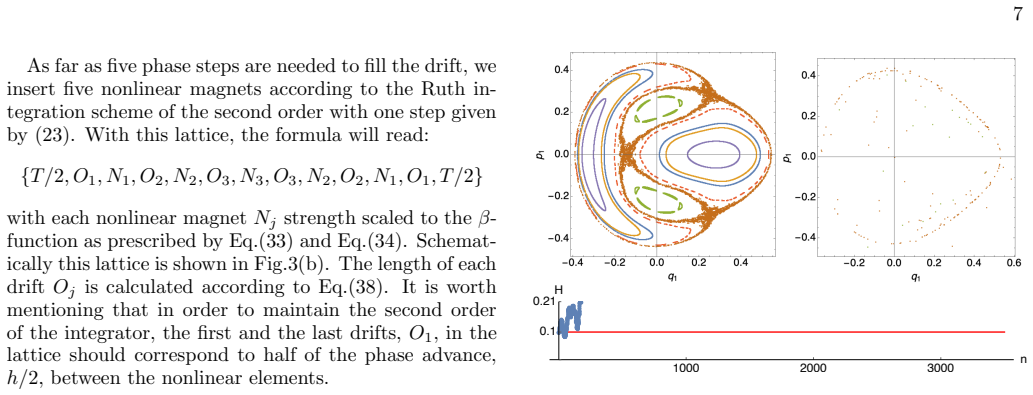
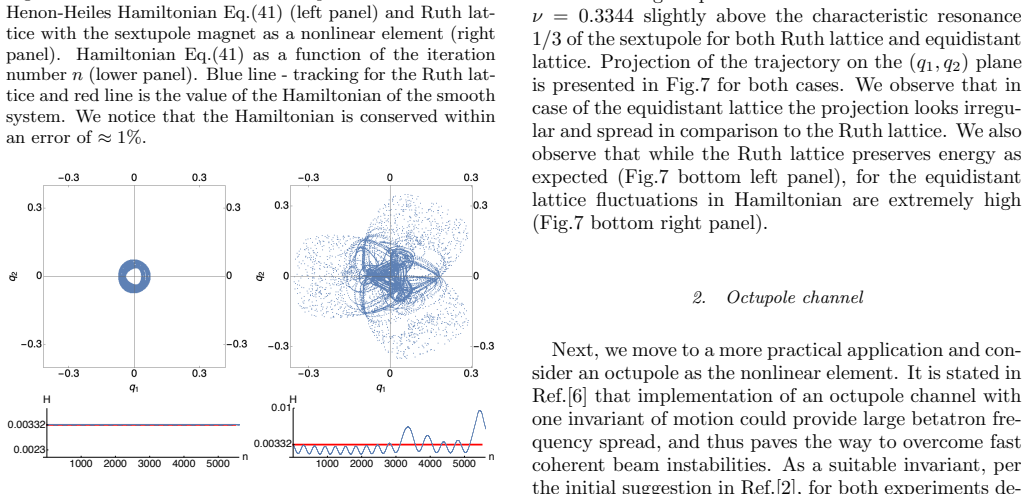
Summary. The paper proposes a method for constructing a nonlinear accelerator lattice whose effective Hamiltonian in normalized (Courant-Snyder) coordinates is a prescribed autonomous Hamiltonian H=(p^2+q^2)/2+V(q). The central idea is to identify a symplectic integrator for H (Euler, Ruth/Strang, Yoshida) with a sequence of rotations and kicks, and to realize the rotations by linear magnet channels with matched phase advances and the kicks by beta-scaled thin nonlinear lenses. The authors derive a beta-scaling relation (Eqs. (33)-(34)), state the requirement of equal phase advances in x and y, and present tracking examples: a Ruth lattice with five sextupoles or octupoles in an equal-beta T-insert that conserves a Henon-Heiles Hamiltonian to about 1%, while an equidistant five-magnet baseline fails; and a Yoshida lattice with three nonlinear elements implementing the Darboux-potential Hamiltonian, with a FODO-based linear channel, conserving the Hamiltonian and the second invariant to about 3%. A MADX cross-check with a sextupole Yoshida lattice is included. No parameters are fitted to make the Hamiltonian appear conserved.
Significance. If the claims hold, the paper gives a constructive reverse-engineering recipe for nonlinear accelerator optics: instead of discretizing a smooth potential by equidistant magnets, one can use high-order symplectic integrator layouts, reducing the number of nonlinear elements (three for the Yoshida example) and providing BCH-based accuracy control. The approach is independent of the choice of nonlinear potential and is demonstrated with explicit, reproducible tracking experiments (initial conditions are tabulated, and OptiMX/MADX are used). The main idealizations, namely thin lenses, exact linear matching, and the absence of fringe fields, chromaticity, and space-charge effects, mean that the practical IOTA/UMER improvement claims are indicative rather than definitive; however, the core equivalence between integrator and lattice is convincingly supported by the numerical examples.
minor comments (6)
- [Section II.D, Eqs. (32)-(34)] The notation in Eq. (34) is confusing: the left-hand side "∂_{x,y}U" and the right-hand side "∂_{q1,q1}V" should be clarified. The intended statement appears to be that the physical kick is generated by U(x,y)=h V(x/√β_x, y/√β_y), so that ∂U/∂x = (h/√β_x) ∂V/∂q1 evaluated at q1=x/√β_x, q2=y/√β_y. Please correct the partial-derivative subscripts and include the two-line derivation from Eq. (32), since this formula fixes all lens strengths in the paper.
- [Section III.B and Section II.E] Please state explicitly that the 30 FODO cells are symmetric thin-lens cells with equal phase advances in x and y, or report μ_x and μ_y from OptiMX. The text says "the phase advance of one cell" without specifying the plane; the Yoshida construction requires ψ_x=ψ_y. For a standard symmetric FODO cell the x and y phase advances over a full cell are indeed equal (the transfer matrices have the same trace), so this is a clarity request rather than a correctness concern.
- [Section III.B] The Yoshida example would be easier to reproduce if the main text included a table of the FODO cell parameters (quadrupole strengths, drift lengths), the positions of the three nonlinear magnets, and the beta functions at those positions. The text currently refers to OptiMX and to supplemental MADX input, but the flagship demonstration should be self-contained.
- [Section III.A.1 and III.A.2] In the head-to-head comparisons, please specify whether the normalization in Eq. (35) is applied with the scaling law appropriate to each lattice (Eqs. (42)/(46) for the equidistant case and Eqs. (43)/(47) for the Ruth case) or with a single f(β). The wording "the amplitude scaling function that is calculated with the help of Eq.(33) and Eq.(34)" is ambiguous when the equidistant lattice deliberately uses a different scaling.
- [Section II.E, Theorem 2] The statement of Theorem 2 contains unclear notation: "nh≤eh0/2h" should presumably read t = n h ≤ e^{h0/(2h)} (or an equivalent form), and the constant h0 should be defined. As written, the expression is hard to parse.
- [Throughout] There are several typos and minor wording issues: "fist proposed" in Sec. III.A.1, "usec" in Appendix D, "Ausralia" in Ref. [32], and the inconsistent rounding of the FODO cell phase advance (0.14π versus 4.208π/30 ≈ 0.1403π). These should be corrected in a revision.
Circularity Check
No significant circularity: the lattice construction is an explicit inverse-problem derivation from BCH and standard symplectic integrators, with no fitted inputs or self-citation chain.
full rationale
The paper's central claim is constructive: given a desired smooth Hamiltonian H=(q^2+p^2)/2+V(q), it builds a nonlinear lattice whose effective Hamiltonian approximates H. The derivation is self-contained: Eqs. (8)-(26) use the standard BCH formula and known symplectic integrator compositions (Strang/Ruth and Yoshida) to show that rotations R and kicks K approximate the desired flow to order O(h^p); Eqs. (29)-(34) derive the required beta-function scaling for the kicks by conjugating the normalized-coordinate operations with the betatron amplitude matrix. No parameter is fitted to force the tracked Hamiltonian to be conserved. The only calibration, Eq. (35), fixes an overall multiplicative strength of the nonlinear channel so that the coefficient in front of the effective Hamiltonian potential is unity; this is an a priori normalization, not a fit to simulation data. The tracking results (Figs. 6, 9, 12, 13) are validation checks of an explicit construction, not predictions extracted from fitted parameters. The paper's use of prior results, including the Danilov-Nagaitsev scaling and the Darboux potential, is external supporting material rather than self-citation, and the recovery of the continuous-limit scaling in Appendix A is a consistency check, not a load-bearing premise. The skeptic concern about unequal FODO phase advances in Sec. III.B is a potential correctness or modeling gap in the example, not a circularity in the derivation; it questions whether the example satisfies the paper's own psi_x=psi_y condition, but does not make the claimed result equivalent to its inputs by construction.
Assumptions & free parameters
free parameters (3)
- integrator phase step h =
0.42 (Ruth sextupole), 0.28 (Ruth octupole), 0.208π (Yoshida)
- linear tune ν =
0.3344 (sextupole), 0.2234 (octupole), 0.07 per FODO cell
- total integrated nonlinear strength =
1
assumptions (6)
- standard math BCH formula and order conditions for symplectic composition (Theorem 1)
- standard math Theorem 2 (Benettin-Giorgilli): bounded trajectories of a symplectic order-p integrator preserve H to O(h^p) for exponentially long times
- domain assumption Transverse linear lattice can be described by block-diagonal transfer matrices with Twiss parameters (Eq.29-30)
- domain assumption Nonlinear elements are thin lenses; their kicks are position-dependent impulses in momentum with the beta-scaled potential Eq.(33)-(34)
- domain assumption The T-insert yields equal transverse beta-functions and the specified phase advance Eq.(36)-(38)
- standard math Darboux potential Eq.(49) with second invariant Eq.(50) is exactly integrable
Cite this review
Pith. "Pith review of Hamiltonian preserving nonlinear optics." pith.science (2026). https://pith.science/paper/2ERTRZAZ
@misc{pith2026190803520,
  author       = {Pith},
  title        = {Pith review of: Hamiltonian preserving nonlinear optics},
  year         = {2026},
  howpublished = {\url{https://pith.science/paper/2ERTRZAZ}},
  note         = {Machine review of arXiv:1908.03520}
}
read the original abstract
In this paper we present a method of constructing a nonlinear accelerator lattice that has an approximate integral of motion that is given upfront. The integral under consideration is a Hamiltonian in normalized (canonical) coordinates that is preserved by a lattice with a given accuracy. We establish a connection between the integrator of a Hamiltonian in normalized coordinates and a real lens arrangement. We apply known algorithms of high-order symplectic integrators, to produce several nonlinear lattices and show that this approach could improve the design of the nonlinear insert considered at the IOTA and UMER facilities. We also suggest new lattice design based on the Yoshida integrator.
Figures


Figures from the paper (10 more)





Reference graph
Works this paper leans on
-
[27]
On the construction and comparison of dif- ference schemes,
G. Strang, “On the construction and comparison of dif- ference schemes,” SIAM Journal on Numerical Analysis , vol. 5, no. 3, pp. 506–517, 1968
work page 1968
-
[1]
Sextupole channel For the first illustration of the Ruth lattice Fig.3(b) based on the second order integrator, we consider the sextupole magnet as a nonlinear element. This type of nonlinear insert was fist proposed in Ref.[30] where au- thors suggested experiment for real world testing of reg- ular and chaotic motion at IOTA ring based on Henon- Heiles sy...
-
[2]
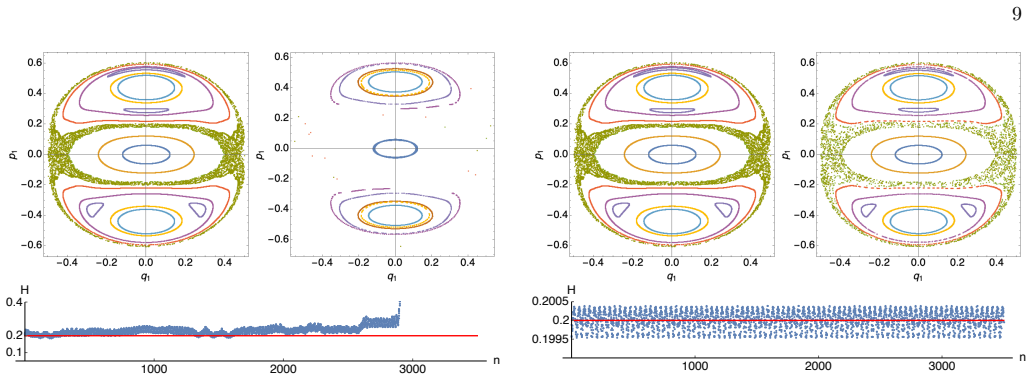
Octupole channel Next, we move to a more practical application and con- sider an octupole as the nonlinear element. It is stated in Ref.[6] that implementation of an octupole channel with one invariant of motion could provide large betatron fre- quency spread, and thus paves the way to overcome fast coherent beam instabilities. As a suitable invariant, pe...
-
[3]
Chromatic and Space Charge Ef- fects in Nonlinear Integrable Optics,
S. Webb, D. Bruhwiler, A. Valishev, S. Nagaitsev, and V. Danilov, “Chromatic and Space Charge Ef- fects in Nonlinear Integrable Optics,” in Proceedings of the ICFA Advanced Beam Dynamics Workshop on High-Intensity and High-Brightness Hadron Beams (54 th ICFA, HB2014), November 10-14, 2014, p. 216, JACoW, East-Lansing, MI, 2014
work page 2014
-
[4]
Beam Physics of Inte- grable Optics Test Accelerator at Fermilab,
S. Nagaitsev and A. Valishev, “Beam Physics of Inte- grable Optics Test Accelerator at Fermilab,” in Proceed- ings of the 3rd International Particle Accelerator Con- ference (IPAC’12), New Orleans, LA, May 20-25, 2012 , p. 1371, IEEE, Piscataway, NJ, 2012
work page 2012
-
[5]
(45) Using the same reasoning as for the original Henon-Heiles system, one may show that due to the fact that all equipotential lines are closed up to the level set H = 1 /4 motion remain bounded, however as before it may be also chaotic. According to the prescription of Ref.[2, 6], the octupole strength now should be scaled with the β-function ac- 9 ����...
-
[6]
and UMER [7] for the quasi-integrable and integrable optics experiments. The linear part of the lattice consists of the so called T-insert introduced in [2], and a drift of length L. The T-insert is an arrangement where part of the linear optics effectively acts as a focusing matrix in both x and y directions, leading to a degenerate case of equal transver...
-
[7]
We observe, that as before lat- tice indeed conserves given Hamiltonian as prescribed
for the smooth Hamiltonian Eq.(41) and Yoshida lat- tice with sextupoles. We observe, that as before lat- tice indeed conserves given Hamiltonian as prescribed. For the MADX input initial conditions that are listed in Table I were transformed to the real coordinate space with the help of the betatron amplitude matrix given by Eq.(30) and linear lattice fu...
Show all 43 references
-
[8]
Practical solutions for nonlinear accelerator lattice with stable nearly regular motion,
V. Danilov, “Practical solutions for nonlinear accelerator lattice with stable nearly regular motion,” Phys. Rev. ST Accel. Beams, vol. 11, p. 114001, Nov 2008
2008
-
[9]
Nonlinear accelerator lat- tices with one and two analytic invariants,
V. Danilov and S. Nagaitsev, “Nonlinear accelerator lat- tices with one and two analytic invariants,” Phys. Rev. ST Accel. Beams, vol. 13, p. 084002, Aug 2010
2010
-
[10]
A normal form approach to the theory of nonlinear beta- tronic motion,
A. Bazzani, E. Todesco, G. Turchetti, and G. Servizi, “A normal form approach to the theory of nonlinear beta- tronic motion,” CERN Yellow Reports, vol. 94-02, 1994
1994
-
[11]
IOTA (integrable optics test accelerator): facility and experimental beam physics program,
S. Antipov, D. Broemmelsiek, D. Bruhwiler, D. Ed- strom, E. Harms, V. Lebedev, J. Leibfritz, S. Nagaitsev, C. Park, H. Piekarz, P. Piot, E. Prebys, A. Romanov, J. Ruan, T. Sen, G. Stancari, C. Thangaraj, R. Thurman- Keup, A. Valishev, and V. Shiltsev, “IOTA (integrable optics ...
2017
-
[12]
Single- particle dynamics in a nonlinear accelerator lattice: at- taining a large tune spread with octupoles in IOTA,
S. Antipov, S. Nagaitsev, and A. Valishev, “Single- particle dynamics in a nonlinear accelerator lattice: at- taining a large tune spread with octupoles in IOTA,” Journal of Instrumentation, vol. 12, pp. P04008–P04008, apr 2017
2017
-
[13]
Single-invariant nonlinear optics for a small electron recirculator,
K. Ruisard, H. B. Komkov, B. Beaudoin, I. Haber, D. Matthew, and T. Koeth, “Single-invariant nonlinear optics for a small electron recirculator,”Phys. Rev. Accel. Beams, vol. 22, p. 041601, Apr 2019
2019
-
[14]
Complex representation of potentials and fields for the nonlinear magnetic insert of the Integrable Optics Test Accelerator,
C. Mitchell, “Complex representation of potentials and fields for the nonlinear magnetic insert of the Integrable Optics Test Accelerator,” arXiv:1908.00036, 2019
1908 arXiv
-
[15]
Normal forms for hamiltonian maps and nonlinear ef- fects in particle accelerators,
A. Bazzani, G. Turchetti, P. Mazzanti, and G. Servizi, “Normal forms for hamiltonian maps and nonlinear ef- fects in particle accelerators,” Nuovo Cimento, vol. B102, no. 51, 1988
1988
-
[16]
Hairer, C
E. Hairer, C. Lubich, and G. Wanner, Geometric numeri- cal integration : structure-preserving algorithms for ordi- nary differential equations . Bernil; New York: Springer, 2006
2006
-
[17]
Turchetti and F
G. Turchetti and F. Panichi, Nonlinear Dynamics and Collective Effects in Paricle Beam Physics , pp. 47–70. Proceedings of the NOCE 2017 Workshop, Arcidosso, Italy 19-22 September 2017, World Scientific Publishing, 2019
2017
-
[18]
A. J. Dragt, Lie Methods for Nonlinear Dynamics with Applications to Accelerator Physics. University of Mary- 14 land, College Park, 2019
2019
-
[19]
Forest, Beam Dynamics: A New Attitude and Frame- work, vol
´E. Forest, Beam Dynamics: A New Attitude and Frame- work, vol. 8 of The Physics and Technology of Particle and Photon Beams. Amsterdam, The Netherlands: Hard- wood Academic / CRC Press, 1998
1998
-
[20]
High-order control for symplectic maps,
M. Sansottera, A. Giorgilli, and T. Carletti, “High-order control for symplectic maps,” Physica D: Nonlinear Phe- nomena, vol. 316, pp. 1 – 15, 2016
2016
-
[21]
Method for enlarging the dy- namic aperture of accelerator lattices,
W. Wan and J. R. Cary, “Method for enlarging the dy- namic aperture of accelerator lattices,” Phys. Rev. ST Accel. Beams, vol. 4, p. 084001, Aug 2001
2001
-
[22]
Some application of splitting-up meth- ods to the solution of mathematical physics problems,
G. I. Marchuk, “Some application of splitting-up meth- ods to the solution of mathematical physics problems,” Aplikace matematiky, vol. 13, no. 2, pp. 103–132, 1968
1968
-
[23]
V. I. Arnold, Ordinary Differential Equations. Springer, 1992
1992
-
[24]
Arnold, Geometrical Methods in the Theory of Ordi- nary Differential Equations
V. Arnold, Geometrical Methods in the Theory of Ordi- nary Differential Equations . Springer, 1988
1988
-
[25]
Die symbolische Exponentialformel in der Gruppentheorie,
F. Hausdorff, “Die symbolische Exponentialformel in der Gruppentheorie,” Ber. Verh. Saechs. Akad. Wiss. Leipzig, vol. 58, pp. 19–48, 1906
1906
-
[26]
Tabor, Chaos and integrability in nonlinear dynamics : an introduction
M. Tabor, Chaos and integrability in nonlinear dynamics : an introduction . New York : Wiley, 1989
1989
-
[28]
with the block of the type Mx,y(s1|s0) = Bx,y(s1) [ cos(ψx,y) sin( ψx,y) − sin(ψx,y) cos( ψx,y) ] B−1 x,y(s0). (29) Here, the lower index denotes coordinate pair (either {x,Px} or{y,Py});ψx,y = s1∫ s0 ds βx,y(s) is the phase advance between position s0 ands1; Bx,y(s) is the co...
-
[29]
A canonical integration technique,
R. D. Ruth, “A canonical integration technique,” IEEE Transactions on Nuclear Science, vol. 30, pp. 2669–2671, Aug 1983
1983
-
[30]
Canonical integrators as tracking codes (or how to integrate perturbation theory with tracking),
E. Forest, “Canonical integrators as tracking codes (or how to integrate perturbation theory with tracking),” AIP Conference Proceedings, vol. 184, no. 1, pp. 1106– 1136, 1989
1989
-
[31]
Fractal decomposition of exponential opera- tors with applications to many-body theories and monte carlo simulations,
M. Suzuki, “Fractal decomposition of exponential opera- tors with applications to many-body theories and monte carlo simulations,” Physics Letters A , vol. 146, no. 6, pp. 319 – 323, 1990
1990
-
[32]
Construction of higher order symplectic in- tegrators,
H. Yoshida, “Construction of higher order symplectic in- tegrators,” Physics Letters A , vol. 150, no. 5, pp. 262 – 268, 1990
1990
-
[33]
Numerical discretization of completely integrable nonlinear hamiltonian systems,
S. Rexford and B. Erdelyi, “Numerical discretization of completely integrable nonlinear hamiltonian systems,” Phys. Rev. Accel. Beams, vol. 21, p. 114601, Nov 2018
2018
-
[34]
S. Y. Lee, Accelerator Physics. World Scientific Publish- ing, 2012
2012
-
[35]
On the hamiltonian in- terpolation of near-to-the identity symplectic mappings with application to symplectic integration algorithms,
G. Benettin and A. Giorgilli, “On the hamiltonian in- terpolation of near-to-the identity symplectic mappings with application to symplectic integration algorithms,” Journal of Statistical Physics , vol. 74, pp. 1117–1143, Mar 1994
1994
-
[36]
H´ enon-Heiles Sin- gle Particle Dynamics at IOTA,
S. A. Antipov and S. Nagaitsev, “H´ enon-Heiles Sin- gle Particle Dynamics at IOTA,” in Proc. of In- ternational Particle Accelerator Conference (IPAC’17), Copenhagen, Denmark, 14-19 May, 2017 , no. 8 in In- ternational Particle Accelerator Conference, (Geneva, Switzerland), p...
2017 doi
-
[37]
The applicability of the third integral of motion: Some numerical experiments,
M. Henon and C. Heiles, “The applicability of the third integral of motion: Some numerical experiments,” Astro- nomical Journal, vol. 69, p. 73, Feb. 1964
1964
-
[38]
Experimental Demonstration of the Henon-Heiles Quasi-Integrable System at IOTA,
N. Kuklev, Y. Kim, S. Nagaitsev, A. Romanov, and A. Valishev, “Experimental Demonstration of the Henon-Heiles Quasi-Integrable System at IOTA,” in Proc. 10th International Particle Accelerator Confer- ence (IPAC’19), Melbourne, Ausralia, May 19-24, 2019 , no. 10 in Internation...
2019
-
[39]
Synchrotron Ra- diation Beam Diagnostics for the Integrable Optics Test Accelerator,
N. Kuklev, Y. Kim, and A. Romanov, “Synchrotron Ra- diation Beam Diagnostics for the Integrable Optics Test Accelerator,” in Proc. 9th International Particle Accel- erator Conference (IPAC’18), Vancouver, BC, Canada, April 29-May 4, 2018 , no. 9 in International Particle Ac- c...
2018
-
[40]
OptiMX: Accelerator Optics Design Software
“OptiMX: Accelerator Optics Design Software.” http: //home.fnal.gov/~ostiguy/OptiM/, July 2019
2019
-
[41]
Landau damping of beam instabilities by electron lenses,
V. Shiltsev, Y. Alexahin, A. Burov, and A. Vali- shev, “Landau damping of beam instabilities by electron lenses,” Phys. Rev. Lett., vol. 119, p. 134802, Sep 2017
2017
-
[42]
Tevatron electron lenses: Design and operation,
V. Shiltsev, K. Bishofberger, V. Kamerdzhiev, S. Kozub, M. Kufer, G. Kuznetsov, A. Martinez, M. Olson, H. Pfef- fer, G. Saewert, V. Scarpine, A. Seryi, N. Solyak, V. Syt- nik, M. Tiunov, L. Tkachenko, D. Wildman, D. Wolff, and X.-L. Zhang, “Tevatron electron lenses: Design and ...
2008
-
[43]
MADX: Methodical Accelerator Design Software
“MADX: Methodical Accelerator Design Software.” http://cern.ch/madx, July 2019
2019
Reviewed August 14, 2026 · model on record in the stance chip above.
Discussion (0). Continue with ORCID to comment.