REVIEW 3 major objections 5 minor 19 references
Convolutional Neural Networks Based Texture Modeling For AV1
T0 review · 3 major / 5 minor · reviewed 2026-08-14 · deepseek-v4-flash
Pith's one-line read The paper claims AV1 can cut bitrate by treating CNN-flagged texture blocks as perceptually insignificant, skipping their residual coding and reconstructing them with one affine motion model; reported savings reach 13.8% at low QP.
desk verdict A genuine AV1 encoder-side texture mode with real low-QP gains, but the headline claim is over-generalized: the evidence only supports texture-heavy content at low QP, and the subjective test is too thin to carry the perceptual claim. read the letter →
The pith
A machine-rendered reading of the paper's core claim, the machinery that carries it, and where it could break.
The reading
What carries the argument
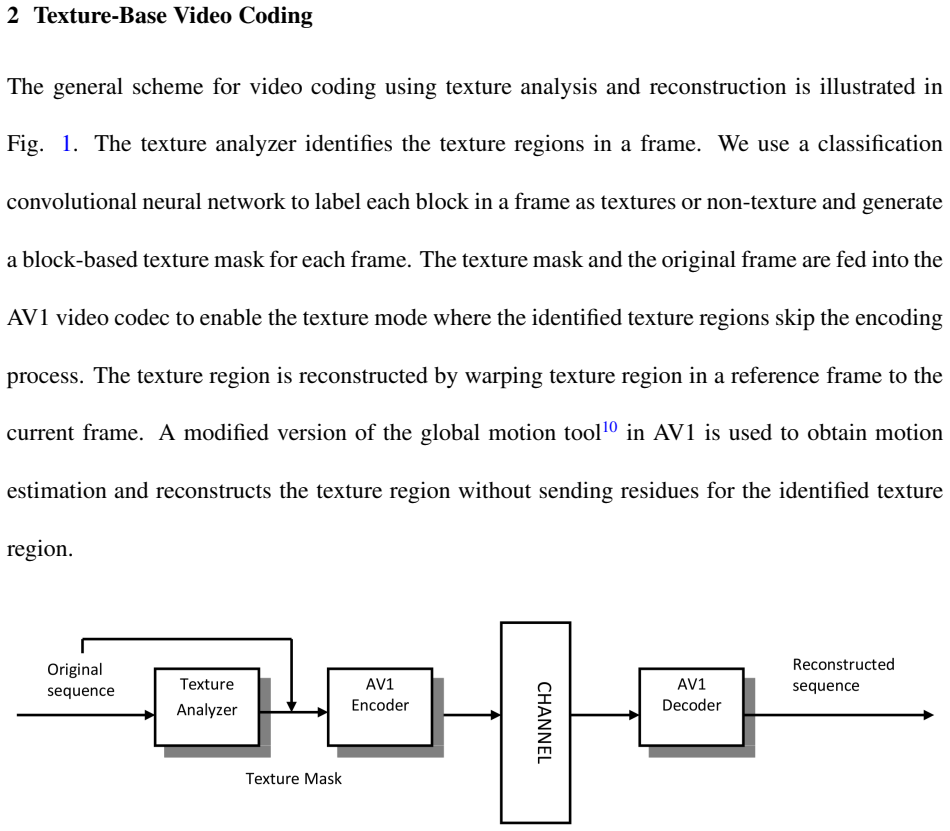
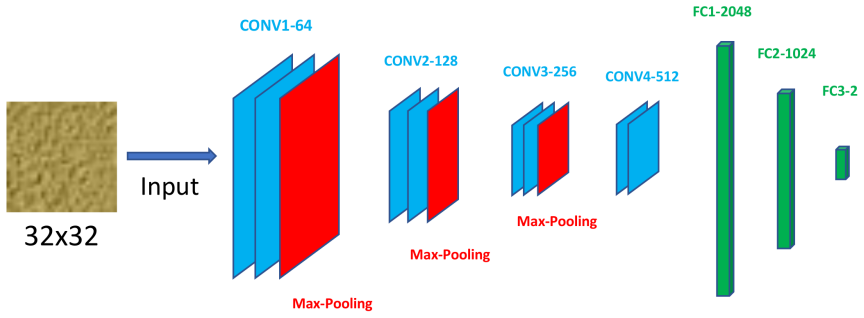
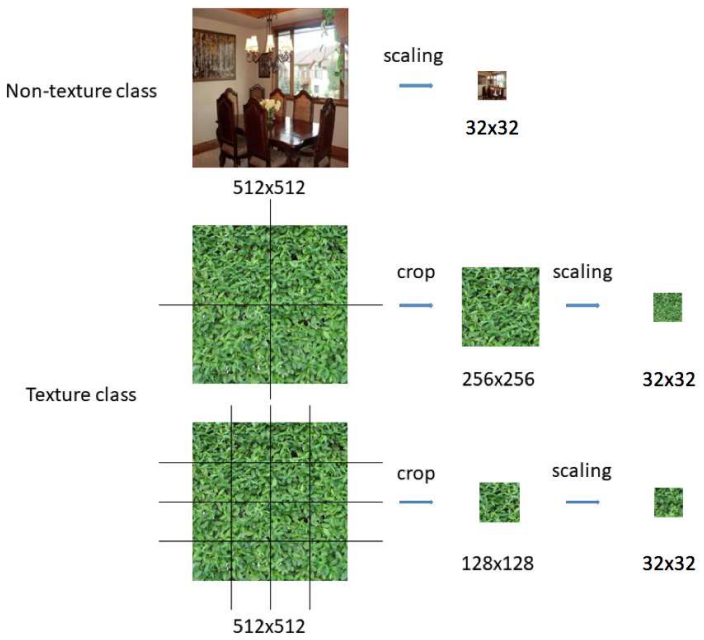
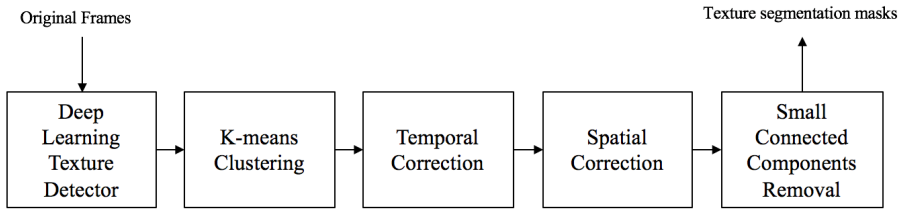
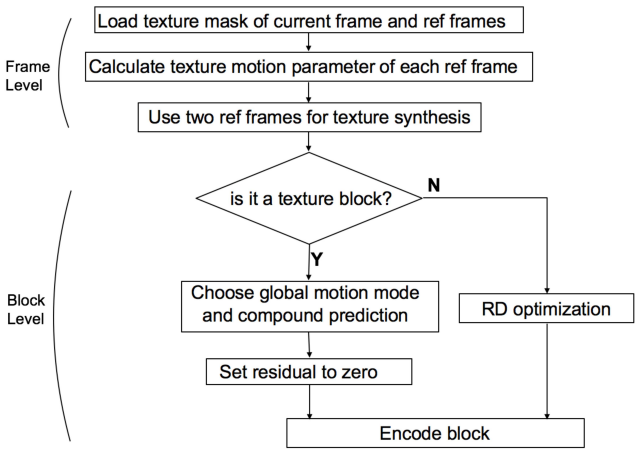
The load-bearing machinery is the texture mode: an encoder-side AV1 coding mode in which a block is not predicted block-by-block but reconstructed by warping the texture region from reference frames with one set of texture motion parameters. The texture motion parameters are an affine model estimated only on pixels inside the CNN-generated texture mask, using feature matching and robust model fitting, and are carried by overwriting the AV1 global motion parameters in the inter-frame header. Around that, the CNN analyzer (a 32x32-block classifier trained on still texture and scene images) produces the texture mask; mask refinement uses K-means clustering, temporal majority voting over three frames, spatial 4-connectivity voting, and removal of small components; and the tex-cp configuration reconstructs texture blocks with compound prediction from the previous and next reference frames. That combination keeps the bitstream syntax unchanged while replacing residual and mode bits with one set of motion parameters.
What would settle it
Ask a fresh panel of viewers to compare texture-mode and baseline reconstructions of high-motion sequences with objects inside the texture mask (e.g., football) at QP=16; the claim is refuted if the texture-mode version is judged worse more often than better, or if viewers consistently report flicker at texture/non-texture borders. A quantitative check is to measure bitrate saving against texture-region coverage on a static textured scene with pure camera pan: the saving should rise with coverage if the motion-parameter overhead is small.
Extended reading notes
Core claim
The central discovery is that blocks a CNN classifies as texture do not need pixel-level prediction or residuals; they can be reconstructed from reference frames by a single affine motion model estimated on the texture region alone. The paper introduces this as an encoder-side "texture mode" in AV1: for each block at least 32x32 whose mask and warped reference blocks are all inside texture regions, the encoder skips rate-distortion search and sends no residue, replacing the frame-level global motion parameters in the bitstream header with texture motion parameters estimated from feature matching and robust model fitting over the texture region. The texture regions are then reconstructed by compound prediction, warping the previous and next reference frames toward the current frame, which suppresses flicker. With this design, the paper reports up to 13.77% data-rate savings at QP=16 (bridgeclose) and average subjective results in which 59% of viewer comparisons found no difference from the AV1 baseline and 19% preferred the texture-mode output.
Load-bearing premise
The claim rests on the premise that the network can tell, in ordinary video, which blocks the human eye truly will not notice, and that simply sliding those same pixels over from a neighboring frame will not make the motion look wrong.
Editorial extensions
If this is right
- At low quantization levels (QP=16, 24) on sequences with large texture regions, texture mode reduces bitrate compared with the AV1 baseline; the largest reported saving is 13.77% at QP=16 for bridgeclose.
- At high quantization levels the saving shrinks and sometimes becomes a loss (e.g., waterfall shows +3.74% more bits at QP=40), so the tool is best applied selectively at low-to-mid QP.
- Because texture mode is purely an encoder-side choice and alters no bitstream syntax, the same AV1 decoder can reconstruct texture-mode streams without modification.
- Using compound prediction from both the previous and the next reference frame (tex-cp) reduces temporal flicker compared with enabling texture mode on all frames, at a small cost in data-rate saving relative to tex-all.
- The reported 20-subject test at QP=16 indicates that on average 59% of comparisons show no visible difference from the baseline, 22% favor the baseline, and 19% favor the texture-mode video.
Reading between the lines
- An extension the paper does not test: if bitrate savings track the texture-mask coverage fraction, a sequence-adaptive on/off controller for texture mode could avoid the negative savings observed at high QP in Table 2.
- Because the classifier is trained only on still images, video-specific textures (rolling water, smoke, motion blur) are likely under-served; augmenting training with video patches or refining masks from motion-compensated temporal voting is a testable improvement.
- The affine motion model is the main ceiling on reconstruction quality, matching the paper's observation that perspective-dominated sequences behave worst; replacing it with a planar-perspective model or per-region motion segmentation should extend the gains.
- Because texture motion parameters overwrite the frame-level global motion parameters, a future syntax-aware AV1 extension could carry multiple texture motion models and allow independently moving texture regions, going beyond the single-global-motion case studied here.
Signed reviews
Editorial analysis
A structured set of objections, weighed in public.
Referee Report
Summary. The paper proposes a CNN-based texture analyzer that classifies 32×32 blocks as "perceptually insignificant" texture, refines the resulting mask with spatial/temporal filtering, and integrates the mask into an AV1 encoder through a new encoder-side "texture mode." In this mode, texture blocks skip conventional inter prediction and are reconstructed by warping corresponding texture regions from reference frames using affine texture motion parameters; no residual is transmitted, and no bitstream syntax change is needed. The authors investigate three configurations (tex-all, tex-sp, tex-cp) and focus on tex-cp, which uses compound prediction from previous and next frames to reduce flickering. Experimental results report data rate savings at four QP values (Table 2) and a 20-subject subjective quality test at QP=16 (Table 3). The abstract and conclusion claim significant data rate reductions with satisfying visual quality.
Significance. If the claims are established, this is a useful contribution: it demonstrates a concrete, non-circular integration of a learned texture classifier into a modern codec, with an encoder-only design that preserves bitstream compatibility. The work builds on prior analysis/synthesis coding and extends it to AV1, and the use of external still-image datasets for training and an independent subjective test are strengths. The central ideas are plausible and the experimental setup is not circular, since the CNN and coding parameters are not fitted to the test videos. However, the evidence currently supports the headline claims only for low-to-mid QP and only for one perceptual condition; the paper's reach exceeds the demonstrated results.
major comments (3)
- [Abstract, Section 3.2, Table 2] The central claim of "significant data rate reductions" is not supported across the tested QP range. At QP=40, seven of the eleven test sequences show positive numbers in the "Data Rate Saving" column (e.g., netflix aerial +4.59%, waterfall +3.74%, intotree +2.83%), meaning rate increases relative to the AV1 baseline. The authors acknowledge in Section 3.2 that "at high QP, texture-based method tends to have worse coding performance," but the abstract and conclusion state the savings without this qualification. The headline claim should be restricted to low-to-mid QP (e.g., QP≤24 or QP≤32), or the authors should provide a clear operational argument for why high-QP losses are acceptable, and the abstract/conclusion should be revised accordingly.
- [Section 3.3, Table 3] The subjective evaluation supports "satisfying visual quality" only at QP=16. The test uses 20 subjects, but Table 3 reports only aggregate percentages (59% "no difference," 19% "better," 22% "worse") without confidence intervals, per-video subject counts, or any inferential statistical analysis. Since PSNR and SSIM are explicitly rejected as unsuitable for this method (Section 3.3), there is no objective quality check at any other QP. Moreover, the authors themselves report visible flickering artifacts in football and coastguard and inaccurate affine warping in intotree (Section 3.3). The manuscript should either add subjective or objective evidence at higher QPs, or explicitly limit the perceptual claim to the tested condition rather than stating broadly that visual quality is "satisfying."
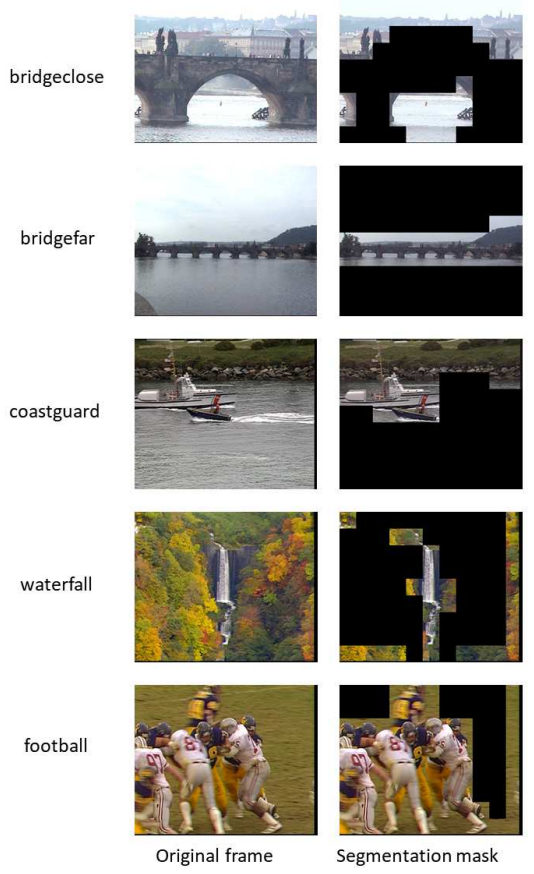
- [Section 2.2 and Section 3.1] The texture analyzer is not quantitatively evaluated. The paper shows only qualitative segmentation examples (Fig. 7) and discusses failure cases (e.g., football and coastguard in Section 3.3), but it does not report precision, recall, IoU, or any other segmentation accuracy metric on a held-out set. Since mask inaccuracies are the main source of the reported visual artifacts (player regions included in texture masks, small texture regions missed), the load-bearing premise that the CNN identifies "perceptually insignificant" regions reliably is not directly supported. A quantitative segmentation evaluation would substantiate the method and help readers assess how much of the coding benefit depends on the classifier's accuracy.
minor comments (5)
- [Section 1] The phrase "none-texture" should be "non-texture" for consistency with the rest of the paper.
- [Author affiliation line] The affiliation text contains a line break in the word "Engin eering"; this should be fixed to "Engineering."
- [Throughout] The term "A V1" appears with a space in several places; use "AV1" consistently.
- [Table 3] The table reports percentages but does not state how many ratings each video received or the number of subjects per video; add the subject count or explicitly state that each of the 20 subjects rated each video.
- [Section 2.1] The training-set description mentions class-imbalance weighting, but no validation accuracy or confusion matrix is reported; reporting these would help the reader judge the classifier's quality.
Circularity Check
No significant circularity: the AV1 coding gains and subjective quality results are measured empirically, not derived from fitted inputs or load-bearing self-citations.
full rationale
The paper's central claim is that a CNN-based texture analyzer, integrated as an encoder-side texture mode in AV1, achieves data-rate savings at low QPs with acceptable visual quality. The derivation chain is empirical and self-contained. The CNN is trained on external still-image datasets (STex and Places365) with a fixed architecture and fixed hyperparameters; no test-sequence data or quality scores are used to train or tune the classifier. The texture motion parameters (Section 2.3.2) are estimated per frame from FAST feature matches and RANSAC on the detected texture regions, not fitted to the reported rate savings. The texture block decision (Section 2.3.3) and block splitting override (Section 2.3.4) are deterministic rules based on mask overlap and warping consistency, not on the rate-distortion outcomes of Table 2. The rate savings in Table 2 are measured by encoding test sequences and comparing actual WebM output sizes against the unmodified AV1 baseline; they are not recalculations of any fitted quantity. The subjective quality claim is supported by an independent 20-subject study at QP=16 (Table 3), which is an external human evaluation rather than a restatement of the method's assumptions. The authors' self-citations (refs 1, 5, 7, 8, 16) provide background, prior architectures, and coding-structure context, but the AV1-specific results are generated fresh for this paper and are not logically forced by those citations. The paper also reports conditions where the method loses to baseline (e.g., high QP in football, waterfall, and netflix aerial in Table 2) and acknowledges artifacts in football, coastguard, and intotree, which is inconsistent with a circular construction that must always confirm its premise. No step in the derivation reduces, by definition or by self-citation, to its own inputs. Thus the circularity score is 0.
Assumptions & free parameters
free parameters (4)
- Connected component size threshold =
5 blocks
- Temporal voting window size =
3 frames
- Texture block size =
32x32 pixels
- Mask refinement spatial neighborhood =
4-connectivity
assumptions (3)
- domain assumption The human visual system tolerates replacement of texture regions with warped reference content without residual coding.
- domain assumption An affine motion model estimated via FAST and RANSAC on the texture region adequately represents the displacement of the entire texture region between frames.
- domain assumption The CNN trained on STex and Places365 generalizes to the test video content.
Cite this review
Pith. "Pith review of Convolutional Neural Networks Based Texture Modeling For AV1." pith.science (2026). https://pith.science/paper/2FQLTQGA
@misc{pith2026190802875,
  author       = {Pith},
  title        = {Pith review of: Convolutional Neural Networks Based Texture Modeling For AV1},
  year         = {2026},
  howpublished = {\url{https://pith.science/paper/2FQLTQGA}},
  note         = {Machine review of arXiv:1908.02875}
}
read the original abstract
Modern video codecs including the newly developed AOMedia Video 1 (AV1) utilize hybrid coding techniques to remove spatial and temporal redundancy. However, efficient exploitation of statistical dependencies measured by a mean squared error (MSE) does not always produce the best psychovisual result. One interesting approach is to only encode visually relevant information and use a different coding method for "perceptually insignificant" regions in the frame, which can lead to substantial data rate reductions while maintaining visual quality. In this paper, we introduce a texture analyzer before encoding the input sequences to identify "perceptually insignificant" regions in the frame using convolutional neural networks. We designed and developed a new scheme that integrate the texture analyzer into the codec that can largely reduce the temporal flickering artifact for codec with hierarchical coding structure. The proposed method is implemented in AV1 codec by introducing a new coding tool called texture mode, where texture mode is a special inter mode treated at the encoder, that if texture mode is selected, no inter prediction is performed for the identified texture regions. Instead, displacement of the entire region is modeled by just one set of motion parameters. Therefore, only the model parameters are transmitted to the decoder for reconstructing the texture regions. Non-texture regions in the frame are coded conventionally. We show that for many standard test sets, the proposed method achieved significant data rate reductions with satisfying visual quality.
Figures
Figures from the paper (4 more)

Reference graph
Works this paper leans on
- [1]
- [2]
-
[3]
F. Zhang and D. R. Bull, ``A parametric framework for video compression using region-based texture models,'' IEEE Journal of Selected Topics in Signal Processing 5 , 1378--1392 (2011)
work page 2011
- [4]
- [5]
-
[6]
U. Joshi, et al. , ``Novel inter and intra prediction tools under consideration for the emerging av1 video codec,'' Proceedings of SPIE 10396 , 10396 -- 10396 -- 13 (2017)
work page 2017
-
[7]
Z. Liu, et al. , ``Adaptive multi-reference prediction using a symmetric framework,,'' Electronic Imaging 2017 (2), 65--72 (2017)
work page 2017
-
[8]
D. Chen, et al. , ``Multi-reference video coding using stillness detection,'' Electronic Imaging (2018). Burlingame, CA, USA
work page 2018
Show all 19 references
-
[9]
``Aom - alliance for open media.'' http://www.aomedia.org/
-
[10]
Parker, et al
S. Parker, et al. , ``Global and locally adaptive warped motion compensation in video compression,'' Proceedings of the IEEE International Conference on Image Processing , 275--279 (2017). Beijing, China
2017
-
[11]
Simonyan and A
K. Simonyan and A. Zisserman, ``Very deep convolutional networks for large-scale image recognition,'' arXiv preprint , arXiv:1409.1556 (2014)
2014 arXiv
-
[12]
Kwitt and P
R. Kwitt and P. Meerwald, ``Stex: Salzburg texture image database.'' http://www.wavelab.at/sources/STex/
-
[13]
Zhou, et al
B. Zhou, et al. , ``Places: An image database for deep scene understanding,'' arXiv preprint , arXiv:1610.02055 (2016)
2016 arXiv
-
[14]
Collobert, K
R. Collobert, K. Kavukcuoglu, and C. Farabet, ``Torch7: A matlab-like environment for machine learning,'' Proceedings of the BigLearn workshop at the Neural Information Processing Systems , 1--6 (2011). Granada, Spain
2011
-
[15]
C. Chen, J. Luo, and K. J. Parker, ``Image segmentation via adaptive k-mean clustering and knowledge-based morphological operations with biomedical applications,'' IEEE transactions on image processing 7 , 1673--1683 (1998)
1998
-
[16]
Liu, et al
Z. Liu, et al. , ``Adaptive multireference prediction using a symmetric framework,'' Proceedings of the IS&T International Symposium on Electronic Imaging, Visual Information Processing and Communication VIII , 65--72(8) (2017). Burlingame, CA
2017
-
[17]
Rosten and T
E. Rosten and T. Drummond, ``Fusing points and lines for high performance tracking,'' Proceedings of the Tenth IEEE International Conference on Computer Vision (ICCV) (2005). Beijing, China
2005
-
[18]
M. A. Fischler and R. C. B. Bolles, ``Random sample consensus: A paradigm for model fitting with applications to image analysis and automated cartography,'' Commun. ACM 24 , 381--395 (1981)
1981
-
[19]
write newline
" write newline "" before.all 'output.state := FUNCTION blank.sep after.quote 'output.state := FUNCTION fin.entry output.state after.quoted.block = 'skip 'add.period if write newline FUNCTION new.block output.state before.all = 'skip output.state after.quote = after.quoted.blo...
Reviewed August 14, 2026 · model on record in the stance chip above.
Discussion (0). Continue with ORCID to comment.