REVIEW 3 major objections 4 minor 86 references
Polygons of Petrovic and Fine, algebraic ODEs, and contemporary mathematics
T0 review · 3 major / 4 minor · reviewed 2026-08-14 · deepseek-v4-flash
Pith's one-line read A historical and mathematical study showing that Petrovic's and Fine's 1890s polygon methods generalize Newton-Puiseux theory and anticipate modern power geometry.
desk verdict A useful historical synthesis with one correct new observation, but the priority claim rests on a Briot–Bouquet citation left as a placeholder. read the letter →
The pith
A machine-rendered reading of the paper's core claim, the machinery that carries it, and where it could break.
The reading
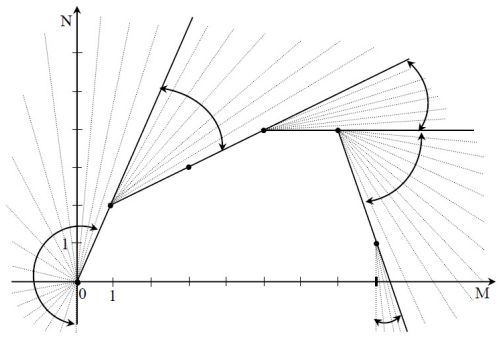
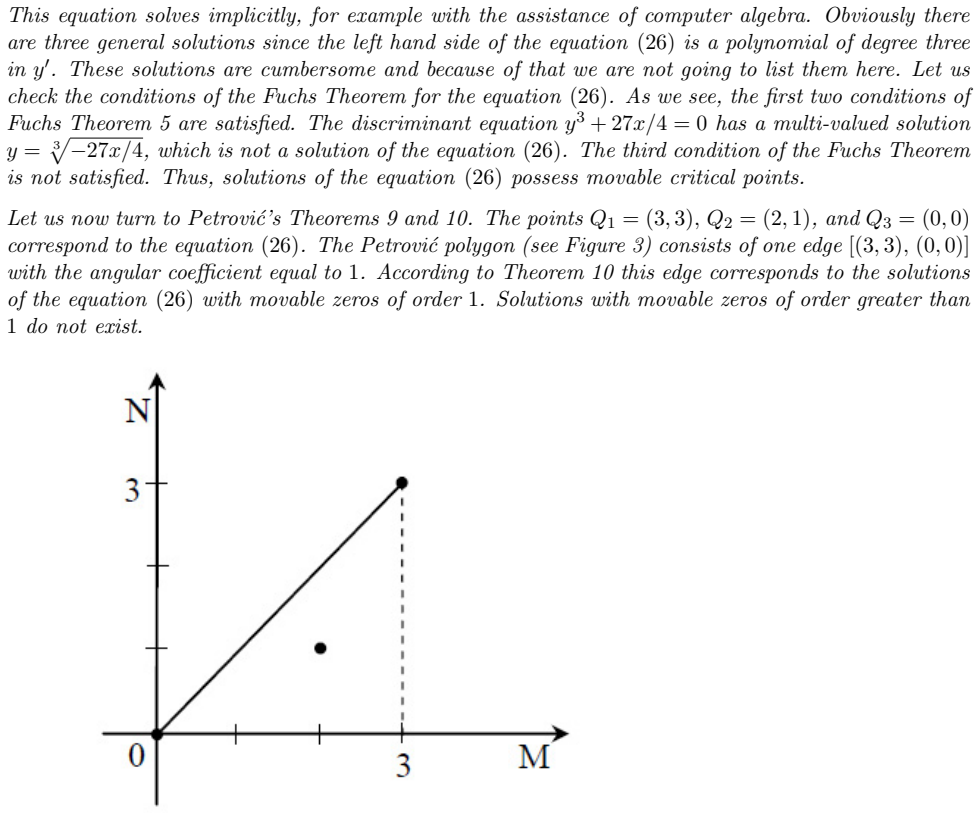
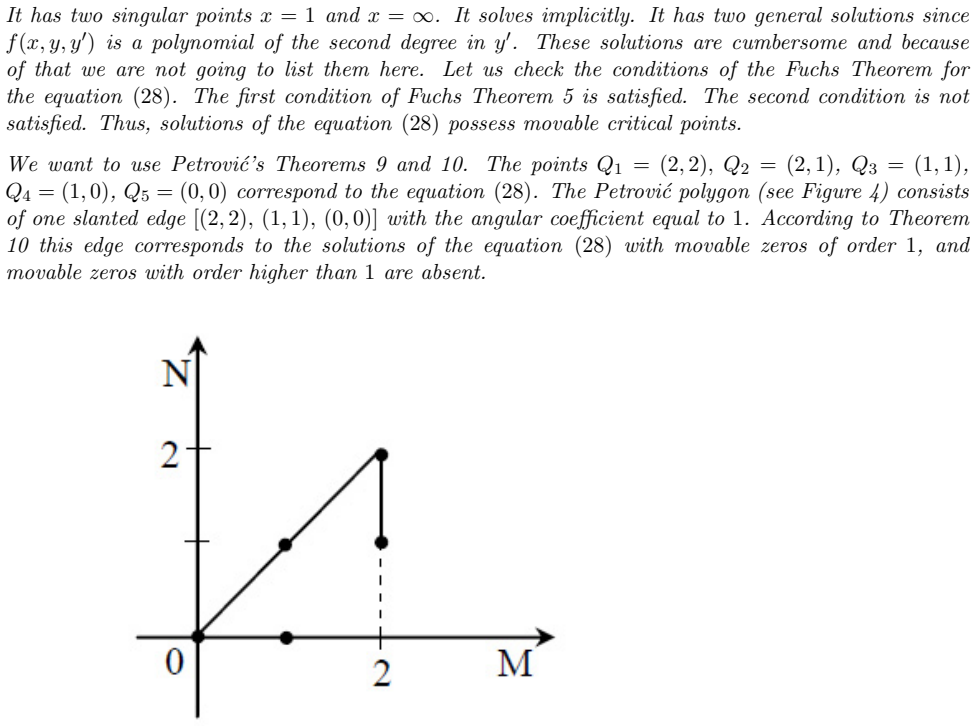
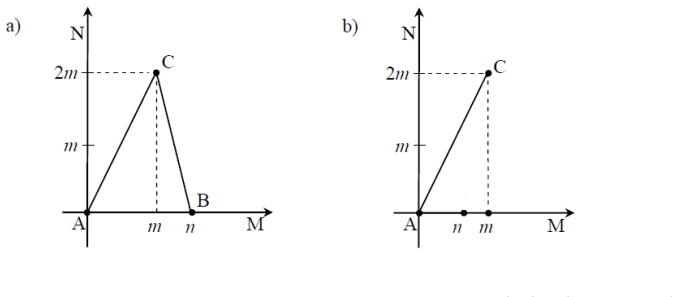
The idea is to plot each monomial of the equation as a point in a plane, with coordinates recording how many derivatives it contains and of what order. The convex hull of these points is a polygon, and each edge or vertex encodes a possible leading behavior of a solution. For first-order equations, Petrovic used this polygon to prove a clean criterion: the general solution has no movable zeros (or poles) exactly when the polygon has no slanted edge on the corresponding side. This is easier to check than the classical Fuchs conditions, which require solving a discriminant equation.
The paper also shows that Fine's polygon, which handles behavior at a singular point of the equation, is just Petrovic's polygon rotated by 90 degrees when the point is nonsingular. The authors connect these 1890s ideas to the contemporary 'power geometry' of Bruno and the work of Cano and Malgrange, arguing that much of the modern theory was anticipated a century earlier.
Extended reading notes
Core claim
The central assertion is that Petrovic's 1894 polygon method, independently paralleled by Fine in 1889, is a genuine generalization of the Newton-Puiseux method to algebraic ODEs and yields effective criteria for movable singularities. This is captured in Theorem 9: 'The necessary and sufficient condition for poles (zeros) of the general solution of a given algebraic ODE of the first order (25) not to depend on the constants of integration is that the polygon N of the equation (25) does not contain right (left) slanted edges.' If true, Petrovic established a simple geometric test decades before modern power geometry.
Load-bearing premise
The load-bearing historical premise is that the authors' reading of the primary sources ([67] Petrovic 1894, [29] Fine 1889, [70] collected works) is faithful and that Fine and Petrovic developed their methods independently and without knowledge of each other. This premise enters in Sections 1.1 and 1.2 and underpins the paper's novelty claims. If, for example, earlier work by Briot and Bouquet already contained the polygon construction for ODEs (hinted at in the incomplete citation 'see [?]' in the retrospective), the priority and neglect narrative would need revision.
Signed reviews
Editorial analysis
A structured set of objections, weighed in public.
Referee Report
Summary. The manuscript is a historical survey of geometric methods in the analytic theory of algebraic ordinary differential equations, centered on Mihailo Petrovic's 1894 polygon method and Henry Fine's 1889 independent construction. It presents the Petrovic polygon as a generalization of the Newton-Puiseux method from algebraic equations to algebraic ODEs, reconstructs both constructions with explicit coordinates, and proves a relation between them: Theorem 7 states that, for a nonsingular point, the Fine polygon of the translated equation coincides with the Petrovic polygon rotated by a quarter turn. The later sections survey applications: Petrovic's criteria for absence of movable poles and zeros (Theorem 9), his theorem on rational first-order ODEs with at most three essentially distinct transcendental single-valued solutions (Theorem 12), results on binomial ODEs, and the relation to modern power geometry, Painleve equations, and works of Cano, Bruno, and others. The final 'Retrospective' asserts that the first Newton-Puiseux-type ideas for differential equations may go back to Briot-Bouquet, but the relevant citation is left incomplete.
Significance. If the historical narrative is correct, the paper recovers a genuinely forgotten anticipation of modern power geometry: Petrovic's polygon test for movable poles and zeros is simpler to apply than Fuchs's discriminant-based criterion and predates the modern 'power geometry' literature by nearly a century. The paper's mathematical core is transparent and checkable: the coordinate definitions in Sections 3 and 4 are explicit, Theorem 7 follows directly from them, and Examples 1-3 contain enough detail for the reader to verify the leading asymptotics. The authors are also commendably candid about the limitations of planar polygons for higher-order equations (Section 3.1) and about Petrovic's absence from the Painleve program (Section 10.1). The main weakness is historical, not mathematical: the priority and neglect claims currently rest on incomplete citations, so the contribution is valuable but not yet in final form.
major comments (3)
- [Retrospective (unnumbered, before Acknowledgements)] The retrospective contains two unresolved citation placeholders: 'Broit and Bouquet, see [?]' and 'Cano ... see [ ?]'. The first is load-bearing: the abstract's claim that Petrovic's geometric ideas were 'left completely unnoticed by the experts' and the attribution of the ODE polygon method to Fine and Petrovic presuppose that no earlier work, in particular Briot-Bouquet, already contained a Newton-Puiseux polygon construction for differential equations. The authors must locate the relevant Briot-Bouquet passage, state explicitly whether it contains such a construction, and adjust the priority and neglect claims accordingly. The incomplete Cano citation should also be completed.
- [Sections 1.1-1.2] The independence of Fine and Petrovic, stated as 'independently' in the abstract and elaborated in Section 1.2, is not supported by documentary evidence; the text only notes that neither cited the other. Because independence is part of the paper's novelty narrative, the authors should either provide evidence such as correspondence, library records, or contemporary reviews, or explicitly qualify the claim as an inference from the absence of mutual citation.
- [Section 6, Theorem 9] Theorem 9, the paper's central mathematical exhibit, is presented with only a two-sentence proof sketch: sufficiency is deferred to Proposition 1 and necessity to 'the methods of analytic theory,' with a reference to Fuchs's techniques, without spelling out the argument. Since the paper states it as a theorem in its own text and uses it to claim that Petrovic anticipated modern criteria, please provide a complete proof or an exact page reference to [67] where Petrovic's proof is given, and explain how Painleve's Theorem 6 enters. This is needed for the reader to verify the 'necessary' direction.
minor comments (4)
- [Retrospective] The name 'Broit and Bouquet' is a typo for 'Briot and Bouquet'; elsewhere the spelling is correct.
- [References, [25]] Reference [25] is described as 'to appear, Bulletin of the AMS, 2020'; if the paper has appeared by now, the reference should be updated with full publication data.
- [Section 3 and Theorem 10] The term 'angular coefficient' is used repeatedly without a definition; define it explicitly as the slope of an edge in the (M,N)-plane and state its relation to the exponent lambda in (15).
- [Section 6, paragraph before Theorem 9] The sentence 'each its vertex corresponds to the exactly one monomial' is grammatically garbled and should be rewritten; a one-sentence justification for first-order equations would also help, since for different terms with the same (M,N) the correspondence is to a unique monomial only after summing coefficients.
Circularity Check
No significant circularity: the paper is a historical survey whose only new coordinate comparison is self-contained, and its self-citations are illustrative rather than load-bearing.
full rationale
No circular step meets the evidence standard. The paper's central mathematical content is historical attribution: Theorem 9 is presented as Petrovic's 1894 criterion, with sufficiency following from Proposition 1 and necessity from Fuchs-type arguments, not from any parameter fitted to the conclusion. The only new derivation, Theorem 7, is an explicit coordinate comparison: substituting x = z + x0 sends Petrovic's exponent pair (M_i,N_i) to Fine's pair (-N_i,M_i), so the claimed coincidence is a direct computation, not an assumed equivalence. The authors' own works [9], [10], [11], and [25] appear only as examples of later Power Geometry applications and as a BAMS cover note; they do not support the priority claim or the polygon criteria. The retrospective does contain unresolved historical citations: 'The first ideas to use the Newton – Puiseux methods in the theory of differential equations probably goes back to Broit and Bouquet, see [?]' and 'Cano implemented the ideas ... see [?].' These are missing references and leave the Briot-Bouquet precedence question open, but an incomplete citation is an evidentiary/completeness concern, not a circular reduction: the mathematical claims do not define their conclusion in terms of that citation. No equation is defined in terms of the result it is used to prove, and no fitted quantity is renamed as a prediction.
Assumptions & free parameters
assumptions (4)
- standard math Painleve Theorem 6: first-order algebraic ODEs have no movable non-algebraic singularities.
- standard math Fuchs Theorem 5 (necessary and sufficient conditions for absence of movable critical points).
- domain assumption Historical accuracy of primary sources [67], [29], [30], [70] as read by the authors.
- standard math Hermite Theorem 3 and Briot-Bouquet theory for elliptic solutions.
Cite this review
Pith. "Pith review of Polygons of Petrovic and Fine, algebraic ODEs, and contemporary mathematics." pith.science (2026). https://pith.science/paper/2GW36SOL
@misc{pith2026190803644,
  author       = {Pith},
  title        = {Pith review of: Polygons of Petrovic and Fine, algebraic ODEs, and contemporary mathematics},
  year         = {2026},
  howpublished = {\url{https://pith.science/paper/2GW36SOL}},
  note         = {Machine review of arXiv:1908.03644}
}
read the original abstract
Here, we study the genesis and evolution of geometric ideas and techniques in investigations of movable singularities of algebraic ordinary differential equations. This leads us to the work of Mihailo Petrovic on algebraic differential equations and in particular his geometric ideas captured in his polygon method from the last years of the XIXth century, which have been left completely unnoticed by the experts. This concept, also developed in a bit a different direction and independently by Henry Fine, generalizes the famous Newton-Puiseux polygonal method and applies to algebraic ODEs rather than algebraic equations. Although remarkable, the Petrovic legacy has been practically neglected in the modern literature, while the situation is less severe in the case of results of Fine. Thus, we study the development of the ideas of Petrovic and Fine and their places in contemporary mathematics.
Figures

Figures from the paper (2 more)
Reference graph
Works this paper leans on
-
[67]
Petrowitch M. Th` eses: Sur les z´ ero et les infinis des int´ egrales des ´ equations diff´ erentielles alg´ ebraiques. Propositions donn´ ees par la Facult´ e.Paris. 1894
-
[1]
Power series solutions for non-linear PDEs
Aroca F., Cano J., Jung F. Power series solutions for non-linear PDEs . Conference: Symbolic and Algebraic Computation, International Symposium ISSAC 2003, Drexel University, Philadelphia, Pennsylvania, USA, August 3-6, 2003, Proceedings
2003
-
[2]
Beri´ c M.Figural polygons of first order ODEs and their connection to the properties of the integrals
-
[3]
Recherches sur les transcendentes de M
Boutroux P. Recherches sur les transcendentes de M. Painlev´ e et l’´ etude asymptotique des ´ equations diff´ erentielles du second ordre.Ann. Sci. Ecole Norm. Sup. Vol. 30. 1913. P. 255–375. Vol. 31. 1914. P. 99–159
1913
-
[4]
Th` eorie des fonctions elliptiques, 1875
Briot C., Bouquet J. Th` eorie des fonctions elliptiques, 1875. P. 389
-
[5]
Proprietes des fonctions definie par des equations differentielles
Briot C., Bouquet J. Proprietes des fonctions definie par des equations differentielles. J. l’Ecole Polytechnique, Cah. 36. 1856. P. 133–198
-
[6]
Brieskorn E., Kn¨ orrer H. Plane Algebraic Curves, 1986. pp. 370–383
work page 1986
-
[7]
Bruno A. D. Asymptotic behaviour and expansions of solutions of an ordinary differential equation . Russian Math. Surv. Vol. 59(3). 2004. P. 429–480
work page 2004
Show all 86 references
-
[8]
Bruno A. D. Power Geometry in Algebraic and Differential Equations. Amsterdam: Elsevier Sci- ence, 2000
2000
-
[9]
D., Goryuchkina I
Bruno A. D., Goryuchkina I. V. Asymptotic expansions of the solutions of the sixth Painlev´ e equa- tion. Trans. Moscow Math. Soc. 2010. P. 1–104
2010
-
[10]
D., Goryuchkina I
Bruno A. D., Goryuchkina I. V. Boutroux asymptotic forms of solutions to Painlev´ e equations and Power Geometry. Doklady Mathematics. Vol. 78 (2). 2008. P. 681-685
2008
-
[11]
D., Parusnikova A
Bruno A. D., Parusnikova A. V. Expansions of solutions to the fifth Painleve equation near its nonsingular point. Doklady Mathematics. Vol. 85 (1). 2012. P. 87–92
2012
-
[12]
D., Shadrina T
Bruno A. D., Shadrina T. V. Axisymmetric boundary layer on a needle . Transactions of Moscow Math. Soc. Vol. 68. 2007. P. 201–259
2007
-
[13]
An extension of the Newton-Puiseux polygon construction to give solutions of Pfaffian forms
Cano J. An extension of the Newton-Puiseux polygon construction to give solutions of Pfaffian forms. Annales de l’institut Fourier. Vol. 43. 1993. P. 125–142
1993
-
[14]
On the series defined by differential equations, with an extension of the Puiseux polygon construction to these equations
Cano J. On the series defined by differential equations, with an extension of the Puiseux polygon construction to these equations . Analysis. Vol. 13. 1993. P. 103–119
1993
-
[15]
Power series solutions of non-linear q-difference equations and the Newton-Puiseux polygon, arXiv:1209.0295v1
Cano J., Fortuny Ayuso P. Power series solutions of non-linear q-difference equations and the Newton-Puiseux polygon, arXiv:1209.0295v1. 2012
2012 arXiv
-
[16]
Sur les ´ equations differentielles du troisieme ordre et d’ordre sup´ erieur dont l’int´ egrale g´ en´ erale a ses points critiques fixes
Chazy J. Sur les ´ equations differentielles du troisieme ordre et d’ordre sup´ erieur dont l’int´ egrale g´ en´ erale a ses points critiques fixes. Acta Math., 34:317-385, 1911
1911
-
[17]
and Robertson E.F
O’Connor J.J. and Robertson E.F. ”Henry Burchard Fine” , MacTutor History of Mathematics archive, University of St Andrews. 35
-
[18]
Cosgrove C. M. Chazy classes IX–XI of third-order differential equations . Stud. Appl. Math., 2000, vol. 104, pp. 171–228
2000
-
[19]
Cosgrove C. M. Higher-order Painlev´ e equations in the polynomial class. I. Bureau symbol P2. Stud. Appl. Math. 2000. 104, pp. 1–65
2000
-
[20]
Cosgrove C. M. Higher-order Painlev´ e equations in the polynomial class. II. Bureau symbol P1. Stud. Appl. Math. 2006. 116, pp. 321–413
2006
-
[21]
Introduction a l’analyse des lignes courbes alg´ ebraique, Fretres Cramer et Cl
Cramer G. Introduction a l’analyse des lignes courbes alg´ ebraique, Fretres Cramer et Cl. Philibert, 1750
-
[22]
Dragovi´ c, V.Mihailo Petrovi´ c, Algebraic Geometry and Differential Equations, pp. 257-266, in Mihailo Petrovi´ c Alas: life work, times, Serbian Academy of Sciences and Arts, Editor-in-chief: Marko Andjelkovi´ c Editors of publication: Stevan Pilipovi´ c, Gradimir V. Milovan...
2019
-
[23]
Algebro-geometric approach to an Okamoto transformation, the Painlev´ e VI and Schlesinger equationsAnnales Henri Poincar´ e, 20, No
Dragovi´ c V., Shramchenko V. Algebro-geometric approach to an Okamoto transformation, the Painlev´ e VI and Schlesinger equationsAnnales Henri Poincar´ e, 20, No. 4, 1121-1148, 2019
2019
-
[24]
Triangular Schlesinger systems and superelliptic curves, ArXiv: 1812.09795
Dragovi´ c V., Gontsov R., Shramchenko V. Triangular Schlesinger systems and superelliptic curves, ArXiv: 1812.09795
-
[25]
About the cover: The Fine - Petrovi´ c polygons and the Newton - Puiseux method for algebraic ODEs , to appear, Bulletin of the AMS, 2020
Dragovi´ c V., Goryuchkina I. About the cover: The Fine - Petrovi´ c polygons and the Newton - Puiseux method for algebraic ODEs , to appear, Bulletin of the AMS, 2020
2020
-
[26]
and Halburd R
Filipuk G. and Halburd R. G. Movable algebraic singularities of second-order ordinary differential equations. 2009. J. Math. Phys, 50:023509
2009
-
[27]
and Halburd R
Filipuk G. and Halburd R. G. Movable singularities of equations of Lienard type. Comput. Meth- ods Funct. Theory. 2009. 9. pp. 551–563
2009
-
[28]
and Halburd R
Filipuk G. and Halburd R. G. Rational ODEs with movable algebraic singularities. Stud. Appl. Math. 2009. 123. pp. 17–36
2009
-
[29]
On the functions defined by differential equations, with an extension of the Puiseux polygon construction to these equations
Fine H. On the functions defined by differential equations, with an extension of the Puiseux polygon construction to these equations . American J. Math. Vol. 11 (4). 1889. pp. 317–328
-
[30]
Singular solutions of ordinary differential equations
Fine H. Singular solutions of ordinary differential equations. American J. Math, Vol. 12, (3) 1890. pp. 295–322
-
[31]
¨Uber Differentialgleichungen, deren Integrale feste Verzweigungspunkte besitzen
Fuchs L. ¨Uber Differentialgleichungen, deren Integrale feste Verzweigungspunkte besitzen. Ges Werke. 1885. Vol. II. P. 355
-
[32]
Sur quelques ´ equations diff´ erentielles lin´ eaires du second ordre, Comptes Rendus
Fuchs R. Sur quelques ´ equations diff´ erentielles lin´ eaires du second ordre, Comptes Rendus. 1906
1906
-
[33]
Sur les ´ equations diff´ erentielles du second ordre et du premier degr´ e dont l’int´ egrale g´ en´ erale est ´ a points critiques fixes, Acta Mathematica
Gambier B. Sur les ´ equations diff´ erentielles du second ordre et du premier degr´ e dont l’int´ egrale g´ en´ erale est ´ a points critiques fixes, Acta Mathematica. 1910
1910
-
[34]
A Singular Mathematical Promenade, ENS Editions, 2017
Ghys E. A Singular Mathematical Promenade, ENS Editions, 2017. p. 302
2017
-
[35]
Golubev V. V. Lectures on analytic theory of differential equations, Moscow-Leningrad, in Rus- sian 1941, pp. 436. 36
1941
-
[36]
Golubev V. V. About one application of Picard’s theorem to the theory of differential equations , in Russian, Math. Sb. 1911
1911
-
[37]
Golubev V. V. On the theory of Painlev´ e equations, in Russian, Math. Sb. 28 (2) 1912
1912
-
[38]
Yu., Singer M
Grigor’ev D. Yu., Singer M. F. Solving ordinary differential equations in terms of series with real exponents. Trans. Amer. Math. Soc. Vol. 327 (1). 1991. P. 329–351
1991
-
[39]
Cours lithographi´ e de l’Ecole polytechnique
Hermite C. Cours lithographi´ e de l’Ecole polytechnique. 1873
-
[40]
On some generalizations of the Malmquist theorem
Hille, E. On some generalizations of the Malmquist theorem. Math. Scand. Vol. 39, 1979. P. 59–79
1979
-
[41]
The meromorphic nature of the sixth Painleve transcendents
Hinkkanen A., Laine I.J. The meromorphic nature of the sixth Painleve transcendents. Anal. Math. 2004. 94: 319
2004
-
[42]
Ordinary Differential Equations, New York, 1956
Ince E.L. Ordinary Differential Equations, New York, 1956
1956
-
[43]
Monodromy preserving deformation of linear ordinary differen- tial equations with rational coefficients: I
Jimbo M., Miwa T., Ueno K. Monodromy preserving deformation of linear ordinary differen- tial equations with rational coefficients: I. General theory and τ-function. Physica D: Nonlinear Phenomena. Vol. 2. Issue 2. 1981. P. 306–352
1981
-
[44]
Joshi N., Radnovi´ c M.Asymptotic behaviour of the fourth Painlev´ e transcendents in the space of initial values, Constructive Approximation 44. 2016. No. 2, pp. 195–231
2016
-
[45]
Joshi N., Radnovi´ c M.Asymptotic behaviour of the third Painlev´ e transcendents in the space of initial values, Proceedeings of the London Mathematical Society (3) 116 2018. no. 6, 1329–1364
2018
-
[46]
The truth about my life, autobiography, in Serbian, publisher: Markovi´ c Sonti´ c, pp
Karadjordjevic D. The truth about my life, autobiography, in Serbian, publisher: Markovi´ c Sonti´ c, pp. 494, Belgarde 2017
2017
-
[47]
Newton-Okounkov bodies, semigroups of integral points, graded algebras and intersection theory
Kaveh K., Khovanskii A. Newton-Okounkov bodies, semigroups of integral points, graded algebras and intersection theory. Annals of Mathematics, V. 176, No 2, 925– 978, 2012
2012
-
[48]
A class of non-linear ODEs with movable algebraic singularities
Kecker T. A class of non-linear ODEs with movable algebraic singularities. Comput. Methods Funct. Theory, 12:653–667, 2012
2012
-
[49]
On the singularity structure of differential equations in the complex plane , PhD thesis, UCL, 2014
Kecker T. On the singularity structure of differential equations in the complex plane , PhD thesis, UCL, 2014
2014
-
[50]
Sur le probl` eme de la rotation d’un corps solide autour d’un point fixe, Acta Math- ematica, 1889
Kowalevski S. Sur le probl` eme de la rotation d’un corps solide autour d’un point fixe, Acta Math- ematica, 1889. 12, 177–232
-
[51]
Sur une propriete du systeme dequations differentielles qui definit la rotation dun corps solide autour dun point fixe Acta Math
Kowalevski S. Sur une propriete du systeme dequations differentielles qui definit la rotation dun corps solide autour dun point fixe Acta Math. 1889. 14. pp. 81–93
-
[52]
A Princeton Companion, copyright Princeton University Press (1978)
Leitch A. A Princeton Companion, copyright Princeton University Press (1978)
1978
-
[53]
Sur les d’eformations isomonodromiques
Malgrange B. Sur les d’eformations isomonodromiques. I. Singularit´ es r´ eguli´ eres, Mathematics and physics (Paris, 1979/1982), Progr. Math., 37, Birkh¨ auser Boston, Boston, MA, 1983, 401–426
1979
-
[54]
Sur le th´ eor` eme de Maillet, Asympt
Malgrange B. Sur le th´ eor` eme de Maillet, Asympt. Anal. Vol. 2. 1989. P. 1–4
1989
-
[55]
Sur les fonctions ` a un nombre fini de brances d´ efinies par les ´ equations differentielles du premier ordre
Malmquist J. Sur les fonctions ` a un nombre fini de brances d´ efinies par les ´ equations differentielles du premier ordre. Acta mathematica. Vol. 36. 1913. pp. 297–334. 37
1913
-
[56]
Sur les fonctions a un nombre fini de branches satisfaisant a une ´ equation diff´ erentielle du premier ordre
Malmquist J. Sur les fonctions a un nombre fini de branches satisfaisant a une ´ equation diff´ erentielle du premier ordre. Acta Math, 42:317–325, 1920
1920
-
[57]
Sur les ´ equations diff´ erentielles du second ordre, dont lint´ egrale g´ en´ erale a ses points critiques fixes
Malmquist J. Sur les ´ equations diff´ erentielles du second ordre, dont lint´ egrale g´ en´ erale a ses points critiques fixes. Ark. f¨ or Mat., Astron. och Fys. 17:1–89, 1923
1923
-
[58]
Sur les fonctions a un nombre fini de branches satisfaisant a une ´ equation diff´ erentielle du premier ordre.Acta Math, 74:175–196, 1941
Malmquist J. Sur les fonctions a un nombre fini de branches satisfaisant a une ´ equation diff´ erentielle du premier ordre.Acta Math, 74:175–196, 1941
1941
-
[59]
Markovi´ c S.General Riccati equation of the first order. 1913. PhD thesis, in Serbian, University of Belgrade
1913
-
[60]
Zur Theorie der Meromorphen Funktionen, Acta Mathematica, 46 (1–2): pp
Nevanlinna R. Zur Theorie der Meromorphen Funktionen, Acta Mathematica, 46 (1–2): pp. 1–99, 1925
1925
-
[61]
Meromorphic functions, German original 1936, Russian translation 1941
Nevanlinna R. Meromorphic functions, German original 1936, Russian translation 1941
1936
-
[62]
De methodis serierum et fluxionum
Newton, I. De methodis serierum et fluxionum . 1670-1671. in Newton, MWP, vol. 3, chapter 1, pp. 32-254
-
[63]
Painlev´ e P.Th` ese: Sur les lignes singuli` eres des fonctions analytiques. Paris. 1887
-
[64]
Painlev´ e P.Sur les lignes singuli` eres des fonctions analytiques, Annales de la facult´ e des sciences de Toulouse 1re s´ erie, tome 2, 1888, B1-B130
-
[65]
M´ emoire sur les equations differentielles dont l’int´ egrale g´ en´ erale est uniforme
Painlev´ e P. M´ emoire sur les equations differentielles dont l’int´ egrale g´ en´ erale est uniforme. Bull. Soc. Math. France. 1900. 28. P. 201–261
1900
-
[66]
Painlev´ e P.Sur les ´ equations diff´ erentielles du second ordre et d’ordre sup´ erieur dont l’int´ egrale g´ en´ erale est uniforme, Acta Mathematica. 1902
1902
-
[68]
Sur une propri´ et´ e des ´ equations diff´ erentielles int´ egrables ` a l’aide des fonctions m´ eromorphes doublement p´ eriodiques.Acta mathematica
Petrovitch M. Sur une propri´ et´ e des ´ equations diff´ erentielles int´ egrables ` a l’aide des fonctions m´ eromorphes doublement p´ eriodiques.Acta mathematica. Vol. 22. 1899. P. 379–386
-
[69]
On a property of differential equations integrable using meromorphic double-periodic functions, Theoretical and Applied Mechanics, Volume 45 (2018) Issue 1, 121–127
Petrovitch M. On a property of differential equations integrable using meromorphic double-periodic functions, Theoretical and Applied Mechanics, Volume 45 (2018) Issue 1, 121–127. English transla- tion of the above Petrovitch’s Acta mathematica paper
2018
-
[70]
Collected works of Mihailo Petrovi´ c, 15 volumes, in Serbian, The State Textbook Company, Belgarde, 1999
1999
-
[71]
Milovanovi´ c,ˇZarko Mija- jlovi´ c, Belgrade, 2019
Mihailo Petrovi´ c Alas: life work, times, Serbian Academy of Sciences and Arts, Editor-in-chief: Marko Andjelkovi´ c Editors of publication: Stevan Pilipovi´ c, Gradimir V. Milovanovi´ c,ˇZarko Mija- jlovi´ c, Belgrade, 2019
2019
-
[72]
Picard E. C.r. Acad. sci. 1879. T. 88, p. 1024-1027. T. 89, p. 662–665
-
[73]
Picard E. Ann. ´Ecole norm. super. 1880. T. 9, p. 145–166
-
[74]
Memoire sur la th´ eorie des fonctions alg´ ebriques de deux variables, J
Picard E. Memoire sur la th´ eorie des fonctions alg´ ebriques de deux variables, J. de Math. pures appl. 1889
-
[75]
Trait´ e d’analyse, 1908
Picard, E. Trait´ e d’analyse, 1908. T. III, p. 378. 38
1908
-
[76]
Sur un th´ eor` eme de M
Poincare H. Sur un th´ eor` eme de M. Fuchs.Acta Math. 1885. T. 7, p. 1–32
-
[77]
Recherches sur les fonctions alg´ ebriques
Puiseux V. Recherches sur les fonctions alg´ ebriques. Journal de math´ ematiques pures et ap- pliquees 1re s´ erie. Tome 15. 1850. P. 365–480
-
[78]
D´ evissage Gevrey
Ramis J.-P. D´ evissage Gevrey. Ast´ erisque. Vol. 59/60. 1978. P. 173–204
1978
-
[79]
Proofs of the Painlev’e property for all Painlev´ e equations.Japan
Shimomura S. Proofs of the Painlev’e property for all Painlev´ e equations.Japan. J. Math. (N.S.), 29:159–180, 2003
2003
-
[80]
A class of differential equations of PI-type with the quasi-Painlev´ e property
Shimomura S. A class of differential equations of PI-type with the quasi-Painlev´ e property. Ann. Mat. Pura Appl, 186:267–280, 2007
2007
-
[81]
Nonlinear differential equations of second Painlev´e type with the quasi-Painlev´ e property along a rectifiable curve
Shimomura S. Nonlinear differential equations of second Painlev´e type with the quasi-Painlev´ e property along a rectifiable curve. Tohoku Math. J, 60:581–595, 2008
2008
-
[82]
Linear Differential Equations in the Complex Domain: Problems of Analytic Contin- uation
Sibuya Y. Linear Differential Equations in the Complex Domain: Problems of Analytic Contin- uation. Transl. Math. Monographs. Vol. 82. A.M.S. 1990
1990
-
[83]
Solomencev E. D. Picard’s theorem Mathematical Enciclopedia, edited by I. M. Vinogradov, Soviet Enciclopedia, 1984, V. 4. p. 286–287
1984
-
[84]
Henry Burchard Fine – In memoriam , Bulletin of the American Mathematical Society 35, (1929), pp
Veblen O. Henry Burchard Fine – In memoriam , Bulletin of the American Mathematical Society 35, (1929), pp. 726–730
1929
-
[85]
A generalization of a Malmquist’s theorem
Yosida K. A generalization of a Malmquist’s theorem . J. Math. Japan. (3) 15. 1933. pp. 253–256. 39
1933
-
[1912]
PhD thesis, in Serbian, University of Belgrade
Reviewed August 14, 2026 · model on record in the stance chip above.
Discussion (0). Continue with ORCID to comment.