REVIEW 3 major objections 4 minor 2 cited by
The Origin of the X-ray Emission in Two Well-Aligned Extragalactic Jets: The Case for IC/CMB
T0 review · 3 major / 4 minor · reviewed 2026-08-14 · deepseek-v4-flash
Pith's one-line read The faintest gamma-ray states of two jets line up with the IC/CMB model for their X-rays.
desk verdict A genuinely new low-state Fermi detection that matches IC/CMB predictions, honestly presented but not yet proof because of the unresolved core-jet degeneracy. read the letter →
The pith
A machine-rendered reading of the paper's core claim, the machinery that carries it, and where it could break.
The reading
What carries the argument
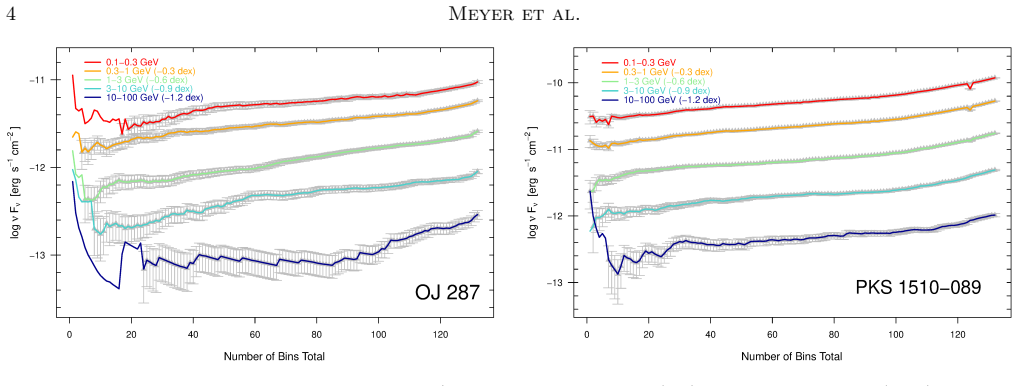
The load-bearing mechanism is IC/CMB: relativistic electrons in the large-scale jet upscatter cosmic microwave background photons to X-ray and gamma-ray energies. Because the inverse-Compton spectrum is essentially the synchrotron spectrum shifted in frequency, a well-measured radio-optical spectral energy distribution plus an X-ray flux fixes the predicted GeV level with no free parameters for the spectral shape. The analysis tool that makes the claim testable is progressive binning of Fermi/LAT light curves, in which weekly bins are sorted by significance and summed from lowest to highest; the minimum flux reached in each energy band is compared with the IC/CMB prediction, and a plateau in the recombined light curve is the signature of a steady component.
What would settle it
Continue Fermi/LAT monitoring and watch the minimum GeV flux: for either source, if any energy band's measured floor falls below the predicted IC/CMB level, or if a deep, prolonged low state of the core fails to reveal a plateau at the predicted flux, the identification fails. The predicted GeV flux is already fixed by the radio-optical and X-ray SEDs, so the test is a direct comparison over the next several years.
Extended reading notes
Core claim
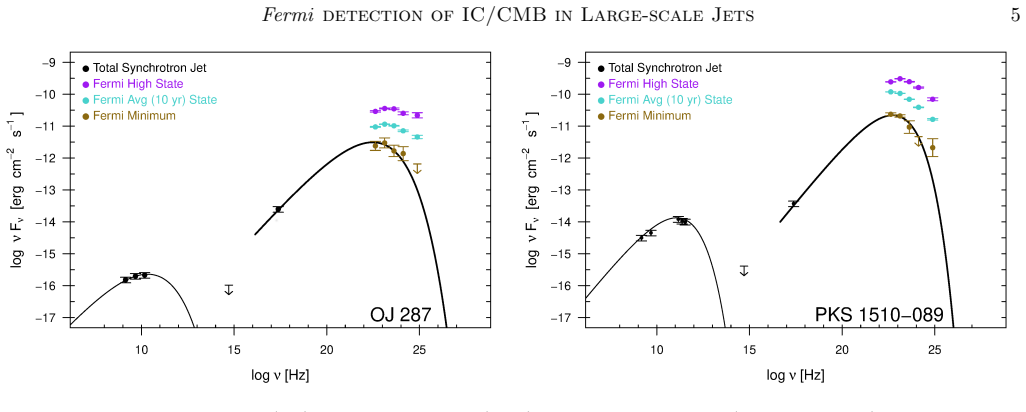
On its own terms, the paper reports the detection of a low-state Fermi/LAT gamma-ray spectrum associated with OJ 287 and PKS 1510-089 that is consistent with the IC/CMB model for their X-ray emission. Under the assumption that the resolved jet's X-rays are entirely inverse-Compton upscattered CMB photons, the GeV spectrum is locked down: it is the radio-optical synchrotron spectrum copied to higher frequencies, with its normalization fixed by the X-ray flux. The authors measure the minimum flux or upper limit in each of five Fermi energy bands using progressive binning of the light curve, and in both objects the minimum GeV flux agrees with the prediction. OJ 287 additionally shows a plateau in the recombined light curve, the signature expected from a non-variable jet component; PKS 1510-089 does not show such a plateau, and the paper leaves open that its minimum gamma-ray state is a low state of the variable core that matches by chance.
Load-bearing premise
The argument assumes that the faintest gamma-ray flux measured toward each source comes from a steady IC/CMB component of the large-scale jet, rather than from the lowest state of the unresolved, variable core that Fermi/LAT cannot separate from the jet.
Editorial extensions
If this is right
- If the IC/CMB interpretation holds, OJ 287 and PKS 1510-089 are the first resolved jets whose X-ray emission is positively identified as upscattered cosmic microwave background, demonstrating that at least some jets stay highly relativistic with Lorentz factors around 20-50 out to hundreds of kiloparsecs.
- The measured gamma-ray floor directly constrains the ratio of magnetic field strength to Doppler factor for each jet; with equipartition assumptions it gives Doppler factors of roughly 22.5 and 19 that can be compared with VLBI proper-motion measurements.
- For PKS 1510-089, continued Fermi/LAT monitoring should show the minimum GeV flux flattening into a plateau when the core falls below the jet floor; if instead the minimum keeps decreasing with core variability, the IC/CMB identification for this source is ruled out.
- The two sources occupy a distinctive parameter region, extreme apparent superluminal speed relative to kinetic power, which the paper interprets as jets viewed near the critical angle of about one over the Lorentz factor, where beaming boosts IC/CMB while the jet remains resolved; this predicts that similar cases are rare but should become more common at higher redshift because the CMB energy dens
Reading between the lines
- A systematic screen of other hard-X-ray jets with high superluminal speeds could apply the same progressive-binning minimum-flux test to search for additional IC/CMB candidates; the plateau signature would be the follow-up discriminator.
- If the PKS 1510-089 match eventually proves to be a core coincidence, the secure sample shrinks to OJ 287 alone, so the OJ 287 plateau and any future second example carry the burden of proof for the model.
- The paper's logic implies a selection effect: IC/CMB-dominated X-ray jets should preferentially appear as extreme outliers in apparent-speed versus power diagrams, so samples built without that preselection will keep ruling the model out for the typical jet.
Signed reviews
Editorial analysis
A structured set of objections, weighed in public.
Referee Report
Summary. The paper tests the IC/CMB model for the X-ray emission in the resolved jets of OJ 287 and PKS 1510-089. From the radio-to-X-ray spectral energy distributions, the authors predict the steady gamma-ray flux that should accompany the X-rays if they are produced by inverse Compton scattering of the CMB. Using a progressive binning method on Fermi/LAT data, they compare the minimum observed flux in five energy bands to these predictions and find agreement for both sources. They interpret this as evidence that these jets remain highly relativistic and well aligned on kpc scales, and argue that the two sources are rare outliers in the apparent-speed / jet-power plane. The paper explicitly acknowledges that for PKS 1510-089 the minimum gamma-ray flux could instead be a low state of the unresolved variable core.
Significance. If the interpretation is correct, this would be the first detection of the IC/CMB component predicted for kpc-scale quasar jets, resolving a two-decade debate in favor of IC/CMB for at least a subset of sources. The gamma-ray prediction is parameter-free given the radio/X-ray SED, providing a sharp, falsifiable test that has previously ruled out IC/CMB for many other jets. The authors should be credited for a transparent presentation of the data and for explicitly discussing the core-jet degeneracy. However, the current evidence is suggestive rather than conclusive: the minimum gamma-ray SED is not simultaneous, the OJ 287 plateau is not statistically quantified, and the PKS 1510-089 case rests on an assumption that the variable core's low state does not mimic the prediction. These limitations prevent the paper from fully establishing the claimed detection.
major comments (3)
- [Section 3, Figure 3 caption and text] The 'minimum SED' shown in Figure 3 is not a simultaneous spectrum: for OJ 287 the five band fluxes are taken from combined bins 17, 4, 7, 10, and 16, and for PKS 1510-089 from bins 7, 7, 1, 1, and 10 (as stated in the text). Because the IC/CMB prediction is a single spectral curve, comparing it to a composite of minima from different time intervals can produce agreement by construction even if no single epoch matches the prediction. The paper should present a truly simultaneous low-state spectrum, or quantify the chance probability that the band-wise minima from different bins would jointly match the predicted shape.
- [Section 3, Figure 2] The claim of a steady gamma-ray floor for OJ 287 rests on 'signs of such plateau behavior' and 'hints of a much smaller plateau', but no statistical test is provided. A quantitative analysis (e.g., a fit of a constant plus variable component, or a comparison of the progressive-binning curve to the expectation for a purely variable source) is needed to establish that the minimum flux is not simply the lowest measured state of a variable core.
- [Section 4, second paragraph] The paper explicitly concedes that for PKS 1510-089 'it is possible that we have simply measured the minimum flux level of the core from the last ten years of Fermi/LAT observations which coincidentally matches the level and spectrum expected from the jet under IC/CMB.' Since Fermi/LAT cannot resolve the jet from the core (Section 3), and Figure 2 shows no plateau, this source cannot be considered a confirmed detection of IC/CMB without additional evidence. The abstract's phrasing 'detection of a low-state Fermi/LAT gamma-ray spectrum ... consistent with the predictions' may overstate the case.
minor comments (4)
- [Section 2.2] The mode name 'F AINT' should presumably be 'FAINT'.
- [Reference list] The entry for Simionescu et al. contains a LaTeX control sequence '/suppress' that should be removed.
- [Abstract] The phrase 'which requires jets which remain highly relativistic' is grammatically awkward; consider revising.
- [Table 1] The column headers 'νFν' appear twice; the table would be clearer if the two halves were separated by a vertical line or the units restated once per half.
Circularity Check
No significant circularity: the gamma-ray prediction is computed from radio/X-ray data and tested against independent Fermi/LAT minimum fluxes.
full rationale
The paper's central test is non-circular. The IC/CMB gamma-ray prediction is derived from the radio-optical synchrotron spectrum and the Chandra X-ray jet flux via the IC/CMB scattering formalism, and is then compared with independently measured Fermi/LAT minimum fluxes. No Fermi gamma-ray data enter the model normalization; the gamma-ray band is used only as the test observable. The progressive-binning minimum-flux method is taken from the authors' prior papers (Meyer & Georganopoulos 2014; Meyer et al. 2015), but that is a data-analysis technique, not a fitted parameter or a result that presupposes IC/CMB. The paper explicitly concedes the main alternative for PKS 1510-089: 'the minimum gamma-ray flux level is due to a low state of the variable core which only matches the IC/CMB prediction by chance,' and it notes the lack of a clear plateau in that source. For OJ 287 the plateau evidence is described only as 'signs' and 'hints,' and the minimum SED is not simultaneous. These are honest limitations on the strength of the claim, not circular reasoning. The non-simultaneous minimum SED and the unresolved core-jet degeneracy weaken the inference but do not make the prediction equivalent to its inputs. No self-citation chain forces the conclusion; earlier same-group papers are cited for method and for the IC/CMB prediction formula, which are independent of the present detection.
Assumptions & free parameters
free parameters (2)
- Minimum electron Lorentz factor gamma_min =
10
- Phenomenological synchrotron SED model parameters =
Not provided
assumptions (4)
- domain assumption The kpc-scale jet X-ray emission is entirely due to IC/CMB from the same electron population producing the radio-optical synchrotron emission.
- domain assumption The jet remains highly relativistic and well-aligned on 10-1000 kpc scales.
- domain assumption The IC/CMB gamma-ray emission is steady and non-variable over the Fermi observational period.
- domain assumption One-zone homogeneous emission region with isotropic CMB target photons.
Cite this review
Pith. "Pith review of The Origin of the X-ray Emission in Two Well-Aligned Extragalactic Jets: The Case for IC/CMB." pith.science (2026). https://pith.science/paper/2J3GETTF
@misc{pith2026190807139,
  author       = {Pith},
  title        = {Pith review of: The Origin of the X-ray Emission in Two Well-Aligned Extragalactic Jets: The Case for IC/CMB},
  year         = {2026},
  howpublished = {\url{https://pith.science/paper/2J3GETTF}},
  note         = {Machine review of arXiv:1908.07139}
}
read the original abstract
Over the past two decades, the most commonly adopted explanation for high and hard X-ray emission in resolved quasar jets has been inverse Compton upscattering of the Cosmic Microwave Background (IC/CMB), which requires jets which remain highly relativistic on 10-1000 kpc scales. In more recent years various lines of observational evidence, including gamma-ray upper limits, have disfavored this explanation in favor of a synchrotron origin. While the IC/CMB model generally predicts a high level of gamma-ray emission, it has never been detected. Here we report the detection of a low-state Fermi/LAT gamma-ray spectrum associated with two jetted AGN which is consistent with the predictions of the IC/CMB model for their X-ray emission. We have used archival multiwavelength observations to make precise predictions for the expected minimum flux in the GeV band, assuming that the X-ray emission from the kpc-scale jet is entirely due to the IC/CMB process. In both sources -- OJ 287 and PKS 1510-089 -- the minimum-detected gamma-ray flux level agrees with predictions. Both sources exhibit extreme superluminal proper motions relative to their jet power, which argues for the well-aligned jets required by the IC/CMB model. In the case of PKS~1510-089, it cannot be ruled out that the minimum gamma-ray flux level is due to a low state of the variable core which only matches the IC/CMB prediction by chance. Continued long-term monitoring with the Fermi/LAT could settle this issue by detecting a plateau signature in the recombined light-curve which would clearly signal the presence of a non-variable emission component.
Figures

Figures from the paper (1 more)

Forward citations
Cited by 2 Pith papers
-
The most extreme high-z radio quasars in the eRASS:1 X-ray survey
The team confirmed 39 new high-redshift radio quasars and found that the number of X-ray-selected blazars at z>4 grows with redshift faster than a constant X-ray/radio ratio model, in broad agreement with the IC/CMB model.
-
The physical mechanism for two rapid changing-look AGNs: SDSS J0225+0030 and SDSS J1723+5504
A revised ADAF-collapse model, with the transition radius estimated from optical flux changes, yields cooling timescales comparable to the observed sub-year turn-on timescales of two changing-look AGNs.
Reference graph
Works this paper leans on
-
[1]
G., & Longair, M
Arshakian, T. G., & Longair, M. S. 2004, MNRAS, 351, 727
2004
-
[2]
Breiding, P., Meyer, E. T., Georganopoulos, M., et al. 2017, ApJ, 849, 95
work page 2017
- [3]
- [4]
-
[5]
2001, MNRAS, 321, L1
Celotti, A., Ghisellini, G., & Chiaberge, M. 2001, MNRAS, 321, L1
2001
-
[6]
M., Birkinshaw, M., et al
Chartas, G., Worrall, D. M., Birkinshaw, M., et al. 2000, ApJ, 542, 655
2000
- [7]
-
[8]
Georganopoulos, M., Perlman, E. S., Kazanas, D., et al. 2006, ApJ, 653, L5
work page 2006
Show all 33 references
-
[9]
Hardcastle, M. J. 2006, MNRAS, 366, 1465
2006
-
[10]
J., & Krause, M
Hardcastle, M. J., & Krause, M. G. H. 2013, MNRAS, 430, 174
2013
-
[11]
C., Ojha, R., Wardle, J
Homan, D. C., Ojha, R., Wardle, J. F. C., et al. 2001, ApJ, 549, 840
2001
-
[12]
G., Marscher, A
Jorstad, S. G., Marscher, A. P., Lister, M. L., et al. 2005, AJ, 130, 1418
2005
-
[13]
G., & Marscher, A
Jorstad, S. G., & Marscher, A. P. 2006, Astronomische Nachrichten, 327, 227
2006
-
[14]
L., & Cooper, N
Kharb, P., Lister, M. L., & Cooper, N. J. 2010, ApJ, 710, 764
2010
-
[15]
L., Marshall, H
Kharb, P., Lister, M. L., Marshall, H. L., et al. 2012, ApJ, 748, 81
2012
-
[16]
P., & Jorstad, S
Marscher, A. P., & Jorstad, S. G. 2011, ApJ, 729, 26
2011
-
[17]
L., Schwartz, D
Marshall, H. L., Schwartz, D. A., Lovell, J. E. J., et al. 2005, ApJS, 156, 13
2005
-
[18]
L., Gelbord, J
Marshall, H. L., Gelbord, J. M., Schwartz, D. A., et al. 2011, ApJS, 193, 15
2011
-
[19]
T., Fossati, G., Georganopoulos, M., et al
Meyer, E. T., Fossati, G., Georganopoulos, M., et al. 2011, ApJ, 740, 98 Fermi detection of IC/CMB in Large-scale Jets 9
2011
-
[20]
T., & Georganopoulos, M
Meyer, E. T., & Georganopoulos, M. 2014, ApJ, 780, L27
2014
-
[21]
T., Georganopoulos, M., Sparks, W
Meyer, E. T., Georganopoulos, M., Sparks, W. B., et al. 2015, ApJ, 805, 154
2015
-
[22]
T., Sparks, W
Meyer, E. T., Sparks, W. B., Georganopoulos, M., et al. 2016, ApJ, 818, 195
2016
-
[23]
T., Breiding, P., Georganopoulos, M., et al
Meyer, E. T., Breiding, P., Georganopoulos, M., et al. 2017, ApJ, 835, L35
2017
-
[24]
P., Brandt, W
Miller, B. P., Brandt, W. N., Gallagher, S. C., et al. 2006, ApJ, 652, 163
2006
-
[25]
S., Georganopoulos, M., Marshall, H
Perlman, E. S., Georganopoulos, M., Marshall, H. L., et al. 2011, ApJ, 739, 65
2011
-
[26]
M., Maraschi, L., Tavecchio, F., et al
Sambruna, R. M., Maraschi, L., Tavecchio, F., et al. 2002, ApJ, 571, 206
2002
-
[27]
M., Gambill, J
Sambruna, R. M., Gambill, J. K., Maraschi, L., et al. 2004, ApJ, 608, 698
2004
-
[28]
A., Marshall, H
Schwartz, D. A., Marshall, H. L., Lovell, J. E. J., et al. 2000, ApJ, 540, 69
2000
-
[29]
2016, ApJL, 816, L15
Simionescu, A., Stawarz, /suppress L., Ichinohe, Y., et al. 2016, ApJL, 816, L15
2016
-
[30]
C., Kharb, P., Lister, M
Stanley, E. C., Kharb, P., Lister, M. L., et al. 2015, ApJ, 807, 48
2015
-
[31]
M., et al
Tavecchio, F., Maraschi, L., Sambruna, R. M., et al. 2000, ApJ, 544, L23
2000
-
[32]
2007, ApJ, 662, 900
Tavecchio, F., Maraschi, L., Wolter, A., et al. 2007, ApJ, 662, 900
2007
-
[33]
Wang, J.-M., Luo, B., & Ho, L. C. 2004, ApJL, 615, L9
2004
Reviewed August 14, 2026 · model on record in the stance chip above.
Discussion (0). Continue with ORCID to comment.