REVIEW 3 major objections 4 minor 65 references
Three-dimensional Structure of Incomplete Carbon-Oxygen Detonations in Type Ia Supernovae
T0 review · 3 major / 4 minor · reviewed 2026-08-09 · deepseek-v4-flash
Pith's one-line read The paper finds that three-dimensional carbon-oxygen detonations in Type Ia supernovae are robust, self-sustaining cellular waves, unlike their one- and two-dimensional counterparts, with a cell size roughly five times the carbon…
desk verdict First 3D simulations of incomplete CO detonations in the SN Ia outer-layer regime; the 3D-vs-2D robustness contrast is new and credible, but the quantitative cell size rests on symmetry-wall confinement that still needs a periodic-boundary check. read the letter →
The pith
A machine-rendered reading of the paper's core claim, the machinery that carries it, and where it could break.
The reading
What carries the argument
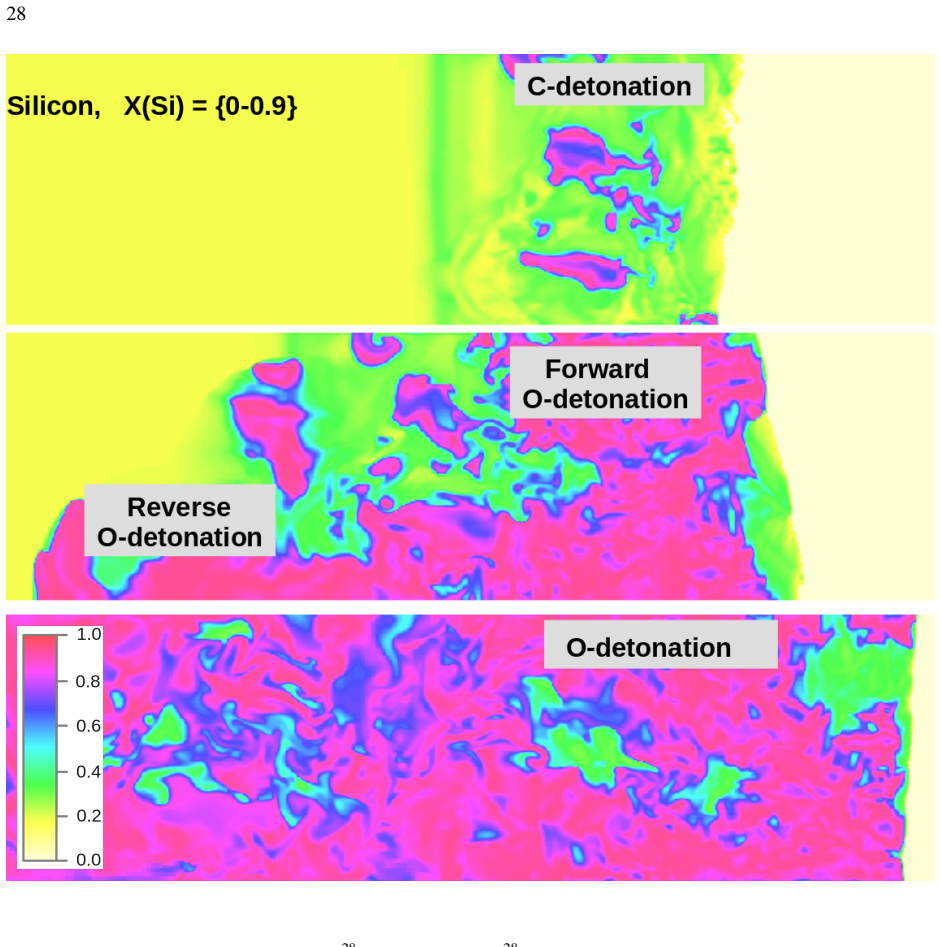
The central object is the cellular detonation structure of a Chapman-Jouguet carbon detonation, quantified by the carbon half-reaction length $x_C$, the distance from the leading shock at which half of the initial $^{12}$C is consumed. The argument is carried by the interplay between the leading shock and transverse reaction waves: in 3D, triple-point collisions and transverse waves re-accelerate burning behind weak shock sections, maintaining a self-sustaining cellular regime with $l_c \simeq 5 x_C$. The simulations use the adaptive-mesh reactive-flow code ALLA with a 13-species nuclear network, and the key diagnostics are head-on Schlieren images that reveal detonation cells in the plane perpendicular to propagation.
What would settle it
Run the identical 3D setup with periodic or non-reflecting transverse boundary conditions in a tube several times wider than $50 x_C$; if the detonation decays or the cell size departs from $l_c \simeq 5 x_C$, the boundary setup, not intrinsic 3D physics, is responsible for the claimed robustness.
Extended reading notes
Core claim
In three dimensions, incomplete carbon-oxygen detonations settle into a quasi-steady cellular regime in which transverse reaction waves re-energize a leading shock that would otherwise decay. The averaged 3D structure closely resembles the steady one-dimensional ZND reaction zone, but carbon is consumed slightly faster and slightly more silicon is produced. The detonation cell size is estimated as $l_c \simeq 5 x_C$ at every background density from $5\times 10^5$ to $10^6$ g cm$^{-3}$, and the relation appears independent of tube width and numerical resolution. In carbon-poor mixtures ($X_C = 0.3$), the same cellular instability triggers a transition to oxygen burning, so the detonation can no longer be treated as quasi-steady. These results imply that dimensionality matters for detonation modeling of SN Ia outer layers: 2D simulations produce cell sizes about 50 times larger and over-predict intermediate-mass elements and residual carbon.
Load-bearing premise
The load-bearing premise is that a rectangular tube with symmetry boundary conditions in the transverse directions captures the behavior of an unconfined three-dimensional detonation; if those boundaries suppress antisymmetric or oblique transverse modes, the measured robustness and cell size could be partly a numerical boundary effect.
Editorial extensions
If this is right
- Three-dimensional incomplete C-detonations in SN Ia outer layers can be treated as quasi-steady cellular waves with a predictable cell scale of about five carbon half-reaction lengths.
- Two-dimensional simulations of detonation waves in SNe Ia need to be re-examined, because they over-predict intermediate-mass elements and residual $^{12}$C by producing much larger cells and intermittent decay.
- In carbon-poor compositions ($X_C \leq 0.3$), the detonation transitions to O-burning, so little oxygen remains in the outer layers and the burning must be modeled as fully non-stationary.
- Chemical inhomogeneities from the cellular structure persist for 20-30 $x_C$ behind the shock, freezing out in the outer layers and potentially producing the observed early light-curve bumps and polarization fluctuations.
- The outcome depends on the geometry of the exploding star, meaning progenitor and explosion geometry can affect the nucleosynthesis of intermediate-mass elements.
Reading between the lines
- If $l_c \simeq 5 x_C$ holds over a wider density range, the cell size could be used as a subgrid mixing-length prescription in full-star SN Ia simulations without resolving each cell.
- The 2D-versus-3D contrast may be a general property of detonations with low energy release, suggesting terrestrial combustion studies of marginally unstable detonations should benchmark 3D rather than 2D calculations.
- The sharp transition to O-burning near $X_C \simeq 0.3$ offers an observable diagnostic: the relative abundances of intermediate-mass elements and residual oxygen in outer ejecta could constrain the C/O ratio of the progenitor's outer layers.
- Testing the symmetry-boundary assumption with a broader set of boundary conditions would strengthen the case before applying the results to unconfined explosion geometries.
Editorial analysis
A structured set of objections, weighed in public.
Referee Report
Summary. The paper presents 2D and 3D reactive-flow simulations of incomplete carbon detonations at densities 0.5, 0.7, and 1.0×10^6 g cm^-3 for C/O = 1 mixtures and at 1.0×10^6 g cm^-3 for a C/O = 0.3/0.7 mixture, using a 13-species alpha network with the ALLA AMR code. The central claim is that 3D CO detonations are strikingly more robust than their 1D and 2D counterparts: they settle into a quasi-steady cellular regime with velocity near the Chapman-Jouguet value and a cell size lc ≈ 5 x_C, whereas 2D detonations undergo repeated weakening and wall-bounce reinitiation. The paper also reports that, in the carbon-poor run, temperature fluctuations at triple-point collisions trigger a transition to oxygen burning, and it connects the resulting chemical inhomogeneities to early light-curve bumps and polarization features in SNe Ia.
Significance. If the 3D robustness and the relation lc ≈ 5 x_C survive an unconfined geometry, this is an important result: it would imply that low-density incomplete C-detonations in SNe Ia are self-sustaining cellular waves whose structure and nucleosynthetic products can be predicted only by 3D simulations, and that existing 2D detonation models overpredict intermediate-mass elements and residual carbon. The paper is commendably free of fitted parameters: the ZND initial conditions come from independent 1D theory, the cell size, stability properties, and O-burning transition are emergent outputs of the time-dependent calculations, and the resolution study spans n_c = 12.3, 24.5, and 49 at a fixed density. The density scan and the explicit 2D/3D comparison are also strengths. The main risk to the central claim is the use of symmetry boundary conditions in the transverse directions, which are not tested against periodic or open-boundary 3D runs.
major comments (3)
- [Section 3.2 / 4.2] The paper's central claim that the 3D detonation is intrinsically robust and that lc ≈ 5 x_C is established only in a rectangular tube with symmetry (reflecting) boundary conditions in the Y and Z directions. The statement in Section 4.2 that 'the obtained results do not depend on ... the boundary conditions' is not supported by any 3D test with periodic or non-reflecting transverse boundaries; the two widths W = 20.8 x_C and W = 41.7 x_C vary the domain size but not the boundary type, and the cited support is from 2D studies at higher densities. This is not a merely formal point, because in the paper's own 2D simulations (Section 4.4) the detonation is repeatedly re-initiated by transverse waves reflecting off the side walls, with a quasi-period that scales with W, showing that wall reflections are dynamically active. Since the 3D tube is only about 4-8 cell sizes wide, the observed cellular pattern and the measured lc could in part be selected by the symmetry planes, which enforce standing-wave nodal conditions and can suppress antisymmetric or oblique transverse modes. Please provide a 3D run with periodic or open transverse boundaries, or a substantially wider unconfined domain, to confirm that the cellular regime and lc ≈ 5 x_C persist without reflecting walls; alternatively, the 'intrinsic' wording should be replaced by a statement that the result is obtained under symmetry boundary conditions, with the uncertainty explicitly discussed.
- [Section 4.5 / Figs. 12-14] The conclusion that carbon-poor mixtures (X_C = 0.3) undergo a rapid transition to O-burning and must be treated as fully non-stationary is based on a single simulation at rho0 = 10^6 g cm^-3. No entry for this run appears in Table 2, so the resolution (n_c), domain size, and run duration are not documented, and no resolution or width variation is shown for this composition. Because this result is used to argue that merger-progenitor outer layers may leave little oxygen and that quasi-steady detonation treatment fails for X_C <= 0.3, please provide the missing run parameters and at least one additional run at a different resolution, density, or domain width to demonstrate that the O-detonation transition is not a numerical artifact.
- [Section 4.3 / Fig. 9] The cell-size estimate lc ≈ 5 x_C is derived by visually identifying '3-4 detonation cells' across a tube of width W = 20.8 x_C, with the wider run shown only as a quarter cross-section. No quantitative cell-size measurement, statistics, or uncertainty is reported, and the resolution comparison is qualitative. Because this relation is a central quantitative result quoted in the abstract, please describe the measurement procedure (for example, triple-point trajectories, shock-front modulation spectra, or a histogram of cell spacings) and give a value with an uncertainty range. The current 'roughly estimate' is a useful first statement, but it is not yet a calibrated measurement.
minor comments (4)
- [Fig. 10 / Table 2] The caption of Fig. 10c refers to run '5e6B' but Table 2 lists the run at rho0 = 0.5 × 10^6 g cm^-3 as '5e5B'; please make the run identifiers consistent.
- [Appendix B] Appendix B appears to be recycled from a manuscript about terrestrial detonations: it describes 'a new massively parallel AMR code HSCD for first-principles reactive Navier-Stokes numerical simulations ... in terrestrial gases,' which does not belong in this astrophysical paper. Please rewrite or remove this appendix so that the numerical-method description matches the ALLA code used in the body of the paper.
- [Tables 1 and 2] The notation for the carbon mass fraction alternates between X_C in the tables and X12_C in the text and figures; please unify the notation to avoid ambiguity.
- [Section 4.3] For reproducibility, please state explicitly whether the '3-4 cells across the width' count refers to the full W = 20.8 x_C tube or to the quarter section shown in Fig. 9d, since the two interpretations give different estimates of lc.
Circularity Check
No circularity: the multidimensional detonation properties are emergent simulation outputs, not fitted inputs or renamed prior results.
full rationale
The paper's central outputs—3D cellular robustness, lc ~ 5 x_C, and the transition to O-burning at X_C = 0.3—are emergent from time-dependent reactive Euler simulations with a specified 13-species alpha network and EOS. ZND initial conditions are taken from the authors' earlier one-dimensional work (Domínguez & Khokhlov 2011), but that is an independent steady-state calculation used only to initialize the multidimensional runs and to define the scaling length x_C; it is not the target result. The cell size is estimated from resolved cellular structure, not fitted, and the paper demonstrates resolution independence (runs 1e6C, 1e6C1, 1e6C2) and width independence (runs 1e6C vs 1e6D). Self-citations to prior 1D stability analysis and to Khokhlov & Dominguez 2015 are contextual; the key instability and O-detonation transition are shown in the present simulations, not merely borrowed. The assertion in Section 4.2 that results do not depend on boundary conditions is supported only by two tube widths and by 2D studies, and no 3D periodic or non-reflecting transverse-boundary run is reported; this is a validity concern about extrapolation to unconfined detonations, but it is not a definitional circularity. Appendix B contains an apparent editorial boilerplate passage about terrestrial HSCD/Navier-Stokes simulations that is inconsistent with the Euler solver described in Section 3.1; it is an artifact and does not enter the derivation chain. No equation or fitted parameter is equivalent by construction to any predicted quantity in this paper.
Assumptions & free parameters
free parameters (4)
- Initial carbon mass fraction X_C =
0.5 and 0.3 by mass
- Background density rho_0 =
0.5, 0.7, 1.0 x 10^6 g/cc
- Initial perturbation radius =
r_p = 0.25 x_C, amplitude not stated
- Tube width W =
20.8 or 41.7 x_C
assumptions (6)
- domain assumption Euler equations with a degenerate electron EOS and an alpha network adequately describe detonation physics in this regime.
- domain assumption The truncated 8-species alpha network matches the full alpha network for rho_0 <= 1e6 g/cc.
- domain assumption Reaction rates from Fowler et al. (1978), Woosley et al. (1978), Thielemann (1993), with Yakovlev & Shalybkov (1989) screening, are accurate enough.
- standard math ZND detonation solutions from Dominguez & Khokhlov (2011) are valid initial conditions and reference states.
- ad hoc to paper A constant-density rectangular tube with symmetry Y/Z boundaries reproduces an unconfined detonation in SN Ia outer layers.
- domain assumption The wave propagates freely at Chapman-Jouguet conditions after the cellular regime develops.
Cite this review
Pith. "Pith review of Three-dimensional Structure of Incomplete Carbon-Oxygen Detonations in Type Ia Supernovae." pith.science (2026). https://pith.science/paper/2JELAKDC
@misc{pith2026250119190,
  author       = {Pith},
  title        = {Pith review of: Three-dimensional Structure of Incomplete Carbon-Oxygen Detonations in Type Ia Supernovae},
  year         = {2026},
  howpublished = {\url{https://pith.science/paper/2JELAKDC}},
  note         = {Machine review of arXiv:2501.19190}
}
abstract
Carbon-oxygen (CO) detonation with reactions terminating either after burning of C$^{12}$ in the leading C$^{12}$ + C$^{12}$ reaction or after burning of C$^{12}$ and O$^{16}$ to Si-group elements may occur in the low-density outer layers of exploding white dwarfs and be responsible for the production of intermediate-mass elements observed in the outer layers of Type Ia supernovae. Basic one-dimensional properties of CO-detonations have been summarized in our previous work. This paper presents the results of two- and three-dimensional numerical simulations of low-density CO-detonations and discusses their multidimensional stability, cellular structure, and propagation through a constant low-density background. We find three-dimensional CO detonations to be strikingly different from their one-dimensional and two-dimensional counterparts. Three-dimensional detonations are significantly more robust and capable of propagating without decay compared to highly unstable and marginal one- and two- dimensional detonations. The detonation cell size and whether burning of C$^{12}$ in a three-dimensional detonation wave is followed by the subsequent O$^{16}$ burning is sensitive to both the background density and the initial C$^{12}$ to O$^{16}$ mass ratio. We also discuss the possible implications for understanding the observed early time bumps in light-curves.
Figures


Figures from the paper (12 more)



Reference graph
Works this paper leans on
-
[1]
, " * write output.state after.block = add.period write newline
ENTRY address archivePrefix author booktitle chapter doi edition editor eprint howpublished institution journal key month number organization pages publisher school series title misctitle type volume year version url label extra.label sort.label short.list INTEGERS output.state before.all mid.sentence after.sentence after.block FUNCTION init.state.consts ...
-
[2]
write newline
" write newline "" before.all 'output.state := FUNCTION format.url url empty "" new.block "" url * "" * if FUNCTION format.eprint eprint empty "" archivePrefix empty "" archivePrefix "arXiv" = new.block " " eprint * " " * new.block " " eprint * " " * if if if FUNCTION format.doi doi empty "" " " doi * " " * if FUNCTION format.pid doi empty eprint empty ur...
-
[3]
cheat sheet
thebibliography [1] 20pt to REFERENCES 6pt =0pt -12pt 10pt plus 3pt =0pt =0pt =1pt plus 1pt =0pt =0pt -12pt =13pt plus 1pt =20pt =13pt plus 1pt \@M =10000 =-1.0em =0pt =0pt 0pt =0pt =1.0em @enumiv\@empty 10000 10000 `\.\@m \@noitemerr \@latex@warning Empty `thebibliography' environment \@ifnextchar \@reference \@latexerr Missing key on reference command E...
2021
-
[4]
- [1] #1 = = ^ ^ ^ .\!\!^ d .\!\!^ h .\!\!^ m .\!\!^ s .\!\!^ @mss
thebibliography [1] 20pt to REFERENCES 6pt =0pt -12pt 10pt plus 3pt =0pt =0pt =1pt plus 1pt =0pt =0pt -12pt =13pt plus 1pt =20pt =13pt plus 1pt \@M =10000 =-1.0em =0pt =0pt 0pt =0pt =1.0em @enumiv\@empty 10000 10000 `\.\@m \@noitemerr \@latex@warning Empty `thebibliography' environment \@ifnextchar \@reference \@latexerr Missing key on reference command E...
2021
-
[5]
, " * write output.state after.block = add.period write newline
ENTRY address archivePrefix author booktitle chapter doi edition editor eprint howpublished institution journal key month note number organization pages publisher school series title type volume year label extra.label sort.label short.list INTEGERS output.state before.all mid.sentence after.sentence after.block FUNCTION init.state.consts #0 'before.all :=...
-
[6]
write newline
" write newline "" before.all 'output.state := FUNCTION format.doi doi empty "" "doi:" doi * if FUNCTION format.eprint eprint empty "" archivePrefix empty "" archivePrefix ":" * if eprint field.or.null * if FUNCTION format.pid eprint empty format.doi format.eprint if FUNCTION n.dashify 't := "" t empty not t #1 #1 substring "-" = t #1 #2 substring "--" = ...
-
[7]
2023, , 948, 10, 10.3847/1538-4357/acad78
Aldoroty , L., Wang , L., Hoeflich , P., et al. 2023, , 948, 10, 10.3847/1538-4357/acad78
-
[8]
Alsabti , A. W., & Murdin , P. 2017, Handbook of Supernovae (Berlin: Springer), 10.1007/978-3-319-21846-5
Show all 65 references
-
[9]
J., et al
Ashall , C., Lu , J., Shappee , B. J., et al. 2022, , 932, L2, 10.3847/2041-8213/ac7235
2022 doi
-
[10]
R., Wheeler , J
Boisseau , J. R., Wheeler , J. C., Oran , E. S., & Khokhlov , A. M. 1996, , 471, L99, 10.1086/310338
1996 doi
-
[11]
2010, ApJL, 711, L66, 10.1088/2041-8205/711/2/L66
Bravo , E., Dom \' nguez , I., Badenes , C., Piersanti , L., & Straniero , O. 2010, ApJL, 711, L66, 10.1088/2041-8205/711/2/L66
2010 doi
-
[12]
Buckley , D. A. H., Bagnulo , S., Britto , R. J., et al. 2021, , 506, 4621, 10.1093/mnras/stab1791
2021 doi
- [13]
- [14]
-
[15]
M., Burns , C
Contreras , C., Phillips , M. M., Burns , C. R., et al. 2018, ApJ, 859, 24, 10.3847/1538-4357/aabaf8
2018 doi
-
[16]
1928, Mathematische Annalen, 100, 32, 10.1007/BF01448839
Courant , R., Friedrichs , K., & Lewy , H. 1928, Mathematische Annalen, 100, 32, 10.1007/BF01448839
1928 doi
-
[17]
R., et al
Deckers , M., Maguire , K., Magee , M. R., et al. 2022, , 512, 1317, 10.1093/mnras/stac558
2022 doi
-
[18]
J., Rest , A., et al
Dimitriadis , G., Foley , R. J., Rest , A., et al. 2019, , 870, L1, 10.3847/2041-8213/aaedb0
2019 doi
-
[19]
2001, , 557, 279, 10.1086/321661
Dom \' nguez , I., H \"o flich , P., & Straniero , O. 2001, , 557, 279, 10.1086/321661
2001 doi
-
[20]
2003, , 74, 938
---. 2003, , 74, 938
2003
-
[21]
2011, , 730, 87, 10.1088/0004-637X/730/2/87
Dom \' nguez , I., & Khokhlov , A. 2011, , 730, 87, 10.1088/0004-637X/730/2/87
2011 doi
-
[22]
1979, Detonation (Los Alamos Series in Basic and Applied Sciences, Berkeley: University of California Press)
Fickett , W., & Davis , C. 1979, Detonation (Los Alamos Series in Basic and Applied Sciences, Berkeley: University of California Press)
1979
-
[23]
A., Woosley , S
Fowler , W. A., Woosley , S. E., & Engelbrecht , C. A. 1978, , 226, 984, 10.1086/156679
1978 doi
-
[24]
N., Wheeler , J
Gamezo , V. N., Wheeler , J. C., Khokhlov , A. M., & Oran , E. S. 1999, , 512, 827, 10.1086/306784
1999 doi
-
[25]
1996, , 457, 500, 10.1086/176748
Hoeflich , P., & Khokhlov , A. 1996, , 457, 500, 10.1086/176748
1996 doi
-
[26]
2019, in Nuclei in the Cosmos XV, Vol
Hoeflich , P., Ashall , C., Fisher , A., et al. 2019, in Nuclei in the Cosmos XV, Vol. 219, 187--194, 10.1007/978-3-030-13876-9_31
2019 doi
-
[27]
2023, , 520, 560, 10.1093/mnras/stad172
Hoeflich , P., Yang , Y., Baade , D., et al. 2023, , 520, 560, 10.1093/mnras/stad172
2023 doi
-
[28]
1993, A&A, 268, 570
H \"o flich , P., Mueller , E., & Khokhlov , A. 1993, A&A, 268, 570
1993
-
[29]
H \"o flich , P., & Schaefer , B. E. 2009, , 705, 483, 10.1088/0004-637X/705/1/483
2009 doi
-
[30]
J., Valenti , S., et al
Hosseinzadeh , G., Sand , D. J., Valenti , S., et al. 2017, ApJL, 845, L11, 10.3847/2041-8213/aa8402
2017 doi
-
[31]
J., Lundqvist , P., et al
Hosseinzadeh , G., Sand , D. J., Lundqvist , P., et al. 2022, , 933, L45, 10.3847/2041-8213/ac7cef
2022 doi
-
[32]
Hoyle , F., & Fowler , W. A. 1960, ApJ, 132, 565, 10.1086/146963
1960 doi
-
[33]
C., Hoeflich , P., Weatherford , C
Hristov , B., Collins , D. C., Hoeflich , P., Weatherford , C. A., & Diamond , T. R. 2018, ApJ, 858, 13, 10.3847/1538-4357/aab7f2
2018 doi
- [34]
-
[35]
1999, YASS, Yet Another Stiff Solver that works, Naval Research Laboratory Technical Memorandoum Reports
Khokhlov , A. 1999, YASS, Yet Another Stiff Solver that works, Naval Research Laboratory Technical Memorandoum Reports
1999
-
[36]
2015, in ICDERS, Vol
Khokhlov , A., & Dominguez , I. 2015, in ICDERS, Vol. 297, Proceedings of the 25th International Colloquium on the Explosion of Reactive Systems, 113.07
2015
-
[37]
2012, in Astronomical Society of the Pacific Conference Series, Vol
Khokhlov , A., Dom \' nguez , I., Bacon , C., et al. 2012, in Astronomical Society of the Pacific Conference Series, Vol. 453, Advances in Computational Astrophysics: Methods, Tools, and Outcome, ed. R. Capuzzo-Dolcetta , M. Limongi , & A. Tornamb \`e , 107
2012
-
[38]
Khokhlov , A. M. 1989 a , , 239, 785, 10.1093/mnras/239.3.785
1989 doi
-
[39]
1989 b , , 239, 785
---. 1989 b , , 239, 785
1989
-
[40]
1991, , 245, 114
---. 1991, , 245, 114
1991
-
[41]
1998, Journal of Computational Physics, 143, 519, 10.1006/jcph.1998.9998
---. 1998, Journal of Computational Physics, 143, 519, 10.1006/jcph.1998.9998
1998
-
[42]
Lee , J. H. S. 1984, Ann. Rev. Fluid Mech., 16, 311–336
1984
-
[43]
2008, The Detonation Phenomenon
---. 2008, The Detonation Phenomenon
2008
-
[44]
H., Brown , P
Marion , G. H., Brown , P. J., Vink \'o , J., et al. 2016, ApJ, 820, 92, 10.3847/0004-637X/820/2/92
2016 doi
-
[45]
1974, Nauchn
Nadyozhin , D. 1974, Nauchn. Inf., 32, 3
1974
-
[46]
Q., Moon , D.-S., Drout , M
Ni , Y. Q., Moon , D.-S., Drout , M. R., et al. 2023 a , , 959, 132, 10.3847/1538-4357/ad0640
2023 doi
-
[47]
2023 b , , 946, 7, 10.3847/1538-4357/aca9be
---. 2023 b , , 946, 7, 10.3847/1538-4357/aca9be
2023 doi
- [48]
-
[49]
S., & Boris , J
Oran , E. S., & Boris , J. P. 2000, Numerical Simulation of Reactive Flow
2000
-
[50]
A., Sollerman , J., Schulze , S., et al
Perley , D. A., Sollerman , J., Schulze , S., et al. 2022, , 927, 180, 10.3847/1538-4357/ac478e
2022 doi
-
[51]
R., Cristallo , S., & Tornamb \'e , A
Piersanti , L., Yungelson , L. R., Cristallo , S., & Tornamb \'e , A. 2019, , 484, 950, 10.1093/mnras/stz033
2019 doi
-
[52]
Y., Chambers , J., Ahmed , K., Gamezo , V
Poludnenko , A. Y., Chambers , J., Ahmed , K., Gamezo , V. N., & Taylor , B. D. 2019, Science, 366, aau7365, 10.1126/science.aau7365
2019 doi
-
[53]
S., & Khokhlov , A
Remming , I. S., & Khokhlov , A. M. 2014, ApJ, 794, 87, 10.1088/0004-637X/794/1/87
2014 doi
-
[54]
J., Holoien , T
Shappee , B. J., Holoien , T. W. S., Drout , M. R., et al. 2019, , 870, 13, 10.3847/1538-4357/aaec79
2019 doi
-
[55]
2009, Proceedings of the Combustion Institute, 32, 83
Shepherd , J. 2009, Proceedings of the Combustion Institute, 32, 83
2009
-
[56]
1993, private communication
Thielemann , F. 1993, private communication
1993
-
[57]
K., Nomoto , K., & Yokoi , K
Thielemann , F. K., Nomoto , K., & Yokoi , K. 1986, , 158, 17
1986
- [58]
-
[59]
X., Zingale , M., Olson , K., et al
Timmes , F. X., Zingale , M., Olson , K., et al. 2000, , 543, 938, 10.1086/317135
2000 doi
-
[60]
2024, , 962, 17, 10.3847/1538-4357/ad0edb
Wang , Q., Rest , A., Dimitriadis , G., et al. 2024, , 962, 17, 10.3847/1538-4357/ad0edb
2024 doi
-
[61]
Webbink , R. F. 1984, , 277, 355, 10.1086/161701
1984 doi
-
[62]
E., Fowler , W
Woosley , S. E., Fowler , W. A., Holmes , J. A., & Zimmerman , B. A. 1978, Atomic Data and Nuclear Data Tables, 22, 371, 10.1016/0092-640X(78)90018-9
1978 doi
-
[63]
E., Weaver , T
Woosley , S. E., Weaver , T. A., & Taam , R. E. 1980, in Texas Workshop on Type I Supernovae, ed. J. C. Wheeler , 96--112
1980
-
[64]
G., & Shalybkov , D
Yakovlev , D. G., & Shalybkov , D. A. 1989, Sov. Sci. Rev. E. Astrophysics and Space Physics, 7, 311
1989
-
[66]
CfA4: Light Curves for 94 Type Ia Supernovae
Campana, S, Mangano, V., Blustin, A. J., et al. 2008, Nature, 2006, 442, 1008 @comment @comment @comment @comment @comment @comment @comment @comment @comment @comment @comment @comment @comment @comment @comment ################### Hamuy ################ @comment ############...
1972 arXiv
Reviewed August 9, 2026 · model on record in the stance chip above.
Discussion (0). Continue with ORCID to comment.