REVIEW 4 major objections 6 minor 21 references
The Missing Adapter Layer for Research Computing
T0 review · 4 major / 6 minor · reviewed 2026-08-02 · deepseek-v4-flash
Pith's one-line read A lightweight adapter layer turns raw provisioned compute into reproducible, GPU-ready research workspaces for small academic teams.
desk verdict A clear, honest engineering report that usefully frames the 'adapter layer' problem, but only the CI/CD latency claim is actually measured; the rest of the metrics framework is proposal, not validation. read the letter →
The pith
A machine-rendered reading of the paper's core claim, the machinery that carries it, and where it could break.
The reading
What carries the argument
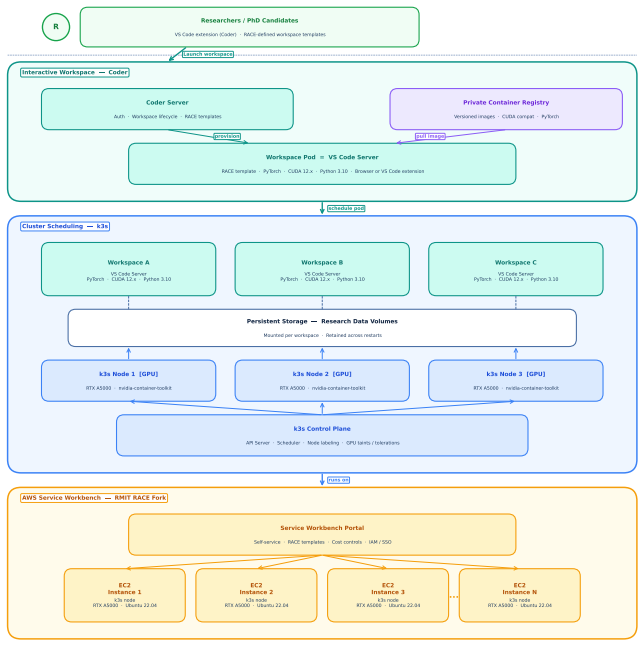
The central object is the 'adapter layer' itself: a software tier between raw provisioned compute and interactive research work, implemented as three cooperating components. k3s (a lightweight Kubernetes distribution packaged as a single binary) pools local GPU workstations into a shared cluster with taints and resource limits so GPU capacity is scheduled and bounded. Coder (a self-hosted remote development platform) provides template-based, self-service workspace creation and lifecycle management, surfacing a full VS Code Server in the browser. Versioned container images (PyTorch/CUDA stacks tested against a host driver compatibility matrix) enforce reproducible environments. The CI/CD pipe
What would settle it
Run a controlled comparative study at an institution that currently provisions cloud VMs for researchers: recruit two matched cohorts, give one the adapter layer and the other the standard VM path, and measure time from compute request to first successful experiment (and GPU utilization over a month). If the standard-path cohort reaches first experiment in under five minutes on average, or achieves GPU utilization above 30% without scheduling, the central claim that an adapter layer is necessary for these gains would be falsified.
Extended reading notes
Core claim
The paper's central claim is that the difficulty researchers face moving from provisioned compute to productive work is not a shortcoming of any single tool but a missing architectural layer. It identifies four recurring gaps — environment reproducibility, onboarding friction, uncoordinated resource usage, and vendor dependency — and shows that each maps to a component of a proposed adapter layer: versioned container images for reproducibility, k3s for lightweight GPU-aware scheduling, and Coder for self-service workspace lifecycle management. The implementation is claimed to be operational, with measurements on three production projects showing end-to-end CI/CD deployment times of 2m51s to
Load-bearing premise
The claimed improvements over the status quo rest on unmeasured baselines — cloud VMs take 10–20 minutes to boot plus 30–90 minutes to configure, onboarding takes 1–3 business days, and academic GPU utilization is typically below 30% — and if those baselines are too pessimistic, the metrics framework does not demonstrate that the adapter layer delivers the gains claimed.
Editorial extensions
If this is right
- Small academic research teams with one technically experienced member can operate an adapter layer on local GPUs, removing the need for a dedicated infrastructure team or cloud vendor lock-in.
- If the reproducibility target of ≥99% workspace starts is met, researchers can expect a known-good environment on every start, eliminating the class of bugs caused by environment drift.
- The five-minute deploy pipeline means a new research project can go from 'git push' to an accessible interactive workspace within a single work session, changing the pace of onboarding and iteration.
- The metrics framework gives institutions a common vocabulary and measurement method to compare any adapter-layer solution against the stated baselines, making the problem tractable and auditable.
- Shared scheduling of GPU nodes makes idle capacity visible and actionable, potentially raising utilization above the 'typically below 30%' baseline for dedicated unmanaged VMs.
Reading between the lines
- If the baselines in Section 4 (10–20 min VM boot, 30–90 min setup, 1–3 day onboarding) are typical, then even a warm-start workspace of 20 seconds represents a two-to-three order-of-magnitude reduction in time-to-first-experiment; a controlled before/after study at a second institution would be a natural next validation.
- The adapter-layer framing suggests that managed cloud platforms and HPC schedulers fail for complementary reasons — one is vendor-locked and the other is batch-oriented — and a portable, self-hosted layer could be adopted as a standard component in university research infrastructure, much like a shared file server.
- The five-minute CI/CD result was measured on free-tier GitHub Actions runners with warm build caches; a testable extension is whether cold-cache builds or self-hosted runners preserve the bound for larger dependency graphs, which would determine how broadly the claim generalizes.
- The metrics framework's 'reproducibility rate' baseline is deliberately indeterminate, which is itself an implicit argument: without an adapter layer, reproducibility problems become unmeasurable and hence unmanageable; future work could operationalize a baseline by instrumenting a cohort of unmanaged VMs with the same health checks.
Signed reviews
Editorial analysis
A structured set of objections, weighed in public.
Referee Report
Summary. The paper identifies a 'missing adapter layer' between raw cloud/local GPU provisioning and usable, reproducible research environments for HDR candidates. It proposes a lightweight open-source implementation built on k3s and Coder, together with a CI/CD pipeline that connects GitHub to a local cluster and deploys a project in under five minutes. The paper also defines a four-metric evaluation framework—deployment latency, environment reproducibility, onboarding time, and GPU utilisation—with baselines and targets. Measured data are reported only for CI/CD deployment latency; the other three metrics are defined but not measured.
Significance. If validated, the contribution is practically valuable: a small academic team can run a self-service, GPU-ready research platform on commodity hardware without dedicated DevOps staff, and the open-source repository and measured CI/CD pipeline are concrete, reusable assets. The proposed metrics framework is a useful attempt to make 'research computing friction' quantifiable. However, the breadth of the central claim—that the adapter layer closes gaps in reproducibility, onboarding, and utilisation—currently rests on asserted baselines and unmeasured outcomes, so the significance is contingent on additional evidence.
major comments (4)
- [§4.2–4.4 and Table 4] The metrics framework defines reproducibility rate, onboarding time, and GPU utilisation, but no measured values from the described 'active use' deployment are reported for any of these dimensions. §4.2 specifies an automated health check but gives no reproducibility result; §4.4 describes dcgm-exporter but presents no utilisation data; Table 4 lists onboarding and GPU-utilisation targets as 'To be established.' The abstract and §6 conclude that the system closes the gap across all four dimensions, but the evidence currently supports only deployment latency. Please add measurements from the deployment or reframe the conclusions to present these dimensions as planned evaluations.
- [§4.1, §4.3, §4.4 (baselines)] The claimed improvement over the status quo rests on asserted baselines: cloud VM setup of 10–20 min plus 30–90 min manual configuration (§4.1), onboarding of 1–3 business days (§4.3), and academic GPU utilisation 'typically below 30%' (§4.4). None of these numbers is supported by a citation or local measurement. If any baseline is unrepresentative, the framework cannot demonstrate the adapter layer's benefit. Provide evidence for each baseline (literature, institutional logs, or clearly labelled estimates) and propagate the uncertainty into the claims.
- [§3.4, Table 2] The central 'under five minutes' claim is not strictly supported by the reported data. Project C's time range is 4m00s–5m00s; if any run reached 5m00s, it is not 'under five minutes.' Report the maximum, mean, and per-project distribution, and state how many runs were strictly below five minutes. The sample size—ten consecutive runs per project on free-tier GitHub Actions runners—also merits a brief variance estimate or confidence interval.
- [§4.5, Table 4] Several targets appear self-referential or arbitrary. The warm-start target of <20 s is exactly the observed value reported in §3.2; the ≥99% reproducibility target has no stated justification; and two targets are 'To be established.' A metrics framework intended as a community benchmark needs either principled target-setting (e.g., derived from user expectations, hardware constraints, or published baselines) or an explicit statement that these are provisional working targets for the authors' own deployment.
minor comments (6)
- [Title, Abstract, §2 heading] The text contains corrupted strings: 'Aarxardapter' in the title, 'betweenhavingcompute resources and usingthem' in the abstract, and 'V endor' in the §2 heading. Please copyedit.
- [Figure 2] Figure 2 mixes EC2 instances with local k3s GPU nodes, making the deployment topology ambiguous. Clarify whether the cluster runs on local hardware, AWS EC2, or a hybrid.
- [§3.2 and Figure 2] The acronym 'RACE' appears in the figure and in the text but is never defined. Define it at first use.
- [Table 2 note] The table note says all projects deploy via Helm, but Project C is described as a CRD deploy. Clarify the deployment mechanism for each project.
- [§4.2] Describing the baseline reproducibility rate as 'indeterminate' is not a baseline. Consider reframing this as 'unmeasured in the absence of the adapter layer' and treat it as a limitation rather than evidence.
- [Reference [9]] The statement that surveys 'consistently find that environment configuration problems are among the most common sources of wasted time' is attributed to [9]; verify that the UK Research Software Survey 2014 supports this specific claim, or add additional references.
Circularity Check
No circularity: the paper is an implementation report whose central CI/CD claim is directly measured on independent free-tier GitHub Actions runners; the metrics framework is a proposal with explicit baselines and targets, not a derivation that reduces to its own inputs.
full rationale
The paper contains no formal derivation chain, no fitted parameters, and no equations, so equation-level circularity is absent. Its central quantitative claim — CI/CD project deployment in under five minutes — is supported by direct measurement in Table 2: ten consecutive runs per project on free-tier GitHub Actions runners, which is an external execution environment rather than a component of the system under test. There are no self-citations to prior work by the authors; all references are to third-party tools or to the project's own public repository as an artifact. The metrics framework in Section 4 is explicitly proposed as a measurement vocabulary, and its targets are described as reflecting what is achievable rather than as independent predictions. Even where the warm-start target (~20s) matches the observed warm-start time, that is a design target, not a fitted input being re-presented as a prediction. The asserted baselines for cloud VM provisioning, onboarding time, and GPU utilization lack local measurement or citation, and the reproducibility baseline is declared 'indeterminate'; these are evidentiary weaknesses (correctness risk) rather than circular reductions, because no result is derived from those baselines by construction. The acknowledged Limitations passage in Section 6.1 concerns operational setup cost, not a circular dependency. Honest finding: no significant circularity.
Assumptions & free parameters
free parameters (7)
- CI/CD deployment bound =
< 5 minutes
- Warm-start latency =
~20 seconds
- Cold-start latency =
~5 minutes
- Cloud VM baseline =
10–20 min boot + 30–90 min setup
- Academic GPU utilization baseline =
typically <30%
- Reproducibility target =
≥99%
- Onboarding baseline =
1–3 business days
assumptions (5)
- domain assumption HDR candidates are domain experts, not systems engineers, and lack time/skills to configure GPU environments.
- domain assumption The four gaps (reproducibility, onboarding, idle capacity, vendor dependency) are the correct and complete decomposition of the problem.
- ad hoc to paper A k3s + Coder cluster is installable and operable by one technically experienced person.
- domain assumption Free-tier GitHub Actions runners give timing representative of heterogeneous research CI/CD workloads.
- ad hoc to paper The stated baselines for cloud setup and academic GPU utilization are accurate enough to infer improvement.
invented entities (1)
-
Adapter layer
independent evidence
Cite this review
Pith. "Pith review of The Missing Adapter Layer for Research Computing." pith.science (2026). https://pith.science/paper/2JIDC6B7
@misc{pith2026260323942,
  author       = {Pith},
  title        = {Pith review of: The Missing Adapter Layer for Research Computing},
  year         = {2026},
  howpublished = {\url{https://pith.science/paper/2JIDC6B7}},
  note         = {Machine review of arXiv:2603.23942}
}
read the original abstract
Higher Degree by Research (HDR) candidates increasingly depend on cloud-provisioned virtual machines and local GPU hardware for their computational experiments, yet a persistent and under-addressed gap separates having compute resources from using them productively. Cloud and infrastructure teams can provision a virtual machine in minutes, but the path from a raw VM to a reproducible, GPU-ready research environment remains a significant barrier for researchers who are domain experts, not systems engineers. We argue that this gap is not a shortcoming of any particular tool but a missing architectural layer: an adapter layer that bridges cloud provisioning and interactive research work. We present a lightweight, open-source implementation of this layer, built on k3s and Coder and already in active use in our research workspace environment. A CI/CD pipeline connects GitHub directly to the local cluster, carrying a research project from commit to a running, accessible workspace in under five minutes. We then define a concrete metrics framework for evaluating any adapter layer covering deployment latency, environment reproducibility, onboarding friction, and resource utilisation and establish baselines against which improvements can be measured.
Figures

Reference graph
Works this paper leans on
-
[1]
k3s: Lightweight Kubernetes, 2024
Rancher Labs. k3s: Lightweight Kubernetes, 2024. Accessed: March 2026
2024
-
[2]
Coder: Self-hosted remote development environments,
Coder Technologies. Coder: Self-hosted remote development environments,
-
[3]
Amazon SageMaker, 2024
Amazon Web Services. Amazon SageMaker, 2024. Accessed: March 2026. 13
2024
-
[4]
Google colaboratory, 2024
Google. Google colaboratory, 2024. Accessed: March 2026
2024
-
[5]
Yoo, Morris A
Andy B. Yoo, Morris A. Jette, and Mark Grondona. SLURM: Simple Linux utility for resource management. InJob Scheduling Strategies for Parallel Processing (JSSPP), pages 44–60, Berlin, Heidelberg, 2003. Springer
2003
-
[6]
OpenPBS: Open source high performance computing workload manager, 2024
Altair Engineering. OpenPBS: Open source high performance computing workload manager, 2024. Accessed: March 2026
2024
-
[7]
JupyterHub, 2024
Project Jupyter. JupyterHub, 2024. Accessed: March 2026
2024
-
[8]
NVIDIA container toolkit, 2024
NVIDIA Corporation. NVIDIA container toolkit, 2024. Accessed: March 2026
2024
Show all 21 references
-
[9]
Parsons, Aleksandra Pawlik, Giacomo Peru, Arno Proeme, John Robinson, and Shoaib Sufi
Simon Hettrick, Mario Antonioletti, Les Carr, Neil Chue Hong, Stephen Crouch, David De Roure, Iain Emsley, Carole Goble, Alexander Hay, Devasena Inupakutika, Mike Jackson, Aleksandra Nenadic, Tim Parkinson, Mark I. Parsons, Aleksandra Pawlik, Giacomo Peru, Arno Proeme, John Ro...
2014
-
[10]
Cloud native computing foundation,
Cloud Native Computing Foundation. Cloud native computing foundation,
-
[11]
Taints and tolerations, 2024
Kubernetes Authors. Taints and tolerations, 2024. Accessed: March 2026
2024
-
[13]
Guido Van Rossum and Fred L. Drake. Python 3 reference manual, 2009
2009
-
[14]
Visual studio code, 2024
Microsoft. Visual studio code, 2024. Accessed: March 2026
2024
-
[15]
Azure machine learning, 2024
Microsoft. Azure machine learning, 2024. Accessed: March 2026
2024
-
[16]
containerd: An industry-standard container runtime, 2024
Cloud Native Computing Foundation. containerd: An industry-standard container runtime, 2024. Accessed: March 2026
2024
-
[17]
GitHub Codespaces, 2024
GitHub. GitHub Codespaces, 2024. Accessed: March 2026
2024
-
[18]
McMichael
Dave Hudak, Doug Johnson, Alan Chalker, Jeremy Nicklas, Eric Franz, Trey Dockendorf, and Brian L. McMichael. Open OnDemand: A web-based client portal for HPC centers.Journal of Open Source Software, 3(25):622, 2018
2018
-
[19]
Kubeflow and kubeflow pipelines
Ekaba Bisong. Kubeflow and kubeflow pipelines. InBuilding Machine Learning and Deep Learning Models on Google Cloud Platform, pages 671–
-
[20]
Kubeflow: Machine learning toolkit for Kubernetes,
Kubeflow Authors. Kubeflow: Machine learning toolkit for Kubernetes,
-
[21]
Accessed: March 2026
2026
-
[685]
Apress, Berkeley, CA, 2019. 14
2019
Reviewed August 2, 2026 · model on record in the stance chip above.
Discussion (0). Continue with ORCID to comment.