Star Coloring on Some Subclasses of Chordal Graphs
Pith reviewed 2026-06-25 22:20 UTC · model grok-4.3
The pith
A structural characterization together with forbidden induced subgraphs recognizes exactly which chordal graphs are star 3-colorable in linear time.
A machine-rendered reading of the paper's core claim, the machinery that carries it, and where it could break.
Core claim
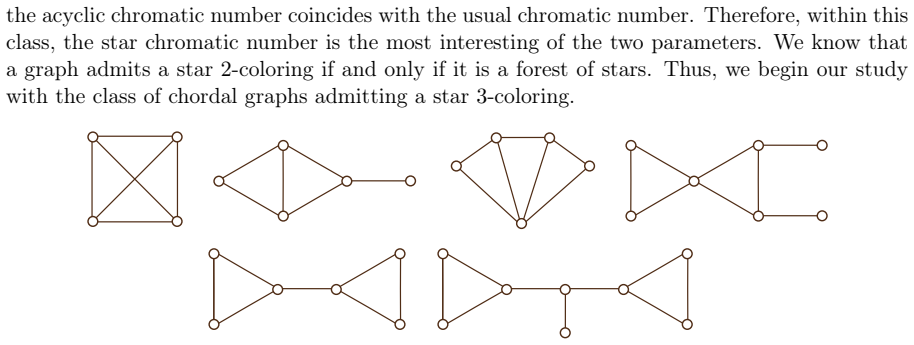
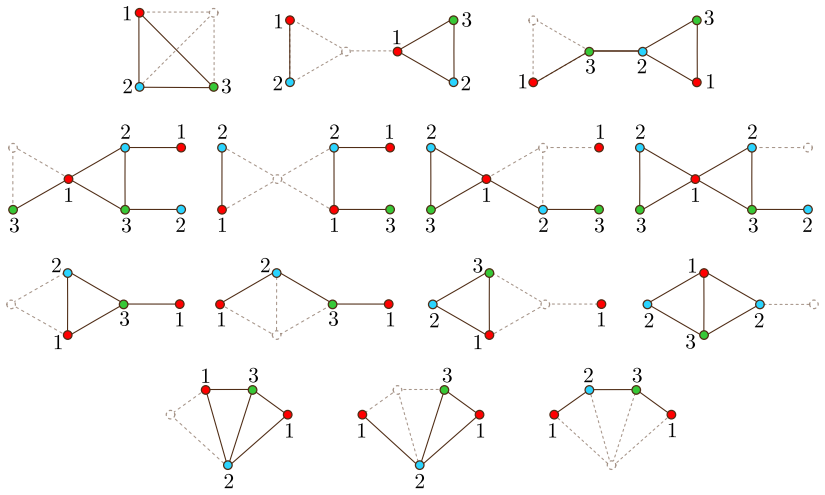
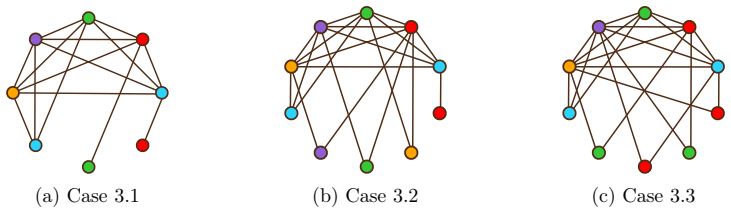
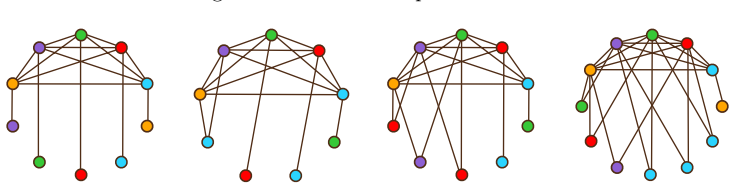
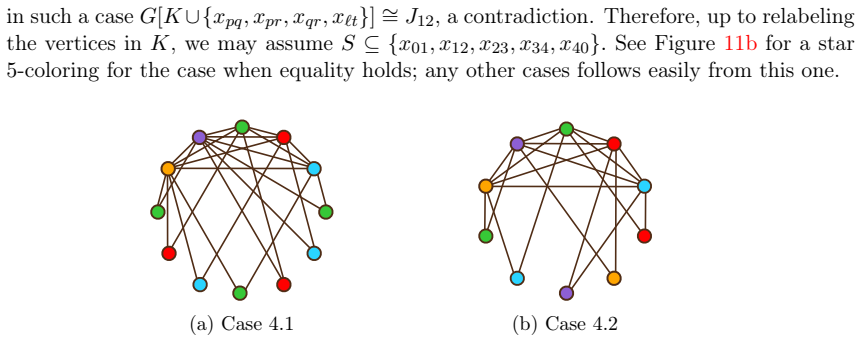
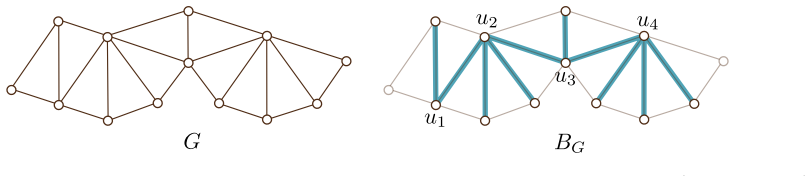
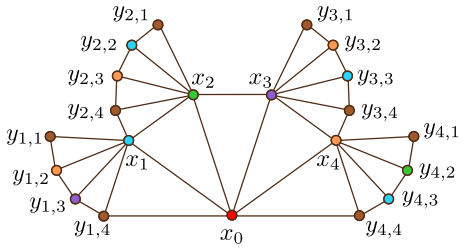
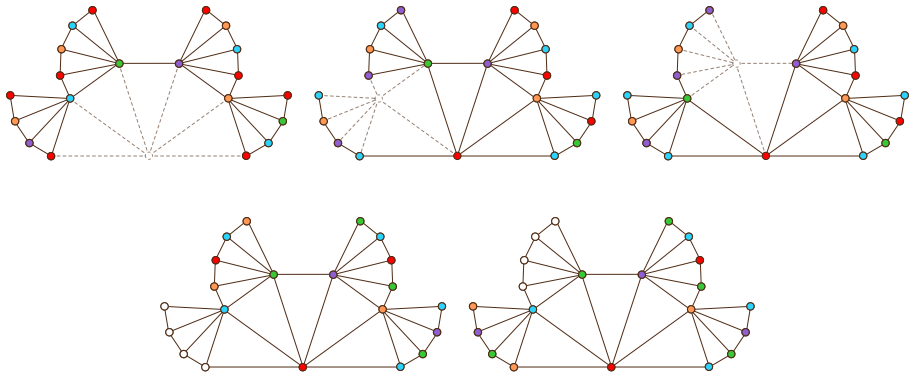
Star 3-colorable chordal graphs are exactly those without certain forbidden induced subgraphs and satisfying a corresponding structural property; the same approach yields finite forbidden-subgraph characterizations for star-4-colorable split graphs and for star-5-colorable split graphs; every 2-path is star 5-colorable while the star-4-colorable 2-paths are characterized by forbidden subgraphs; there exists a 2-tree on 21 vertices whose star chromatic number is 6 while every proper induced subgraph has star chromatic number 5.
What carries the argument
The collection of forbidden induced subgraphs for star 3-colorable chordal graphs, which together with the structural characterization partitions the class.
If this is right
- Star 3-colorability of chordal graphs can be decided by a certifying algorithm in linear time.
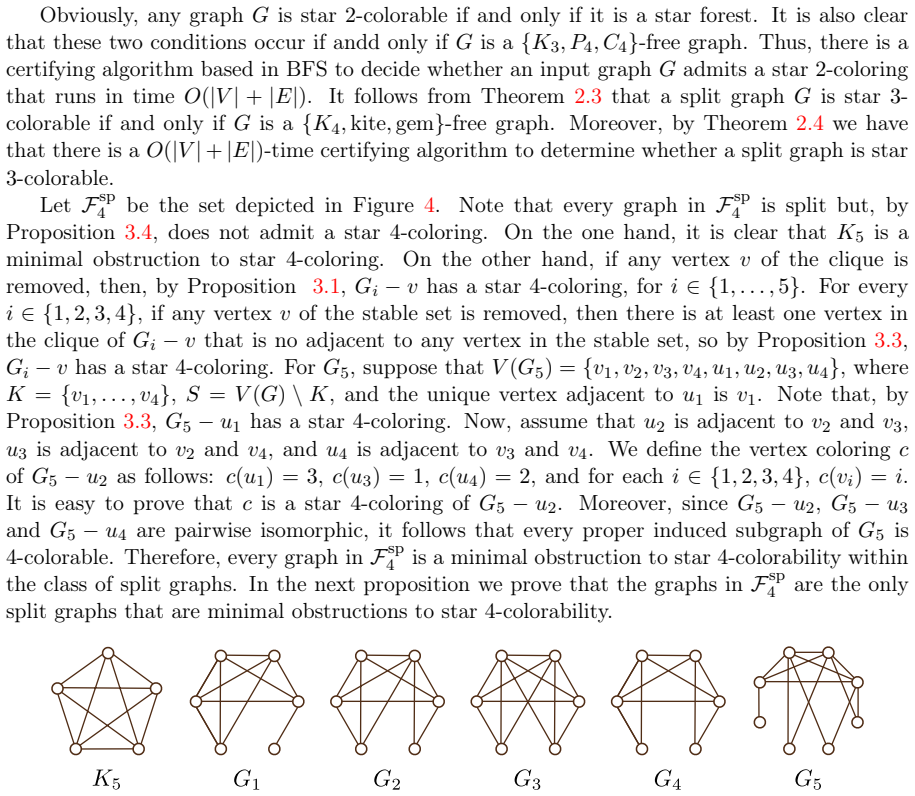
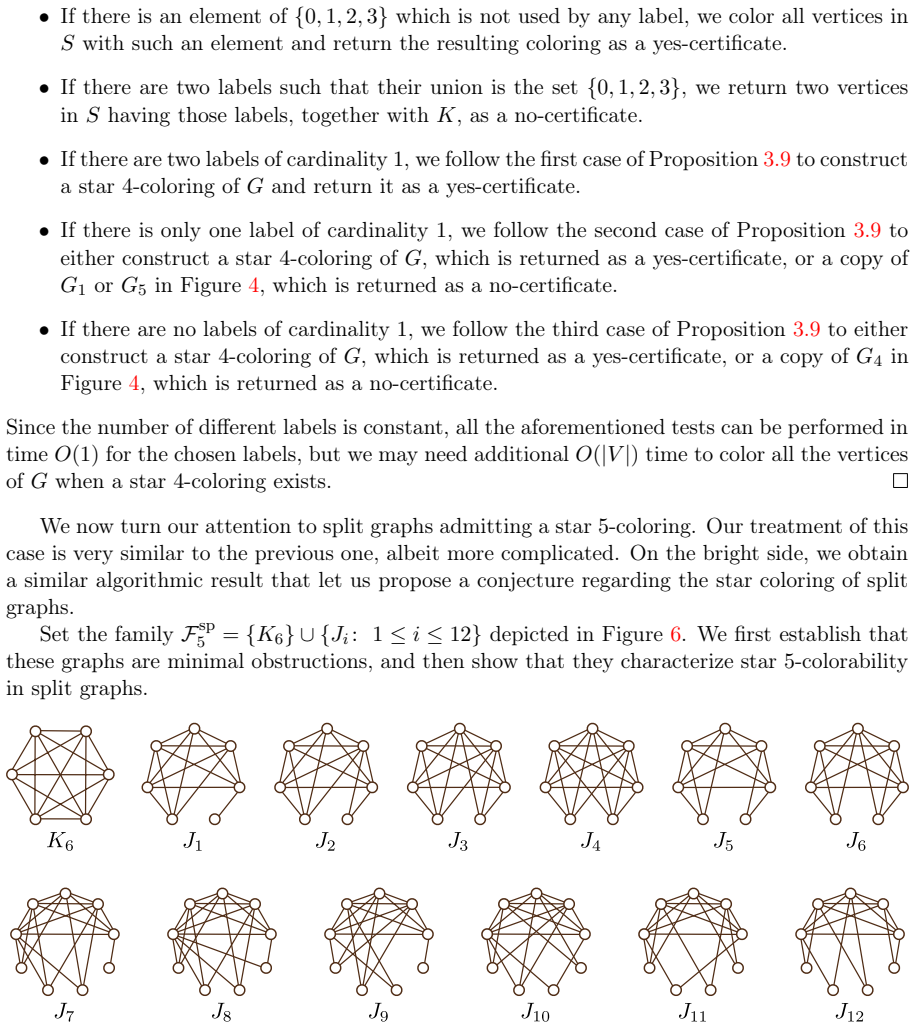
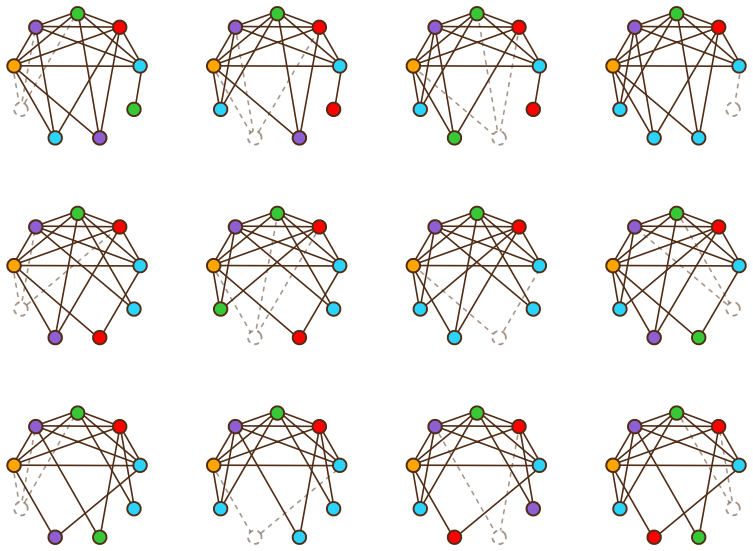
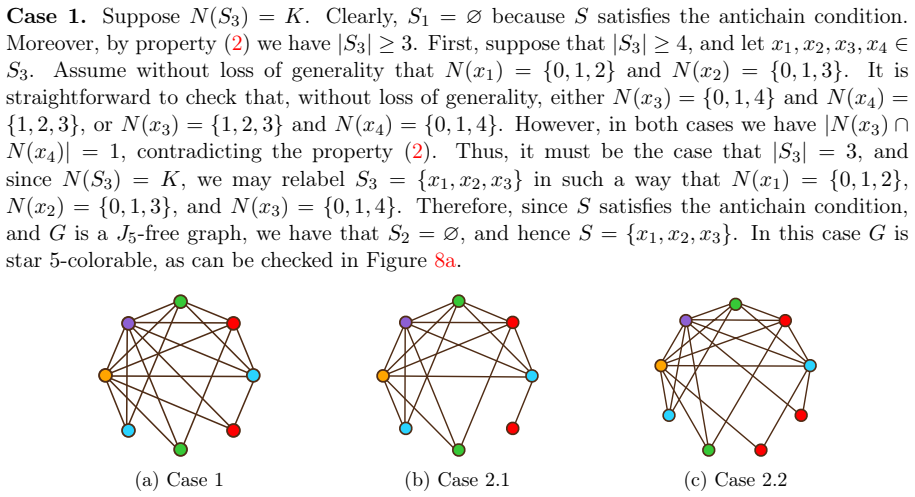
- Star 4-colorability and star 5-colorability of split graphs each admit linear-time certifying recognition via finite forbidden induced subgraphs.
- Every 2-path has star chromatic number at most 5, with equality for some instances that avoid the forbidden subgraphs for 4 colors.
- A 2-tree on 21 vertices requires 6 colors for star coloring, while all its proper induced subgraphs require only 5.
Where Pith is reading between the lines
- The linear-time recognition may be useful for practical graph coloring applications on chordal graphs arising in optimization.
- Similar forbidden-subgraph techniques could be applied to other coloring variants on chordal graphs.
- The example 2-tree indicates that star chromatic number grows with the size of 2-trees even though treewidth remains 2.
- The characterizations separate the decision problem from the search for an actual coloring.
Load-bearing premise
The listed forbidden induced subgraphs and the structural characterization together include all star-3-colorable chordal graphs and exclude all others without exception or overlap.
What would settle it
A chordal graph that is star 3-colorable yet contains one of the listed forbidden subgraphs, or a chordal graph with star chromatic number greater than 3 that matches the structural description.
Figures
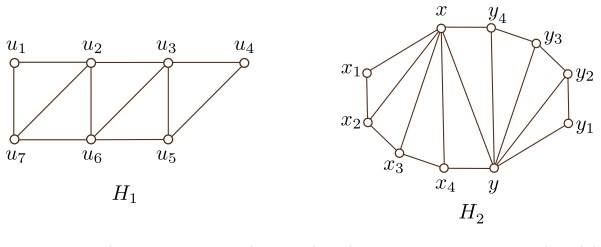
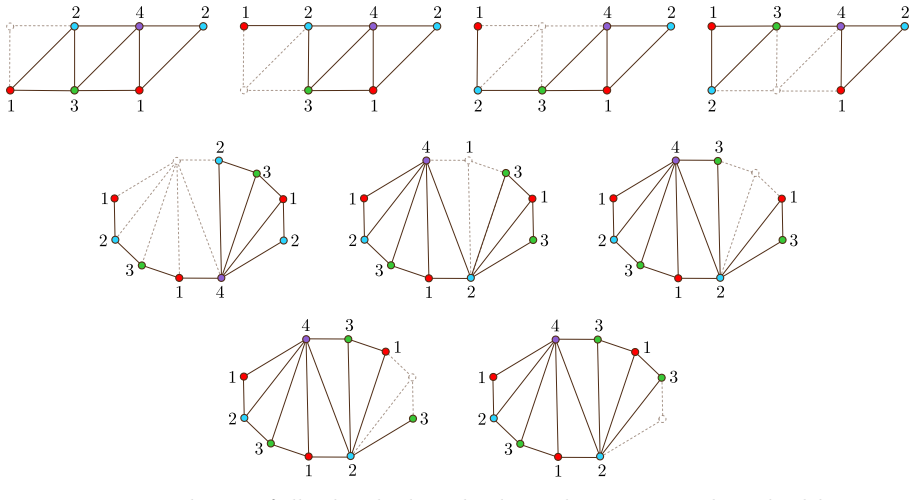
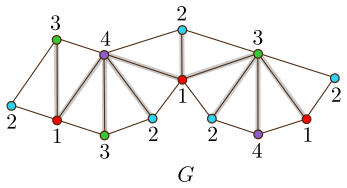

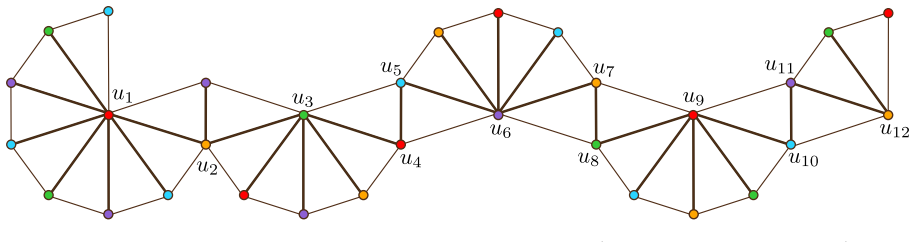
read the original abstract
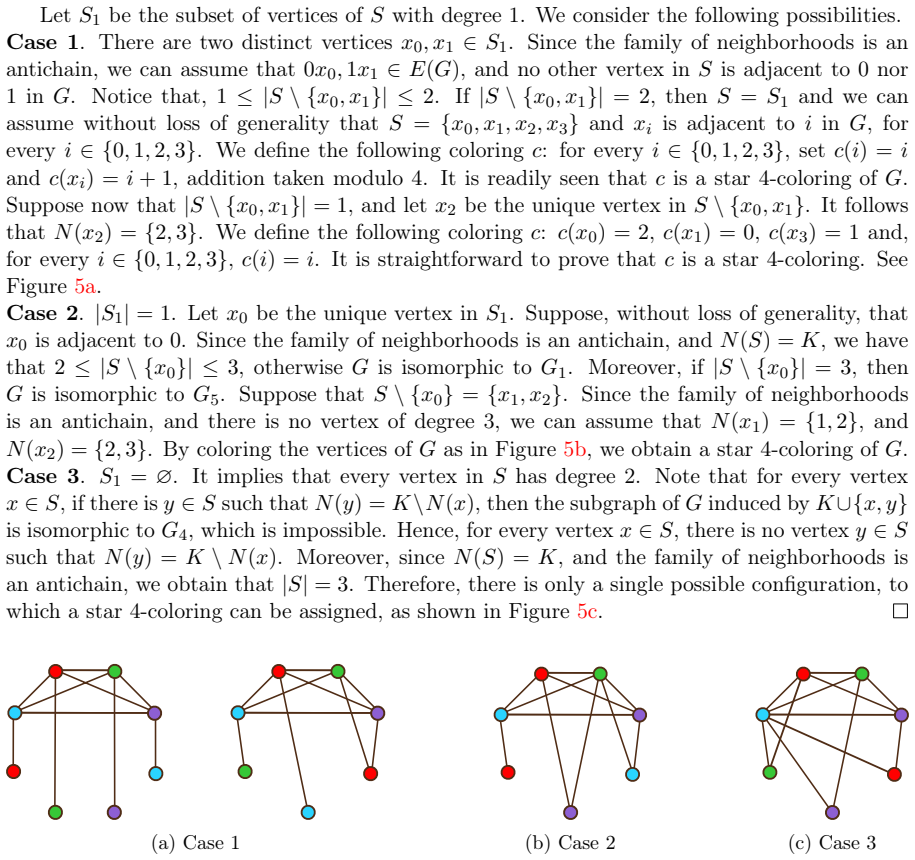
A star coloring of a graph $G$ is a proper coloring in which no path on four vertices is bicolored. The star chromatic number $\chi_{\star}(G)$ is the minimum number of colors in a star coloring of $G$. In this work we study star colorings from the perspective of forbidden induced subgraphs, focusing on three subclasses of chordal graphs. We provide both a structural characterization and a characterization in terms of forbidden induced subgraphs for star $3$-colorable chordal graphs; such characterizations yield a simple certifying recognition algorithm, running in time $O(|V|+|E|)$, for this class. We also characterize split graphs that are star $4$-colorable and star $5$-colorable in terms of (finitely many) forbidden induced subgraphs, again deriving linear-time certifying recognition algorithms. Finally, we study star colorings of $2$-trees and $2$-paths: we characterize the $2$-paths that are star $4$-colorable, prove that every $2$-path is star $5$-colorable, and exhibit a $2$-tree on $21$ vertices with star chromatic number $6$ such that any proper induced subgrahp has star chromatic number $5$.
Editorial analysis
A structured set of objections, weighed in public.
Referee Report
Summary. The paper provides both a structural characterization and a characterization in terms of forbidden induced subgraphs for star 3-colorable chordal graphs, yielding a simple certifying recognition algorithm running in O(|V|+|E|) time. It also characterizes split graphs that are star 4-colorable and star 5-colorable via (finitely many) forbidden induced subgraphs, again with linear-time certifying algorithms. For 2-trees and 2-paths, the paper characterizes the 2-paths that are star 4-colorable, proves every 2-path is star 5-colorable, and exhibits a 2-tree on 21 vertices with star chromatic number 6 such that every proper induced subgraph has star chromatic number 5.
Significance. If the characterizations are correct and complete, the work supplies efficient recognition procedures for star colorability in these chordal subclasses, which is a concrete algorithmic contribution. The explicit 2-tree example with χ*=6 (and the hereditary property noted) is a useful concrete datum for bounding star chromatic numbers in treewidth-2 graphs. The stress-test concern about unexamined derivations does not fully land on the full manuscript, as the abstract is expected to omit proofs and lists; however, the absence of any verification data or explicit lists even in summary form leaves the partition claim untestable from the given information.
major comments (2)
- Abstract: the central claim that the (unspecified) forbidden induced subgraphs together with the structural description exactly partition chordal graphs into star-3-colorable and non-colorable instances (with no missing cases or overlaps) is load-bearing for both the characterization and the linear-time algorithm; without the explicit list or a completeness argument, the claim cannot be assessed.
- Abstract: the assertion of an O(|V|+|E|) certifying recognition algorithm is stated as a direct corollary, but no description of the certification mechanism (e.g., how the forbidden-subgraph check produces a certificate) is supplied, making the complexity claim unverified.
Simulated Author's Rebuttal
We thank the referee for their careful review of the manuscript. The major comments focus on the abstract; the full characterizations, proofs, and algorithmic details appear in the body of the paper as described below.
read point-by-point responses
-
Referee: Abstract: the central claim that the (unspecified) forbidden induced subgraphs together with the structural description exactly partition chordal graphs into star-3-colorable and non-colorable instances (with no missing cases or overlaps) is load-bearing for both the characterization and the linear-time algorithm; without the explicit list or a completeness argument, the claim cannot be assessed.
Authors: The abstract is a high-level summary. Section 3 of the manuscript gives the explicit finite list of forbidden induced subgraphs for star-3-colorable chordal graphs, the structural characterization, and the completeness proof. The proof shows that a chordal graph is star-3-colorable if and only if it avoids the listed subgraphs and satisfies the structural conditions, with no missing cases or overlaps; both directions are established by explicit constructions and case analysis. revision: no
-
Referee: Abstract: the assertion of an O(|V|+|E|) certifying recognition algorithm is stated as a direct corollary, but no description of the certification mechanism (e.g., how the forbidden-subgraph check produces a certificate) is supplied, making the complexity claim unverified.
Authors: The manuscript derives the linear-time certifying algorithm directly from the characterizations in Section 3: forbidden-subgraph detection for a fixed finite set runs in O(|V|+|E|) time, and the structural description yields an explicit star coloring when the graph is colorable. The certificate is either the coloring (constructible in linear time) or the discovered forbidden subgraph. These steps are spelled out following the characterizations. revision: no
Circularity Check
No significant circularity
full rationale
The paper derives structural and forbidden-subgraph characterizations for star-3-colorable chordal graphs, plus similar results for split graphs and 2-paths/2-trees, directly from the definitions of star coloring and chordal graphs. These are standard combinatorial case analyses and minimal-obstruction arguments with no equations, fitted parameters, or self-referential quantities; the linear-time recognition algorithms follow immediately as corollaries of the characterizations being checkable. No load-bearing step reduces to a prior result by the same authors or to an input by construction.
Axiom & Free-Parameter Ledger
axioms (1)
- standard math Standard definitions and basic properties of chordal graphs, split graphs, 2-trees, and star coloring hold.
Reference graph
Works this paper leans on
-
[1]
Albertson, Glenn G
Michael O. Albertson, Glenn G. Chappell, Hal A. Kierstead, André Kündgen, and Radhika Ramamurthi. Coloring with no2-coloredP 4’s.The Electronic Journal of Combinatorics, 11:R26–R26, 2004
2004
-
[2]
Acyclic, starandinjectivecolouring: AcomplexitypictureforH-freegraphs.Journal of Computer and System Sciences, 154:103662, 2025
Jan Bok, Nikola Jedličková, Barnaby Martin, Pascal Ochem, Daniël Paulusma, and Siani Smith. Acyclic, starandinjectivecolouring: AcomplexitypictureforH-freegraphs.Journal of Computer and System Sciences, 154:103662, 2025
2025
-
[3]
Murty.Graph Theory, volume 244 ofGraduate Texts in Mathematics
John Adrian Bondy and U.S.R. Murty.Graph Theory, volume 244 ofGraduate Texts in Mathematics. Springer London, London, 2008
2008
-
[4]
Oleg V. Borodin. On acyclic colorings of planar graphs.Discrete Mathematics, 25(3):211– 236, 1979. 37
1979
-
[5]
Kathie Cameron, Jan Goedgebeur, Shenwei Huang, and Yongtang Shi.k-Critical graphs inP 5-free graphs.Theoretical Computer Science, 864:80–91, 2021
2021
-
[6]
House of graphs 2.0: A database of interesting graphs and more.Discrete Applied Mathematics, 325:97–107, 2023
Kris Coolsaet, Stijn D’hondt, and Jan Goedgebeur. House of graphs 2.0: A database of interesting graphs and more.Discrete Applied Mathematics, 325:97–107, 2023
2023
-
[7]
Star coloring of graphs.Journal of Graph Theory, 47(3):163–182, 2004
Guillaume Fertin, André Raspaud, and Bruce Reed. Star coloring of graphs.Journal of Graph Theory, 47(3):163–182, 2004
2004
-
[8]
Stéphane Foldes and Peter L. Hammer. Split graphs. InProceedings of the Eighth Southeast- ern Conference on Combinatorics, Graph Theory and Computing (Louisiana State Univ., Baton Rouge, La., 1977), volume No. XIX ofCongress. Numer., pages 311–315. Utilitas Math., Winnipeg, MB, 1977
1977
-
[9]
North Holland, 2004
Martin Charles Golumbic.Algorithmic graph theory and perfect graphs 2nd Edition. North Holland, 2004
2004
-
[10]
Acyclic colorings of planar graphs.Israel Journal of Mathematics, 14(4):390–408, 1973
Branko Grünbaum. Acyclic colorings of planar graphs.Israel Journal of Mathematics, 14(4):390–408, 1973
1973
-
[11]
Algorithm 447: efficient algorithms for graph manipu- lation.Commun
John Hopcroft and Robert Tarjan. Algorithm 447: efficient algorithms for graph manipu- lation.Commun. ACM, 16(6):372–378, June 1973
1973
-
[12]
Karthick
T. Karthick. Star coloring of certain graph classes.Graphs and Combinatorics, 34(1):109– 128, 2018
2018
-
[13]
On3-colorableP 5-free graphs.SIAM Journal on Discrete Mathematics, 26(4):1682–1708, 2012
Frédéric Maffray and Grégory Morel. On3-colorableP 5-free graphs.SIAM Journal on Discrete Mathematics, 26(4):1682–1708, 2012
2012
-
[14]
Graph formats, 2026
Brendan McKay. Graph formats, 2026. Accesed: February 20th, 2026
2026
-
[15]
McKay and Adolfo Piperno
Brendan D. McKay and Adolfo Piperno. Practical graph isomorphism, II.Journal of Symbolic Computation, 60:94–112, 2014
2014
-
[16]
Colorings and homomorphisms of minor closed classes
Jaroslav Nešetřil and Patrice Ossona de Mendez. Colorings and homomorphisms of minor closed classes. In Boris Aronov, Saugata Basu, János Pach, and Micha Sharir, editors, Discrete and Computational Geometry: The Goodman-Pollack Festschrift, pages 651–664. Springer Berlin Heidelberg, Berlin, Heidelberg, 2003. A Split minimal obstructions to star 6-colorabi...
2003
discussion (0)
Sign in with ORCID, Apple, or X to comment. Anyone can read and Pith papers without signing in.