REVIEW 2 major objections 2 minor 85 references
A conservative adaptive rank method for the Wigner-Poisson system
T0 review · 2 major / 2 minor · reviewed 2026-06-26 · grok-4.3
Pith's one-line read A conservative adaptive rank method for the Wigner-Poisson system combines local density-momentum updates with global energy correction to preserve invariants while adapting numerical rank.
desk verdict The paper adds Fermi-Dirac reconstruction plus a global energy correction to an existing adaptive-rank scheme for 1D1V Wigner-Poisson and reports near-machine-precision conservation on three standard tests. read the letter →
The pith
A machine-rendered reading of the paper's core claim, the machinery that carries it, and where it could break.
The reading
What carries the argument
The conservative macroscopic correction that performs local density-momentum updates through Fermi-Dirac reconstruction followed by a global quadratic moment correction for total energy.
What would settle it
A run of one of the benchmark instabilities in which the discrete total energy deviates from machine precision by more than a few orders of magnitude while the adaptive rank procedure is engaged.
Extended reading notes
Core claim
The scheme merges a sampling-based adaptive rank Wigner-Poisson update with a conservative macroscopic correction that supplies local density-momentum updates, uses a Fermi-Dirac-type reconstruction to map them onto the kinetic solution, and adds a global quadratic moment correction to satisfy the discrete total energy constraint. The corrected state is then stored in an ACA SVD representation whose rank adapts to the phase-space structure produced by the nonlocal Wigner operator and the self-consistent Poisson field.
Load-bearing premise
The Fermi-Dirac reconstruction transfers local macroscopic updates to the kinetic level without leaving errors that the subsequent global energy correction cannot remove, even when adaptive rank compression is active.
Editorial extensions
If this is right
- The method reproduces the expected phase-space evolution in the two-stream instability, strong Landau damping, and bump-on-tail instability for multiple values of the quantum parameter.
- Adaptive ranks remain bounded throughout the evolution of the tested periodic problems.
- Global discrete invariants are preserved with errors near machine precision.
- Results are nearly identical to those obtained from a related formulation that enforces mass, momentum, and energy globally.
Reading between the lines
- The near-equivalence of local-plus-global and fully global correction strategies suggests that designers of adaptive-rank schemes have latitude in choosing where to enforce conservation.
- Because the reconstruction is motivated by the quantum-statistical structure of the Wigner-Poisson model, similar corrections may prove useful in other quantum kinetic equations whose equilibrium distributions differ from classical Maxwell-Boltzmann forms.
Editorial analysis
A structured set of objections, weighed in public.
Referee Report
Summary. The manuscript proposes a conservative adaptive rank method for the 1D1V Wigner-Poisson system. It combines a sampling-based adaptive rank Wigner-Poisson update with a macroscopic correction consisting of a conservative density-momentum solve, Fermi-Dirac-type reconstruction to transfer local updates to the kinetic level, and a global quadratic moment correction to enforce the discrete total energy constraint. The corrected distribution is folded into an ACA SVD representation whose rank adapts to the complexity induced by the nonlocal Wigner operator and self-consistent Poisson field. Numerical experiments on the two-stream instability, strong Landau damping, and bump-on-tail instability for several values of the quantum parameter H demonstrate that the method captures benchmark dynamics, maintains bounded adaptive ranks, and preserves the specified global invariants with errors near machine precision. A comparison with a related globally conservative formulation is also presented, showing nearly identical results in the tested periodic setting.
Significance. If the reported conservation properties are robust under adaptive-rank compression, the approach would provide a practical route to long-time deterministic simulations of quantum kinetic systems at reduced cost while retaining the macroscopic invariants required for physical fidelity. The explicit comparison of local-plus-global versus fully global correction strategies and the observation of bounded ranks across multiple instabilities constitute concrete strengths.
major comments (2)
- [Numerical experiments] Numerical experiments section: the abstract and results claim conservation errors reach near machine precision and that benchmark dynamics are captured, yet no quantitative error tables, convergence studies with respect to rank tolerance or time step, or plots of invariant drift versus H are supplied; without these data the central claim that the reconstruction-correction-compression sequence reliably preserves the discrete invariants cannot be assessed.
- [Method section] Method section (description of the correction and ACA SVD step): the Fermi-Dirac reconstruction followed by a single global quadratic energy correction is applied before the ACA SVD truncation; no algebraic argument or numerical test demonstrates that the post-truncation distribution remains consistent with the corrected macroscopic moments, leaving open the possibility that truncation re-introduces moment errors that subsequently affect the self-consistent field, especially for varying H.
minor comments (2)
- The notation for the adaptive rank tolerance and the precise definition of the quadratic moment correction operator should be stated explicitly rather than referenced only to prior work.
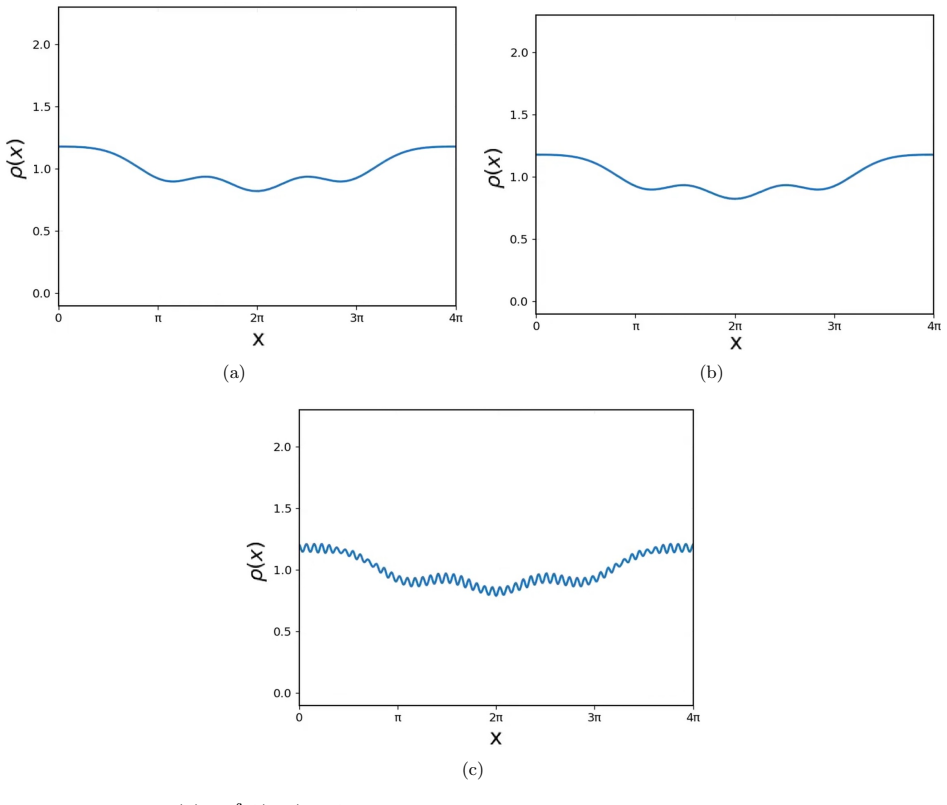
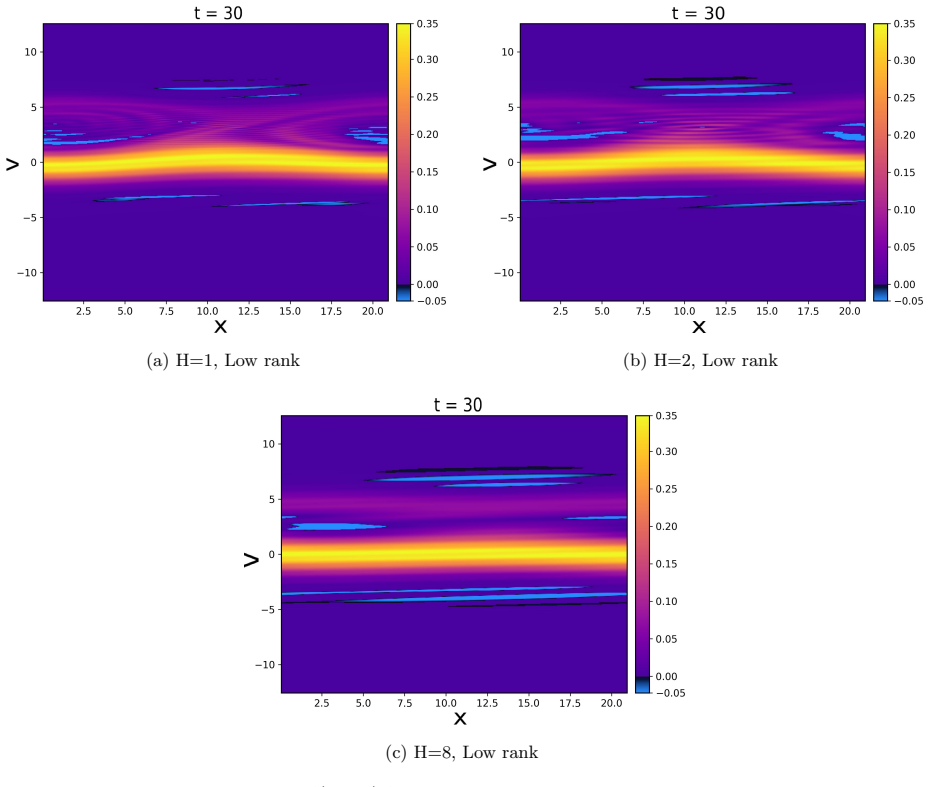
- Figure captions for the phase-space plots should include the specific H values and final simulation times to allow direct comparison with the conservation-error statements.
Simulated Author's Rebuttal
We thank the referee for the careful reading and constructive comments. We address the two major comments point by point below, indicating the revisions we will make.
read point-by-point responses
-
Referee: Numerical experiments section: the abstract and results claim conservation errors reach near machine precision and that benchmark dynamics are captured, yet no quantitative error tables, convergence studies with respect to rank tolerance or time step, or plots of invariant drift versus H are supplied; without these data the central claim that the reconstruction-correction-compression sequence reliably preserves the discrete invariants cannot be assessed.
Authors: We agree that the presentation would benefit from additional quantitative data. In the revised manuscript we will insert tables reporting the maximum conservation errors for mass, momentum, and energy over the full simulation interval for each benchmark and each tested value of H. We will also add plots of the time histories of the invariant drifts versus H and a short convergence study with respect to the ACA rank tolerance (showing that errors remain near machine precision down to the tolerances used in the main experiments). These additions will directly support the central conservation claim. revision: yes
-
Referee: Method section (description of the correction and ACA SVD step): the Fermi-Dirac reconstruction followed by a single global quadratic energy correction is applied before the ACA SVD truncation; no algebraic argument or numerical test demonstrates that the post-truncation distribution remains consistent with the corrected macroscopic moments, leaving open the possibility that truncation re-introduces moment errors that subsequently affect the self-consistent field, especially for varying H.
Authors: The reported numerical results already show that the complete sequence (correction followed by ACA SVD) yields invariant errors at or near machine precision for all tested H. This empirical evidence indicates that any re-introduced moment errors remain negligible under the chosen rank tolerances. Nevertheless, we acknowledge the absence of an a-priori algebraic guarantee. In the revision we will add a short paragraph explaining that the ACA tolerance is set below the target conservation threshold and will include a supplementary numerical check (for one representative case) that compares the macroscopic moments immediately before and after the SVD truncation step. A rigorous algebraic proof for the adaptive-rank case lies outside the present scope. revision: partial
Circularity Check
No significant circularity; method is algorithmic construction validated by experiments
full rationale
The paper describes an explicit numerical algorithm: sampling-based adaptive rank Wigner-Poisson update combined with a density-momentum solve, Fermi-Dirac reconstruction, and global quadratic moment correction. These steps are presented as post-processing choices applied after the rank update, not as a derivation that reduces to a fitted parameter or self-defined quantity. Conservation errors near machine precision are reported from numerical experiments on three benchmark problems, not asserted as an algebraic identity. Citations [7] and [8] reference related prior formulations but are not invoked as load-bearing uniqueness theorems or ansatzes that close the central claim; the present work compares the two correction strategies empirically. No step matches the enumerated circularity patterns (self-definitional, fitted-input prediction, etc.). The derivation chain is therefore self-contained against external benchmarks.
Assumptions & free parameters
assumptions (1)
- standard math Standard assumptions of finite-dimensional linear algebra and discrete conservation laws for hyperbolic PDE discretizations.
Cite this review
Pith. "Pith review of A conservative adaptive rank method for the Wigner-Poisson system." pith.science (2026). https://pith.science/paper/2KY5YCTX
@misc{pith2026260620234,
  author       = {Pith},
  title        = {Pith review of: A conservative adaptive rank method for the Wigner-Poisson system},
  year         = {2026},
  howpublished = {\url{https://pith.science/paper/2KY5YCTX}},
  note         = {Machine review of arXiv:2606.20234}
}
read the original abstract
We propose a conservative adaptive rank method for the 1D1V Wigner-Poisson system. The method targets a central challenge in deterministic quantum kinetic simulations: reducing the cost of phase-space evolution while preserving the macroscopic invariants needed for physical fidelity. The scheme combines a sampling-based adaptive rank Wigner-Poisson update [7] with a conservative macroscopic correction. A conservative density-momentum solve provides local macroscopic updates, a Fermi-Dirac-type reconstruction transfers them to the kinetic solution, and a global quadratic moment correction enforces the discrete total energy constraint at the kinetic level. Unlike Maxwell-Boltzmann-type corrections commonly used in classical kinetic settings, the reconstruction uses a Fermi-Dirac-type form motivated by the model's quantum-statistical structure. The corrected state is incorporated into an ACA SVD representation, allowing the numerical rank to adapt to the phase-space complexity generated by the nonlocal Wigner operator and self-consistent Poisson field. Numerical experiments for the two-stream instability, strong Landau damping, and bump-on tail instability show that the method captures benchmark Wigner-Poisson dynamics for several values of the quantum parameter H, maintains bounded adaptive ranks, and preserves the specified global discrete invariants with conservation errors near machine precision. We also compare this formulation, which uses local density-momentum correction plus global total energy correction, with a related globally conservative formulation for mass, momentum, and energy [8]. The two approaches produce nearly identical phase-space and diagnostic results for the periodic benchmark test considered here, indicating that both correction strategies are compatible with adaptive rank compression for Wigner-Poisson dynamics in the tested 1D1V periodic setting.
Figures


Figures from the paper (8 more)



Reference graph
Works this paper leans on
-
[1]
Journal of Computational Physics , pages=
A review of low-rank methods for time-dependent kinetic simulations , author=. Journal of Computational Physics , pages=. 2025 , publisher=
2025
-
[2]
2014 , publisher=
Numerical methods for partial differential equations , author=. 2014 , publisher=
2014
-
[3]
2001 , publisher=
Chebyshev and Fourier spectral methods , author=. 2001 , publisher=
2001
-
[4]
2014 , publisher=
The Art of Computer Programming: Seminumerical Algorithms, Volume 2 , author=. 2014 , publisher=
2014
-
[5]
SIAM Journal on Scientific Computing , volume=
A low-rank projector-splitting integrator for the Vlasov--Poisson equation , author=. SIAM Journal on Scientific Computing , volume=. 2018 , publisher=
2018
-
[6]
SIAM Journal on Matrix Analysis and Applications , volume=
Dynamical low-rank approximation , author=. SIAM Journal on Matrix Analysis and Applications , volume=. 2007 , publisher=
2007
-
[7]
Nature , volume=
Burning plasma achieved in inertial fusion , author=. Nature , volume=. 2022 , publisher=
2022
-
[8]
2016 , publisher=
Quantum kinetic theory , author=. 2016 , publisher=
2016
Show all 85 references
-
[9]
Physical Review E , volume=
Kinetic theory molecular dynamics and hot dense matter: Theoretical foundations , author=. Physical Review E , volume=. 2014 , publisher=
2014
-
[10]
Journal of Scientific Computing , volume=
A Hybrid SBP-SAT/Fourier Pseudo-spectral Method for the Transient Wigner Equation Involving Inflow Boundary Conditions , author=. Journal of Scientific Computing , volume=. 2024 , publisher=
2024
-
[11]
Journal of Computational Physics , pages=
A Semi-Lagrangian Adaptive-Rank (SLAR) Method for Linear Advection and Nonlinear Vlasov-Poisson System , author=. Journal of Computational Physics , pages=. 2025 , publisher=
2025
-
[12]
Journal of Computational Physics , volume=
A conservative high order semi-Lagrangian WENO method for the Vlasov equation , author=. Journal of Computational Physics , volume=. 2010 , publisher=
2010
-
[13]
Journal of Computational Physics , volume =
Wei Guo and Jing-Mei Qiu , title =. Journal of Computational Physics , volume =
-
[14]
Journal of Scientific Computing , volume=
A Local Macroscopic Conservative (LoMaC) low rank tensor method for the Vlasov dynamics , author=. Journal of Scientific Computing , volume=. 2024 , publisher=
2024
-
[15]
SIAM Journal on Scientific Computing , volume=
A conservative low rank tensor method for the Vlasov dynamics , author=. SIAM Journal on Scientific Computing , volume=. 2024 , publisher=
2024
-
[16]
Journal of Computational Physics , volume=
A mass, momentum, and energy conservative dynamical low-rank scheme for the Vlasov equation , author=. Journal of Computational Physics , volume=. 2021 , publisher=
2021
-
[17]
Contemporary Mathematics , volume=
The maximal-volume concept in approximation by low-rank matrices , author=. Contemporary Mathematics , volume=. 2001 , publisher=
2001
-
[18]
arXiv preprint arXiv:2407.11290 , year=
Distributed memory parallel adaptive tensor-train cross approximation , author=. arXiv preprint arXiv:2407.11290 , year=
-
[19]
SIAM Journal on Numerical Analysis , volume=
Diagonally implicit Runge--Kutta methods for stiff ODE’s , author=. SIAM Journal on Numerical Analysis , volume=. 1977 , publisher=
1977
-
[20]
1982 , publisher=
Iterative methods for large, sparse, nonsymmetric systems of linear equations , author=. 1982 , publisher=
1982
-
[21]
SIAM Journal on scientific and statistical computing , volume=
GMRES: A generalized minimal residual algorithm for solving nonsymmetric linear systems , author=. SIAM Journal on scientific and statistical computing , volume=. 1986 , publisher=
1986
-
[22]
Physical review , volume=
On the quantum correction for thermodynamic equilibrium , author=. Physical review , volume=. 1932 , publisher=
1932
-
[23]
Statistical Mechanics Fourth Edition , author=
-
[24]
2013 , publisher=
Statistical Physics: Volume 5 , author=. 2013 , publisher=
2013
-
[25]
Physical Review B , volume=
Wigner-function model of a resonant-tunneling semiconductor device , author=. Physical Review B , volume=. 1987 , publisher=
1987
-
[26]
Applied physics letters , volume=
Numerical calculation of particle trajectories and tunneling times for resonant tunneling barrier structures , author=. Applied physics letters , volume=
-
[27]
IEEE Transactions on Electron Devices , volume=
The methodology of simulating particle trajectories through tunneling structures using a Wigner distribution approach , author=. IEEE Transactions on Electron Devices , volume=. 1991 , publisher=
1991
-
[28]
ZAMM-Journal of Applied Mathematics and Mechanics/Zeitschrift f
An analysis of the quantum Liouville equation , author=. ZAMM-Journal of Applied Mathematics and Mechanics/Zeitschrift f. 1989 , publisher=
1989
-
[29]
SIAM journal on numerical analysis , volume=
A spectral method for the numerical simulation of quantum tunneling phenomena , author=. SIAM journal on numerical analysis , volume=. 1990 , publisher=
1990
-
[30]
SIAM journal on numerical analysis , volume=
A spectral collocation technique for the solution of the Wigner--Poisson problem , author=. SIAM journal on numerical analysis , volume=. 1992 , publisher=
1992
-
[31]
Journal of Computational Physics , volume=
The integration of the Vlasov equation in configuration space , author=. Journal of Computational Physics , volume=. 1976 , publisher=
1976
-
[32]
Journal of Computational Physics , volume=
Numerical simulation of the quantum Liouville-Poisson system , author=. Journal of Computational Physics , volume=. 1991 , publisher=
1991
-
[33]
SIAM journal on numerical analysis , volume=
Operator splitting methods applied to spectral discretizations of quantum transport equations , author=. SIAM journal on numerical analysis , volume=. 1995 , publisher=
1995
-
[34]
SIAM journal on numerical analysis , volume=
An operator splitting method for the Wigner--Poisson problem , author=. SIAM journal on numerical analysis , volume=. 1996 , publisher=
1996
-
[35]
Journal of Computational Physics , volume=
Semi-spectral method for the Wigner equation , author=. Journal of Computational Physics , volume=. 2016 , publisher=
2016
-
[36]
Journal of Scientific Computing , volume=
Numerical methods for the Wigner equation with unbounded potential , author=. Journal of Scientific Computing , volume=. 2019 , publisher=
2019
-
[37]
Journal of Computational Physics , volume=
A high order efficient numerical method for 4-D Wigner equation of quantum double-slit interferences , author=. Journal of Computational Physics , volume=. 2019 , publisher=
2019
-
[38]
Journal of Computational Electronics , volume=
A higher-order accurate operator splitting spectral method for the Wigner--Poisson system , author=. Journal of Computational Electronics , volume=. 2022 , publisher=
2022
-
[39]
Journal of Computational and Applied Mathematics , volume=
A hybrid sinc-Galerkin/finite-difference method for the time-dependent Wigner equation , author=. Journal of Computational and Applied Mathematics , volume=. 2022 , publisher=
2022
-
[40]
Communications in Computational Physics , volume=
Adaptive conservative cell average spectral element methods for transient Wigner equation in quantum transport , author=. Communications in Computational Physics , volume=. 2011 , publisher=
2011
-
[41]
SIAM Journal on Scientific Computing , volume=
An advective-spectral-mixed method for time-dependent many-body Wigner simulations , author=. SIAM Journal on Scientific Computing , volume=. 2016 , publisher=
2016
-
[42]
Journal of computational physics , volume=
A WENO-solver combined with adaptive momentum discretization for the Wigner transport equation and its application to resonant tunneling diodes , author=. Journal of computational physics , volume=. 2015 , publisher=
2015
-
[43]
Physics Reports , volume=
An introduction to applied quantum mechanics in the Wigner Monte Carlo formalism , author=. Physics Reports , volume=. 2015 , publisher=
2015
-
[44]
Physical Review B—Condensed Matter and Materials Physics , volume=
Unified particle approach to Wigner-Boltzmann transport in small semiconductor devices , author=. Physical Review B—Condensed Matter and Materials Physics , volume=. 2004 , publisher=
2004
-
[45]
Monte Carlo Methods and Applications , volume=
A benchmark study of the Wigner Monte Carlo method , author=. Monte Carlo Methods and Applications , volume=. 2014 , publisher=
2014
-
[46]
Journal of Computational Physics , volume=
Comparison of deterministic and stochastic methods for time-dependent Wigner simulations , author=. Journal of Computational Physics , volume=. 2015 , publisher=
2015
-
[47]
Physical Review E , volume=
Lattice wigner equation , author=. Physical Review E , volume=. 2018 , publisher=
2018
-
[48]
Journal of Computational Physics , volume=
A truly forward semi-Lagrangian WENO scheme for the Vlasov-Poisson system , author=. Journal of Computational Physics , volume=. 2019 , publisher=
2019
-
[49]
2011 , publisher=
Quantum plasmas: An hydrodynamic approach , author=. 2011 , publisher=
2011
-
[50]
Journal of Computational Physics , volume=
Arbitrarily high order convected scheme solution of the Vlasov--Poisson system , author=. Journal of Computational Physics , volume=. 2014 , publisher=
2014
-
[51]
2000 , publisher=
Thermal Physics , author=. 2000 , publisher=
2000
-
[52]
1976 , publisher=
Solid State Physics , author=. 1976 , publisher=
1976
-
[53]
2011 , publisher=
Statistical Mechanics , author=. 2011 , publisher=
2011
-
[54]
BIT Numerical Mathematics , volume=
A projector-splitting integrator for dynamical low-rank approximation , author=. BIT Numerical Mathematics , volume=. 2014 , publisher=
2014
-
[55]
BIT Numerical Mathematics , volume=
An unconventional robust integrator for dynamical low-rank approximation , author=. BIT Numerical Mathematics , volume=. 2022 , publisher=
2022
-
[56]
Journal of Computational Physics , volume=
Dynamically orthogonal tensor methods for high-dimensional nonlinear PDEs , author=. Journal of Computational Physics , volume=. 2020 , publisher=
2020
-
[57]
Journal of Computational Physics , volume=
Dynamic tensor approximation of high-dimensional nonlinear PDEs , author=. Journal of Computational Physics , volume=. 2021 , publisher=
2021
-
[58]
Numerical Linear Algebra with Applications , volume=
Randomized low-rank approximation of parameter-dependent matrices , author=. Numerical Linear Algebra with Applications , volume=. 2024 , publisher=
2024
-
[59]
SIAM Journal on Scientific Computing , volume=
A semi-Lagrangian Vlasov solver in tensor train format , author=. SIAM Journal on Scientific Computing , volume=. 2015 , publisher=
2015
-
[60]
Journal of Scientific Computing , volume=
Rank-adaptive tensor methods for high-dimensional nonlinear PDEs , author=. Journal of Scientific Computing , volume=. 2021 , publisher=
2021
-
[61]
SIAM Journal on Scientific Computing , volume=
Reduced Augmentation Implicit Low-rank (RAIL) integrators for advection-diffusion and Fokker--Planck models , author=. SIAM Journal on Scientific Computing , volume=. 2025 , publisher=
2025
-
[62]
RPI Comp Sci Dept TR , pages=
Finding maximum Volume sub-matrices of a matrix , author=. RPI Comp Sci Dept TR , pages=. 2007 , publisher=
2007
-
[63]
Computer Physics Communications , volume=
Parallel cross interpolation for high-precision calculation of high-dimensional integrals , author=. Computer Physics Communications , volume=. 2020 , publisher=
2020
-
[64]
Physics of Plasmas , volume=
Quantum kinetic modeling of KEEN waves in a warm-dense regime , author=. Physics of Plasmas , volume=. 2026 , publisher=
2026
-
[65]
arXiv preprint arXiv:2506.21314 , year=
A Sampling-Based Adaptive Rank Approach to the Wigner-Poisson System , author=. arXiv preprint arXiv:2506.21314 , year=
-
[66]
SIAM Journal on Applied Mathematics , volume=
The quantum hydrodynamic model for semiconductor devices , author=. SIAM Journal on Applied Mathematics , volume=. 1994 , publisher=
1994
-
[67]
Comptes Rendus Mathematique , volume=
A note on quantum moment hydrodynamics and the entropy principle , author=. Comptes Rendus Mathematique , volume=. 2002 , publisher=
2002
-
[68]
Mathematical Proceedings of the Cambridge Philosophical Society , volume=
Quantum mechanics as a statistical theory , author=. Mathematical Proceedings of the Cambridge Philosophical Society , volume=. 1949 , organization=
1949
-
[69]
Mathematical Models and Methods in Applied Sciences , volume=
Wigner--Poisson and nonlocal drift-diffusion model equations for semiconductor superlattices , author=. Mathematical Models and Methods in Applied Sciences , volume=. 2005 , publisher=
2005
-
[70]
Computer Physics Communications , volume=
Asymptotic preserving schemes for the Wigner--Poisson--BGK equations in the diffusion limit , author=. Computer Physics Communications , volume=. 2014 , publisher=
2014
-
[71]
Journal of statistical physics , volume=
Quantum energy-transport and drift-diffusion models , author=. Journal of statistical physics , volume=. 2005 , publisher=
2005
-
[72]
SIAM Journal on Mathematical Analysis , volume=
Quantum BGK Model near a Global Fermi--Dirac Distribution , author=. SIAM Journal on Mathematical Analysis , volume=. 2020 , publisher=
2020
-
[73]
Physical Review Letters , volume=
Ab initio studies on the stopping power of warm dense matter with time-dependent orbital-free density functional theory , author=. Physical Review Letters , volume=. 2018 , publisher=
2018
-
[74]
Reviews of Modern Physics , volume=
Physics principles of inertial confinement fusion and US program overview , author=. Reviews of Modern Physics , volume=. 2023 , publisher=
2023
-
[75]
2012 , publisher=
Semiconductor equations , author=. 2012 , publisher=
2012
-
[76]
Applied Physics Reviews , volume=
Recent advances in Wigner function approaches , author=. Applied Physics Reviews , volume=. 2018 , publisher=
2018
-
[77]
Reviews of Modern Physics , volume=
Boundary conditions for open quantum systems driven far from equilibrium , author=. Reviews of Modern Physics , volume=. 1990 , publisher=
1990
-
[78]
Physical Review E , volume=
Kinetic investigations of nonlinear electrostatic excitations in quantum plasmas , author=. Physical Review E , volume=. 2022 , publisher=
2022
-
[79]
SIAM Journal on Scientific Computing , volume=
Numerical Study of Transient Wigner--Poisson Model for RTDs: Numerical Method and Its Applications , author=. SIAM Journal on Scientific Computing , volume=. 2023 , publisher=
2023
-
[80]
Journal of Computational Physics , volume=
A robust and conservative dynamical low-rank algorithm , author=. Journal of Computational Physics , volume=. 2023 , publisher=
2023
-
[81]
Journal of Computational Physics , volume=
Robust and conservative dynamical low-rank methods for the Vlasov equation via a novel macro-micro decomposition , author=. Journal of Computational Physics , volume=. 2024 , publisher=
2024
-
[82]
Journal of mathematical physics , volume=
Quantum hydrodynamic model by moment closure of Wigner equation , author=. Journal of mathematical physics , volume=. 2012 , publisher=
2012
-
[83]
Communications in Computational Physics , volume=
Numerical validation for high order hyperbolic moment system of Wigner equation , author=. Communications in Computational Physics , volume=. 2014 , publisher=
2014
-
[84]
Journal of Statistical Physics , volume=
Derivation of isothermal quantum fluid equations with Fermi-Dirac and Bose-Einstein statistics , author=. Journal of Statistical Physics , volume=. 2012 , publisher=
2012
-
[85]
2026 , eprint=
A Structure-preserving Adaptive-Rank Approach to the High-Dimensional Wigner-Poisson System , author=. 2026 , eprint=
2026
Reviewed June 26, 2026 · model on record in the stance chip above.
Discussion (0). Continue with ORCID to comment.