Brillouin Light Scattering Spectroscopy of Propagating Magnons at Sub-Kelvin Temperatures
Pith reviewed 2026-06-25 19:48 UTC · model grok-4.3
The pith
Brillouin light scattering detects coherently driven propagating magnons inside a dilution refrigerator at sub-kelvin temperatures.
A machine-rendered reading of the paper's core claim, the machinery that carries it, and where it could break.
Core claim
The central claim is that Brillouin Light Scattering spectroscopy can optically detect coherently driven propagating spin waves in a yttrium iron garnet film mounted inside a dilution refrigerator, with the BLS response tracking the electrical transmission signal for the same mode while the sample remains at sub-kelvin temperatures.
What carries the argument
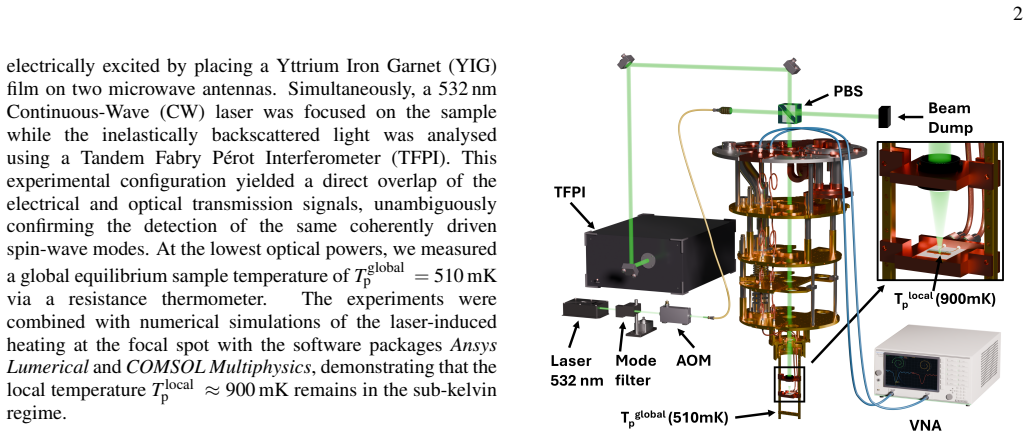
Brillouin Light Scattering spectroscopy performed on a yttrium iron garnet film in a dilution refrigerator, enabling simultaneous optical and electrical readout of the same propagating spin-wave mode.
If this is right
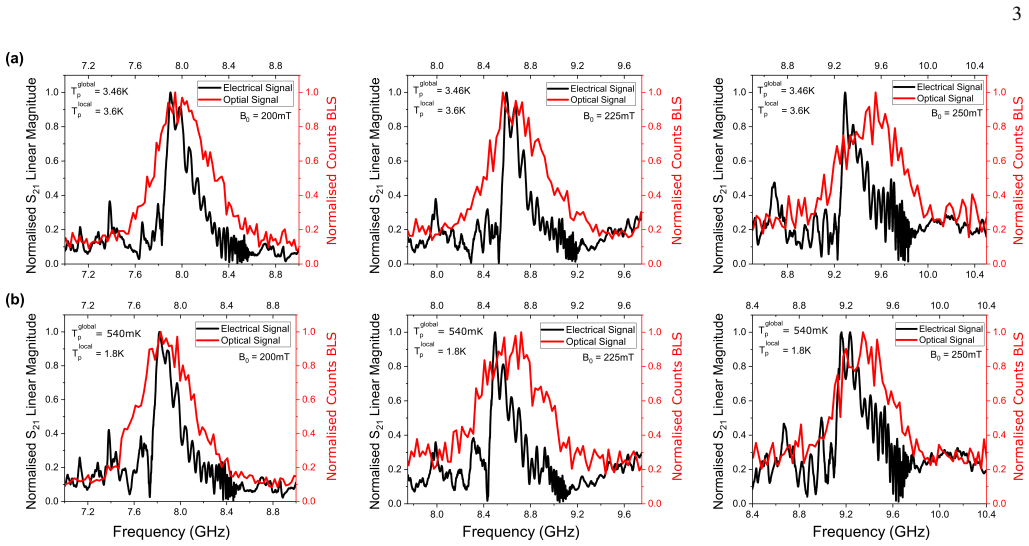
- BLS spectra track the electrically measured transmission across applied magnetic fields, validating the optical method for the same spin-wave mode.
- Free-space optical access to magnons becomes available in the sub-kelvin regime.
- The approach supplies an optical interface needed for magnon-mediated quantum transduction in hybrid systems.
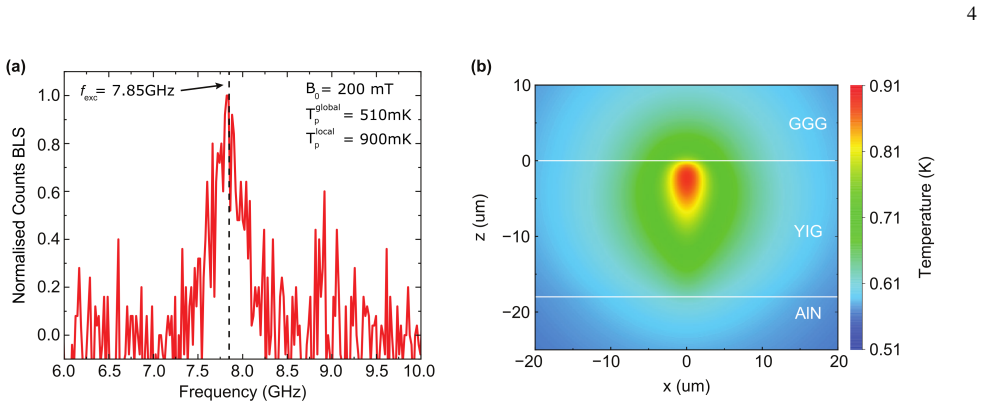
- Detection remains possible at optical powers low enough to keep global temperature at 510 mK.
Where Pith is reading between the lines
- The optical channel could allow magnon experiments that avoid direct electrical wiring at the coldest stage.
- Combining the setup with optical photon sources might enable direct tests of microwave-to-optical conversion at millikelvin temperatures.
- Local heating models could be refined by measuring temperature-dependent BLS intensity to confirm the quantum-regime boundary.
Load-bearing premise
That the detected BLS signal originates from the coherently driven magnons rather than from laser-induced heating or optical artifacts, while the local temperature at the focal spot stays low enough for the quantum regime.
What would settle it
If the BLS frequency peak no longer coincides with the electrically measured transmission frequency when the base temperature is raised above the point where thermal magnons dominate.
Figures
read the original abstract
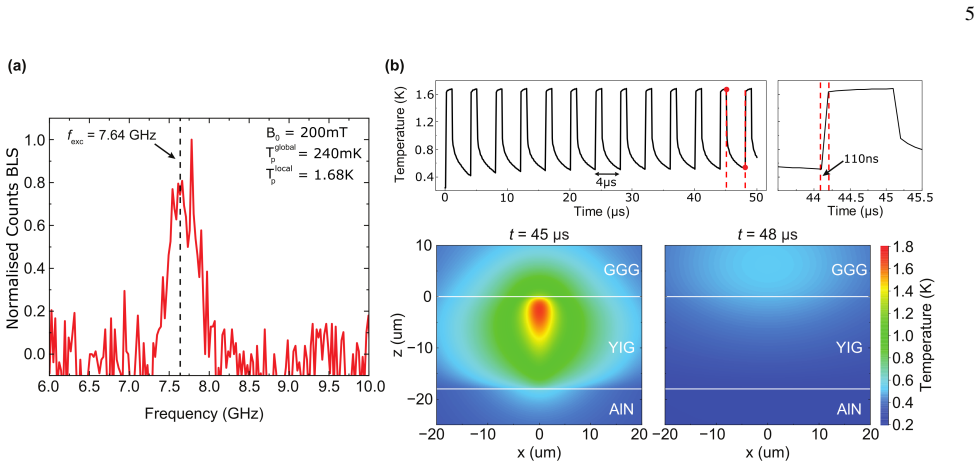
Coupling light to magnetic excitations in the form of spin waves underpins both the optical study of magnetism and emerging schemes for quantum transduction, positioning the quanta of these excitations, magnons, as promising carriers for hybrid quantum networks. However, exploiting them in the quantum regime requires millikelvin temperatures to suppress thermal magnon populations, thereby confining such experiments to dilution refrigerators. There, magnons can already be excited and read out electrically, yet an optical interface required for microwave-to-optical photon conversion has been missing. Here, we demonstrate the first optical detection of coherently driven, propagating spin waves via Brillouin Light Scattering (BLS) spectroscopy inside a dilution refrigerator. By simultaneously recording the optical and electrical responses of the same spin-wave mode in a yttrium iron garnet film, we find that the BLS spectra track the electrically measured transmission across a range of applied magnetic fields. For the lowest optical power of 7.9 {\mu}W that still enabled spin-wave detection, we measured a global equilibrium sample temperature of 510 mK via a resistance thermometer, while numerical modelling of the laser-induced heating yields a maximum local temperature of 900 mK at the focal spot. This brings free-space optical access to magnons into the sub-kelvin regime, representing a milestone towards magnon-mediated quantum transduction in hybrid quantum systems.
Editorial analysis
A structured set of objections, weighed in public.
Referee Report
Summary. The manuscript reports the first demonstration of Brillouin light scattering (BLS) spectroscopy to detect coherently driven, propagating magnons in a yttrium iron garnet film inside a dilution refrigerator. Simultaneous recording of BLS spectra and electrical transmission shows that the optical signal tracks the electrical data across applied magnetic fields. At the lowest usable optical power of 7.9 μW, a global temperature of 510 mK is measured by resistance thermometer, while numerical modeling of laser heating gives a maximum local temperature of 900 mK at the focal spot, placing the experiment in the sub-Kelvin regime.
Significance. If the local temperature bound holds, the result is a clear milestone: it supplies the missing free-space optical interface to magnons at millikelvin temperatures, directly relevant to magnon-mediated microwave-to-optical transduction in hybrid quantum systems. The simultaneous electrical-optical correlation provides independent support that the BLS signal arises from driven magnons rather than heating artifacts, strengthening the experimental claim.
major comments (1)
- [temperature estimation and heating model discussion] The sub-Kelvin claim (title, abstract, and final sentence) rests on the numerical heating model that caps local temperature at 900 mK. No experimental validation of this model (e.g., local thermometry at the focal spot, or sensitivity analysis of inputs such as optical absorption, thermal boundary resistance, or YIG thermal conductivity below 1 K) is described. If any input is inaccurate, the local temperature could exceed 1 K, removing the experiment from the claimed regime. This is load-bearing for the central milestone statement.
minor comments (1)
- [abstract] The abstract and main text should explicitly note that 900 mK remains below 1 K and therefore qualifies as sub-Kelvin under the authors' definition.
Simulated Author's Rebuttal
We thank the referee for the positive evaluation of the work's significance and for the constructive comment regarding the temperature estimation. We address the concern point by point below.
read point-by-point responses
-
Referee: [temperature estimation and heating model discussion] The sub-Kelvin claim (title, abstract, and final sentence) rests on the numerical heating model that caps local temperature at 900 mK. No experimental validation of this model (e.g., local thermometry at the focal spot, or sensitivity analysis of inputs such as optical absorption, thermal boundary resistance, or YIG thermal conductivity below 1 K) is described. If any input is inaccurate, the local temperature could exceed 1 K, removing the experiment from the claimed regime. This is load-bearing for the central milestone statement.
Authors: We agree that the local-temperature bound is central to the sub-Kelvin claim and that the manuscript currently presents only the numerical result without additional validation steps. Direct local thermometry at the ~1 µm focal spot is not feasible within the dilution-refrigerator geometry and optical-access constraints of the present setup. We will therefore add a dedicated section that reports a systematic sensitivity analysis of the model inputs (optical absorption coefficient, thermal boundary resistance at the YIG-substrate interface, and low-temperature YIG thermal conductivity) together with the resulting uncertainty range on the maximum local temperature. This revision will make the robustness of the 900 mK upper bound explicit while preserving the experimental data already shown. revision: yes
- Direct experimental local thermometry at the optical focal spot inside the dilution refrigerator is not possible with the current apparatus.
Circularity Check
No significant circularity in derivation chain
full rationale
This is an experimental demonstration paper reporting BLS spectra that track independent electrical transmission measurements across magnetic fields, with global temperature from a resistance thermometer and local temperature bounded by numerical modeling. No equations, fitted parameters renamed as predictions, self-definitional relations, or load-bearing self-citations appear in the abstract or described content. The result is benchmarked against external electrical data and does not reduce any claim to its own inputs by construction.
Axiom & Free-Parameter Ledger
axioms (2)
- domain assumption Brillouin light scattering signal is linearly proportional to magnon amplitude under the low-power conditions used.
- domain assumption Numerical model of laser heating accurately predicts local temperature at the focal spot.
Reference graph
Works this paper leans on
-
[1]
Pirro, V
P. Pirro, V . I. Vasyuchka, A. A. Serga, and B. Hillebrands, Nat. Rev. Mater.6, 1114 (2021)
2021
-
[2]
A. A. Serga, A. V . Chumak, and B. Hillebrands, J. Phys. D: Appl. Phys.43, 264002 (2010)
2010
-
[3]
Zenbaa, C
N. Zenbaa, C. Abert, F. Majcen, M. Kerber, R. O. Serha, S. Knauer, Q. Wang, T. Schrefl, D. Suess, and A. V . Chumak, Nat. Electron.8, 106 (2025)
2025
-
[4]
Finocchioet al., Nano Futures8, 012001 (2024)
G. Finocchioet al., Nano Futures8, 012001 (2024)
2024
-
[5]
Q. Wang, G. Csaba, R. Verba, A. V . Chumak, and P. Pirro, Phys. Rev. Appl.21, 040503 (2024)
2024
-
[6]
A. V . Chumaket al., IEEE Trans. Magn.58, 0800172 (2022)
2022
-
[7]
Mahmoud, F
A. Mahmoud, F. Ciubotaru, F. Vanderveken, A. V . Chumak, S. Hamdioui, C. Adelmann, and S. Cotofana, J. Appl. Phys. 128, 161101 (2020)
2020
-
[8]
Kuznetsov, H
N. Kuznetsov, H. Qin, L. Flajšman, and S. van Dijken, Sci. Adv. 11, eads2420 (2025)
2025
-
[9]
Kr ˇcma, O
J. Kr ˇcma, O. Wojewoda, M. Hrtoˇn, J. Holobrádek, J. A. Arregi, J. Panda, E. Pribytova, and M. Urbánek, Sci. Adv.11, eady8833 (2025)
2025
-
[10]
Heinz, T
B. Heinz, T. Brächer, M. Schneider, Q. Wang, B. Lägel, A. M. Friedel, D. Breitbach, S. Steinert, T. Meyer, M. Kewenig, C. Dubs, P. Pirro, and A. V . Chumak, Nano Lett.20, 4220 (2020)
2020
-
[11]
V ogel, R
M. V ogel, R. Aßmann, P. Pirro, A. V . Chumak, B. Hillebrands, and G. von Freymann, Sci. Rep.8, 11099 (2018)
2018
-
[12]
Kargar and A
F. Kargar and A. A. Balandin, Nat. Photon.15, 720 (2021)
2021
-
[13]
Sebastian, K
T. Sebastian, K. Schultheiss, B. Obry, B. Hillebrands, and H. Schultheiss, Front. Phys.3, 35 (2015)
2015
-
[14]
S. O. Demokritov and V . E. Demidov, IEEE Transactions on Magnetics44, 6 (2008)
2008
-
[15]
Sandercock and W
J. Sandercock and W. Wettling, Solid State Commun.13, 1729 (1973)
1973
-
[16]
N. T. Falkner, M.-N. Duman, Z. Zabolizadeh, H. Mahmodi, C. Shi, T. R. Zhang, J. Cox, and I. V . Kabakova, Journal of Biomedical Optics30, 124509 (2025)
2025
-
[17]
Bouvet, C
P. Bouvet, C. Bevilacqua, Y . Ambekar,et al., Nat. Photon.19, 681 (2025)
2025
-
[18]
Antonacci, T
G. Antonacci, T. Beck, A. Bilenca, J. Czarske, K. Elsayad, J. Guck, K. Kim, B. Krug, F. Palombo, and G. Prevedel, R. Scarcelli, Biophys. Rev.12, 615 (2020)
2020
-
[19]
Bevilacqua, J
C. Bevilacqua, J. M. Gomez, U.-M. Fiuza, C. J. Chan, L. Wang, S. Hambura, M. Eguren, J. Ellenberg, A. Diz-Muñoz, M. Leptin, and R. Prevedel, Nature Methods20, 755 (2023)
2023
-
[20]
Keshmiri, D
H. Keshmiri, D. Cikes, M. Samalova, L. Schindler, L.-M. Appel, M. Urbanek, I. Yudushkin, D. Slade, W. J. Weninger, A. Peaucelle, J. Penninger, and K. Elsayad, Nature Photonics 18, 276 (2024)
2024
-
[21]
R. O. Serha, K. H. Mcallister, F. Majcen, S. Knauer, T. Reimann, C. Dubs, G. A. Melkov, A. A. Serga, V . S. Tyberkevych, A. V . Chumak, and D. A. Bozhko, Science Advances12, eaee2344 (2026)
2026
-
[22]
R. O. Serha, C. Dubs, C. Guguschev, B. Aichner, D. Schmoll, J. Schäfer, J. Panda, M. Weiler, P. Pirro, M. Urbánek, and A. V . Chumak, Communications Materials7, 134 (2026)
2026
-
[23]
Jiang, J
Z. Jiang, J. Lim, Y . Li, W. Pfaff, T. H. Lo, J. Qian, A. Schleife, J. M. Zuo, V . Novosad, and A. Hoffmann, Appl. Phys. Lett.123, 130501 (2023)
2023
-
[24]
Y . Li, W. Zhang, V . Tyberkevych, W. K. Kwok, A. Hoffmann, and V . Novosad, J. Appl. Phys.128, 130902 (2020)
2020
-
[25]
Forsch, R
M. Forsch, R. Stockill, A. Wallucks, I. Marinkovi ´c, C. Gärtner, R. A. Norte, F. van Otten, A. Fiore, K. Srinivasan, and S. Gröblacher, Nat. Phys.16, 69 (2020)
2020
-
[26]
Lachance-Quirion, Y
D. Lachance-Quirion, Y . Tabuchi, A. Gloppe, K. Usami, and Y . Nakamura, Appl. Phys. Express12, 070101 (2019)
2019
-
[27]
Wehner, D
S. Wehner, D. Elkouss, and R. Hanson, Science362, eaam9288 (2018)
2018
-
[28]
H. J. Kimble, Nature453, 1023 (2008)
2008
-
[29]
Reiserer and G
A. Reiserer and G. Rempe, Rev. Mod. Phys.87, 1379 (2015)
2015
-
[30]
Lachance-Quirion, S
D. Lachance-Quirion, S. P. Wolski, Y . Tabuchi, S. Kono, K. Usami, and Y . Nakamura, Science367, 425 (2020)
2020
-
[31]
Tabuchi, S
Y . Tabuchi, S. Ishino, A. Noguchi, T. Ishikawa, R. Yamazaki, K. Usami, and Y . Nakamura, Science349, 405 (2015)
2015
-
[32]
Bhoi and S.-K
B. Bhoi and S.-K. Kim, inSolid State Physics, V ol. 71, edited by R. L. Stamps (Academic Press, 2020) pp. 39–71
2020
-
[33]
Bhoi and S.-K
B. Bhoi and S.-K. Kim, inSolid State Physics, V ol. 70, edited by R. L. Stamps and H. Schultheiß (Academic Press, 2019) pp. 1–77
2019
-
[34]
Knauer, K
S. Knauer, K. Davídková, D. Schmoll, R. O. Serha, A. V oronov, Q. Wang, R. Verba, O. V . Dobrovolskiy, M. Lindnera, T. Reimann, C. Dubs, M. Urbánek, and A. V . Chumak, J. Appl. Phys.133, 143905 (2023)
2023
-
[35]
A. F. van Loo, R. G. E. Morris, and A. D. Karenowska, Phys. Rev. Applied10, 044070 (2018)
2018
-
[36]
Krantz, M
P. Krantz, M. Kjaergaard, F. Yan, T. P. Orlando, S. Gustavsson, and W. D. Oliver, Appl. Phys. Rev.6, 021318 (2019)
2019
-
[37]
R. O. Serha, C. Dubs, and A. V . Chumak, APL Materials14, 030901 (2026)
2026
-
[38]
Schmoll, A
D. Schmoll, A. A. V oronov, R. O. Serha, D. Slobodianiuk, K. O. Levchenko, C. Abert, S. Knauer, D. Suess, R. Verba, and A. V . Chumak, Phys. Rev. B111, 134428 (2025)
2025
-
[39]
R. O. Serha, A. A. V oronov, D. Schmoll, R. Klingbeil, S. Knauer, S. Koraltan, E. Pribytova, M. Lindner, T. Reimann, C. Dubs, C. Abert, R. Verba, M. Urbánek, D. Suess, and A. V . Chumak, Materials Today Quantum5, 100025 (2025)
2025
-
[40]
S. O. Demokritov, N. M. Kre˘ınes, and V . I. Kudinov, Pis’ma Zh. Eksp. Teor. Fiz.43, 312 (1986)
1986
-
[41]
S. O. Demokritov, N. M. Kre ˘ınes, and V . I. Kudinov, Zh. Eksp. Teor. Fiz.92, 689 (1987)
1987
-
[42]
P. Che, R. Ciola, M. Garst, V . Kravchuk, P. R. Baral, A. Magrez, H. Berger, T. Schönenberger, H. M. Rønnow, and D. Grundler, Communications Materials6, 139 (2025). 8
2025
-
[43]
S. R. Boona and J. P. Heremans, Physical Review B90, 064421 (2014)
2014
-
[44]
Bhandari and G
C. Bhandari and G. Verma, Physical Review152, 731 (1966)
1966
-
[45]
Walton, J
D. Walton, J. Rives, and Q. Khalid, Physical Review B8, 1210 (1973)
1973
-
[46]
B. Pan, T. Guan, X. Hong, S. Zhou, X. Qiu, H. Zhang, and S. Li, Europhysics Letters103, 37005 (2013)
2013
-
[47]
Daudin, R
B. Daudin, R. Lagnier, and B. Salce, Journal of Magnetism and Magnetic Materials27, 315 (1982)
1982
-
[48]
Prakash, B
A. Prakash, B. Flebus, J. Brangham, F. Yang, Y . Tserkovnyak, and J. P. Heremans, Physical Review B97, 020408 (2018)
2018
-
[49]
Simon, NIST5030(1994)
N. Simon, NIST5030(1994)
1994
-
[50]
Schmoll, N
D. Schmoll, N. Kuznetsov, P. Rehberger, F. Vilsmeier, R. Verba, D. Slobodianiuk, R. O. Serha, K. O. Levchenko, S. van Dijken, A. V . Chumak, and S. Knauer, Supplemental Material toBrillouin Light Scattering Spectroscopy of Propagating Magnons at Sub-Kelvin Temperatures, (2026)
2026
-
[51]
V ogel, A
M. V ogel, A. V . Chumak, E. H. Waller, T. Langner, V . I. Vasyuchka, B. Hillebrands, and G. von Freymann, Nature Physics11, 487 (2015). 9 Supplementary Information: Brillouin Light Scattering Spectroscopy of Propagating Magnons at Sub-Kelvin Temperatures I. DETAILED DESCRIPTION OF THE DILUTION REFRIGERA TOR COUPLED BRILLOUIN LIGHT SCA TTERING SPECTROSCOP...
2015
-
[52]
M. R. Schweizer, F. Kühn, V . S. L’vov, A. Pomyalov, G. von Freymann, B. Hillebrands, and A. A. Serga,Applied Physics Letters124, 092402 (2024)
2024
-
[53]
S. R. Boona and J. P. Heremans,Physical Review B90, 064421 (2014)
2014
-
[54]
Bhandari and G
C. Bhandari and G. Verma,Physical Review152, 731 (1966)
1966
-
[55]
Walton, J
D. Walton, J. Rives, and Q. Khalid,Physical Review B8, 1210 (1973)
1973
-
[56]
B. Pan, T. Guan, X. Hong, S. Zhou, X. Qiu, H. Zhang, and S. Li,Europhysics Letters103, 37005 (2013)
2013
-
[57]
Daudin, R
B. Daudin, R. Lagnier, and B. Salce,Journal of Magnetism and Magnetic Materials27, 315 (1982)
1982
-
[58]
Prakash, B
A. Prakash, B. Flebus, J. Brangham, F. Yang, Y . Tserkovnyak, and J. P. Heremans,Physical Review B97, 020408 (2018)
2018
-
[59]
Simon, NIST 5030 (1994)
N. Simon, NIST 5030 (1994)
1994
-
[60]
Schmoll, A
D. Schmoll, A. A. V oronov, R. O. Serha, D. Slobodianiuk, K. O. Levchenko, C. Abert, S. Knauer, D. Suess, R. Verba, and A. V . Chumak,Phys. Rev. B111, 134428 (2025)
2025
-
[61]
R. C. LeCraw and L. R. Walker,Journal of Applied Physics32, S167 (1961)
1961
-
[62]
R. O. Serha, A. A. V oronov, D. Schmoll, R. Verba, K. O. Levchenko, S. Koraltan, K. Davídková, B. Budinská, Q. Wang, O. V . Dobrovolskiy, M. Urbánek, M. Lindner, T. Reimann, C. Dubs, C. Gonzalez-Ballestero, C. Abert, D. Suess, D. A. Bozhko, S. Knauer, and A. V . Chumak,npj Spintronics2, 29 (2024)
2024
discussion (0)
Sign in with ORCID, Apple, or X to comment. Anyone can read and Pith papers without signing in.